IT Glue vs Hudu: Which documentation tool fits your MSP in 2026
Documentation is the foundation of every MSP operation. When a server goes down at 2 AM or a client calls about a password reset, your team needs answers fast. The right documentation platform can mean the difference between a five-minute fix and a two-hour investigation.
IT Glue and Hudu are two of the most popular options for MSPs. Both promise to centralize your knowledge, secure your passwords, and streamline your workflows. But they take very different approaches to solving the same problem.
Let's break down what each platform actually delivers so you can choose the one that fits your team.

What IT Glue and Hudu actually do
At their core, both tools are IT documentation platforms. They store client information, network diagrams, passwords, and procedures in a centralized, searchable system. The difference is in execution.
IT Glue has been around since 2013 and was acquired by Kaseya in 2018. It is built for scale, with deep integrations across the Kaseya ecosystem and enterprise-grade features that larger MSPs need. Hudu launched more recently as a challenger, positioning itself as a simpler, more affordable alternative with a focus on user experience and self-hosting options.
What is IT Glue
IT Glue is a cloud-based documentation platform owned by Kaseya. It targets MSPs with deep PSA/RMM integrations and enterprise-grade features. With over 300,000 users across 70+ countries, it has established itself as the dominant player in the MSP documentation space.
The platform is SOC 2 Type II compliant and offers features like automated password rotation, network discovery through Network Glue, and AI-powered SOP generation through Cooper Copilot. IT Glue integrates with major PSA platforms including ConnectWise Manage, Autotask, and Kaseya BMS, plus RMM tools like NinjaRMM, ConnectWise Automate, and Datto.
IT Glue's pricing starts at $29 per user per month for the Basic plan, but requires a 5-user minimum. The Select plan jumps to $38 per user, and Enterprise starts at $44 per user. All plans require a 36-month commitment for the listed pricing, plus a one-time onboarding fee.
What is Hudu
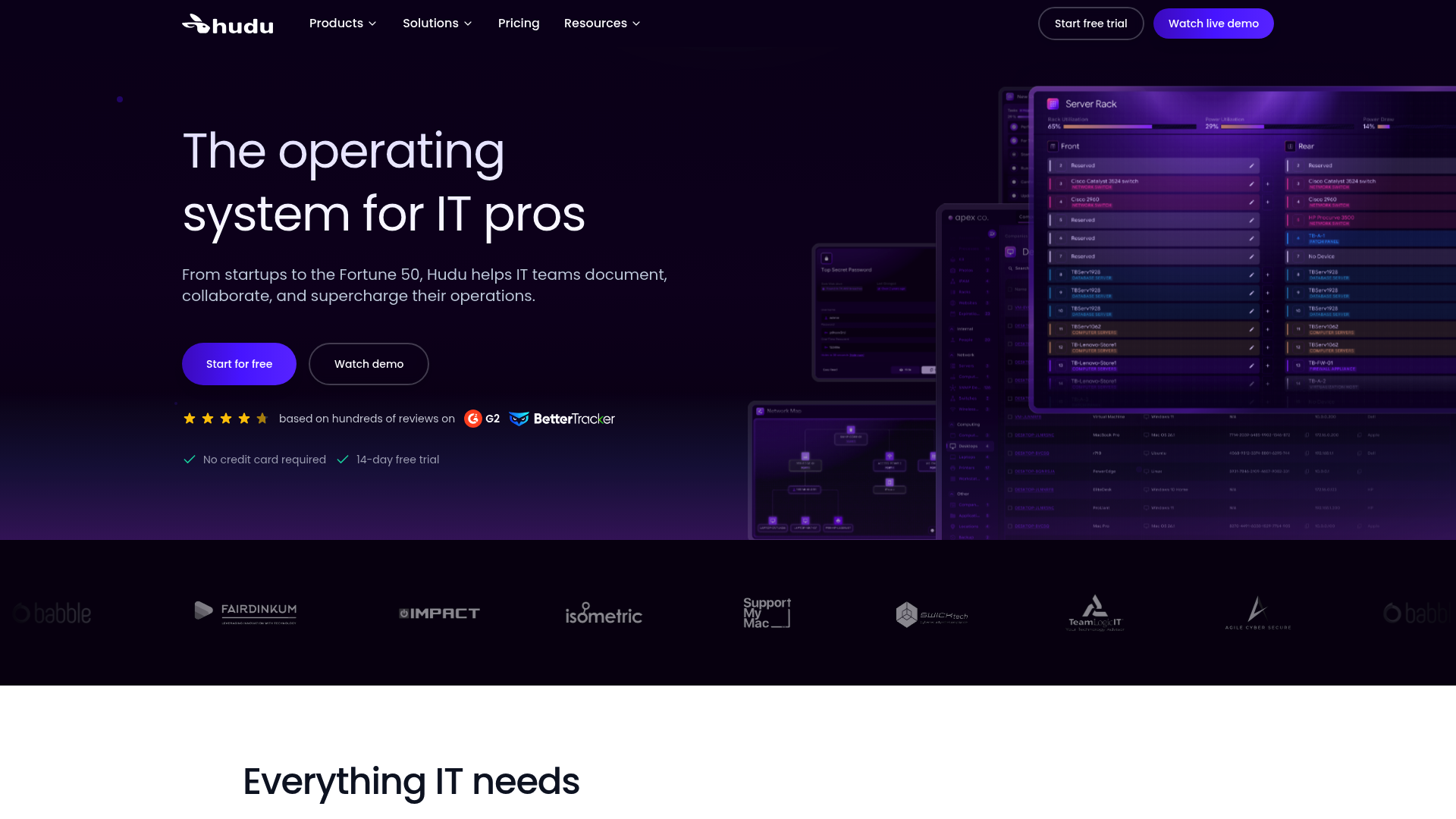
Hudu is a newer documentation platform offering both cloud and self-hosted deployment options. With 5,200+ IT teams using the platform, it has gained traction as a more affordable, user-friendly alternative to IT Glue.
Hudu offers a single pricing tier at $30 per user per month (or $27 per user per month when billed annually). There are no user minimums, no setup fees, and no long-term contracts required. The platform includes core documentation features, password management, asset tracking, and a growing list of integrations.
Key differentiators include self-hosting capabilities for organizations with specific security requirements, a simpler and more modern interface, and faster implementation timelines. Hudu also offers Hudu Radar as a $9 per company per month add-on for network discovery and monitoring.
Pricing comparison: The real numbers
Pricing is where the differences between these platforms become stark. IT Glue's enterprise positioning shows in its pricing structure, while Hudu takes a more straightforward approach.
IT Glue pricing
| Plan | Price | Minimum Users | Key Features |
|---|---|---|---|
| Basic | $29/user/mo | 5 users | 1 integration, 1-way PSA/RMM sync, Vault, workflows |
| Select | $38/user/mo | 5 users | 2 integrations, 2-way PSA sync, all Basic features |
| Enterprise | $44/user/mo | 5 users | Unlimited integrations, full feature set |
| 1-4 users | $49-102/user/mo | N/A | Only available on Enterprise tier |
Source: IT Glue Pricing
IT Glue also charges a one-time onboarding fee that cannot be waived. For teams under 5 users, pricing escalates significantly, making it less accessible for smaller MSPs.
Add-on costs add up quickly:
- Network Glue: $453/month for automated network discovery
- MyGlue: $407/month for client password portal
- myITprocess: $199-299/month for QBR reporting
Hudu pricing
| Plan | Monthly | Annual | Key Features |
|---|---|---|---|
| Hudu | $30/user/mo | $27/user/mo | No minimums, unlimited docs, 24/7 support, all features |
Source: Hudu Pricing
Hudu's pricing is refreshingly simple. One tier, all features included, no user minimums, no setup fees, and month-to-month billing. The only add-on is Hudu Radar for network discovery at $9 per company per month, significantly less than IT Glue's Network Glue.
Cost at different team sizes
Let's look at actual monthly costs for different team sizes, assuming annual billing where available:
| Team Size | IT Glue Basic | IT Glue Enterprise | Hudu (Annual) |
|---|---|---|---|
| 3 users | $147/mo (Enterprise only) | $147-306/mo | $81/mo |
| 5 users | $145/mo | $220/mo | $135/mo |
| 10 users | $290/mo | $440/mo | $270/mo |
| 20 users | $580/mo | $880/mo | $540/mo |
The math is clear. For smaller teams under 10 users, Hudu is significantly more affordable. IT Glue only becomes competitive on a per-user basis at scale, and that is before factoring in the add-ons many MSPs need.
Feature comparison: What you actually get
Both platforms cover the basics: documentation, passwords, assets, and integrations. The difference is in depth and polish.
Documentation and knowledge base
Both IT Glue and Hudu offer structured documentation with templates, version control, and search. IT Glue provides a more rigid framework that enforces consistency across large teams. Hudu offers more flexibility in how you organize information, which smaller teams often prefer.
IT Glue's knowledge base includes features like document flags, completion profiles, and team-based user experiences. Hudu focuses on simplicity with real-time editing, comments, and an intuitive organization structure.
Password management
Both platforms include password vaults with encryption, access controls, and sharing capabilities. IT Glue offers advanced features like automated password rotation for Active Directory, Microsoft Entra ID, and Microsoft 365. It also provides Password SafeShare for generating time-limited or usage-based password links.
Hudu covers the essentials with secure credential storage, access controls, and client sharing capabilities. For most MSPs, both platforms handle password management adequately.
Asset tracking
This is where IT Glue pulls ahead. Network Glue, available as a $453 per month add-on, provides automated network discovery, documentation, and diagramming. It scans client networks, identifies devices, maps relationships, and keeps everything current automatically.
Hudu offers Hudu Radar as a $9 per company per month add-on for network discovery and monitoring. While more affordable, it is a newer feature with less mature capabilities compared to Network Glue.
Integrations
| Category | IT Glue | Hudu |
|---|---|---|
| PSA | ConnectWise Manage, Autotask, Kaseya BMS, ServiceNow, HaloPSA | ConnectWise PSA, Autotask |
| RMM | Kaseya VSA, ConnectWise Automate, NinjaRMM, Datto RMM, N-Central | Atera, Addigy, NinjaOne |
| Networking | Cisco Meraki, Auvik, Datto Networking | Auvik, Cisco Meraki, Cloudflare |
| Microsoft | M365, Azure AD, Active Directory, Intune | CIPP (M365 sync) |
| Communication | Slack, Microsoft Teams | Limited |
Source: IT Glue, Hudu Integrations
IT Glue's integration ecosystem is broader, especially for PSA platforms and Kaseya products. Hudu covers the major players but has fewer native integrations overall.
Security and compliance
Both platforms are SOC 2 certified and offer enterprise-grade security. IT Glue provides immutable audit trails, IP access control, and automated account backups. Hudu offers encryption, SSO, audit logs, and the option to self-host for complete data control.
For MSPs with strict compliance requirements, Hudu's self-hosting option can be a deciding factor. IT Glue is SaaS-only, which may not work for certain regulated industries or clients with specific data residency requirements.
User experience: What MSPs actually say
Real user feedback reveals the practical differences between these platforms.
IT Glue user feedback
IT Glue users consistently praise the platform's depth and integration capabilities. The ability to link related assets, automate documentation from RMM tools, and manage complex client environments earns high marks from larger MSPs.
However, complaints about the interface are equally consistent. Users describe it as slow, clunky, and difficult to navigate. The search functionality receives particular criticism for not returning relevant results. Many MSPs report needing a dedicated administrator to manage the platform effectively.
Hudu user feedback
Hudu users highlight the platform's simplicity and value. The interface is described as intuitive, modern, and easy to learn. Implementation timelines are shorter, and teams report being productive faster than with IT Glue.
The main criticism is that Hudu has fewer enterprise features and a less mature ecosystem. Some users miss the depth of IT Glue's integrations, particularly around network discovery and PSA automation.
Which MSPs should choose which tool
The right choice depends on your team size, budget, and technical requirements.
Choose IT Glue if
- You have 10+ users and can justify the per-seat cost
- You need Network Glue's automated network discovery and diagramming
- Deep PSA/RMM integration is critical to your workflows
- You are already invested in the Kaseya ecosystem
- You have resources to dedicate to platform management
- You need advanced features like automated password rotation and AI-powered SOP generation
Choose Hudu if
- You are a smaller MSP with under 10 users
- Budget is a primary concern
- You want self-hosting options for compliance or data control
- You prefer a simpler, more modern interface
- You need faster implementation without extensive training
- You want transparent pricing without long-term contracts
Making the switch: Migration realities
Switching documentation platforms is not trivial. Your documentation is the institutional knowledge of your business. Losing it or having it scattered during a migration creates real operational risk.
Both IT Glue and Hudu offer data export capabilities. IT Glue provides automated account backups and cross-account migration services. Hudu offers hands-on migration assistance with data mapping, imports, and validation during onboarding.
The typical migration timeline ranges from a few weeks to a few months depending on the amount of documentation and the complexity of your setup. Plan for parallel operation during the transition, and expect some productivity hit as your team learns the new system.
If you are considering a switch, start with a pilot. Migrate one client's documentation first to understand the process and identify any issues before committing your entire knowledge base.
Documentation is just the start
Your documentation platform is the foundation, but it is not the whole solution. Even the best documentation still requires humans to search it, interpret it, and act on it.
That is where automation comes in. At Rallied, we have seen MSPs reduce their L1 ticket volume by 50-100 hours per month by connecting their documentation to an AI that actually executes fixes, not just suggests them. When a password reset comes in, the AI reads your documentation, verifies the user, resets the password, notifies the user, and updates the ticket. No technician required.
Whether you choose IT Glue or Hudu, the real win comes from making that documentation actionable. The best documentation in the world does not help if your technicians are still manually executing the same procedures day after day.
Ready to see how automation can transform your MSP? Calculate your ROI or request a demo to learn more.
Frequently Asked Questions
Is IT Glue or Hudu better for a small MSP with 3-5 technicians?
For smaller teams, Hudu is generally the better choice. It has no user minimums, no setup fees, and starts at $27 per user per month annually. IT Glue requires 5 users minimum and charges a setup fee, making it less accessible for small MSPs.
Does Hudu have the same integrations as IT Glue in this comparison?
Hudu has fewer native integrations than IT Glue, particularly for PSA platforms. IT Glue integrates with ConnectWise Manage, Autotask, Kaseya BMS, ServiceNow, and HaloPSA. Hudu covers ConnectWise PSA and Autotask but has a smaller overall ecosystem.
Can I self-host IT Glue vs Hudu for compliance reasons?
Only Hudu offers self-hosting options. IT Glue is strictly SaaS. If your clients or compliance requirements demand on-premise data control, Hudu is your option between these two.
Which has better network discovery capabilities in an IT Glue vs Hudu evaluation?
IT Glue's Network Glue is more mature and comprehensive but costs $453 per month. Hudu's Hudu Radar is $9 per company per month but is a newer feature with less mature capabilities.
How do migration paths compare when switching between IT Glue and Hudu?
Both platforms offer migration assistance. IT Glue has cross-account migration services and automated backups. Hudu provides hands-on migration support with data mapping and validation. Plan for several weeks to a few months for a full migration depending on your documentation volume.
Is IT Glue worth the higher price compared to Hudu?
IT Glue is worth the premium if you need its specific enterprise features: Network Glue's automated discovery, deep Kaseya ecosystem integration, AI-powered SOP generation, or MyGlue client portal. For most smaller MSPs, Hudu delivers comparable core functionality at a significantly lower cost.