NinjaOne vs Datto RMM: Which RMM fits your MSP in 2026
Choosing the right remote monitoring and management (RMM) platform is one of those decisions that can make or break your MSP's efficiency. Pick the wrong tool and your technicians spend more time fighting the software than fixing client issues. Pick the right one and everything just clicks.
What is NinjaOne?
NinjaOne is a cloud-native IT operations platform founded in 2013 (see our full NinjaOne RMM review for a deeper dive). The company positions itself as more than just an RMM, calling their product a "unified IT operations platform" that combines endpoint management, autonomous patching, backup, and remote access in a single console.
The numbers back up their growth story. NinjaOne serves 35,000+ customers across 150+ countries and manages over 14 million endpoints. They've maintained a 98% customer satisfaction score for more than five years running, and Gartner named them a Leader in the Magic Quadrant for Endpoint Management.
What makes NinjaOne stand out is their focus on ease of use. The platform was built as SaaS from day one, which means no on-premise infrastructure to maintain. Their cloud-native architecture allows for same-week deployment, and they offer free unlimited onboarding, training, and support. For MSPs that need to get up and running quickly without a massive training investment, this approach has clear appeal.
NinjaOne covers the full stack: Windows, Mac, and Linux endpoint management, mobile device management for iOS and Android, patch management for both operating systems and over 6,000 third-party applications, cloud backup, and a native remote access tool called NinjaOne Remote that connects in 2-3 seconds.
What is Datto RMM?
Datto RMM is a cloud-based remote monitoring and management platform with roots dating back to 2007 (read our complete Datto RMM guide for the full breakdown). Datto built a strong reputation in backup and disaster recovery before expanding into RMM. In 2022, Kaseya acquired Datto, and the RMM is now part of the broader Kaseya ecosystem.
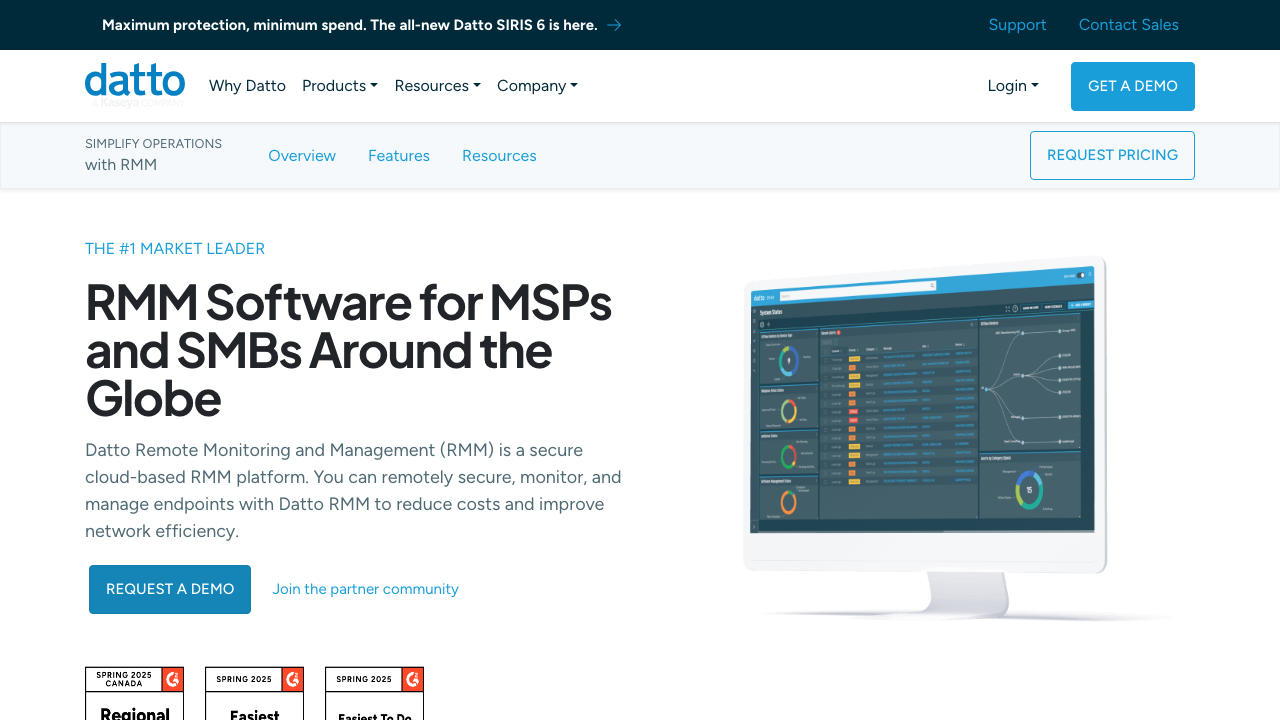
Datto RMM targets MSPs and SMBs with a security-first approach. The platform includes built-in ransomware detection and response capabilities, which is a notable differentiator. They also offer native Microsoft 365 management for onboarding, offboarding, and quarantining users, something most RMMs handle through integrations rather than native functionality.
The platform runs on Amazon AWS EC2 infrastructure across five regional data centers, promising 99.99% uptime. Datto ranks in the top 20% of the BSIMM (Building Security In Maturity Model) assessment, making them the only IT vendor dedicated to MSPs with this security validation.
Datto RMM integrates deeply with the broader Datto and Kaseya product suite. If you're already using Autotask PSA, Datto SIRIS backup, or Datto networking equipment, the RMM fits naturally into that workflow. For MSPs invested in the Kaseya ecosystem, this integration is a significant advantage.
Feature comparison
Core RMM capabilities
Both platforms cover the essentials you'd expect from a modern RMM. Remote monitoring and alerting, patch management for operating systems and third-party software, remote access and control, scripting and automation, and asset discovery and inventory are all present in both tools.
Where they diverge is in execution. NinjaOne emphasizes their autonomous patch management with AI-powered intelligence that analyzes telemetry and forums to flag unstable updates. If a patch looks risky based on community reports, the system can automatically pause it across your environment. Datto offers automated patching as well, but without the same AI-driven risk assessment layer.
Platform support
NinjaOne supports Windows, Mac, Linux, iOS, and Android from a single console. Their Mac and Linux support is robust, with full remote access capabilities across all platforms.
Datto RMM also supports Windows, Mac, and Linux, but user reviews consistently note that Mac remote tools are more limited compared to the Windows experience. If you manage a significant number of Apple endpoints, this is worth testing during your trial.
Integrations
Both platforms integrate with the major PSA tools: ConnectWise Manage, Autotask, and HaloPSA. Both support popular remote access tools like Splashtop and TeamViewer. Both connect with security vendors including Bitdefender, CrowdStrike, and SentinelOne.
NinjaOne's integration list is longer, with connections to ServiceNow, Okta, Microsoft Entra, Duo, PagerDuty, Slack, and many documentation platforms including IT Glue and Liongard. Datto's integration story is more focused on the Kaseya ecosystem, with particularly tight coupling to Autotask PSA.
Unique differentiators
NinjaOne's standout features include their native documentation system (Ninja Dojo), a mobile app for technicians, and their 180+ total features according to GetApp data. Their Patch Intelligence AI and single-click remote access are genuinely useful day-to-day.
Datto's unique strengths are built-in ransomware detection, deep integration with Datto backup products, and native Microsoft 365 management. The BSIMM security validation also matters for MSPs serving regulated industries or security-conscious clients.
User ratings and reviews
The user ratings tell a consistent story across every review platform:
| Platform | NinjaOne | Datto RMM |
|---|---|---|
| G2 | 4.7/5 (3,702 reviews) | 4.5/5 (731 reviews) |
| TrustRadius | 9.1/10 | 7.4/10 |
| GetApp | 4.7/5 | 4.3/5 |
NinjaOne has significantly more reviews on every platform, suggesting either larger market adoption or more engaged users willing to leave feedback. The gap is particularly noticeable on G2, where NinjaOne has over five times as many reviews as Datto.
Looking at specific categories on G2, NinjaOne leads in every measured dimension:
| Category | NinjaOne | Datto RMM |
|---|---|---|
| Ease of Use | 9.1 | 8.9 |
| Quality of Support | 9.1 | 8.4 |
| Ease of Setup | 9.1 | 8.8 |
| Patch Management | 9.0 | 8.6 |
| Remote Access | 9.2 | 8.8 |
The pattern is clear: users consistently praise NinjaOne's ease of use and interface speed, while Datto reviews mention a steeper learning curve and more complex implementation.
Pricing
Neither vendor publishes complete public pricing, which is unfortunately standard in the RMM industry. Both use per-device subscription models with volume discounts.
NinjaOne does provide some pricing transparency. According to their pricing page, plans start at $3.75 per device for 50 or fewer endpoints and drop to as low as $1.50 per device at 10,000+ endpoints. They offer a 14-day free trial with no setup fees or hidden costs. Support, onboarding, and training are all included at no extra charge.
Datto RMM requires contacting sales for pricing. The platform is often bundled with other Kaseya ecosystem offerings, which can make direct price comparisons difficult. If you're already using other Kaseya products, you may get better pricing through bundling.
Several factors affect your actual price with either vendor: endpoint count, which feature modules you need, contract length, and any promotional incentives. The only way to get accurate pricing is to request quotes from both vendors based on your specific endpoint count and requirements.
Ease of use and implementation
NinjaOne onboarding
NinjaOne's cloud-native architecture means deployment is genuinely fast. Most users report being fully operational in less than a week, with the average learning time under three hours per technician. The interface is modern and intuitive, with a single-pane dashboard that doesn't require clicking through multiple screens to find what you need.
NinjaOne includes free unlimited onboarding and training, which removes a common hidden cost that trips up MSPs evaluating RMMs. Their support team consistently earns praise for responsiveness, maintaining that 98% customer satisfaction score.
Datto RMM onboarding
Datto RMM is cloud-based but carries more complexity in configuration. User feedback consistently mentions a steeper learning curve, particularly for technicians new to RMM platforms. One TrustRadius reviewer noted the "initial learning curve can overwhelm beginner IT technicians."
Implementation typically takes longer than NinjaOne, though exact timelines vary based on environment complexity and existing Kaseya ecosystem integration. Datto provides training resources, but the depth of features and configuration options means more upfront investment in getting your team proficient.
Support quality for Datto RMM has received mixed reviews since the Kaseya acquisition, with some users noting inconsistency in response times compared to the pre-acquisition experience.
Which RMM should you choose?
Choose NinjaOne if:
- You want minimal training overhead and fast technician onboarding
- You need to be fully operational within the same week
- User experience and interface speed are priorities
- You manage diverse endpoint types including Mac and Linux
- You value responsive, included support without extra fees
- You prefer transparent pricing with no hidden costs
Choose Datto RMM if:
- You're already invested in the Kaseya ecosystem (Autotask PSA, Datto backup, etc.)
- Native backup integration is critical to your workflows
- Built-in ransomware detection is a must-have for your security posture
- You use Autotask PSA and want the tightest possible integration
- You prefer an established vendor with a long track record in the MSP space
- You need native Microsoft 365 management capabilities
Making the switch to better IT operations
Choosing an RMM isn't just about feature checklists. It's about reducing the overhead your technicians deal with every day. The right tool should fade into the background and let your team focus on solving client problems, not managing the management tool itself.
Consider your team's technical expertise and training capacity. Factor in the total cost including implementation time, not just the subscription price. And test both platforms with your actual workflows before committing.
Both NinjaOne and Datto RMM offer free trials. Use them. Set up a few endpoints, run through your standard procedures, and see which one feels natural to your team.
At Rallied, we believe your best technicians shouldn't be stuck resetting passwords or unlocking accounts. Whether you choose NinjaOne or Datto RMM, our AI technician integrates with your stack to handle those repetitive L1 tickets autonomously. While your RMM keeps endpoints healthy, we keep your help desk moving, executing fixes, notifying users, and updating tickets without human intervention.
The goal is the same regardless of which RMM you pick: resolve issues faster, reduce technician overhead, and focus on work that actually matters. Choose the RMM that gets you there with the least friction for your specific team and client base.
Frequently Asked Questions
Is NinjaOne or Datto RMM better for small MSPs?
NinjaOne generally fits small MSPs better due to its faster onboarding, lower training requirements, and more intuitive interface. Datto RMM can work but requires more upfront investment in learning and configuration.
Does NinjaOne vs Datto RMM pricing differ significantly?
NinjaOne publishes pricing starting at $3.75 per device, while Datto RMM requires contacting sales. NinjaOne claims to be 40% less than competitors based on customer testimonials, but you should get quotes from both for your specific endpoint count.
Which has better patch management in a NinjaOne vs Datto RMM comparison?
NinjaOne scores higher on G2 for patch management (9.0 vs 8.6) and offers AI-powered autonomous patching that flags risky updates. Datto provides automated patching but without the same AI-driven risk assessment.
Can I switch easily between NinjaOne and Datto RMM?
Both platforms allow migration, but expect some transition time for agent deployment, policy recreation, and technician training. NinjaOne's faster deployment may make switching to them quicker than switching to Datto.
Does Datto RMM integrate better with Kaseya products than NinjaOne?
Yes. Since Kaseya acquired Datto, the integration between Datto RMM and other Kaseya products like Autotask PSA is tighter than what NinjaOne can offer. If you're heavily invested in the Kaseya ecosystem, this is a significant factor.
Which platform has better customer support, NinjaOne or Datto RMM?
User ratings consistently favor NinjaOne, with a 9.1 support score on G2 compared to Datto's 8.4. NinjaOne also includes unlimited free support, while Datto has received mixed reviews on support consistency since the Kaseya acquisition.