Atera vs Datto RMM: Which One Is Right for Your MSP in 2026?
TL;DR
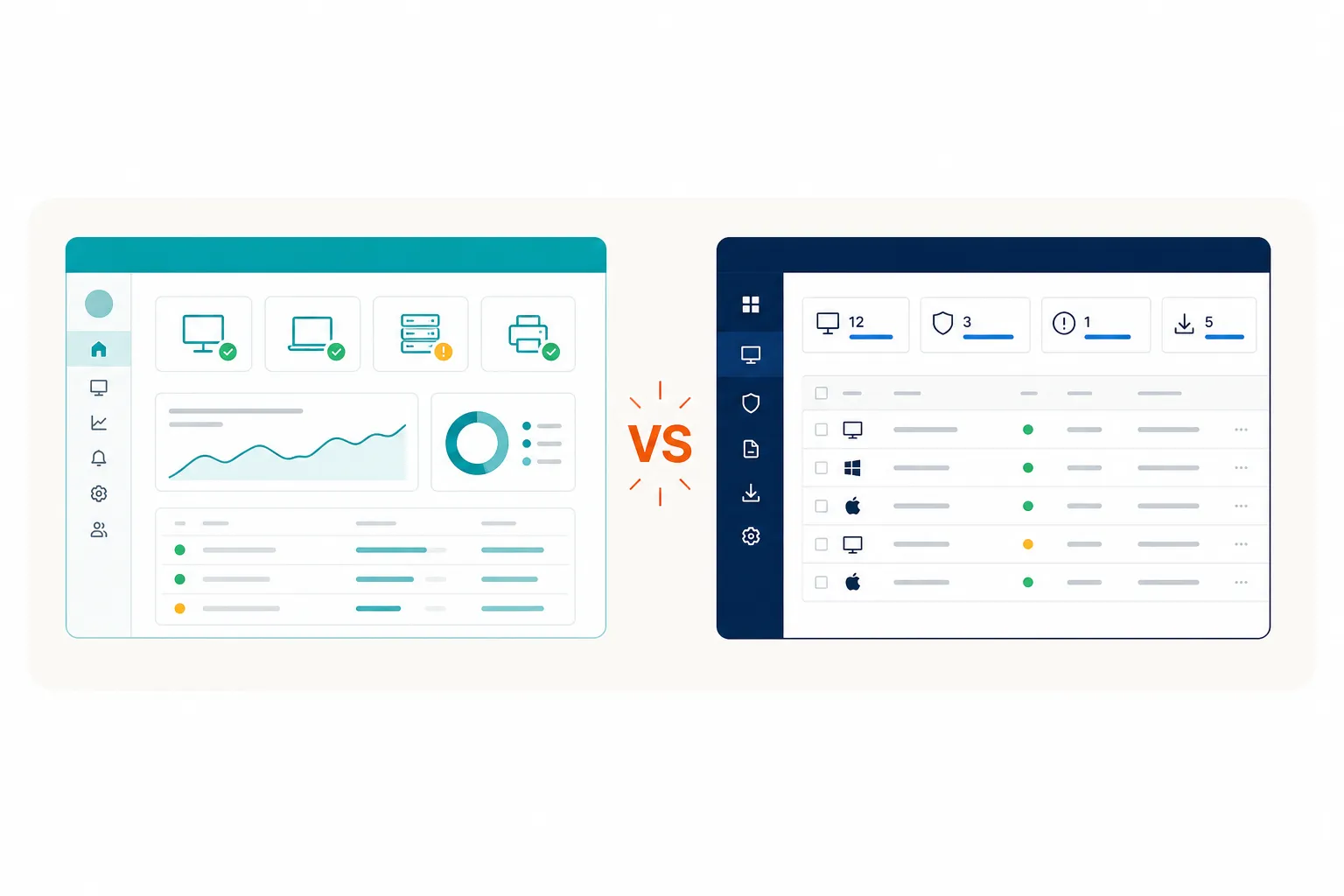
Atera is the modern, AI-native, all-in-one choice: RMM, ticketing, and an autonomous AI agent (Robin) bundled under transparent per-technician pricing with no device caps. It's the better fit for MSPs who want one platform to run their whole service desk, especially smaller-to-mid-size shops scaling without adding headcount.
Datto RMM is the enterprise-grade specialist: best-in-class patch management, native Autotask PSA integration, and serious compliance infrastructure. It's a strong choice if you're already in the Kaseya ecosystem - but the 3-year contracts, quote-only pricing, and Kaseya's well-documented billing headaches make it a commitment you want to enter with eyes open.
Neither is wrong. They're solving for different shops. And if your real problem is tech time burned on L1 tickets regardless of which RMM you pick - that's a separate problem, and one an AI technician like Rallied handles at the layer above both platforms.
We've tested a lot of RMMs over the years, and the Atera vs Datto RMM debate is one we get asked about constantly - particularly from MSPs who've either been on Datto for years and are wondering if the grass is greener, or newer shops trying to figure out whether an all-in-one platform like Atera is worth the trade-offs.
The honest answer: they're genuinely different tools built for different philosophies. Atera is betting that the future of IT management is unified and AI-native. Datto (now under Kaseya) is betting on integration depth with an existing ecosystem. Both bets have merit. Which one pays off depends entirely on how your shop runs.
Let's get into it.
What each platform actually is
Before the feature-by-feature breakdown, it's worth being clear about what kind of tool each one is - because they're not really the same category of product, even though both show up in RMM comparisons.
Atera is an all-in-one IT management platform that bundles RMM, PSA, ticketing, patch management, and AI into a single product. When you sign up for Atera, you're getting your monitoring, your help desk, and your AI agent in one subscription, priced per technician regardless of how many endpoints you manage. The platform currently serves 13,000+ customers managing 6 million+ devices globally, and has been pushing hard into the AI-native positioning with its Robin autonomous agent.
Datto RMM is a dedicated remote monitoring and management tool - part of the broader Datto (now Kaseya) product family. It's purpose-built for endpoint monitoring, patch management, and automation, but it does not include a native PSA or ticketing system. You're expected to pair it with Autotask PSA (also Kaseya), which is where the platform genuinely shines. Datto RMM holds a 4.5/5 rating on G2 from 700+ reviews and has a loyal installed base among mid-to-large MSPs, especially those who built their stack around Autotask.
The comparison most people are actually running when they ask "Atera vs Datto" is: do I want an all-in-one with AI baked in, or a specialized RMM paired with the Kaseya ecosystem? That's the real fork in the road.
Atera: the all-in-one AI bet
Atera's pitch is simple: stop buying five tools when one does the job. The platform covers monitoring, alerting, remote access (Splashtop on all plans, AnyDesk from Expert tier), patch management, ticketing, billing, and AI - and charges you per technician, not per device.
That per-technician model is genuinely differentiated. Most RMMs charge by endpoint, which means growth costs you directly. With Atera, adding 500 more managed devices doesn't move your monthly bill.
Robin: Atera's autonomous AI agent
The headline feature in 2026 is Robin, Atera's patented autonomous AI agent. Atera claims Robin resolves 92% of technical issues end-to-end, with a median time to resolution under 120 seconds and a response time of 0.1 seconds. That's not ticket suggestions or copilot help - Robin is supposed to detect, diagnose, take action, and close the loop without a technician touching it.
Early customer results back this up to varying degrees. SWNS Media Group reports that Robin resolves 85% of their help desk tickets autonomously, with a 66% decrease in ticket handling time. Leeds United saw a 35% reduction in incoming tickets. These aren't fringe numbers.
That said, "92% autonomous resolution" is a marketing claim, and the real-world figure depends heavily on your ticket mix and how well you've configured Robin's approved actions. The headline is directionally true for straightforward L1 - password resets, connectivity checks, standard troubleshooting. Complex L2 still needs a human. Anyone promising otherwise is selling.
AI Copilot (on all plans)
Even before Robin, Atera has embedded AI throughout the platform via AI Copilot. It's available on every plan, including Professional, and covers ticket summarization, AI-generated replies, script generation, device filtering, and sentiment analysis. For technicians, the practical benefit is roughly 1-2 hours of context-switching saved per day - a number that shows up consistently across G2 reviews.
What Atera doesn't do well
Atera's integration ecosystem is smaller than legacy platforms. If you've built workflows around ConnectWise or need deep script-engine capabilities (think ConnectWise Automate's level of scripting flexibility), Atera can feel limited. Power users who've migrated from Automate often note that the script builder and automation engine don't go as deep.
Reporting is another gap. The preset reports cover the basics well, but teams who need complex custom analytics find the built-in tools hit a ceiling. You get 11 preset reports on Expert tier, up to 10 custom on Master - but anything more sophisticated requires Enterprise.
The G2 community rates Atera 4.6/5 from 1,135 reviews - 79% five stars, with the most common praise around ease of use, the AI features, and the pricing model. Negative reviews cluster around integrations depth and advanced reporting.
Datto RMM: the enterprise infrastructure play
Datto RMM has a different DNA. It was built for MSPs managing hundreds to thousands of endpoints across multiple clients, with a heavy emphasis on security, compliance, and reliability. The platform holds BSIMM validation (top 20% of assessed firms), runs on a 99.99% uptime SLA, and offers regional data residency options in the US, EU (Ireland), and APAC (Sydney) - the kind of infrastructure credibility that matters when you're managing healthcare or financial services clients.
Patch management: genuinely best-in-class
If you ask MSPs what Datto RMM does better than almost anything else, they'll say patching. The platform's patching engine is consistently called out in G2 reviews as reliable, granular, and audit-ready - with a compliance tracking approach that makes enterprise customers and their auditors happy. Automated deployment across Windows, macOS, and Linux, with scheduling and approval workflows that give you real control.
The flip side is that the policy structure is rigid. If you want to set different reboot windows for different clients while sharing an approval policy, you end up copying entire policies and managing them separately. A recurring complaint on Reddit's r/msp reads:
"Since approvals, rebooting and scheduling is all one policy, it makes it difficult to customize policies... If you have a customer that is OK with the approvals and reboot options but want it scheduled for 1pm instead of 2pm, you have to copy the policy and now you're stuck managing approvals for another policy."
For a shop with 50 clients, that overhead accumulates fast.
Autotask integration: the real selling point
Where Datto RMM genuinely earns its keep is for shops already on Autotask PSA. The native integration between Datto RMM and Autotask is tight in a way that third-party integrations rarely match - alerts auto-create tickets, ticket context flows bidirectionally, and the unified admin experience is legitimately useful. If Autotask is your PSA, Datto RMM is the natural pair.
The native Microsoft 365 management module is also a real differentiator - Datto built M365 management directly into the platform, which simplifies user lifecycle work for shops managing heavy Microsoft environments.
The Kaseya problem
This is where we need to be direct. The technical product - Datto RMM itself - is solid. The reviews say so, the market position says so. But Kaseya's acquisition in 2022 introduced friction that shows up consistently in user feedback in 2025-2026.
Multiple Reddit threads describe experiences like:
"Datto RMM worked. Kaseya sucks."
And more pointedly:
"Do not trust Kaseya. Horrible company just happens to own innovative Datto tech. Support is awful across all Datto products we use... They send everything related to credit memos and cancels to an account manager who must be miserable dealing with the company's terrible billing practices all day."
The 3-year standard contract is the specific friction point that drives migration decisions. When Datto RMM performs well, the lock-in is fine. When you hit a support issue that stays open for months (there are reports of tickets open 4+ months without resolution), the contract becomes the thing standing between you and an exit.
Web Remote - Datto's built-in screen sharing - is also a known weak spot. The community is clear: it's laggy, missing features that competitors have had for years, and appears to have been deprioritized under Kaseya. Most power users route around it via Splashtop or direct RDP.
Datto RMM on G2: 4.5/5 from 700+ reviews. Strong scores for patching, automation, and M365 management. Consistent complaints about Web Remote, policy inflexibility, and Kaseya support responsiveness.
Pricing: apples and oranges, but let's try anyway
This is the comparison most people want, and it's genuinely hard because Datto doesn't publish pricing.
Atera pricing
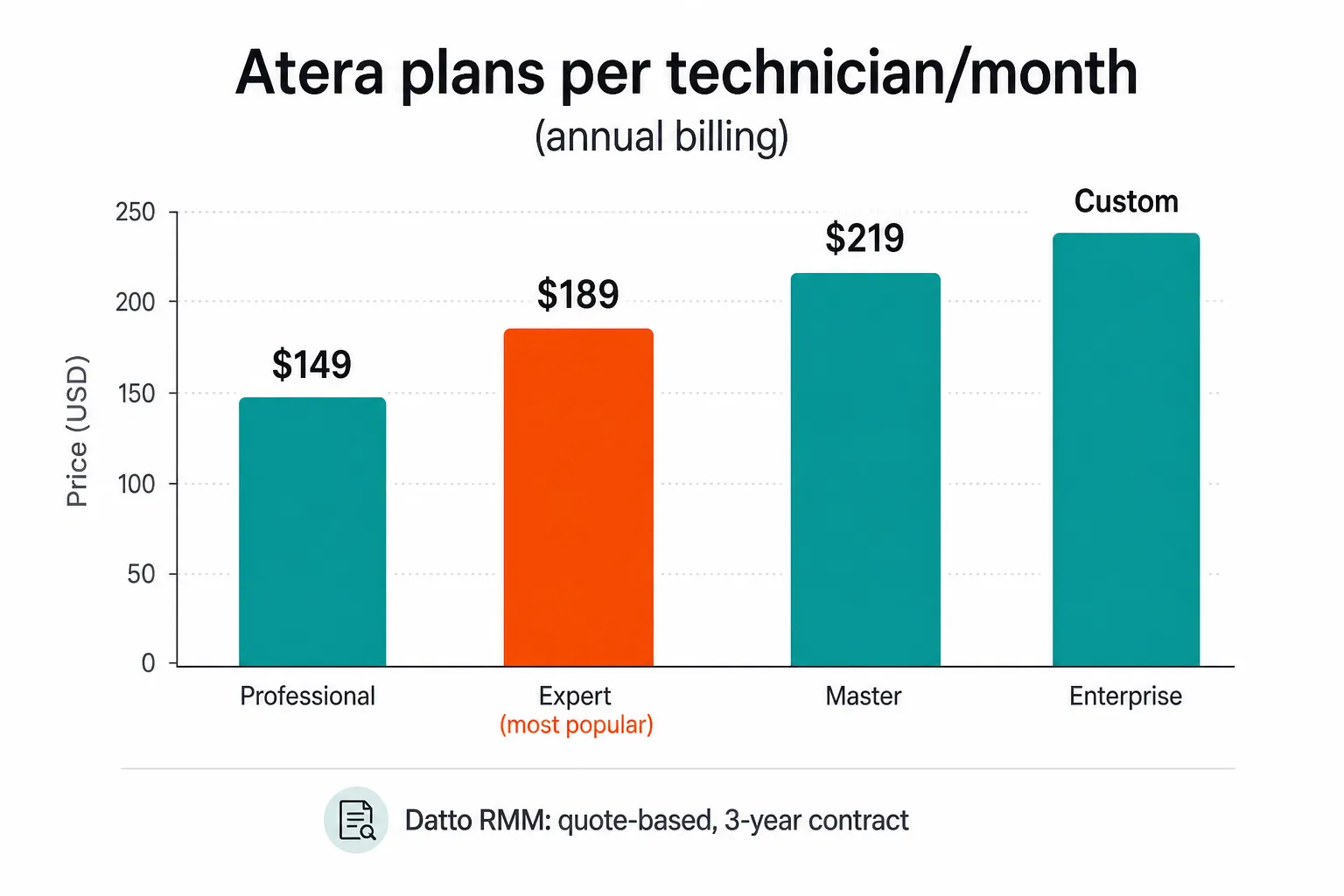
Atera charges per technician per month, annual billing:
| Plan | Price (annual) | Price (monthly) |
|---|---|---|
| Professional | $149/tech/mo | $169/tech/mo |
| Expert (most popular) | $189/tech/mo | $229/tech/mo |
| Master | $219/tech/mo | $269/tech/mo |
| Enterprise | Custom | Custom |
All plans include unlimited endpoints and AI Copilot. Remote access, patch management, and ticketing are all bundled - no separate licensing.
Add-ons include Network Discovery at $29/month per technician (included in Enterprise) and a Work from Home module at $5/month per end user.
For a 3-tech MSP on Expert: $189 × 3 = $567/month for unlimited endpoints, RMM, PSA, ticketing, and AI. No per-device overage.
Datto RMM pricing
Datto doesn't publish per-unit pricing. You contact sales, get a quote based on endpoint count, and sign a standard 3-year contract. MSP community reports suggest Datto is competitive at mid-to-large scale, but the contract terms and the Kaseya ownership dynamic make it a different kind of commitment. If you're bundling Autotask PSA, backup (SIRIS), and RMM, the combined cost can be significant - and bundle pricing transparency has been flagged as a consistent complaint.
Bottom line on pricing: If your MSP is growing and you value predictability and flexibility, Atera's per-technician model with monthly cancellation rights is substantially lower risk. If you're a larger shop getting meaningful volume discounts from Datto and you're already embedded in the Kaseya ecosystem, the math might look different - but you should model the 3-year downside scenario before signing.
Feature comparison
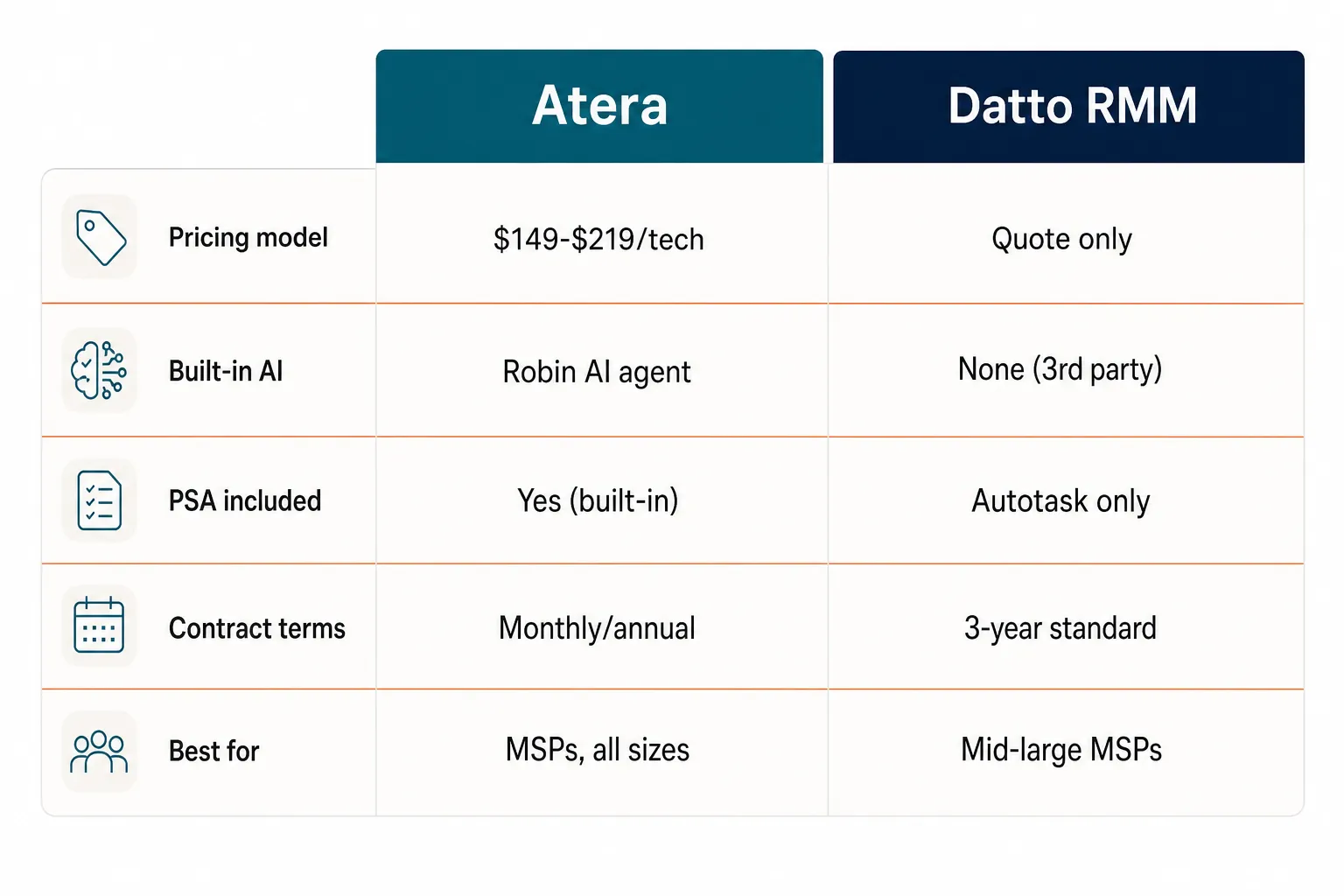
| Feature | Atera | Datto RMM |
|---|---|---|
| Pricing model | Per technician, published | Quote-based, custom |
| Contract terms | Monthly or annual, cancel anytime | 3-year standard |
| Built-in AI agent | Robin (92% autonomous resolution) | None native |
| AI Copilot | All plans | Not native |
| PSA / ticketing | Built-in (all plans) | Requires Autotask (separate) |
| Patch management | Strong, automated | Best-in-class, audit-ready |
| Remote access | Splashtop + AnyDesk (Expert+) | Web Remote (laggy), Agent Browser |
| Script builder | Limited vs. legacy RMMs | No built-in script builder |
| M365 management | Via integrations | Native module |
| G2 rating | 4.6/5 (1,135 reviews) | 4.5/5 (700+ reviews) |
| Free trial | 30 days, no credit card | Contact sales |
| Endpoint cost | Unlimited per technician | Per endpoint (custom) |
| Data residency | US + EU + APAC (Enterprise) | US, Ireland, Sydney |
| HIPAA BAA | Enterprise only | Available |
Who should pick Atera
You're a good fit for Atera if:
- You want one tool to run your whole service desk. RMM, ticketing, billing, and AI in a single login. No integration duct-tape between your PSA and your monitoring platform.
- You're scaling endpoints without scaling headcount. The per-technician pricing means 200 more devices doesn't cost you $400/month. That math matters at growth stage.
- You want AI now, not eventually. Robin and Copilot are production-ready, included in all plans, and have real customer proof points. You don't have to wait for a separate AI add-on contract to close.
- You're not locked into Autotask. If you're on HubSpot, SuperOps, or running a PSA-less workflow, Atera's built-in ticketing is the better path.
- You want to be able to leave. Monthly billing with no long-term commitment is a real option with Atera. If it stops working for you six months in, you can exit cleanly.
The MSPs who get the most value from Atera tend to be growing shops in the 2-20 technician range who want to stop stitching together multiple tools and are open to letting AI take more of the L1 load.
Who should pick Datto RMM
You're a good fit for Datto RMM if:
- You're already on Autotask PSA. The native integration is genuinely excellent. If you've built your workflows around Autotask, switching RMMs to get a tighter integration would cost more than the friction you're experiencing.
- You have serious compliance requirements. BSIMM validation, regional data residency, and audit-ready reporting make Datto a credible answer in regulated industries.
- Patching is your #1 priority. No current RMM has a more reliable, audit-friendly patching engine at scale. If you're managing 5,000+ endpoints with strict patch compliance SLAs, Datto's patching infrastructure holds up.
- You can absorb 3-year commitment risk. If your business is stable, your account manager is responsive, and you're getting volume pricing that works, the lock-in is manageable.
- You're managing large-scale backup + RMM workflows. The Datto SIRIS + RMM combo is genuinely strong for MSPs where backup and recovery are core revenue.
The shops where Datto RMM earns its keep tend to be established mid-to-large MSPs with a Kaseya/Autotask ecosystem already in place and compliance requirements that justify the platform's infrastructure overhead.
The layer both of them are missing
Here's something worth saying plainly: whichever RMM you pick, the RMM is not the thing that resolves your tickets. It monitors. It alerts. It gives you visibility and automation hooks. But when a user submits a ticket saying "I can't log in" or "my mailbox access is gone," someone still has to do something.
For most MSPs, that someone is a level-1 technician burning 45-90 minutes a day on password resets, account unlocks, and permission changes. That's the work that doesn't scale - and it's not an RMM problem.
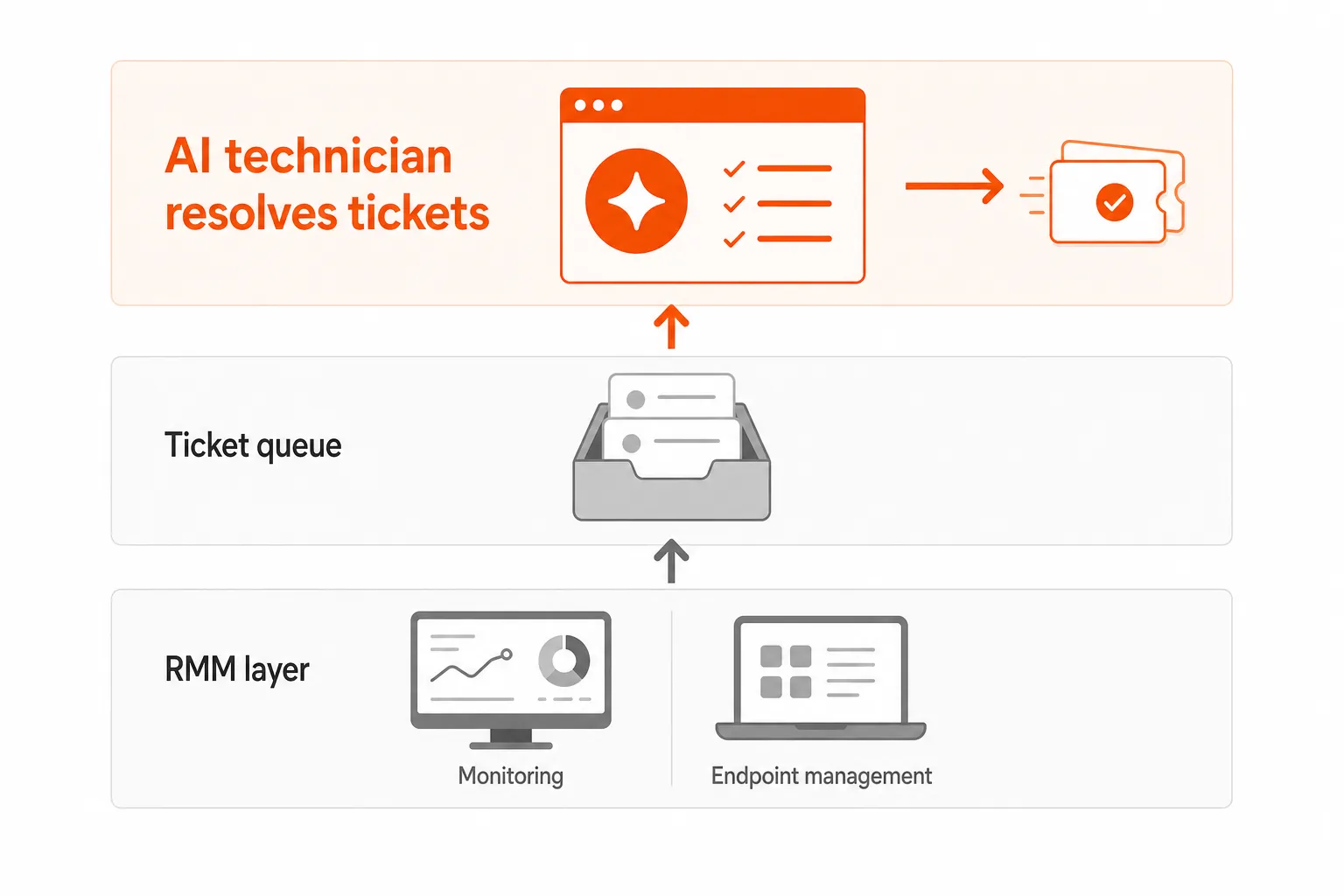
Atera's Robin takes a run at this within the Atera ecosystem. But if you're on Datto RMM, or if you want L1 resolution that works across your PSA, RMM, identity layer, and documentation - Robin isn't the answer, because Robin lives inside Atera.
This is the problem Rallied was built for. Rallied is an AI technician that connects to your PSA (ConnectWise, Autotask, HaloPSA, SuperOps), your RMM (including both Atera and Datto RMM), your identity stack (M365, Entra ID, Okta, JumpCloud, Google Workspace), and your docs (IT Glue, Hudu) - and resolves tickets end-to-end. Password resets, account unlocks, onboarding, offboarding, license management, MFA enrollment. It reads the ticket, does the work, updates the PSA, notifies the user, closes it.
The typical MSP with 200-400 tickets/month sees roughly $7K-$15K/month in L1 tech time become Rallied's cost: $0.50 per ticket, no base fee, no contract lock-in. It deploys in the same week you connect your tools - no 6-month implementation, no dedicated admin. One MSP described their previous AI tool as "a trainwreck of fail" after months of setup; Rallied's pitch is that you'll know in the first week whether it works.
Our take
If we were advising an MSP today:
Pick Atera if you want one modern platform with AI baked in, no device-count pricing, and the ability to leave if it doesn't work. The 30-day free trial removes almost all the risk. Robin won't handle everything, but it handles enough to noticeably reduce your L1 load, and the Copilot tools make your technicians faster even when the AI isn't fully autonomous. For most shops not already embedded in Kaseya, Atera is the stronger starting position in 2026.
Pick Datto RMM if you're already in the Autotask ecosystem, you're managing large-scale compliance-heavy environments, and patching quality is a genuine business differentiator for your clients. Just go in knowing you're committing to a 3-year relationship with Kaseya, and make sure you've pressure-tested the support responsiveness and billing practices before you sign.
And regardless of which one you pick - if L1 resolution is still eating your techs' time, that's a separate lever worth pulling.
Try Rallied
Rallied is an AI technician purpose-built for MSPs - and it integrates with both Atera and Datto RMM as part of your stack. It resolves L1 and L2 tickets autonomously: password resets, account unlocks, onboarding, offboarding, access management - real execution, not suggestions. At $0.50 per resolved ticket with no base fee and no implementation contract, you can connect your existing tools and know in the first week whether it's working. No 6-month onboarding. No dedicated admin tax.
If you're evaluating RMMs because you're trying to reduce the manual ticket load on your team, Rallied is the piece that handles the execution layer regardless of which RMM you land on.
Frequently Asked Questions
What is the main difference between Atera and Datto RMM?
Atera is an all-in-one platform combining RMM, PSA, ticketing, and a built-in AI agent (Robin) under per-technician pricing starting at $149/month. Datto RMM is a focused RMM tool with enterprise-grade patching and a native Autotask PSA integration, but uses quote-based pricing with standard 3-year contracts. Atera suits MSPs wanting everything in one platform; Datto fits shops already committed to the Kaseya/Autotask ecosystem.
How much does Atera cost per month?
Atera charges per technician, not per device. Plans run $149/month (Professional), $189/month (Expert), and $219/month (Master) billed annually. Monthly billing is available at a 10–20% premium. Enterprise pricing is custom. All plans include unlimited endpoints and AI Copilot. Full pricing details are on Atera's pricing page.
Does Datto RMM have public pricing?
No - Datto RMM uses quote-based pricing customized per partner. Standard contracts are 3 years. Pricing depends on endpoint count, region (US, EU, APAC), and bundled products. Multiple MSPs on Reddit flag the 3-year lock-in and opaque billing as friction points, especially under Kaseya ownership.
Which RMM has better AI features - Atera or Datto?
Atera leads here. Robin, Atera's autonomous AI agent, claims to resolve 92% of technical issues end-to-end with a median time to resolution under 120 seconds. Datto RMM does not have a native AI agent - AI capabilities would need to come from a third-party tool layered on top of the platform. If autonomous ticket resolution is your goal, Atera has a head start.
Can I add an AI technician to Atera or Datto RMM?
Yes - Rallied integrates directly with both Atera and Datto RMM as an autonomous AI technician. It reads inbound tickets, executes fixes (password resets, account unlocks, onboarding/offboarding, license management), and closes them - without a human touching them. It deploys in the same week you connect your PSA and RMM, at $0.50 per resolved ticket with no base fee.