The ROI of automating tier 1 tickets for MSPs in 2026
TL;DR
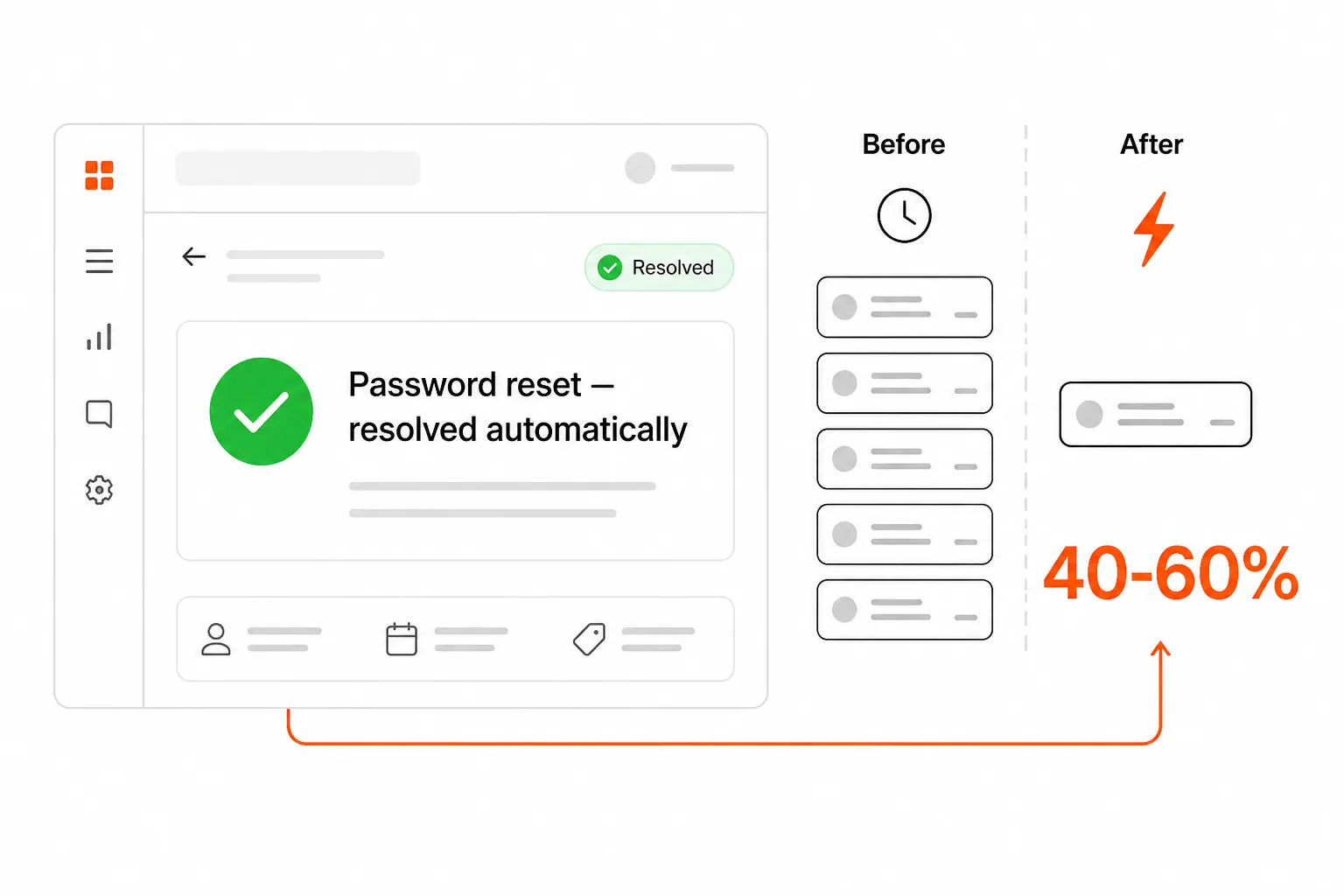
40-60% of MSP tickets are tier 1 - password resets, account unlocks, onboarding tasks that follow the same script every time. At $35-50 per ticket fully loaded, an MSP handling 500 tickets/month with 50% L1 volume is burning $8,750-12,500/month on work that shouldn't touch a human. Automating that work costs a fraction of that, pays back within 60-90 days, and frees your senior techs for the complex troubleshooting that actually moves the business forward. The math is straightforward. The barrier isn't ROI - it's picking a tool that actually deploys.
The problem isn't that MSPs are inefficient
It's that their best people are spending a meaningful chunk of every day on things that don't require them.
Password resets. Account unlocks. MFA re-enrollments. New hire onboarding. Contractor offboarding. These tasks are not hard. They're just frequent, repetitive, and time-consuming - and they land in the queue at random hours alongside the actual emergencies that need a skilled technician's attention.
The result is predictable: senior techs get interrupted constantly, ticket queues back up, and the MSP ends up either hiring more L1 staff (expensive, slow to ramp) or quietly eroding margins by using expensive people for cheap work.
The frustrating part is that this problem has been visible for years. What changed recently is that the tools to actually solve it - without a six-month implementation project or a dedicated automation developer - are finally good enough to deploy.
Let's look at the math.
What tier 1 actually costs you
Before you can calculate ROI, you need to know the baseline. And most MSPs, when they run these numbers, are surprised.
The cost per ticket
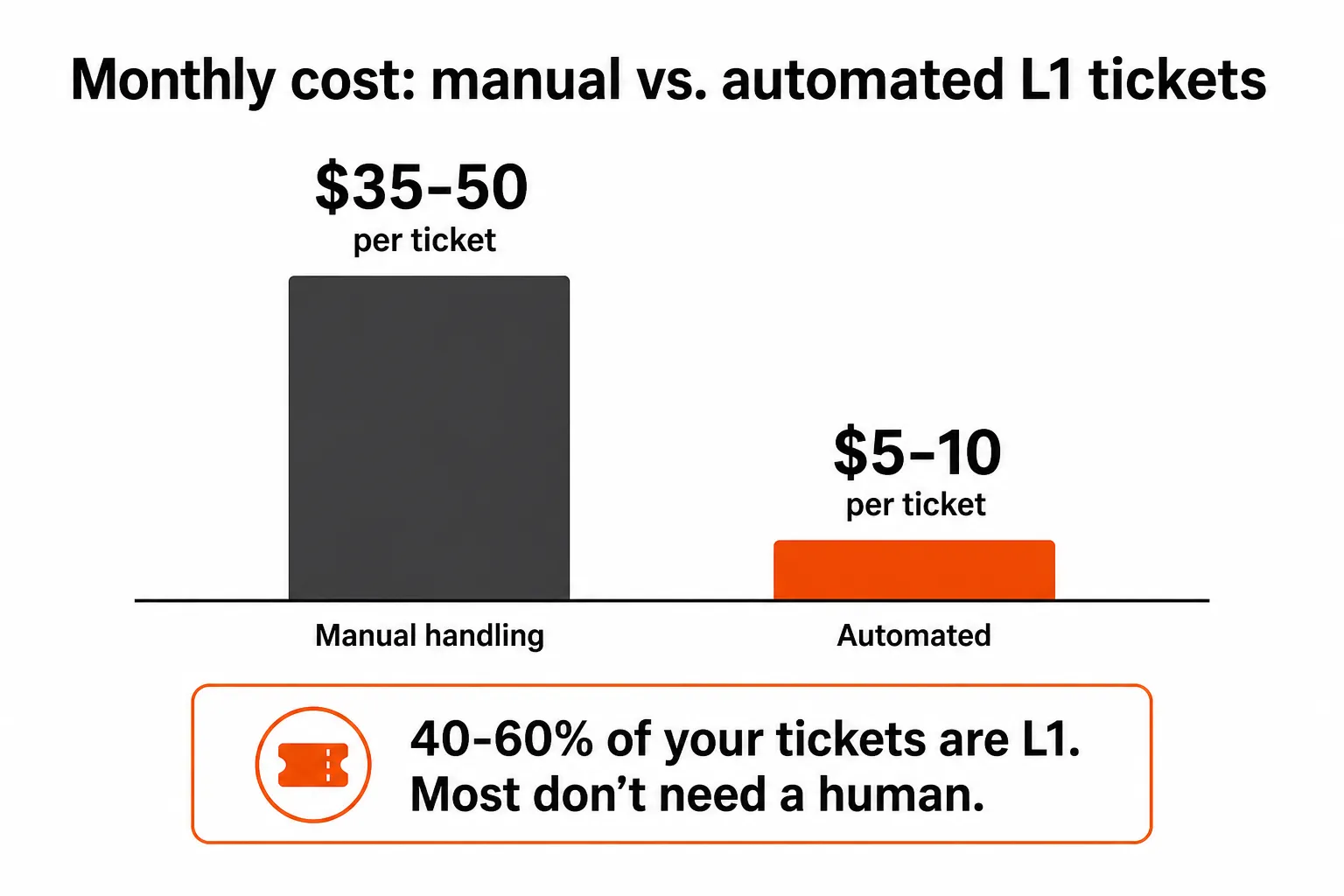
Industry data puts the fully loaded cost of manually handling a tier 1 ticket at $35-50. That figure includes technician time, overhead, and tooling - not just salary. At a loaded tech cost of $45-65/hour and average L1 handling time of 5-15 minutes per ticket, the per-ticket math isn't shocking. But multiplied across volume, it adds up fast.
Then add dispatch and triage overhead. Manual ticket categorization and routing takes 5-10 minutes per ticket. At $50/hour loaded cost, that's $4-8 per ticket just to get it to the right person - before anyone's actually touched the problem. Most MSPs dedicate at least a partial FTE to dispatch; that role costs $50,000-70,000/year all-in.
The volume reality
40-60% of MSP ticket volume qualifies as tier 1 and routine. Password resets alone account for 18% of all L1 tickets - the single largest category. Add account unlocks, MFA issues, user provisioning, basic software installs, and routine device troubleshooting, and you're looking at half your queue.
For a typical mid-size MSP handling 1,000 tickets/month:
| Category | Volume | L1 Eligible | Cost @ $45/ticket |
|---|---|---|---|
| Password resets & unlocks | ~180 tickets | ~180 | $8,100 |
| Onboarding/offboarding | ~100 tickets | ~80 | $4,500 |
| MFA & access issues | ~120 tickets | ~100 | $5,400 |
| Basic RMM / device | ~150 tickets | ~90 | $6,750 |
| Total L1 eligible | ~550 tickets | ~450 | ~$20,250/month |
That's $243,000 a year in labor costs for tickets that - in principle - don't need a human to resolve them.
What automation actually saves
The ROI case for tier 1 automation rests on three things: resolution speed, volume coverage, and tech time redirected to higher-value work.
Speed
Manual password resets take 5-15 minutes. Automated ones take seconds. That's not hyperbole - it's how reset scripts work when they're wired directly to the identity provider and the PSA. ConnectWise's case study of Decision Digital found that automated triage dropped from 10 minutes per ticket to 9 seconds - a 67x improvement. The ticket resolution time for individual L1 tasks follows similar curves.
For end users, this matters beyond the numbers. A password reset that takes 12 hours to get through the queue (because it's sitting behind three P1 incidents) versus one resolved in two minutes without a tech ever touching it - that's a real quality-of-service difference that affects client retention.
Volume
Modern AI technicians handle 40-60% of ticket volume autonomously when properly deployed. That's not deflection - it's full resolution: the system connects to the identity provider or RMM, executes the fix, documents the action in the PSA, and closes the ticket. No human in the loop.
Thread, the dispatch triage platform, processes 9,500 AI-assisted tickets per MSP partner per month across its network. Decision Digital, after deploying automation, reached 85% ticket automation rates and a 38% reduction in staffing costs. That's the ceiling of what a mature deployment looks like - most MSPs land in the 40-60% range in the first few months.
Cost per automated ticket
Automated ticket resolution costs $5-10 per ticket, compared to $35-50 manually. The math across our earlier example:
| Scenario | Volume | Cost/ticket | Monthly cost |
|---|---|---|---|
| Manual L1 handling | 450 tickets | $45 | $20,250 |
| Automated L1 handling | 450 tickets | $7.50 avg | $3,375 |
| Monthly savings | $16,875 |
That's a rough model, not a guarantee - your numbers depend on your ticket mix, tech rates, and how cleanly the automation integrates with your stack. But the direction is consistent.
How the ROI timeline actually plays out
The payback period depends almost entirely on how fast you get to live.
The old generation of MSP automation tools - Rewst, Pia - required months of setup, a dedicated admin, and in some cases a "forward-deployed engineer" engagement that cost five figures before you saw a single automated ticket. That's not a knock on their capabilities; it's just a structural reality that makes the ROI case harder to build in year one.
Newer AI agent platforms are different. Same-week activation is the benchmark for L1 agents in 2026 - which means the clock on ROI starts almost immediately.
"Ticket volume growth outpaces hiring. Clients add 50 users, we get 150 new tickets/month, but budget for zero new hires." - r/msp operator, from a thread on scaling MSP support without burning out techs (source)
For most mid-size MSPs, the math looks roughly like this:
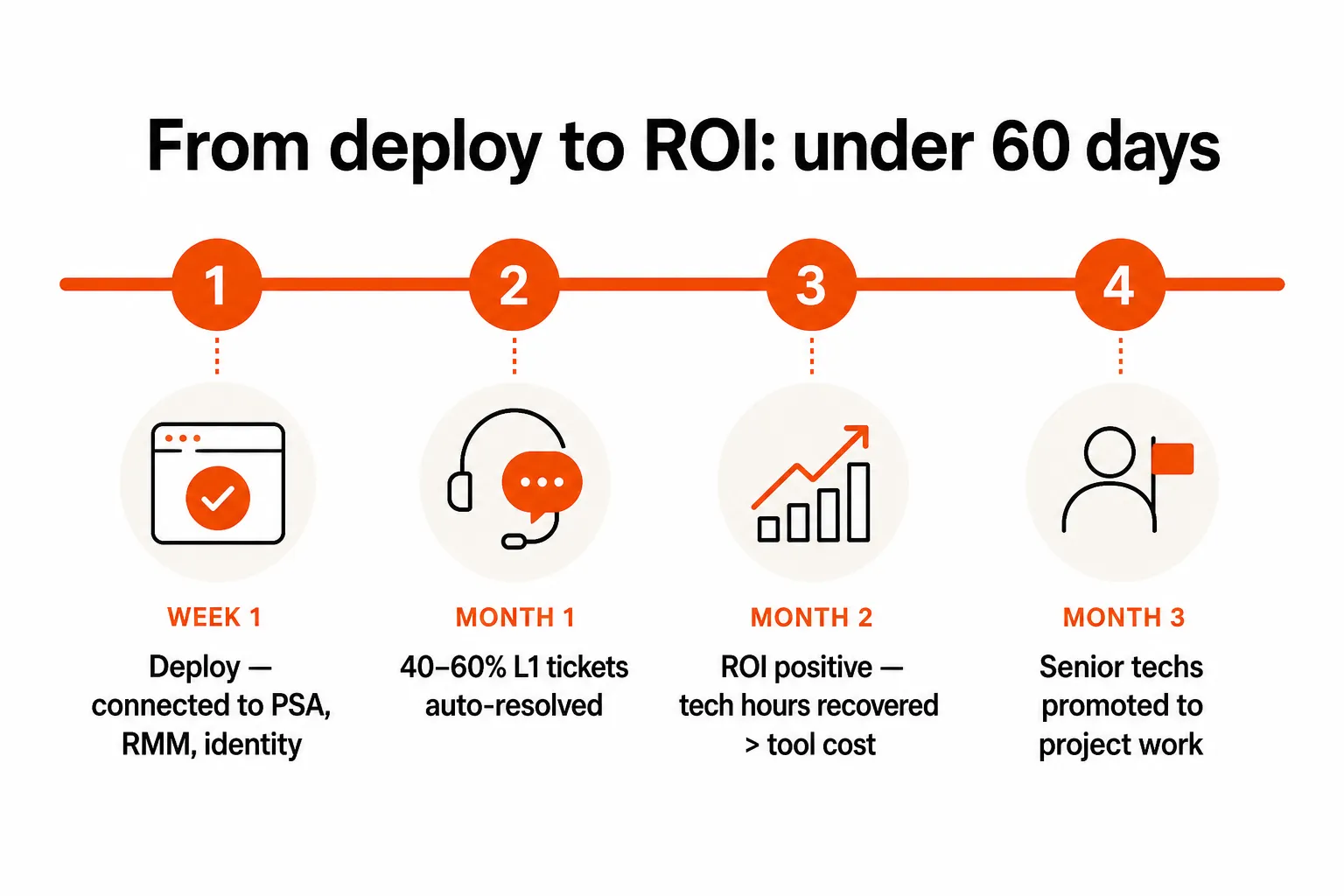
Month 1: Deploy, connect PSA + RMM + identity. First automated tickets close in week one. 20-30% of L1 volume automated by end of month.
Month 2: Volume ramps as the system encounters more ticket types. 40-50% L1 automation. Monthly tool cost overtaken by recovered tech hours.
Month 3+: Senior techs begin shifting to project work, escalations, and complex troubleshooting. Dispatcher time shrinks. The headcount math changes - not because people were let go, but because the same team can handle more volume.
Industry data puts typical payback at 60-90 days for mature AI automation deployments. That tracks with the economics: if you're recovering $16,000/month in labor costs and paying $600-1,500/month for the tool, the crossover happens fast.
The real barriers (and how to read them)
The MSP community is legitimately skeptical of vendor ROI claims, and that skepticism is earned. Here's what's actually true about the barriers.
"We've been burned before"
This comes up constantly in r/msp discussions. Operators who gave Pia or Rewst a real shot describe months of setup, a nearly-full-time admin requirement, and tools that suggest next steps instead of executing them.
"Rewst is technically solid, if you have the resources to invest, the ROI potential is real. Most MSPs underestimate the investment required." - r/msp operator (source)
The burn comes from a real problem: workflow builders and RPA tools require a developer to get value, and most MSPs don't have one. The newer AI agent category (tools that connect to your PSA and identity stack and actually execute, rather than building workflows you have to maintain) solves a different problem. But it's reasonable to be skeptical until you see a demo close an actual ticket.
"The scope is narrow"
This one's fair. AI technicians in 2026 are good at L1 - they're not replacing senior engineers on complex network troubleshooting or multi-tenant security incidents. If you're hoping to automate your entire ticket queue, you'll be disappointed. If you're hoping to automate the half of your queue that's genuinely routine, the technology is there.
"Rallied and NeoAgent close L1 tickets end-to-end. The tools work, and they all have customer wins to back them up." - Rev.io's AI Agent Stack deep dive
"Pricing is the foundation"
One r/msp thread thread surfaced a point worth repeating: "Pricing is the foundation. If you don't have it right, automation won't save you - you'll just be efficient at low margin." Automation improves efficiency; it doesn't fix a pricing problem. If your contracts are underpriced, the savings from automation get absorbed by margin pressure rather than flowing to the bottom line. Worth checking that your pricing is right before you model the ROI.
"Implementation cost eats the savings"
For platforms with long implementations, this is real. For platforms that deploy in a week with no implementation fee, it's not. The implementation cost is a variable you control by choosing the right tool.
How Rallied handles this
Rallied is an AI technician purpose-built for MSPs. It connects to your PSA (ConnectWise, Autotask, Halo PSA, SuperOps), your RMM (Datto, NinjaRMM), and your identity stack (M365, Entra ID, Okta, JumpCloud, Google Workspace) - and when a ticket comes in, it doesn't suggest a fix. It executes one.
The workflow looks like this:
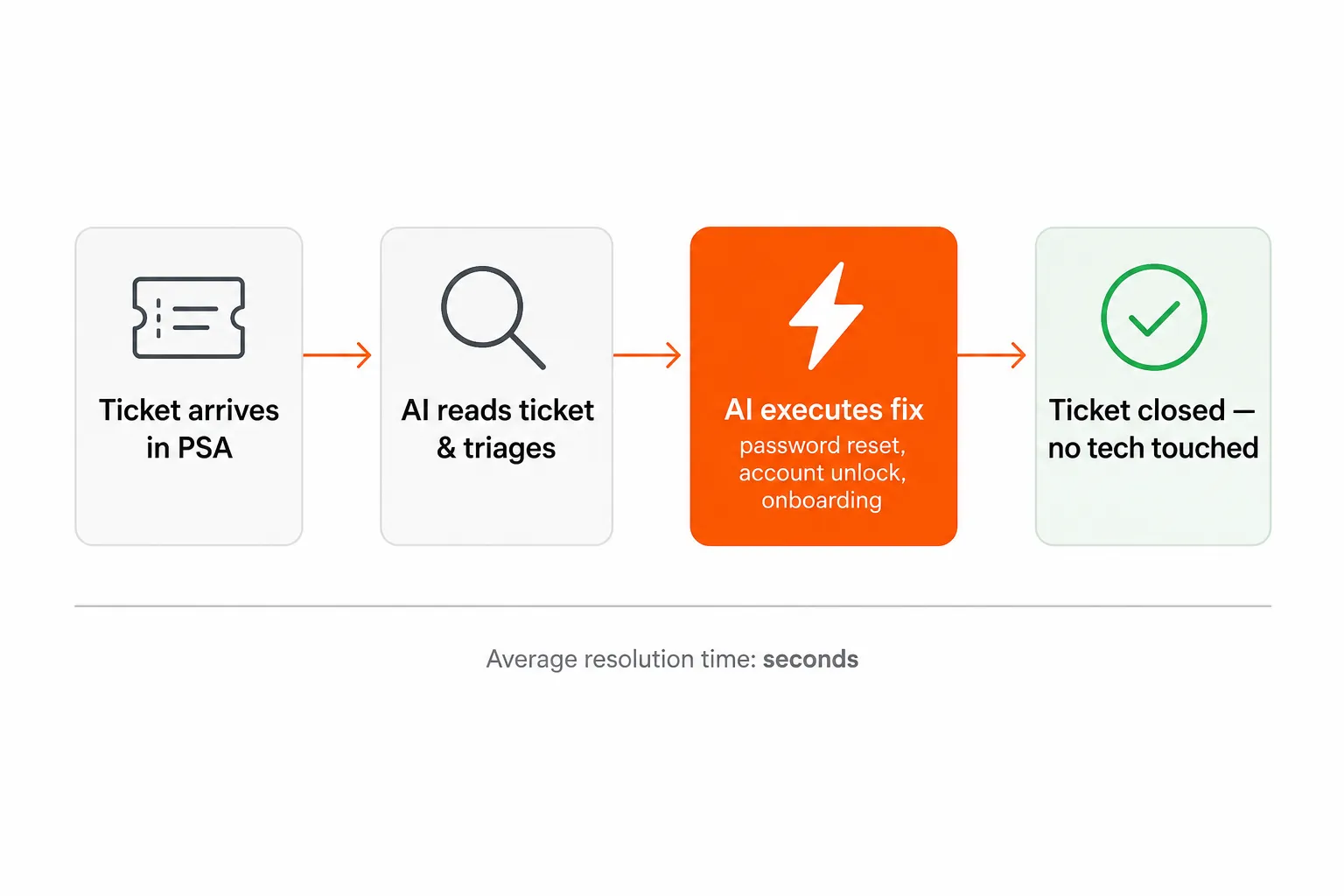
A ticket arrives in the PSA. Rallied reads it, triages it, connects to the relevant system (say, Entra ID for a password reset), executes the fix, documents it, and closes the ticket. The tech never touches it. Resolution time: seconds, not minutes.
What it handles today:
- Password resets and account unlocks across all major identity providers
- MFA enrollment and troubleshooting
- User onboarding and offboarding (M365, Entra, Okta, JumpCloud, Google Workspace)
- RMM script execution (software installs, reboots, device remediation)
- Inbound L1 call routing and triage
Pricing is per-outcome: $3 per ticket where Rallied actually did work - made a system change, ran a workflow start to finish. No charge if it couldn't resolve. No base fee, no seat licenses, no implementation cost. At 200 outcomes/month, that's $600. At 500, $1,500. The minimum is $150/month.
Put that against the recovery math: 200 outcomes/month at 15 minutes of tech time each is 50 hours recovered. At $75/hour loaded cost, that's $3,750/month in recovered margin - against $600 in tool cost. The math works even at conservative assumptions.
Rallied deploys in under a week. 14-day free trial, no credit card required.
The honest summary
Not every MSP should automate tier 1 tickets today. If your ticket volume is under 100/month, the economics are thin. If you're on a PSA that Rallied doesn't support yet, you'll need to wait. If your contracts are underpriced, automation won't solve that for you.
But for most mid-size MSPs handling 500+ tickets/month with a meaningful L1 component: the math works, the technology is there, and the main risk is picking a tool that takes six months to deploy and still can't execute.
The pattern that's emerging in the market is two-layer: triage and dispatch tools (like Thread) handling categorization and routing, and execution agents (like Rallied) actually closing the L1 tickets. Rev.io's analysis of the AI agent stack describes this as the emerging standard for MSPs serious about automation.
Your best people shouldn't be resetting passwords. That's not why they got into IT, and it's not what you hired them for.
Try Rallied
Rallied is the AI technician built for MSPs who want to stop paying senior tech rates for L1 work. It connects to your full stack - PSA, RMM, identity, documentation - and resolves tickets end-to-end, autonomously, the same week you deploy it.
No workflow builder. No implementation project. No charge when it can't resolve. Just tickets closing without a human touching them.
Start your free 14-day trial - $50 in credit, no card required.
Frequently Asked Questions
What percentage of MSP tickets are tier 1?
Industry benchmarks consistently put L1 ticket volume at 40-60% of total tickets for most MSPs. Password resets alone account for 18% of all tier 1 tickets, with account unlocks, MFA issues, and basic device troubleshooting making up most of the remainder. These are repetitive, predictable tasks that follow the same steps every time - which is exactly what makes them automatable. MSPs that have deployed AI technicians like Rallied report resolving 40-60% of total ticket volume without any tech involvement.
How much does it cost to handle a tier 1 ticket manually?
The fully loaded cost of manually handling a tier 1 ticket runs $35-50 per ticket, once you factor in technician time, overhead, and tooling. That's based on a loaded tech cost of $45-65/hour and an average handling time of 5-15 minutes per L1 ticket. Triage and dispatch alone adds another $4-8 per ticket in dispatcher time. For an MSP handling 500 tickets a month with 50% being L1, that's $8,750-12,500/month in labor costs for work that shouldn't need a human at all.
How fast can an MSP see ROI from tier 1 automation?
Most MSPs see positive ROI within 60-90 days of deploying AI ticket automation. The fastest path is tools with same-week deployment - platforms that require 6-month implementations eat that ROI window before you're even live. Rallied, for example, deploys in under a week with no implementation fee, which means a 200-outcome/month MSP is looking at roughly $600/month in tool cost against $7,500-15,000/month in recovered tech labor. That math goes positive fast.
Will automating tier 1 tickets mean layoffs?
Not in practice, and most MSPs aren't deploying it for headcount reduction anyway. The bigger story is that ticket volume grows faster than hiring budgets - automating L1 work lets existing techs handle more tickets without burning out. Senior engineers stop spending their days on password resets and start doing the complex troubleshooting and project work that actually moves the needle. The r/msp consensus is clear: automation is about doing more with the team you have, not replacing them.
What tier 1 tasks can be fully automated today?
The most reliably automatable L1 tasks are: password resets and account unlocks (Entra ID, Okta, JumpCloud, Google Workspace), MFA enrollment and troubleshooting, user onboarding and offboarding across M365 and identity providers, software installs and RMM script execution, and basic device configuration. Rallied handles all of these end-to-end - connecting to ConnectWise, Autotask, Halo PSA, Datto RMM, NinjaRMM, and the major identity platforms. More complex troubleshooting still needs a human, but the high-volume repetitive work is largely solved.