NinjaOne AI in 2026: what it actually does (and what it still can't touch)
TL;DR
NinjaOne's AI is real. For patch management and vulnerability detection, it's among the best in the RMM market -- and the results back that up. But NinjaOne AI is infrastructure AI. It manages endpoints, patches operating systems, and detects CVEs without scanning. What it does not do is answer a ticket. Password resets, account unlocks, MFA enrollments, access changes -- none of that touches NinjaOne's AI layer. If you thought getting NinjaOne meant your L1 burden was handled, you're about to be surprised by your next monthly ticket queue. The MSPs winning right now run NinjaOne for the infrastructure layer and a purpose-built AI agent like Rallied for the service desk -- two different problems, two different tools.
NinjaOne has held the #1 spot on G2 for RMM software for 23 consecutive quarters. That's not a press release claim -- that's 23 quarters of MSPs saying it outperforms everything else they've used. When NinjaOne started building AI into their platform, the MSP community paid attention. The question every shop was quietly asking: is this real, or is it just the word "AI" sprinkled over the same automation we've had since 2018?
We dug in. Here's what NinjaOne AI actually does in 2026, where it earns its place, and where the gap still sits that most MSPs don't fully account for.
What "NinjaOne AI" actually covers
NinjaOne's AI story is built around two capabilities: Patch Intelligence AI and real-time vulnerability management. Both are legitimately AI-powered. Both focus on the same problem space -- protecting and maintaining endpoints.
The positioning is "human-centered AI." That sounds like something a marketing team wrote at 11pm, but it actually describes something real: the platform uses AI to make better endpoint decisions faster, while keeping humans in control when things get unusual. It's not autonomous in the scary sense. It's autonomous in the "we already analyzed millions of deployment signals and this patch is safe, just push it" sense.
What NinjaOne's AI does not do -- and this matters -- is touch your service desk. It doesn't read tickets. It doesn't resolve user issues. It doesn't handle the 40 to 60 percent of monthly ticket volume that's password resets, account unlocks, and access requests. More on that in a moment.
Patch Intelligence AI: the headline feature
Patch Intelligence AI is NinjaOne's flagship AI capability, and it's genuinely worth the attention it gets. The problem it solves is one every MSP knows well: patch deployments fail or cause disruption not because IT teams are careless, but because no single team can properly evaluate every patch across every client configuration before rolling it out. Bad patches get deployed. Things break. Clients call.
NinjaOne's Patch Intelligence AI solves this at scale. The system continuously analyzes vendor patch advisories, CVE data and zero-day vulnerability intelligence, real-world deployment signals from across the NinjaOne customer base, and community forums tracking patch stability issues in the field. When a patch shows instability signals -- maybe it's bricking a specific hardware configuration, maybe there's a conflict with a line-of-business application that only shows up in certain environments -- Patch Intelligence AI automatically pauses deployment. Stable patches proceed autonomously. You set the policies; the AI makes the per-patch call.
The results NinjaOne cites are 93% reduction in time spent on patch management and 95% improvement in patch compliance. Those numbers align with what customers describe. The IT team at the City of Kansas City reported going from a 72-hour patch identification, testing, and deployment cycle to "almost instantaneous" remediation. Alabbar reported 30% reduction in patch deployment time.
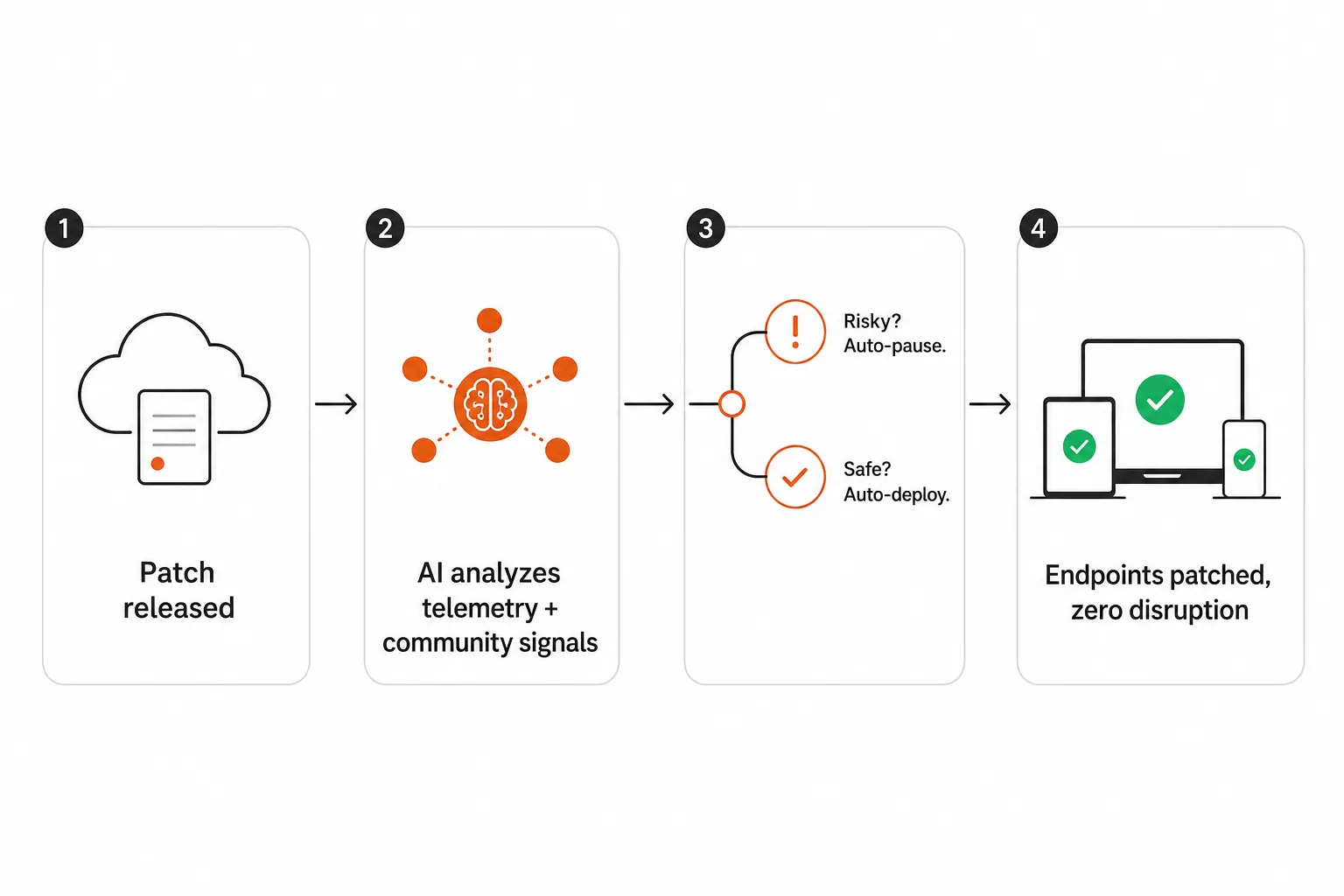
The distinction that matters here: traditional patch management is rules-based. Patch on Tuesday, test Wednesday, deploy Thursday. Patch Intelligence AI is learning-based. This specific patch, in this deployment context, with these community signals, is risky or safe. That's a different capability, and for MSPs managing hundreds of clients across varied hardware and software configurations, it's genuinely valuable.
One practical detail: NinjaOne supports patching for Windows, macOS, and Linux OS vulnerabilities, plus auto-updates for 6,000+ third-party applications. The breadth of coverage matters because most of the exploitable surface area in a typical MSP client environment isn't the OS -- it's Adobe, Chrome, VLC, and the dozen other third-party apps that never get patched manually.
Real-time vulnerability management
The second AI play in NinjaOne is their vulnerability management module, which uses an architecture worth understanding because it's meaningfully different from the traditional approach.
Classic vulnerability management scans endpoints on a schedule. That creates three persistent problems: scan windows are disruptive (especially on production servers), weekly cycles mean you're blind to new CVEs for days at a time, and offline devices just don't get scanned at all. NinjaOne flipped this with a scan-free model.
Their AI engine correlates endpoint software inventory -- collected continuously by the NinjaOne agent running in the background -- with a continuously updated CVE intelligence feed. The correlation happens entirely server-side. No scanning overhead on endpoints, no scan windows, no disruption. Vulnerabilities surface in minutes rather than waiting for the next scan cycle. For devices that are offline, newly disclosed CVEs get matched against the last-known software state, so remediation workflows are queued and ready the moment the device reconnects.
The AI layer handles risk-based prioritization on top of detection. Not just what's vulnerable, but what's being actively exploited in the wild, what has real-world threat context versus theoretical exposure, what actually needs immediate attention. That distinction -- between a CVSS score and actual real-world risk -- is where a lot of vulnerability programs fail. High-CVSS findings that nobody is actively exploiting pile up in queues while genuinely dangerous lower-scored CVEs go unnoticed.
One flag worth noting for MSPs evaluating the full cost picture: vulnerability management in NinjaOne requires an additional license. At scale, it roughly doubles the per-device cost for that feature. Several Reddit users in the r/msp community have flagged this as a frustration -- Action1 includes vulnerability scanning in its base pricing, and several other competitors do too. For a platform positioning itself as a unified all-in-one, treating vulnerability management as an upsell creates some tension with the story.
NinjaOne's position in the RMM market
Context matters when evaluating any AI feature set. NinjaOne doesn't sit in a crowded middle of the RMM market -- it sits clearly at the top by independent measure. 23 consecutive G2 RMM category leader awards is the headline stat, but the per-category scores tell a more specific story: 9.3 for ease of use, 9.3 for quality of support, 9.4 for remote monitoring. Gartner recognized NinjaOne in their 2026 Magic Quadrant as well.
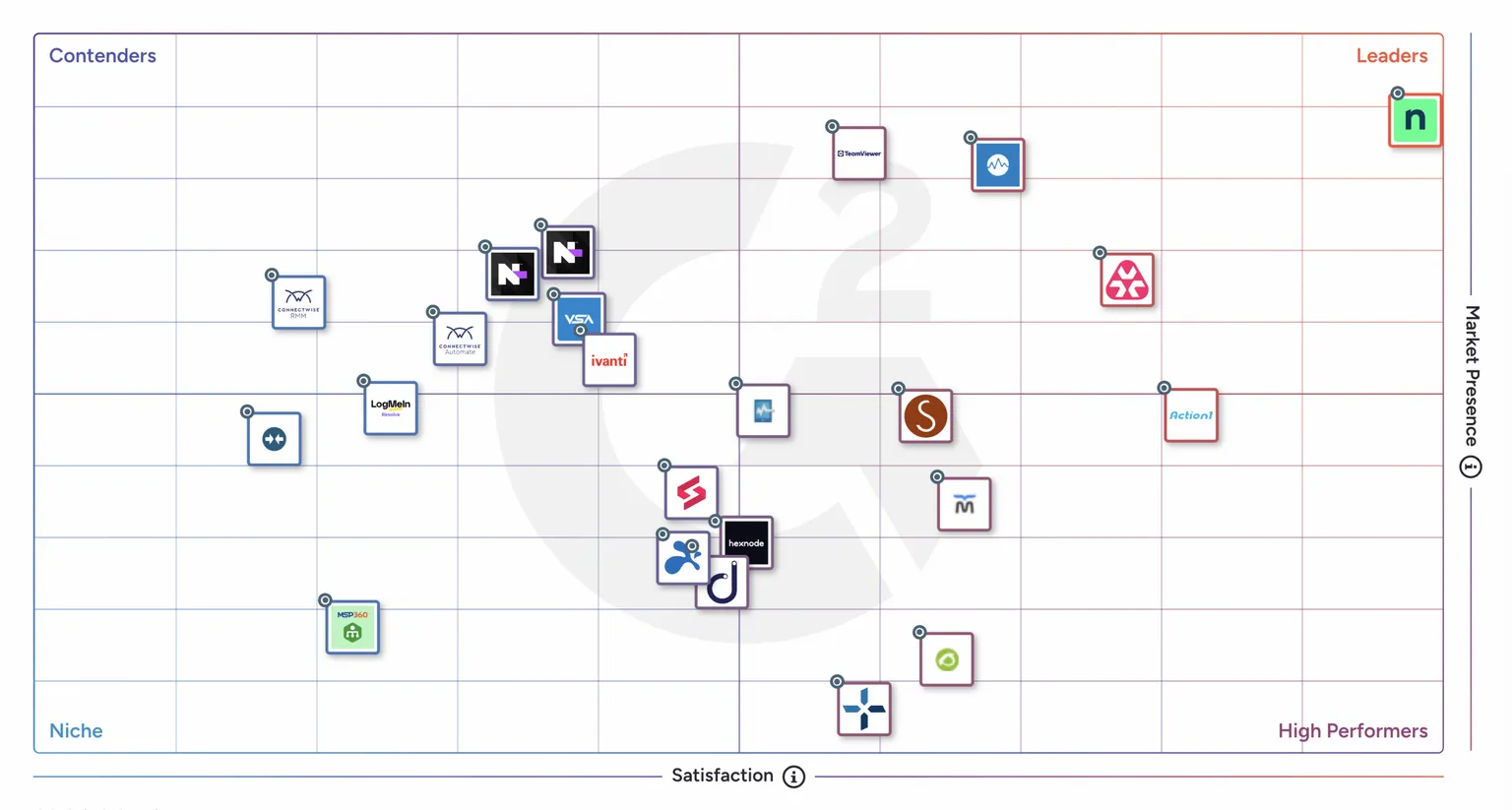
The support score (9.3/10, 98% CSAT) is meaningful in a category where support quality is a real differentiator. Unlimited support included in every plan, no tiered support tiers, no "submit a ticket and wait" -- that's a legitimate competitive advantage for MSPs whose clients can't wait.
The trade-off is pricing. NinjaOne runs higher than Atera, Syncro, and Action1 at comparable endpoint counts. The per-device pricing starts around $3.75/month for smaller deployments and scales down to $1.50/month at 10,000+ endpoints. That's a real cost delta versus volume-focused competitors. For MSPs where patch management quality and operational simplicity are the deciding factors, the premium holds up. For shops where cost-per-endpoint is the primary driver, competitors can offer 80% of the feature set at meaningfully lower cost.
What NinjaOne AI doesn't touch
Here's where most MSPs have a gap they don't fully see coming.
NinjaOne's AI is infrastructure AI. It looks after endpoints. It patches operating systems. It detects software vulnerabilities before they become breaches. What it does not do is anything that lives on the service desk side of your operation.
When a user emails in with a locked account: NinjaOne doesn't touch that ticket. When someone needs a password reset: NinjaOne doesn't handle it. When a new hire needs their Microsoft 365 license, Entra ID account, and security group memberships set up: that's still a human job. When a contractor needs to be offboarded across five systems before they walk out the door: manual work, every time. When someone's MFA enrollment breaks: a technician is handling that call.
That's not a knock on NinjaOne. Endpoint management and service desk management are genuinely different problem spaces that require different architectures. But MSPs frequently conflate "we have an AI-powered RMM" with "our AI problem is solved" -- and those are not the same thing.
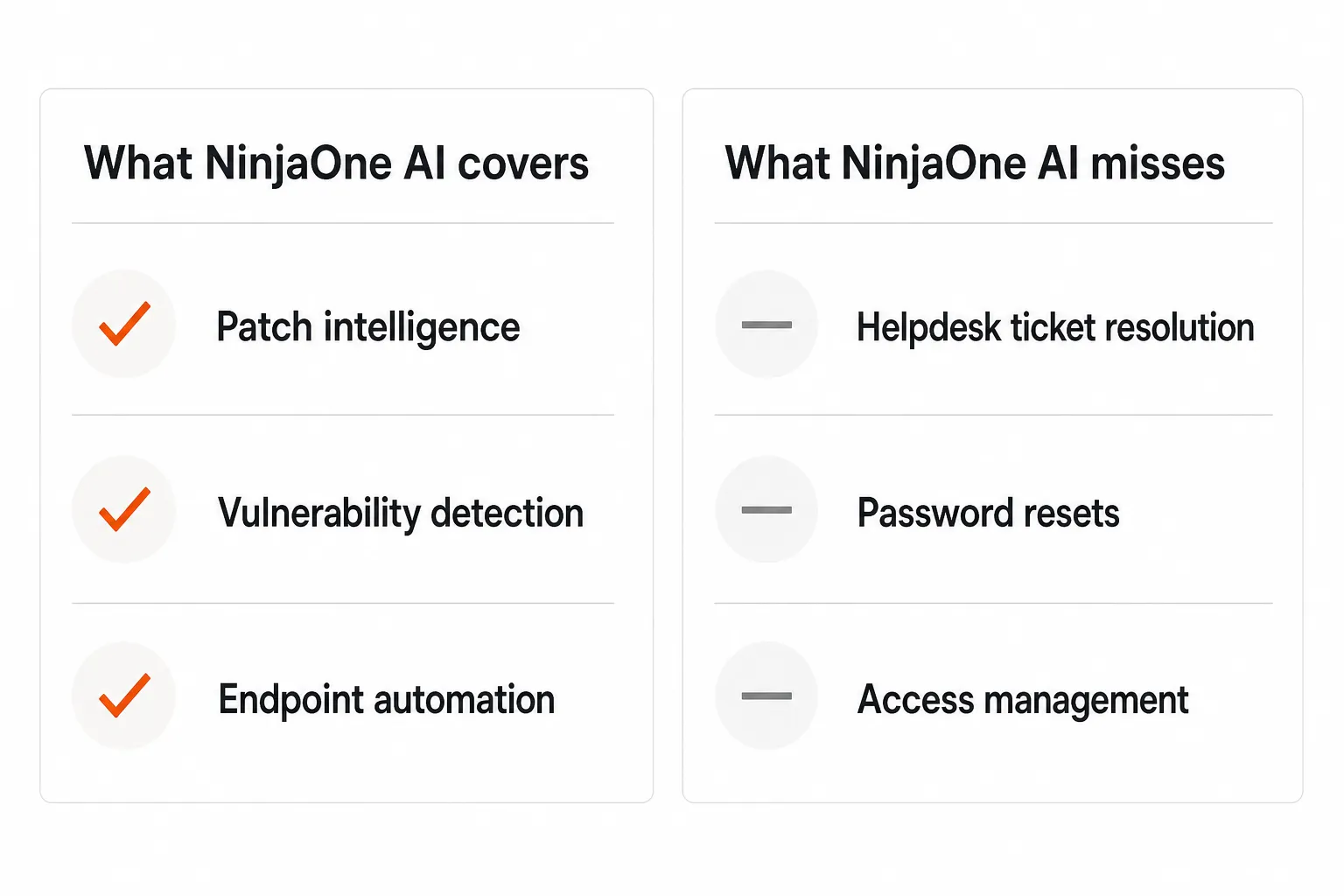
Pull your ticket data from the last 30 days. Password resets, account unlocks, MFA issues, access requests, license assignments, permission changes, new-hire provisioning, contractor offboarding. That category accounts for 40 to 60 percent of L1 ticket volume at most MSPs. Not a single one of those tickets is being touched by NinjaOne's AI. A technician is handling every one manually.
This isn't a gap NinjaOne created -- it's a gap they're simply not trying to fill. Their product is RMM. They do that extremely well. The service desk is a different product category.
The cost of that gap, in real numbers
The math on this is straightforward, and it's the kind of thing that becomes obvious once you write it down.
An MSP handling 200 to 400 tickets per month has somewhere between 50 and 100 hours of L1 service desk work per month: password resets, account unlocks, MFA problems, access changes. That's one-plus FTEs worth of time doing work that requires no judgment, no expertise, and no human presence. At an average MSP labor cost of $75 to $125 per hour fully loaded, that's $7,000 to $15,000 per month of technician time sitting on work that should be automated.
Your best techs are resetting passwords. NinjaOne's Patch Intelligence AI is not going to fix that.
The NinjaOne ROI story -- 605 hours per month saved, 3.6 FTE equivalents -- is real for the endpoint management side of the business. Automated patching saves 153 hours per month. Automated maintenance saves another 125. Faster ticket remediation from better RMM visibility saves 73 more. Those numbers are credible.
But they're measuring a different department. The infrastructure team runs patching and endpoint automation. The service desk handles user issues. Both need AI. Only one gets it from NinjaOne.
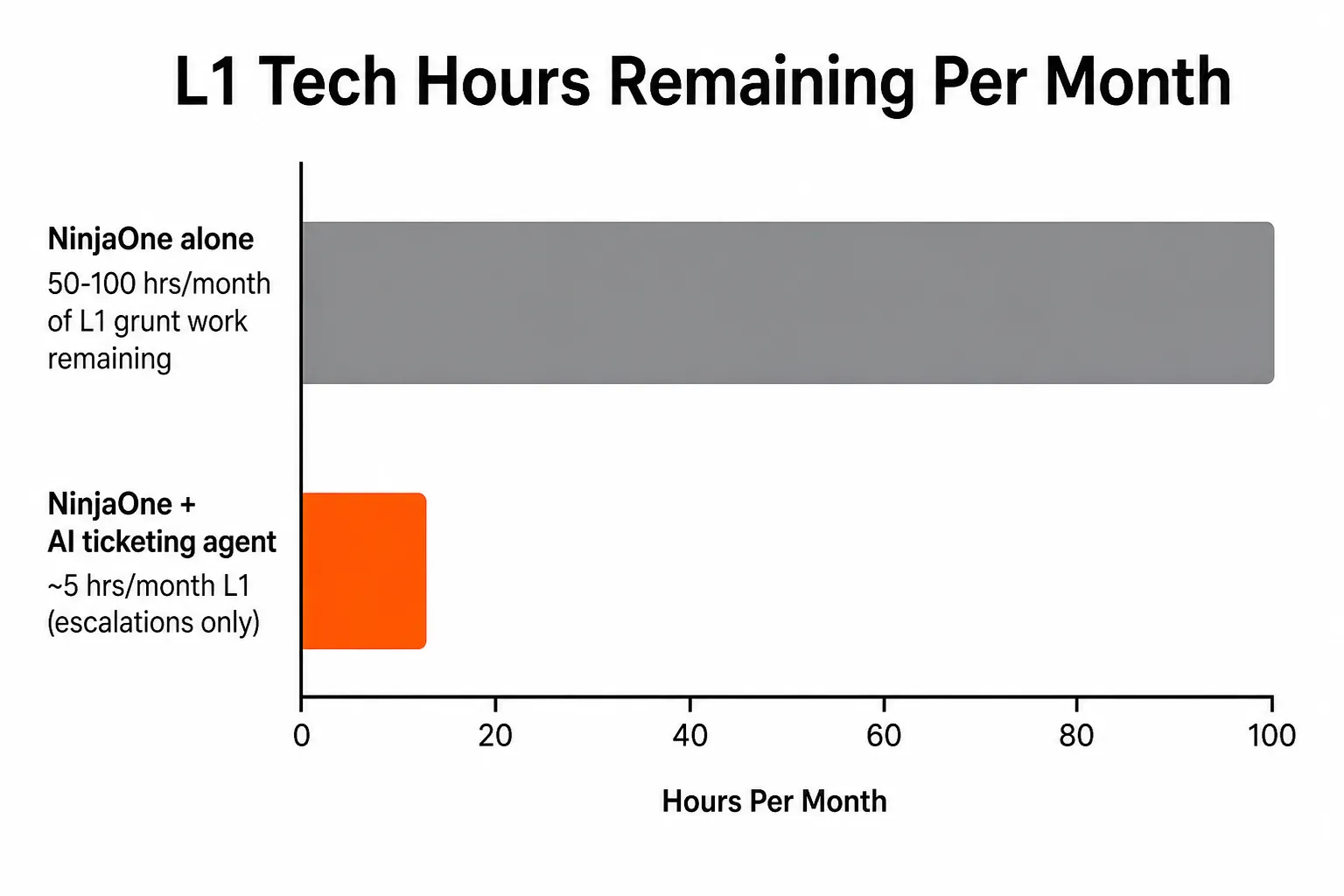
The other thing worth flagging: the L1 service desk grind isn't just a cost problem. It's a retention problem. Senior technicians leave shops where they spend half their day on password resets. NinjaOne doesn't make that better -- it makes the endpoint management side of their job better, which is genuinely valuable, but the thing making them want to quit is still there.
Closing the gap: NinjaOne and a dedicated AI technician
The stack that works for MSPs in 2026 is not "one AI tool to rule them all." It's infrastructure AI handling the endpoint layer, and a dedicated execution engine handling the service desk layer. Different problems, different architectures, different tools.
NinjaOne covers the infrastructure half with genuine strength. For the service desk half, MSPs are adding purpose-built AI agents that connect directly to their RMM and PSA. The feature that separates real solutions from the noise: actual execution, not just recommendations. A tool that tells your tech "this looks like a password reset" is not saving anyone time. A tool that reads the ticket, resets the password in Entra ID or Okta or JumpCloud, notifies the user, updates the ticket in ConnectWise or Autotask, and closes it -- that's where the labor cost disappears.
Deployment speed is the other thing that matters. The MSP market has been burned badly by tools that promised transformation and delivered six months of implementation pain with a dedicated admin tax on top. Rewst, in the right hands, is genuinely powerful -- but "in the right hands" means someone who knows how to build in it, and that person costs money and takes time. MSPs who've tried Pia and hit the same wall know the feeling. Same-week deployment, no training dataset, no professional services engagement -- that's a different category, and it's the bar that actually gets adopted.
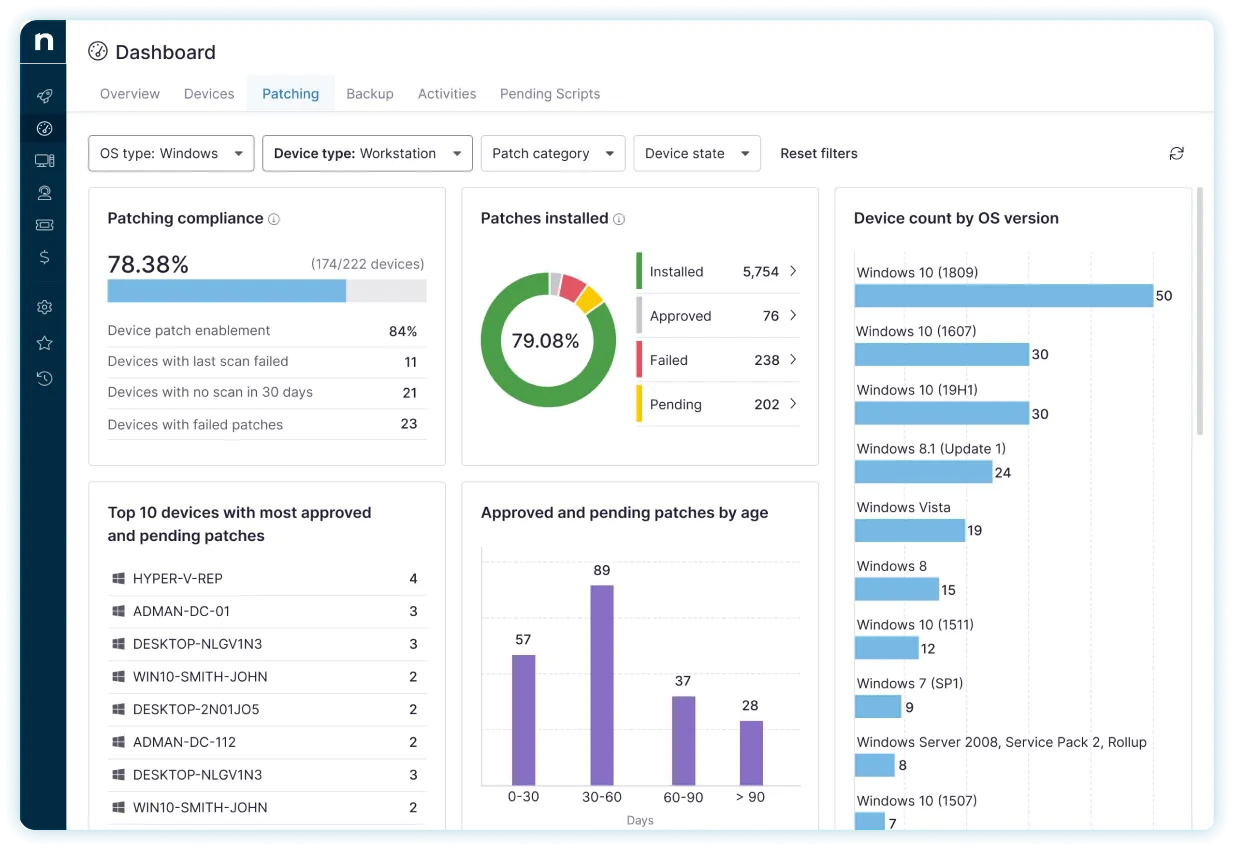
The way to think about the full stack: NinjaOne handles what happens to endpoints when no human is involved -- patches, vulnerability scanning, automated remediation. An AI technician handles what happens when a human submits a ticket -- reading the request, diagnosing the issue, executing the fix across identity providers, sending the confirmation, closing the loop. Two different workflows, two different tools, zero overlap.
Try Rallied
Rallied is an AI technician built specifically for MSPs to resolve L1 and L2 tickets end-to-end, without a technician. It connects directly to NinjaOne alongside your PSA (ConnectWise, Autotask, HaloPSA), identity providers (Entra ID, Okta, JumpCloud, Google Workspace), and documentation tools (IT Glue, Hudu). When a ticket lands, Rallied reads it, executes the fix across your stack, notifies the user, and closes the ticket. No human involved.
It goes live the same week you connect your stack. No implementation fee, no admin overhead, no workflow builder to learn. Pricing is $0.50 per ticket resolved, no base fee, no lock-in. For a 200-400 ticket-per-month shop, that typically converts $7,000 to $15,000 per month of L1 tech time into a few hundred dollars of automation cost.
NinjaOne handles your endpoints. Rallied handles your service desk. Together, they're the full AI layer most MSPs have been trying to build for the last three years.
Frequently Asked Questions
Does NinjaOne have AI features?
Yes. NinjaOne's primary AI features are Patch Intelligence AI (which analyzes patch stability and auto-pauses risky updates) and real-time vulnerability management (which uses server-side CVE correlation to detect vulnerabilities without endpoint scanning). These are genuine AI-powered capabilities, not just marketing language. That said, NinjaOne AI is focused entirely on endpoint and infrastructure management -- it has no AI for helpdesk ticket resolution, password resets, or account management.
What is NinjaOne Patch Intelligence AI?
Patch Intelligence AI is NinjaOne's flagship AI feature. It continuously analyzes patch telemetry, vendor advisories, and real-world deployment signals from across the NinjaOne customer base to determine whether a patch is safe to deploy. Risky or unstable patches get automatically paused; stable ones proceed autonomously. NinjaOne customers report reductions in patch management time of up to 93%, and some describe going from 72-hour patch cycles to near-instantaneous remediation.
Is NinjaOne AI good for MSPs?
For infrastructure work -- patching, vulnerability management, endpoint automation -- NinjaOne AI is genuinely strong. NinjaOne has held the #1 G2 position for RMM software for 23 consecutive quarters and its AI-powered patch management is widely considered best-in-class. Where it falls short for MSPs is the helpdesk: NinjaOne AI has no capability for resolving support tickets, handling password resets, or managing user access. MSPs typically need a separate AI layer like Rallied to cover that gap.
How do NinjaOne and Rallied work together?
NinjaOne and Rallied are complementary tools. NinjaOne covers the infrastructure layer: monitoring, patching, vulnerability management, and endpoint automation. Rallied covers the service desk layer: resolving L1 and L2 tickets, handling password resets, account unlocks, onboarding, and offboarding -- autonomously. Rallied integrates directly with NinjaOne as an RMM, so it can trigger NinjaOne scripts and commands during ticket resolution. Together they cover the full MSP stack without either tool duplicating the other's job.
How much does it cost to add AI ticket resolution to a NinjaOne setup?
Rallied, which integrates natively with NinjaOne, charges $0.50 per ticket resolved with no base fee or platform fee. For an MSP handling 200-400 tickets per month, that typically replaces $7,000-$15,000 per month in L1 tech time. There's no implementation period -- most MSPs are live within a week of connecting their PSA and RMM.