NinjaOne vs N-able: Which RMM Is Right for Your MSP in 2026?
TL;DR
NinjaOne and N-able N-central are both strong RMMs. NinjaOne wins on ease of use, patch management, and fast deployment - rated #1 on G2 for 23 consecutive quarters with a 4.7/5 score. N-able N-central wins on automation depth and power for complex environments - particularly for MSPs managing 500+ endpoints who are willing to invest in the learning curve. Neither platform automatically resolves tickets. If your senior engineers are still spending hours on password resets and account unlocks, that's a Rallied problem, not an RMM problem.
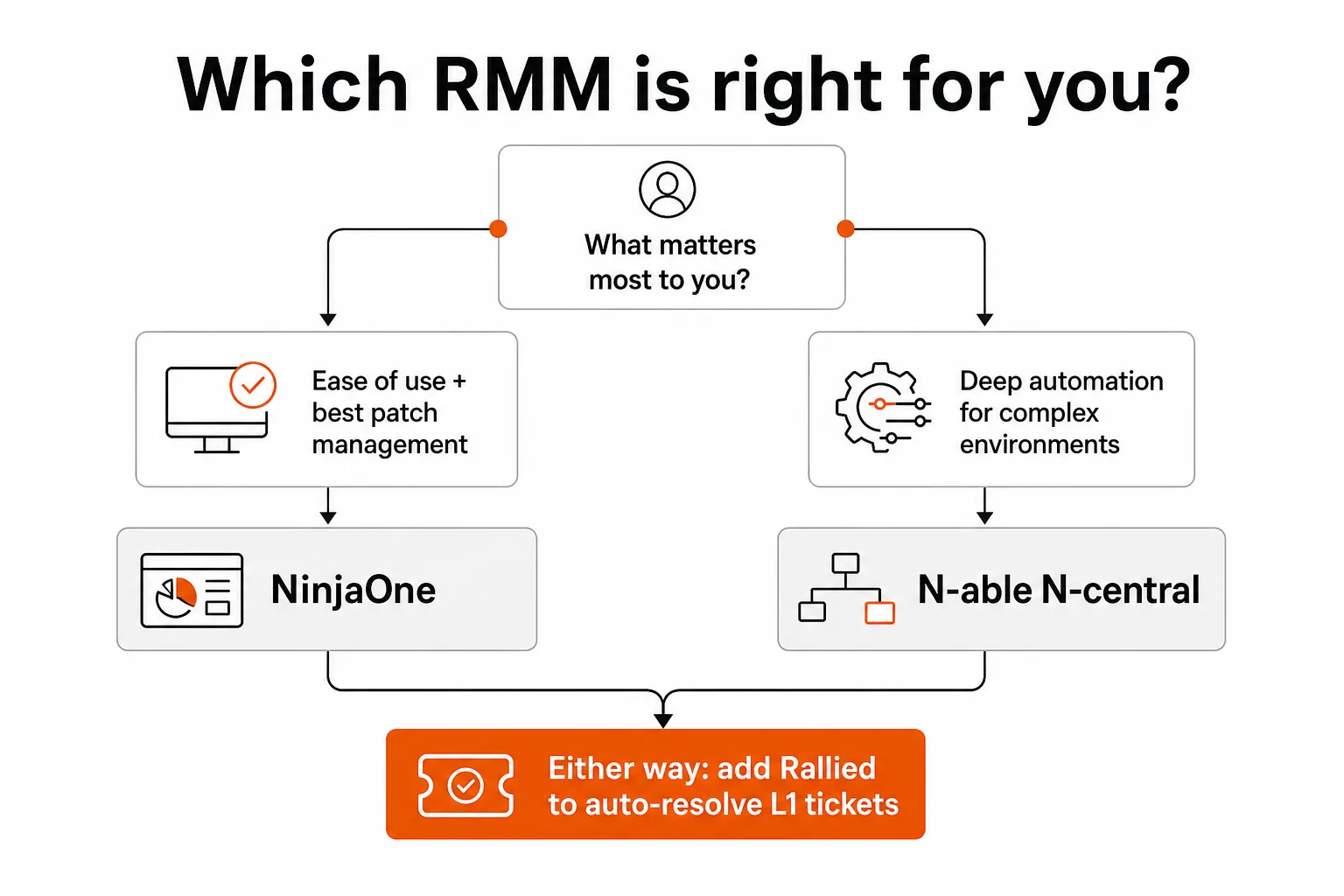
Pick NinjaOne if: you want the smoothest UX, best-in-class patch management, and operational in one week.
Pick N-able if: you need deep automation and scripting for complex multi-site environments, and your team has the technical appetite to configure it.
Add Rallied either way if you want L1 tickets handled autonomously - it integrates with both.
We ran this comparison after talking to MSPs who'd used both platforms - and a handful who'd switched between them. The patterns were consistent enough to be useful. We tested both UIs, dug into pricing, and spent time in both the MSP Reddit community (r/msp) and G2 reviews to separate the vendor messaging from the real-world experience.
Here's what we found.
What NinjaOne and N-able actually are
Before the feature shootout, let's be precise: both are remote monitoring and management (RMM) platforms built for MSPs. Their job is to give your team eyes on every endpoint across every client - and ideally, arms to fix things without dispatching a tech.
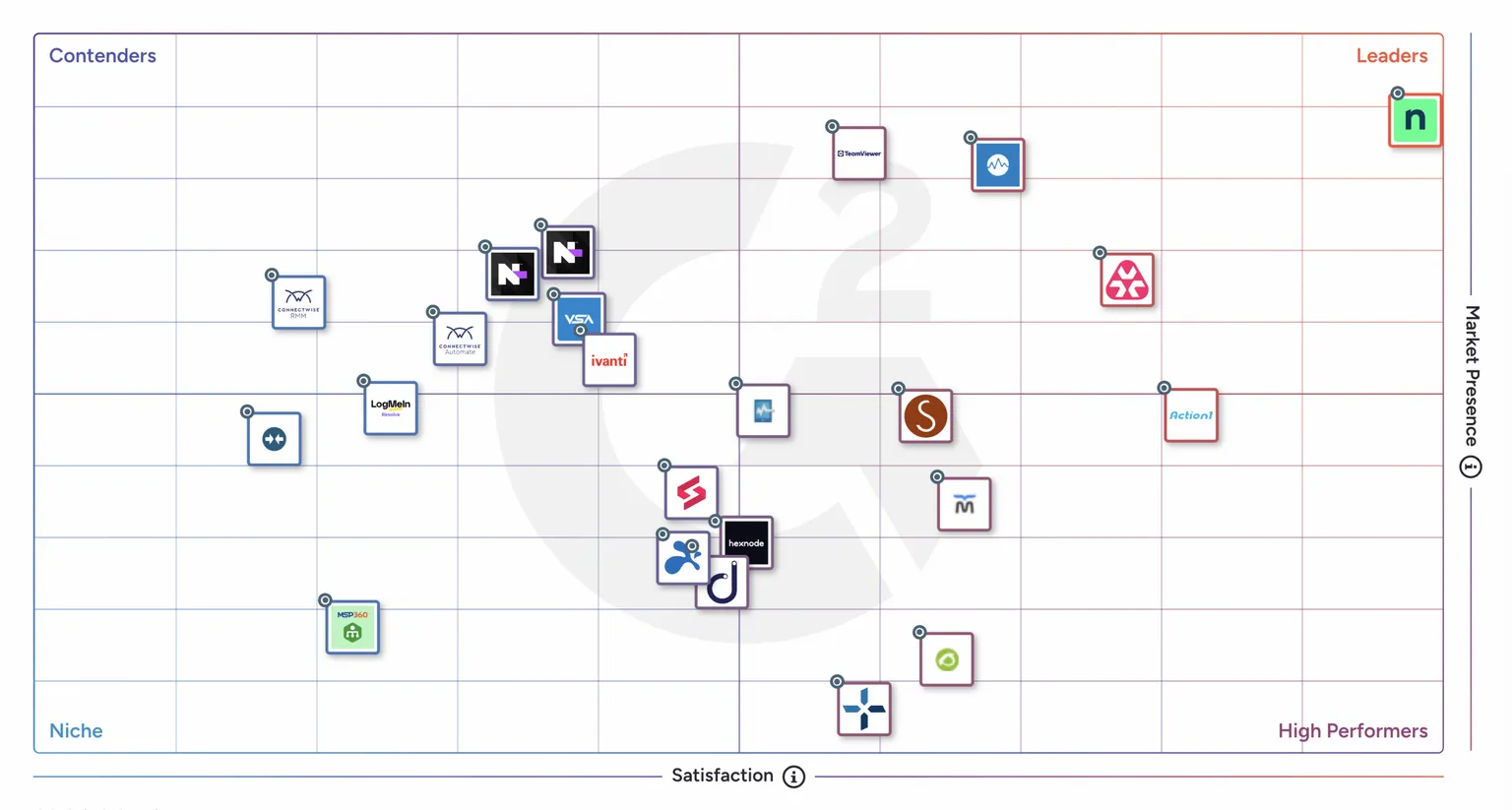
NinjaOne is a cloud-native RMM that's grown into a unified endpoint management platform. It handles monitoring, patching, remote access, endpoint automation, MDM, and IT documentation - all from one console. The company has held the #1 position on G2 in the RMM category for 23 consecutive quarters as of Spring 2026, which is a genuinely unusual streak.
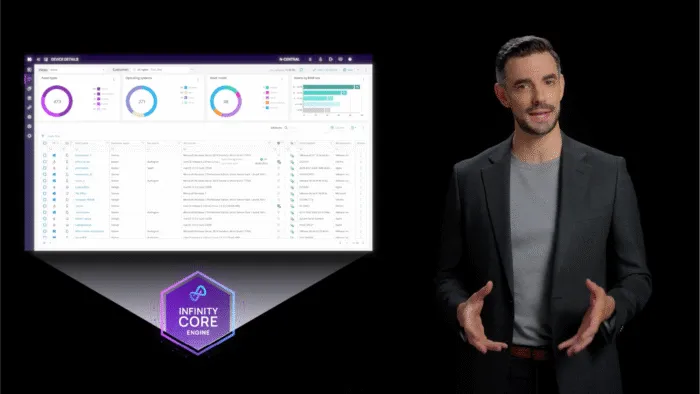
N-able N-central is the heavier-weight cousin. It's been around longer, has a more power-user reputation, and its "Infinity Core" architecture is specifically designed for flexibility at scale. N-central combines RMM with built-in EDR/XDR/MDR security management and AI agents (called N-zo) that handle everything from CVE prioritization to asset inventory. Named a Leader in the 2025 Gartner Magic Quadrant for Endpoint Management Tools.
The short version: NinjaOne is the polished, modern choice. N-central is the powerful, complex one.
The G2 scoreboard
Let's start with the most objective numbers we have. Both platforms are on G2:
| Platform | Overall G2 rating | Reviews | Ease of use | Quality of support | Patch management |
|---|---|---|---|---|---|
| NinjaOne | 4.7/5 | 4,386+ | 9.3/10 | 9.3/10 | 9.1/10 |
| N-able N-Sight RMM | 4.3/5 | 348 | 8.4/10 | 8.3/10 | 8.4/10 |
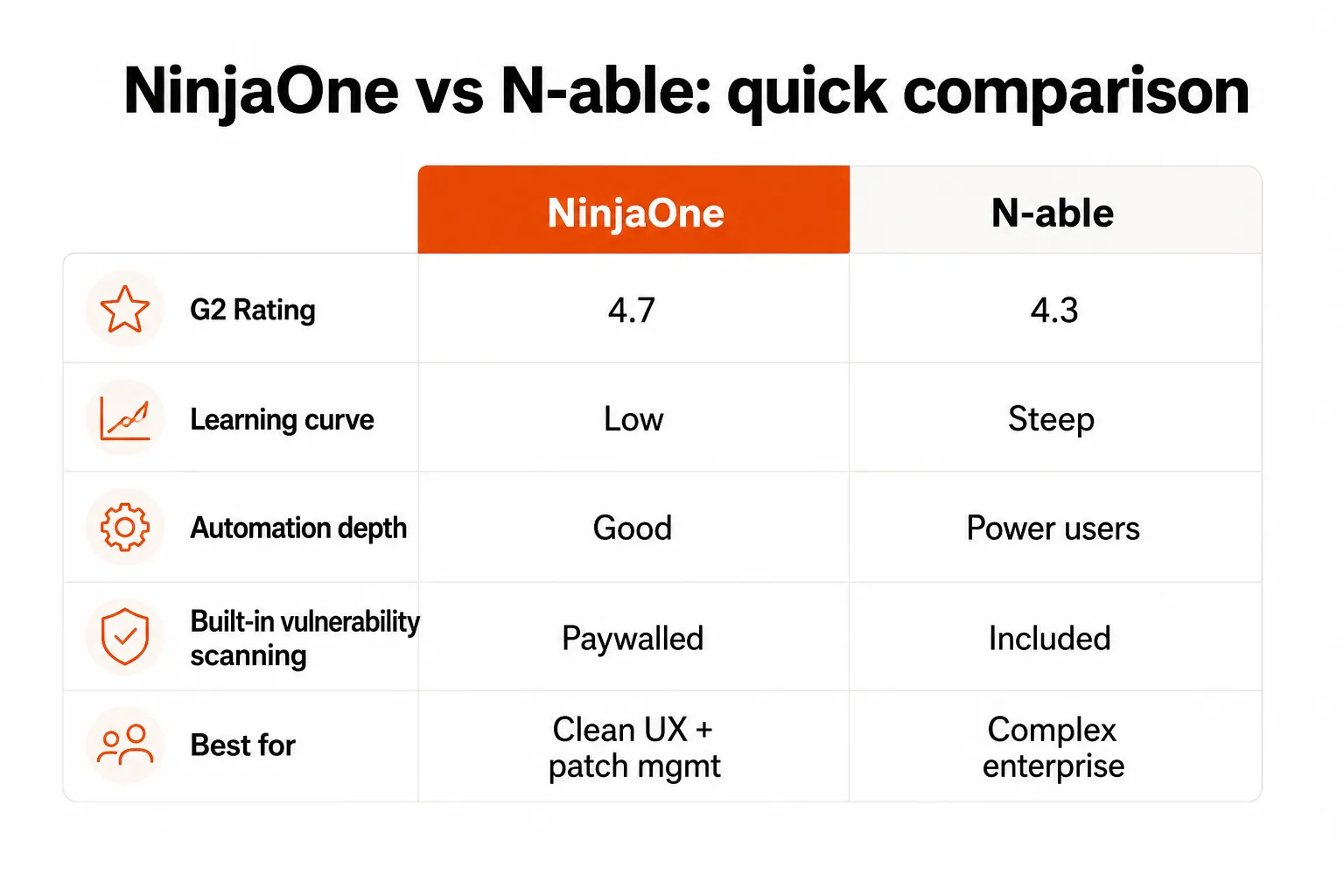
The gap is real. NinjaOne's 4.7 vs. N-able's 4.3 reflects a consistent pattern: NinjaOne users are more likely to recommend the product, and they score it higher on almost every dimension. N-able's community is smaller on G2 but more technically sophisticated - the reviews skew toward power users who appreciate what N-central can do once configured.
Ease of use: NinjaOne by a wide margin
This isn't even close. NinjaOne's 9.3/10 on ease of use is its most consistent score across reviews, and the Reddit community agrees:
"Switched from N-Able and sooooo much happier. NinjaOne patch management is genuinely good." - r/msp
The average NinjaOne deployment is fully operational in under one week. Learning the core features takes about three hours on average. That's not a marketing claim - it tracks with what MSPs report in the field.
N-central is a different animal. G2 reviewers consistently note that the initial setup and policy configuration require significant effort. One user put it well:
"It takes time to learn, particularly for new users. The initial setup and policy configuration may require a bit of effort, but once dialed in, it becomes a highly efficient tool." - G2 review
The G2 average time to implement for N-able is one month, compared to NinjaOne's one week. For a busy MSP bringing on new clients, that difference matters.
Our take: If you're onboarding new techs regularly, or you're an MSP owner who doesn't want to spend six weeks configuring your RMM before it earns its keep, NinjaOne is the default choice. N-central rewards patience - but most MSPs don't have the runway for it.
Patch management: NinjaOne's crown jewel
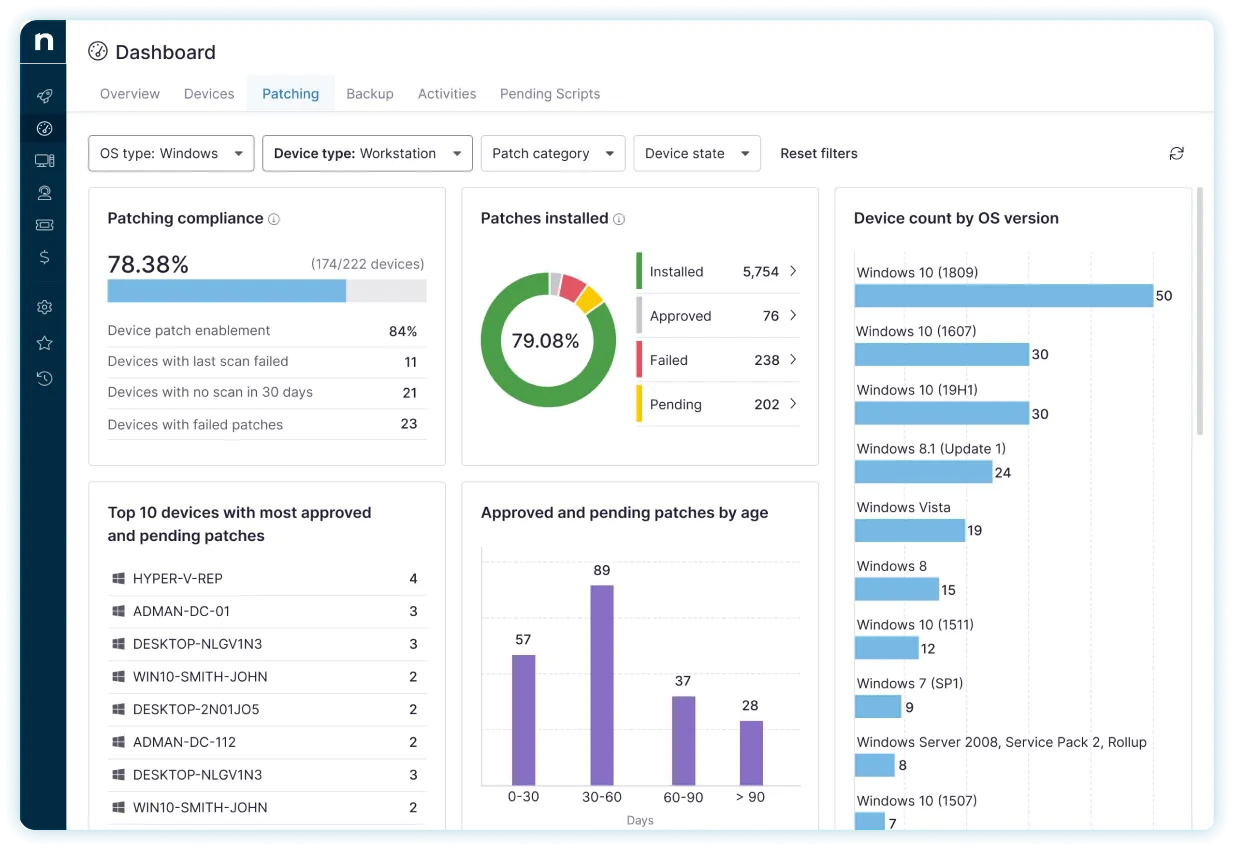
Patch management is where NinjaOne earns its premium positioning. The Patch Intelligence AI analyzes CVE data and community signals before approving updates - so when a Windows KB breaks machines, NinjaOne can flag it before your team deploys it.
The Winget integration for third-party patching gets a lot of praise too, though one security researcher flagged that Winget packages are community-maintained and carry different risk profiles than enterprise-vetted software. Worth knowing before you rely on it for sensitive environments.
One MSP's experience captures the value well:
"Reputation-based patch holds saved us from a bad KB update that bricked machines last fall." - r/msp
N-able N-central has solid patch management - it includes vulnerability scanning in the base platform alongside patching, which NinjaOne doesn't (more on that below). But NinjaOne's Patch Intelligence AI and its 9.1/10 G2 patch management score represent a genuine edge.
Our take: If patch management is your biggest operational headache, NinjaOne is the better choice. It's the main reason power users stick with it despite the premium pricing.
Automation: N-able wins for power users
This is where N-central earns its reputation. The drag-and-drop automation builder, deep scripting support, and policy flexibility are consistently cited as differentiators - particularly for MSPs managing complex, heterogeneous environments.
From the community:
"N-central has a bit of a learning curve but it's a superior platform and a better deal per endpoint w a minimum spend. The birds eye view of..." - r/Nable
"One of my favorite tools is the ability to push policies and tasks, which lets me reboot users' machines when needed. Honestly, this solves about 50% of issues most of the time, often before they even happen." - G2 review
N-central's AI agents (N-zo) go further than NinjaOne's built-in automation. The Product Expert agent answers console questions with source-linked guidance. The Asset Expert handles device-to-user ownership resolution and unencrypted device detection (N-able claims 53% efficiency gains). The Security Expert surfaces CVE priorities and cross-device exposure. These are functional AI features baked into the RMM itself, not a separate product.
NinjaOne has 100+ out-of-the-box automations and a custom workflow builder - solid coverage for most MSPs. But the Reddit community is clear that N-central's automation library has more depth for power users who need to build complex, multi-step workflows.
Our take: For complex environments with 500+ endpoints and a technically sophisticated team, N-central's automation depth is real and worth the learning curve. For most MSPs - especially those under 200 endpoints or without a dedicated RMM admin - NinjaOne's automation is more than enough and far easier to maintain.
Security: N-able includes more in the base product
Here's a concrete trade-off most comparisons bury: NinjaOne paywall's vulnerability scanning. It costs roughly an additional $1.50-$2.50/device/month on top of base pricing - essentially doubling your per-device cost if you need it.
N-central includes vulnerability scanning alongside patch management in the base platform, plus integrated EDR/XDR/MDR options through N-able's security stack.
This is the biggest pricing complaint in the NinjaOne community:
"Vulnerability scanning should not be an upsell. Action1 and Syncro include it free; NinjaOne charges $2/device extra." - r/msp
If your MSP has compliance requirements around vulnerability management - or you're managing healthcare, finance, or government clients - N-central's included posture is a meaningful advantage. NinjaOne counters with an impressive compliance certification stack: FedRAMP Moderate, SOC 2, HIPAA, ISO 27001, GovRAMP, NIS2 - the broadest compliance posture of any RMM. But that doesn't include vuln scanning for free.
Pricing: neither is transparent, both cost real money
NinjaOne publishes its pricing model but not its exact rates by region - you'll need to request a quote. What we know from community data:
| Endpoint count | NinjaOne estimated price/device/month |
|---|---|
| 50 or fewer | ~$3.75 |
| 100-500 | ~$3.00-$3.50 |
| 500-2,000 | ~$2.50-$3.00 |
| 2,000-10,000 | ~$1.75-$2.25 |
| 10,000+ | ~$1.50 |
Add vulnerability scanning: roughly $1.50-$2.50/device/month extra.
Real-world example: 100 endpoints, with vulnerability scanning included - NinjaOne runs approximately $500-$600/month all-in. Atera at the same scale runs approximately $100-$120/month. N-central pricing is quote-only; community data suggests it's competitive per-endpoint at scale, with a minimum spend threshold.
N-central pricing is not publicly available. You contact sales and get a quote. The community consensus is that it's a better per-endpoint deal than NinjaOne at larger scale (1,000+ endpoints), especially for MSPs who want vulnerability scanning included.
From a community member comparing both at ~2,500 nodes:
"N-central is a powerful remote monitoring and management (RMM) platform that stands out for its robust automation capabilities and deep device visibility. It's especially well-suited for MSPs managing complex environments." - G2 review
Our take: NinjaOne's pricing is transparent enough to model, but the vulnerability scanning paywall is a real gotcha. If you're budgeting for a full-featured stack, get the all-in quote before comparing sticker prices.
Scalability and long-term reliability
Both platforms scale well. NinjaOne manages 150,000+ endpoints per deployment and is cloud-native, so there's no infrastructure to manage. N-central has users who have been on the platform for over ten years managing 1,800+ workstations and 500+ servers - that longevity matters.
One pattern that comes up in the N-central community: on-premise deployments at very large scale (12,000+ agents) have had some server instability issues, though N-able has been steadily improving cloud reliability. If you're on the N-able SaaS option, this is less of a concern.
NinjaOne has its own ecosystem concern: the acquisition of DropSuite (backup software) and integration into NinjaOne's pricing was deeply unpopular with existing DropSuite customers, who went from $15-20/month to $200+/month. It's a signal that NinjaOne is moving toward a more integrated (and possibly less open) ecosystem - something to factor in if you value flexibility.
N-central's dashboard advantage
One thing the N-able community consistently praises is the dashboard:
"Currently using ninja but finding favourable pricing and offering from N-Able, dashboard seems better, more informative and allows us to setup tv screens..." - r/msp
The north-south pane layout, asset visibility, and informative device view are cited as superior for MSPs who want a TV-dashboard-style overview. If your NOC operates around a central monitoring screen, N-central's layout may be a genuine advantage.
The thing neither platform does
Here's the angle that most NinjaOne vs N-able content skips over: both platforms are excellent at detecting and alerting. Neither one resolves tickets.
Your RMM tells you that a user is locked out. It logs the alert. It might even open a PSA ticket. But your tech still has to open ConnectWise, find the user, reset the password in Entra ID or Active Directory, verify access, notify the user, and close the ticket. Every time.
Password resets alone account for roughly 18% of L1 ticket volume at a typical MSP. On top of that: account unlocks, permission changes, MFA re-enrollments, mailbox access requests, onboarding. All of it lands on a human technician, regardless of which RMM you're running.
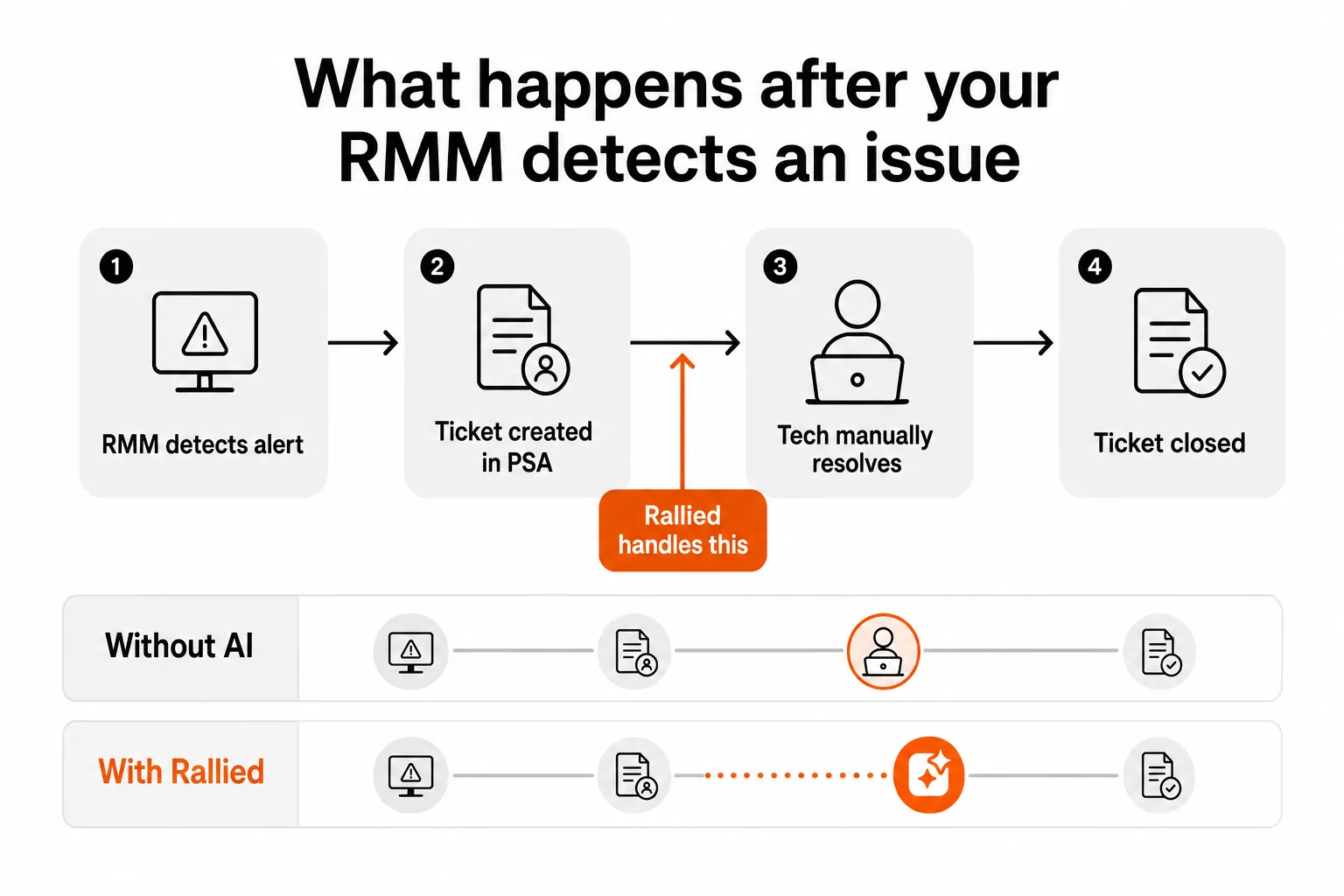
That's the gap Rallied is built to close. It's an AI technician - not an RMM, not a workflow builder - that connects to your PSA, RMM, and identity stack and actually executes L1 tickets end-to-end. When a ticket lands, Rallied reads it, fixes the issue across your stack (resetting the password, unlocking the account, granting the permission), notifies the user, and closes the ticket. No tech touches it.
It integrates natively with both NinjaOne and N-able, as well as Datto RMM, ConnectWise Automate, Atera, and Kaseya - so whichever RMM you pick, you can layer Rallied on top to handle the work the RMM detects but doesn't resolve.
Who picks which
Pick NinjaOne if:
- You want the most intuitive UX in the category - 9.3/10 on G2 for ease of use
- Patch management is a priority (Patch Intelligence AI, 9.1/10 on G2 for patching)
- You want to be operational in under a week - most deployments are live in under 7 days
- You have government or healthcare clients and need FedRAMP/HIPAA/GovRAMP compliance
- You're a growing MSP without a dedicated RMM admin on staff
Pick N-able N-central if:
- Your team has the technical depth to configure it - and will benefit from the power once they do
- You're managing 500+ endpoints across complex, multi-site environments
- You want vulnerability scanning included without paying extra per device
- You need deep, customizable automation and scripting for edge-case workflows
- You run a NOC and want the dashboard visibility of the north-south pane layout
Our take: NinjaOne is the right default for most MSPs. It's faster to deploy, easier to maintain, and the patch management is genuinely best-in-class. N-central wins on automation depth for the MSPs who will actually use it - but that's a smaller audience than N-able's marketing suggests.
Try Rallied
Whichever RMM you choose, the tickets still land on your technicians. Rallied is the AI technician that handles what your RMM detects - reading each ticket, executing the fix across your PSA and identity stack, and closing it before a human ever opens it.
Password resets, account unlocks, permission changes, onboarding and offboarding - all at $3 per ticket outcome, with a $150/month minimum, no lock-in contract, deployed the same week. For an MSP running 200-400 tickets per month with 40-60% L1 volume, the math works out to roughly $450/month for work that would otherwise cost over $1,000 in tech time.
It connects natively to NinjaOne, N-able, Datto RMM, ConnectWise, Autotask, HaloPSA, Entra ID, Okta, JumpCloud, IT Glue, and Hudu. Your senior engineers stay on billable projects. The L1 grind goes to Rallied.
Frequently Asked Questions
Is NinjaOne better than N-able for MSPs?
It depends on what you need. NinjaOne is better for MSPs who want the cleanest UX, the best autonomous patch management, and fast deployment (typically one week). N-able N-central is better for power users managing complex, multi-site environments at scale - once you're past the steeper learning curve, the automation depth is hard to match. Both are strong tools; the choice comes down to your team's technical appetite and what you stress about most.
How much does NinjaOne cost compared to N-able?
NinjaOne uses per-device pricing starting at $3.75/device/month for 50 or fewer endpoints, dropping to $1.50/device/month at 10,000+ endpoints. N-able N-central pricing is not publicly listed - you need to request a quote. One practical note: NinjaOne charges extra for vulnerability scanning (roughly doubling per-device cost), while N-able includes it in the base platform. Always get an all-in quote before comparing.
What is the main difference between NinjaOne and N-able N-central?
The main difference is complexity vs. polish. NinjaOne is the more approachable platform - rated 9.3/10 on G2 for ease of use, operational in under a week, with industry-leading patch management. N-able N-central is the more powerful platform - deeper scripting, broader automation capabilities, and embedded AI agents (N-zo) - but it has a steeper learning curve and typically takes around a month to implement properly.
Does NinjaOne or N-able handle ticket resolution automatically?
Neither platform resolves tickets autonomously. Both are RMM tools - they monitor and alert, and they can run scripts and automations. But the actual ticket-level work (password resets, account unlocks, permission changes, onboarding) still requires a human technician to act on the alert. Tools like Rallied sit on top of your RMM and PSA to actually execute that work end-to-end - reading the ticket, making the change, notifying the user, and closing it.
Can I use Rallied with NinjaOne or N-able?
Yes - Rallied integrates natively with both NinjaOne and N-able (as well as Datto RMM, ConnectWise Automate, Atera, and Kaseya). It connects to your RMM for endpoint actions and to your PSA for ticket context, then resolves L1 tickets end-to-end: password resets, account unlocks, permission changes, onboarding and offboarding. Pricing is $3 per ticket outcome with a $150/month minimum and no lock-in contract.