What is agentic AI for MSPs?
TL;DR
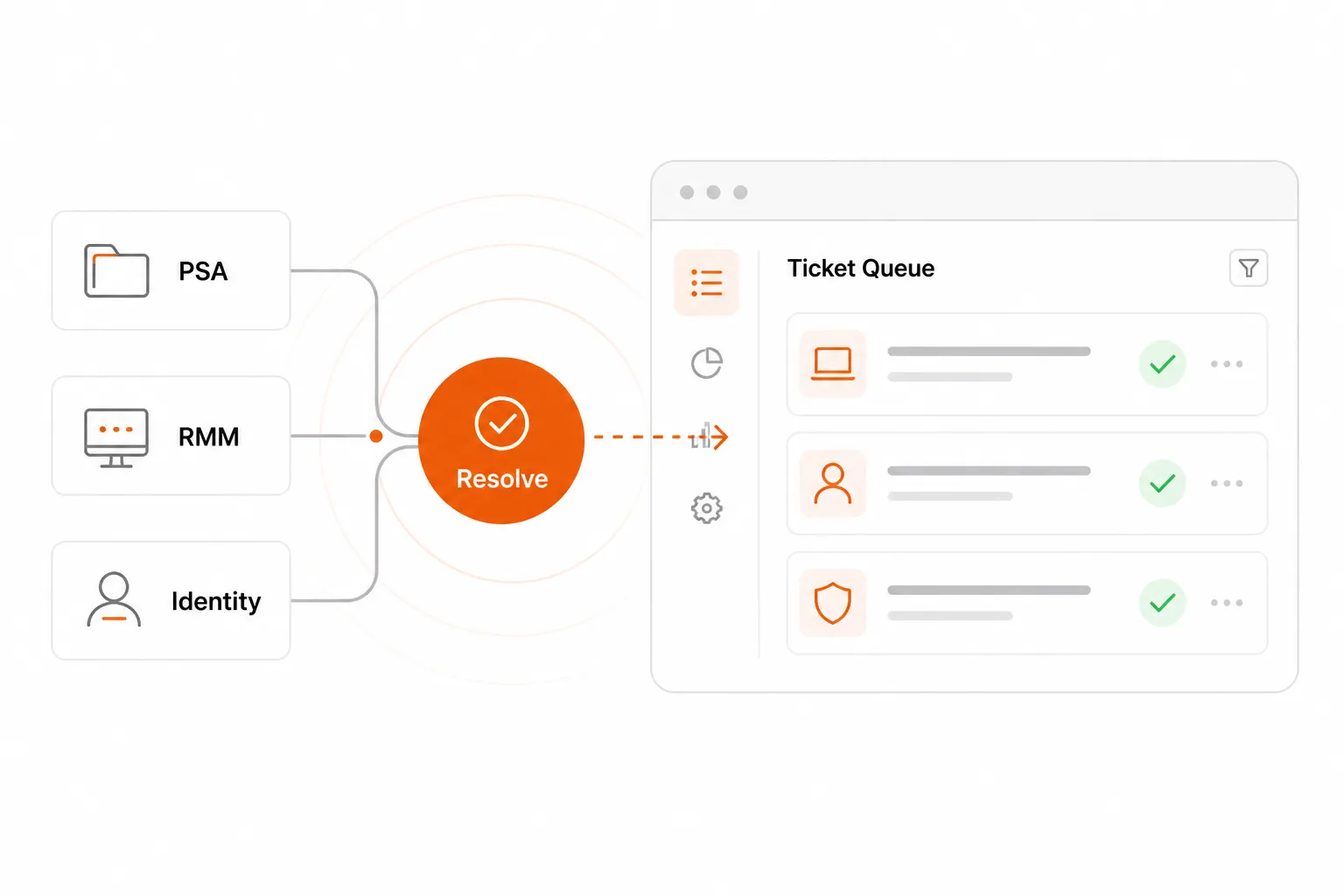
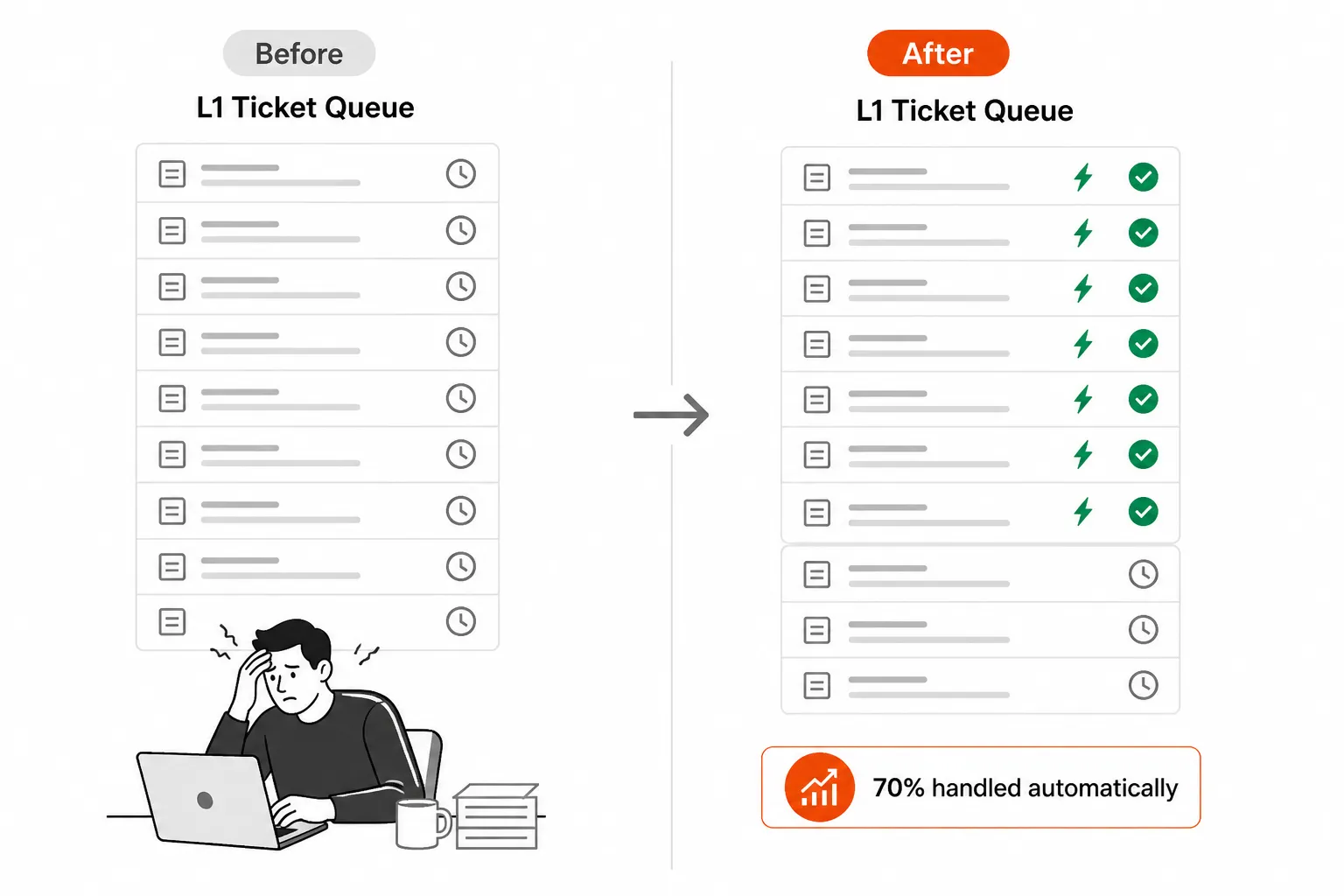
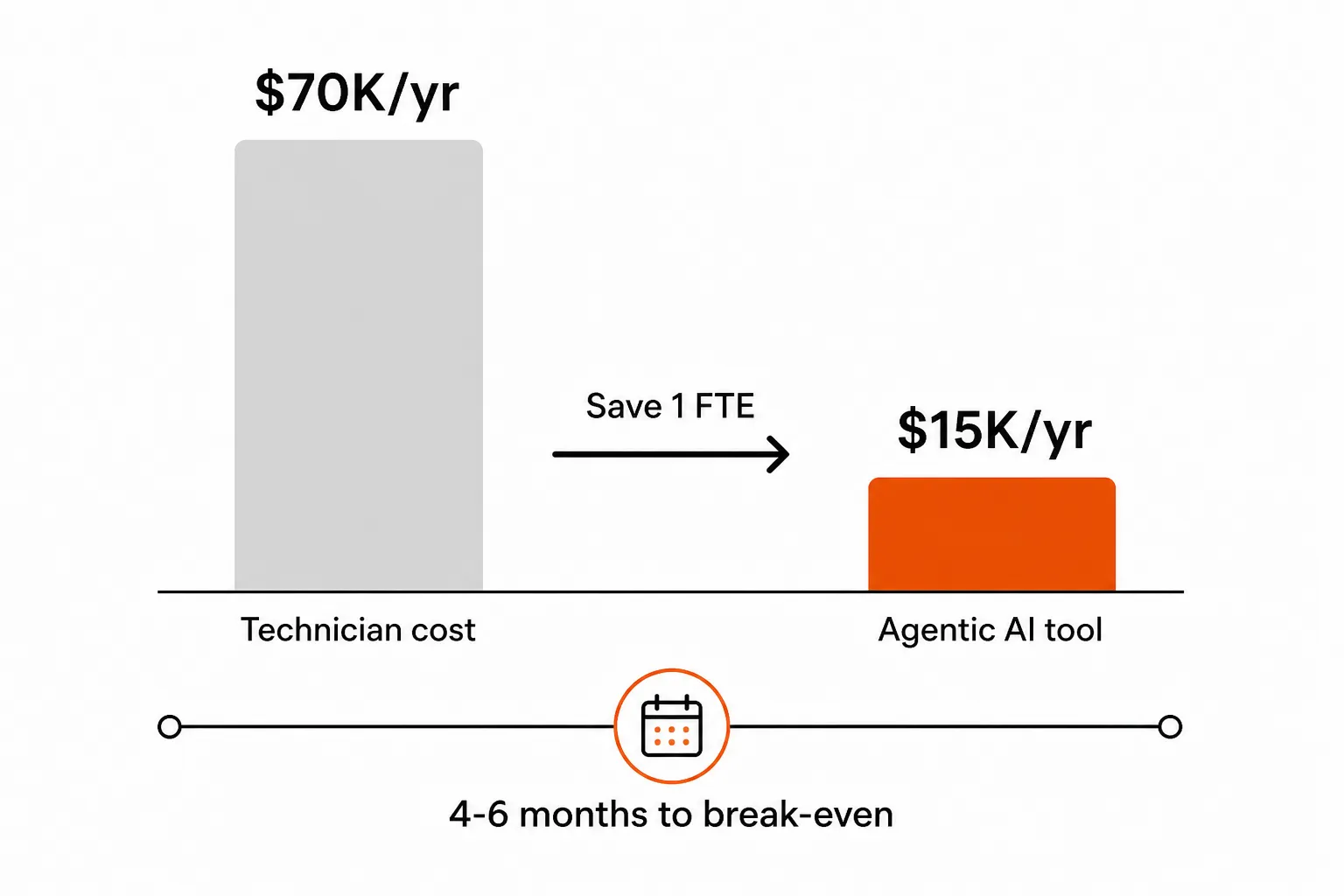
Agentic AI for MSPs is the step past copilots and RPA: software that actually resolves L1 tickets on its own - password resets, account unlocks, user onboarding, alert triage - by reasoning about context and acting in your PSA, RMM, and identity systems without a human in the loop. The honest numbers: expect 30–40% ticket deflation (not the 60% vendors claim), break-even in 4–6 months, and 8–16 weeks of real deployment work (not the 4-week happy path). The economics are real for MSPs at scale. The question is whether your stack and ticket volume are in the range where the math works - and whether your vendor of choice actually executes rather than just suggesting.
What "agentic" actually means
The word gets thrown around a lot. It's worth pinning down what it means in practice, because the distinction changes the whole value calculation.
Most AI tools in the MSP space are one of two things: copilots that suggest ("here's how I'd respond to this ticket") or RPA workflows that execute rigid scripts ("if ticket type = password reset, run steps 1–5"). Both are useful. Neither is agentic.
Agentic AI does something different: it observes the situation, gathers context from multiple systems, reasons about what the right action is, and then takes that action - without a human approving each step.
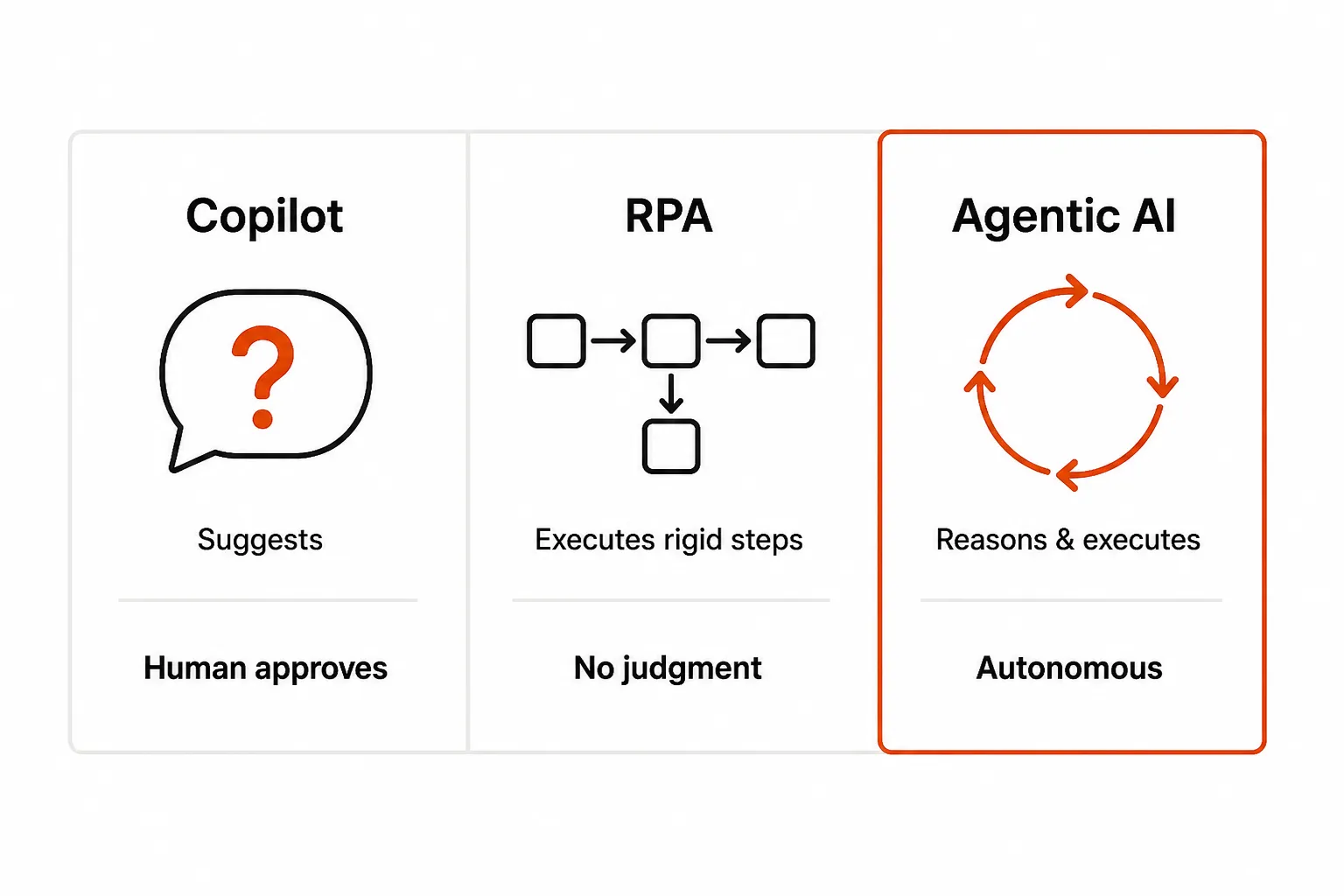
Here's what that looks like on a real ticket. A user submits "Can't login." An RPA workflow would need a branching script for every possible cause: forgotten password? locked account? MFA misconfiguration? Suspended subscription? You need a separate flow for each. A copilot might suggest the right troubleshooting steps. An agentic AI checks the user's account state against Entra ID, sees it's a standard lockout after failed attempts with no fraud signals, unlocks the account and sends the user a reset link - then closes the ticket. No human required.
The key word is judgment. Agentic AI reasons under ambiguity. RPA executes under certainty. For MSP support - where real tickets are messy and "can't login" could mean a dozen different things - that distinction matters.
Anthropic's research on building effective agents describes this well: effective agents "perceive context, plan actions, and use tools to take actions" rather than following predetermined paths. The MSP implementation of this is an AI that can query your PSA, pull from your RMM data, check identity systems, and make a judgment call about what to do next.
Why MSPs are the right target
Agentic AI isn't uniformly valuable across all support contexts. MSPs happen to be almost perfectly positioned for it. A few reasons:
The ticket mix is highly automatable. Across most MSPs, 40–50% of L1 tickets are password resets, account unlocks, basic software installs, and MFA issues. These don't require judgment calls about edge cases - they require fast, accurate execution. That's exactly where agentic AI outperforms humans: it's faster (2–3 minutes vs. 15–30 for a human technician), available 24/7, and doesn't get burned out on repetitive tasks.
Technician labor is expensive and scarce. A fully-loaded L1 technician runs $40–55/hour. Technical staff turnover in the MSP space averages 25–35% annually in competitive markets, and you're competing for that talent against cloud vendors with much larger budgets. Any tool that lets your existing team spend less time on password resets and more time on actual troubleshooting pays for itself quickly.
The integration layer is already there. MSPs are, by definition, running ConnectWise or Autotask, Datto or NinjaRMM, M365, Entra ID or Okta or JumpCloud. The infrastructure agentic AI needs to actually do things - ticket APIs, identity APIs, device management APIs - already exists. This is why MSPs see faster ROI than, say, an enterprise IT department that might have none of this standardized.
SLA pressure is constant. 24/7 coverage expectations are standard in MSP contracts but expensive to staff for. Agentic AI that can resolve routine tickets at 2am without paging a technician has real dollar value in SLA compliance.
What it actually handles
The use cases that work reliably in production break down into a few clear buckets.
Password resets and account unlocks
This is the bread-and-butter use case - and for good reason. Password resets alone account for 20–30% of L1 tickets at most MSPs. The resolution flow is well-defined, the identity integrations are mature, and the accuracy rate for agentic AI is high (90%+ on standard lockouts).
A mature agentic AI deployment on a lockout ticket looks like: check account state in Entra ID or Okta, verify no fraud signals (unusual IP, suspicious timing, prior escalations), unlock the account, trigger a password reset notification, close the ticket, and log everything for the audit trail. Two to three minutes from submission to resolution.
The one place practitioners get burned: agentic AI that doesn't check why an account was locked. A compliance hold is not a standard lockout. The platforms that handle this well have configurable guardrails - "never unlock accounts with a hold flag without human approval" - built into the agent behavior.
User onboarding and offboarding
Onboarding and offboarding are high-value, high-repetition, error-prone. The typical manual process - create email, set permissions, provision apps, send welcome kit, notify manager - takes 3–4 hours when done carefully. Done carelessly, you get stranded licenses, incomplete access, or (worse on offboarding) accounts that stay active after someone leaves.
Agentic AI handles this by connecting to the HR trigger (new user in Active Directory, or termination date in your HRIS), pulling the onboarding template for the user's role from your documentation, and executing the provisioning sequence. For offboarding: disable account, revoke licenses, archive email, offboard connected applications - with a completion checklist sent to the manager.
Real-world: 4 hours down to 15 minutes per user, with more consistent output than the manual process.
L1 triage and escalation
The trickier use case - and where the 30–40% vs. 60% deflection gap opens up. Agentic AI is good at recognizing known issues and resolving or escalating them with context. "Can't access file server" is a known pattern. "Application crashes when opening a specific attachment" requires actual troubleshooting that current agentic AI doesn't handle reliably.
The right mental model: think of agentic AI as a very capable, very fast L1 junior technician who's excellent at documented procedures but shouldn't be trusted with novel problems. They resolve the ones they can, and escalate the ones they can't - but they escalate with full context (account state, recent changes, ticket history, attempted resolution steps), so the human picking it up isn't starting from scratch.
Alert triage
Monitoring alerts flood MSP queues. Most are false positives or already-handled issues by the time a human sees them. Agentic AI that can cross-reference an alert against recent ticket history, check whether the trigger condition already resolved, and auto-close the false positive - or auto-remediate known patterns (clear cache for disk space alerts, restart a known flaky service) - reduces alert noise significantly. Practitioners report 70%+ reduction in alerts requiring human review.
The honest ROI math
Vendor claims on ticket deflection run 50–60%. What practitioners actually report on r/msp is closer to 30–40%. The gap is real and worth understanding before you sign anything.
Here's a realistic model for a 100-person MSP handling 1,000 tickets/month:
| Metric | Vendor claim | Realistic |
|---|---|---|
| Ticket deflection rate | 50–60% | 30–40% |
| Tickets resolved autonomously | 500–600/mo | 300–400/mo |
| Avg. resolution time saved | 15 min/ticket | 15 min/ticket |
| Monthly hours saved | 125–150 hrs | 75–100 hrs |
| Value at $45/hr fully loaded | $5,600–$6,750/mo | $3,375–$4,500/mo |
| Tool cost | $500–$2K/mo | $500–$2K/mo |
| Break-even | ~2–4 months | ~4–8 months |
The math still works - but it works better at scale. An MSP under 50 people with under 500 tickets per month is going to have a harder time justifying the overhead of integration and ongoing tuning. At 100+ people with 1,000+ tickets, the economics are solid.
One r/msp thread put it plainly:
"$2K/month tool saves us 1.5 FTE in a 100-person MSP. That's $7K/month we're not paying in salary. ROI is real. But only works at scale - if you're under 50 people, probably not worth it."
That's the calibration most MSPs land on after a year of deployment.
What deployment actually looks like
Vendor marketing says 4–8 weeks. Real-world practitioners say 8–16 weeks is more accurate, and here's why.
The 4-week timeline assumes: your PSA is clean, your identity setup is standardized, you have documentation in a format the AI can use, and you're only starting with password resets. That's the happy path.
The real path involves: PSA integration with your ticket routing rules, RMM integration for device-level automation, identity setup across Entra ID (and possibly Okta and/or JumpCloud if you have mixed environments), configuring intent matching so the AI knows a "can't login" ticket is different from a "can't access network drive" ticket, and setting up escalation guardrails. Then testing against real ticket patterns before you go live.
"Rewst integrates well with ConnectWise, but getting it to talk to our on-prem stuff was a nightmare. 12 weeks of setup. Vendor says 4–8 weeks, but that's the happy path." - r/msp practitioner
What makes this go faster: standardized identity (single IdP rather than mixed), clean PSA ticket categorization, and an MSP-native platform that doesn't need you to explain what a ConnectWise ticket is.
What to look for in a platform
A few things separate the platforms that hold up from the ones that disappoint.
Execution depth, not just automation breadth. Some platforms give you a workflow builder and call it agentic AI. The question to ask: does it actually connect to Entra ID, Okta, or JumpCloud and take action there, or does it create a ticket for your tech to do the action? The latter is not L1 automation - it's just better triage.
Human-in-the-loop options for sensitive actions. Full autonomy on security-adjacent decisions is a liability. Good platforms let you configure: "auto-resolve standard lockouts, but require human approval before unlocking accounts with a compliance hold or suspicious login pattern." That distinction is what makes the compliance conversation with enterprise clients go smoothly.
Audit trails on everything. Every action the AI takes should be logged - what it did, why, when, what systems it touched. This matters for compliance and for debugging when something goes wrong.
MSP-native integrations. ConnectWise, Autotask, and Halo PSA. Datto and NinjaRMM. Entra ID, Okta, JumpCloud, Google Workspace. These are table stakes. A platform missing even one of your primary tools creates gaps that require workarounds, and workarounds are where things go wrong.
Speed to live. Not the happy-path marketing number - ask for references from MSPs of similar size and complexity and find out how long it actually took.
Try Rallied
Rallied is an AI technician built for exactly this: autonomous L1 resolution for MSPs, deployed in the same week without the workflow-builder overhead.
Where it differs from platforms like Rewst: Rallied doesn't ask you to build workflows. The agent connects to your PSA (ConnectWise, Autotask, Halo PSA, SuperOps), your RMM (Datto, NinjaRMM), your identity layer (Entra ID, Okta, JumpCloud, Google Workspace), and your documentation (IT Glue, Hudu) - and starts handling tickets from there. No visual builder, no dedicated implementation consultant, no six-month runway before you see deflection.
Pricing is $0.50 per ticket worked - $250/month at 500 tickets, $500/month at 1,000 - with a 14-day trial and $50 in credit, no card required. The economics are designed to align with yours: you pay per ticket handled, not a flat platform fee regardless of utilization.
For MSPs who've been burned by AI tools that promised execution and delivered suggestions - Rallied's pitch is that it actually does the work.
Frequently Asked Questions
What is agentic AI for MSPs?
Agentic AI for MSPs is autonomous AI software that resolves IT support tickets without human intervention - handling tasks like password resets, account unlocks, user onboarding, and basic triage by reasoning about context and executing actions directly in your PSA, RMM, and identity systems. Unlike copilots (which suggest next steps) or RPA (which follows rigid scripts), agentic AI adapts to the situation and takes action on its own. Tools like Rallied are built specifically for this use case.
How much ticket deflection can MSPs realistically expect from agentic AI?
Vendor claims typically run 50–60% ticket deflection. Real-world MSP practitioners on communities like r/msp report 30–40% is more accurate for most deployments, depending on how routine your ticket mix is and how well integrated the platform is with your stack. Password resets and account unlocks - which often make up 20–30% of L1 volume on their own - are where agentic AI performs most reliably.
How long does it take to deploy agentic AI in an MSP?
Vendor marketing often says 4–8 weeks, but practitioners report 8–16 weeks is more typical once you factor in PSA and RMM integration, identity system setup (Entra ID, Okta, JumpCloud), configuring escalation rules, and testing against real ticket patterns. Tools that deploy faster tend to be narrower in scope; broader platforms take longer but handle more. Setting realistic expectations with your team before you start saves a lot of frustration.
Is agentic AI safe to use for access and identity management?
Safety is the legitimate concern most MSPs raise. The tools that hold up under scrutiny are the ones that offer human-in-the-loop approvals for sensitive actions (unlocking a flagged account, offboarding a user), complete audit trails on every action taken, and configurable guardrails for compliance requirements. Agentic AI should never be fully autonomous on security-adjacent decisions without those safeguards in place.
What's the ROI math for agentic AI at an MSP?
A typical 50–100 person MSP handling 500–2,000 tickets per month can realistically automate 30–40% of L1 volume with agentic AI. At 15 minutes per ticket and a fully-loaded technician cost of $40–55/hour, that works out to roughly $7K–$15K/month in recovered technician time. Tool costs for most MSP-scale platforms run $500–$2,000/month - making break-even achievable in 4–6 months for MSPs with sufficient ticket volume. Rallied's pricing starts at $250/month for 500 tickets ($0.50/ticket).