Best ConnectWise Alternatives for MSPs in 2026
ConnectWise has been the default choice for MSPs for years. But "default" doesn't mean "best." If you're tired of wrestling with a clunky interface, waiting days for support responses, or trying to decode opaque pricing, you're not alone.
The good news? You have options. Real options. In 2026, the MSP software market has matured enough that several alternatives can match ConnectWise on features while delivering a better day-to-day experience.
This guide compares seven alternatives worth your consideration. Each one solves a specific pain point that drives MSPs away from ConnectWise. Some prioritize ease of use. Others focus on transparent pricing. A few are betting everything on AI. Let's break down which one fits your situation.
What to look for in ConnectWise alternatives
Before diving into the list, let's establish the criteria. When MSPs leave ConnectWise, they typically cite four complaints we hear often from teams evaluating RMM automation:
- Complexity: Steep learning curves that require dedicated administrators
- Support: Slow responses and tiered support that gates help behind expensive plans
- Pricing: Opaque models with hidden fees and auto-renewing contracts
- Performance: Slow agents, unreliable patching, or limited cross-platform support
The alternatives below address at least one of these directly. Some address all four.
Here's a quick comparison before we dive into the details:
| Alternative | Best For | Pricing Model | Free Trial | Key Strength | Key Weakness |
|---|---|---|---|---|---|
| NinjaOne | Fast, reliable RMM | Per-device (custom) | 14 days | Fastest agent, #1 support | No built-in PSA |
| Atera | Predictable costs | Per-tech ($149-$209) | 30 days | Built-in Splashtop, AI-first | Support inconsistencies |
| Syncro | Unified platform | Per-tech (custom) | 14 days | Security + RMM + PSA | UI feels pieced together |
| HaloPSA | PSA-first MSPs | Per-tech (~$62-$112) | Available | 100+ integrations | Requires separate RMM |
| SuperOps | Modern UX lovers | Per-tech or per-endpoint | Available | Transparent pricing, AI | Newer player, smaller ecosystem |
| Datto RMM | Cloud-native security | Custom quotes | Demo | Ransomware detection | No mobile app |
| N-able N-central | Enterprise scale | Custom quotes | Available | Gartner-recognized | Steep learning curve |
1. NinjaOne
NinjaOne has held the top spot on G2 for RMM for years. The pitch is simple: fast agent, clean interface, excellent support. No bloat.
The agent lives up to the hype. Users consistently report it feels "lean" compared to ConnectWise's resource-heavy footprint. Cross-platform support is genuine (Windows, macOS, and Linux), not an afterthought. Patching works reliably across all three.
Where NinjaOne differs from ConnectWise is its philosophy. ConnectWise tries to be everything at once. NinjaOne focuses on doing RMM exceptionally well. That means no built-in PSA. You'll need to integrate with a separate PSA (ServiceNow, Autotask, Zendesk) if you want unified workflows.
Pricing requires contacting sales. No public pricing page means you'll need to negotiate. The 14-day free trial lets you test the agent performance yourself.
Best for: MSPs who want the fastest, most reliable RMM and don't mind integrating with a separate PSA.
Pros:
- Fastest agent in the category
- Free unlimited training for all customers
- Transparent public roadmap
- Consistently rated #1 for customer support
Cons:
- No built-in PSA (requires integration)
- Pricing not publicly available
- Less suited for enterprises needing deep customization
2. Atera
Atera takes a different approach: per-technician pricing instead of per-device. For MSPs managing hundreds or thousands of endpoints, this can mean significant cost savings.
The platform is genuinely all-in-one. RMM, PSA, ticketing, and remote access (via built-in Splashtop) live in the same interface. No juggling separate licenses for remote support.
Atera has gone all-in on AI. Their AI Copilot assists with ticket resolution, auto-remediation handles common issues without human intervention, and smart ticketing categorizes incoming requests automatically. Whether this is a genuine productivity boost or marketing fluff depends on your workflow. If you're evaluating AI tools for your MSP, see our analysis of MSP AI in 2026.
Pricing is public and straightforward: $149 per technician/month for Pro, $189 for Growth, $209 for Power. The 30-day free trial is longer than most competitors offer.
Support gets mixed reviews. Some users praise responsiveness. Others report tickets sitting unanswered. The disparity suggests consistency issues that ConnectWise refugees should watch for.
Best for: Small-to-mid MSPs wanting predictable costs and an all-in-one platform with modern AI features.
Pros:
- Per-technician pricing scales predictably
- Built-in Splashtop (no separate remote access tool)
- 30-day free trial
- Strong mobile apps for iOS and Android
Cons:
- Support quality varies by user reports
- Limited enterprise integrations compared to larger competitors
- Third-party patching can be finicky
3. Syncro
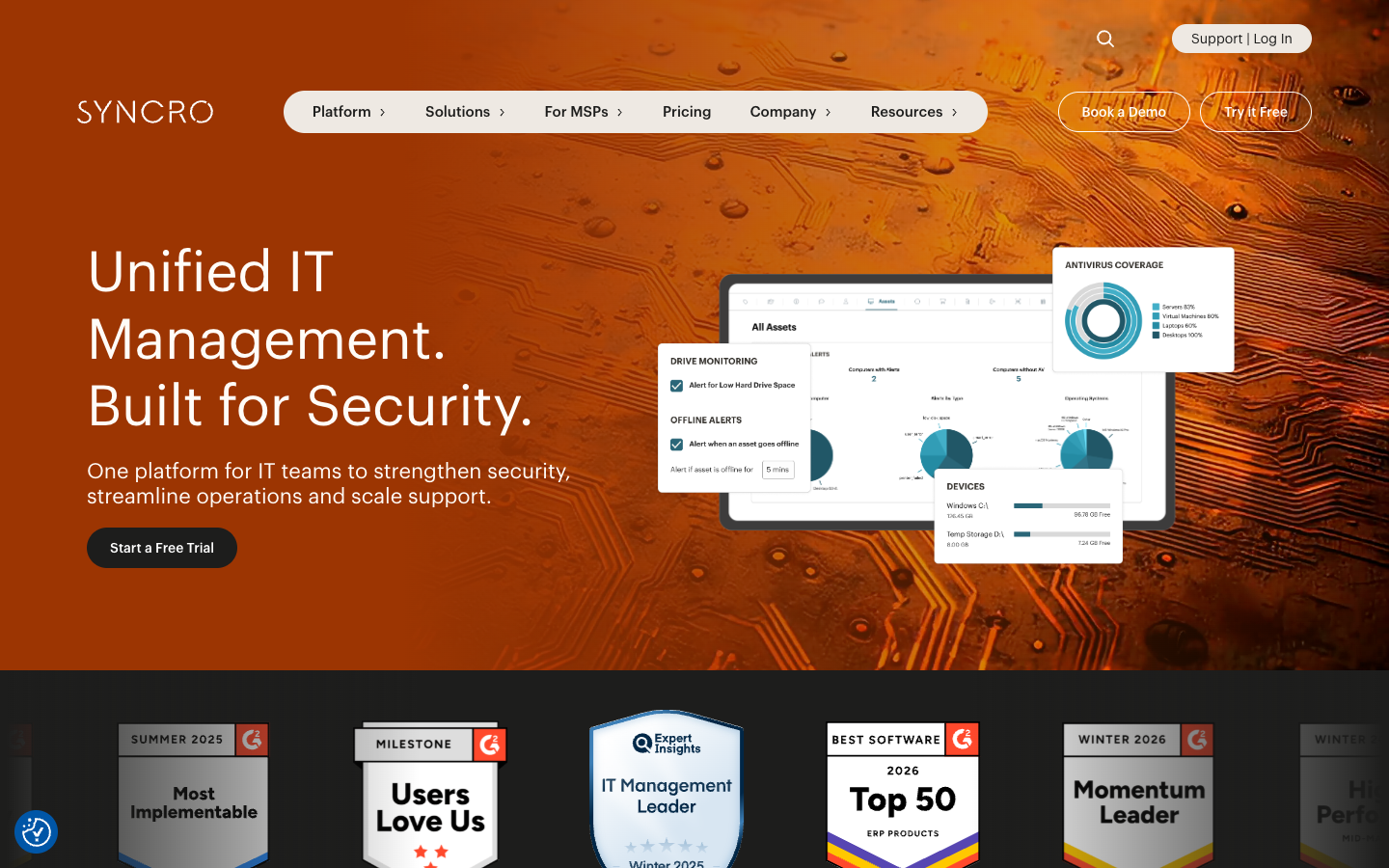
Syncro positions itself as the unified platform for IT management and security operations. RMM, PSA, and security features share one interface and one database.
The security angle is the differentiator. While most RMMs focus on monitoring and patching, Syncro builds security operations into the core workflow. This matters for MSPs navigating compliance requirements or offering security services to clients.
The platform includes ticketing, invoicing, CRM, scripting, patch management, and Microsoft 365 management. Accounting integrations with QuickBooks and Xero are solid.
User feedback on Syncro's support is consistently positive. The community describes it as responsive and technically competent. That's notable in an industry where support quality often separates good vendors from bad ones.
Pricing requires contacting sales. Like ConnectWise, there's no public pricing page. The 14-day trial gives you time to evaluate the unified workflow.
Best for: Small MSPs wanting a unified platform with built-in security operations and strong accounting integrations.
Pros:
- Security operations built-in, not bolted-on
- Good support reputation
- Unified RMM + PSA + security
- Strong QuickBooks/Xero integration
Cons:
- UI described by some users as "welded together"
- Limited advanced automation compared to enterprise tools
- No public pricing
4. HaloPSA
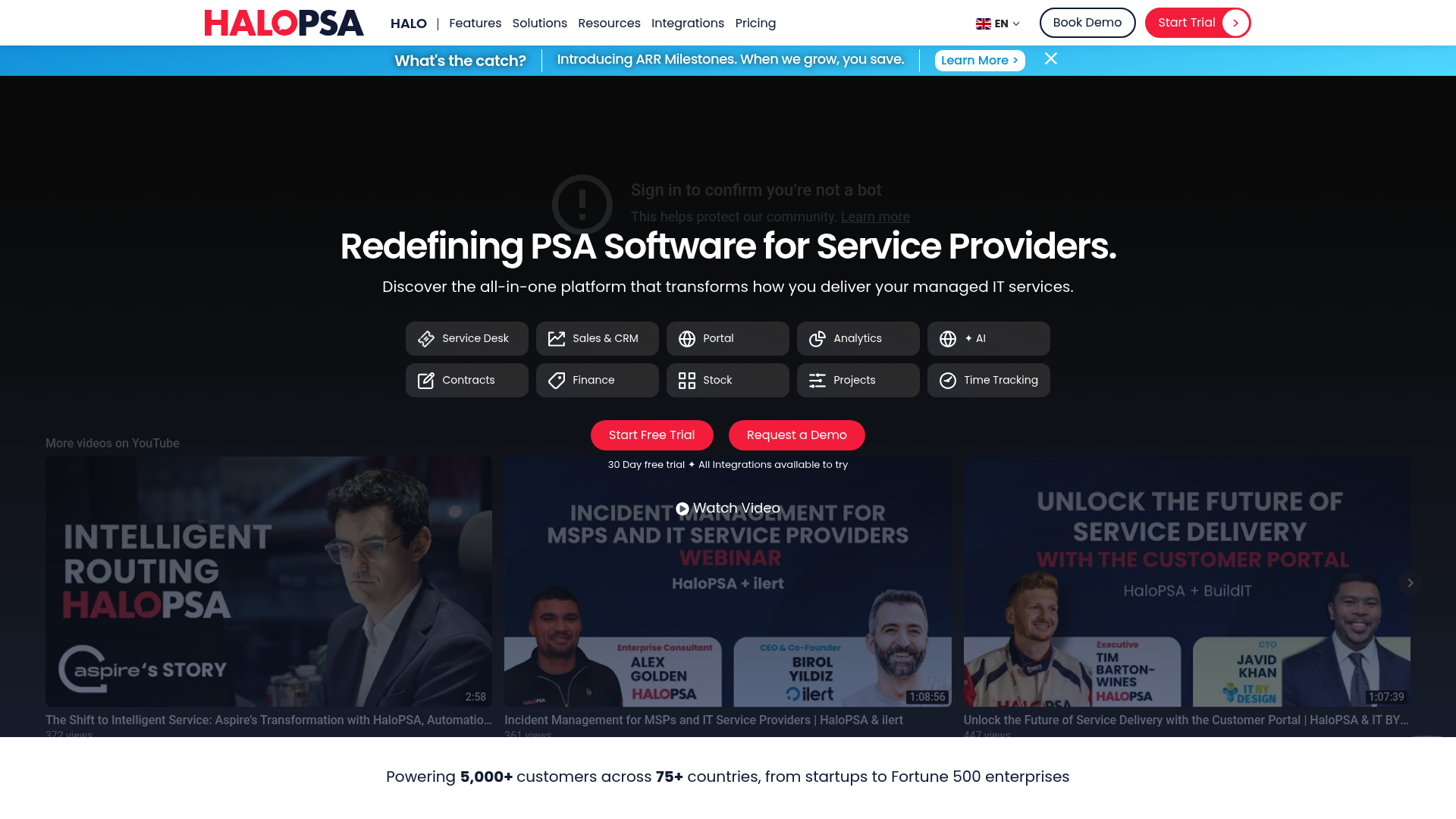
HaloPSA is the PSA-focused alternative. While others on this list lead with RMM, HaloPSA leads with service desk, ticketing, CRM, and project management. The RMM is an integration, not a native feature.
With 5,000+ customers across 75+ countries, HaloPSA has proven traction. The platform covers service desk, sales, projects, contracts, billing, stock management, time tracking, and reporting. The 100+ integrations include Slack, Xero, Jira, Salesforce, and Outlook.
Migration from ConnectWise is designed to be straightforward. CSV imports handle most data transfer. For MSPs dreading the migration project, this matters.
Independent ratings back up the claims. "HaloPSA scores 4.8/5 overall capability versus ConnectWise's 4.1/5 on Capterra. Customer service scores 4.9/5 versus ConnectWise's 3.7/5."
Pricing is tiered: approximately $62-$112 per user/month depending on the plan (prices shown in GBP). Annual billing offers discounts.
Best for: MSPs prioritizing PSA functionality, service desk excellence, and easy migration from ConnectWise.
Pros:
- PSA-first design with deep functionality
- 100+ integrations
- Designed for easy ConnectWise migration
- Higher user satisfaction scores than ConnectWise
Cons:
- Requires separate RMM integration
- Learning curve for advanced features
- UK-based (pricing in GBP)
5. SuperOps
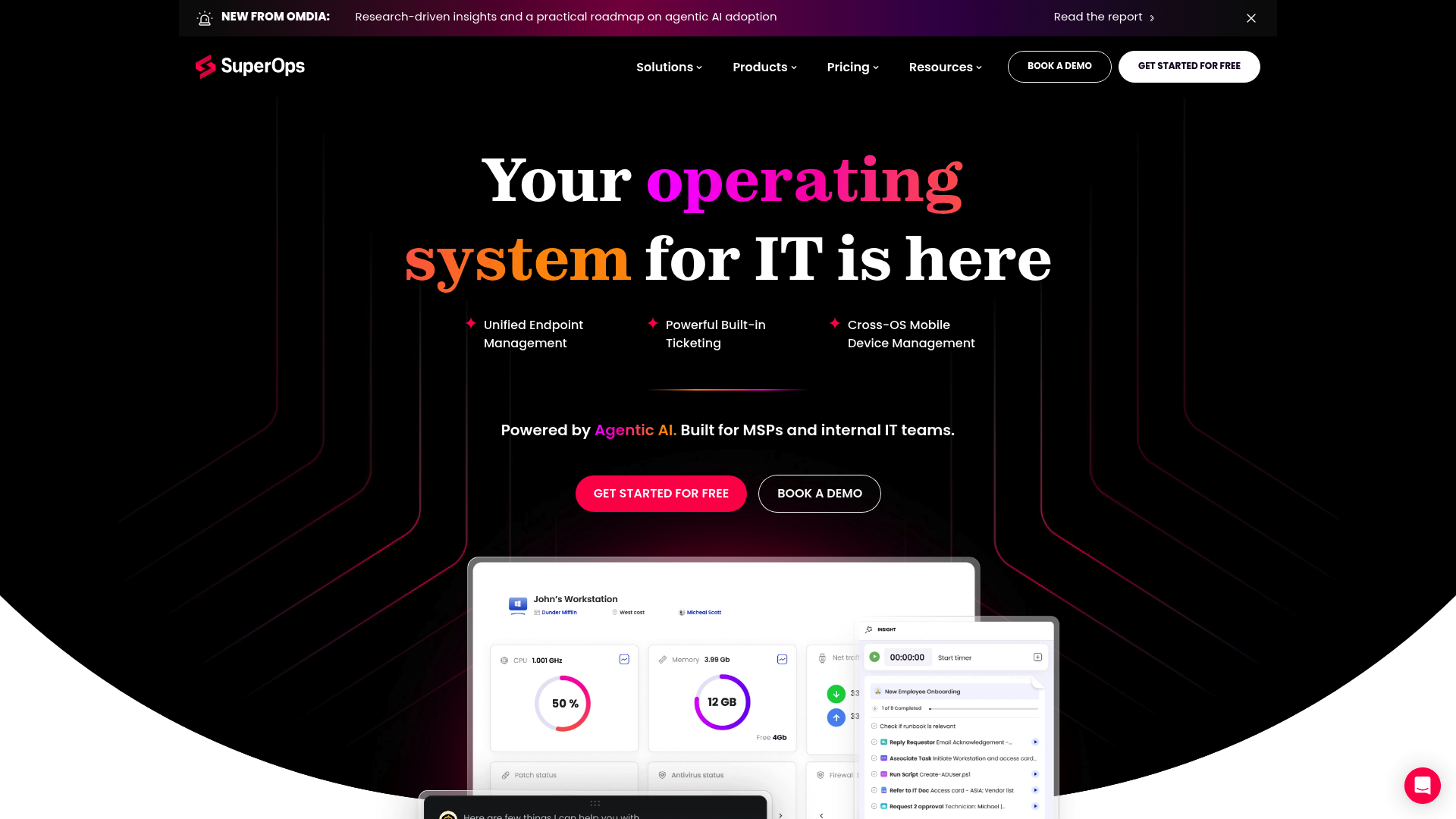
SuperOps is the challenger brand. Founded in 2026, it has no legacy baggage. The platform was built for modern MSPs who want AI assistance, transparent pricing, and an interface that doesn't feel like it was designed in 2008.
The transparency starts with pricing. Unlike most competitors hiding behind "contact sales," SuperOps displays pricing publicly. Plans range from $89/technician/month for PSA-only to $179/technician/month for the full Super plan with 150 endpoints per technician. There's also a per-endpoint model for larger deployments.
Monica AI is SuperOps' assistant. It helps with ticket resolution, suggests automations, and learns from your team's patterns. The AI is included in Super and Super Plus plans, not a pricey add-on.
"The comparison scores tell the story. SuperOps rates 9.9/10 for quality of support versus ConnectWise's 7.4. Ease of use scores 9.3/10 versus ConnectWise's 7.2."
The tradeoff is ecosystem maturity. As a newer player, SuperOps has fewer third-party integrations and a smaller community. For MSPs heavily invested in niche tools, this could be a blocker.
Best for: MSPs wanting modern UX, transparent pricing, and AI features without enterprise complexity.
Pros:
- Public, transparent pricing
- 9.9/10 support quality rating
- Monica AI included in higher tiers
- Modern, intuitive interface
Cons:
- Newer player with smaller ecosystem
- Endpoint limits on per-tech plans (150/technician)
- Fewer integrations than established competitors
6. Datto RMM
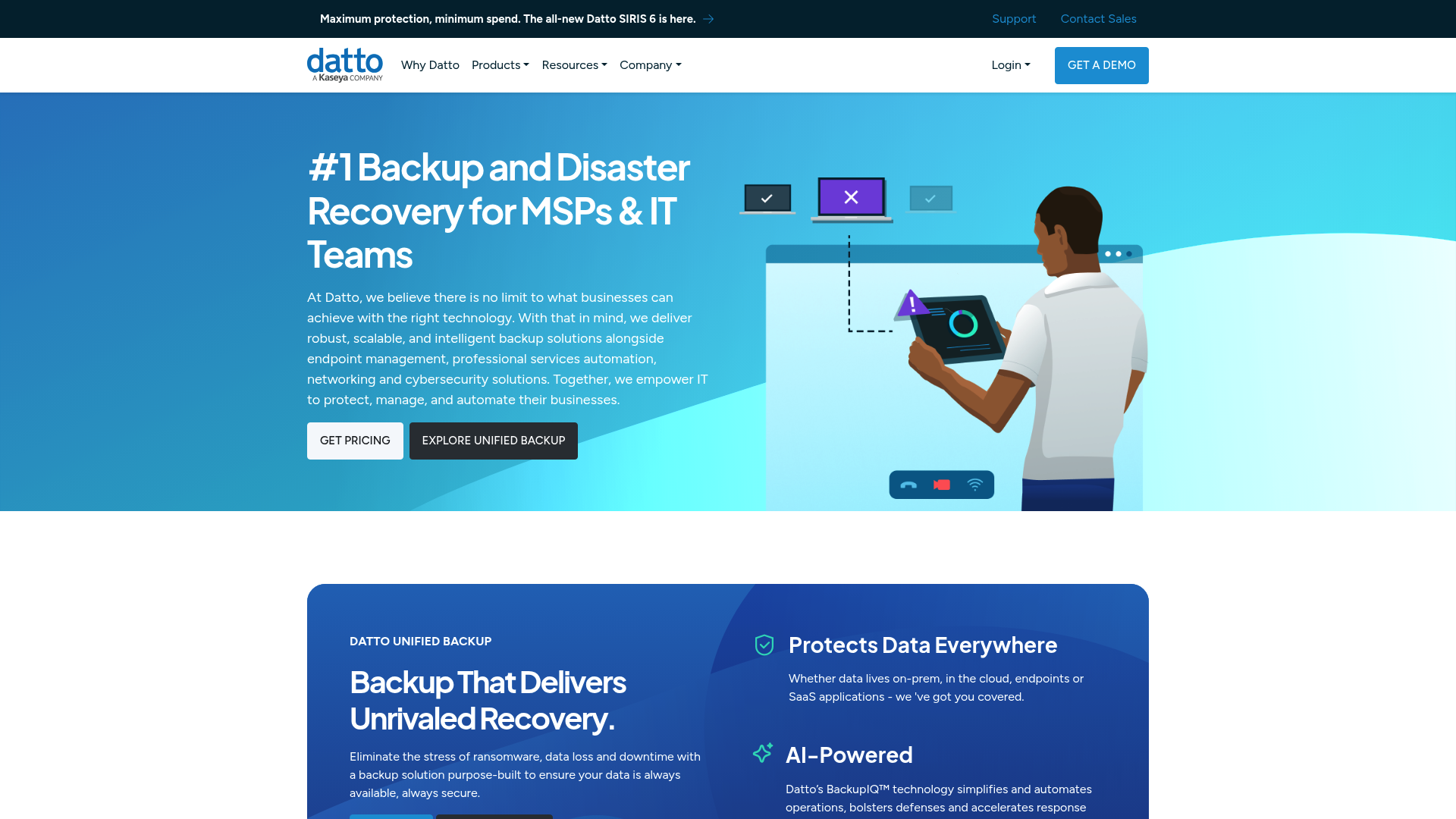
Datto RMM is the cloud-native option. No on-premise servers. No maintenance windows. Just a web console and agents.
Security is the headline feature. Native ransomware detection, two-factor authentication, and a "security-first" architecture differentiate Datto from RMMs that treat security as an afterthought. For MSPs offering security services or working with regulated industries, this matters.
Microsoft 365 management is deeply integrated. Tenant overview, user management, and device association work without third-party connectors.
The multi-tenant view lets you manage multiple client organizations from one console. Scripting, patch management, and remote access are all included.
Pricing requires contacting sales. No public pricing available. The free trial requires a demo request.
Best for: Mid-size MSPs wanting cloud-native RMM with built-in security features and strong Microsoft integration.
Pros:
- 100% cloud-based (no server maintenance)
- Native ransomware detection
- Strong Microsoft 365 integration
- Multi-tenant architecture
Cons:
- No mobile app for management
- Limited third-party patching options
- Support inconsistencies reported
- No public pricing
7. N-able N-central
N-able N-central is the enterprise choice. If you're managing thousands of endpoints across complex networks, this is the tool built for that scale.
The platform made Gartner's 2025 Magic Quadrant for Endpoint Management Tools. Canalys named N-able a Global RMM and PSA Champion in 2024.
N-central's "Infinity Core" is its differentiator. It's a flexible policy deployment system that lets you target endpoints with precision while maintaining standards. The claim is that you can "deploy fewer policies" while achieving more flexibility than competitors.
Security integration runs deep. EDR, XDR, MDR, and data protection all connect natively. CMMC compliance controls are automated. For government contractors or regulated industries, this is a significant advantage. If you're evaluating security tools specifically, see our cyber risk audit tools comparison.
Take Control (remote access) is built-in. No separate licensing.
The learning curve is real. Training new technicians takes time. The interface has the density of an enterprise tool, which means power but also complexity.
Pricing is custom. No public tiers. The trial is available through the N-ableMe portal.
Best for: Large MSPs or enterprises managing complex environments at scale with security and compliance requirements.
Pros:
- Gartner-recognized platform
- Deep security integration (EDR, XDR, MDR)
- Automated CMMC compliance controls
- Built-in Take Control remote access
Cons:
- Steep learning curve
- macOS agent reliability issues reported
- Overwhelming for small teams
- No public pricing
How to choose the right ConnectWise alternative
There's no perfect RMM. There's only the right fit for your specific situation. Here's a decision framework:
Choose NinjaOne if: You want the fastest, most reliable RMM and don't mind integrating with a separate PSA. The agent performance and support quality are best-in-class.
Choose Atera if: You want predictable per-technician pricing and an all-in-one platform with modern AI features. The 30-day trial gives you time to evaluate properly.
Choose Syncro if: You want unified RMM, PSA, and security operations in one platform. The QuickBooks/Xero integration is solid for MSPs prioritizing accounting workflow.
Choose HaloPSA if: PSA functionality is your priority. The service desk, CRM, and project management depth exceed most competitors. Easy migration from ConnectWise is a bonus.
Choose SuperOps if: You want transparent pricing, modern UX, and AI assistance without enterprise bloat. The public pricing eliminates negotiation headaches.
Choose Datto RMM if: Cloud-native architecture and built-in security are priorities. The ransomware detection and Microsoft 365 integration appeal to security-focused MSPs.
Choose N-able N-central if: You're operating at enterprise scale with complex environments. The Gartner recognition and deep security integration justify the learning curve for large operations.
The reality of switching
Here's the truth no vendor will tell you: switching RMMs is painful. Data migration, retraining technicians, reconfiguring integrations. It takes time and money.
But staying with a tool that frustrates your team daily has costs too. Slow technicians, missed SLAs, employee turnover. Those add up.
The MSPs who switch successfully do three things:
Audit their actual usage. Most ConnectWise customers use 20% of the features. If you're primarily using ConnectWise Automate, you may not need a full platform replacement.
Plan the migration. Don't underestimate data export, script conversion, and agent deployment time.
Train before go-live. Parallel-run systems during transition. Don't cut over on a Friday.
One more reality check: every tool on this list has limitations. "Picking RMMs is like picking your fantasy football team," as one MSP put it. "You think it'll solve your problems but mostly you just hate everyone by midseason."
The goal isn't finding a tool with zero flaws. It's finding a tool whose flaws don't block your specific workflow.
Moving beyond ConnectWise
ConnectWise isn't going anywhere. It's still the market leader by volume. But market leadership doesn't mean it's the right choice for your MSP.
The alternatives above prove that. Whether you prioritize speed (NinjaOne), predictable pricing (Atera, SuperOps), PSA depth (HaloPSA), security (Datto), or enterprise scale (N-able), there's a better fit out there.
The question is: what's actually holding you back? Complexity? Cost? Support quality? Performance? Identify the pain, then match it to the solution. If ticket volume is your main issue, see our post on why L1 tickets are killing your MSP.
And remember: the tool is only half the equation. The other half is what you do with the tickets that still come in. That's where we can help. Rallied works with these platforms to automate L1 ticket resolution. Password resets, account unlocks, mailbox permissions. The repetitive work that drains your margins.
The best RMM in the world won't help if your technicians are still spending half their day on tasks an AI could handle in seconds. See how much you could save with our ROI calculator.
Frequently Asked Questions
Which ConnectWise alternative offers the best value for small MSPs?
Atera and SuperOps both offer strong value for smaller teams. If you're a smaller shop, also check our guide to the best RMM software for small businesses. Atera's per-technician pricing ($149-$209/month) includes built-in remote access and AI features. SuperOps starts at $89/month for PSA-only or $149/month for full RMM with transparent public pricing. Both beat ConnectWise on predictability.
Can I migrate my ConnectWise data to these alternatives?
Most alternatives offer migration assistance. HaloPSA specifically advertises easy ConnectWise migration with CSV imports. NinjaOne, Atera, and SuperOps all provide migration support. The complexity depends on how much historical data and custom scripting you're moving.
Do any ConnectWise alternatives include both RMM and PSA?
Yes. Atera, Syncro, and SuperOps are all-in-one platforms with native RMM and PSA. HaloPSA is PSA-first with RMM integration options. NinjaOne is RMM-only and requires PSA integration. For a deeper PSA comparison, see our best PSA software for MSPs guide.
Which ConnectWise alternative has the best support?
NinjaOne consistently rates #1 for customer support on G2. SuperOps scores 9.9/10 versus ConnectWise's 7.4 on quality metrics. Syncro also has a strong support reputation in user communities.
Are there any free ConnectWise alternatives?
None of the enterprise-grade alternatives are free. Some offer limited free tiers (typically for very small deployments), but MSP-grade RMM/PSA requires paid licenses. HelpWire offers free remote support for basic use cases, but it's not a full RMM replacement.
How long does it take to switch from ConnectWise to an alternative?
Migration timelines vary. Simple setups can migrate in days. Complex environments with extensive scripting and custom integrations may take weeks. Most vendors recommend running systems in parallel during transition. NinjaOne customers report going live in '30 minutes to an hour' for basic deployments.
Which ConnectWise alternative is best for AI automation?
Atera and SuperOps lead on AI integration. Atera's AI Copilot assists with ticket resolution and auto-remediation. SuperOps includes Monica AI for workflow suggestions and ticket assistance. Both are betting heavily on AI as a differentiator from legacy tools.