6 Best HaloPSA Alternatives in 2026: An Honest MSP Comparison
TL;DR
HaloPSA is the most powerful PSA in the market for MSPs who can staff a dedicated admin and invest 3-6 months in setup. If you can't, or if the five-agent floor, UK-only support timezone, or mobile app dead zone are real problems for your shop, here's where to look instead:
- ConnectWise PSA - the industry default for large, established MSPs already in the ConnectWise ecosystem
- Autotask PSA - solid pick if you're already on Datto RMM or IT Glue
- SuperOps - modern, AI-native, unified PSA+RMM, best for MSPs under 30 techs who want simplicity
- Syncro - flat per-tech pricing, zero per-device fees, best for cost-conscious shops
- Atera - all-in-one with Robin AI that autonomously resolves up to 92% of tickets
Whatever PSA you pick, pairing it with Rallied as an AI technician layer dramatically reduces the L1 ticket load that burns your best techs regardless of which platform holds the tickets.
HaloPSA earns its 4.8/5 on G2 for a reason. For MSPs in the 15-50 tech range with the bandwidth to configure it properly, it's arguably the most capable PSA available. The Actions engine chains automation logic that other platforms can't touch. Published pricing - starting at $85/agent/month for 10+ agents - means no sales call to know if it's in your budget.
But it comes with a real implementation tax. The MSPGeek community calls it the "Halo Tax": one tech, 20+ hours a week, for the first three months, just to get the platform running the way the demo looked. The mobile app is effectively non-functional for field techs. QuickBooks billing sync has caused some shops to miss thousands in invoices. Support is UK-based, which means North American shops are waiting until afternoon for help with morning fires.
None of that makes HaloPSA bad. It makes it wrong for a certain type of shop. If that's you, here are the honest alternatives.
Why MSPs start looking for HaloPSA alternatives
Before listing tools, it's worth being specific about what's actually driving the search - because the reason shapes which alternative fits.
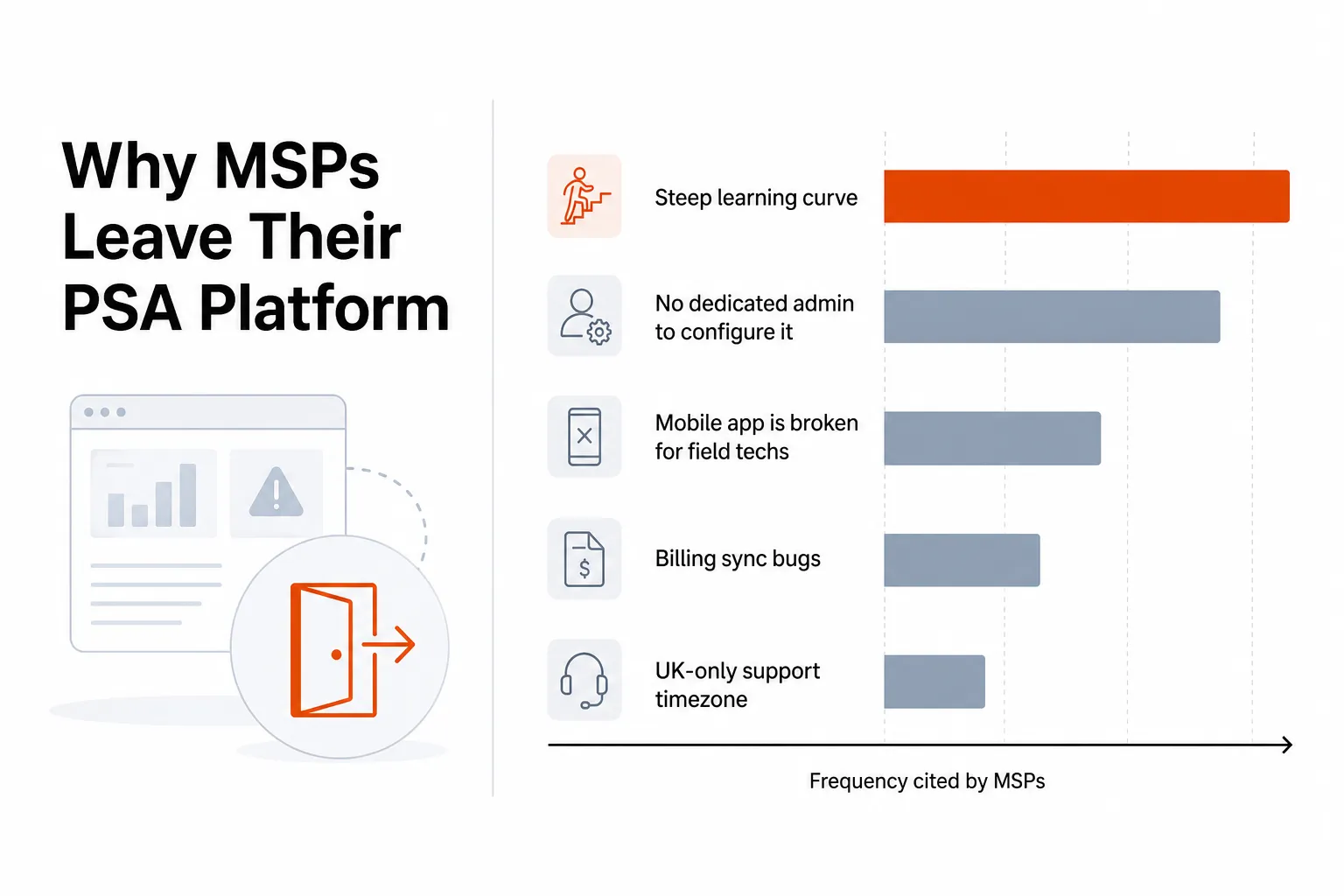
"We don't have a Halo admin." The most cited reason across r/msp and r/halopsa. HaloPSA is a construction kit, not a finished home. If nobody on your team has 20 hours a week to dedicate to configuration for the first three months, you'll either bounce off it or limp along with a half-configured platform that frustrates everyone.
"The mobile app may as well not exist." One reviewer who switched from ConnectWise put it bluntly: "Technicians cannot start and stop timer from it/easily enter time. It's essentially an app with links that open the tickets in a browser." Field-heavy MSPs find this a dealbreaker.
"Billing keeps breaking." Multiple Reddit threads report QuickBooks sync causing missed invoices, random discounts on customer bills, and billing teams still on multiple support calls a week after six months. Not universal, but frequent enough to plan for.
"We're a five-person shop." HaloPSA's five-agent floor means a solo tech or a two-person MSP is paying for seats they don't have - and buying into a platform designed for shops three times their size.
"Support is only available in the UK timezone." Fine for companies in Europe. For North American shops, serious issues that happen in the morning are resolved at 3 PM.
What to look for in a HaloPSA alternative
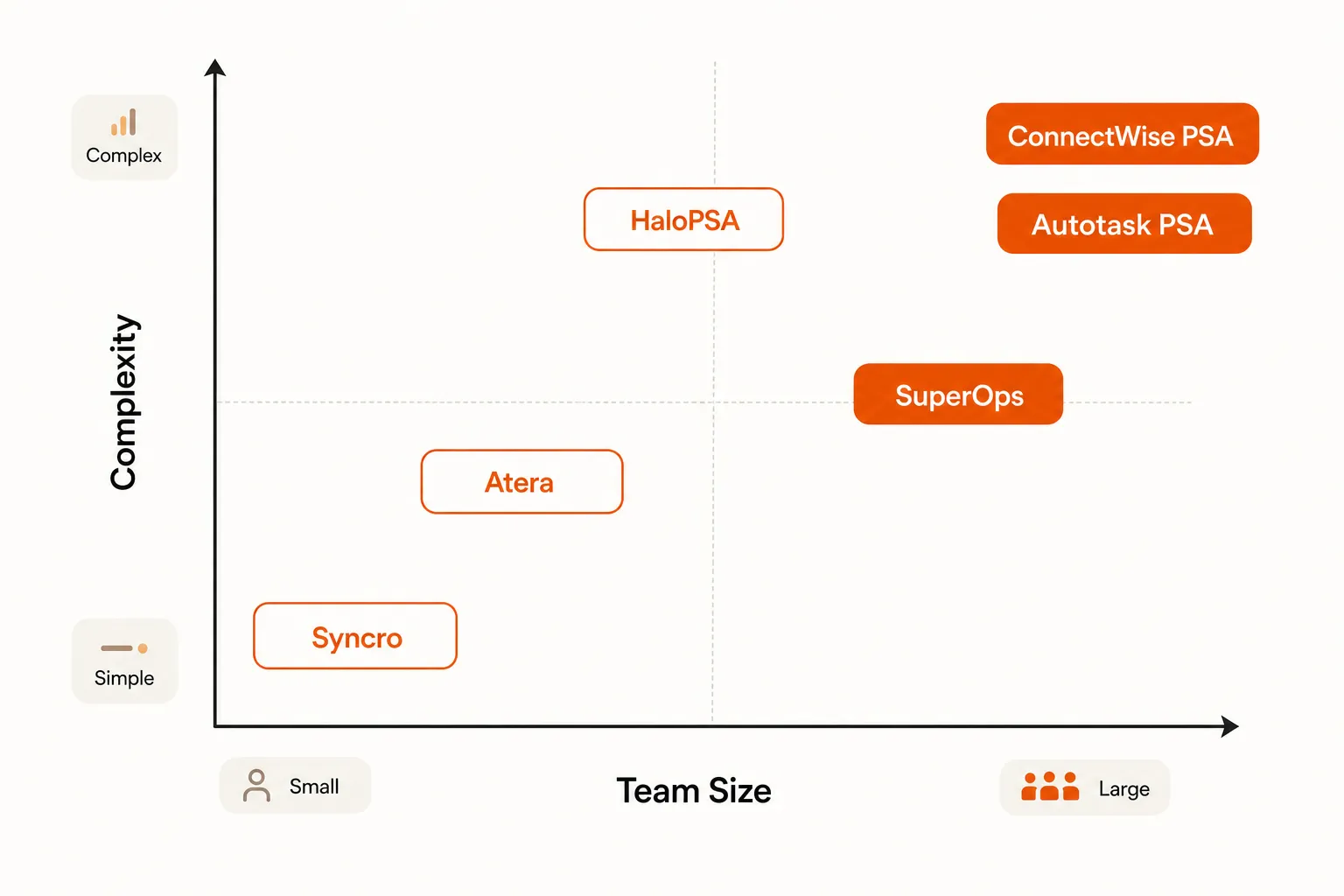
The honest answer is that there's no perfect PSA - just a better fit for your constraints. Before evaluating tools, get clear on three things:
Do you want PSA-only or PSA+RMM bundled? HaloPSA is PSA-only. If you want to consolidate tools, SuperOps, Syncro, and Atera all bundle RMM with their PSA. ConnectWise and Autotask are PSA-first with RMM sold separately.
How much implementation overhead can you absorb? ConnectWise and Autotask are roughly as complex as HaloPSA. SuperOps, Syncro, and Atera are meaningfully faster to stand up.
What's the real cost at your team size? License costs are public for most options listed here. Don't skip the implementation and admin labor math - it's the difference between a $25K/year tool and a $60K/year one.
| Platform | Best for | Pricing | PSA+RMM? |
|---|---|---|---|
| ConnectWise PSA | 50+ tech MSPs in the CW ecosystem | Quote-based (~$55-85/user/mo est.) | Separate |
| Autotask PSA | Datto/IT Glue shops | Quote-based (~$50-75/user/mo est.) | Separate |
| SuperOps | 5-30 tech MSPs wanting modern UX | Custom (AI-native platform) | Bundled |
| Syncro | Cost-conscious shops, field-light | $179/tech/mo (annual) | Bundled |
| Atera | Any size, AI-forward teams | $149-219/tech/mo | Bundled |
1. ConnectWise PSA
Best for: Established mid-market MSPs already invested in the ConnectWise ecosystem
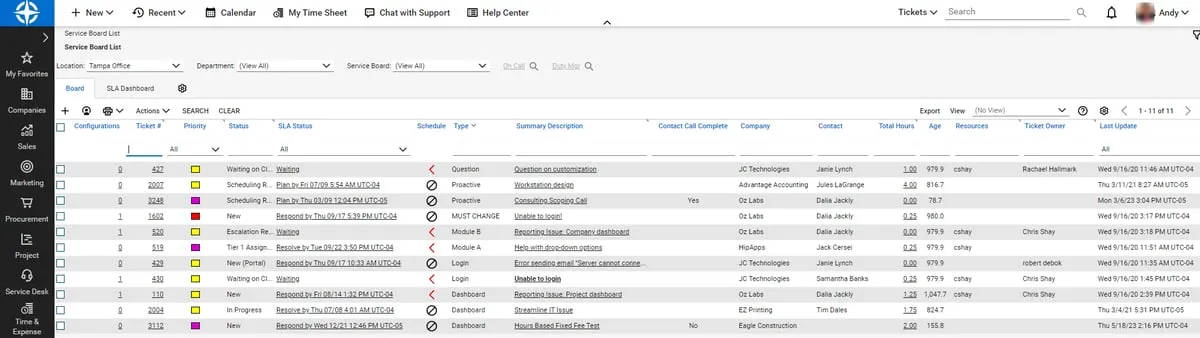
ConnectWise PSA (formerly ConnectWise Manage) is the closest thing the MSP industry has to a default standard for large shops. It's been around since 1982 and runs a significant share of MSP operations in North America. The platform covers service desk, project management, time tracking, billing, CRM, and reporting in one place - and if you're already using ConnectWise RMM, ConnectWise Automate, or ScreenConnect, the shared data layer makes the whole ecosystem run tighter.
That ecosystem depth is also the trap. ConnectWise is notoriously complex to implement, with reported costs of $15,000-$30,000 for a 20-tech rollout and implementation timelines that rival or exceed HaloPSA. Pricing is quote-based - no numbers on the website - with community estimates putting it at $55-85/user/month for a full feature set, and Reddit threads reporting ~20% annual price increases at renewal. G2 rates ConnectWise PSA at 4.1/5 - lower than HaloPSA - with complaints frequently citing a dated interface and sales-call-required pricing.
ConnectWise added Sidekick, an AI assistant integrated with Microsoft Teams, to help with ticket triage and administrative tasks. It's useful for surface-level work, but it suggests rather than executes.
Our take: ConnectWise PSA is the right choice if you're already neck-deep in the ConnectWise ecosystem and need the tight data layer between PSA, RMM, and BCDR. If you're not, it's a lot of complexity and a lot of money to get in and stay in. The HaloPSA → ConnectWise switch usually happens at 50+ techs, not 15.
2. Autotask PSA
Best for: MSPs in the Kaseya/Datto stack
Autotask PSA, owned by Kaseya, covers the same fundamentals as HaloPSA - service desk, contracts, billing, time tracking, project management - and integrates natively with Datto RMM and IT Glue, two of the most widely used tools in the MSP stack. If you're already paying for Datto RMM, Autotask is the natural PSA to pair with it: one vendor relationship, tighter data sync, one support number.
Pricing is quote-only, with community estimates ranging from $50-75/user/month depending on modules. Real-world costs tend to land above HaloPSA once implementation and onboarding fees are factored in - G2 reviewers note a complex initial setup and limited public documentation. The Kaseya acquisition hasn't made things simpler; some shops report feeling bundled into packages they didn't ask for.
The platform itself is mature and broadly capable. Time and expense tracking is strong. Contract management handles the complexity that most MSP billing creates. The CRM module is functional for pipeline tracking. What it doesn't have is HaloPSA's customization depth - the Actions engine equivalent in Autotask is more limited, which is either a relief or a constraint depending on how you feel about configuration work.
Our take: If you're running Datto RMM and IT Glue, Autotask is the path of least resistance - the integrations are native and the vendor relationship simplifies contract renewals. If you're not in the Kaseya stack, the case for Autotask over HaloPSA is harder to make: similar complexity, less flexibility, higher total cost.
3. SuperOps
Best for: Modern MSPs who want AI-native PSA+RMM without three separate tools
SuperOps is the newcomer on this list and the one most worth watching. It was built from scratch as an AI-native platform - not "we added AI features to a legacy codebase" but genuinely designed around automation and intelligence as core primitives. The MSPSuite bundles PSA and RMM in one platform, which eliminates the integration overhead that shops running HaloPSA + a separate RMM deal with daily.
The value proposition is consolidation with a modern architecture: one system for device management, client management, ticketing, billing, and project tracking. The AI layer sits underneath all of it - automating ticket routing, flagging anomalies, reducing the manual categorization work that burns tech time on every ticket queue.
Pricing isn't publicly listed - you'll need to contact sales - which is a fair point of frustration for MSPs who've had their fill of quote-required vendors. Community reception is positive but still limited compared to the established players; G2 review volume is lower because SuperOps is newer. Early adopters consistently highlight the unified architecture and the fact that configuration takes days rather than months.
Our take: SuperOps is the best-positioned HaloPSA alternative for MSPs in the 5-30 tech range who want modern tooling without the Halo Tax. You give up depth of customization in the Actions engine equivalent. You get it back in speed-to-running and the elimination of a separate RMM contract. The AI-native architecture will compound over time in ways that bolted-on AI features won't.
4. Syncro
Best for: Cost-conscious MSPs who want flat, predictable pricing and a solid all-in-one
Syncro has the simplest pricing story on this list: $179/tech/month on an annual plan, unlimited endpoints, no per-device charges. That's it. You manage 100 endpoints or 1,000 endpoints - same price. For shops that have watched their per-device fees compound with NinjaOne or Atera as they onboard new clients, this model is a genuine relief.
The platform bundles RMM, PSA, remote access (Splashtop, included), billing, and Microsoft 365 security management. The M365 integration is notably good: Entra ID user sync, password and MFA reset directly from Syncro, and CIS-aligned security baselines with drift detection. That's a meaningful chunk of L1 work handled without leaving the platform.
G2 gives Syncro 4.5/5 with 501 reviews, earning G2 Winter 2026 badges including Leader, Best Usability, and Most Implementable. The community is consistently positive about support quality (24/5 live chat) and QuickBooks integration. The recurring complaints are about missing features that more mature platforms have, and a UI that some users find less modern than Atera or SuperOps.
Our take: Syncro is the right call if predictable costs matter more than automation ceiling. You won't build the kind of multi-step workflow logic that HaloPSA's Actions engine enables. What you get is a competent, well-supported all-in-one at a price that doesn't require a CFO approval. Strong fit for field-heavy shops running Windows-first endpoints.
5. Atera
Best for: MSPs who want AI to start handling tickets autonomously, not just suggest fixes
Atera is the most aggressively AI-forward platform on this list. Its Robin agent claims to resolve 92% of technical issues autonomously, end-to-end, with an average response time of 0.1 seconds. Password resets, control sharing, device-level actions - Robin handles them without a technician touching the ticket. Atera positions it as the path to what they call "Autonomous IT": a platform where routine support runs itself.
This matters in the context of a HaloPSA comparison. HaloPSA's automation is all about the workflow you configure - the Actions engine does what you set it up to do. Atera with Robin is trying to do the work before you configure anything, using AI reasoning to understand what a ticket is asking for and act on it. These are fundamentally different automation philosophies.
Pricing is published and per-tech: Professional at $149/tech/month, Expert at $189 (most popular), Master at $219, Enterprise custom. All plans include RMM, ticketing, AI Copilot, and patch management. Robin (the autonomous agent) is an add-on on higher tiers. The per-tech unlimited-endpoint model removes the device count anxiety that haunts per-device pricing. 13,000+ customers and 6 million+ devices under management give it more at-scale credibility than newer platforms.
The platform isn't without limits. Reporting is thinner than HaloPSA's SQL-backed system. The customization ceiling is lower - you can configure workflows, but you're not building the multi-condition nested logic that HaloPSA enables. Complex billing configurations and multi-tier contract structures are harder here than in Autotask or HaloPSA.
Our take: Atera is the alternative to reach for when you want AI doing the actual work rather than guiding you through it. The autonomous ticket resolution from Robin is genuinely ahead of where ConnectWise and Autotask sit today. The trade-off is depth of customization and reporting. For MSPs who've burned months on HaloPSA configuration and want the platform to do more of that thinking for them, Atera is worth a 30-day trial.
Which platform should you pick?
The honest decision tree:
- Already in ConnectWise ecosystem (50+ techs)? Stay there or go deeper into ConnectWise PSA.
- Running Datto RMM + IT Glue? Autotask is the low-friction PSA choice.
- Under 30 techs, want modern AI-native, willing to trade customization depth for speed? SuperOps.
- Cost is a real constraint, field-tech heavy, Windows-first? Syncro at $179/tech/month flat.
- Want AI that resolves tickets rather than just managing them? Atera with Robin.
What none of these alternatives solve on their own: the ticket volume problem. Your techs are still handling L1 tickets - password resets, account unlocks, permission changes - and that work costs MSPs $7,000-$15,000/month in senior tech time for a shop running 200-400 tickets/month. Switching PSAs redistributes where those tickets live. It doesn't reduce how many your team has to touch.
The missing piece: autonomous ticket resolution
Here's what MSPs who've been through a PSA migration usually discover: the PSA switch was the right call, but the ticket volume problem didn't move. They've got a better platform. The same techs are still spending 40% of their day on work a junior hire could do.
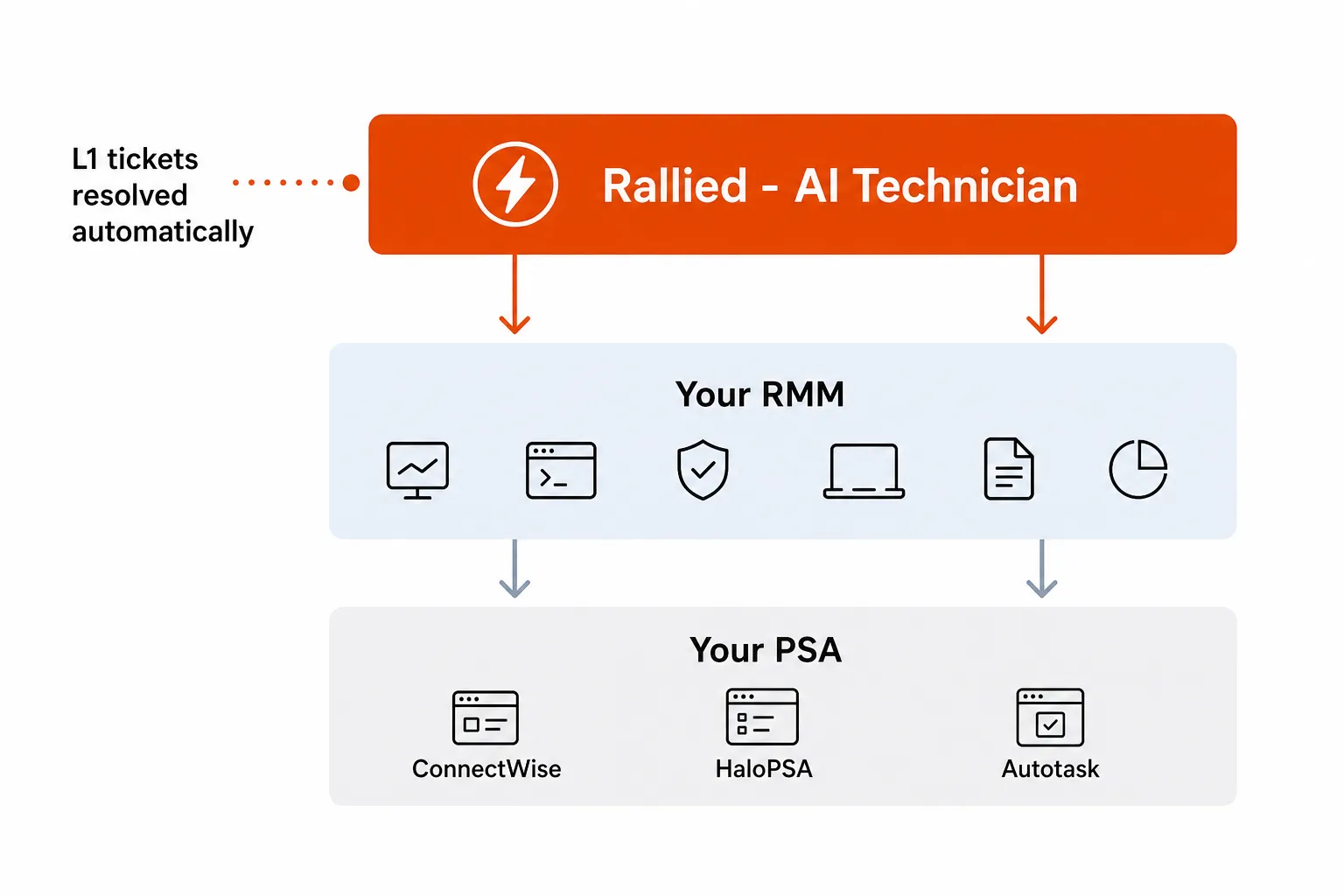
The structural fix isn't the PSA - it's an AI technician layer that connects to the PSA and handles the work before a human tech ever sees it. Rev.io named this the three-layer "AI Agent Stack" that MSPs are building in 2026: triage at the top, orchestration in the middle, execution at the bottom. The execution layer is what resolves the ticket. Most PSAs don't do that. The PSA holds the ticket; something else has to close it.
Try Rallied
Rallied is an AI technician built specifically for that execution layer. It connects to ConnectWise, Autotask, HaloPSA, SuperOps, Datto RMM, NinjaOne, M365, Entra ID, Okta, IT Glue, and Hudu - whatever stack you're running - and resolves L1 and L2 tickets end-to-end: reads the ticket, diagnoses the issue, fixes it across your entire stack, notifies the user, closes the ticket.
The differentiation from Atera's Robin and other AI tools is execution depth and deployment speed. Rallied goes live the same week you connect your PSA - no 6-month implementation, no dedicated admin to train it, no forward-deployed engineer. It handles passwords resets, MFA unlocks, account unlocks, group membership changes, onboarding, offboarding, and RMM-triggered endpoint work. CRN named it one of 10 Hot MSP Tools in 2026.
Pricing is $0.50 per ticket resolved - anything Rallied touches, whether it closes or escalates. Zero minimum. Zero platform fee. For an MSP running 300 tickets/month where 60% are L1 work, that's $90/month to eliminate work that currently costs $4,000-$6,000 in tech time. The math on the Rallied pricing page runs this scenario out in detail.
It's not a PSA. It doesn't replace whichever platform you pick from the list above. It's the layer that finally makes the PSA worth it - because your senior techs stop touching the work that shouldn't reach them in the first place.
Frequently Asked Questions
What is the main reason MSPs switch away from HaloPSA?
The most common reason is the implementation overhead. HaloPSA's Actions engine is genuinely powerful, but it requires a dedicated admin for the first three to six months - 20+ hours a week of configuration before the platform runs smoothly. Shops without that bandwidth hit a wall fast. The broken mobile app for field techs and QuickBooks billing sync issues are close runners-up.
Is HaloPSA free to try?
HaloPSA offers a 30-day free trial with full access - no credit card required. That's enough time to explore the interface but not nearly enough to evaluate the Actions engine, which takes weeks to configure properly. Plan the trial around a specific workflow you want to automate, not a general browse.
What's the cheapest HaloPSA alternative?
Syncro runs $179/tech/month (annual) with unlimited endpoints and no per-device charges. Atera starts at $149/tech/month (Professional plan) and bundles RMM, ticketing, and AI features. Both are meaningfully simpler to implement than HaloPSA, which reduces the real total cost even when their sticker price looks similar.
Can small MSPs (under 10 techs) use HaloPSA?
HaloPSA has a hard five-agent minimum - so the floor cost is around $545/month. More practically, small shops rarely have the bandwidth to staff a dedicated Halo admin, and the platform's complexity punishes under-investment. SuperOps, Syncro, or Atera are better fits for shops under ten techs.
Does Rallied replace a PSA?
No - Rallied is an AI technician that runs on top of your existing PSA, not a replacement for one. It connects to ConnectWise, Autotask, HaloPSA, and SuperOps, then handles inbound L1/L2 tickets autonomously - password resets, account unlocks, onboarding, offboarding - at $0.50 per ticket resolved, same week you connect it.