Managed services pricing: the honest guide with real numbers
TL;DR
Managed services pricing falls into three main models - per-user ($70–$250/user/month), per-device ($50–$400/device/month), and flat-rate ($3K–$10K+/month) - but the real cost is always buried in scope exclusions, security depth, and tech labor. Tiered pricing ("Good / Better / Best") is becoming the default because clients want choice and MSPs want margin clarity. The average MSP charges $85–$180/user/month, earns 20–30% net margins, and loses more money to underutilized tech time than to any pricing model choice. If you're evaluating AI automation tools as a way to recover that margin, the implementation cost matters as much as the platform fee - most tools add $49K–$84K in first-year costs before you see a single automated ticket.
Managed services pricing has a problem: two proposals can quote the exact same headline number and deliver wildly different services. One MSP at $150/user includes help desk, monitoring, M365 admin, EDR, backup, and quarterly reviews. Another at $150/user excludes servers, after-hours work, advanced incident response, and compliance reporting. The client sees the same number. The MSP knows the two quotes are nowhere close.
This guide cuts through that. We'll cover every pricing model with real dollar ranges, the benchmark data from actual industry surveys, and the math most pricing guides skip - including what AI automation tools actually cost to run.
The three core pricing models
Per-user pricing
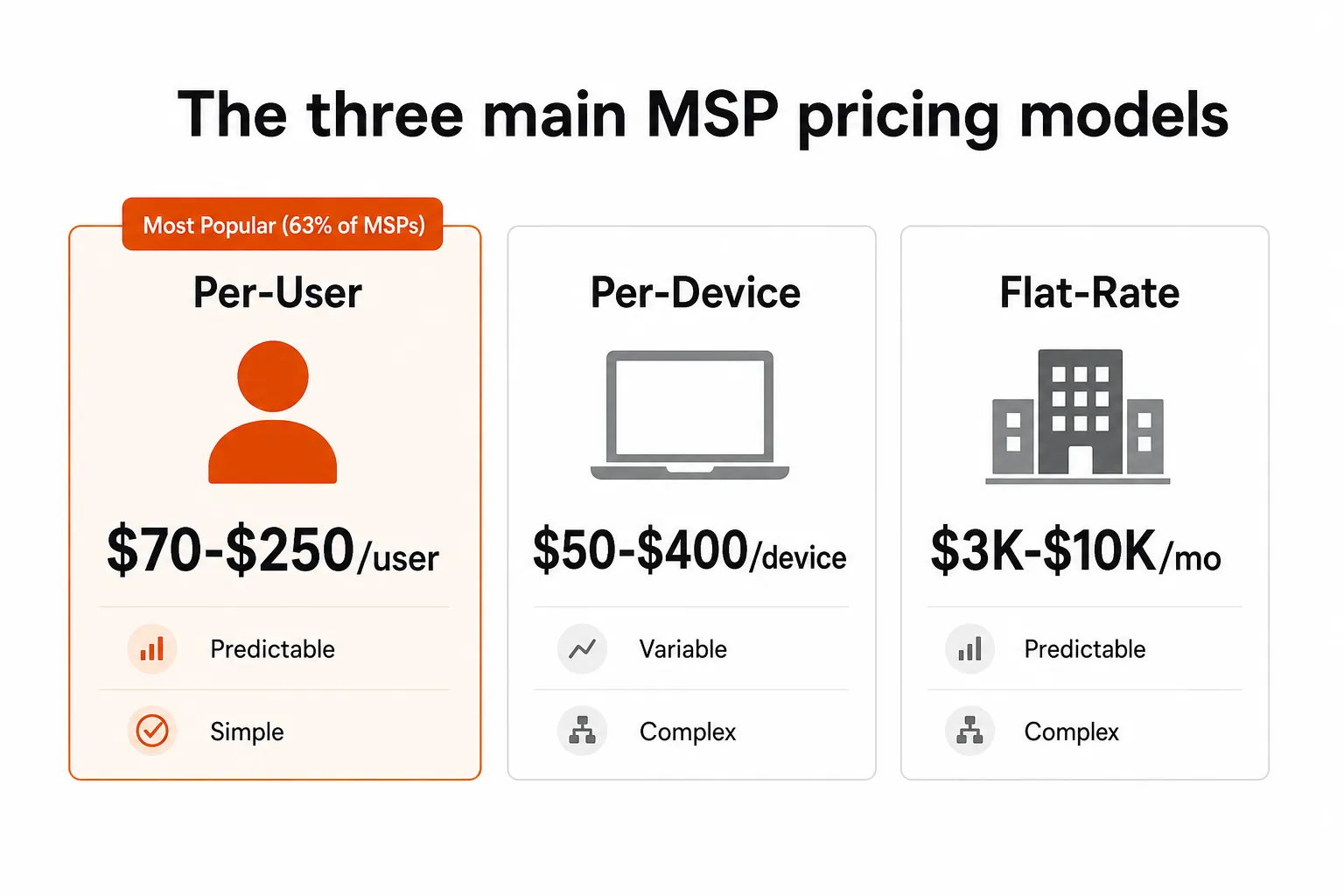
The most common model by far. 63% of MSPs use some form of per-user billing, and it's easy to see why - headcount is how clients think about their own costs, so the pricing aligns cleanly with how they budget.
Typical ranges in 2026:
| Company size | Low end | Mid range | High end |
|---|---|---|---|
| 1–50 employees | $70/user | $100–$120/user | $150+/user |
| 50–100 employees | $100/user | $130–$170/user | $200+/user |
| 100–300 employees | $110/user | $150–$200/user | $250+/user |
| Regulated industries | +$50 premium | +$75 premium | +$100 premium |
What's typically included at the $100–$150/user range: help desk, endpoint monitoring and patching, M365 administration, basic antivirus and firewall oversight, user onboarding and offboarding. What's often not included: servers, network appliances, after-hours work, advanced incident response, compliance reporting.
That exclusion list is where per-user pricing falls apart. A client buys $150/user thinking they're covered, then sees a $250/hour line item the first time a server needs attention on a Saturday. We'd recommend against per-user for any client with meaningful server infrastructure or after-hours support needs unless those are explicitly priced in.
Where it works: Standardized office environments - same device types, predictable headcount, business-hours support. Think professional services firms, small legal offices, accountants.
Per-device pricing
Charges separately for each managed asset. Better at reflecting actual support burden in heterogeneous environments; worse at producing predictable invoices.
Typical rates:
| Device type | Low end | Standard | High end |
|---|---|---|---|
| Workstation/laptop | $50/month | $75–$100/month | $120+/month |
| Server (physical/VM) | $150/month | $250–$300/month | $400+/month |
| Firewall | $30/month | $50–$75/month | $100+/month |
| Network switch | $15/month | $30–$50/month | $75+/month |
A real example: a 50-person company with 75 workstations, 3 servers, and 2 firewalls at mid-range rates. Workstations at $75 = $5,625. Servers at $250 = $750. Firewalls at $50 = $100. Total: ~$6,475/month. The same company at $130/user would be $6,500 - nearly identical in this case, but the per-device bill is honest about what's driving cost.
Where it works: Infrastructure-heavy environments (clinics, warehouses, manufacturing), multi-site operations with varied device mixes, call centers with shared workstations where per-user billing doesn't reflect reality.
Flat-rate / all-inclusive pricing
One monthly fee, everything in, scope defined upfront. The simplest thing to sell and the hardest to run profitably without extremely tight scoping.
Typical ranges run $3,000–$10,000+/month depending on headcount and complexity - these are usually quoted by business size tier rather than per unit. For smaller, well-documented environments (50–200 users), flat-rate can work well. For messy environments with lots of custom requests, it becomes a race against scope creep.
The catch: MSPs that price flat-rate either charge a large enough risk premium to cover the unknown, or they get burned when the client's environment turns out to be messier than the discovery call suggested. The ones who make it work have airtight statements of work and don't flinch when scope creep hits - every request outside the SOW gets a change order.
Tiered pricing: the emerging standard
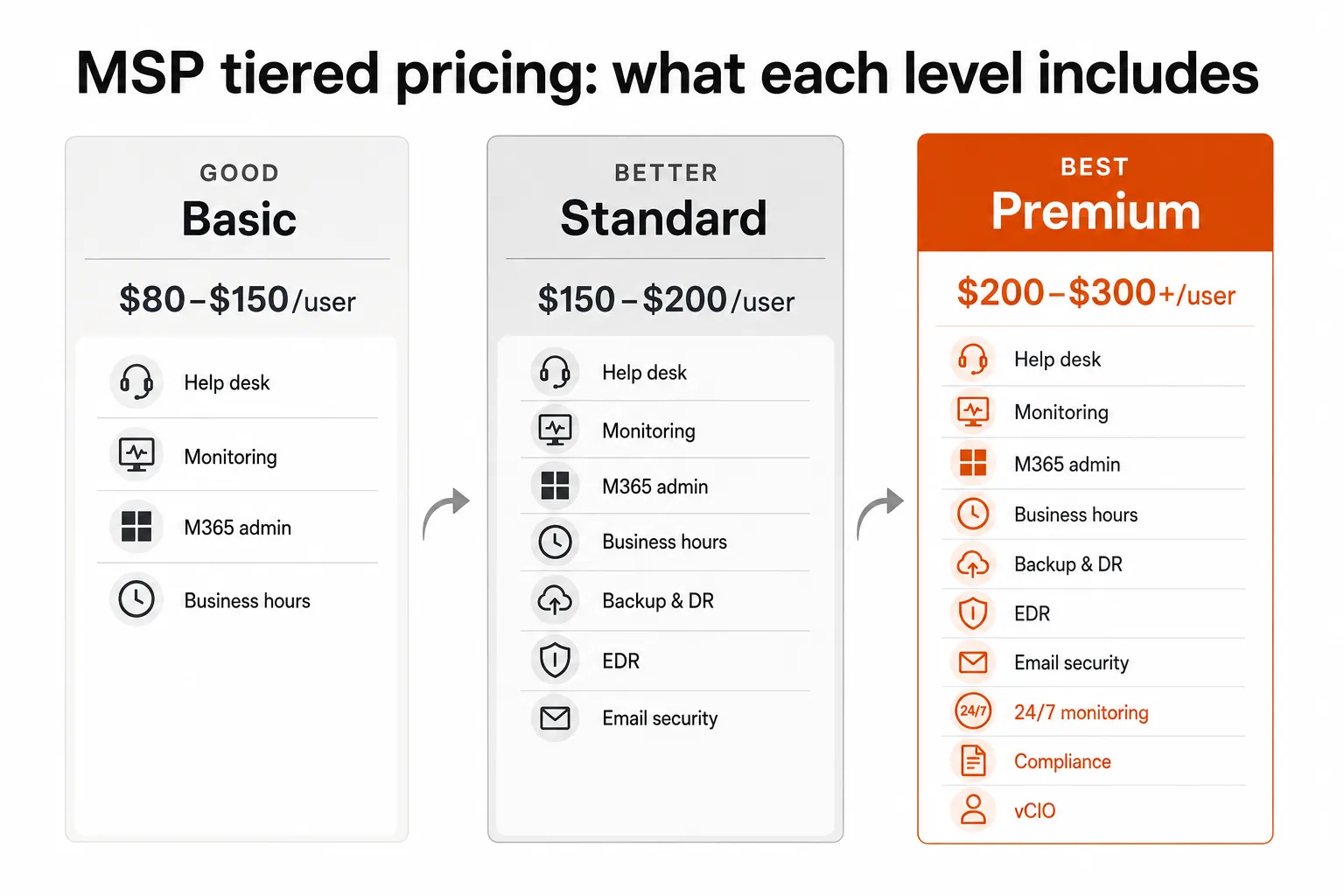
The model gaining the most ground is tiered bundling - three packages that let clients self-select rather than negotiate. Major MSP platforms like ConnectWise and Autotask now ship tiered pricing templates as the default, which tells you where the market is going.
A typical tier structure:
Tier 1 - Basic ($80–$150/user/month) Help desk, monitoring and patching, M365/Google Workspace admin, basic antivirus and firewall, business-hours support, quarterly reviews.
Tier 2 - Standard ($150–$200/user/month) Everything in Tier 1, plus backup and disaster recovery, EDR (endpoint detection and response), email security, after-hours escalation.
Tier 3 - Premium ($200–$300+/user/month) Everything in Tier 2, plus 24/7 proactive monitoring, vulnerability scanning, compliance reporting (SOC2, HIPAA, PCI), strategic planning and vCIO, advanced incident response.
Why tiered pricing wins: clients arrive knowing roughly what they need. A healthcare clinic that touches PHI knows they need compliance support - they'll pick Tier 3 without a lengthy negotiation. A 20-person marketing agency that just needs "IT to work" buys Tier 1 and stays there. The MSP closes faster and the contract scope is unambiguous from day one.
What the numbers actually look like
The Kaseya 2024 MSP Benchmark Survey puts the median per-user rate at $85/month for co-managed IT services, with 51% of MSPs pricing below $150/user. That's the commodity band - the clients who are shopping purely on price and the MSPs competing for them.
The upper tier looks different. MSPs with average monthly contracts above $7,500 saw that segment double year over year in Kaseya's data - a signal that the industry is bifurcating. Commodity MSPs are competing harder for smaller contracts; differentiated MSPs are growing contracts and margins.
The global managed services market sits at $401–$460 billion in 2026 growing at 8–14% annually depending on which analyst you read. There are 150,000–200,000 companies globally that self-identify as MSPs. That's a lot of competing quotes.
The hidden variable: tech labor
The biggest driver of MSP profitability isn't which pricing model you pick - it's technician utilization. A 10-tech team operating at 60% billable utilization instead of 75% loses over $135,000 annually in recoverable labor costs. The pricing model is almost irrelevant if the underlying labor economics are broken.
The math that matters:
- Average cost per tech-hour: $15.56–$30+ (loaded, with benefits and overhead)
- Average cost per ticket: $15.56–$30+ depending on complexity
- Target gross margin: 50–60%
- Realized gross margin for most MSPs: 30–40%
The gap between target and realized margin usually lives in three places: scope creep eating into flat-rate contracts, uncontrolled after-hours work, and routine L1 tickets consuming senior tech time. Password resets and account unlocks shouldn't cost $25–$30 of tech time each. They almost always do.
"Your best people shouldn't be resetting passwords." - Rallied
That line lands because it's true. Password resets alone account for ~18% of L1 ticket volume across MSPs. At 15 minutes per reset and $25 loaded cost, a 200-ticket-a-month shop is spending $750/month on password resets. That's before you count MFA issues, account unlocks, and permission requests.
Where AI fits in your pricing strategy
Automation tools are increasingly part of the MSP cost structure - and increasingly part of the margin recovery story. The pitch is compelling: automate L1 work, reduce tech hours per ticket, improve margins without raising prices. The reality is more complicated.
The implementation tax on traditional tools
Most MSP automation platforms (Rewst, Pia, NeoAgent) don't publish pricing, which is itself a signal. What we know from community reporting: these tools typically require a "forward-deployed engineer" engagement at $5,000–$50,000 upfront, a 6–12 month implementation timeline, and 20–40 hours per month of ongoing admin once live.
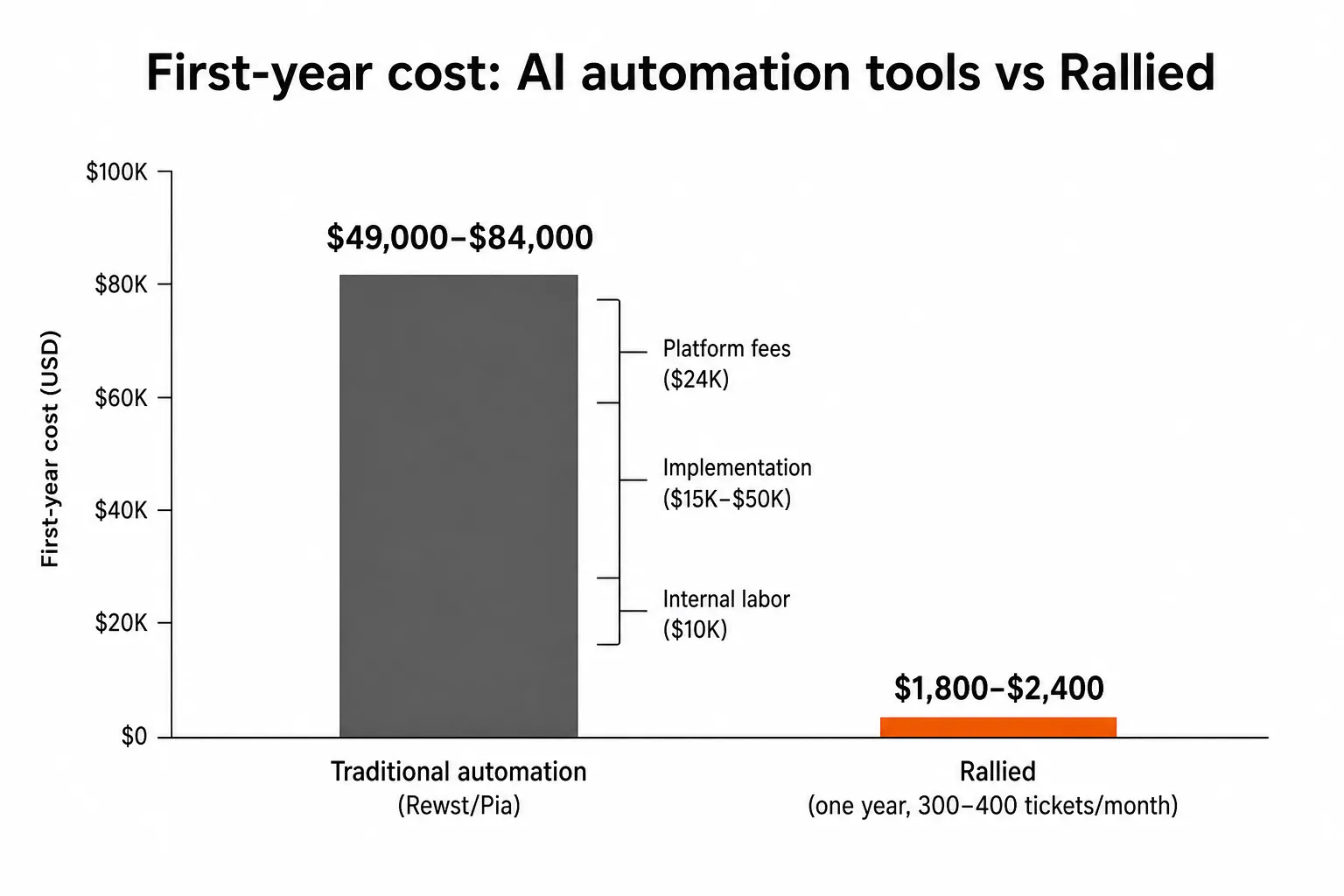
A realistic first-year cost for a 500-endpoint MSP adopting a traditional automation platform:
| Cost item | Amount |
|---|---|
| Platform fees (12 months) | $24,000 |
| Implementation / FDE | $15,000–$50,000 |
| Internal admin overhead | ~$10,000 |
| First-year total | $49,000–$84,000 |
Payback window: 6–12 months, and that's if the implementation goes smoothly.
Rallied: per-client pricing, zero implementation
Rallied takes a different approach to the cost structure entirely. The pricing is $20/client/month on the Standard plan - flat rate per client, everything included. No base fee, no seat licenses, no implementation fee. The AI technician connects to your PSA, RMM, M365, and identity stack in the same week, then starts working tickets autonomously.
What Rallied handles: password resets, MFA unlocks, account unlocks, permission changes, user onboarding and offboarding (M365, Entra, Okta, JumpCloud, Google Workspace), software installs via RMM, and inbound L1 voice calls. Failed attempts are free.
For a 500-endpoint MSP handling 300–400 automatable tickets per month, the comparison:
| Traditional automation | Rallied | |
|---|---|---|
| Implementation cost | $15,000–$50,000 | $0 |
| Platform fee (12 months) | $24,000+ | $20/client/month |
| Go-live timeline | 6–12 months | 1 week |
| Admin overhead | 20–40 hrs/month | 0 |
| Failed attempt cost | Billed | Free |
The ROI math for Rallied: at 200–400 automatable tickets/month, 15 minutes of tech time per ticket, and $75–$150/hour loaded cost, that's $3,750–$15,000/month in recoverable labor. The payback on $20/client/month is measured in days, not months.
Pricing decisions for MSPs: what we'd do
After going through the data, a few things stand out:
Don't pick a pricing model in the abstract. Per-user works until your client has three servers and wants them covered. Per-device works until the client's device count grows unpredictably. Start with your actual cost-to-deliver model and price from there, not the other direction.
Tier from day one. Even if you're only selling one tier today, design the packaging so tiers are easy to add. When a client asks for 24/7 or compliance support, you want to say "that's Tier 3" instead of "let me build a custom quote." The second answer costs you time and often costs you the deal.
Price onboarding separately, always. Stabilization work (cleaning up the environment, documenting everything, configuring your tools) is real labor. Building it into the first-year recurring fee creates a pricing cliff when year two rolls around and the discount disappears. Price it separately, document it, and let clients see the work.
Audit tech time before raising prices. If margins are tight, the first question is where the tech hours are going - not what to charge. Automated L1 work (the 18% of tickets that are password resets, the 15% that are account unlocks) is the fastest margin recovery play most MSPs have access to, and it doesn't require renegotiating a single contract.
Try Rallied
Rallied is an AI technician built for MSPs - it connects to your PSA, RMM, M365, and identity stack and resolves L1 and L2 tickets autonomously. Password resets, MFA unlocks, onboarding, offboarding, inbound voice calls. No workflow builder, no implementation project, no admin overhead. The Standard plan is $20/client/month with a 14-day free trial, no credit card required. If you're trying to recover margin from routine tickets without a 6-month implementation project, this is the straightest path there.
Frequently Asked Questions
What is the average cost of managed IT services per user per month?
Most MSPs charge between $85 and $180 per user per month for standard managed services. Small businesses typically pay $70–$150/user, while mid-market companies (75–300 users) see rates of $100–$250/user depending on security depth, compliance requirements, and whether servers and network gear are bundled. AI-powered MSP tools like Rallied can reduce the labor cost underlying those rates by automating L1 and L2 ticket work.
What's the difference between per-user and per-device MSP pricing?
Per-user pricing charges a fixed monthly fee per employee regardless of device count - typically $70–$250/user/month. Per-device pricing charges separately for each managed asset: workstations ($50–$120/month), servers ($150–$400/month), and firewalls ($30–$75/month). Per-user dominates (63% of MSPs use it) because it aligns with how clients think about headcount, but per-device is better for infrastructure-heavy environments where device complexity drives actual support burden.
How do MSPs price for AI automation in their service stack?
Traditional workflow automation tools (like Rewst and Pia) add $24,000–$84,000 in first-year costs - including implementation fees of $5,000–$50,000 and 20–40 hours/month of ongoing admin overhead. Rallied takes a different approach: $20/client/month, no implementation fee, no base fee, and connects in one week. For MSPs wanting to improve margins without a 6-month onboarding project, per-client pricing makes the ROI immediate.
What are typical MSP profit margins?
Healthy MSP gross margins run 50–60%, with net margins of 20–30% for well-run operations. The biggest margin killer is technician underutilization: a 10-person team operating at 60% billable utilization instead of 75% loses over $135,000 annually in recoverable labor. Automating L1 ticket work - password resets, account unlocks, onboarding - is one of the fastest ways to improve utilization and recapture margin.
Is flat-rate or tiered pricing better for MSPs?
Tiered pricing ('Good / Better / Best') is rapidly becoming the default for most MSPs because it lets clients self-select their risk tolerance without forcing the MSP to over-deliver or underprice. Flat-rate works well for clean, well-scoped smaller environments (50–200 users) but breaks down when scope creep hits. MSPs with tiered options also tend to close deals faster - the client picks a tier rather than negotiating a custom quote line by line.