The 6 best Huntress alternatives for MSPs in 2026

Huntress has earned its reputation. 4.9/5 on G2 from 883 reviews. 10,000+ MSP partners. A 24/7 SOC that catches persistent footholds antivirus misses. For most small to mid-sized MSPs, it's the fastest path from "we have endpoint protection" to "we have real managed detection."
But Huntress isn't the right fit for every MSP or every client. Some shops are managing enterprise accounts that need autonomous AI response. Others are serving three-person offices where a 50-endpoint minimum makes the math awkward. Some want zero-trust application control instead of detection-and-respond. And some are already deep in Microsoft 365 and want to get more mileage from what they're already paying for.
This post covers six alternatives worth evaluating - what each one does differently, who it's actually built for, and where Huntress still wins. No filler, no sponsored picks.
What Huntress does well - and where it falls short
Huntress is a managed security platform built specifically for MSPs and the SMBs they serve. Its core products are Managed EDR ($8.99/month per endpoint), Managed ITDR ($4.80/month per identity), Managed SIEM ($4.00/month per data source), and Security Awareness Training ($2.08/month per learner). Every tier includes 24/7 SOC access and custom incident reporting with no feature gating.
The product is genuinely well designed for its intended use case. Deployment takes under an hour with proper permissions. The SOC catches persistent footholds that antivirus misses. Reddit's r/msp community - not known for being easy to impress - routinely calls it "probably the easiest out of all solutions" to get running.
The gaps are structural, not product quality issues:
- Volume minimums. Huntress's pricing tiers start at 50 units across all products - 50-99 endpoints, 50-99 identities, 50-99 sources. Small clients or small MSPs get awkward math.
- Detection, not prevention. Huntress finds threats and responds. It doesn't prevent unauthorized software from running in the first place - that's a different product category (zero trust/application control).
- SMB focus. For enterprise clients with complex cloud workloads, hybrid identity environments, or Fortune 500 compliance requirements, Huntress is undersized.
- Point solution. Huntress does managed security. It doesn't help with the 200-400 operational tickets per month (password resets, account unlocks, onboarding) that drain MSP engineer time in parallel.
Comparing Huntress alternatives at a glance
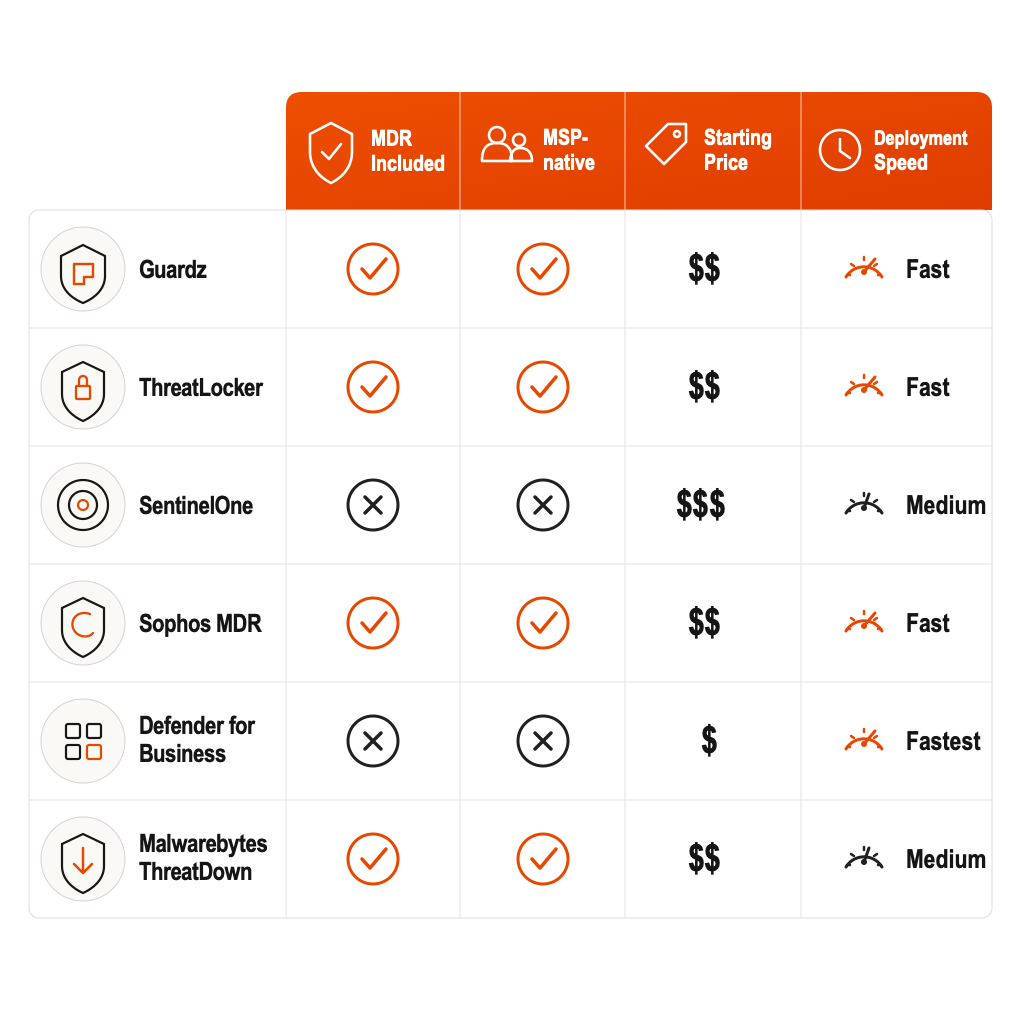
| Product | Type | MDR included | Starting price | Best for |
|---|---|---|---|---|
| Guardz | Unified security + MDR | Yes (Ultimate/Elite) | ~$7–$11/user/month | All-in-one MSP security stack |
| ThreatLocker | Zero trust / application control | Yes (Cyber Hero Team) | ~$5–$11/endpoint/month | Ransomware prevention, compliance |
| SentinelOne | Autonomous EDR/XDR | Optional (Vigilance) | $69.99/endpoint/year | Enterprise clients, large deployments |
| Sophos MDR | Managed detection & response | Yes | ~$137–$215/endpoint/year | Vendor-agnostic MDR on existing stack |
| Microsoft Defender for Business | EDR + antivirus | No | $3/user/month | M365-centric SMBs, budget-conscious clients |
| Malwarebytes ThreatDown | EDR + MDR | Yes | ~$10/device/month | Small clients, no seat minimums |
1. Guardz
Guardz is positioning its cybersecurity offerings as a broader, unified platform with a single, multi-tenant console (see chart). The platform combines identity threat detection and response, endpoint protection, email security, cloud data protection, security awareness training, phishing simulation, external exposure monitoring, dark web monitoring, and managed detection and response.
By contrast, Huntress' approach is more modular and segmented. Huntress offers multiple managed cybersecurity products as standalone offerings, and those are the services it sells or resells to customers. Huntress also provides 24/7 security operations center (SOC) support for subscribers of those managed products. So Guardz' broader, bundle-first approach is more aligned with certain managed service providers than Huntress'.
That said, it's important to note that the higher tiers of Guardz also embed management of SentinelOne endpoint protection and Check Point email security. Guardz correlates those signals with identity and cloud activity. So Guardz is a closer fit for managed service providers seeking to replace multiple security vendors, rather than just swapping out one endpoint detection and response (EDR) agent.
Key features:
- Unified 24/7 MDR - AI triages activity across identity, endpoint, email, and cloud data while human analysts validate threats and direct response
- Endpoint protection - Managed Microsoft Defender in Pro, SentinelOne Control in Ultimate, and SentinelOne Complete with deeper telemetry and threat hunting in Elite
- Email security - Check Point Advanced Email in Ultimate, with outbound DLP and encryption added in Elite
- Identity and exposure controls - ITDR, cloud data monitoring, external footprint scanning, and dark web monitoring share the same user-centric risk view
- MSP operations - Multi-tenant management, automated remediation, white-labeled reports, security business reviews, and prospecting reports
Pricing: Guardz does not publish exact seat prices. Its official pricing page bills per user across Pro, Ultimate, and Elite and offers a 14-day trial. MSPs in a July 2026 r/msp discussion reported roughly $7–$11/user/month depending on tier and volume. Because commenters also described recent pricing and tier changes, treat that range as anecdotal and get the final scope and rate in writing.
What users say: As of August 2026, Guardz holds 4.6/5 on G2 from 123 reviews. Reviewers praise its ease of use, coverage, and consolidated dashboard; recurring complaints include limited features, customization, and integrations. G2 reflects review-platform sentiment and does not independently validate individual capabilities. Capterra shows 4.9/5 from seven reviews, a positive but very small sample. The July r/msp discussion is mixed: users praise the SentinelOne and Check Point bundle, responsive support, and reduced tool overhead, while others report slowness, limited visibility, sales or billing problems, and concentration risk. Reddit is practitioner context, not market consensus.
When to choose Guardz over Huntress: Your clients use Microsoft 365 or Google Workspace, and you want endpoint, identity, email, awareness, exposure monitoring, and MDR under one model. Guardz is less compelling if you need standalone endpoint coverage without a supported cloud tenant, public pricing, a mature SIEM, or full freedom to select every component. Its onboarding documentation currently requires a Microsoft 365 or Google Workspace environment.
2. ThreatLocker
ThreatLocker is a zero trust endpoint protection platform built on a deny-by-default model. Instead of detecting threats after they run, ThreatLocker prevents unauthorized software from executing at all. Applications require explicit approval before they can run. Ransomware, rogue code, and unauthorized scripts are blocked automatically - not flagged and queued.
It's a fundamentally different philosophy from Huntress. Huntress waits for evidence of compromise and responds. ThreatLocker assumes everything is unauthorized until proven otherwise.
Key features:
- Allowlisting - Deny-by-default application control with automatic learning mode to inventory what's running before lockdown
- Ringfencing - Granular policy control over what each application can access (files, registry, network, privilege escalation)
- Zero Trust Network Access - Deny-by-default device authentication for every network connection
- Privilege Access Management - Elevate rights at the application level, not user level; eliminates standing admin privileges
- MDR via Cyber Hero Team - 24/7/365 managed detection with typical 60-second response time
Pricing: Custom quotes required. Community-reported ranges run roughly $5–$11/endpoint/month for standard deployments. Average implementation time is approximately two months with ROI payback in six months, per G2 user data.
What users say: G2 reviewers (4.8/5 from 474 reviews) consistently praise the Cyber Hero support team - some describe it as the best vendor support in 20+ years of IT. The tradeoff is learning curve: ringfencing and zero trust policy configuration require security expertise, and there are 44 G2 mentions of setup complexity.
When to choose ThreatLocker over Huntress: Your clients are compliance-heavy (healthcare, finance, legal) or have been hit by ransomware and want prevention-first rather than detection-based coverage. ThreatLocker also ranked #49 on Deloitte's 2024 Technology Fast 500 and #120 on Inc 5000 2025 - the platform is scaling fast.
Note: Many MSPs run ThreatLocker alongside Huntress rather than as a replacement. ThreatLocker blocks; Huntress hunts. Together they cover more ground than either alone.
3. SentinelOne Singularity
SentinelOne is an AI-native enterprise cybersecurity platform. It scored 100% detection accuracy with zero delays in the MITRE ATT&CK 2024 evaluation - 88% less noise than the median vendor. It's been named a Gartner Magic Quadrant Leader for five consecutive years (2025). Four of the Fortune 10 run it.
Where Huntress is managed-first and MSP-native, SentinelOne is autonomous-first and enterprise-grade. The platform responds to threats without waiting for a human SOC analyst to review - its AI agents act in real time. Huntress pairs AI with human threat hunters; SentinelOne's default posture is autonomous action with human oversight available.
Key features:
- Singularity Endpoint - NGAV + EDR + EPP with autonomous prevention and response across Windows, macOS, Linux, and containerized workloads
- Singularity Cloud Workload Security - Protection across VMs, containers, and Kubernetes on public/private/on-premises clouds
- Singularity Identity - Active Directory and Entra ID threat detection and credential protection
- Purple AI - Generative AI investigation assistant and agentic SOC analyst
- Singularity AI SIEM - AI-native SIEM that processes at machine speed
Pricing:
| Plan | Price/endpoint/year |
|---|---|
| Core | $69.99 |
| Control | $79.99 |
| Complete | $179.99 |
| Commercial | $229.99 |
| Enterprise | Custom |
What users say: G2 reviewers (4.7/5 from 201 reviews) highlight exceptional autonomous detection and a lightweight agent. The consistent complaint is complexity - the UI can feel convoluted, and configuration requires technical depth. On r/msp, a recurring pattern is smaller MSPs pairing SentinelOne with Huntress for the managed service layer rather than using SentinelOne alone.
When to choose SentinelOne over Huntress: You're managing enterprise clients (mid-market to large), need cloud workload protection or hybrid identity coverage, or want autonomous AI response rather than human-reviewed SOC. SentinelOne protects 9,250+ customers globally, including 4 of the Fortune 10 - if your client is asking whether their security would satisfy a Fortune 500 auditor, SentinelOne passes that test in a way Huntress may not.
4. Sophos MDR
Sophos MDR is the closest direct competitor to Huntress in managed security. It's fully managed 24/7, covers endpoint and identity threats, and is designed to be sold by MSPs to their customers. 39,000+ organizations trust it worldwide. It holds the highest customer review count of any MDR vendor on Gartner Peer Insights - 4.8/5 from 290 reviews - and is #1-rated MDR solution in the Spring 2026 G2 Overall Grid.
The major differentiator from Huntress: Sophos MDR works with your existing security stack. It integrates with 350+ third-party tools - CrowdStrike, SentinelOne, Microsoft Defender, and others. You don't have to rip and replace; you layer Sophos MDR on top as the managed response layer.
Key features:
- Agentic AI response - AI resolves 52% of cases end-to-end in an average of 89 seconds; human analysts supervise and own accountability
- 350+ integration ecosystem - Bring your own endpoint agents or use Sophos
- 24/7 expert-led threat hunting - Human analysts, not just AI dashboards
- Full-scale incident response - No hourly caps, dedicated IR lead included, root cause analysis
- Breach protection warranty - Financial backing for confirmed breaches
Pricing: Two service tiers - MDR Essentials and MDR Complete. Essentials starts at roughly $137/user/year for 1-9 users; Complete runs approximately $215–$226/endpoint/year. Pricing is quote-based via the Sophos pricing form.
What users say: MSPs on r/msp consistently mention attractive partner pricing and the ability to consolidate endpoint and MDR costs under one vendor. G2 reviewers (4.7/5 from 506 reviews) call out fast response times and better-than-competitors ratings versus CrowdStrike, SentinelOne, and Arctic Wolf in the Spring 2026 grids. The one wrinkle flagged in community discussions: Sophos's product portfolio is large - MDR, Intercept X, XDR, ZTNA - and some MSPs find the positioning confusing.
When to choose Sophos MDR over Huntress: You're already running a specific endpoint tool and don't want to rip it out, or you have clients on a mix of platforms and need a vendor-agnostic managed response layer. Sophos MDR also achieved 100% detection coverage in the MITRE ATT&CK Enterprise 2025 evaluation - on par with Huntress's detection quality.
5. Microsoft Defender for Business
Microsoft Defender for Business is built on the same technology stack as Defender for Endpoint - the enterprise product. It's sized and priced for organizations up to 300 users. At $3/user/month standalone, it's the most cost-effective entry point on this list.
For MSPs already selling M365 Business Premium at $22/user/month, Defender for Business is already included - you're paying for it whether you deploy it or not.
Key features:
- Automatic attack disruption - Contains ransomware and human-operated attacks in real time; 3-minute average disruption
- Endpoint detection and response (EDR) - Behavioral monitoring, cloud-delivered threat intelligence, automated investigation
- Vulnerability management - Discover, prioritize, and remediate software weaknesses
- Wizard-based onboarding - Pre-configured policies; no Intune required
- Multi-Tenant Lighthouse integration - Manage multiple customer tenants from one console
Pricing:
| Plan | Price | What's included |
|---|---|---|
| Defender for Business (standalone) | $3/user/month | Antivirus, EDR, vulnerability management, auto-remediation, mobile |
| M365 Business Premium | $22/user/month | Defender for Business + Office 365 + Intune + Entra ID + Teams + 1TB OneDrive |
| M365 Business Premium (no Teams) | $18.79/user/month | Same as above, minus Teams |
What users say: G2 reviewers (4.5/5 from 30 reviews) call onboarding simple and M365 integration seamless. The acknowledged gaps: zero-day detection lags SentinelOne and Sophos; the portal has had reliability issues in multi-tenant setups; cross-platform support (Mac, Android) is weaker than competitors. The r/msp consensus is that Defender for Business works well as a baseline but that MSPs commonly layer it with a dedicated EDR - including, notably, Huntress - for deeper coverage.
When to choose Defender for Business over Huntress: Your clients are Microsoft-centric SMBs on M365 Business Premium, and the $3/user standalone cost makes the security math work for smaller accounts. It won't replace Huntress for MSPs who need active threat hunting and a dedicated SOC - but for straightforward endpoint protection under 300 users, it's hard to beat the value.
6. Malwarebytes ThreatDown
ThreatDown is Malwarebytes' enterprise MDR tier - the direct Huntress competitor on this list in terms of feature set. The lower-tier Malwarebytes for Teams is standalone endpoint protection with no seat minimums starting at $119.99/year for three devices.
The standout advantage over Huntress: no minimum seat requirement. Huntress's pricing tiers start at 50 units per product - endpoints, identities, data sources, and learners are each counted separately. For MSPs serving smaller clients, that floor is a real constraint. ThreatDown removes it.
Key features (ThreatDown MDR):
- 24/7 SOC analyst coverage - Human analysts monitoring, investigating, and responding
- EDR + ITDR - Endpoint and identity threat detection and response (ITDR launching May 2026)
- Ransomware rollback - Restore encrypted files to pre-attack state
- Patch management + vulnerability assessment - Automated patching across Windows, macOS, and third-party apps
- Email security + DNS filtering - Layered pre-delivery protection
- Endpoint isolation + active response shell - Contain compromised devices remotely
- Single lightweight agent across all features
Pricing:
| Tier | Price |
|---|---|
| Malwarebytes for Teams (3 devices) | $119.99/year |
| Malwarebytes for Teams (10 devices) | $399.99/year |
| Malwarebytes for Teams (20 devices) | $519.99/year |
| ThreatDown MDR | ~$10/device/month (custom quotes) |
What users say: Malwarebytes for Teams holds a 4.5/5 on G2 from 37 reviews. Users praise the clean interface, lightweight resource footprint, and effective malware detection. On r/msp and r/SmallMSP, the conversation around ThreatDown consistently lands on two points: no seat minimums as a key advantage over Huntress, and ~$10/device/month as a competitive price point for full MDR. ThreatDown ranks #1 in MRG Effitas 360° ransomware assessments - ahead of Bitdefender, Symantec, and ESET. The one concern that occasionally surfaces in community threads: a 2021 security breach at Malwarebytes is still cited, though no customer data was reported compromised.
When to choose ThreatDown over Huntress: You're serving clients under 50 seats, or your MSP portfolio skews toward smaller accounts where Huntress's volume tiers create pricing friction. ThreatDown delivers comparable detection quality and 24/7 analyst coverage without the minimum commitment.
How to choose a Huntress alternative
The decision usually comes down to four questions: Do you want one security platform or a set of specialized tools? Do you need prevention or detection? What size are your clients? And how much do you want to self-manage?
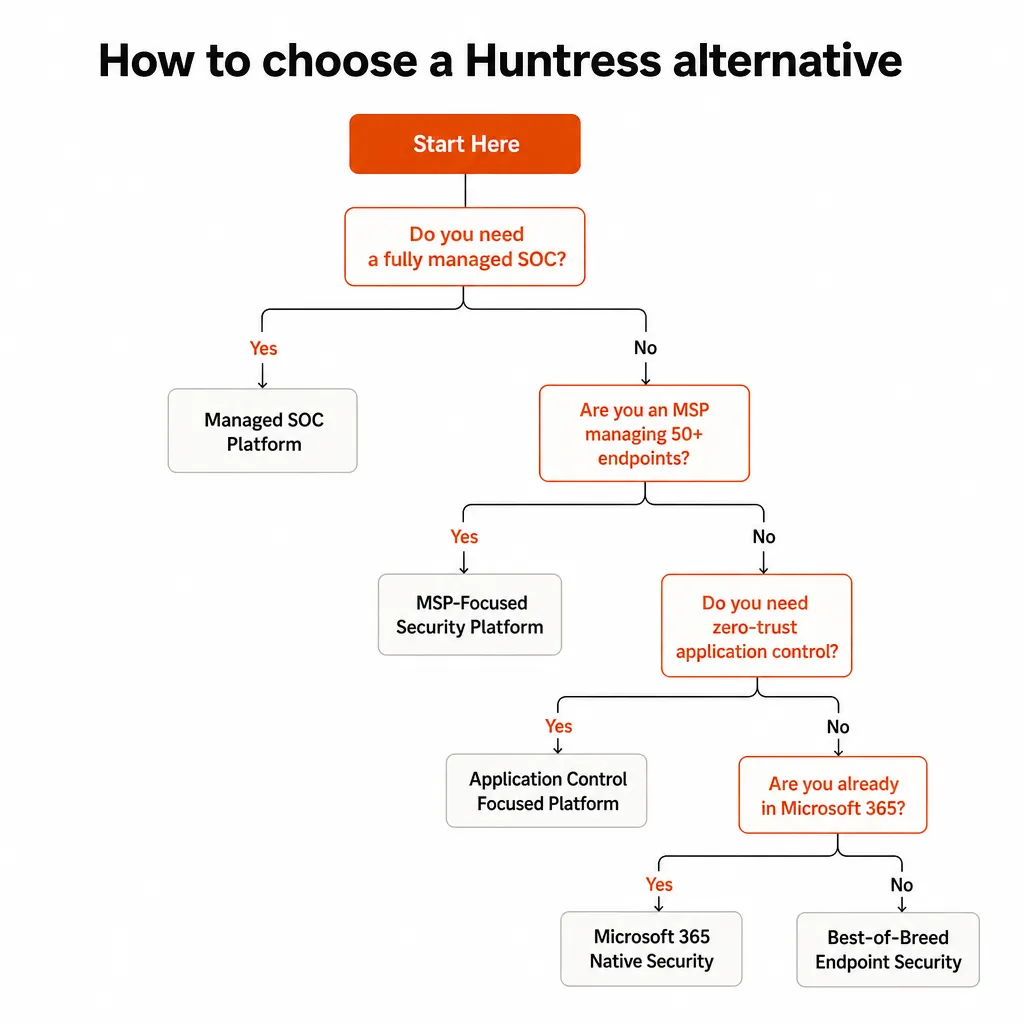
A simple framework:
- Want to consolidate the security stack: Guardz - endpoint, identity, email, awareness, exposure monitoring, and MDR under one MSP-native platform
- Clients under 50 seats, need MDR: ThreatDown by Malwarebytes - comparable detection, no minimums, ~$10/device/month
- Clients in Microsoft 365, tight budget: Defender for Business - $3/user/month standalone, already included in M365 Business Premium
- Clients want prevention-first, compliance-heavy: ThreatLocker - zero trust application control, stops attacks before they execute
- Existing security stack, need managed oversight: Sophos MDR - 350+ integrations, works with whatever endpoints you already have
- Enterprise clients with complex cloud/identity needs: SentinelOne - Gartner Leader, autonomous AI response, Fortune 10 grade
Most of these are not mutually exclusive. Many MSPs run ThreatLocker alongside Huntress or Sophos. Defender for Business often gets layered with a dedicated EDR. The typical security stack for a well-protected mid-sized MSP client ends up looking like two to three of these tools working together.
One thing your security stack doesn't solve
Whichever platform you choose, your security tools address external threats. They catch ransomware, flag account takeovers, and respond to endpoint intrusions. What they don't touch is the operational ticket queue - the 200-400 password resets, account unlocks, and onboarding requests that hit your engineers every month regardless of how well-protected your clients' endpoints are.
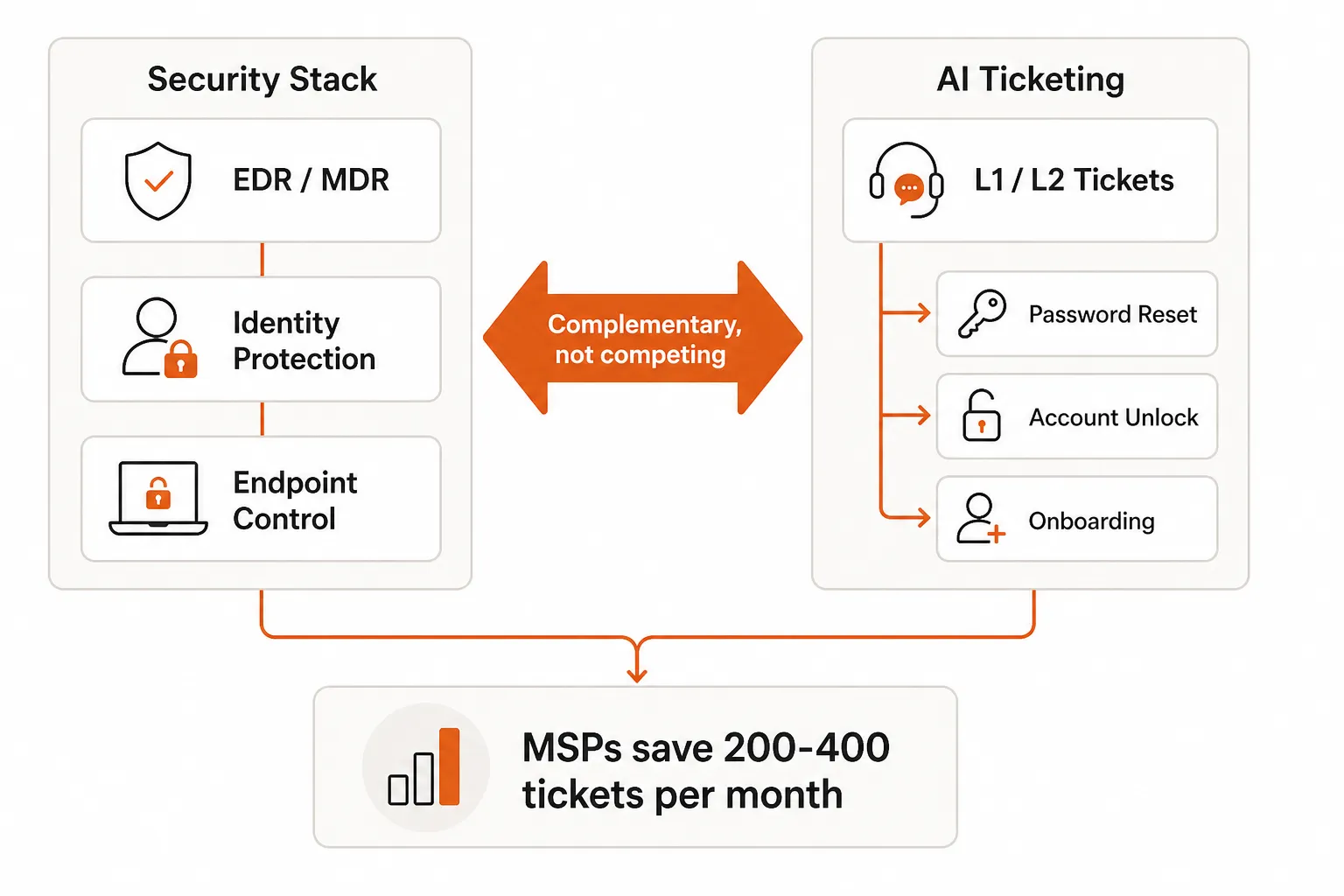
Security tools and operational automation solve different problems. The MSPs getting the most leverage aren't just optimizing their security stack - they're automating the ticket work that doesn't require a human at all.
Try Rallied
Rallied is an AI technician for MSPs that connects to your PSA, RMM, and M365 stack and resolves L1 and L2 tickets end-to-end - password resets, account unlocks, onboarding, offboarding, triage - without a tech touching them. The average MSP recovers $7K–$15K per month in engineer time handling automatable work that doesn't need a person.
It's not a security tool. It's the other half of the problem - the operational side that your security stack leaves untouched. If you're evaluating how to build a leaner, faster MSP in 2026, it's worth running Rallied's ROI calculator alongside your security stack evaluation.
Frequently Asked Questions
What is the main difference between Guardz and Huntress?
Guardz bundles endpoint, identity, email, awareness, exposure monitoring, and MDR in one MSP platform. Its Ultimate and Elite plans combine SentinelOne endpoint protection and Check Point email security with Guardz ITDR and cross-surface response. Huntress takes a modular approach built around individually priced managed products and its 24/7 human-led SOC. Guardz is the stronger fit when consolidation is the priority; Huntress may suit MSPs that prefer modular purchasing and its established SOC model. Compare Guardz and Huntress.
What is the main difference between Huntress and ThreatLocker?
Huntress is a reactive, detection-based MDR platform - it monitors for threats, hunts for footholds, and responds when something is found. ThreatLocker is a proactive zero-trust application control platform - it blocks unauthorized software from running in the first place. Many MSPs run both together for layered coverage. If your clients face compliance pressure or ransomware risk, ThreatLocker is worth evaluating alongside or instead of Huntress. Learn more about ThreatLocker.
Is there a free alternative to Huntress for small MSPs?
Microsoft Defender for Business is the closest to a free option - it's included in Microsoft 365 Business Premium ($22/user/month) alongside Teams, Exchange, Intune, and Entra ID. If you're already selling M365 to clients, Defender for Business is essentially no additional cost. For SMBs outside the Microsoft ecosystem, Malwarebytes for Teams starts at $119.99/year for three devices with no seat minimums.
Does Huntress have a minimum seat requirement?
Huntress pricing tiers start at 50 endpoints for Managed EDR, Managed ITDR, Managed SIEM, and Managed SAT - the pricing table on huntress.com/pricing lists '50-99' as the first volume bracket. This minimum makes Huntress less suitable for MSPs serving very small clients. ThreatDown by Malwarebytes and Microsoft Defender for Business have no published minimums.
Can I use Sophos MDR with tools I already have instead of replacing everything?
Yes - this is one of Sophos MDR's clearest differentiators. It integrates with 350+ third-party security and IT tools, including CrowdStrike, SentinelOne, Microsoft Defender, and others. You can keep your existing endpoint agents and layer Sophos MDR on top as a managed response service, rather than ripping and replacing your current stack.
Which Huntress alternative is best for enterprise clients?
SentinelOne Singularity is the strongest choice for enterprise clients. It's a Gartner Magic Quadrant Leader for five consecutive years, protects 4 of the Fortune 10, and scored 100% detection with zero delays in the MITRE ATT&CK 2024 evaluation. Its autonomous AI response and cloud workload security capabilities exceed what Huntress covers. The tradeoff: it's more expensive ($69.99–$229.99/endpoint/year) and requires more configuration than Huntress.