Huntress vs Blackpoint Cyber: Which MDR is Right for Your MSP in 2026?
TL;DR
Huntress and Blackpoint Cyber are the two MDRs MSPs actually argue about on Reddit - and for good reason. They're both good. But they're built around different philosophies.
Huntress gives you a world-class SOC with a portal you actually want to use - tool-centric, with MSPs in the driver's seat. Blackpoint is SOC-first, people-first - analysts watching your environments around the clock so you don't have to.
The short version: if your team wants visibility and control, go Huntress. If you want to hand off threat detection entirely and trust humans to handle it, go Blackpoint. Neither one is a bad call.
Where MSPs get into trouble is thinking MDR alone handles their operational burden. It doesn't. Huntress and Blackpoint are security tools - they don't close the password reset tickets stacking up in your PSA at 9am. That's a separate problem, and we'll get to it.
Why MSPs are rethinking their security stack in 2026
The ransomware math has changed. According to Huntress's own research, traditional EDR misses 72% of attacks - the ones that establish footholds, sit quietly, and move laterally before anyone notices. Windows Defender and a solid antivirus policy handle commodity threats well. But the attacker who compromises a credentials file and spends three weeks exploring your network before encrypting anything? That's what MDR exists to catch.
The other shift is identity. Business email compromise isn't a malware problem - it's a stolen credential problem. Blackpoint's SOC locks down an average Microsoft 365 account every 30 minutes across their customer base. Huntress's Managed ITDR detects impossible travel, privilege escalation, and mail forwarding rules that scream "someone else is in this inbox."
So the question isn't really "should my MSP have MDR?" That conversation is over. The question is which MDR - and which philosophy.
The decision frame: tool-centric vs SOC-centric
Before comparing the products feature-by-feature, it helps to understand what you're actually choosing between.
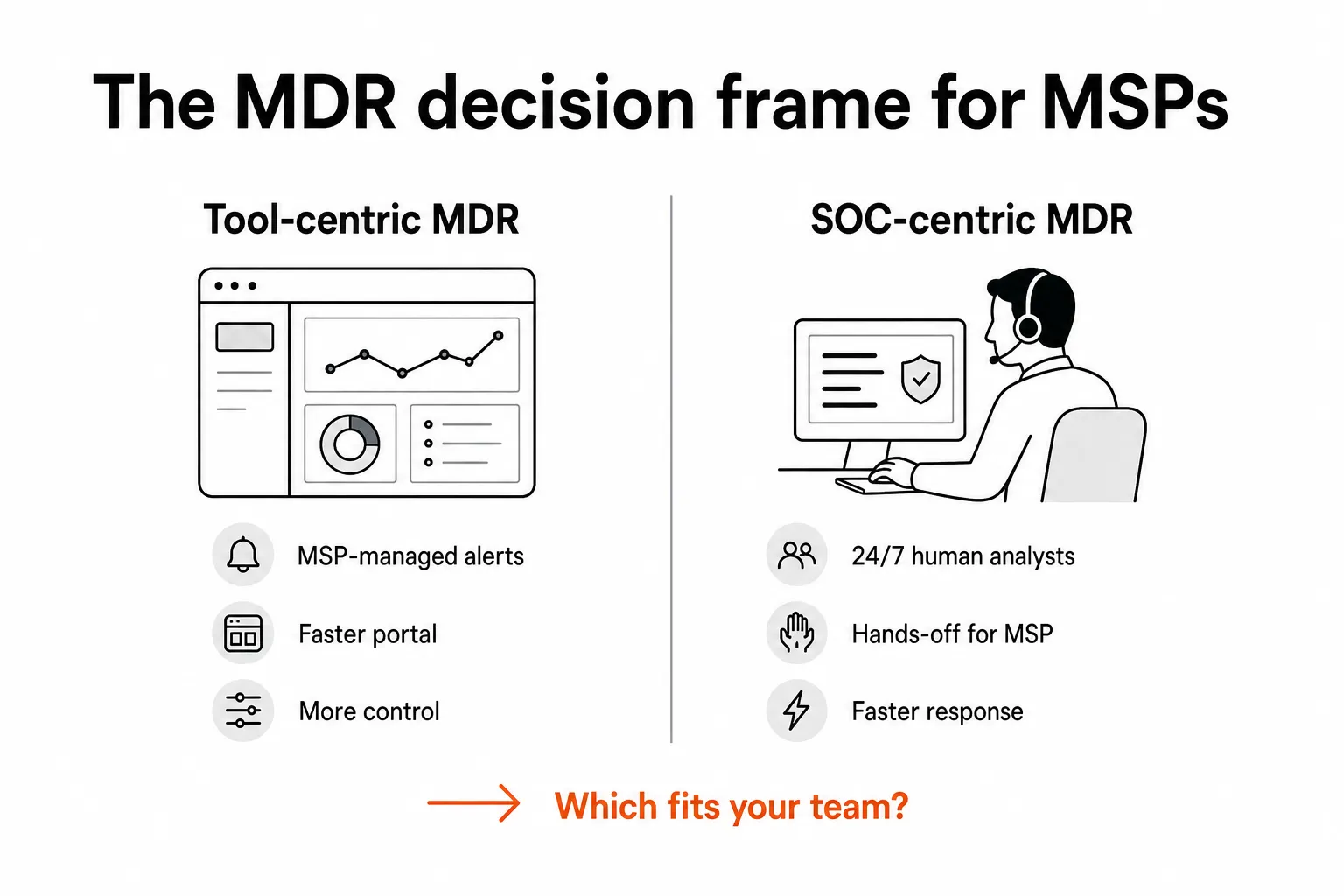
Tool-centric MDR means the platform does sophisticated detection and gives your team the intelligence to act. You're in the loop on every investigation. You decide how to respond. The SOC backs you up, but you're the primary actor.
SOC-centric MDR means the platform's analysts are the primary actors. They watch, investigate, contain, and remediate. Your team is on call if needed, but the default is "we handled it."
Huntress leans tool-centric. Blackpoint leans SOC-centric. Neither is wrong - they're designed for different MSP operating models.
Huntress
Huntress was built for the MSP market from day one, and it shows. The company protects 5 million+ endpoints globally with an industry-leading <1% false positive rate and an 8-minute mean time to remediation.
What Huntress actually does
The flagship is Managed EDR - a lightweight agent that runs behavioral analysis on endpoints and feeds alerts to a 24/7 SOC. When something real fires, the SOC investigates, confirms, and either remediates automatically (isolating the device, removing malware, reversing policy changes) or calls you. The key word is real: Huntress is deliberately conservative about alerting. Quiet isn't a sign it's not working.
On top of EDR, Huntress has built out a full stack:
- Managed ITDR at $4.80/identity/month - monitors Microsoft 365 and Google Workspace for account takeover, BEC, privilege escalation, and suspicious login behavior
- Managed SIEM at $4.00/data source/month - smart filtered log aggregation with extended retention
- Managed SAT at $2.08/learner/month - phishing simulations and security awareness training built in
Huntress pricing
| Product | Direct pricing | Typical MSP pricing |
|---|---|---|
| Managed EDR | $8.99/endpoint/month | ~$1.95–$4.50/endpoint/month |
| Managed ITDR | $4.80/identity/month | ~$2.40/identity/month |
| Managed SIEM | $4.00/source/month | ~$2.00/source/month |
| Managed SAT | $2.08/learner/month | ~$1.00/learner/month |
MSP partner pricing is typically 50% off list. At $4.50/endpoint for a 200-endpoint MSP, you're looking at roughly $900/month - cheaper than one good security analyst working part-time, with 24/7 coverage that doesn't call in sick.
The pricing is fully transparent. No "contact us for details," no tiers that hide response capabilities. Every endpoint gets the same 24/7 SOC access whether you're protecting 50 seats or 5,000.
What the community says about Huntress
The r/msp community is where honest vendor feedback happens, and Huntress gets broadly positive marks - 4.8/5 on G2 across 1,200+ verified reviews, with a 97% recommendation rate.
The most common testimonial pattern: someone questions paying $400–500/month when nothing is happening, then gets a call from the SOC one Monday morning explaining they already contained and cleaned an active compromise.
"Monday morning, I got a call from Huntress's automated alert system letting me know there was an incident I needed to review. A new exec had clicked on a phishing email, downloaded a malicious RMM installer, which then ran PowerShell scripts to install remote access tools. In the time it took me to log into the portal, Huntress had already identified the attack behavior, isolated the device, removed all of the offending tools, and was in the process of running the other remediations."
- r/msp thread on removing Huntress, October 2025
The occasional complaint is about agent removal in older versions (2023–2024 threads mention scripts that didn't work cleanly). Recent threads don't surface this as a recurring issue, but worth testing before a full rollout.
Our take: Huntress is the MDR for MSPs who want a fast, clean portal, transparent pricing, and a SOC that backs them up without taking the wheel. It's the tool-centric choice - you stay informed and in control, and the SOC steps in when it counts.
Blackpoint Cyber
Blackpoint Cyber has been in the MDR business since 2014 - before "MDR for MSPs" was even a product category - and the company's positioning reflects that depth. Where Huntress built a slick platform and layered in the SOC, Blackpoint built the SOC first and wrapped the platform around it.
What Blackpoint actually does
The core offering is 24/7 human-monitored MDR across endpoint, cloud, and identity environments. Blackpoint's SOC uses what they call "tier 1 eyes on glass" monitoring - analysts actively watching your environments rather than waiting for automated alerts to fire. The implication: threats get caught not just when a rule triggers, but when a human notices something off.
The CompassOne platform - Blackpoint's unified interface - consolidates endpoint detection, Microsoft 365 protection, and identity security into a single view with shared context. A reviewer on G2 put it plainly: CompassOne added dark web monitoring, vulnerability scanning, and SIEM integration at roughly the same price point.
The numbers that stand out from Blackpoint's own data:
- The SOC locks down an average Microsoft 365 account every 30 minutes across the customer base
- 20% of newly onboarded organizations have active business email compromise hiding in their environment when they connect
That second stat is the one that justifies the onboarding conversation. You don't know what's already in there until someone with a SOC looks.
Blackpoint pricing
Blackpoint doesn't publish pricing publicly - you'll need a direct conversation with their sales team. Based on G2 reviewer feedback, one MSP cited $11/month per user, which was described as "excellent value" for the service level. Expect pricing to vary based on endpoint count, service tier, and commitment size.
The lack of public pricing is a genuine friction point compared to Huntress. You can't quickly compare per-endpoint cost in a spreadsheet - you need a sales call. For some MSPs that's fine; for others it adds a step they'd rather skip.
What the community says about Blackpoint
4.7/5 stars on G2 from 258 verified reviews, ranked as the #1 Grid Leader in the MDR category. The review themes cluster tightly:
"The value is excellent; you get so much for only $11/month/user."
- Donald H., President/CTO, G2 review, April 2026
"Easy to use and hard to remove from an endpoint!!! A+!!! The SOC is always quick to answer my calls in the event we need to call in for an investigation!"
- Edward H., G2 review, December 2025
On r/msp, the dominant framing in Huntress vs Blackpoint threads is that Blackpoint is "SOC-centric" where Huntress is "tool-centric." MSPs who want to hand off threat investigation entirely land on Blackpoint; MSPs who want more portal visibility and control lean Huntress. The community generally respects both, with the occasional thread noting Huntress's UI has a polish advantage.
Our take: Blackpoint is the MDR for MSPs who want to hand the wheel to humans and trust the process. If your team is stretched thin and a SOC call at 2am is more valuable than a portal you log into, Blackpoint fits. The opaque pricing is the main friction point; budget a sales conversation.
Head-to-head comparison
| Dimension | Huntress | Blackpoint Cyber |
|---|---|---|
| SOC model | Tool-centric: MSP gets portal + SOC backup | SOC-centric: analysts handle investigation first |
| Pricing transparency | Fully public | Custom quote only |
| EDR pricing (MSP) | ~$1.95–$4.50/endpoint/month | ~$11/user/month (one cited example) |
| Identity protection | Managed ITDR ($4.80/identity direct) | Included in CompassOne |
| G2 rating | 4.8/5 (1,200+ reviews) | 4.7/5 (258 reviews) |
| False positive rate | <1% (self-reported) | Not publicly disclosed |
| Free trial | Yes, no credit card required | Sales-led evaluation |
| Platform breadth | EDR + ITDR + SIEM + SAT as modular add-ons | CompassOne unified (endpoint + cloud + identity) |
| Established since | 2015 | 2014 |
| Portal experience | Highly praised (community consensus) | Functional, fewer UI mentions |
Who wins which scenario
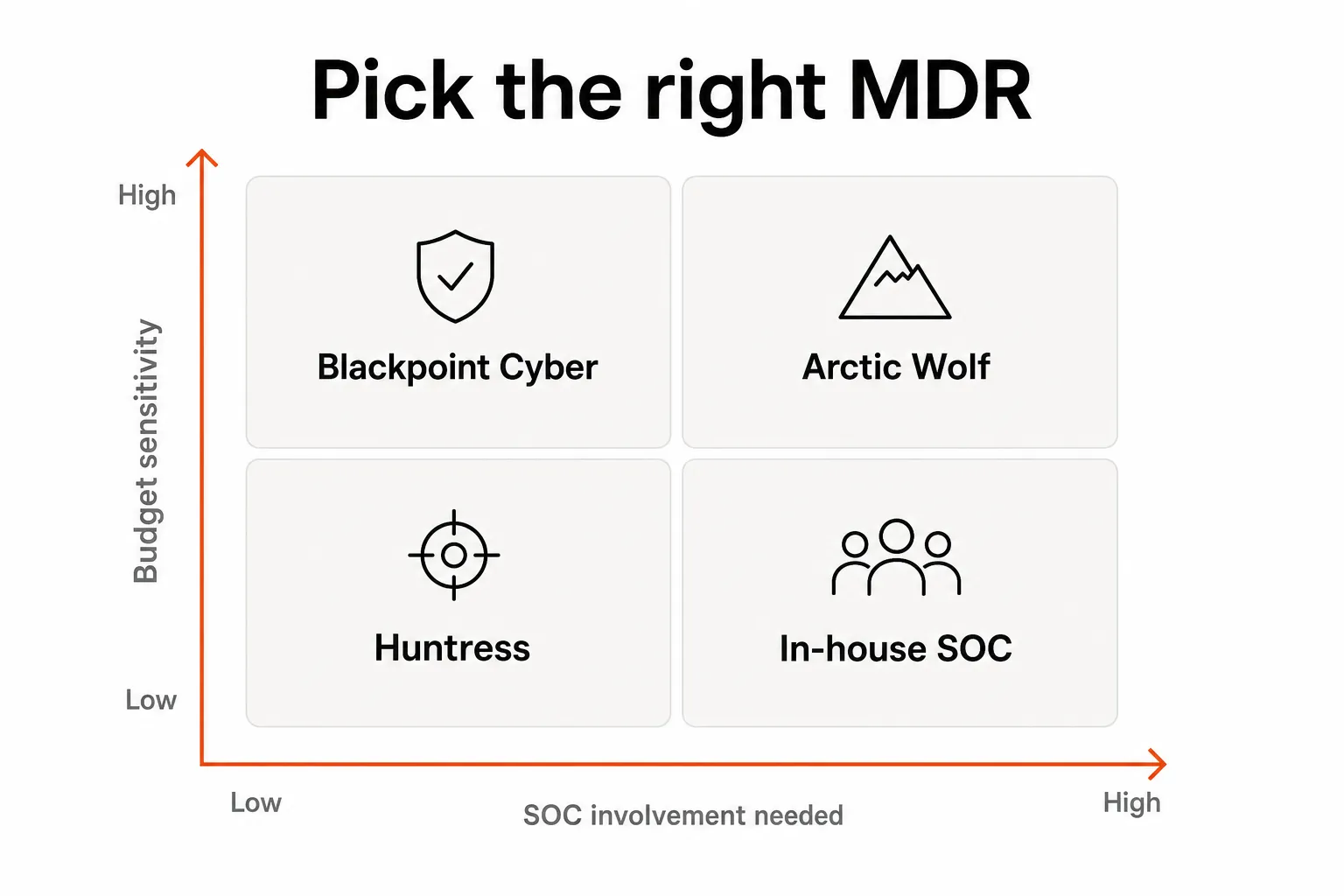
Choose Huntress if:
- You want pricing you can put in a spreadsheet without a sales call
- Your team wants to stay informed and review alerts in a portal they'll actually use
- You're building modular - want EDR now, add ITDR or SIEM later
- You're in high-volume verticals (healthcare, finance, legal) where audit trails and per-product controls matter
- You value the option to start a free trial before committing
Choose Blackpoint Cyber if:
- Your team is resource-constrained and "more alerts" is a liability, not an asset
- You want a human SOC calling your team when something real happens, not an email
- You've been burned by alert fatigue and need a more hands-off model
- You're onboarding clients in high-risk environments where the 20% BEC-at-onboarding stat hits close to home
- You'd rather negotiate pricing than trust a published number that might not reflect your actual deal
The honest answer in most r/msp threads: try Huntress first because the free trial removes risk. If your team finds it valuable and keeps the portal open, it's the right fit. If the alerts feel like noise and you want more human intervention in the loop, talk to Blackpoint.
The gap neither tool fills: your L1 ticket queue
Here's something worth saying plainly: Huntress and Blackpoint are security tools. They're excellent at what they do - detecting threats, containing incidents, protecting endpoints and identities.
What they don't do is resolve the password reset ticket that came in at 8am. Or the account unlock from the new hire whose MFA isn't set up right. Or the offboarding request that needs to be processed before the contractor's access becomes a liability. Or the 60 other L1 tickets your techs spend half their day on.
That's a separate operational problem, and it's one most MSPs underestimate. The average MSP with 200–400 tickets/month is burning 37–75 hours a month of senior tech time on work a competent L1 could handle - except the L1 bench is expensive, hard to hire, and turns over constantly.
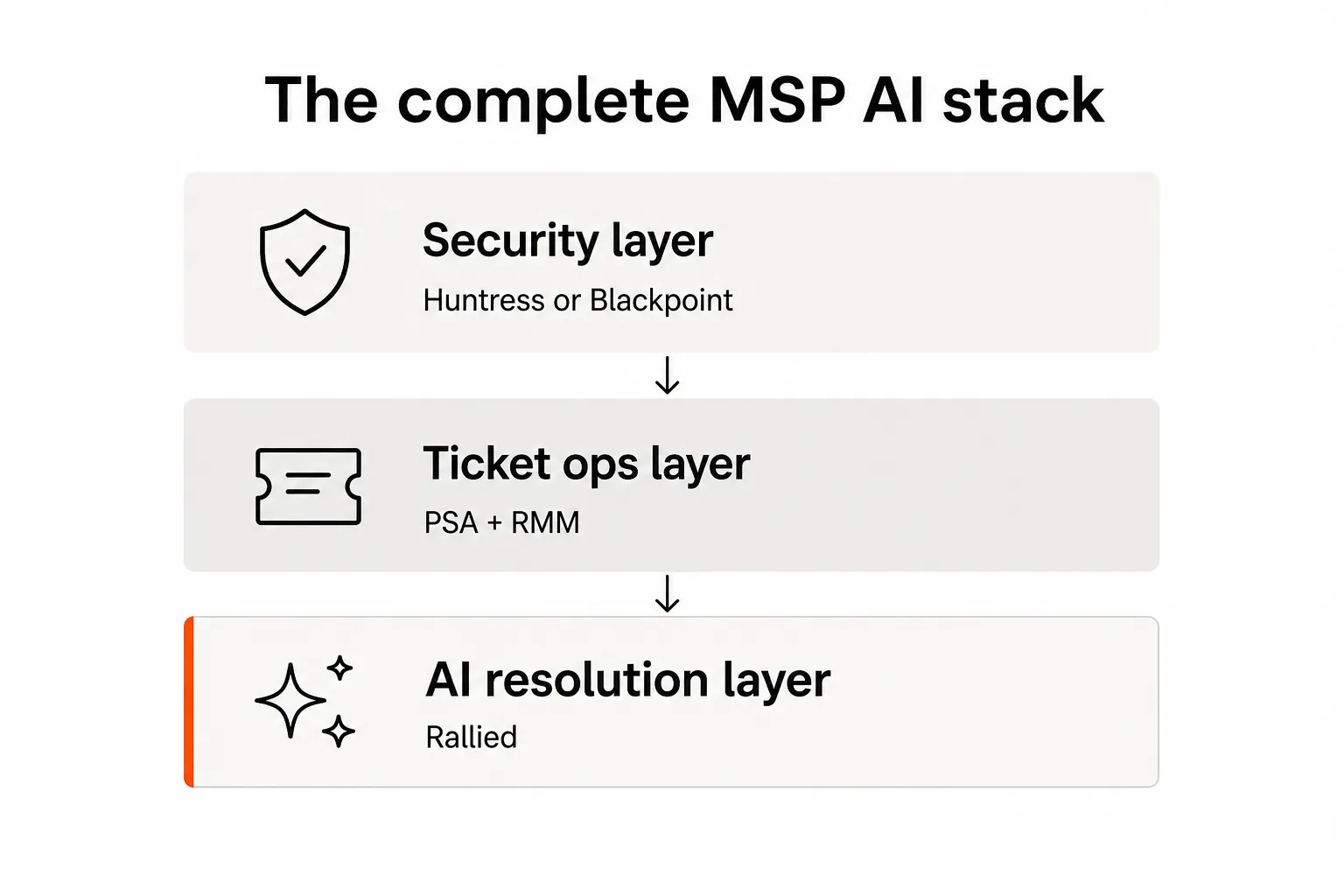
The stack that's emerging in forward-looking MSPs looks like this: MDR at the security layer (Huntress or Blackpoint, depending on your model) + AI ticket resolution at the ops layer. They don't overlap. They don't compete. They solve different problems in the same MSP stack.
Try Rallied
Rallied is an AI technician built specifically for MSPs that resolves L1 and L2 tickets autonomously - password resets, MFA unlocks, account provisioning, onboarding, offboarding, access management - without a tech touching them.
It connects directly to your PSA (ConnectWise, Autotask, HaloPSA, SuperOps), your RMM (Datto, NinjaOne, ConnectWise Automate), and your identity stack (Microsoft 365, Entra ID, Okta, JumpCloud, Google Workspace). It reads the ticket, executes the fix, documents the solution, and closes the ticket. No recommendation queue, no human click-to-apply - it does the work.
Unlike automation platforms that take months to configure, Rallied deploys in the same week you connect your tools. Pricing is $3 per ticket outcome - a $150/month minimum, and tickets Rallied can't move are free. An MSP handling 150 L1 tickets a month pays $450. The same 150 tickets handled by a senior tech at $30/hour costs over $1,100.
The math is different from MDR math, but the logic is the same: you're buying back hours your team shouldn't be spending on repeatable work, so they can focus on the cases that actually need human judgment.
If you're evaluating Huntress or Blackpoint for your security layer, it's worth a parallel conversation about what's handling your ticket ops layer. The two questions don't need to be answered at the same time, but they're both worth answering.
Frequently Asked Questions
Is Huntress or Blackpoint Cyber better for small MSPs?
Huntress tends to be a better fit for smaller MSPs who want more hands-on visibility - the portal gives you context and control over every alert. Blackpoint's SOC-centric model shines when your team is stretched thin and you'd rather hand off threat investigation entirely. Both work at small scale; the difference is how much you want to be involved.
What is the pricing difference between Huntress and Blackpoint Cyber?
Huntress publishes transparent pricing: $8.99/endpoint/month direct, with MSP partner pricing typically 50% lower (roughly $1.95–$4.50/endpoint). Blackpoint uses custom quote-based pricing - one G2 reviewer cited $11/user/month as an example. Huntress is generally the more price-transparent option; Blackpoint requires a sales conversation to get a number.
How does Huntress compare to Blackpoint Cyber on the r/msp community?
Both are respected on r/msp. The community consensus is that Huntress has a better dashboard and more MSP-friendly portal experience, while Blackpoint is described as more 'SOC-centric' - it's a people-first service with analysts watching your environments around the clock. As one thread put it: 'Huntress is flashier, but both are great companies and both offer a great toolset.'
Can I use both Huntress and Blackpoint Cyber together?
In practice, MSPs choose one MDR, not both - they overlap too heavily on core function. The real stack question is which MDR to pair with your RMM and PSA. Both Huntress and Blackpoint integrate with common RMMs like ConnectWise Automate, NinjaOne, and Datto.
What is Rallied and how does it complement my MDR choice?
Rallied is an AI technician for MSPs that resolves L1 and L2 support tickets autonomously - password resets, account unlocks, onboarding, offboarding, access management. It connects to your PSA, RMM, and identity stack and closes tickets without a tech touching them. It's not a security tool - it handles the operational ticket volume that neither Huntress nor Blackpoint is designed for, freeing your team to focus on the security work that actually needs human judgment.