Huntress pricing: what MSPs actually pay in 2026

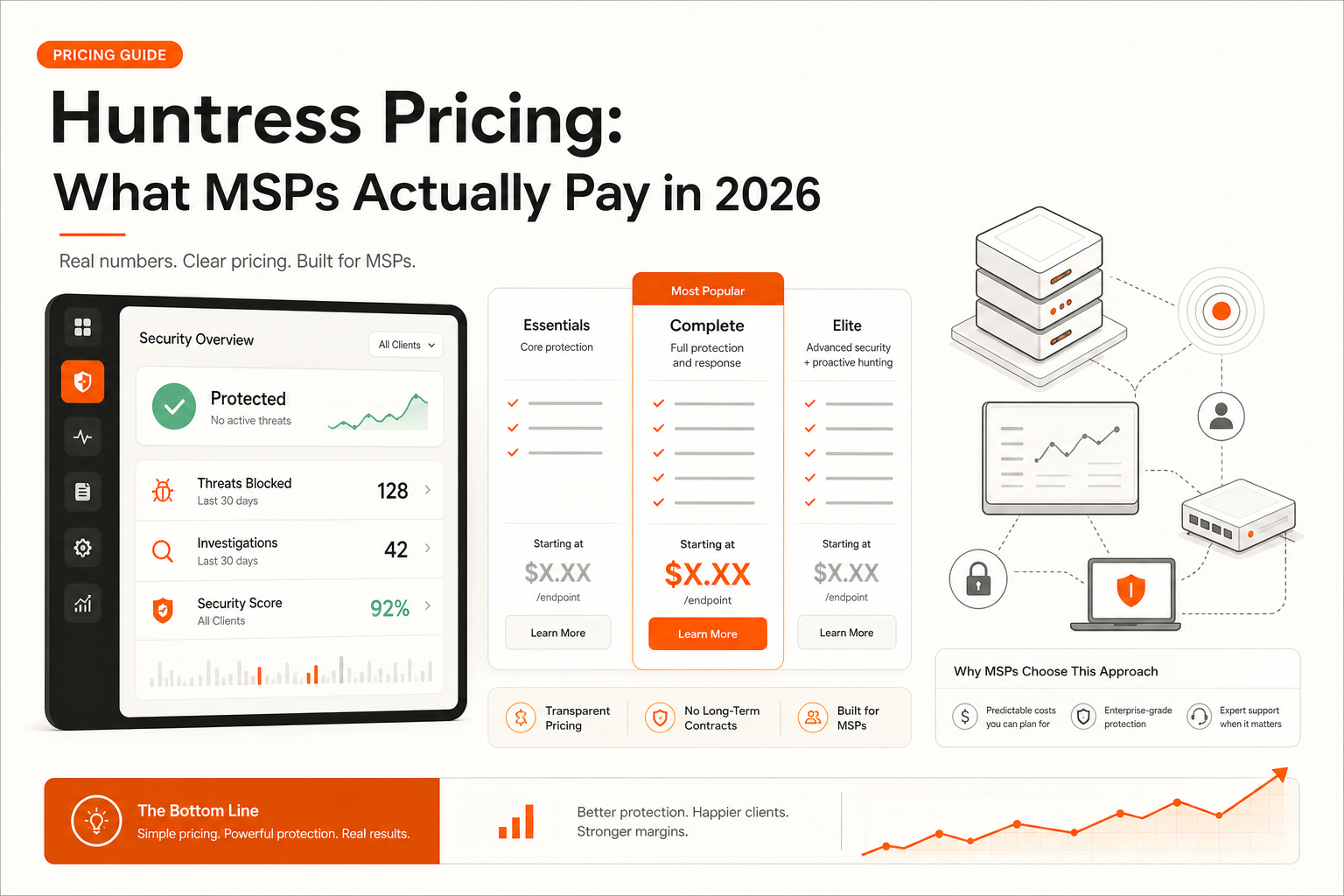
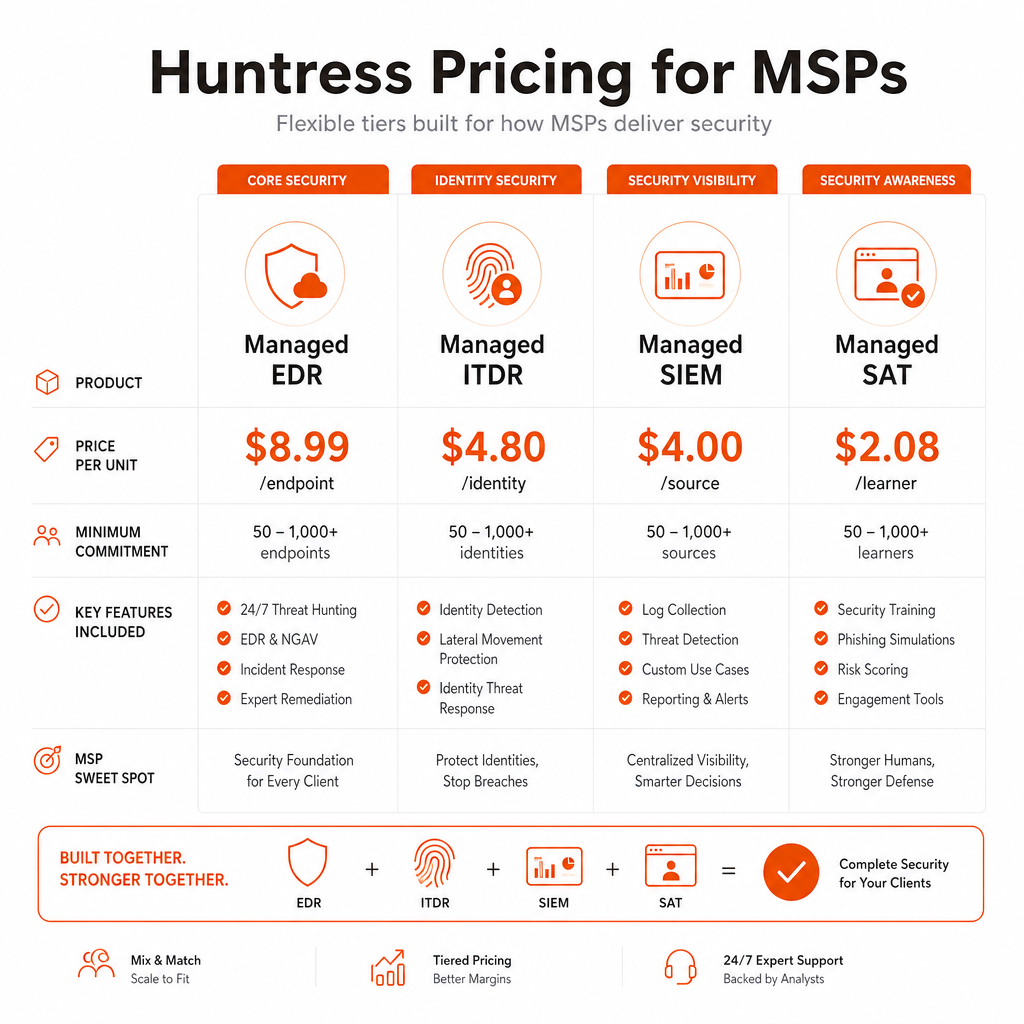
Huntress pricing is per unit, with no feature tiers or bundles. Published list rates are $8.99 per endpoint for Managed EDR, $4.80 per identity for ITDR, $4.00 per data source for SIEM, $4.00 per identity for ISPM and $2.08 per learner for SAT, each the monthly MSRP on the Huntress pricing page, with the 24/7 SOC included. Per-unit rates drop with volume, and MSP partners pay less.
How much less matters, because the number on an MSP's cost sheet rarely matches the Huntress pricing page. MDR Cost reports channel partner rates for Managed EDR of $2.50 to $3.50 per endpoint, which Huntress does not publish. This breakdown covers list rates for all five products, what partners report paying, worked monthly costs, contract terms, and how Huntress compares with CrowdStrike, SentinelOne and Arctic Wolf.
What Huntress is and who it's for
Huntress is a managed detection and response (MDR) platform built for MSPs and the businesses they support. Its pricing page covers five products: endpoint protection (Managed EDR), identity threat detection (Managed ITDR), log aggregation and compliance (Managed SIEM), identity security posture management (Managed ISPM) and user security training (Managed SAT). A sixth product, Managed ESPM for endpoint security posture, appears in the product menu without a published price. Everything runs under a 24/7 human-led, AI-assisted security operations center.
Huntress describes itself as a channel-first vendor, which means it builds its pricing around MSPs and resellers rather than direct buyers. The pitch to MSPs is that you get a SOC without hiring one, at a per-unit price you can read before you talk to sales. That is a different approach from the "call for pricing" model most enterprise security vendors still use.
Huntress list pricing by product
All prices below are the monthly MSRP, in US dollars, per unit. The Huntress pricing page says cost is based on your number of endpoints, identities, learners and data sources, and that 24/7 SOC management is included at no additional cost. Per-unit rates fall as volume rises. Huntress's example rates at 100 units are $7.99 per endpoint for EDR, $3.60 per identity for ITDR, $3.50 per source for SIEM, $1.75 per learner for SAT and $3.40 per identity for ISPM.
| Product | Per-unit cost | What it covers | Minimum (direct) |
|---|---|---|---|
| Managed EDR | $8.99/endpoint | Endpoint detection, threat remediation, managed antivirus, 24/7 SOC | 50 |
| Managed ITDR | $4.80/identity | Identity threat detection (M365, Google Workspace), account takeover prevention, policy change detection, 24/7 SOC | 50 |
| Managed SIEM | $4.00/source | Log aggregation, smart filtering, compliance reporting, long-term retention | 50 |
| Managed ISPM | $4.00/identity | Managed Microsoft 365 identity hardening, drift remediation, billed per licensed identity | 50 |
| Managed SAT | $2.08/learner | Phishing simulations, security training, engagement tracking, compliance reporting | 50 |
There is no separate SOC line item. MDR Cost puts it plainly: "Huntress SOC pricing" is really the price of whichever product you buy.
What MSP partners actually pay for Huntress
The list rates above are what a direct buyer pays. MSPs that qualify as partners get what Huntress calls Partner Supported pricing with aggregate discounting, and those rates are not on the website. MDR Cost reports channel partner rates of $2.50 to $3.50 per endpoint per month for Managed EDR, before the MSP adds its own markup.
| Endpoints | Via MSP partner / month (channel-reported) | Direct list |
|---|---|---|
| 50 | $125-175 | $449.50/month |
| 100 | $250-350 | $7.99 per endpoint |
| 250 | $625-875 | Tiered, quoted by Huntress |
| 500 | $1,250-1,750 | Tiered, quoted by Huntress |
Individual partners report lower numbers again. One r/msp pricing thread includes a poster quoting EDR at $1.95 and ITDR at $1.10 per unit per month, which shows how far partner rates can sit below list.
Huntress says it offers similar pricing to all partners, and its support docs give three ways to see your rate: start a trial and open "billing & subscription" from the top-right menu, contact Huntress directly, or ask in communities like Reddit, MSPgeek and Discord where partners share their pricing.
To qualify for partner pricing, Huntress asks that:
- You are an IT or cybersecurity service provider, such as an MSP.
- At least 40% of your total business, or of your MSP business unit's revenue, comes from IT security services and IT support, including break-fix.
- Your website and public profiles such as LinkedIn say you provide IT security services and support.
- You support Huntress directly for your clients as part of a managed services offering.
If you don't fit that description but think you should qualify, Huntress says to ask your account rep for a review. The 50-seat minimum per product applies to direct and reseller purchases. Huntress's pricing page says clients who buy through an MSP face no Huntress-required minimum seat count.
If you price security into a per-user bundle, our guide to MSP per-user pricing and the broader managed services pricing breakdown show where a Huntress line item fits.
Huntress cost examples at common MSP sizes
These use the published direct list rates, so treat them as a ceiling. Partner pricing lands well under these numbers.
- At 50 endpoints, EDR alone costs $449.50 a month, or $5,394 a year. Adding ITDR for the same 50 identities brings it to $689.50 a month.
- At 100 endpoints, the direct EDR rate drops to $7.99 per endpoint. Through the channel, MDR Cost reports EDR at $250 to $350 a month for 100 endpoints.
- At 250 endpoints and above, direct rates step down further and Huntress quotes them. Through the channel, MDR Cost reports EDR at $625 to $875 a month for 250 endpoints.
What's included in each Huntress product
Managed EDR: $8.99/endpoint
24/7 endpoint threat detection and response, backed by 6M+ endpoints under management. The product includes:
- Active threat hunting and behavioral detection rather than a signature-only approach.
- Managed antivirus, included at no extra cost.
- Host isolation by the SOC for fast-spreading threats, plus Managed Response, which lets you pre-approve automatic remediation actions.
- Custom incident reporting with clear remediation steps, so your team investigates real threats instead of noise.
MSPs mention in reviews that Huntress catches "persistent footholds that antivirus misses", which is the job EDR is supposed to do. At $8.99 per endpoint you're paying for a SOC analyst's time, not just log forwarding. For the difference between the two categories, see EDR vs antivirus.
Managed ITDR: $4.80/identity
Identity Threat Detection and Response for Microsoft 365 and Google Workspace. It covers account takeovers, business email compromise, privilege escalation and suspicious policy changes, including session hijacking and rogue logins that bypass MFA. Huntress protects 16M+ identities globally.
- 24/7 monitoring for suspicious login patterns, MFA bypasses and unauthorized changes.
- Automated remediation that revokes sessions, disables accounts and resets passwords.
- Custom incident reporting focused on identity-specific risks.
Endpoints are one attack path and identities are another, so most MSPs bundle EDR and ITDR to cover both.
Managed SIEM: $4.00/source
Huntress Managed SIEM aggregates logs from servers, firewalls and cloud services, with smart filtering to cut noise. A "source" is one log input: one firewall, one server or one cloud application.
- Pre-built filters flag security events and drop routine noise like successful logins and log rotations.
- Pooled storage gives you a log retention allocation shared across all sources, so there are no per-source overages.
- Compliance reporting for SOC 2, CMMC and HIPAA is built in.
- Threat correlation across data sources.
SIEM is optional. Many MSPs start with EDR and ITDR, then add SIEM when a client needs compliance reporting or long-term log retention.
Managed ISPM: $4.00/identity
Managed ISPM appears alongside the other four products on the Huntress pricing and trial pages, at an MSRP of $4.00 per licensed identity per month ($3.40 at 100 identities), the same unit ITDR bills on. The pricing page describes it as fully managed Microsoft 365 identity hardening: policies built from Huntress SOC threat intelligence, drift detected and remediated in about 15 minutes, a Learning Mode that previews a policy's impact before anything changes, and one dashboard for multi-tenant management.
Managed SAT: $2.08/learner
Security Awareness Training delivered by Emmy-award-winning animators, with phishing simulations, role-based training paths and automated reporting.
- Customizable training content covering ransomware, phishing, business email compromise and credential hygiene.
- Phishing simulations with real-time reporting on who clicks.
- Engagement tracking you can show compliance auditors.
- A 98% completion rate for users who start assignments.
Huntress pricing and contract terms MSPs should know
The SOC is included
The 24/7 human-led SOC is part of every per-unit price. Huntress's pricing page says there are no confusing tiers, add-ons or expensive bundles, so there is no higher plan you need to buy to unlock response.
Volume tiers
The MSRP is the starting rate, and the per-unit cost drops at higher volumes; Huntress shows example pricing at 100 units. You can increase your commitment mid-term to reach a lower tier, and doing so restarts your 12-month contract from the new date.
No setup or onboarding fees
You deploy the Huntress agent and console in under an hour with standard IT admin permissions. Most MSPs don't need Huntress's professional services team, though it is available if you want help integrating with your PSA or RMM.
12-month term, billed monthly in arrears
The standard term is 12 months, billed monthly in arrears based on deployed usage. If you commit to 250 endpoints and deploy 275, you're billed for 275.
Free trial
Huntress offers a fully featured trial, not a cut-down version, backed by the same 24/7 SOC as paid customers, with no credit card required. Most MSPs use it as a proof of concept on a real client environment before committing. You can start the trial here.
Huntress pricing vs CrowdStrike, SentinelOne and Arctic Wolf
Huntress's own MDR vendor comparison, updated in October 2026, lists these starting prices. It's a vendor-written page, so read it as Huntress's framing, and note the units and billing periods differ.
| Vendor | Starting price (as listed) |
|---|---|
| Huntress | $8.99 per endpoint/month for EDR |
| CrowdStrike | $184.99 per device/year |
| SentinelOne | $299.99 per endpoint/year in the summary table ($229.99 in the page's own SentinelOne section), as an add-on to the Commercial package |
| Arctic Wolf | $2.99 per user/month, billed annually, 30+ users |
CheckThat.ai's pricing summary lands in the same place: Huntress is consistently benchmarked at $3 to $9 per endpoint per month, against concierge-model MDR providers charging $12 to $25 or more. The gap reflects a more automated service model compared with providers that assign a named SOC team.
For head-to-head detail, see Huntress vs SentinelOne, Huntress vs Blackpoint Cyber, our list of Huntress alternatives and the wider roundup of MDR tools for MSPs.
Huntress vs building your own SOC
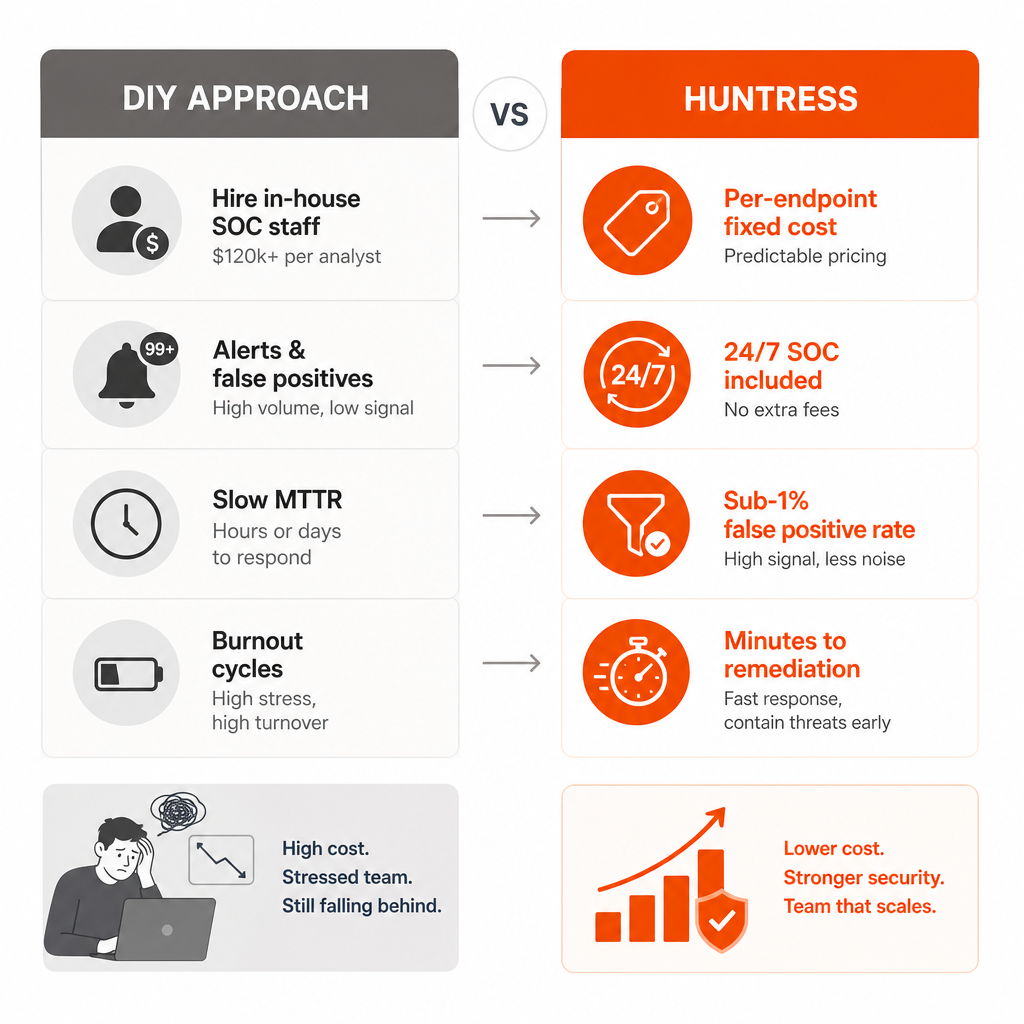
A dedicated SOC analyst costs $80-120k a year plus benefits, overhead and ramp-up time, and most small to mid-market MSPs can't justify the hire. So security work gets done in between other tickets, or it doesn't get done, and alert fatigue stretches response times to hours or days.
Huntress puts 24/7 coverage inside the per-unit price. At channel-reported partner rates, EDR for 250 endpoints runs $625 to $875 a month, which is a fraction of one analyst's salary for round-the-clock coverage. The bigger change for an MSP is that you can sell managed security as a service without building a SOC in-house. If you're still deciding what level of coverage to sell, MDR vs EDR for MSPs covers the trade-off.
What MSPs say about Huntress pricing
From G2 reviews and community feedback:
"I sleep better when my clients are being protected with Huntress. Huntress helps us by looking for persistent footholds in a network that antivirus just doesn't catch. We're getting a lot of the benefits of a bigger EDR platform for an extremely reasonable price." Dylan Sauce, Innovative Communication Systems
"During the trial process, we made enough money to pay for Huntress for three months in the first two days. We've worked closely with a lot of the different teams from Huntress, and everybody's awesome." Keenan Cline, Lightbulb Networks
"The value that we get with Huntress far exceeds what we're getting with SentinelOne. Huntress has allowed us to deliver a solution that is monitoring 24/7 from an EDR perspective, while also adding that critical SOC component." Andy Warner, Connecting Point
On TrustRadius, Huntress scores 9.5 out of 10 across 47 reviews. One reviewer wrote: "Short of hiring a SOC service, which can be quite expensive, Huntress is the best value for peace of mind from external threats." Not every buyer agrees on cost, though. Another TrustRadius reviewer said: "This is offered at a premium price and we decided not to invest very heavily in this type of service yet."
Huntress's pricing page shows a 4.8 out of 5 rating from 1,200+ G2 reviews and a 4.9 average on Capterra. Our full Huntress review covers where it falls short.
How the Huntress SOC works
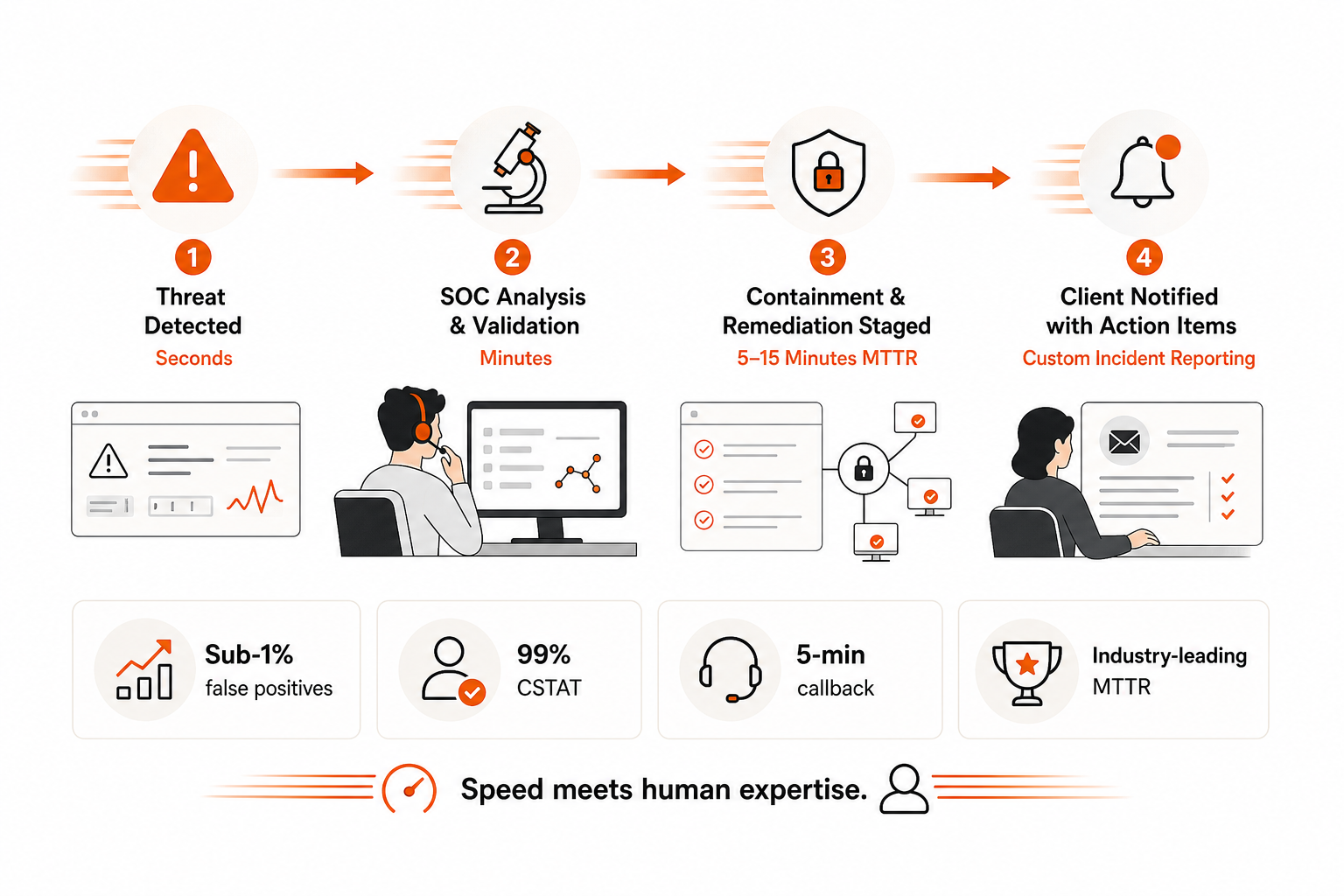
This is where MSPs say the platform earns its cost. When a threat is detected:
- Detection takes seconds, as behavioral analytics flag anomalous activity at the endpoint or identity level.
- A human analyst triages the alert within minutes to decide whether it's a real threat or noise.
- If it's real, the SOC stages remediation (5-15 minutes MTTR): isolating the threat, revoking sessions, disabling accounts or blocking C2 traffic, whatever the threat requires.
- Your team gets a clear incident report with context and next steps, so you know what happened and what was done.
Legacy EDR tools fire alerts and expect your team to work out the response. Huntress includes the team that does it.
Huntress MSP partner program
Huntress prices MSP partners separately from direct customers. Partner benefits include:
- Co-marketing, with sales materials, case studies and co-branded resources.
- Free NFR (not-for-resale) licenses through the Neighborhood Watch program, so you can run Huntress on your own environment before pitching it to clients.
- Dedicated partner support with faster response times and a partner success manager.
To get partner pricing or NFR licenses, request them directly from Huntress.
Where Rallied fits next to Huntress
Huntress covers the security side of your stack. The tickets that eat your techs' mornings are a separate cost: password resets, account unlocks and new-user setups that sit in the queue until an L1 tech picks them up. Our password reset ticket volume statistics show how much of the queue that work takes up.
Rallied is an AI agent that closes those tickets in ConnectWise, HaloPSA or Autotask. It runs the fix in Microsoft 365 and your RMM, then writes the notes and time entry back to the ticket. There is one plan at $300 a month with 2,000 credits, which covers roughly 700 tickets in a typical month based on Rallied's production data, and a ticket the agent couldn't finish or wasn't allowed to act on is never charged. The full breakdown is on the pricing page.
Frequently Asked Questions
What's the minimum contract for Huntress?
Direct and reseller purchases carry a 50-seat minimum per product on a 12-month standard term. MSP partners are billed monthly in arrears on deployed usage, and clients who buy through an MSP face no Huntress-required minimum seat count. There's no setup or onboarding fee.
Does Huntress pricing include the 24/7 SOC?
Yes. Huntress's pricing page says 24/7 SOC management is included at no additional cost across its products. There is no standalone SOC line item, so the SOC price is built into whichever product you buy.
Can I combine multiple Huntress products at a discount?
Huntress says it has no bundles, and each product is billed on its own unit. Discounts come from volume tiers and from partner pricing. At list rates, EDR plus ITDR for 50 endpoints and 50 identities costs $689.50 a month.
How much do MSP partners pay for Huntress?
Huntress doesn't publish partner rates. MDR Cost reports channel partner pricing for Managed EDR of $2.50 to $3.50 per endpoint per month before MSP markup, against a direct list price of $8.99. You can see your own rate by starting a trial and opening billing and subscription, or by asking Huntress.
How do I qualify for Huntress partner pricing?
Huntress asks that you are an IT or cybersecurity service provider, that at least 40% of your revenue comes from IT security services and IT support, that your website and public profiles say so, and that you support Huntress directly for your clients as a managed service. If you don't meet every point, your account rep can review your case.
What happens if my endpoint count grows mid-contract?
Huntress bills monthly in arrears on deployed usage, so if you commit to 250 endpoints and deploy 275, you're billed for 275. You can also raise your commitment mid-term to reach a lower per-unit tier, which restarts the 12-month term from that date.
How does Huntress compare to hiring your own SOC?
A dedicated SOC analyst costs $80-120k a year plus overhead. At channel-reported partner rates, Huntress Managed EDR for 250 endpoints runs $625 to $875 a month, with 24/7 monitoring and remediation included.
How does Huntress pricing compare to CrowdStrike and SentinelOne?
Huntress's own comparison page lists CrowdStrike from $184.99 per device per year and SentinelOne's MDR add-on from $229.99 to $299.99 per endpoint per year (the page gives both figures), against Huntress EDR at $8.99 per endpoint per month. Read those as a vendor's framing, and check current quotes before you decide.