7 best IT Glue alternatives in 2026 (for MSPs who've done the math)

TL;DR
IT Glue is still the gold standard for MSP documentation - 350,000 users don't end up on a platform by accident. But the 36-month contracts, the Kaseya acquisition's shadow, and per-user pricing that compounds fast have a lot of shops quietly doing the math. If the math isn't working for you, here's where the real alternatives sit:
- Hudu is the direct swap - same feature set, 40% cheaper, no long-term contract, 4.7/5 on G2
- Confluence is for teams who don't need the MSP-specific layer (no PSA sync, no multi-tenancy, but genuinely good for internal knowledge)
- Passportal (N-able) makes sense if you're already deep in the N-able stack
- Syncro bundles lightweight docs into its RMM+PSA - not a replacement, but it removes one tool from your stack
- Rewst is not a documentation tool; it's a workflow engine - but it reads from IT Glue/Hudu and adds the execution layer on top
If you're running Rallied for autonomous ticket resolution, none of these choices matter much - Rallied connects natively to both IT Glue and Hudu and reads your runbooks either way.
Why people actually leave IT Glue
Before running through the list, it's worth being honest about what's driving the searches. IT Glue is a well-built product - Cooper Copilot's SOP Generator alone has produced 100,000+ documents since launch, and a 4.6/5 G2 rating with 339 reviews isn't the profile of a broken tool. The frustrations that push MSPs to look elsewhere are more structural:
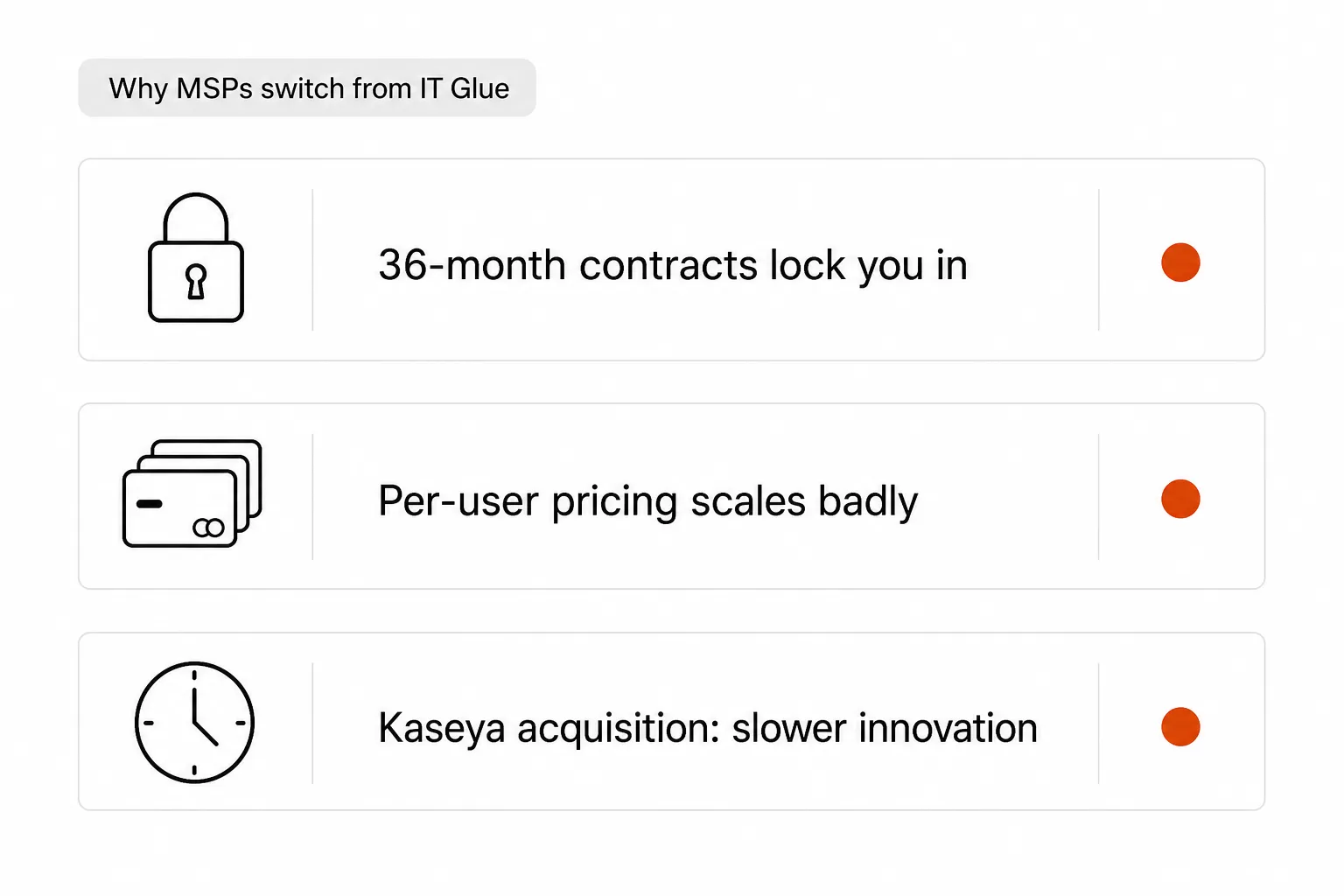
The contract structure. IT Glue's pricing page lists rates at $29–$49/user/month - but those are 36-month commitment prices. You're not signing up for software; you're signing a 3-year agreement. For a growing MSP where headcount shifts frequently, that lock-in hurts.
Add-on sprawl. The base plans look reasonable until you realize that Ninja Glue (auto-documentation, password rotation) is $453/month on top, and My IT Glue (end-user portal) is another $407/month. What looked like $38/user suddenly has four line items.
The Kaseya ceiling. The r/sysadmin community threads on IT Glue are interesting: even fans of the product end up in conversations about roadmap stagnation. One upvoted comment: "IT Glue is a stagnant product. Unless you have multiple Kaseya... One of the last updates I liked the most was Cooper Copilot." That's damning praise - the AI feature is keeping goodwill alive, but the broader product feels like it's orbiting Kaseya's priorities rather than MSP ones.
None of this makes IT Glue a bad product. It makes it a mature product with a structure that doesn't fit everyone. Here's what fits better.
The 7 best IT Glue alternatives in 2026
1. Hudu - best direct replacement
Best for: MSPs who want IT Glue functionality without the contract and the price.
Hudu is the most direct IT Glue alternative on the market. It covers the same territory - structured documentation, password management, IT asset tracking, IPAM, client portals, PSA/RMM integrations - and does it at $27/user/month on an annual basis with no minimum user count. No 36-month contract. 14-day free trial, no card required.
For a 10-person MSP team, the annual math is $27 × 10 × 12 = $3,240. That same team on IT Glue Select ($38/user/month) is $4,560 before add-ons. Hudu even built an IT Glue savings calculator that shows the typical 40% cost delta - ballsy move, and it checks out.
The platform has earned 5,500+ users across MSPs and IT teams and a 4.7/5 rating on G2 (350+ reviews). What actually drives those reviews is a combination of the interface being genuinely intuitive and the support being noticeably in-house and responsive. IT Glue's support has a reputation for being slow post-acquisition; Hudu's users mention 24/7 direct support as a differentiator.
The feature set holds up on the things that matter most to MSPs:
- Structured Docs - standardized layouts that enforce consistency across technicians, not free-form pages that drift over time
- Asset tracking - customizable forms for devices, vendors, and systems
- Password vaults - RBAC, audit logs, OTP generator
- IPAM - subnet management and network visualization
- Client portals - external sharing without exposing your full knowledge base
- Hudu Radar (add-on, $9/company/month) - network discovery and device auto-documentation
What Hudu doesn't have is IT Glue's Cooper Copilot SOP Generator, which auto-captures browser workflows and converts them to step-by-step SOPs with screenshots. That's a genuinely useful feature and not something Hudu has replicated at the same depth yet. If AI-assisted SOP creation is your primary reason for being on IT Glue, weigh that carefully.
One of Hudu's case studies: TeamLogic IT reported 75% faster ticket resolution after switching. That's not from IT Glue being slow - it's from the documentation being actually findable, which is the whole point.
"The Hudu team listens, the updates are frequent and relevant, and the platform is intuitive from day one." - Patrick W., Braintree Group, via G2
Pricing: $27/user/month (annual). Radar add-on: $9/company/month. Free trial: 14 days, no card.
Our take: For the majority of MSPs evaluating IT Glue alternatives, Hudu wins on the fundamentals - cost, contract flexibility, UX, and support responsiveness. The only gap is IT Glue's SOP Generator depth, which matters for some shops and not at all for others.
2. Confluence - best for internal knowledge (non-MSP use)
Best for: Teams that need collaborative internal documentation and are already in the Atlassian ecosystem.
Atlassian Confluence is a 2025 Gartner Magic Quadrant Leader for Collaborative Work Management and the preferred knowledge platform for tens of thousands of software, product, and operations teams globally. For IT teams managing a single environment - or internal IT departments rather than MSPs with client portfolios - it's a solid choice.
The pricing is genuinely good: free for up to 10 users, Standard at ~$8-10/user/month for unlimited users and 250 GB storage, Premium at ~$13-16/user/month with Rovo AI, analytics, and 99.9% SLA.
The honest conversation for MSPs: Confluence is not an IT Glue replacement. It doesn't have PSA/RMM integration. It doesn't have multi-tenant client portals that silo documentation per managed organization. It doesn't have a built-in password vault, IT asset tracking, or network documentation. What it has is excellent collaborative editing, real-time co-authoring, whiteboards, Jira integration, and Rovo AI (on Premium) that searches across your entire workspace.
If you're running a team of 5-10 people managing one environment and what you actually need is "a place where everyone can write down how things work," Confluence is hard to beat at that price. If you're an MSP managing 30 clients with separate environments, you'll hit the walls fast.
Pricing: Free (10 users), Standard ~$8-10/user/month, Premium ~$13-16/user/month.
Our take: Pick Confluence if your primary need is internal knowledge management and you're in the Atlassian ecosystem. Don't pick it as an IT Glue substitute if you need multi-tenancy, PSA sync, or client portals - it wasn't built for that job.
3. Passportal (N-able) - best for N-able shops
Best for: MSPs already on N-able's RMM who want credential and documentation management without adding another vendor.
Passportal is N-able's password management and documentation platform, built specifically for MSPs and bundled into the N-able ecosystem. If you're running N-able RMM, you likely already have access to it. The primary components:
- Password Manager - AES-256 encrypted credential vault with granular RBAC
- Documentation Manager - IT documentation organized around clients, assets, and processes
- Blink - Self-service password reset portal for end users, reducing L1 password tickets
- Site - Documentation and password management for on-premise environments
The ecosystem integration is the genuine selling point. Passportal connects to ConnectWise Manage, N-able RMM, and Microsoft 365 without the glue work you'd need if these were separate vendors. For N-able shops, that's real value.
The honest limitation: Passportal's documentation capabilities are considerably more basic than IT Glue or Hudu's. The platform is credential-management-first with documentation layered on top, not the other way around. MSPs who need deep structured docs, SOP workflows, and asset relationship mapping at IT Glue's depth typically find it lacking.
Pricing is bundled and not publicly listed - you'd know what you're paying if you're an N-able customer. For shops not already in the N-able ecosystem, there's little reason to start there for documentation alone.
Pricing: Bundled with N-able subscriptions; custom quote required.
Our take: Passportal is a solid choice if you're already in N-able and want to consolidate your password management and basic docs under one vendor. It's not worth starting a new N-able relationship just for documentation if you have other options.
4. Syncro - best all-in-one for small MSPs
Best for: Small MSPs (under 15 techs) who want RMM, PSA, and basic documentation in one bill.
Syncro is not an IT Glue alternative in the strict sense - it's a combined RMM + PSA platform that includes lightweight documentation capabilities alongside endpoint management, remote access, and M365 security. The documentation module handles runbooks, SOPs, and config notes, and it integrates directly with Hudu for teams that need more depth.
The pricing model is genuinely different: $179-$209/tech/month with unlimited endpoints. That's per-technician pricing - a 5-tech shop managing 500 endpoints pays the same as one managing 50. For small shops with rapidly growing device counts, this is a materially better model than per-device alternatives.
Syncro earned 19 G2 Winter 2026 badges including High Performer, Most Implementable, and Best Estimated ROI. The implementation speed badge is consistent with what MSPs report: it's genuinely fast to get running, partly because the feature set is opinionated rather than infinitely configurable.
What it doesn't do: deep client documentation portals, password vault audit trails at IT Glue's depth, SOP generators, or cross-client asset relationship mapping. If your documentation need is "we need to be able to find SOPs during a ticket," Syncro covers that. If it's "we need a full IT documentation system that clients can log into," it falls short.
Pricing: $209/tech/month (month-to-month), $179/tech/month (12-month term). 14-day free trial, no card required.
Our take: Syncro makes sense for small shops consolidating their toolset. As a standalone documentation replacement for IT Glue, it's underpowered - but if you're also looking to replace your RMM and PSA, it's worth the free trial.
5. Rewst - best for MSPs who want to go beyond documentation
Best for: MSPs who've outgrown documentation and want their tools to actually execute work.
This one needs a brief reframe: Rewst is not a documentation platform. It's a workflow automation engine. It connects to your PSA, RMM, identity systems, and documentation tools (including IT Glue and Hudu) to orchestrate multi-step business processes autonomously. Password reset workflow? Rewst handles the trigger-to-close loop. New hire onboarding? It provisions accounts across AD, M365, and your PSA without a technician touching each step.
The reason it belongs on this list is that many MSPs evaluating IT Glue alternatives are actually asking a different question than "where do I store my docs." They're asking "why does a technician still have to touch a ticket after the SOP says exactly what to do?" That question lands you in Rewst territory - or in Rallied territory, which we'll cover at the end.
Rewst's impact claims are backed by case studies: Network IT Easy saves 75-80 hours/week across the team. Marcus Networking automated billing reconciliation and saved $120K+/year. The platform has accumulated 15+ million hours saved across its MSP base.
The honest trade: the setup investment is real. Rewst requires time to configure workflows, and the MSPs who get the most out of it tend to have someone who genuinely wants to learn the platform. The RoboRewsty AI assistant (builds workflows from plain-language descriptions) reduces that friction, but it doesn't eliminate it.
Pricing is usage-based or per-managed-endpoint - no public rate card, requires a demo.
Our take: Rewst isn't an IT Glue alternative. It's a tier above that - automation infrastructure that reads from IT Glue/Hudu and acts on what it finds. If you've hit the ceiling on documentation and want your stack to start resolving work rather than just recording it, Rewst is worth the conversation. Just budget implementation time honestly.
6. Notion - best if you genuinely just need a wiki
Best for: Small internal IT teams who need lightweight structured knowledge and nothing MSP-specific.
Notion has built a devoted user base on the strength of its flexibility - nested pages, databases, kanban boards, templates, and a freemium tier that's genuinely useful. For a solo IT consultant or a 2-3 person internal team managing one environment, it's a capable knowledge base.
For MSPs, the gaps are fundamental:
- No PSA or RMM integration
- No multi-tenant client portals
- No password management (separate tool required)
- No IT asset tracking beyond what you build manually
- Per-user pricing that gets complicated fast when you're trying to give clients view-only access
Notion's strengths - flexible page structure, embedded databases, easy sharing via links, AI writing assistance on the paid tier - translate well to general knowledge management. They translate poorly to MSP-specific documentation requirements like managing 25 separate client environments each with their own network diagrams, credential vaults, and SOP libraries.
Pricing: Free (no limit on users/pages, some features restricted), Plus ~$12/user/month, Business ~$18/user/month, Enterprise custom.
Our take: Notion is excellent at what it does. What it does is not what IT Glue does. If you're a solo MSP or internal IT admin who just needs a lightweight place to put things, Notion is pleasant to use and free to start. If you're managing multiple clients, look elsewhere.
7. IT Portal - best for centralized ITSM + documentation
Best for: MSPs looking for a platform that combines an ITSM layer with documentation and client visibility.
IT Portal is a centralized IT management platform that pairs documentation with a client-facing service desk layer. Where IT Glue and Hudu are documentation-first (and add portal features on top), IT Portal approaches from the ITSM side - structured around service delivery workflows with documentation embedded.
The platform covers: asset management, network documentation, password management, client portals with SLA tracking, and integrations with common PSA and RMM tools. It's particularly useful for MSPs who want clients to have visibility into their environments without granting them access to the technician-facing documentation system.
Exact pricing requires a demo - the platform offers a trial but doesn't publish rates publicly. Community sentiment around IT Portal is positive but limited, mostly from smaller MSPs who value the client portal depth over the documentation breadth.
Our take: IT Portal is worth evaluating if your client portal needs are sophisticated and IT Glue's MyGlue add-on feels like an upsell for something that should be table stakes. Not the deepest documentation platform in this list, but a reasonable all-in-one for MSPs where client-facing visibility is the priority.
How to actually pick one
The choice usually comes down to two questions:
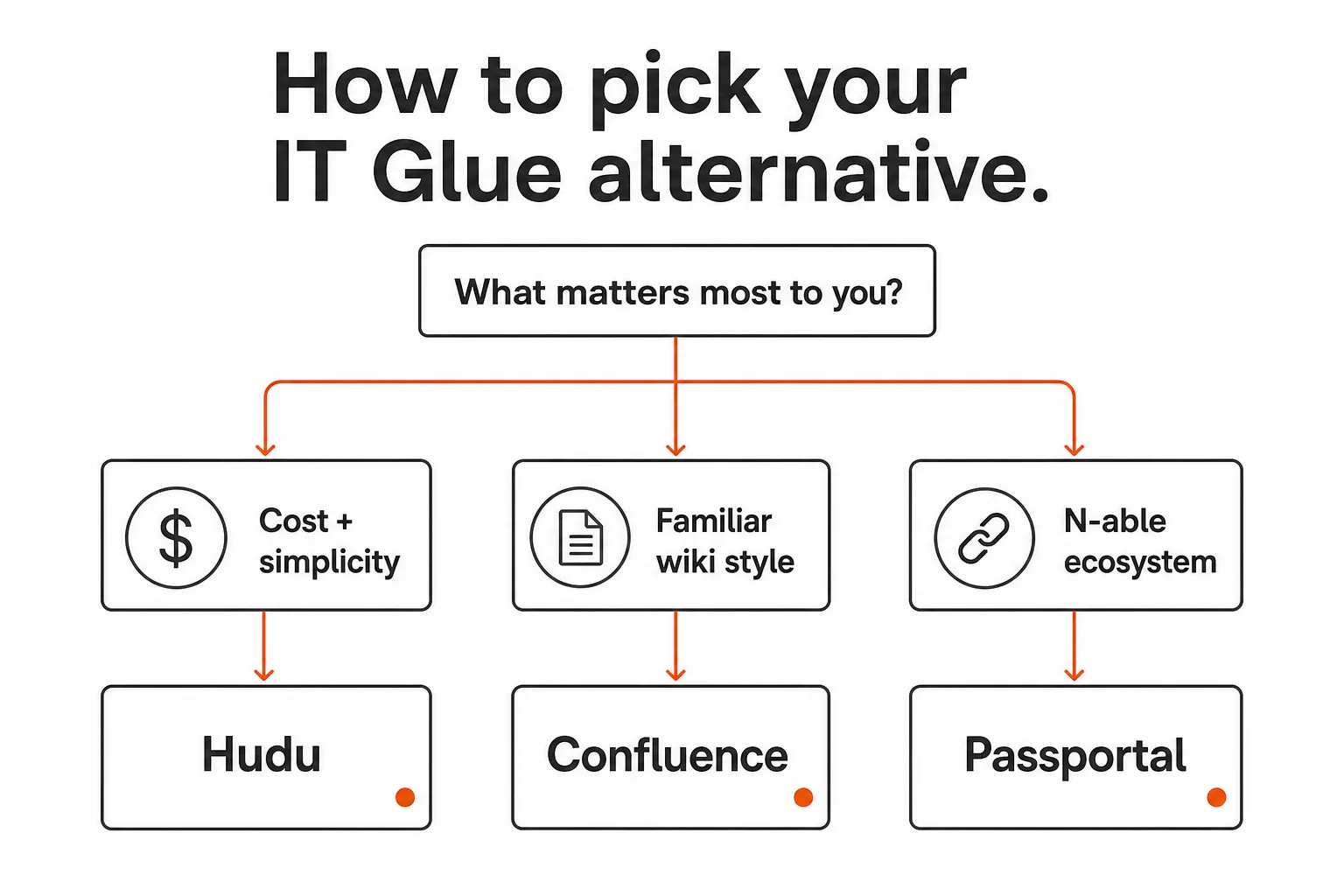
1. Do you need MSP-specific features? If you're managing multiple clients with separate environments, separate credential vaults, and a need for client-facing portals, you need Hudu or IT Glue (or Passportal if you're N-able-native). Confluence and Notion aren't built for this.
2. What's your current level of documentation maturity? If you're starting from scratch, Hudu's free trial is the fastest path to a functional system. If you're already on IT Glue and have years of structured data, a migration plan matters - Hudu offers assisted migration, but it takes real work.
Here's the simple decision table:
| Situation | Pick this |
|---|---|
| Want IT Glue at 40% less, no contract | Hudu |
| Already on N-able RMM | Passportal |
| Internal IT team, Jira user, just need a wiki | Confluence |
| Small MSP, want RMM+PSA+docs bundled | Syncro |
| Need automation that acts on your docs | Rewst or Rallied |
| Solo consultant, just need lightweight notes | Notion |
| Want client portal depth + ITSM layer | IT Portal |
One thing documentation tools can't do
Here's the thing that doesn't get said enough: the best documentation system in the world still requires a technician to read it and act on it. Your IT Glue runbook says exactly how to reset a password - and then a senior engineer opens a ticket, opens IT Glue, reads the runbook, performs the reset, updates the ticket, and closes it.
That's the workflow everyone on this list optimizes. Better search, better structure, better SOP capture. But a technician still touches the ticket.
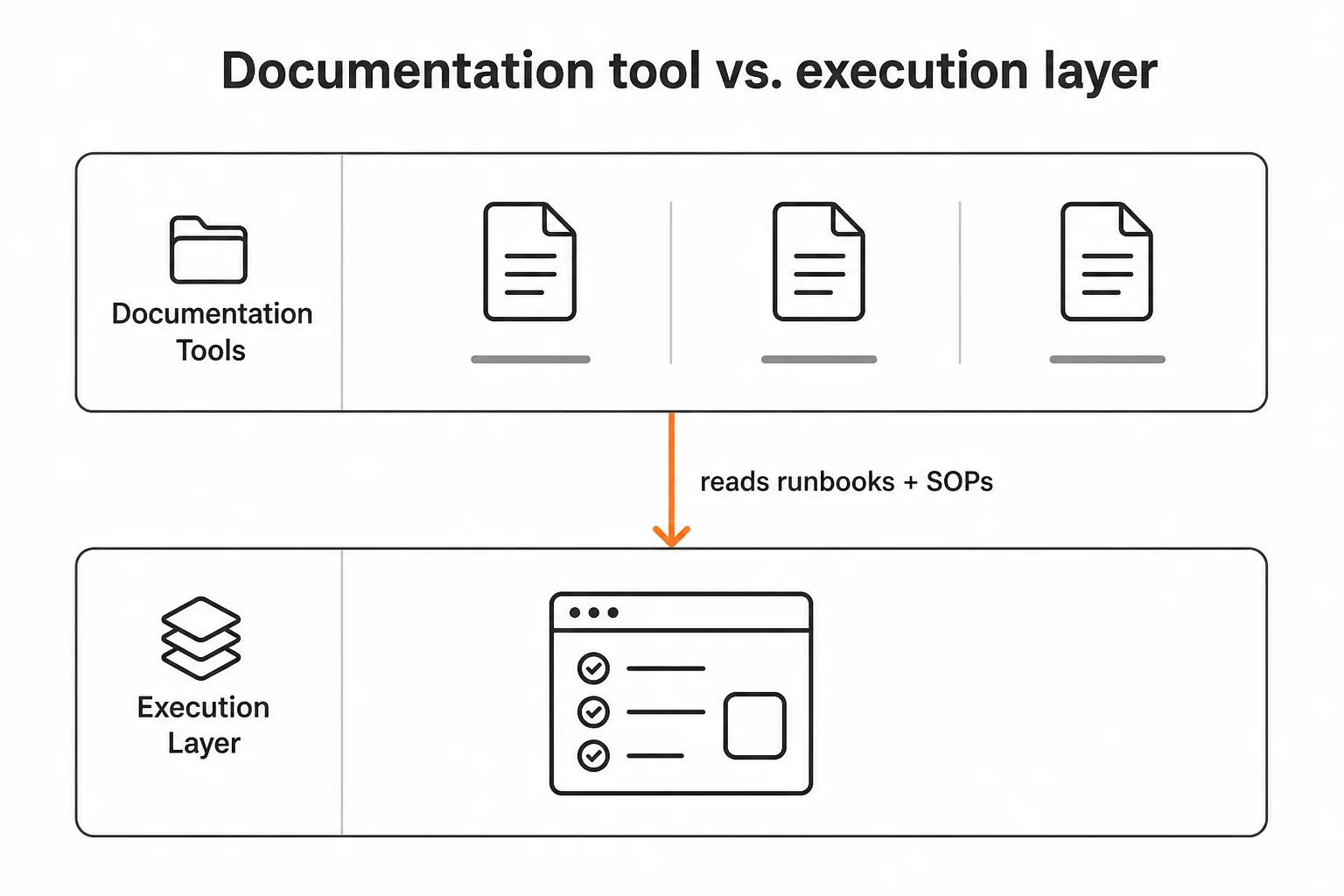
The shift that's happening in 2026 is MSPs adding an execution layer on top of their documentation - an AI that reads the runbook and does the work. That's what Rewst does for complex workflows. It's what Rallied does for L1 tickets specifically. Rallied connects to IT Glue and Hudu natively, reads the relevant runbooks, and closes the ticket without routing it to a technician.
The documentation tool you pick still matters - clean, structured docs make the execution layer more reliable. But the documentation isn't the ceiling anymore; it's the floor.
Try Rallied
Rallied is an AI technician built for MSPs that autonomously resolves L1 and L2 tickets - password resets, account unlocks, onboarding, offboarding, access management, license changes - without a human touching them. It connects natively to your PSA (ConnectWise, Autotask, HaloPSA, SuperOps), your RMM (Datto, NinjaOne, ConnectWise Automate), and your documentation platform (IT Glue or Hudu) on day one.
The pitch is simple: whichever documentation tool you pick from this list, Rallied makes it work harder. It's the difference between a runbook being a reference document and it being a literal set of instructions an agent executes. Pricing is $0.50/ticket with no base fee, no contract, and no implementation overhead - it runs live the same week you connect your PSA. Featured in CRN's 10 Hot MSP Tools for 2026 alongside Rewst, Thread, and Atera Robin.
For MSPs running 200-400 tickets/month, that typically translates to $7K-$15K/month in L1 tech time back in your pocket.
Frequently Asked Questions
What is the best IT Glue alternative for MSPs in 2026?
Hudu is the most direct IT Glue alternative for MSPs. It covers the same core use cases - structured documentation, password management, asset tracking, and client portals - at roughly 40% less cost, with no 36-month contract and a 14-day free trial. Hudu has 5,500+ MSPs and IT teams on the platform with a 4.7/5 G2 rating.
How much does IT Glue cost compared to alternatives?
IT Glue runs $29–$49/user/month on 36-month contracts (Basic through Enterprise), plus add-ons like Ninja Glue ($453/month) and My IT Glue ($407/month). Hudu costs $27/user/month with no minimum commitment. Confluence starts at $0 (10 users) and scales to ~$16/user/month on Premium. Passportal pricing is bundled with N-able and not publicly listed.
Can I use IT Glue with an AI ticket resolution tool?
Yes. IT Glue and its alternatives like Hudu serve as the documentation layer. AI execution tools like Rallied sit on top of that layer - they read your runbooks and SOPs from IT Glue or Hudu to autonomously resolve L1 tickets. The two layers are complementary, not competing.
Is Confluence a good IT Glue alternative for MSPs?
Confluence works well as a general wiki but falls short as an IT Glue replacement for MSPs specifically. It lacks PSA/RMM integrations, multi-tenant client portals, IT asset tracking, and password management. If your team mostly needs a knowledge base for internal use and isn't managing multiple clients, Confluence is a reasonable choice - especially at its free or Standard pricing.
What should I look for when evaluating IT documentation tools?
MSPs should evaluate on five dimensions: (1) PSA/RMM integration depth - does it sync with ConnectWise, Autotask, HaloPSA, NinjaRMM? (2) Multi-tenancy - can you silo documentation per client? (3) Password management - vault, audit logs, RBAC? (4) Pricing model - per-user vs. flat, contract length, add-on costs? (5) Deployment speed - how long before technicians can actually use it? IT Glue and Hudu score highest across all five for MSPs.