Autotask Pricing 2026: What It Actually Costs & Why MSPs Are Switching
TL;DR
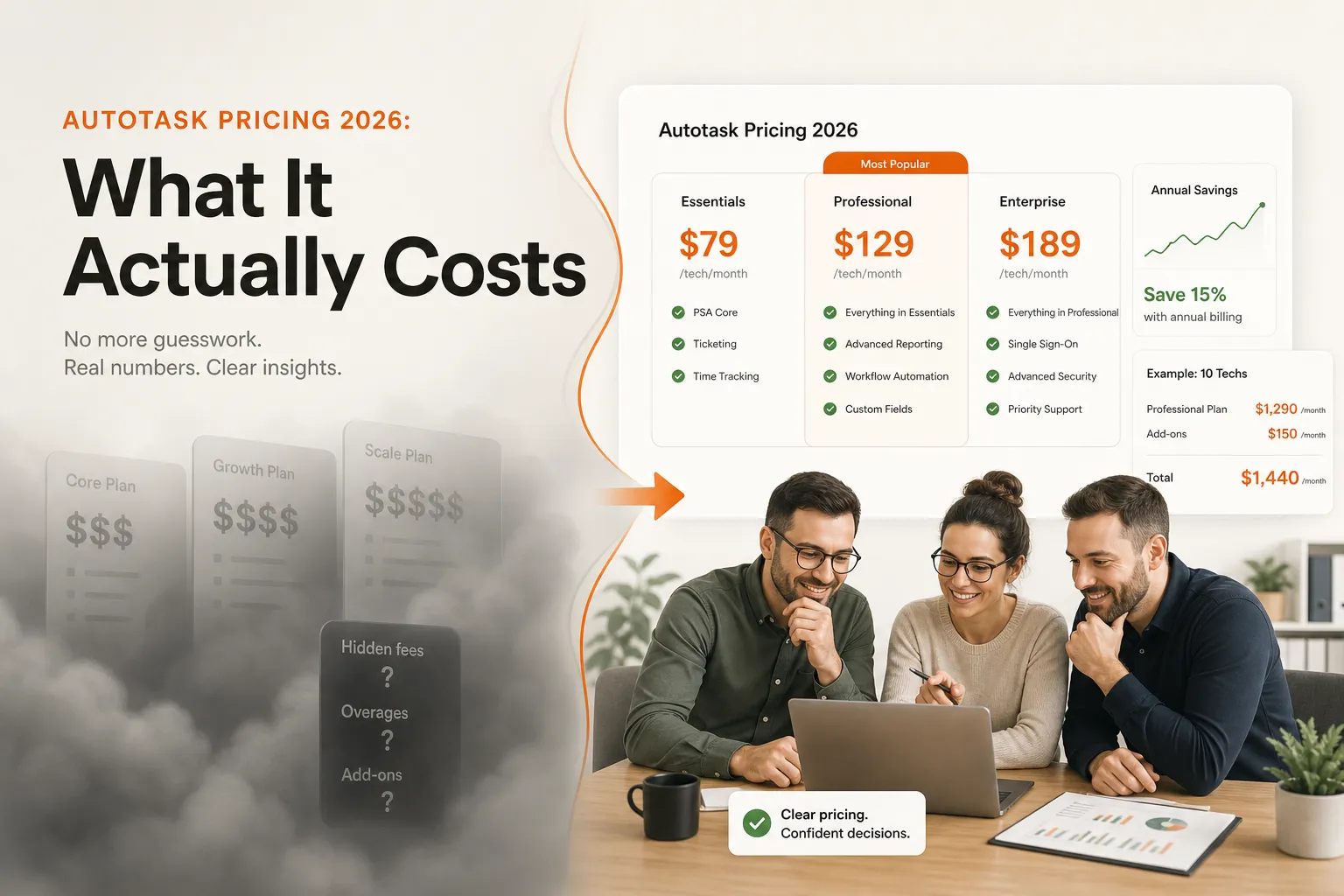
Autotask pricing is opaque by design. Kaseya quotes $50–$99+ per user per month, but actual pricing depends on your contract length, team size, and negotiating power. The real cost: $600–$1,200+ annually per user when you include onboarding fees ($2K–$6K) and multi-year contract pressure. Worse, renewals face 7% increases on short-term deals unless you commit 2–3 years. MSPs report this aggressive approach is pushing them to HaloPSA and ConnectWise Manage - platforms with simpler setup, faster implementation, and pricing you can actually plan around.
Autotask Isn't Hidden; It's Intentionally Opaque
Autotask PSA is the cloud platform most MSPs know. Twenty years in market, 4.3/5 stars on G2, and available in nearly every Kaseya bundling discussion. But here's the catch: Autotask doesn't publish pricing anywhere.
Not on their homepage. Not in a calculator. Not even in a sales email until the conversation is well underway. The Autotask pricing page exists solely to collect your contact information so sales can send you a custom quote.
This is intentional.
Custom-quoting lets Kaseya charge different prices to different customers based on size, urgency, contract term, and negotiating savvy. It prevents price comparison. It lets a sales team extract $95/user from one customer and $65/user from another - and neither side knows they're getting different deals. It's a strategy that works great for margin, terrible for customer trust.
And it's working. Users are leaving.
What You're Actually Paying
Based on community reports and third-party research, here's what Autotask pricing actually looks like:
Per-User Cost Range
| Scenario | Cost |
|---|---|
| Mid-market baseline (3-year contract) | $3.99–$5.25/user/month |
| Standard reported range | $50–$99/user/month |
| Recent customer quote (Australian pricing) | $99 AUD/user/month (~$65 USD) |
| Experienced user quote (25 users, long-term) | $58 USD/user/month |
| Premium tier example | $99+ USD/user/month |
The Onboarding Tax
That per-user number? It's before setup.
- Onboarding/setup fees: $2,000–$6,000 (one-time)
- Implementation timeline: 4–8 weeks typical
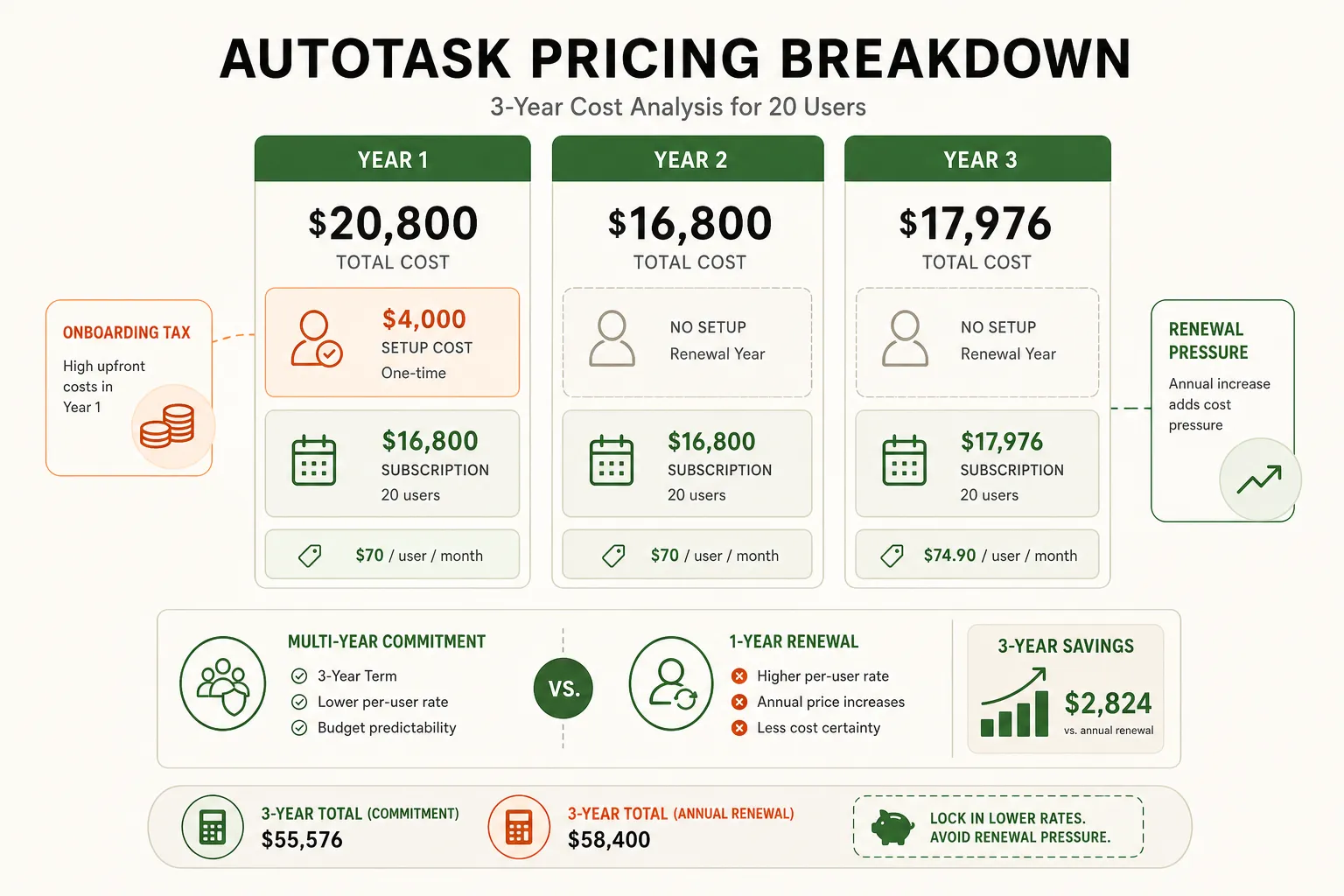
For a 20-person MSP paying $70/user/month, that's:
- Year 1 total: (20 × $70 × 12) + $4,000 setup = $20,800
- Year 2 onward: $16,800/year (if pricing holds)
But it won't hold.
The Renewal Trap: Multi-Year Contracts & Price Increases
Here's where Autotask's pricing model gets ugly.
MSPs report that Kaseya sales aggressively push multi-year contracts at renewal, offering better per-user rates to lock you in 2–3 years. The unspoken threat: renew for 1 year and face a 7% annual increase on top of any other adjustments.
One MSP captured it bluntly:
"Autotask is pressuring us to renew for 2 years or face a 7% increase for next year. PSA support is so bad. After almost 20 years of using PSA we are looking at CW. Our PSA rep is nonresponsive. Used to be good. But who wants to feel bullied by the PSA rep?"
This isn't isolated frustration. It's a pattern. The 2023 Kaseya acquisition of the Datto portfolio (which includes Autotask) changed the playbook. Pre-acquisition, Autotask was "the mature PSA." Post-acquisition, it became "the expensive PSA run by a margin-extraction team."
The Math on Multi-Year Pressure
- 1-year renewal: $70/user + 7% increase = $74.90/user (if you don't lock in)
- 3-year lock-in: Offered at $68/user/month (lower rate)
A 20-person shop faces the choice: sign 3 years at $16,320/year or pay $17,976/year for flexibility on year 2. Over three years, the "discount" locks you into a $48,960 commitment versus $16,320 + $17,976 + $19,245 = $53,541 on singles. But you can't know year 2's price, so the "safe" choice looks like the multi-year lock-in.
Community Sentiment: Why People Are Leaving
The MSP Reddit community is candid about Autotask pricing. Here's what they're actually saying:
"We left autotask and datto rmm because of kaseya and I'm so happy we did. We moved to halo and ninja, both are better and faster at everything. I've saved countless hours in the past year and that includes the time it took to move everything over. I'm honestly happy kaseya bought them only because it pushed me to look at moving to something else that's actually better."
That quote is from someone who spent years on Autotask. The Kaseya acquisition didn't just change pricing-it changed the product's reputation from "worth the cost" to "costs too much for what you get."
Another user flagged the real problem with opaque pricing:
"For anyone who has renewed their Autotask PSA contract in the last half year, what price points has Kaseya pitched you? We are under the gun for getting renewed and I just want to ensure the pricing being passed are passing the smell test."
That's not a question about features. It's a question about whether the quoted price is fair. Because there's no public pricing, MSPs have to crowdsource to reality-check their deals. That's a trust problem Autotask's pricing model created.
The 30% Incident: Trust Erosion Post-Kaseya
In March 2023, an MSP reported that Kaseya was pushing a 30% price increase on Autotask renewals. The thread exploded - 80+ comments of agreement and frustration.
Kaseya's support team later disputed the claim ("There is no 30% increase slated"), but the damage was done. The MSP community already believed the worst about Kaseya's "acquire and extract margin" approach.
Whether the specific 30% was real or miscommunication, the perception stuck: Kaseya owns Autotask now, and they're going to raise prices.
Pricing Compared: Alternatives MSPs Are Choosing
When MSPs leave Autotask, where do they go? The data is clear.
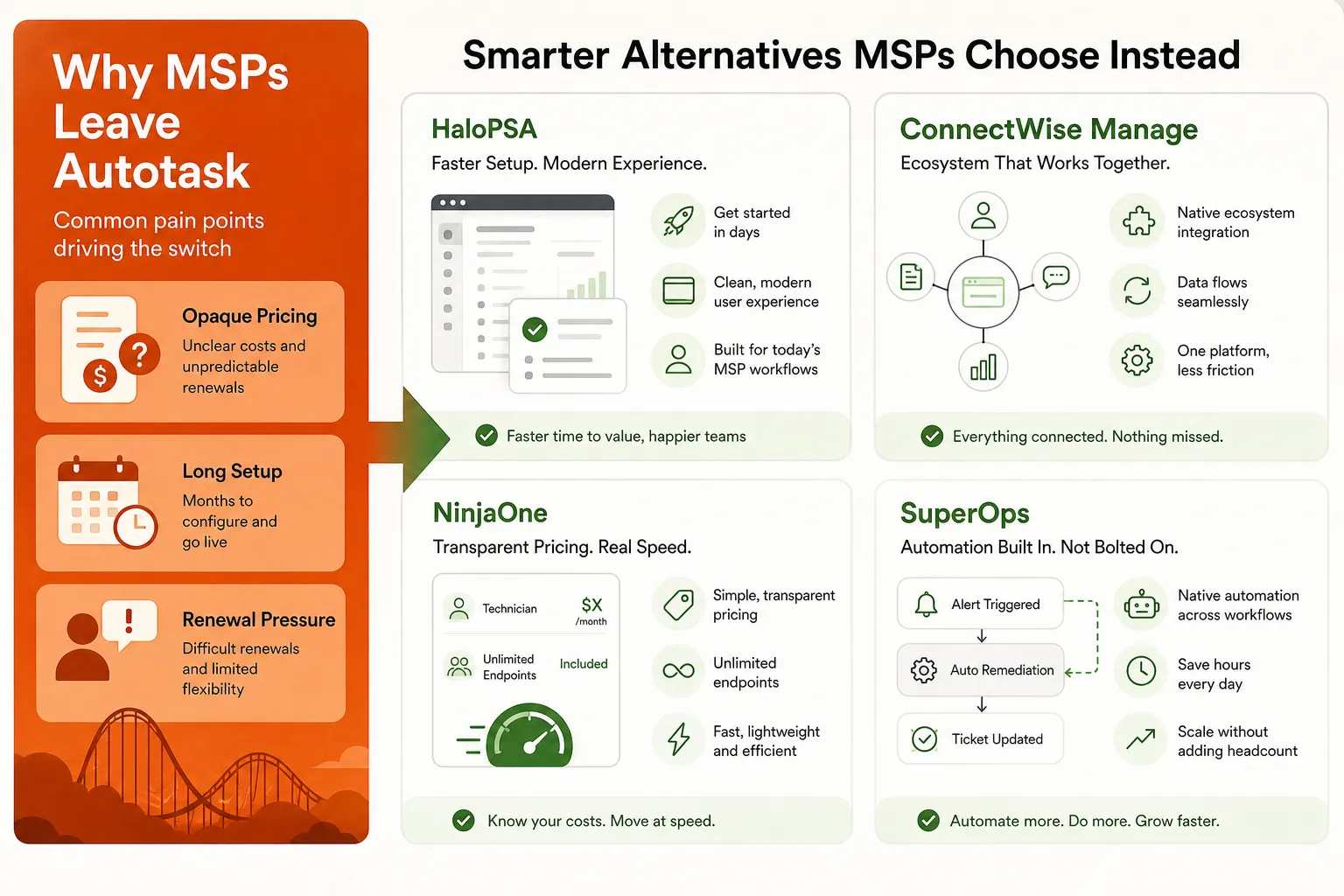
HaloPSA
- Positioning: Modern UX, simpler setup (2–4 weeks typical)
- Pricing: More transparent than Autotask; reports suggest $50–$75/user/month depending on tier
- Why MSPs switch: "Drop-in replacement with better value and faster onboarding"
ConnectWise Manage
- Positioning: Full-featured PSA for shops already on ConnectWise Automate
- Pricing: Similarly opaque to Autotask, but ecosystem tie-in makes it stickier
- Why MSPs switch: Unified ticketing + RMM + IT security in one stack
NinjaOne (RMM + Ticketing)
- Positioning: Strong RMM with integrated ticketing for MSPs not needing full PSA
- Pricing: Transparent per-technician model, $79+/user/month
- Why MSPs switch: "Better and faster at everything" - speed and responsiveness matter as much as cost
SuperOps
- Positioning: Purpose-built for modern MSPs with AI-first automation
- Pricing: Custom but reputation for fairness
- Why MSPs switch: Native no-code automation, lower setup overhead
The pattern: MSPs aren't chasing the cheapest option. They're chasing transparency and simplicity. Autotask's opaque pricing and heavy onboarding requirements became liabilities once better alternatives existed.
One More Thing: The Setup Complexity Tax
Autotask's pricing doesn't just include onboarding fees. It assumes weeks of configuration work post-launch.
The platform is feature-rich (truly), but that richness comes with complexity. Users report that "customization" is often required before Autotask works the way your MSP needs it to. This means:
- Months before the platform delivers real value
- Dedicated staff time to configure workflows
- Ongoing tuning and adjustment
For an MSP already stretched thin, that overhead is a cost, even if Kaseya doesn't charge for it directly.
By comparison, competitors like HaloPSA pride themselves on faster time-to-value. Less configuration, quicker productivity. The math: even if HaloPSA costs slightly more per user, you're paying less in opportunity cost and internal labor.
Autotask Is Still Mature. It's Just Not the Clear Winner Anymore.
Autotask remains a solid, 20-year-old platform. It's still a G2 Leader (4.3/5 stars), and customers report good integration depth with the Datto RMM ecosystem (if you're on that stack).
But "mature and capable" is no longer a competitive advantage when the pricing is opaque and the renewal experience is antagonistic. MSPs have options now:
- Faster to value (HaloPSA)
- Better pricing predictability (most alternatives)
- Stronger support stories (community consensus)
The Kaseya acquisition changed the conversation. It went from "Autotask is the enterprise-grade choice" to "Autotask will raise your prices if you let them lock you in."
The Automation Angle
Here's where this matters for ticket resolution and MSP operations: the best PSA is useless if you still need to manually process tickets.
Autotask includes Cooper, Kaseya's AI-powered ticket assistant, but Cooper is mostly for suggestions - summarizing tickets, proposing next steps, helping with documentation. It doesn't execute. Your techs still pick up the ticket, read the suggestion, and do the work.
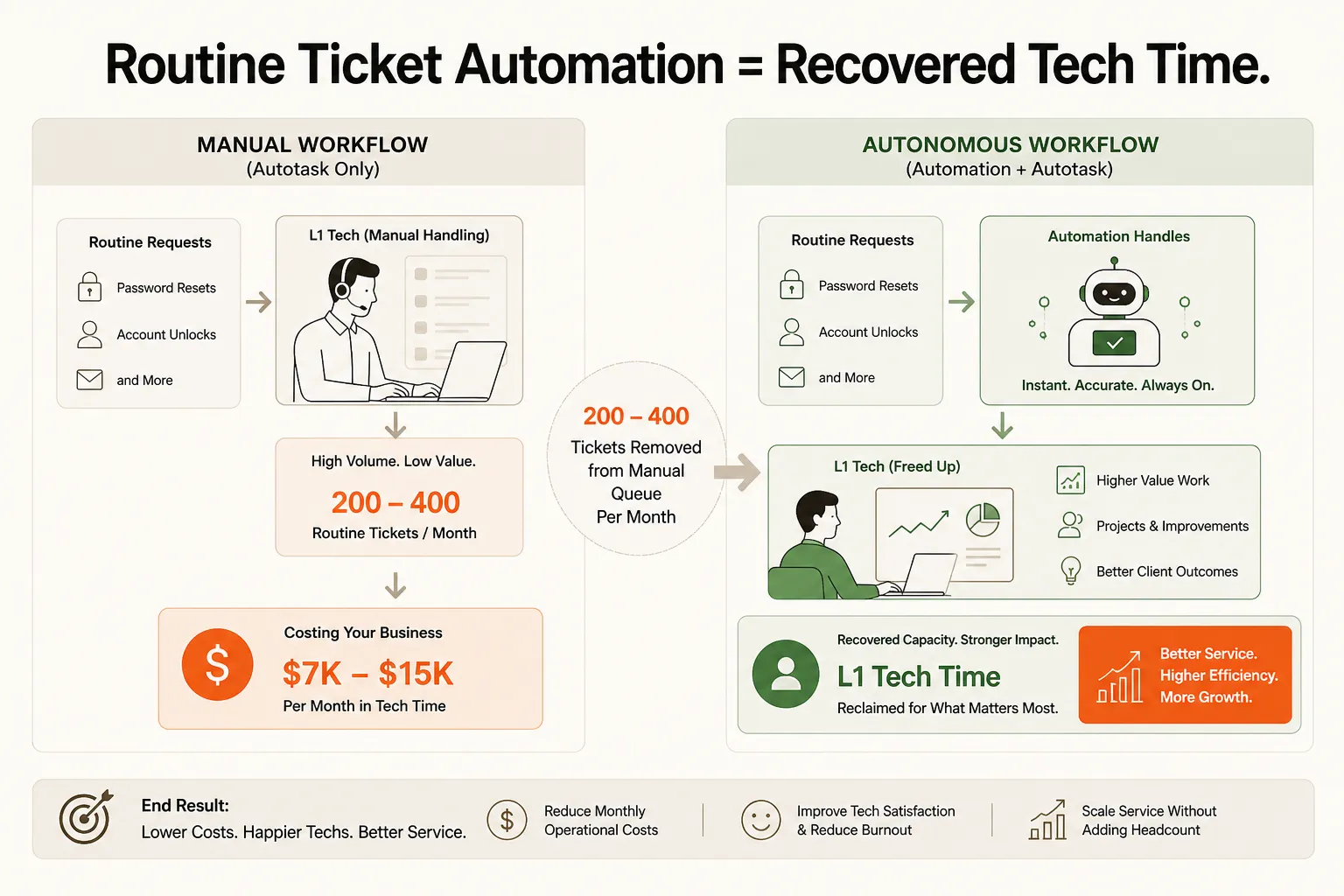
For routine work-password resets, account unlocks, mailbox permission changes, M365 provisioning-that manual step is where time leaks. Autotask+Cooper might suggest a fix, but someone's still opening the toolset and running the command.
That's where autonomous ticket resolution comes in. Tools that connect to your stack (PSA, RMM, M365, identity) and execute fixes end-to-end, without waiting for a tech to pick up the ticket, mean that 200–400 routine tickets per month that currently land on your L1 team can be handled autonomously. That's $7K–$15K/month in recovered tech time.
Autotask's price (opaque, $50–$99+/user) is justified by feature breadth, but it doesn't solve the fundamental problem that PSA users face: most tickets are manual work that humans have to touch.
Try Rallied
If you're evaluating PSA costs and wondering how to actually reduce labor (not just manage it better), autonomous ticket resolution changes the math.
Rallied connects to your PSA, RMM, and M365 stack and resolves L1/L2 tickets end-to-end-password resets, account unlocks, onboarding, offboarding-without human touch. The Autotask integration posts every resolution back as a ticket note and time entry. Unlike workflow engines that require months of setup, Rallied deploys the same week and handles work on day one.
For an MSP paying Autotask's $50–$99/user and worried about renewal pricing, adding autonomous ticket resolution means the techs freed up by automation can focus on higher-value work. No new PSA license. No re-architecture. Just less routine work on the team's plate.
Give it 30 days free with your existing stack.
Frequently Asked Questions
What's the real cost of Autotask per user?
Autotask pricing starts at $50–$99+ USD per user per month depending on plan tier and contract terms. Mid-market customers report $3.99–$5.25 per user on longer contracts, but renewals often face 7% increases on shorter terms. Add $2,000–$6,000 in onboarding fees and you're looking at $600–$1,200+ annually per user before discounts.
Why doesn't Autotask publish their pricing?
Autotask uses a custom-quote model that varies by customer size, contract length, feature modules, and negotiating power. Kaseya intentionally keeps pricing opaque so sales can quote higher to customers without competitive leverage. This opacity is part of the pricing strategy - it prevents price comparison and lets sales extract maximum margin from each customer.
What's the 'multi-year pressure' I hear about?
MSPs report that Kaseya sales heavily push 2–3 year contracts, offering better per-unit pricing to lock in longer terms. Short-term renewals face ~7% annual increases. This forces you to choose between committing 2–3 years with Autotask or paying significantly more for flexibility. Users describe this as 'bullying' renewal tactics.
Is Autotask still worth it post-Kaseya acquisition?
Autotask remains a mature, feature-rich PSA platform (4.3/5 on G2, 20+ years in market). However, community sentiment shifted sharply post-acquisition in 2023. Users cite pricing aggression, deteriorating support, and platform speed issues as reasons to switch. It's still capable but no longer the clear winner it was five years ago.
What's driving MSPs to HaloPSA and ConnectWise instead?
HaloPSA is cited as a faster, modern alternative with simpler setup and better pricing transparency. ConnectWise Manage appeals to shops already on ConnectWise Automate. Both offer clearer pricing, faster implementation, and customers report fewer renewal surprises. The broader trend: post-2023, Kaseya's acquisition changed Autotask from 'the mature choice' to 'the expensive choice that might get repriced on you.'