Best network monitoring software in 2026
TL;DR
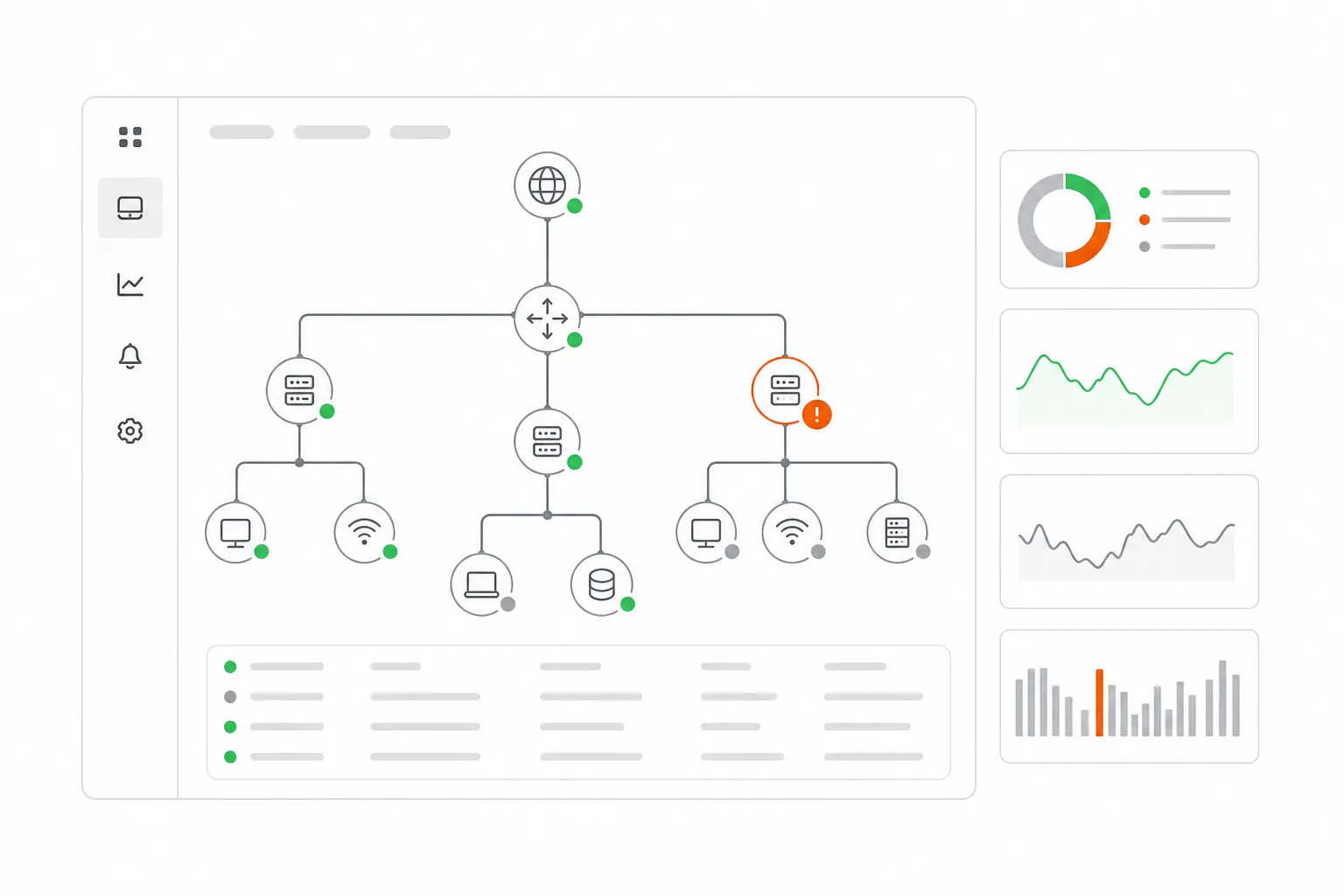
The network monitoring market breaks into three pretty distinct camps, and which one fits depends less on features than on your scale and who's doing the work:
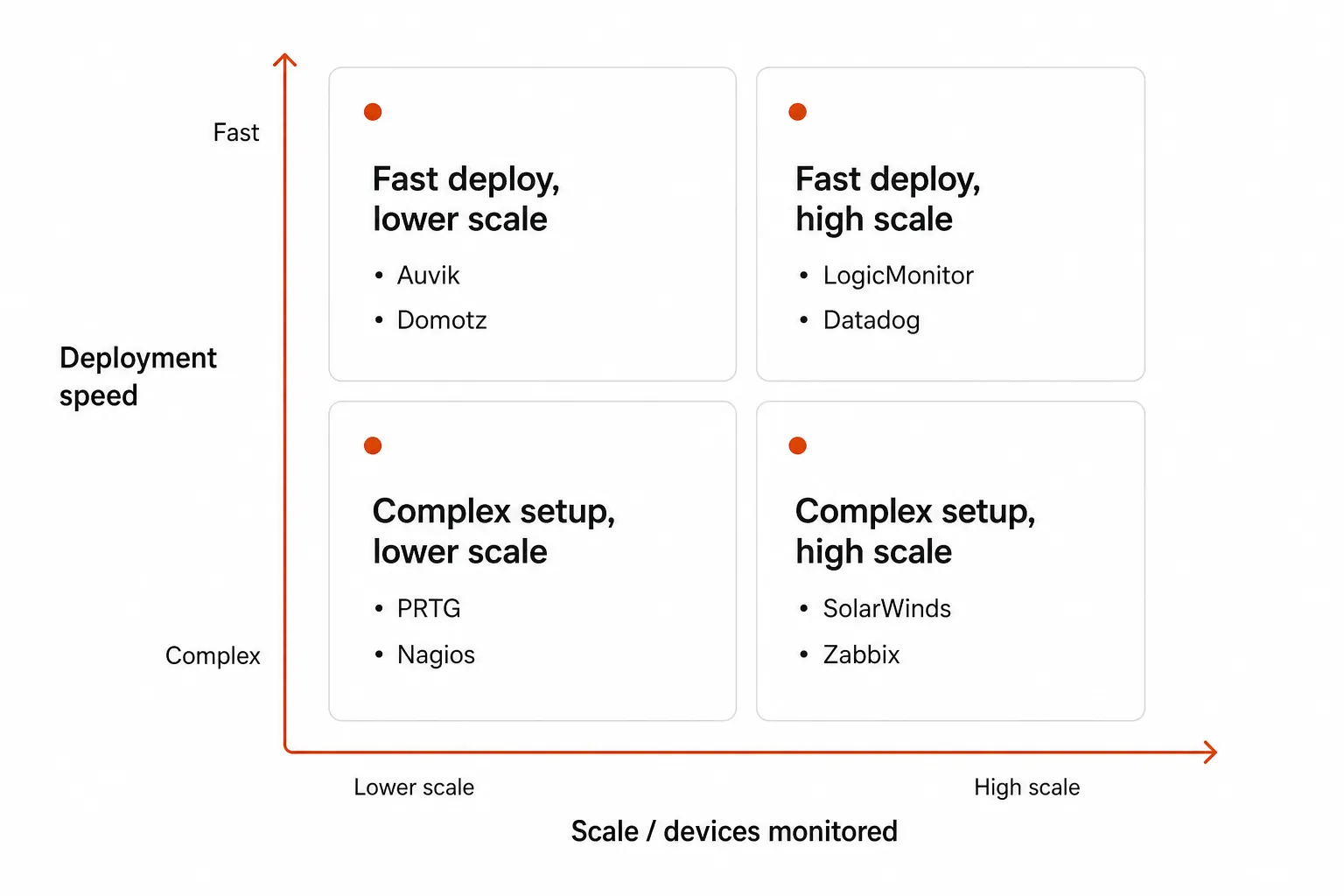
- MSPs managing dozens of client networks: Auvik for fastest onboarding and best UI; Domotz if cost-per-site is the deciding factor (typically 30–60% cheaper).
- Mid-market IT teams, on-premise-heavy: PRTG for broad coverage across any vendor stack - just budget for sensor creep. ManageEngine OpManager for SolarWinds-equivalent depth at a fraction of the price.
- Enterprise or cloud-native teams: SolarWinds NPM if you have the budget and a dedicated team to run it. Datadog if you're already in the Datadog ecosystem and need network tied to APM. LogicMonitor for AI-driven alert noise reduction at enterprise scale.
- Power users who hate licensing fees: Zabbix - free forever on-premise, unlimited scale, serious learning curve.
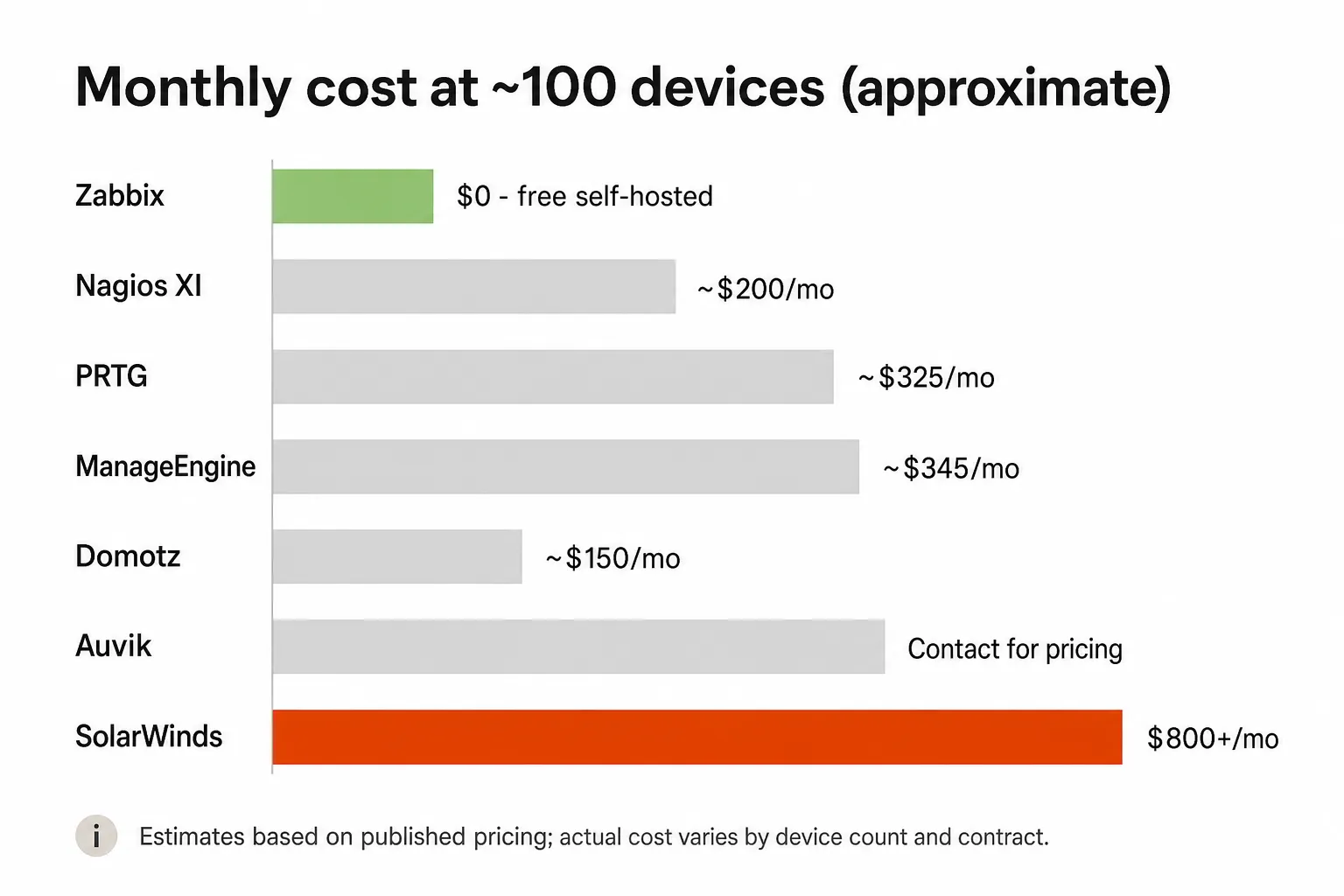
The thing most reviews miss: the sticker price is almost never what you actually pay. Sensor creep, per-billable-device tiering, and opaque renewal math will double your monitoring budget if you're not paying attention. We ran the numbers.
How we evaluated
We tested these tools against a shared set of scenarios: initial deployment on a new client network, discovery of a multi-vendor switch/router/server environment, alert tuning to reduce noise, and the real cost at 100 devices, 500 devices, and 1,000 devices. We cross-referenced against G2 reviews, Reddit's r/msp, Gartner Peer Insights, and hands-on MSP analysis from sources like Flamingo.
We also ran the actual pricing math - not just the headline tier, but what you'd pay 18 months in once sensor counts grow and renewals land.
Quick comparison
| Tool | Best for | Starting price | G2 rating | Deployment |
|---|---|---|---|---|
| Auvik | MSPs, fast onboarding | Quote (per device) | - | 15 min |
| Domotz | MSPs, transparent pricing | $1.50/device/mo | 4.83/5 | < 15 min |
| PRTG | Multi-vendor, SMB–mid-market | $179/mo (500 sensors) | 4.7/5 | Hours |
| Zabbix | Power users, zero cost | Free (self-hosted) | 4.4/5 | Days–weeks |
| SolarWinds NPM | Large enterprise | From $2,829 | - | Days |
| ManageEngine OpManager | Mid-market, SolarWinds alt | $345/25 devices | - | Hours |
| Datadog | Cloud-native, DevOps teams | ~$15–25/host + add-ons | 4.4/5 | Hours |
| LogicMonitor | AI-driven NOC, enterprise | $16/unit/mo | 4.5/5 | Hours |
1. Auvik
Auvik is the platform that 80,000+ IT professionals and MSPs trust to manage client networks - and the 15-minute onboarding claim is real, not marketing. Once the collector is deployed at a client site, Auvik discovers all devices via CDP, LLDP, and vendor APIs within 30 minutes. You get live Layer 1–3 topology maps, preconfigured alerts, and bandwidth monitoring without hours of manual configuration.
For MSPs managing dozens or hundreds of client networks simultaneously, Auvik's multi-tenant architecture is the point. Every client is a first-class tenant with its own visibility, alerts, and access controls - no franken-build of role-based permissions to fake isolation. Auvik also won the 2025 MSP Today Product of the Year, which is the kind of recognition that comes from real adoption rather than analyst schmoozing.
Pros:
- Genuine 15-minute deployment - verified by multiple MSP case studies
- 64+ preconfigured alerts mean you're catching issues before clients notice on day one
- Deep PSA integrations: ConnectWise, Autotask, Halo PSA, ServiceNow, and 20+ others
- MTTR reduction of up to 75% (per Auvik's MSP messaging) from visual topology-driven troubleshooting
Cons:
- No public pricing - requires a sales form submission, which MSPs find friction-heavy when comparing options
- Some learning curve past initial setup: dashboard takes time to feel natural for junior techs
- Overkill for very small shops (under 5 clients); cost-per-site may not pencil vs. simpler tools
Pricing:
Auvik doesn't publish pricing. Their pricing page explicitly states: "Competitors and AI tools show the wrong prices. Get accurate pricing directly from Auvik." Translation: per-device model, scaled to your device count, requires a sales conversation. MSP community feedback suggests it's mid-range - more than Domotz, less than SolarWinds, predictable once you know your device count.
14-day free trial with all features, no credit card required.
Our take: Auvik is the safe default pick for MSPs who want fast time-to-value without hiring a monitoring specialist. The opaque pricing is a genuine friction point if you're cost-comparing against Domotz - but once you're in, it's one of the most polished MSP-native network management experiences available.
2. Domotz
Domotz is what Auvik would look like if it competed on price rather than polish. It monitors 600+ customers across 40,000+ networks in 190 countries, earns a 4.83/5 on G2 with 105 reviews (86% five-star, zero three-star, two-star, or one-star visible), and recently added an agent-native MCP Server exposing 40+ tools for AI agent integration.
The pricing transparency alone sets it apart. Where Auvik requires a sales call to get a number, Domotz publishes it: $1.50 per managed device per month or $35 per collector per month. You pick which devices are billable; unmanaged devices still show up on your map. That distinction matters for MSPs - you're paying for what you actively support, not everything that shows up on discovery.
TRINUS cut costs 66% after switching to Domotz: "Domotz was 1/3 of the cost of our incumbent monitoring solution, which made deployment across all our sites possible." CIO Solutions reports saving four hours per site on onboarding and troubleshooting.
"Before Domotz, we'd realize a device existed only when something went wrong - or worse, when a client told us. Now we see it all, the moment it shows up."
Pros:
- Transparent, published pricing: $1.50/device/mo or $35/collector/mo
- SOC 2 Type II and ISO 27001 certified - matters for enterprise clients
- MCP Server for AI agent integration (forward-looking feature most competitors don't have)
- Layer-2 discovery by MAC address catches devices that SNMP-based tools miss
Cons:
- Fewer integrations than Auvik (PSA coverage is solid but the overall ecosystem is narrower)
- Smaller community and fewer third-party tutorials vs PRTG or Zabbix
- Feature depth in some areas (bandwidth analysis, custom alerting logic) lags behind PRTG
Pricing:
| Model | Cost |
|---|---|
| Per managed device | $1.50/device/mo |
| Per collector/site | $35/collector/mo |
| Free trial | 14 days, no card required |
Our take: For MSPs who've run the math, Domotz is often the right call. The per-site model makes cost predictable at scale in a way per-device billing doesn't. If you're currently with Auvik and the bill is creeping, it's worth a side-by-side test.
"The biggest difference is the pricing model. Domotz is per site, while Auvik is per billable device. You'd have to do the math for your own requirements."
3. PRTG network monitor
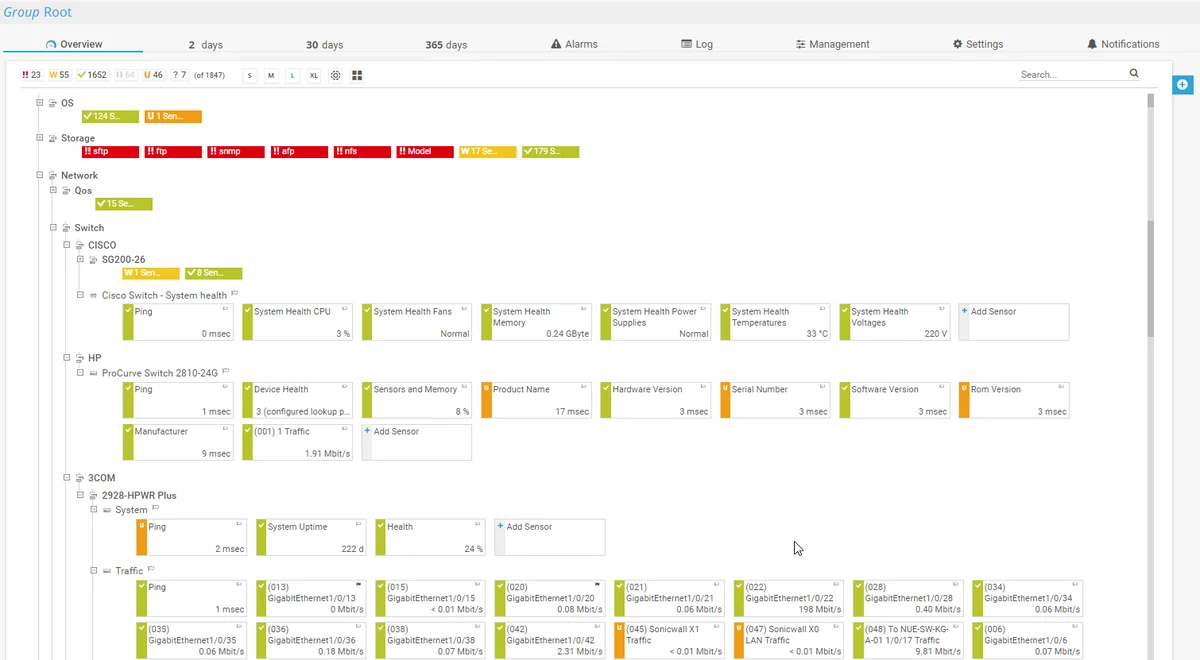
PRTG has been around for 25+ years and 500,000+ active users globally - and it earns that install base. You get 320+ sensor types covering firewalls, switches, servers, VMs, cloud services, databases, and custom EXE/script outputs, all from one tool. Auto-discovery finds ~90% of what you need the moment you point it at a subnet. 4.7/5 on G2 with 209 reviews, 4.5 on Gartner Peer Insights (~825 ratings).
The breadth is genuinely impressive. One G2 reviewer described pulling live Modbus data from factory floor PLCs and correlating it with CNC machine power draw - "no other tool I've tried lets me do that without fighting through three layers of middleware." PRTG's sensor model makes unusual monitoring scenarios possible without custom development.
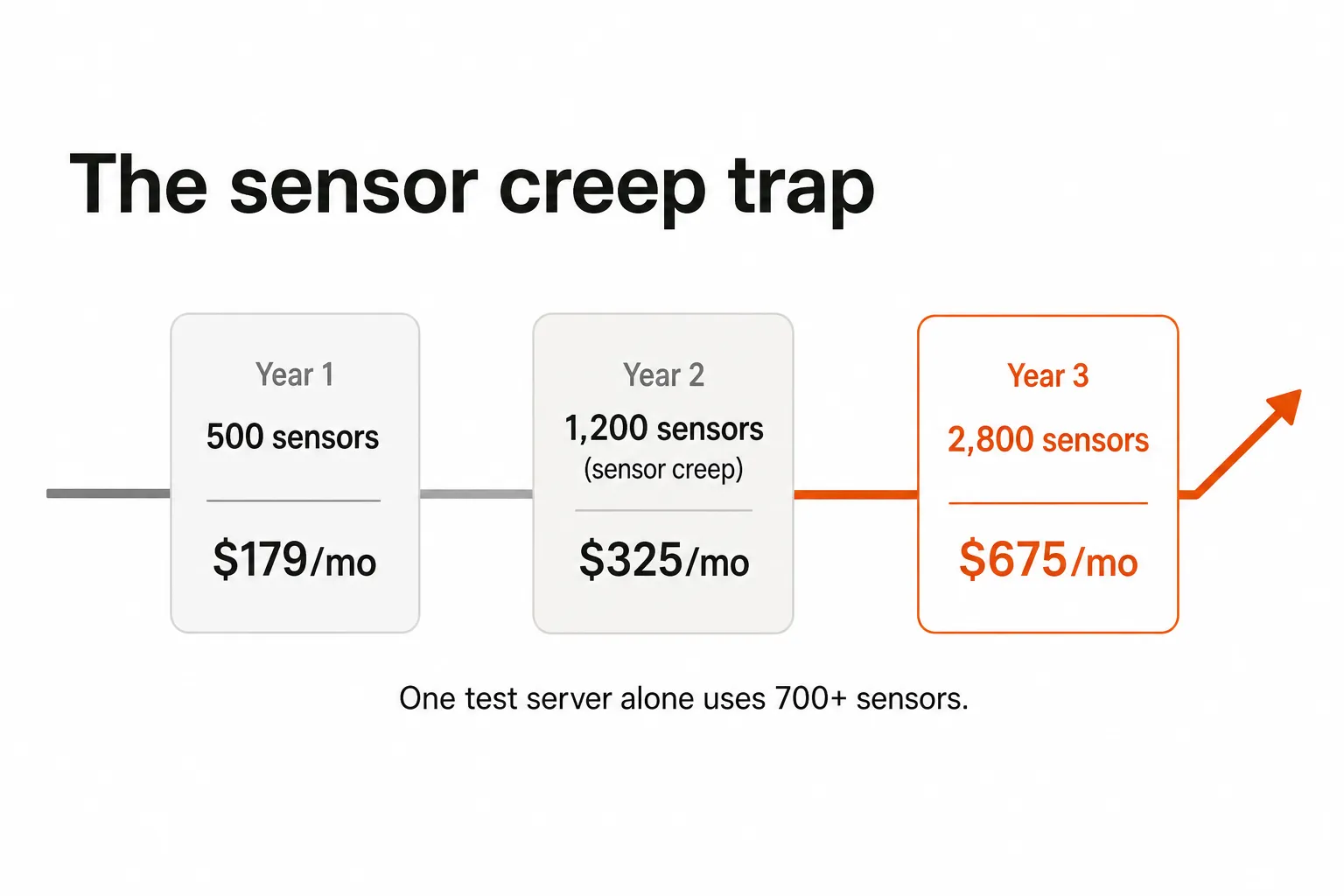
But here's the thing you'll hit at month 18: sensor creep. One firewall, one 52-port switch, one VMware host, three Hyper-V hosts, six Windows servers, two NAS units, and a printer consumed over 700 sensors in a test rig documented by Flamingo's MSP analysis. That's a single small site. With 20 client sites, you're looking at the $675/month 2,500-sensor tier or above - and you'll hit it faster than expected.
The other thing to know: in July 2024, Paessler ended perpetual licenses and moved PRTG to subscription-only. Like-for-like maintenance costs rose roughly 124–126%. If you're on old perpetual licenses, that renewal conversation is coming.
Pros:
- 320+ sensor types; genuinely the widest coverage for multi-vendor environments
- Agentless - no software to push to endpoints
- Free tier covers 100 sensors (10–20 devices) permanently, no time limit
- Strong multi-site monitoring via remote probes (free to deploy)
Cons:
- Sensor creep is real and sneaks up on you - budget for it explicitly
- Single-database architecture means per-client isolation requires separate PRTG instances, unlike natively multi-tenant MSP tools
- 2024 subscription switch roughly doubled recurring costs for existing customers
Pricing:
| Tier | Sensor limit | Monthly (annual billing) |
|---|---|---|
| Freeware | 100 | $0 |
| PRTG 500 | 500 | $179 |
| PRTG 1000 | 1,000 | $325 |
| PRTG 2500 | 2,500 | $675 |
| PRTG 5000 | 5,000 | $1,183 |
| XL1 (unlimited) | 10,000+ | $1,492 |
Source: Paessler pricing page
Our take: PRTG is excellent for IT teams managing single-site or small-to-medium portfolios with diverse hardware. If you need SNMP from a custom industrial device, a legacy switch with no API, and a modern cloud workload all in one view, PRTG handles it. But go in with eyes open on the sensor math - it's not the MSP tool it used to be at the lower tiers.
"PRTG feels like it was built to monitor a single site but is pitched as an enterprise-level network monitor."
- Trustpilot review, cited in Flamingo MSP analysis
4. Zabbix
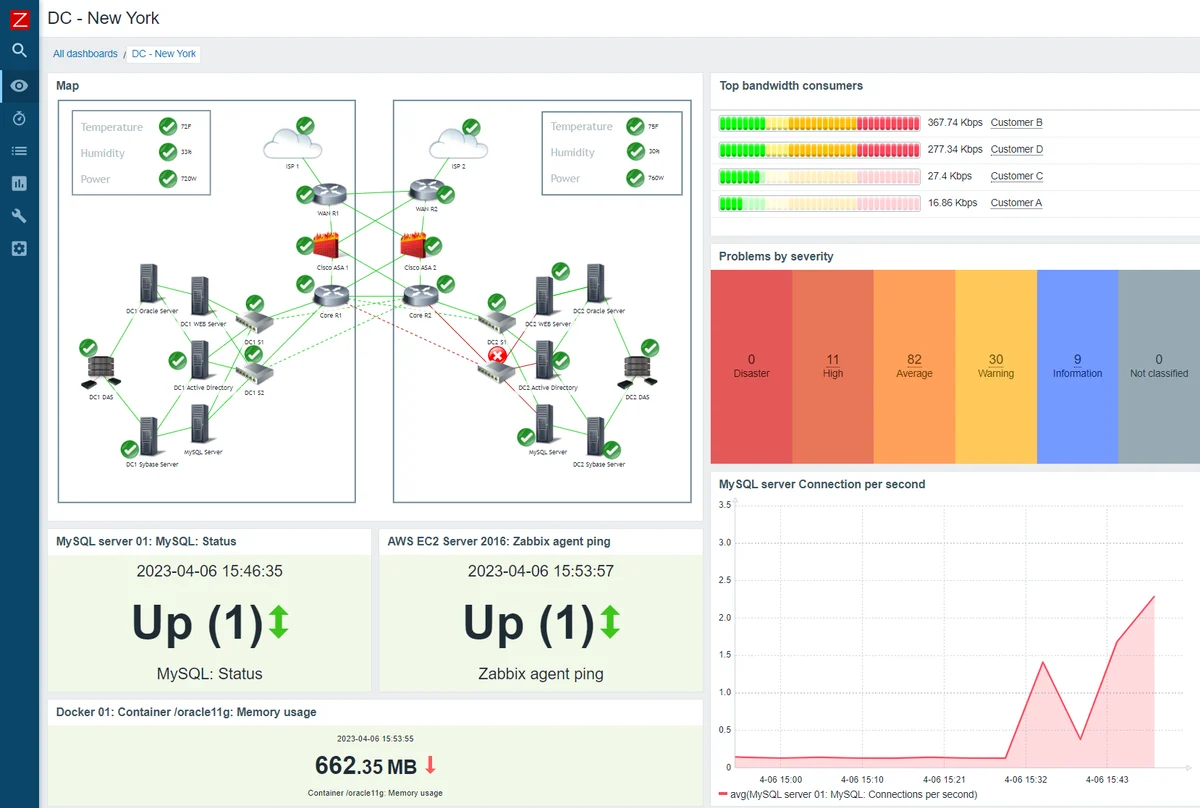
Zabbix is the option everyone considers and half the people regret not committing to sooner. It's 100% open source, runs on your own infrastructure, carries no per-device licensing fees, and deploys across 300,000+ organizations in 190+ countries - including NATO, Dell, Orange, ESA, and T-Systems. 4.4/5 on G2 (208 reviews), 4.6 on Gartner Peer Insights (341 reviews).
The financial math is undeniable at scale. PRTG at the 2,500-sensor tier costs $675/month - $8,100/year. Zabbix monitoring the same environment costs $0 in licensing. For a 50-person MSP managing 200 client networks, that difference is real money. As one r/msp veteran put it:
"I've worked a lot with Zabbix and I love it. It is a great tool, but it definitely requires time to spin new networks to be monitored. At the end of the day it saves you a ton of money and it scales extremely well for large environments."
The catch is upfront. Zabbix doesn't have point-and-click setup - you need to understand how it models hosts, items, triggers, and templates before you can do anything useful. Multiple Reddit threads note that a typical Zabbix deployment takes days to weeks for someone new to the platform. Teams without in-house monitoring expertise should probably start with PRTG or Auvik first.
If you do have the expertise - or are willing to build it - Zabbix Cloud is a fully managed SaaS option starting at $50/month (Nano tier, 50 NVPS), removing the infrastructure burden while keeping the flexibility.
Pros:
- Zero licensing cost on-premise - unlimited hosts, metrics, users
- Scales to millions of metrics; distributed proxy architecture handles remote/air-gapped sites
- Deep customization: custom triggers, templates, integrations, and complex alerting logic
- Modern UI (much improved in recent versions) with geomaps, topology views, SLA tracking
Cons:
- Steep learning curve - not for teams without monitoring expertise or time to invest
- Self-hosting means you're responsible for infrastructure, backups, and scaling
- Initial setup takes significantly longer than PRTG or Auvik
Pricing:
| Option | Cost |
|---|---|
| On-premise (self-hosted) | Free |
| Zabbix Cloud Nano (50 NVPS) | $50/mo |
| Zabbix Cloud Medium (1,000 NVPS) | $750/mo |
| Zabbix Cloud xLarge (5,000 NVPS) | $2,500/mo |
| Commercial support | Quote (contact Zabbix LLC) |
NVPS = New Values Per Second. A 100-host deployment with 10 metrics per host at 60-second intervals = ~17 NVPS (fits in Nano). Calculator available at zabbix.com/cloud.
Our take: Zabbix is the right call for power users, experienced admins, and MSPs with the technical depth to configure it. The TCO advantage over PRTG or SolarWinds at scale is substantial. But treat it as a multi-week investment to get right, not a weekend project.
5. SolarWinds NPM
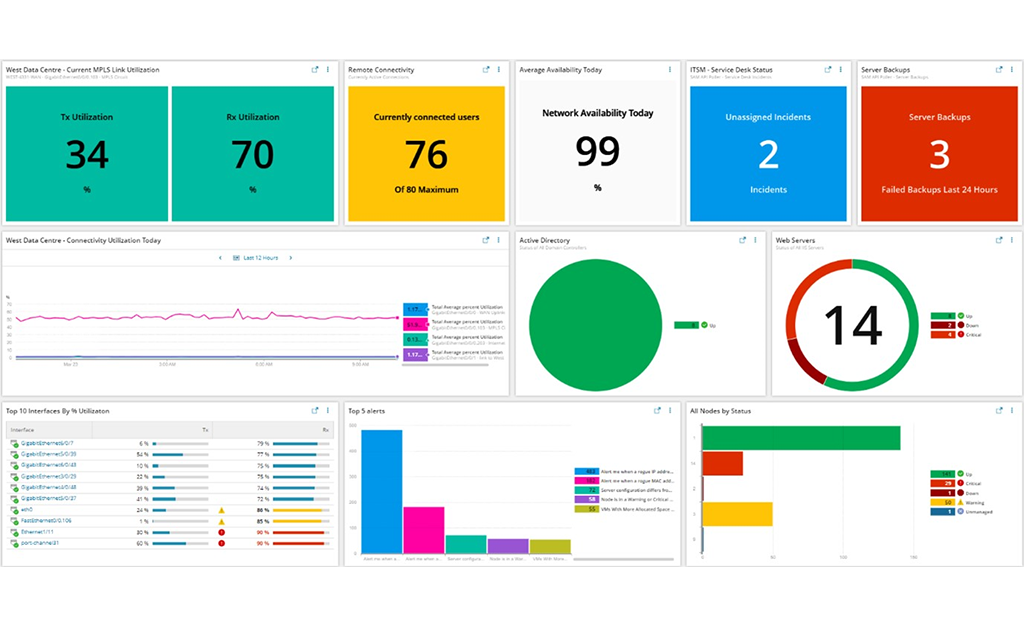
SolarWinds Network Performance Monitor (NPM) is the enterprise gold standard - if you're willing to pay enterprise prices and manage enterprise complexity. Built on the SolarWinds Orion platform, NPM gives you NetPath (hop-by-hop visibility across on-prem and cloud), PerfStack (multi-source metric correlation in one view), and AIOps-powered anomaly detection that catches issues before operations are impacted.
It's the tool IT teams reach for when they're managing 500+ nodes across hybrid environments and need the depth to justify the spend. The 30-day free trial is fully functional; no credit card required.
The elephant in the room: in December 2020, the SUNBURST supply-chain attack breached ~18,000 SolarWinds customers - including multiple U.S. government agencies - via malicious updates pushed through the Orion platform. SolarWinds has invested heavily in remediation: dedicated CISO, third-party security audits, a Secure by Design program. Most large enterprise customers who stayed report accepting the updated security posture. But for organizations in regulated industries, it remains a due-diligence conversation.
The licensing math is also worth stress-testing before you buy. NPM pricing is node-based and quote-driven - starting at $2,829 for the base module, with SolarWinds Observability Self-Hosted starting at $8/node/month. Mid-market deployments (100–500 nodes) typically run $50K–$150K/year; enterprise (500+ nodes) often exceeds $200K. Module bundling (NPM + NCM + NTA + IPAM) compounds the cost.
Pros:
- NetPath and PerfStack are genuinely differentiated features for enterprise troubleshooting
- AIOps anomaly detection and ML-driven alerting at scale
- Deep integration ecosystem: AWS, Azure, GCP, Cisco, VMware, Citrix, 100+ platforms
- Strong on-premises support for complex hybrid environments
Cons:
- Opaque, quote-based pricing with no public calculator - sticker shock on renewals is real
- Security trust damage from SUNBURST (2020) remains a consideration for regulated industries
- Setup and maintenance require dedicated resources - not an MSP self-service tool
- Module bundling means "full stack" often costs 2–3x the base license
Pricing:
| Tier | Starting cost |
|---|---|
| NPM (standalone module) | From $2,829 |
| Observability Self-Hosted | From $8/node/mo |
| Mid-market deployment (100–500 nodes) | $50K–$150K/yr |
| Enterprise (500+ nodes) | $200K+/yr |
Our take: SolarWinds NPM is the right call at the high end - large IT shops with 500+ nodes, multiple teams, and dedicated monitoring staff who need depth and integration coverage. For anyone below that threshold, ManageEngine OpManager delivers comparable monitoring at 30–50% of the cost.
6. ManageEngine OpManager
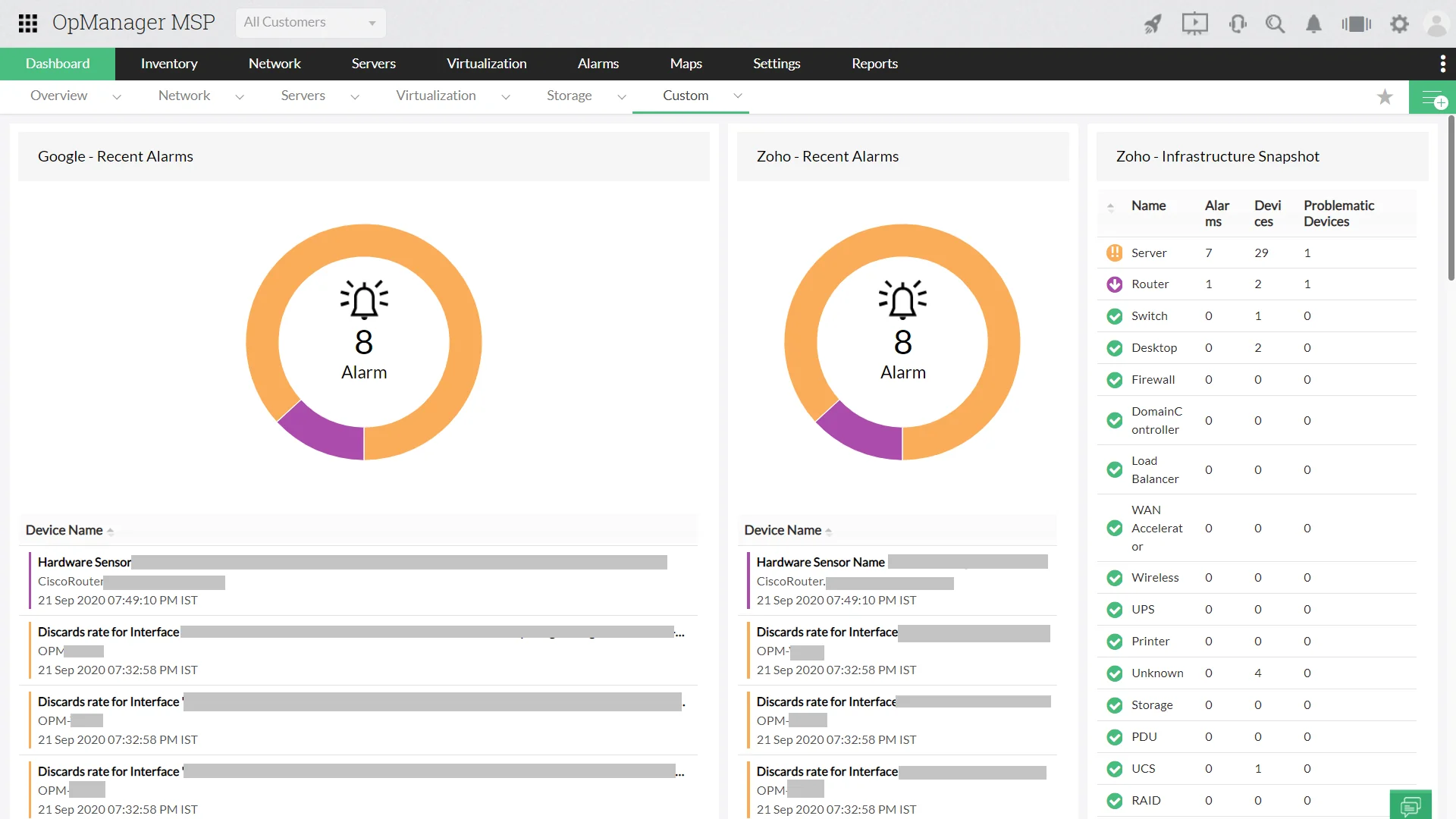
ManageEngine OpManager is Zoho's enterprise network monitoring platform - and the most compelling answer to the question "why are we paying SolarWinds prices?" It monitors 2,000+ performance metrics across routers, switches, firewalls, servers, VMs, and storage, delivers Layer 2/3 topology maps and 3D rack views, and scales to 30,000+ devices on the Enterprise edition. Over 9,000 businesses use it, including L'Oreal, NASA, DHL, AT&T, and Siemens.
The pricing makes it hard to look away. Professional Edition starts at $345 for 25 devices - not $345/month per sensor-based tier, but $345 for the license. A UK manufacturing customer reported £400,000 in savings after switching from SolarWinds.
The licensing model is cleaner than PRTG's: one license per device, unlimited interfaces and sensors on that device. No sensor math, no creep.
Pros:
- Device-based licensing with no sensor creep - one license covers all metrics for that device
- Significantly cheaper than SolarWinds for equivalent monitoring depth
- 5-minute install time reported consistently in community feedback
- AIOps features (adaptive ML thresholds, capacity forecasting) on Pro and Enterprise editions
Cons:
- Some users find alert tuning requires careful initial setup to avoid false positives
- Add-on sprawl: NetFlow, Configuration Manager, Firewall Analyzer each sold separately (though OpManager Nexus bundles them at 40% off)
- Enterprise edition and MSP pricing require direct contact
Pricing:
| Edition | Devices | Starting price |
|---|---|---|
| Standard | 25 | $245 |
| Professional | 25 | $345 |
| Enterprise | 250 | $4,595 |
| MSP Edition | Multi-tenant | Contact sales |
Our take: For mid-market IT teams that have been priced out of SolarWinds or are watching PRTG costs climb, ManageEngine OpManager is the honest answer. The device-based licensing is more predictable than PRTG sensors, the setup is fast, and the feature depth holds up at the enterprise tier.
7. Datadog
Datadog Network Monitoring makes the most sense if you're already a Datadog customer - and considerably less sense if you're not. The platform ties network visibility directly to application performance, logs, and infrastructure in one unified view: you can go from a latency spike in network traffic to the specific service generating it without leaving the dashboard. That's a genuine capability gap compared to standalone network monitoring tools.
The platform covers three angles: Cloud Network Monitoring (CNM) for app-to-app traffic in cloud/hybrid environments, Network Device Monitoring (NDM) for physical and virtual devices (100+ vendor support via SNMP, NetFlow, APIs), and Network Path Monitoring for hop-by-hop latency analysis. 4.4/5 on G2 with 723 reviews, with 62% five-star ratings.
Where it gets expensive: NDM is billed per device, typically $50–300/device/month depending on polling frequency and data volume. A mid-size team with 50 cloud hosts + 15 network devices can run ~$3,100/month before premium features. That's real money if you're not already in the Datadog ecosystem.
Pros:
- Unified correlation between network, APM, infrastructure, and logs - no context-switching
- 100+ supported device vendors - Cisco, Juniper, Meraki, F5, Arista, Aruba
- Open-source agent; agentless auto-discovery; 600+ integrations
- Strong anomaly detection and threshold alerting tied to broader observability context
Cons:
- Expensive if network monitoring is your primary use case - the platform is built as an observability suite add-on, not a standalone tool
- NDM per-device pricing ($50–300/device/month) adds up fast at scale
- Complex billing with multiple add-ons; total cost requires careful modeling
Pricing:
| Component | Estimated cost |
|---|---|
| Base infrastructure | ~$15–25/host/mo |
| CNM add-on | ~$10–15/host/mo |
| NDM add-on | ~$50–300/device/mo |
| Example: 50 hosts + 15 devices | ~$3,100/mo |
Source: Datadog pricing page
Our take: Datadog is the network monitoring answer for DevOps-native teams already running Datadog APM and infra monitoring. The unified observability value is real. If network monitoring is your only use case and you're evaluating from scratch, the per-device costs will make PRTG or ManageEngine look very attractive.
8. LogicMonitor
LogicMonitor is the enterprise platform for teams serious about reducing alert noise and moving toward AI-driven operations. 109,000+ users rely on it; the platform earned Gartner Magic Quadrant Leader status in Digital Experience Monitoring (2025) and was recognized as 1 of 103 AI-native companies at NVIDIA GTC 2026.
The headline differentiator is Edwin AI - the platform's event intelligence and automation layer. A Forrester Total Economic Impact study measured 313% ROI from Edwin AI implementation, with customers reporting 88% alert noise reduction and 67% ITSM incident reduction. Those numbers are unusually concrete for this category.
LogicMonitor's Hybrid Unit pricing model is cleaner than most enterprise tools: one unit covers one on-prem device, one cloud IaaS instance, 7 cloud PaaS instances, 5 wireless APs, or 7 Kubernetes pods. Essentials starts at $16/unit/month; the Signature + Edwin AI tier runs $53/unit/month.
4.5/5 on G2 with 643 reviews; 4.8/5 on Gartner Peer Insights (149 reviews). Enterprise customers include Bank of America, Fidelity, NHS, UCSF, and Cloudflare.
Pros:
- Edwin AI: 88% alert noise reduction, 67% ITSM incident reduction (Forrester-verified)
- Hybrid Unit model accommodates mixed on-prem/cloud/container environments cleanly
- 3,000+ integrations; 30-second polling intervals for real-time visibility
- MSP-specific architecture with multi-tenant isolation and fast client onboarding
Cons:
- Signature + Edwin AI tier at $53/unit/month is enterprise pricing - not for sub-100-node deployments
- Essentials tier (capped at 999 units) means larger deployments must move to Advanced or Signature
- Some features (SaaS monitoring, real user monitoring, session replay) are add-ons
Pricing:
| Package | Per unit/mo | Best for |
|---|---|---|
| Essentials | $16 | Foundational monitoring, up to 999 units |
| Advanced | $27 | Enterprise hybrid infrastructure |
| Signature + Edwin AI | $53 | AI-driven NOC, proactive operations |
15-day free trial on any plan. Source: LogicMonitor pricing
Our take: LogicMonitor earns serious consideration for enterprise and large MSP environments where alert fatigue is the real enemy. If your NOC team spends more time triage than actual investigation, Edwin AI's noise reduction alone may justify the cost. For smaller environments, Essentials is surprisingly accessible at $16/unit.
How to choose network monitoring software
The right tool depends on three questions more than any feature checklist.
1. Who's doing the work?
If you're an MSP onboarding dozens of client networks, deployment time is the multiplier - every extra hour of setup is billed to either you or margin. Auvik and Domotz win here. If you have a dedicated NOC team, you can absorb Zabbix's learning curve or LogicMonitor's configuration depth.
2. How fast is your environment growing?
PRTG and Auvik can both surprise you on cost growth. PRTG because sensors multiply faster than expected; Auvik because the per-billable-device model scales linearly with portfolio growth. Domotz's per-site pricing is more predictable if your client count is growing faster than individual device counts. Zabbix scales infinitely on-premise with no licensing gates.
3. Is this standalone or part of a broader observability stack?
If you're already in Datadog, tacking on NDM makes obvious sense - the correlation value is real. If you're not, buying into Datadog just for network monitoring is expensive compared to a standalone tool. Same logic applies to LogicMonitor: its value compounds with integration coverage.
The hidden cost traps most reviews don't cover
Network monitoring licensing has a few recurring gotchas worth naming explicitly before you commit.
Sensor creep (PRTG). You budget for 1,000 sensors and hit 2,500 within a year. A single server uses 5–10 sensors (CPU, memory, disk, NICs, services). A 52-port switch with per-interface monitoring consumes 50+ sensors on its own. The Flamingo MSP analysis documented a single small test rig burning through 700+ sensors - one client site, 11 devices. Plan your sensor budget by site before you sign.
Perpetual-to-subscription conversions. PRTG already did this in July 2024, with like-for-like renewal costs roughly doubling. Nagios still offers perpetual licensing (from $1,890 for 10 nodes). If TCO predictability matters, factor in the risk of the vendor switching models mid-contract.
Quote-based opacity. SolarWinds and Auvik don't publish pricing. That's a deliberate choice - it lets them price based on what you'll pay rather than what it costs to serve you. Always run competitive quotes in parallel before you commit.
Module bundling. SolarWinds' "full stack" (NPM + NCM + NTA + IPAM) costs significantly more than the base NPM quote. ManageEngine's OpManager Nexus bundles the equivalent at 40% off. Know what you actually need before accepting a bundle upsell.
Try Rallied
Network monitoring catches the problem. Rallied fixes it.
When Auvik or Domotz fires an alert on a password reset, an account lockout, or a software install failure, that ticket still needs a technician to work it. Rallied is an AI technician built specifically for MSPs that integrates with your PSA (ConnectWise, Autotask, Halo, SuperOps), RMM (Datto, NinjaOne), identity (M365, Entra ID, Okta, JumpCloud, Google Workspace), and documentation (IT Glue, Hudu) to resolve L1 and L2 tickets autonomously - password resets, MFA unlocks, user onboarding, account unlocks, software installs.
It deploys in the same week, costs $0.50 per ticket worked, handles 40–60% of ticket volume autonomously, and recovers $7K–$15K/month of tech time for a typical MSP. No six-month implementation, no dedicated admin overhead.
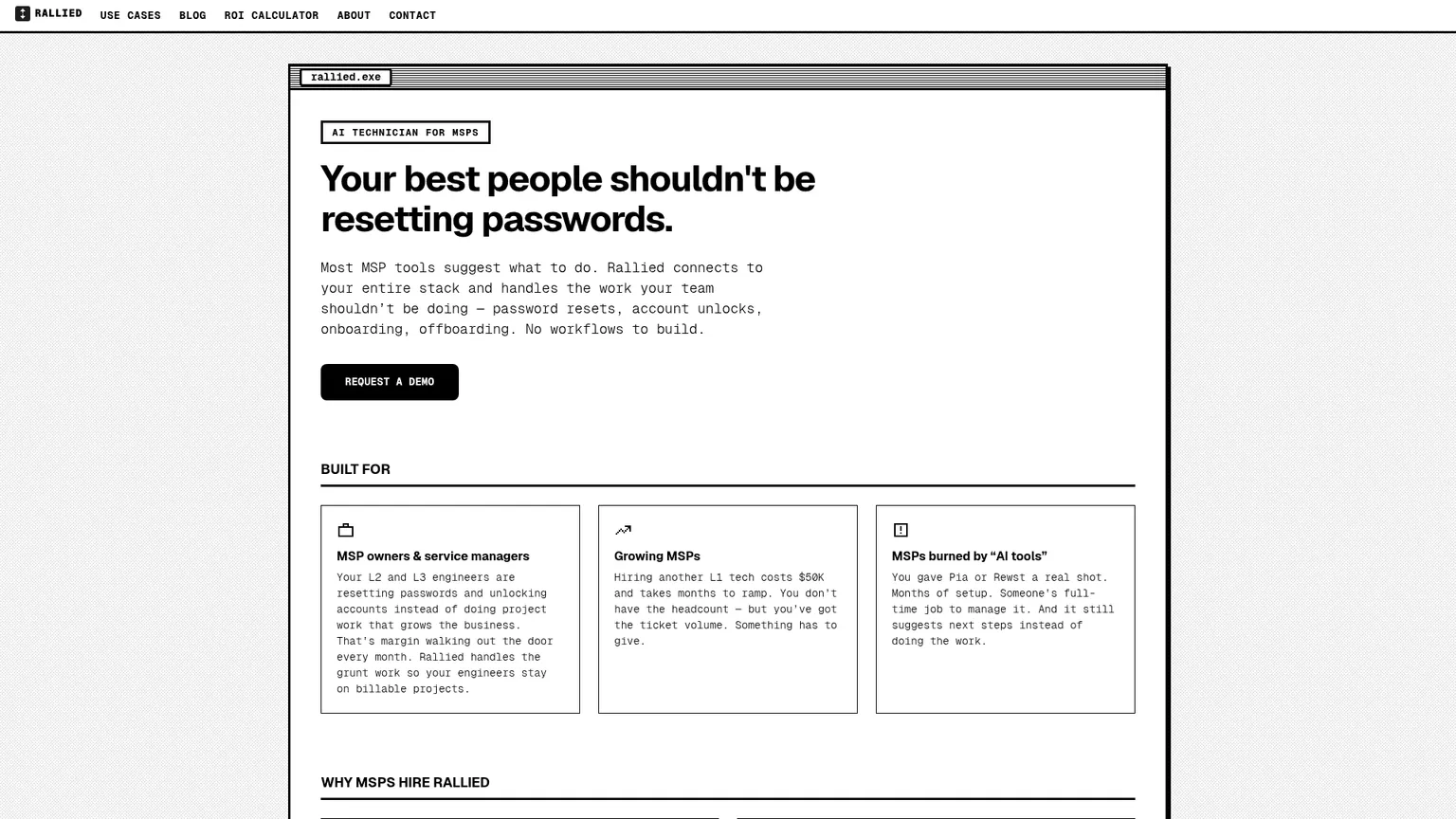
Good monitoring generates alerts. Rallied closes them. Try it free for 14 days.
Frequently Asked Questions
What is the best network monitoring software for MSPs in 2026?
Auvik and Domotz are the top picks for MSPs. Auvik deploys in under 15 minutes per client and gives you real-time topology maps across your entire portfolio. Domotz is the better value play - starting at $1.50 per managed device per month, it's typically 30–60% cheaper than Auvik at scale, and one customer (TRINUS) cut costs 66% after switching.
Is Zabbix free to use?
Zabbix is completely free to self-host - no per-device license fees, no usage caps, no vendor lock-in. The catch is that it requires real monitoring expertise to deploy and tune. Zabbix Cloud starts at $50/month (Nano tier) for a fully managed option. Commercial support subscriptions are also available if you need SLA-backed assistance.
How much does PRTG Network Monitor cost?
PRTG uses per-sensor subscription pricing. The PRTG 500 tier runs $179/month (500 sensors), PRTG 1000 is $325/month, and PRTG 2500 is $675/month. A free tier covers 100 sensors (roughly 10–20 devices) with no time limit. Important: Paessler ended perpetual licenses in July 2024, so existing customers saw renewal costs roughly double.
What's the difference between Auvik and Domotz?
Both are cloud-based MSP network monitoring platforms that deploy in minutes. The main difference is pricing model: Domotz charges per device or per collector site (from $1.50/device/mo or $35/collector/mo), which is transparent and scales predictably. Auvik uses a tiered per-billable-device model and requires a sales quote - there's no public pricing. For smaller MSPs or those managing many small sites, Domotz usually comes out cheaper. For MSPs who need deeper topology mapping and PSA integrations, Auvik's feature set often wins.
Does SolarWinds still have a security problem after the 2020 breach?
The 2020 SUNBURST supply-chain attack affected roughly 18,000 SolarWinds customers and remains a trust factor in the market. SolarWinds has since invested heavily in security - dedicated CISO, third-party audits, a Secure by Design program - and most large enterprise customers who stayed have accepted the remediation. For organizations with strict compliance requirements, it's worth reviewing the updated security posture before committing.