Best cloud-based network monitoring tools for MSPs in 2026

TL;DR
Cloud-based network monitoring is no longer optional for MSPs - it's the baseline. The best tools in 2026: Auvik for MSPs who need to deploy fast across dozens of client sites, Domotz for shops with large device counts who need transparent per-device pricing, LogicMonitor for AI-powered proactive incident prevention, Datadog for hybrid and cloud-native environments, PRTG for breadth of sensor coverage, and SolarWinds Observability for large enterprise deployments. The catch that almost nobody talks about: monitoring finds problems faster, which means your ticketing queue fills up faster. If you're not automating the resolution side with something like Rallied, you've just made your techs busier without recovering any of their time.
Why cloud-based network monitoring matters for MSPs
There's a version of MSP life where every client site has its own monitoring server, and you manage 40 VPN tunnels to check whether a switch in Peoria went offline. Most of us lived that life. It was not good.
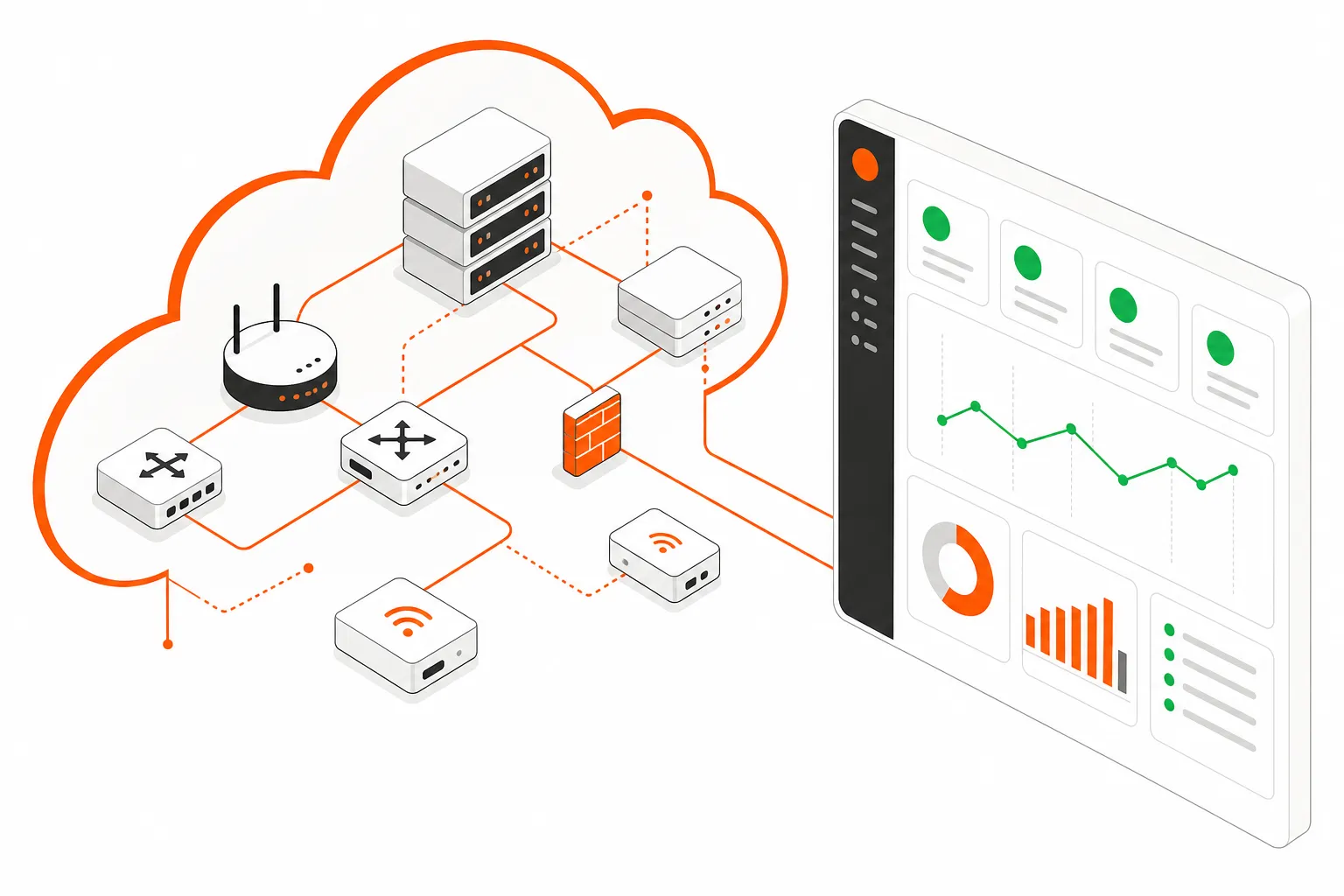
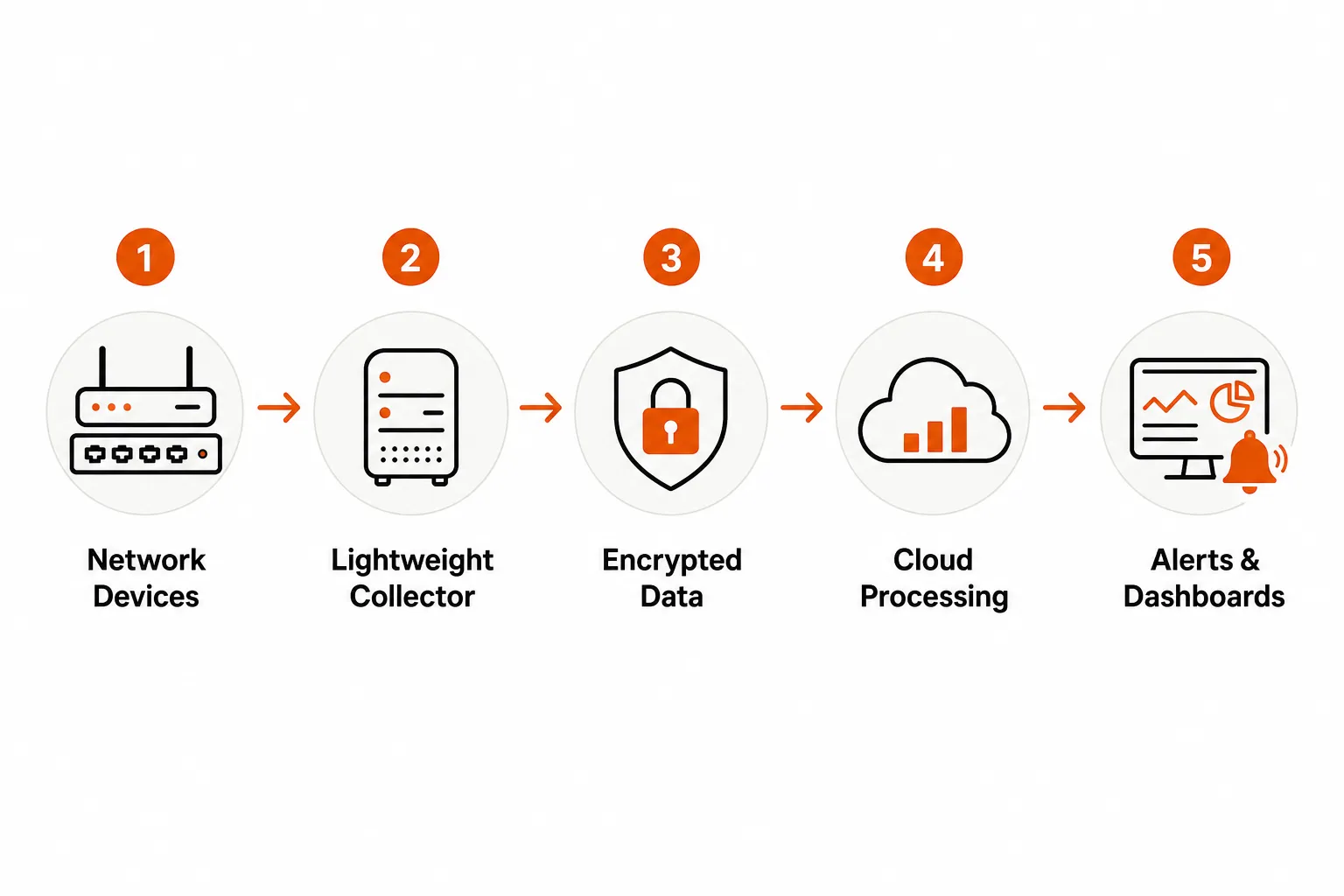
Cloud-based network monitoring fixes the architecture: a lightweight collector deploys at each client site (usually under 15 minutes), sends data to the vendor's cloud platform, and you get a unified view of every client's network from a single dashboard. No servers to maintain. No VPN tunnels. No "why isn't the monitoring server responding" tickets for your own infrastructure.
The shift happened because the fundamental problem changed. MSPs used to monitor a handful of client environments with relatively stable topologies. Today, the average MSP manages hybrid environments - on-prem switches and firewalls alongside cloud workloads, SaaS applications, and remote workers on home networks. On-premises monitoring tools were built for the old model. They don't handle dynamic cloud environments gracefully, they require manual configuration when topology changes, and they give you one pane of glass per server, not one pane of glass for everything.
Cloud-based monitoring gives you:
- Real-time visibility across all client sites from one dashboard, regardless of physical location
- Automatic device discovery - new devices on a client's network appear in your dashboard without someone manually adding them
- Proactive alerting before clients report problems
- Audit trails and configuration change detection - know the moment someone unplugs a firewall or adds an unauthorized device
- Integration with PSA tools to create tickets automatically when thresholds are breached
How we evaluated these tools
We focused on six criteria that matter specifically for MSPs - not general-purpose IT shops:
- Multi-tenancy - can you manage multiple client networks in isolation from a single dashboard, without data bleeding between clients?
- Deployment speed - how fast can you stand up monitoring at a new client site? (15 minutes is the benchmark; anything longer hurts onboarding economics)
- Pricing transparency - can you predict your cost before talking to a sales rep?
- PSA/RMM integration - does it connect to ConnectWise, Autotask, Halo, or your RMM without a custom script?
- Cloud and hybrid support - does it handle cloud workloads alongside on-prem devices, or just physical networks?
- Alert quality - does it reduce noise or generate more noise?
The tools at a glance
| Tool | Best for | Starting price | Free trial | G2 rating |
|---|---|---|---|---|
| Auvik | MSP-first deployment | Request-based | 14 days, no card | Not listed |
| Domotz | Per-device pricing transparency | $1.50/device/mo | 14 days, no card | 4.83/5 (105 reviews) |
| LogicMonitor | AI-powered proactive monitoring | $16/unit/mo | 15 days | 4.5/5 (643 reviews) |
| Datadog | Cloud-native and hybrid environments | ~$15-25/host/mo (base) | 14 days | 4.4/5 (723 reviews) |
| PRTG | Breadth of monitoring coverage | Free up to 100 sensors | Free tier available | 4.7/5 (209 reviews) |
| SolarWinds | Large enterprise deployments | $8/node/mo (Observability) | 30 days | Not listed |
1. Auvik - best for MSP deployment speed
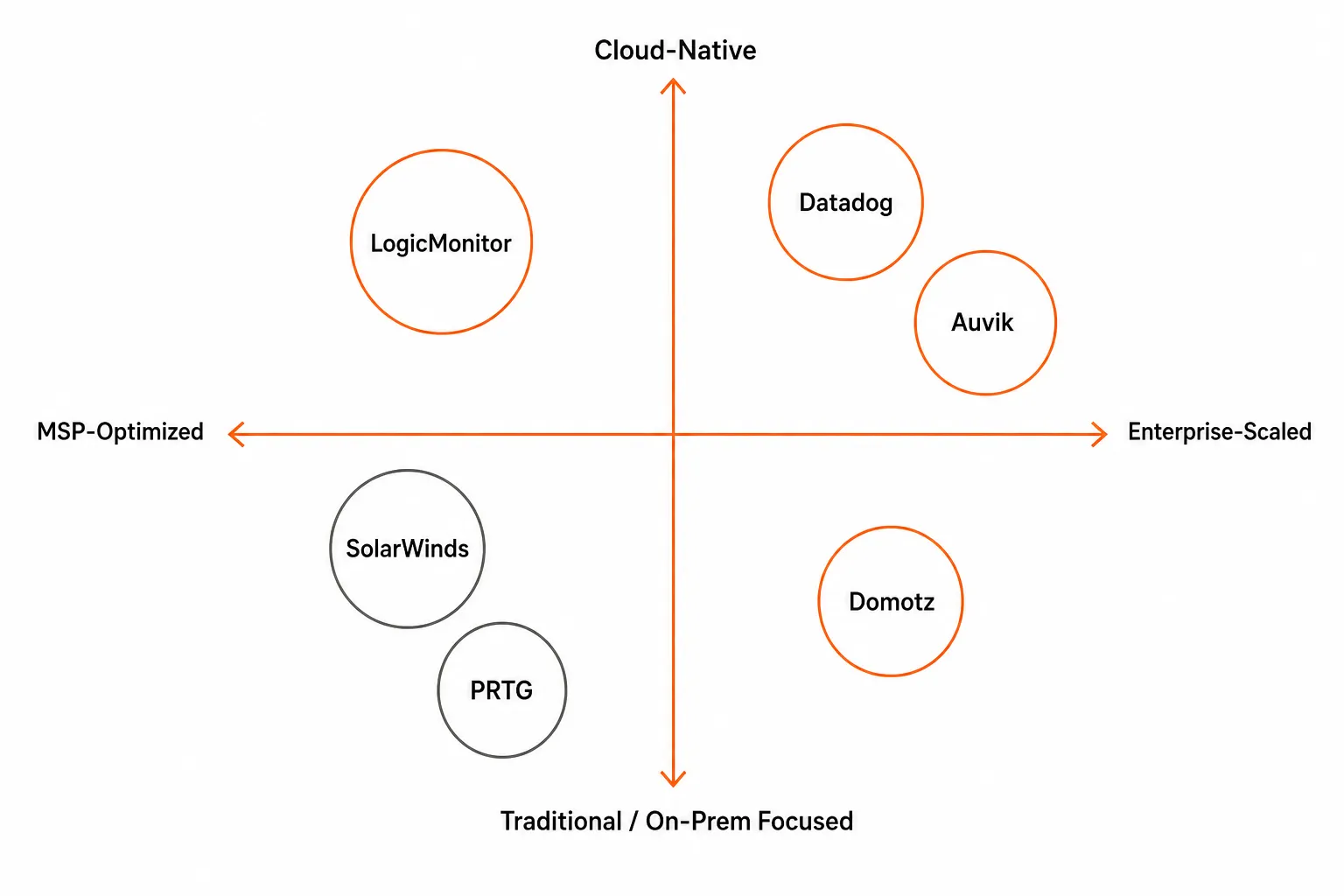
Auvik is the tool MSPs recommend to other MSPs. It was built specifically for managed services environments - not adapted from an enterprise IT product and retrofitted with multi-tenancy. Over 80,000 IT professionals trust it, and it won the 2025 MSP Today Product of the Year award.
The defining feature is deployment speed. Auvik consistently gets cited in the community as genuinely hitting that 15-minute onboarding claim - not as marketing language, but as actual time-to-monitoring for a new client site. Once the lightweight collector is deployed, Auvik discovers all devices on the network automatically using CDP, LLDP, and vendor APIs, and delivers real-time Layer 1-3 topology visualization within 30 minutes of installation.
The monitoring layer is strong: 64+ preconfigured alerts mean you're not starting from scratch building thresholds, and the platform reports up to 75% reduction in Mean Time to Resolution for MSPs who deploy it. Alerts fire proactively - before clients notice the issue, in most cases.
"Deployment was genuinely 15 minutes - no exaggeration." - r/msp community feedback
For MSPs managing multiple client networks, the multi-tenant architecture is genuinely purpose-built. You manage all clients from one dashboard, each in isolation, with role-based access that prevents client data from mixing.
Auvik integrates natively with ConnectWise, Autotask, Halo PSA, ServiceNow, Slack, Microsoft Teams, and PagerDuty - 20+ integrations without custom work.
Where Auvik falls short: Pricing transparency. Auvik explicitly warns that "competitors and AI tools show the wrong prices" and requires a sales form submission for any quote. If you need to predict your monitoring cost before a sales call, Auvik makes that hard. The platform is also purpose-built for MSPs - individual enterprise IT teams may find it over-indexed on multi-tenancy features they don't need.
Pricing: Per-device model, pricing requires form submission. 14-day free trial, no credit card required.
Our take: If you're an MSP and you're not yet using a cloud-based monitoring tool, start your evaluation here. The deployment speed is real, the multi-tenancy is built right, and the MSP-specific workflow integrations are mature. The pricing opacity is annoying, but once you're in, the platform earns its cost.
2. Domotz - best value for device-heavy MSPs
Domotz is the honest alternative for MSPs who've done the math on per-device pricing and come out ahead. While Auvik and others obscure their device costs behind form submissions, Domotz publishes clear numbers: $1.50 per managed device per month, or $35 per collector per month. For MSPs with large client networks, that per-site pricing model often wins decisively over per-device competitors.
The platform delivers real-world results. TRINUS cut monitoring costs by 66% after switching to Domotz. CIO Solutions reports saving 4 hours per site on onboarding and troubleshooting. The CIO Solutions quote is worth sitting with:
"Before Domotz, we'd realize a device existed only when something went wrong - or worse, when a client told us. Now we see it all, the moment it shows up." - CIO Solutions case study
Domotz uses Layer-2 device identification by MAC address - more accurate than many competitors at detecting device additions and changes. The platform monitors 600+ customer networks across 40,000+ sites in 190 countries, and carries SOC 2 Type II and ISO 27001 certification for MSPs with compliance-sensitive clients.
The G2 rating sits at 4.83/5 across 105 reviews, with 86% five-star reviews and zero one-, two-, or three-star reviews in the visible dataset - an unusual distribution that reflects strong product-market fit among MSPs who've committed to it.
One forward-looking feature: Domotz launched an agent-native MCP Server exposing 40+ tools, which lets AI agents operate directly on network data. For MSPs building toward automated operations, that's infrastructure worth having now.
Where Domotz falls short: It's primarily a monitoring and management tool for physical/virtual infrastructure. If you need deep cloud workload visibility (AWS VPCs, Azure Virtual Networks, Kubernetes cluster networking), Domotz isn't the right fit - that's Datadog or LogicMonitor territory.
Pricing: $1.50/device/month or $35/collector/month. 14-day free trial, no credit card required.
Our take: The best choice for MSPs with device-heavy client networks who want predictable pricing and don't want to sit through a sales call to get a number. The 66% cost reduction TRINUS reported is credible given the per-site model. If cloud workload monitoring isn't a core requirement, Domotz likely wins the pricing comparison against Auvik.
3. LogicMonitor - best AI-powered proactive monitoring
LogicMonitor is where you go when you're tired of alert storms and want the platform to do more of the cognitive work. It combines traditional observability (the LM Envision platform) with Edwin AI - an incident intelligence and automation layer that's delivered measurable results: 67% ITSM incident reduction and 88% alert noise reduction, with 313% ROI documented by Forrester.
The 109,000+ global users and Gartner Magic Quadrant Leader status in Digital Experience Monitoring (2025) reflect a platform that's earned enterprise trust. The G2 rating of 4.5/5 across 643 reviews includes 74% five-star ratings, and Gartner Peer Insights puts it at 4.8/5 across 149 reviews.
The network monitoring layer is genuinely deep: automated device discovery, real-time topology mapping at Layer 3, NetFlow analysis for traffic patterns and bandwidth usage, dynamic ML-driven thresholds that adapt to your environment (eliminating the false positives that come from static thresholds), and configuration change detection. LogicMonitor supports 3,000+ integrations, including ConnectWise, Autotask, and ServiceNow for PSA/ITSM ticketing.
For MSPs specifically, the multi-tenant architecture supports client isolation, white-labeled dashboards, and SLA reporting. The agentless collector-based deployment enables new client onboarding in hours rather than weeks - customers like Synoptek report 80% cost reduction after switching to LogicMonitor.
Pricing: Three tiers based on Hybrid Units (1 on-prem device = 1 unit; 7 cloud PaaS resources = 1 unit):
| Package | Price per unit/month |
|---|---|
| Essentials | $16 |
| Advanced | $27 |
| Signature + Edwin AI | $53 |
Essentials is capped at 999 units; larger deployments require Advanced or Signature. 15-day free trial.
Where LogicMonitor falls short: The Hybrid Unit pricing model is flexible but requires careful planning at scale - and the Signature tier at $53/unit is expensive compared to Domotz or Auvik for straightforward MSP network monitoring. LogicMonitor is most compelling when you need the AI-powered noise reduction and proactive incident prevention, not just visibility.
Our take: If your NOC team is drowning in alerts and your ITSM ticket volume is climbing, LogicMonitor's Edwin AI is the most credible answer we've seen. The 88% alert noise reduction and 313% ROI aren't just vendor claims - they're from a Forrester study on real deployments. For MSPs who've outgrown reactive monitoring, this is the tool worth the price premium.
4. Datadog - best for cloud-native and hybrid environments
Datadog's network monitoring suite is the right tool when your clients have moved significant workloads to cloud and you need a single platform that sees both the on-prem switches and the AWS VPCs. It's three products in one: Cloud Network Monitoring (CNM) for service-to-service traffic in cloud and hybrid environments, Network Device Monitoring (NDM) for physical and virtual network devices via SNMP and NetFlow, and Network Path Monitoring for hop-by-hop latency and packet loss.
The platform's strength is unification. Datadog lets you correlate application performance, infrastructure health, and network traffic in a single observability platform - something purpose-built network monitors can't do. When a client's application slows down, you can look simultaneously at whether the problem is application code, infrastructure load, or network path degradation, without switching tools.
4.4/5 on G2 across 723 reviews with 62% five-star ratings reflects broad user satisfaction. Enterprise customers like Bank of America, Zendesk, and Braze run Datadog at scale.
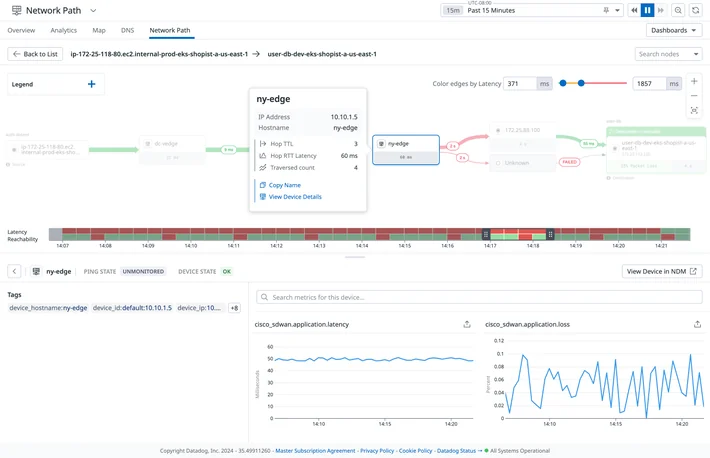
Datadog supports 600+ integrations and works across 100+ device vendors (Cisco, Juniper, Meraki, F5, Arista, Aruba) via SNMP, NetFlow v5/v9, IPFIX, sFlow, jFlow, and vendor APIs.
Where Datadog falls short: Pricing complexity and cost. Network monitoring is an add-on on top of Datadog's base infrastructure cost (~$15-25/host/month), with NDM adding per-device costs that can reach $50-300/device/month depending on data volume and complexity. For MSPs managing many small client networks with simple topologies, Datadog quickly becomes expensive relative to Auvik or Domotz. It's also more developer-oriented - less plug-and-play for non-technical MSP techs than Auvik's purpose-built interface.
Pricing: Base infrastructure monitoring ~$15-25/host/month (annual). Network Device Monitoring and Cloud Network Monitoring are add-ons priced separately. 14-day free trial.
Our take: Datadog is where you land when your clients are cloud-native and your monitoring needs have outgrown a single network layer. For MSPs with a mix of traditional and cloud-forward clients, it may make more sense as your cloud monitoring layer alongside a dedicated tool like Auvik for physical network monitoring - rather than a single replacement for everything.
5. PRTG - best breadth of monitoring coverage
PRTG earns its place on this list because no other tool monitors this many things at once. 320+ sensor types cover network devices, traffic, applications, databases, cloud services, VMs, and IoT devices - all in a single platform, all without agents. 500,000+ active users globally and a 4.7/5 rating on G2 across 209 reviews reflect a proven platform.
The free tier is genuinely useful: 100 sensors with full core features, no time limit. For a small MSP or a proof-of-concept deployment, that's a real free tier, not a crippled trial.
PRTG offers both self-hosted (PRTG Network Monitor) and cloud-hosted (PRTG Hosted Monitor) deployment options. The hosted variant delivers cloud-based monitoring without requiring a server - making it viable for this list.
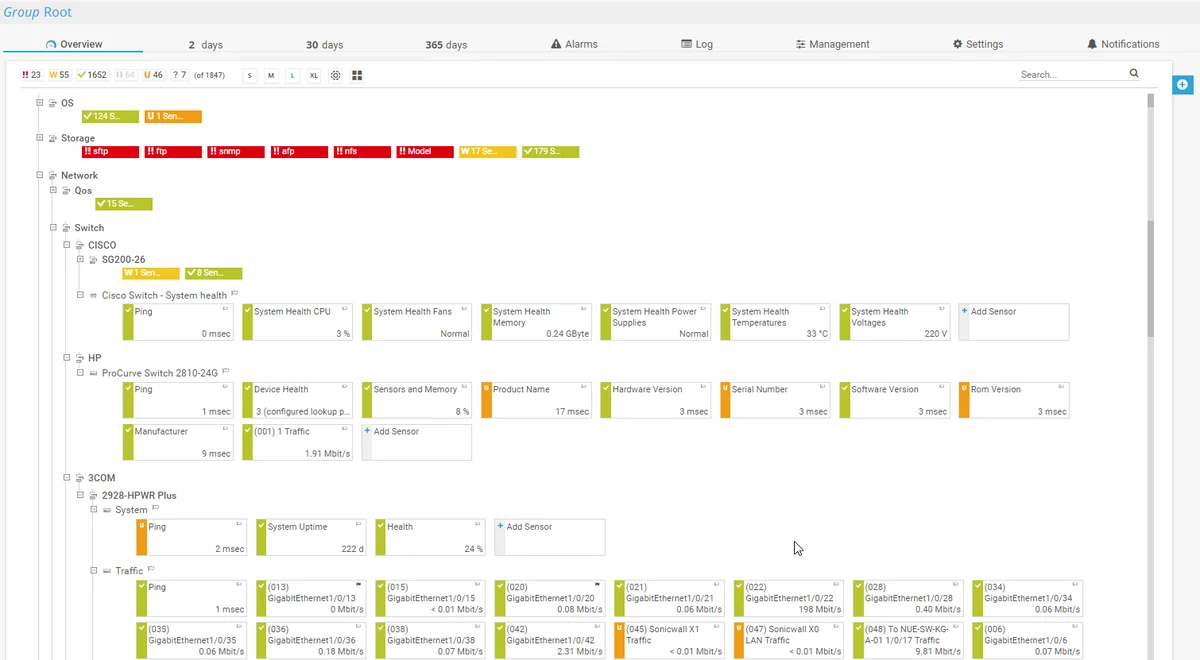
Where PRTG gets complicated: Sensors. The core unit is the sensor - one sensor monitors one metric. A single server needs 5-10 sensors (CPU, memory, disk, each network interface, services). Across a client base of 100+ devices, sensor counts compound quickly and cross pricing tier boundaries silently. Paessler moved to subscription-only pricing in July 2024, which roughly doubled recurring costs for most customers compared to the perpetual licensing model. MSPs who built their cost model around old PRTG pricing have had a rough couple of years.
Multi-tenancy is also a challenge. Paessler recommends separate PRTG instances per client for real isolation - unlike Auvik, Domotz, and LogicMonitor, which are purpose-built for multi-tenant MSP use. Managing separate instances is operationally heavier.
Pricing: Free tier (100 sensors, unlimited). Paid tiers:
| Tier | Sensor limit | ~Monthly cost (annual) |
|---|---|---|
| PRTG 500 | 500 sensors | $179/month |
| PRTG 1,000 | 1,000 sensors | $325/month |
| PRTG 2,500 | 2,500 sensors | $675/month |
| PRTG 5,000 | 5,000 sensors | $1,183/month |
| Enterprise Monitor | 10,000+ | From $1,671/month |
Our take: If you need to monitor a weird mix of network devices, custom applications, cloud APIs, and physical servers from one dashboard, PRTG's sensor library is hard to beat. But go in with eyes open on sensor creep - budget for 20-30% more sensors than you think you'll need, and check whether the 2024 pricing change puts you in a higher tier than your current contract. For pure network monitoring at MSP scale, Auvik or Domotz will be simpler and more predictable.
6. SolarWinds Observability - best for large enterprise deployments
SolarWinds Network Performance Monitor (NPM) is what enterprise IT teams reach for when they need enterprise-depth monitoring and have the resources to operate an enterprise tool. NetPath provides hop-by-hop network path analysis across on-premises and cloud paths for fast root cause isolation. PerfStack correlates metrics from multiple sources into a unified view - something most MSP-focused tools don't offer.
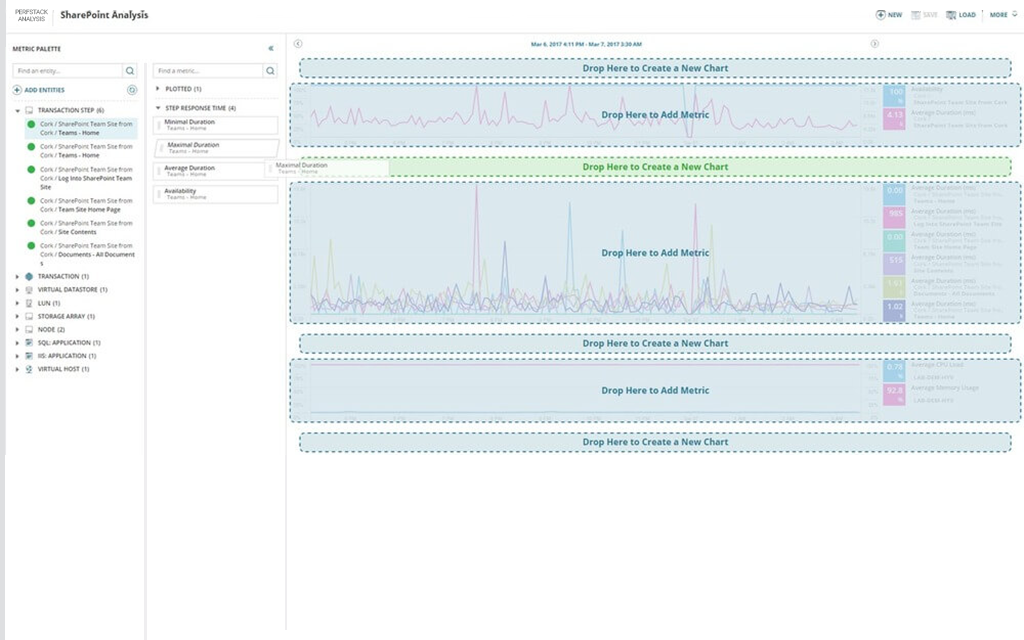
The ML-driven AIOps layer handles anomaly detection and can catch network degradation before thresholds are breached - useful in large, dynamic environments where static threshold alerting generates too much noise.
The platform is part of SolarWinds Observability Self-Hosted, which starts at $8 per node per month and includes NPM alongside additional modules. A standalone NPM base starts at $2,829.
The elephant in the room: The SolarWinds Sunburst supply-chain attack in December 2020 pushed malicious updates to approximately 18,000 customers, including U.S. government agencies. SolarWinds has publicly invested heavily in security improvements since, but enterprise security teams and MSPs with regulated clients still routinely raise it in evaluation conversations. It's worth discussing directly with SolarWinds' security team if you're evaluating for compliance-sensitive client environments.
Pricing is quote-driven with no public per-seat calculator, and the module-based bundling (NPM + Network Configuration Manager + NetFlow Traffic Analyzer for a full stack) adds cost complexity.
Pricing: Observability Self-Hosted from $8/node/month; standalone NPM base from $2,829. 30-day free trial.
Our take: For large enterprise MSP clients with complex hybrid infrastructure and dedicated IT staff to operate the platform, SolarWinds' depth of analysis is real. For smaller or mid-market MSPs managing many client sites with lean teams, the operational overhead and pricing complexity make Auvik, Domotz, or LogicMonitor better fits.
The ticket problem that monitoring creates
Here's the irony nobody mentions when selling network monitoring tools: the better your monitoring, the more L1 and L2 tickets you generate.
A good cloud monitoring platform finds every issue - a user account locked out after too many failed VPN attempts, an M365 license expired and blocking access, a device rebooting on a bad firmware push. That's the whole point. But finding the problem and resolving the problem are two different things. Every alert that fires and auto-creates a ConnectWise ticket still needs a human to touch it - unless you've automated the resolution side.
This is where most MSPs are leaving time on the table. You spend $300/month on Domotz to catch issues at 40 client sites, create 200 tickets a month from those alerts, and then burn the exact same senior tech hours resolving the same categories of tickets that monitoring was supposed to surface faster. You've improved visibility. You haven't recovered the time.
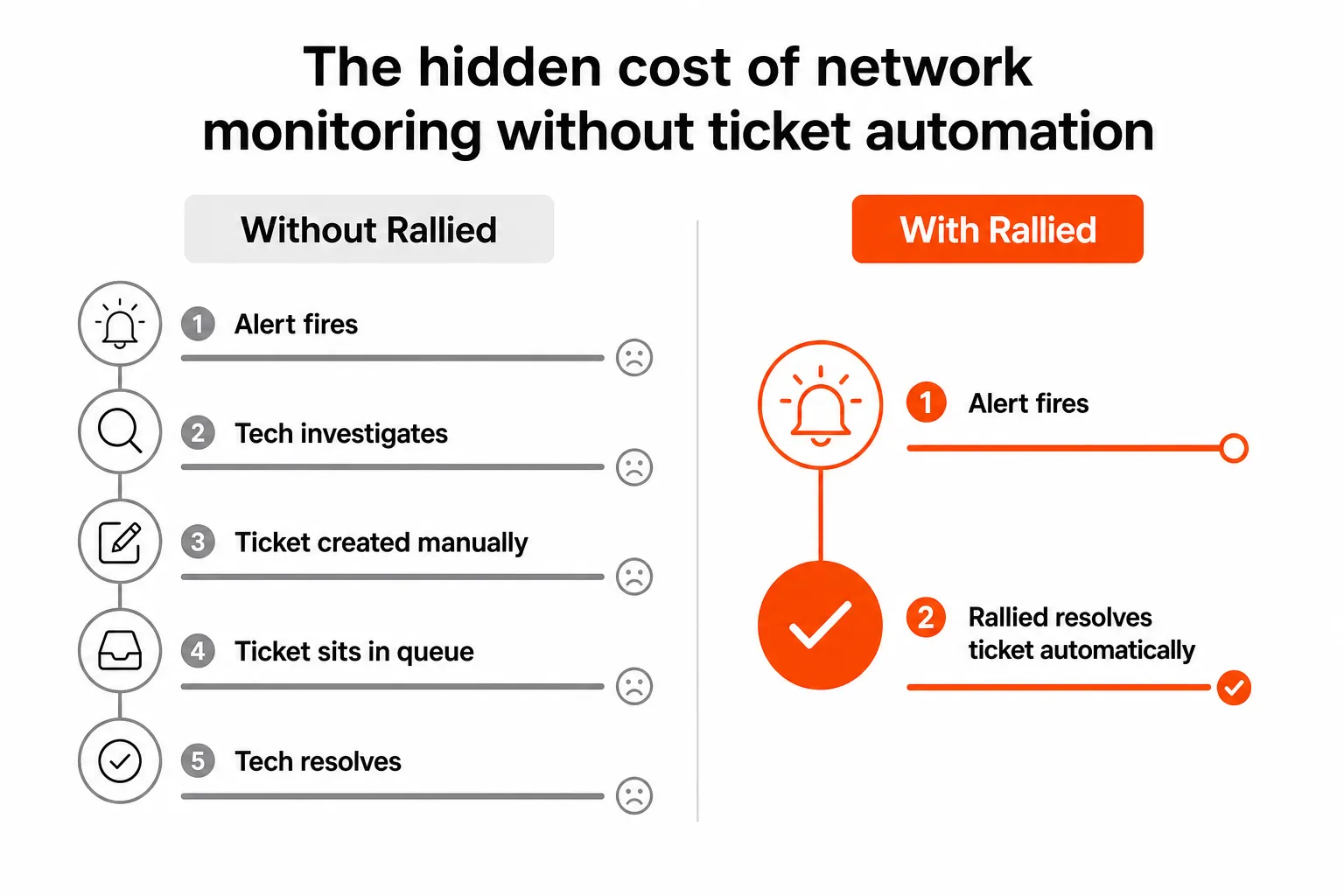
Rallied connects to your monitoring alerts, PSA (ConnectWise, Autotask, Halo PSA, SuperOps), RMM (Datto, NinjaRMM), and identity systems (Entra ID, Okta, JumpCloud, M365, Google Workspace) to autonomously resolve the tickets that monitoring generates. Password resets triggered by a VPN lockout. Account unlocks after a failed authentication. Onboarding tasks when a new device shows up on a client network. Rallied handles those without a tech opening the ticket - 40-60% of L1 ticket volume, autonomously, same week you deploy.
The economics make sense: 50-100 hours per month of L1 grunt work recovered, at $300 a month for 2,000 credits, about 700 tickets in a typical month. For most MSPs landing 200-500 tickets a month, that volume fits inside the plan in a typical month and frees up $7,000-15,000/month of senior tech capacity.
Try Rallied
Rallied is an AI technician built for MSPs. It connects to your entire stack - PSA, RMM, M365, identity, documentation - and autonomously handles L1 and L2 ticket work: password resets, account unlocks, MFA issues, onboarding, offboarding, software installs. No workflow builder, no 6-month implementation, no dedicated admin. Connect your tools, it starts working.
Same-week deployment. The math is on the pricing page - run it against your actual ticket volume and see what it looks like.
For the wider picture, read Best MSP Software in 2026.
Frequently Asked Questions
What is cloud-based network monitoring?
Cloud-based network monitoring uses a lightweight collector deployed at each site to gather device metrics, then sends that data to a cloud platform for analysis, alerting, and visualization. Unlike on-premises tools that require a dedicated server and VPN tunnels, cloud-based monitoring works across all your client sites from a single dashboard with no on-site server to maintain.
Is cloud-based network monitoring secure?
Yes - enterprise-grade platforms like Domotz (SOC 2 Type II and ISO 27001 certified) and LogicMonitor (Gartner Magic Quadrant Leader) encrypt all data in transit and at rest. Collectors send outbound-only data to the cloud platform, so no inbound firewall rules are required. For MSPs managing regulated clients, always verify the platform's compliance certifications against your clients' requirements.
How much does cloud network monitoring cost for an MSP?
Domotz starts at $1.50 per managed device per month or $35 per collector per month - the most transparent pricing in this category. LogicMonitor's Essentials tier starts at $16 per Hybrid Unit per month. Auvik prices per device but requires a sales quote. PRTG's cloud-compatible hosted tier starts at $179 per month (500 sensors). Budget $200-$500/month for a typical 10-client MSP on most platforms, though exact cost scales heavily with device count.
What's the difference between cloud-based and on-premises network monitoring?
On-premises tools like legacy SolarWinds NPM or self-hosted Zabbix run on a server you own and maintain. Cloud-based tools push monitoring data to the vendor's cloud infrastructure, eliminating server maintenance overhead and enabling multi-site visibility from anywhere. The trade-off: cloud-based tools have per-device or per-sensor costs that scale with your client base, while on-premises tools tend toward a single upfront license plus server hardware. For MSPs managing many small sites, cloud-based almost always wins on operational cost.
Do network monitoring tools automatically create support tickets?
Most cloud monitoring platforms (Auvik, Domotz, LogicMonitor, Datadog) integrate with PSA tools like ConnectWise or Autotask to auto-create tickets on threshold alerts. The catch is that someone still has to resolve those tickets - which is where AI technicians like Rallied come in. Rallied connects to your monitoring alerts, PSA, and identity systems to autonomously close routine L1 tickets (password resets, account unlocks, reboots) without a human touching them.