The 6 best MDR tools for MSPs in 2026
TL;DR
The honest short version: if you're managing SMB clients and want the best ROI on MDR, Huntress is still the community favorite - $8.99/endpoint/month, purpose-built for MSPs, and genuinely acts on threats rather than just alerting you about them. If you're already running Sophos Intercept X, Sophos MDR is a natural layer-on with impressive speed (52% of incidents resolved by AI in 89 seconds). For larger MSPs serving mid-market clients with real security budgets, Arctic Wolf and CrowdStrike Falcon Complete are the premium options worth the conversation. The thing most comparison posts miss: MDR tools generate tickets - account lockouts, MFA resets, endpoint re-imaging after a malware hit. Rallied handles those L1/L2 cleanup tickets automatically, so your techs aren't manually working through the aftermath at 11pm.
Why most MDR comparisons miss the point for MSPs
Most MDR tool roundups are written for enterprise security teams with a dedicated SOC budget and an in-house threat analyst on staff. That's not you.
You're managing 40, 80, maybe 200 client accounts. Your "security team" is a couple of technicians who also handle password resets, printer jams, and the CEO's Wi-Fi issues. You need an MDR tool that fits that operational reality - not one that was designed for a Fortune 500 security org and then given an "MSP program" as an afterthought.
The questions that actually matter for MSPs are different:
- Does it integrate with ConnectWise, Autotask, or HaloPSA so alerts become tickets in your existing workflow?
- Is multi-tenant management genuinely built-in, or is it a login-per-client situation?
- Does the vendor actually do something when they detect a threat, or do they just alert you and wait?
- What does it cost per endpoint, and does that math work when you're reselling to a 25-seat client?
- How fast can you deploy it across a new client without blocking out two weeks?
Those are the lenses we used to evaluate these six tools. Detection capability matters, but operational fit matters more for an MSP.
How we picked these six
We combined research from product documentation, pricing data, G2 reviews, Gartner Peer Insights, and community feedback from r/msp - where MSP owners and service managers share unfiltered takes on what actually works in the field. Each tool was evaluated on MSP-native fit, pricing transparency, detection capability, SOC response model, and real-world deployment speed.
We excluded tools that have no meaningful MSP program and limited community data. We also aren't including Intercom-adjacent tools or vendors with no realistic SMB pricing story.
MDR tools for MSPs: quick comparison
| Tool | Best for | Starting price | MDR model | G2 rating |
|---|---|---|---|---|
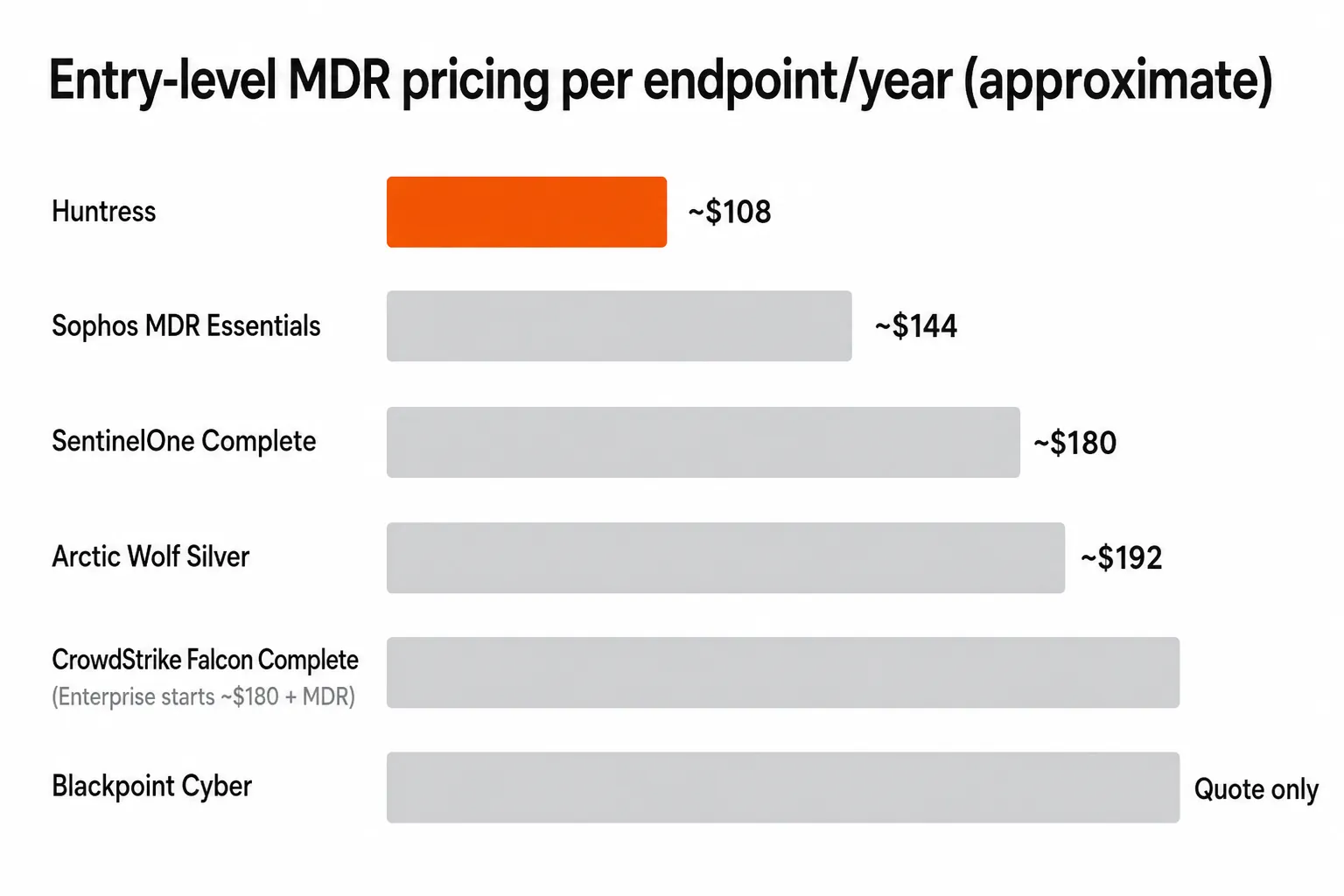
| Huntress | Small/mid MSPs | $8.99/endpoint/mo | Human SOC + AI | 4.8/5 |
| Blackpoint Cyber | MSP-native SOC feel | Quote only | Automated + SOC | 4.7/5 (258 reviews) |
| Sophos MDR | Existing Sophos shops | ~$12/user/mo | Agentic AI + human | 4.8/5 Gartner |
| Arctic Wolf | Larger MSPs / enterprise | ~$16/endpoint/mo | Concierge + SOC | IDC Leader 2026 |
| SentinelOne Vigilance MDR | Platform depth + MDR | ~$15/endpoint/mo | AI + human analysts | 4.7/5 (201 reviews) |
| CrowdStrike Falcon Complete | Enterprise-facing MSPs | Custom quote | Agentic + human SOC | 4.6/5 (438 reviews) |
1. Huntress - best for small and mid-size MSPs
Huntress has earned its position as the default MDR recommendation on r/msp and in MSP communities for good reason. It's one of the few security vendors that was genuinely built for MSPs first - not an enterprise product with an MSP tier bolted on afterward.
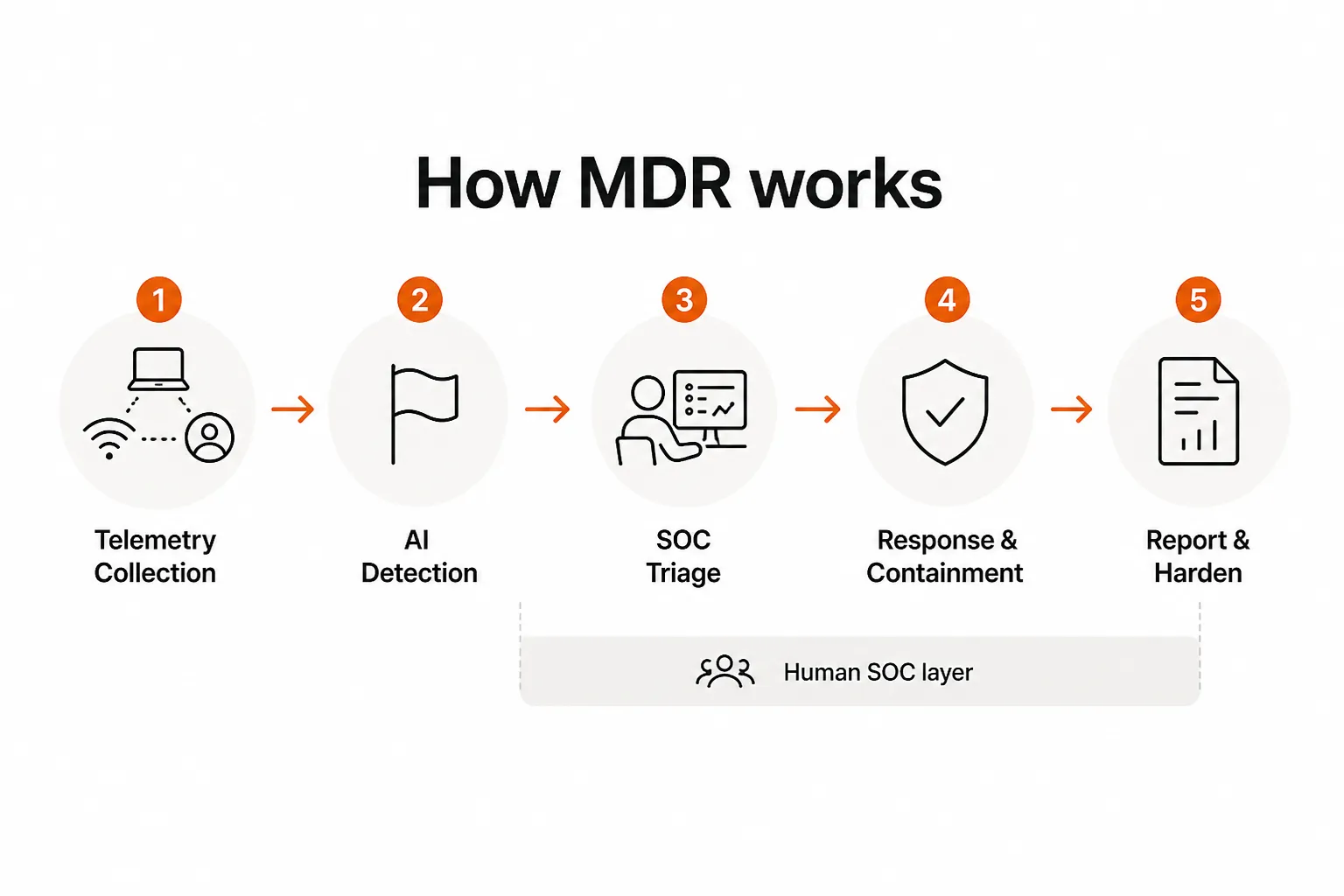
The core pitch is "last-line defense": Huntress sits below your existing antivirus (including Microsoft Defender, which it's often paired with rather than replacing), hunts for threats that slipped through, and has a 24/7 human SOC that investigates and responds. The Managed EDR product is the anchor, and they've since expanded to Managed ITDR (identity threat detection across Microsoft 365, Entra ID), Managed SIEM, and Security Awareness Training.
Two things stand out in community feedback. First, the false positive rate - Huntress claims under 1%, which tracks with what MSPs report; you're not drowning in noise. Second, the 8-minute mean time to respond, backed by an actual human SOC that makes calls rather than just passing alerts back to you. The SOC will reach out directly to your clients in an active incident if needed, which is exactly what an MSP wants at 2am.
The community isn't without concerns. One thread flagged that the quarantine feature - when Huntress quarantines an infected endpoint - can have a broader org-wide impact in some configurations, which you need to understand before deploying at scale. MSPs running Huntress extensively will want to test quarantine behavior in their specific environment before it becomes relevant in a live incident.
Pricing
| Product | List price | MSP partner pricing |
|---|---|---|
| Managed EDR | $8.99/endpoint/month | ~50% off list |
| Managed ITDR | $4.80/identity/month | ~50% off list |
| Managed SIEM | $4.00/source/month | Volume pricing |
| Security Awareness Training | $2.08/learner/month | Volume pricing |
MSP partner pricing is typically around 50% off list, so the real per-endpoint cost for a well-run MSP is closer to $4-5/month. At that margin, reselling to SMB clients is genuinely viable.
Pros
- Purpose-built for MSPs, multi-tenant from day one
- Transparent per-unit pricing that scales with SMB client sizes
- Human SOC that actually acts, not just alerts
- Strong Microsoft Defender integration (complements rather than replaces)
- 5M+ endpoints protected globally
Cons
- Not a full AV replacement - you still need endpoint protection alongside it
- Quarantine feature behavior needs careful testing in multi-tenant environments
- Some community feedback on product focus fragmentation as they've expanded the suite
Verdict: If you're managing SMB clients and need a low-drama MDR that the whole team can operate without a security specialist on staff, Huntress is the starting point. The economics work at SMB scale and the MSP-native design shows in day-to-day operations. We'd reach for it first for any MSP building out a security stack from scratch.
2. Blackpoint Cyber - best for MSP-native threat response
Blackpoint Cyber doesn't talk about alerts - they talk about actions. Their core positioning is that traditional EDR tools generate alerts that humans have to parse, while Blackpoint's CompassOne platform detects and responds before the alert stage. That distinction is worth taking seriously, not just as marketing.
The stat they lead with: Blackpoint locks compromised Microsoft 365 accounts on average every 30 minutes based on detected account compromises. They also claim to find active Business Email Compromise (BEC) in 20% of new organizations at onboarding - meaning clients who thought they were clean often aren't.
The MSP community feedback is particularly strong for Blackpoint. Their G2 profile shows 4.7/5 from 258 verified reviews, with 86% five-star ratings. The common thread in reviews is "true partnership" language - MSPs describe it as feeling less like a vendor relationship and more like having a dedicated SOC team.
One specific differentiator for MSPs: Blackpoint positions explicitly against traditional alert-heavy models, claiming conventional EDR misses 72% of attacks that don't generate traditional alert signatures. Whether or not that specific number is exact, the underlying point holds - signature-based detection has real gaps, and behavioral detection with human follow-through is meaningfully different.
Blackpoint integrates directly with ConnectWise PSA, Datto RMM, and Microsoft 365, which is the core MSP stack for most shops.
Pricing
Blackpoint doesn't publish pricing. You'll need a sales conversation. The G2 data suggests a 7-month ROI payback and 1-month implementation window, which frames the cost as meaningfully justified for the right client profile.
Pros
- "Actions, not alerts" model that genuinely differentiates from alert-heavy EDR
- 4.7/5 on G2 with 258 verified reviews and 86% five-star
- Strong PSA/RMM integration (ConnectWise, Datto, M365)
- Fast implementation (1-month per G2 aggregate data)
- MSP-native design with multi-client management
Cons
- No public pricing - requires a sales conversation before you can model unit economics
- Less name recognition than Sophos or CrowdStrike when talking to enterprise clients
- Limited public community discussion compared to Huntress (B2B-focused, less r/msp chatter)
Verdict: Blackpoint is the right pick for MSPs who want a SOC-as-a-service that genuinely contains threats rather than just notifying you about them. The no-public-pricing model is a minor friction point, but the community feedback is clear. Worth a call if you're evaluating Huntress alternatives or want a dedicated MDR rather than an EDR-plus-SOC model.
3. Sophos MDR - best for MSPs running Sophos endpoint
Sophos MDR holds the distinction of being #1 in G2's Spring 2026 MDR Grid and earning a Gartner Customers' Choice badge for 2026 - achievements that aren't common to hold simultaneously. It's trusted by 39,000+ organizations, which makes it one of the largest MDR deployments by volume.
The headline number that makes Sophos stand out from the operational perspective: 52% of incidents are resolved end-to-end by AI, with an average resolution time of 89 seconds. Human Sophos analysts supervise the AI decisions and handle everything the AI escalates. That 89-second figure is real - it's the median, not the optimistic case - and it's backed by 100% detection coverage in the MITRE ATT&CK Enterprise 2025 Evaluation.
Another point worth naming directly: Sophos MDR is vendor-agnostic. It integrates with 350+ third-party security tools, including CrowdStrike, SentinelOne, and Microsoft Defender. That's relevant for MSPs who have mixed-vendor client environments - you're not forced to rip and replace existing tools to layer on the MDR service.
That said, the r/msp community positions the Huntress vs. Sophos choice clearly: if you're already running Sophos Intercept X and Sophos firewalls across your clients, Sophos MDR is the natural extension and the integration is seamless. If you're starting fresh or have a mixed environment, Huntress wins on simplicity and margin economics.
The friction point is pricing opacity. Multiple MSP community threads report "surprise at quotes" for Sophos MDR Complete, with per-user costs landing around $226/user/year in some markets. The product naming is also confusing - MDR vs XDR vs MDR Complete vs Intercept X has generated r/msp vent threads specifically about trying to figure out which SKU to order.
Pricing
| Tier | Annual list price | Notes |
|---|---|---|
| MDR Essentials | Detection + triage, basic IR | |
| MDR Complete | ~$215-230/endpoint/year | Full IR, proactive hunting, breach warranty |
| Intercept X + MDR Complete bundle | ~$215-230/endpoint/year | Endpoint + MDR combined |
Pricing sourced from EnterpriseAV (March 2026) and r/msp community discussion. All quotes are sales-customized; these are benchmarks.
Pros
- 52% AI-autonomous resolution in 89 seconds - genuinely fast
- 100% MITRE ATT&CK 2025 detection coverage
- Vendor-agnostic (works with CrowdStrike, SentinelOne, Defender)
- Breach protection warranty included in MDR Complete
- Strongest pick if you're already deep in Sophos Intercept X
Cons
- Pricing opacity causes friction - requires sales engagement to get real numbers
- Product portfolio naming is confusing (MDR vs XDR vs ITDR naming)
- Some community reports of meaningful YoY price increases
- Sticker shock on MDR Complete (~$226/user/year in some markets)
Verdict: If your clients are already on Sophos Intercept X, layering on Sophos MDR Complete is the right call - the integration is native and the AI response speed is genuinely best-in-class. If you're evaluating cold, the pricing conversation takes work and the entry-level tier ($144/user/year) is solid but trails Huntress on MSP-native flexibility. Best for MSPs with an existing Sophos commitment or enterprise clients where the Gartner/G2 credentials open doors.
4. Arctic Wolf - best for larger MSPs serving mid-market clients
Arctic Wolf sits in the premium tier of the MDR market and doesn't try to hide it. Their 2026 positioning is anchored to the Aurora Agentic SOC - what they're calling "the world's largest commercial agentic SOC" - and a Concierge Delivery Model that assigns dedicated security experts who learn your clients' environment specifically, rather than running a generic monitoring function.
The analyst recognition is real: Arctic Wolf was named a 2026 IDC MarketScape Leader for midmarket MDR. The target customer is a mid-market organization - think $25M-$500M revenue - which maps to the upper end of what most MSPs are managing.
Two things distinguish Arctic Wolf in the market. First, the Concierge model: you get dedicated security engineers who understand organizational context, not a different analyst every time. For complex clients or regulated industries, that continuity matters a lot. Second, the Security Operations Warranty - up to $3M in financial assistance for cybersecurity incidents that occur while you're an active Arctic Wolf customer.
The honest challenge for MSPs: Arctic Wolf's pricing is premium by design, and the r/cybersecurity community reflects that tension directly. Threads looking for "Arctic Wolf alternatives" are common, with users noting that 24/7 SOC coverage can exceed $100,000/year even for mid-market deployments, and that annual price escalators (typically 5-15% year-over-year) make multi-year budgeting unpredictable.
For MSPs, Arctic Wolf makes most sense as a premium security offering for clients in regulated industries (healthcare, financial services, legal) where the IDC analyst credential and the Concierge model close deals that pure-play MSP tools can't.
Pricing
Per UnderDefense's 2026 pricing guide and AWS Marketplace data:
| Tier | Annual per-unit cost | Notes |
|---|---|---|
| Base | $15,000/year flat | Minimum commitment |
| Silver | $192/unit/year (~$16/mo) | Entry-level MDR |
| Gold | $218/unit/year (~$18/mo) | Standard MDR |
| Platinum | $257/unit/year (~$21/mo) | Premium tier |
Full deployment budgets: $15,000 to $500,000+/year depending on scope and org size. MSP resale pricing requires a custom conversation.
Pros
- Concierge model with dedicated security experts - not a rotation of analysts
- IDC MarketScape Leader 2026 for midmarket MDR
- $3M Security Operations Warranty is a compelling client conversation
- Strong in regulated industries where analyst credentials matter
- Aurora Agentic SOC with genuine AI-native architecture
Cons
- Pricing is premium and escalates annually (5-15% typical escalators)
- $15,000/year base minimum limits SMB applicability
- Active community search for alternatives due to cost friction
- Less MSP-native than Huntress or Blackpoint for smaller accounts
Verdict: Arctic Wolf is the right conversation when your client is a mid-market company in a regulated industry that needs to show their board or their cyber insurer a credible security posture. The Concierge model and analyst credentials justify the premium. Not the tool for sub-100-seat SMB clients where the unit economics break down.
5. SentinelOne Vigilance MDR - best for platform depth and advanced threat visibility
SentinelOne is primarily a platform company, and Vigilance MDR is the managed service layer on top of the Singularity platform. If you're evaluating SentinelOne, you're really evaluating two things together: the endpoint and identity protection platform and the MDR service.
The platform itself is legitimately strong. SentinelOne has been a Gartner Magic Quadrant Leader for EPP for five consecutive years, achieved 100% detection in the MITRE ATT&CK 2024 Enterprise Evaluation with 88% less noise than competitors, and protects 9,250+ customers including four of the Fortune 10. The Storyline feature - which automatically builds the full attack chain context for any incident - is genuinely useful for analysts and cuts triage time meaningfully.
The community take from G2's 201 verified reviewers: 4.7/5, with the lightweight agent, strong detection, and Storyline attack-chain visibility as standout positives. The consistent criticism: slow portal responsiveness, steep learning curve on advanced features, and UI complexity. MSPs with a security-focused technician on staff who can learn the platform properly will get real value; shops where the platform needs to be operated by generalist technicians will hit friction.
Purple AI, their threat hunting AI assistant, is genuinely differentiated - it lets analysts query threat data in natural language and run automated hunting workflows. For MSPs building security practices, it's the kind of tool that can accelerate a non-specialist technician's effectiveness.
On MDR specifically: Vigilance MDR is a 24/7 monitoring and response service with SentinelOne analysts. The Complete tier (which includes the Agentic AI SOC Analyst) is priced at $179.99/endpoint/year. That's the platform cost; Vigilance MDR is an add-on service layered on top.
Pricing
| Platform tier | Annual per-endpoint cost | MDR add-on |
|---|---|---|
| Core | $69.99/year | Not applicable |
| Control | $79.99/year | Not applicable |
| Complete | $179.99/year | Vigilance MDR add-on available |
| Commercial | $229.99/year | Vigilance MDR add-on available |
| Enterprise | Custom | Vigilance MDR included in some configurations |
Pricing from SentinelOne's public pricing page and SentinelOne Flex for flexible MSP models.
Pros
- 5-year consecutive Gartner MQ Leader for EPP
- Purple AI natural language threat hunting - genuinely differentiating for security practice MSPs
- Ransomware Rollback built-in (automated file restoration post-attack)
- Storyline attack-chain visualization cuts analyst triage time
- 100% MITRE ATT&CK 2024 detection, 88% less noise than competitors
Cons
- Steep learning curve - best utilized by security-focused technicians, not generalists
- Portal responsiveness issues noted consistently in G2 reviews
- MDR is an add-on layer, not the primary product - adds cost complexity
- Premium pricing ($179.99/endpoint/year for Complete) before the MDR add-on
Verdict: SentinelOne is the right call for MSPs building a security practice with technicians who will invest in learning the platform. The Storyline attack chain and Purple AI give a skilled analyst real leverage. Not the right tool for an MSP that needs security to "just work" with minimal training investment.
6. CrowdStrike Falcon Complete - best for enterprise-facing MSPs
CrowdStrike is the default answer when an enterprise client's CISO walks into an MSP meeting and asks what security platform you're using. Seven consecutive Gartner Magic Quadrant Leader awards for Endpoint Protection don't happen by accident, and Falcon Complete - their fully managed MDR service - sits at the top of the market in both capability and price.
The numbers from Falcon Complete are credible: 1-minute median time-to-contain (MTTC) for active threats, 75% reduction in mean time to resolve compared to in-house SOCs, and 2.7 million detections remediated monthly across the customer base. The Agentic MDR model - deterministic AI automation plus human-in-the-loop validation for every containment decision - is a genuine architecture decision, not just marketing language.
For MSPs, CrowdStrike runs a Powered Service Providers program with multi-tenant console access, Falcon Flex licensing for modular per-endpoint customization, and a partner portal at partner.crowdstrike.com. The integration story with ConnectWise, Autotask, and major PSAs is solid.
The honest friction: CrowdStrike isn't priced for SMB clients, and the G2 community is direct about this. The 4.6/5 from 438 reviewers includes consistent feedback about "premium pricing as a challenge for SMBs" and a steep learning curve on advanced features. MSPs in r/msp tend to note that CrowdStrike works best when you're serving clients who know the name, have the budget, and expect enterprise-grade security.
The Falcon platform tiers start at $59.99/year (Go, max 100 devices) and reach $179.99/year (Enterprise), with Falcon Complete as a custom-priced managed layer on top.
Pricing
| Platform tier | Annual per-device cost | Notes |
|---|---|---|
| Falcon Go | $59.99/year | Max 100 devices |
| Falcon Pro | $99.99/year | Unlimited, advanced policy |
| Falcon Enterprise | $179.99/year | Full threat hunting, 24/7 OverWatch |
| Falcon Complete MDR | Custom quote | Fully managed + elite SOC |
MSP partner pricing via Falcon Flex with volume discounts. A 500-device Enterprise deployment runs approximately $89,995/year before MDR service fees.
Pros
- 7-time Gartner MQ Leader for EPP - the credential enterprise clients recognize
- 1-minute median time-to-contain with Falcon Complete
- Agentic MDR with deterministic automation - not just alert-passing
- Strong multi-tenant and PSA integration for MSP programs
- 2.7M detections remediated monthly - real operational scale
Cons
- Premium pricing that doesn't fit SMB client economics
- Steep learning curve on advanced platform features
- Alert fatigue noted in G2 reviews at scale
- Falcon Complete MDR pricing is custom - no list pricing to model against
- Best-in-class but complex to operate without dedicated security staff
Verdict: CrowdStrike is the right tool when you're serving enterprise or security-mature mid-market clients who expect the industry name on their SOC report. If your clients are 25-200 seat SMBs, the pricing math doesn't work and the operational complexity is unnecessary. For MSPs with a mixed book - SMB plus some enterprise clients - CrowdStrike and Huntress can coexist in the portfolio.
The practical decision
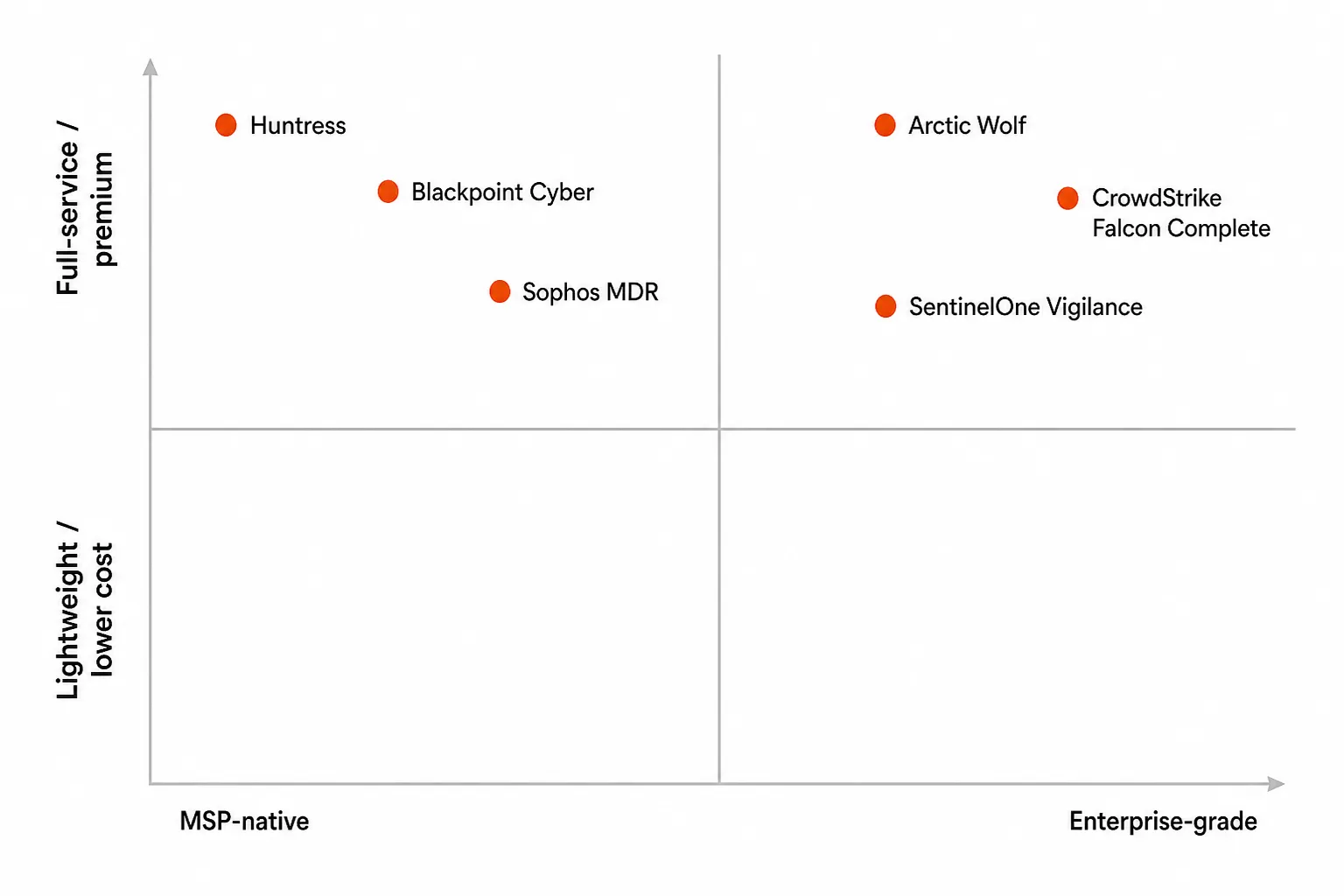
Most MSPs don't need one MDR tool - they need a primary tool for their SMB volume and sometimes a different answer for enterprise accounts.
The split that makes sense in practice:
- 80% of your clients are SMBs. Huntress or Blackpoint covers this tier well. Huntress wins on pricing transparency; Blackpoint wins if you want a true "handled, not just alerted" SOC feel.
- Enterprise or regulated-industry clients deserve a different conversation. Arctic Wolf's Concierge model, Sophos MDR Complete (if they're already in the Sophos ecosystem), or CrowdStrike Falcon Complete depending on what their security posture needs and what their board will recognize.
- Clients with complex M365/identity environments where attack surface is multi-vector - SentinelOne Vigilance MDR and its Singularity Identity module is worth evaluating.
One thing that often gets missed: when MDR detects a real incident, it generates a ticket cascade. Account lockouts. MFA resets. Endpoint re-imaging. Access revocations for offboarding when credentials are compromised. Those L1 and L2 tickets land in your PSA and someone has to work them. If you're not handling that ticket volume automatically, you're manually cleaning up security incidents on top of detecting them.
Try Rallied
Rallied is an AI technician built specifically for MSPs. It connects to your PSA (ConnectWise, Autotask, Halo PSA, SuperOps), RMM (Datto, NinjaRMM), and identity stack (Entra ID, Okta, JumpCloud, M365, Google Workspace), then handles L1/L2 tickets autonomously - including exactly the ticket types that MDR incidents generate: password resets, account unlocks, MFA resets, user provisioning and deprovisioning.
When your MDR tool detects a compromised account and locks it down, the resulting "I can't log in" tickets from the end user don't need a human technician. Rallied handles them - checking the security state, walking the user through the reset process, and closing the ticket. That's the operational loop: MDR catches the threat, Rallied handles the cleanup.
Deployment is same-week, no 6-month implementation ramp. Pricing starts at $250/month (500 tickets at $0.50 each). 14-day free trial, $50 in credit, no card required.
Frequently Asked Questions
What is MDR and how is it different from EDR?
EDR (Endpoint Detection and Response) is software that detects threats on endpoints and logs them. MDR (Managed Detection and Response) is a service that adds a 24/7 human SOC layer on top of EDR - analysts monitor the alerts, investigate them, and take action. EDR gives you the data; MDR gives you the team to do something with it. For MSPs managing dozens of client environments, MDR is often more practical than trying to monitor EDR alerts in-house. Rallied integrates with your PSA and RMM to automatically handle the L1/L2 tickets that result from security incidents.
How much does MDR typically cost for MSPs?
MDR pricing for MSPs generally runs from $8 to $25 per endpoint per month at list price. Huntress starts at $8.99/endpoint/month with typical MSP partner discounts bringing it closer to $4-5. Sophos MDR Essentials starts at about $12/user/month ($144/year). Arctic Wolf starts around $16/endpoint/month ($192/year). CrowdStrike Falcon Complete and Blackpoint Cyber require a custom quote. Most vendors offer volume pricing for MSP partners, so the per-unit cost drops meaningfully at scale.
Which MDR tool is best for small MSPs?
Huntress is the most commonly recommended MDR for small MSPs, particularly for those managing SMB clients with 10-500 endpoints per account. It's purpose-built for MSPs, priced accessibly at $8.99/endpoint/month with MSP partner pricing available, and the community feedback on r/msp is consistently strong. Blackpoint Cyber is another strong option for smaller MSPs who want a dedicated SOC without building alert-handling workflows. Rallied pairs well with either - it handles the ticket volume that security events generate.
Do MSPs need MDR if they already have antivirus or EDR?
Antivirus catches known threats. EDR catches more, but produces alerts that require someone to investigate them. Most MSPs don't have the staffing to run a 24/7 SOC in-house, which means EDR alerts go uninvestigated overnight and on weekends - exactly when attackers move. MDR solves that coverage gap by putting a human SOC team on the alerts. The community consensus in r/msp is clear: EDR alone creates alert fatigue and real blind spots. MDR is the realistic upgrade path for most MSP security offerings.
What should MSPs look for when choosing an MDR tool?
Five things matter most: (1) MSP-native pricing and multi-tenant management - not enterprise tools priced down. (2) PSA and RMM integration so alerts flow into your existing ticket workflow. (3) What the vendor actually does with alerts - some just notify you, the best ones contain and remediate before you even know. (4) Deployment speed - tools requiring 6+ months of setup are a problem at scale. (5) Support quality when something real happens. Tools like Rallied complement MDR by autonomously resolving the L1 tickets (account unlocks, password resets, MFA issues) that security incidents generate.