Best MSP Software in 2026: 9 Tools Compared by Price, Fit, and What They Actually Do

The best MSP software in 2026 depends on which layer of the stack you are filling. NinjaOne is the RMM to beat, and HaloPSA is the PSA most 10 to 50 tech shops switch to. Atera and Syncro put PSA and RMM on one per-tech bill. Rallied is the AI layer that closes L1 tickets inside ConnectWise, HaloPSA, or Autotask.
Rallied is $300 a month, which covers about 700 tickets in a typical month. If you run a shop of under 10 techs, the picks for small MSPs are further down, and the rest of the stack covers documentation, security, and backup.
Best MSP software at a glance
| Tool | Layer | Pricing model | Fits |
|---|---|---|---|
| NinjaOne | RMM | Per device, about $1.50 to $3.75 a month | Any MSP that wants the most polished RMM and patching |
| Rallied | AI ticket resolution | $300 a month for 2,000 credits | MSPs on ConnectWise, HaloPSA, or Autotask that want L1 tickets closed before a tech picks them up |
| HaloPSA | PSA | Per agent, published, about $99 a month billed annually | 10 to 50 tech shops that want ConnectWise depth without the implementation drag |
| Atera | All-in-one | Per tech, $149 to $219 a month | Growing device counts, AI features bundled in |
| Syncro | All-in-one | Per tech, $129 to $179 a month on an annual term | 1 to 30 tech shops that want one bill for RMM, PSA, and M365 security |
| SuperOps | All-in-one | Quote only | New MSPs with no legacy stack to migrate |
| Datto RMM | RMM | Quote only | Autotask shops and Kaseya customers |
| N-able N-central | RMM | Quote only | Large, complex estates with an admin who can configure it |
| ConnectWise PSA | PSA | Quote only | 50+ tech MSPs already inside the ConnectWise platform |
How we chose the best MSP software
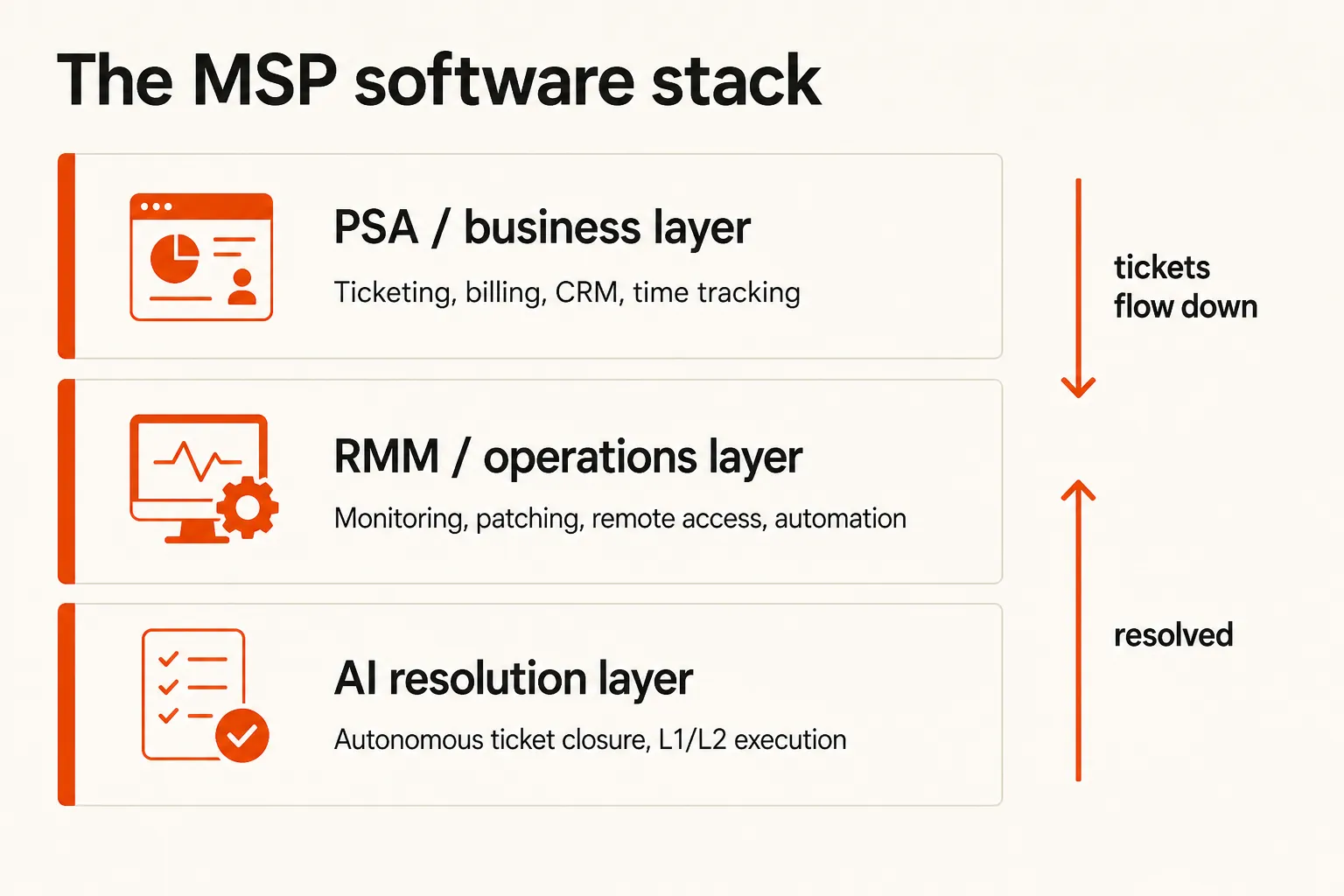
We kept tools that MSPs actually run their businesses on, with public G2 or Capterra reviews, active r/msp discussion, and pricing we could either find or explain. Each entry covers a distinct job in the stack, so there are no near-duplicates padding the count. The four layers are PSA (business operations), RMM (endpoints), all-in-one (both), and AI ticket resolution (closing the ticket). Most MSPs need something in each, or one tool that covers two. If the PSA and RMM split is new to you, our RMM vs PSA guide covers it.
Rallied is our product. It sits at number two because the one job every other tool on this list leaves to a technician is closing the ticket itself, and that is the job it does. We have kept the entry to what the product does today and what it will not do.
1. NinjaOne
Fits MSPs of any size that want the smoothest RMM on the market.
NinjaOne has been G2's top-rated RMM for 23 quarters in a row and holds 4.7 out of 5 from 5,846 G2 reviews. It manages Windows, macOS, Linux, mobile, and virtual devices from one console, and NinjaOne says most of its MSPs are running within a week. G2 reviewers put the time to implement closer to a month, which is still fast for an RMM.
Patching is where it pulls ahead. Autonomous patching covers Windows, macOS, Linux, and more than 8,800 applications, including Chrome, Edge, and Firefox, and Patch Intelligence AI reads telemetry, forums, and deployment signals so risky updates are paused before they go out. One r/msp member described it as "the only tool that saved us from a bad Windows KB that would have bricked machines." FedRAMP Moderate, SOC 2, GovRAMP, ISO 27001, and HIPAA make it the default for government and healthcare work.
The platform now reaches past the RMM. NinjaOne lists backup, MDM, and an IT service desk alongside endpoint management, and Katana AI summarises device health and alerts across client environments and recommends scripts and next steps, with role-based access control and a global kill switch. It is still an RMM first, so shops that bill complex contracts or run projects usually pair it with a dedicated PSA. Per-device cost climbs at smaller endpoint counts. Our NinjaOne review goes deeper, and the pricing breakdown covers what shops actually pay.
NinjaOne prices per device, paid monthly or annually, with free onboarding and training. Syncro's October 2026 tools comparison lists NinjaOne at $3.75 down to $1.50 per endpoint a month, and quoted ranges run from about $3.75 under 50 endpoints to $1.50 above 10,000. Get pricing.
2. Rallied
Fits MSPs on ConnectWise, HaloPSA, or Autotask that want password resets, lockouts, mailbox access, and onboarding closed before a tech picks them up.
The other eight tools on this list route, track, and bill the ticket, and Rallied is the one that closes it. When a ticket reaches the status you choose in your PSA, Rallied reads the request, the client's instructions, and how the last one like it was fixed. It checks the live state in Microsoft 365, the RMM, and the client's documentation in IT Glue or Hudu, runs the approved fix, tells the user what happened, and writes the notes and the time entry back to the ticket. Median resolution is two minutes.
The tickets it takes are the ones your dispatcher is tired of seeing:
- Password resets, with the requester verified before the reset runs
- MFA re-enrolment, lockouts, and shared mailbox access
- Distribution list changes, including on-prem AD groups synced to M365
- New user onboarding and offboarding across M365, groups, and licences
- Software licence assignment and stuck print spoolers on the endpoint
You set the boundary per action and per client. Each action is Auto, Approval, or Off, so lookups can run on their own while a password reset waits for a technician's sign-off. New accounts start in Plan Mode, where Rallied posts the exact steps it would take on real tickets without touching a system, and you widen access as it earns it. Hardware, onsite work, and security incidents always go to a tech, with the diagnosis already in the notes.
What it will not do matters as much. Rallied is not a PSA or an RMM and does not replace either. It works on top of ConnectWise, HaloPSA, or Autotask, with Microsoft 365 and your RMM (Datto RMM, NinjaOne, N-central, ConnectWise Automate) connected underneath. If a ticket needs site knowledge nobody wrote down, it hands off rather than guessing. The company is younger than everything else here and there is no G2 profile yet, so a few weeks on real tickets is the proof. Setup takes under an hour, and Rallied has been SOC 2 Type II certified since October 2026.
Rallied is $300 a month, billed monthly, with 2,000 credits included. Each ticket costs 1, 3 or 8 credits depending on how much work the agent did on it, so a typical month covers about 700 tickets, which is a typical figure rather than a guarantee. A ticket Rallied looked at but could not finish costs nothing. Unused monthly credits roll over for one month, extra credits are $0.10 each, and at zero credits the agent pauses with an internal note on the ticket rather than charging past your balance. If you are weighing it against Pia, Rewst, or NeoAgent, the comparison pages put the four side by side.
3. HaloPSA
Fits 10 to 50 tech MSPs that want deep customisation without ConnectWise-scale implementation.
HaloPSA scores 4.8 for customer service and a lower 4.3 for ease of use on Capterra, and runs at more than 5,000 customers in 75 countries. The feature that earns the switch is the Actions engine. Where ConnectWise handles if-then rules, Actions chain into multi-step logic for conditional billing, multi-tier approvals, SLA escalations, and API calls, so an MSP with a particular way of working can model it inside the PSA instead of around it.
Pricing is published, with every feature at every tier and native Microsoft CSP billing built in. HaloPSA also made a 10-year rolling independence pledge in 2023, which lands with owners who have watched ConnectWise and Autotask change hands.
The cost is a dedicated Halo admin for the first few months, because without one owning the configuration the product feels like too much. Projects are the weak spot reviewers name most. A CEO reviewing it on Capterra in August 2026 wrote that the project module is "virtually useless, they aren't real projects and tasks, they are actually just a collection of service tickets," while rating the ticketing and billing rules highly. The five-agent floor rules out very small shops, and support is UK-based, so North American shops get slow answers after 10am Pacific. Our HaloPSA guide, HaloPSA project management guide, and pricing breakdown cover the rollout in detail.
Syncro's October 2026 comparison lists HaloPSA at $99 per agent a month billed annually. Earlier quotes shops reported fell with agent count, so confirm the current rate for your headcount on the pricing page:
| Agent count | Earlier reported price per agent a month |
|---|---|
| 5 to 9 | about $109 |
| 10 to 24 | about $85 |
| 25 to 49 | about $69 |
| 50 to 99 | about $55 |
| 150+ | about $35 |
Implementation partners typically charge $5,000 to $15,000 for a mid-sized rollout.
4. Atera
Fits MSPs whose device count is growing faster than their headcount and who want AI features bundled rather than bought separately.
Atera charges per technician with unlimited endpoints at every tier, which changes the maths for any shop adding devices quickly. Plans start at $149 per tech a month on an annual term and top out at $219. Atera reports 13,000 customers managing more than 6 million devices.
The headline feature is Robin, an AI agent that Atera says resolves 92% of technical issues end to end. Atera's own case studies report SWNS Media Group at 85% of help desk tickets resolved by Robin, Leeds United down 35% on incoming tickets, and Trapp Technology (140,000 endpoints) down 30% on first reply time. AI Copilot, bundled into every plan, drafts replies, summarises tickets, and generates scripts. Atera is a Gartner Magic Quadrant Visionary in endpoint management and on CRN's AI 100 for 2026.
Workflow depth still trails HaloPSA and ConnectWise, and the r/msp footprint is lighter than the older platforms, so there is less peer advice to draw on when something breaks. See our Atera review and Atera pricing for the tradeoffs by shop size.
| Plan | Annual | Monthly |
|---|---|---|
| Professional | $149 per tech | $169 per tech |
| Expert | $189 per tech | $229 per tech |
| Master | $219 per tech | $269 per tech |
| Enterprise | Custom | Custom |
30-day free trial, no credit card.
5. Syncro
Fits 1 to 30 tech MSPs that want RMM, PSA, and Microsoft 365 security on one bill.
Syncro bundles RMM, PSA, ticketing, Microsoft 365 security, Entra ID identity management, and Splashtop remote access on a per-technician bill. It picked up 19 G2 Winter 2026 badges, including High Performer and Best Estimated ROI.
Syncro's pricing now has two published tiers on an annual term, Core at $129 and Team at $179 per tech a month, with unlimited endpoints. The M365 side goes deeper than most platforms bother with: CIS-aligned baselines, configuration drift detection, Entra ID sync, and identity actions such as password resets, MFA, and session revoke, all inside the console. Backup in the platform covers Microsoft 365 and Entra ID, so endpoint and server backup still needs a separate product.
Automation is scripting-heavy, so if you want no-code orchestration HaloPSA or Rewst do it better, and the documentation module does not replace Hudu or IT Glue. Our Syncro XMM guide covers the unified platform, and Syncro pricing covers what each tier includes.
| Plan | Price |
|---|---|
| Core, annual term | $129 per tech a month |
| Team, annual term | $179 per tech a month |
| M365 Cloud Backup add-on | $1.90 per user a month |
14-day free trial, no credit card.
6. SuperOps
Fits MSPs starting fresh who would rather begin on an AI-first platform than migrate off one later.
SuperOps ships as MSPSuite for providers and ITSuite for in-house teams. The MSP version combines unified PSA and RMM with AI-driven ticket routing, device operations, and profitability reporting, and the AI is built into those flows rather than added as a module.
Shops that started recently and have no legacy stack are the ones picking it, because they are choosing a first platform rather than replacing one. The community is smaller than the incumbents, with fewer r/msp threads and fewer integrations tested at scale, and pricing goes through a quote. Our SuperOps review and SuperOps pricing have the detail. If you are five years into ConnectWise, the switching cost is the whole story.
7. Datto RMM
Fits MSPs already running Autotask PSA or committed to the Kaseya stack.
Datto RMM holds 4.5 out of 5 on G2 from more than 700 reviews, runs on three regional data centres with a 99.99% uptime SLA, and has a strong record on patching and monitoring reliability. The clear case for it is the native Autotask PSA integration, which covers ticket creation, device-to-account mapping, and billing automation more tightly than third-party connectors manage. Microsoft 365 management is built in rather than bolted on.
Datto is owned by Kaseya, which sells RMM, PSA, backup, and security together through Kaseya 365 subscriptions. That ownership is also where r/msp threads turn: three-year contract requirements, sales friction, and pricing opacity come up repeatedly, and community feedback says development pace has slowed since the acquisition. Pricing is quote only, calibrated to endpoint count, with multi-year terms common. The Datto RMM guide and Datto RMM pricing cover what shops report paying.
8. N-able N-central
Fits large MSPs with complex, multi-client environments and the admin depth to configure them.
N-able N-central made the Gartner Magic Quadrant for Endpoint Management Tools in 2025, holds 4.3 out of 5 on G2 from 348 reviews, and runs estates of 1,800+ workstations and 500+ servers. N-able ships four AI agents (Product Expert, Asset Expert, Security Expert, and an MCP server for agent-to-agent automation) and a drag-and-drop automation engine that G2 reviewers credit with resolving around half of issues before users report them.
The learning curve is real. r/msp is consistent that N-central rewards expertise and punishes shortcuts, documentation gaps push admins to community forums, and shops without dedicated admin time struggle. Pricing is quote only, per device with volume discounts. Under about 100 endpoints the setup investment does not pay back quickly. Our N-central guide covers configuration in detail.
9. ConnectWise PSA
Fits 50+ tech MSPs that need every PSA capability and are already inside the ConnectWise platform.
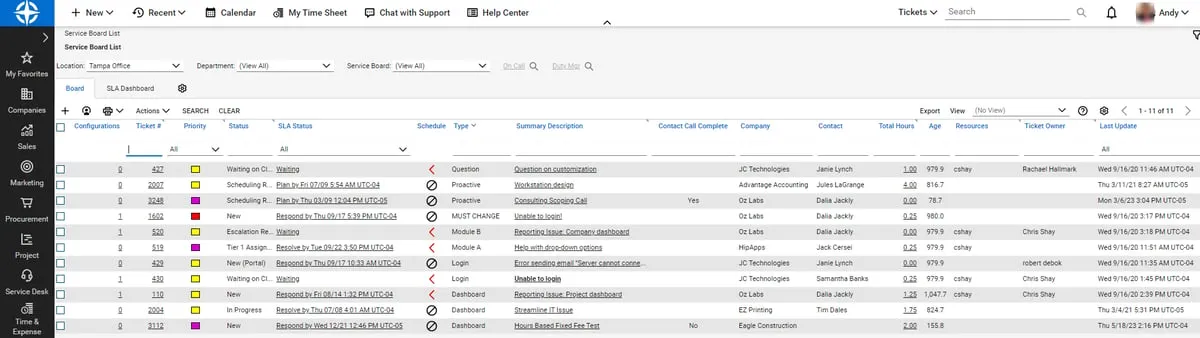
ConnectWise PSA, formerly ConnectWise Manage, is the incumbent. ConnectWise has been building it since 1982, says more than 100,000 MSP and IT pros use its products, and the PSA covers service desk, projects, time, billing, procurement, and CRM under one roof. The ConnectWise Platform ties the PSA to ConnectWise RMM, CPQ, ScreenConnect, backup, and security on a unified data layer, which removes the integration tax that best-of-breed stacks carry. Sidekick, the AI assistant in Teams, handles triage, record lookups, and admin clicks. It suggests rather than resolves, which is the gap Rallied fills for ConnectWise shops, and our ConnectWise AI guide covers what Sidekick does today.
The depth is also the cost. The UI is complex, onboarding takes weeks, implementation partners charge thousands, and r/msp is full of shops that moved to HaloPSA because maintaining a ConnectWise instance became someone's job. Pricing needs a sales call; expect $65 to $140+ per user a month depending on bundle and term. Our ConnectWise Manage review, ConnectWise PSA pricing, and ConnectWise vs HaloPSA comparison cover the decision.
Best software for small MSPs
Under about 10 techs, the monthly bill and the hours spent configuring a tool matter more than feature depth, because nobody in the shop has time to be the admin. A few patterns hold up for small shops.
Start with tools you can price without a sales call. Syncro's October 2026 all-in-one comparison found four platforms that publish a price you can read on the site: Syncro, Atera, NinjaOne, and HaloPSA. SuperOps, ConnectWise, and Pulseway go to a quote. DeskDay's 2026 tools guide suggests tagging every tool by pricing model (per tech, per endpoint, or per user) and by the segment it fits, which is a quick way to cut a long list down to the products built for your size.
These are the picks for a small shop:
- If you want one bill and one login, choose Syncro Core at $129 per tech a month or Atera from $149, both with unlimited endpoints, so the bill grows when you hire rather than when a client adds laptops.
- If you want the strongest RMM and can live with per-device pricing, choose NinjaOne. One r/msp reply to a new MSP owner listed it for "RMM, Patching, Software Patching, Ticketing, Documentation, MDM" and noted SentinelOne can be bought through it.
- If you are starting with no existing stack and want PSA and RMM in one product, take a SuperOps demo.
- If you want a dedicated PSA, HaloPSA's five-agent floor sets the minimum, so shops below that usually start on an all-in-one's ticketing.
Hold off on ConnectWise PSA and N-central until you have the headcount to run them, since both reward a dedicated admin and N-central rarely pays back under about 100 endpoints. Rallied fits small shops that already run ConnectWise, HaloPSA, or Autotask, and its $300 monthly price stays the same whether you have two techs or twenty. For budget options, see our guides to free MSP software, open-source MSP software, RMM software for small businesses, and the Syncro vs Atera comparison.
Beyond PSA and RMM: documentation, security, and backup
Most of today's top results on MSP software treat the stack as more than PSA and RMM, and so do most MSPs. Syncro's 2026 guide counts six jobs in an MSP stack: RMM, PSA, backup and recovery, endpoint security, documentation, and the platform that ties them together. The nine tools above cover the first two and the AI layer. These are the ones that sit beside them.
Documentation holds the runbooks, credentials, and client notes your techs and any AI agent work from. Hudu starts at $27 per user a month billed annually, and IT Glue is the other common choice. Rallied reads the client's docs from either during triage. Our IT documentation software comparison and IT Glue vs Hudu cover the choice.
For endpoint security, Huntress is the managed EDR option with a published price and a 24/7 SOC. See Huntress pricing and the wider MDR tools comparison.
For backup, Syncro's guide names Acronis Cyber Protect Cloud and Axcient x360Recover as the leaders on recovery, and Kaseya bundles backup with RMM and PSA in Kaseya 365. Our backup software comparison goes through the options.
How to choose MSP software
The search says "best MSP software", but the useful question is which layer you are filling, so start there.
If you need a PSA, choose HaloPSA for 10 to 50 techs and ConnectWise for 50+. Under 10 techs, the overhead of either rarely pays back, and our best PSA software comparison covers the lighter options.
If you need an RMM, choose NinjaOne if patching and polish matter most, N-central for a large complex estate with an admin to run it, and Datto if you are already on Autotask. Our RMM automation guide covers what to automate first once the RMM is in.
If you want one bill for both, Atera fits per-tech pricing with bundled AI, Syncro fits a straightforward all-in-one with strong M365 depth, and SuperOps fits a shop starting fresh.
If your PSA and RMM are settled and the queue is still full of password resets, Rallied adds the layer that closes them. It does not replace anything above it. The best AI tools for MSP ticket automation comparison covers the alternatives in that layer.
One pricing pattern to understand before signing anything:
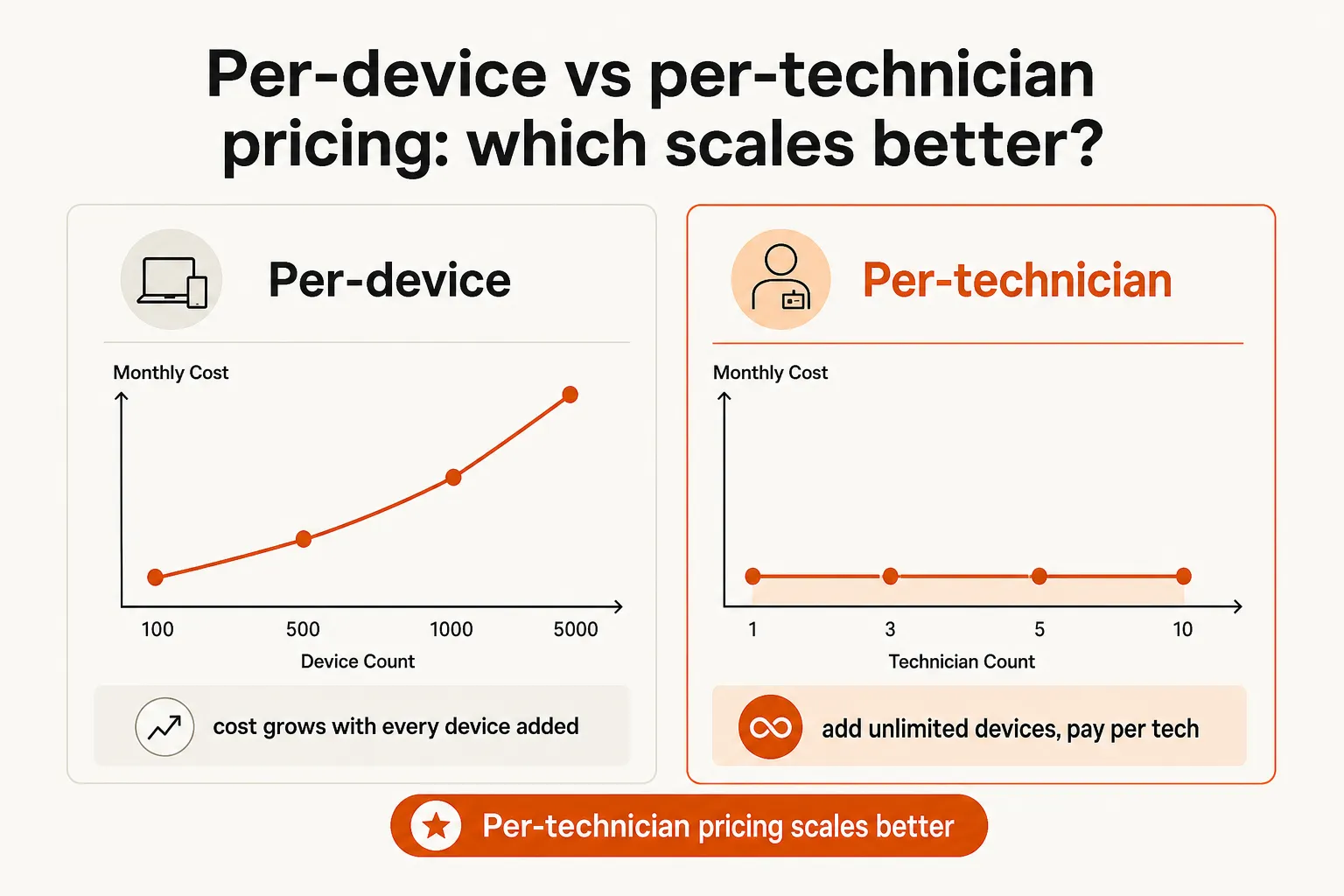
Per-device pricing (NinjaOne, Datto, N-able) grows with your endpoint count. Per-technician pricing (Atera, Syncro) grows only when you hire. Rallied's $300 monthly plan stays the same unless you buy extra credits at $0.10 each, and unused credits roll over for one month. Which model wins depends on which of those numbers is growing fastest in your shop. The MSP ROI calculator takes your tech count, what each tech costs, and the share of their time on repetitive tickets, and shows what automating that share is worth, so you can check the math before you commit.
Frequently Asked Questions
What is MSP software?
MSP software is the set of tools a managed service provider runs its business on. The core is a PSA for tickets, time, and billing, and an RMM for monitoring and managing client endpoints. Around those sit documentation (IT Glue, Hudu), security tooling, backup, and increasingly an AI layer that resolves routine tickets inside the PSA.
What is the best software for small MSPs?
For shops under about 10 techs, an all-in-one priced per tech with unlimited endpoints usually fits best, such as Syncro Core at $129 per tech a month on an annual term or Atera from $149. NinjaOne is the pick if you want the strongest RMM and can accept per-device pricing. ConnectWise PSA and N-central tend to pay back only once you have the headcount for a dedicated admin.
What is the difference between PSA and RMM?
The PSA runs the business: ticket boards, time entries, contracts, invoicing, and projects. The RMM runs the endpoints: monitoring, patching, scripting, and remote access. Some platforms (Atera, Syncro, SuperOps) combine both, and most larger MSPs run one of each and integrate them.
How much does MSP software cost?
RMM runs about $1.50 to $3.75 per device a month (NinjaOne), HaloPSA is listed at about $99 per agent a month billed annually, Atera runs $149 to $219 per tech a month, and Syncro lists Core at $129 and Team at $179 per tech a month on an annual term. ConnectWise, Datto, N-able, and SuperOps are quote only. Rallied is $300 a month for 2,000 credits, about 700 tickets in a typical month.
Do I need an AI layer on top of my PSA and RMM?
Only if routine tickets are eating tech time your shop would rather bill. PSA-native assistants such as ConnectWise Sidekick suggest and summarise, while a resolution layer runs the fix and closes the ticket. If your dispatcher can name the five ticket types that come in every day, that is the queue an AI layer is for.
What software do MSPs use?
Most MSPs run a PSA (ConnectWise PSA, HaloPSA, Autotask) for tickets, time, contracts, and billing, and an RMM (NinjaOne, Datto RMM, N-central, ConnectWise Automate) to monitor and patch client endpoints. A documentation platform such as IT Glue or Hudu stores runbooks and client notes, with backup and security tools alongside. Smaller shops often cover PSA and RMM with one all-in-one product like Atera, Syncro, or SuperOps, and some add an AI agent such as Rallied to resolve routine requests inside the PSA.
What is MSP software used for?
Day to day, it takes in client requests, gets them worked, and turns the time into invoices. The PSA converts emails and portal requests into tickets and records the time entries billing runs from, while the RMM watches client devices, raises alerts, pushes patches, and gives techs remote access. Where an MSP has an AI layer, it handles repetitive requests such as password resets, mailbox access, and new user setup.
What is an MSP platform?
"MSP platform" usually means an all-in-one product that combines PSA and RMM, so tickets, billing, monitoring, and remote access share one login and one client list. Atera, Syncro, and SuperOps are sold this way, and ConnectWise and Kaseya sell their own suites as platforms. An all-in-one is simpler to buy and run, while larger MSPs often pair a dedicated PSA with a dedicated RMM for more control over contracts, dispatch, and scripting.