MSP per user pricing: what it actually costs in 2026
TL;DR
MSP per user pricing in 2026 runs $70–$280/user/month for most businesses, with the majority landing in the $100–$200 range. The specific number depends on three things: company size (bigger usually means lower per-unit cost), tier (basic help desk vs. full security stack), and industry (regulated sectors pay a 20–40% premium). Tiered bundles - Good/Better/Best - are now the standard structure, not the exception. If you're comparing proposals, the headline per-user rate is the wrong thing to compare. What matters is what's included at that rate, and what gets billed separately. Rallied is one tool that helps MSPs increase margins within these pricing structures by automating the L1 ticket work that eats through technician hours.
Why per user pricing became the default
The managed services industry has tried most pricing structures over the past decade. Per-device made intuitive sense for a while - you charge for every workstation, server, firewall, switch. You're managing assets, so you bill by asset. Clean in theory.
In practice, it's a headache. A 100-person company with 150 laptops, 8 servers, 4 firewalls, and 20 switches generates a billing line item for every asset class. The total swings as inventory changes. Clients don't know how to budget it. And the math rarely aligns with what actually drives support volume - which is usually the people, not the devices.
Per user pricing survives because it maps to how businesses already think. Headcount is a number they track. It aligns with how they budget for everything else - seats in software, benefits per employee, desks per person. According to Kaseya's 2024 MSP Benchmark Survey, per-user is now the dominant billing model among MSPs, used by the clear majority as their primary structure.
The shift also happened because identity-based software licensing followed the same logic. Microsoft 365 charges per user. EDR tools charge per endpoint but map cleanly to users. Backup solutions are increasingly user-centric. When your entire vendor stack bills per user, billing your clients per user just makes the math easier to reconcile.
What MSPs actually charge per user in 2026
The honest answer is: it varies enormously, and anyone giving you a single number is smoothing over the real variation.
That said, here are the ranges that emerge consistently across industry benchmarks, published guides, and r/msp community discussions:
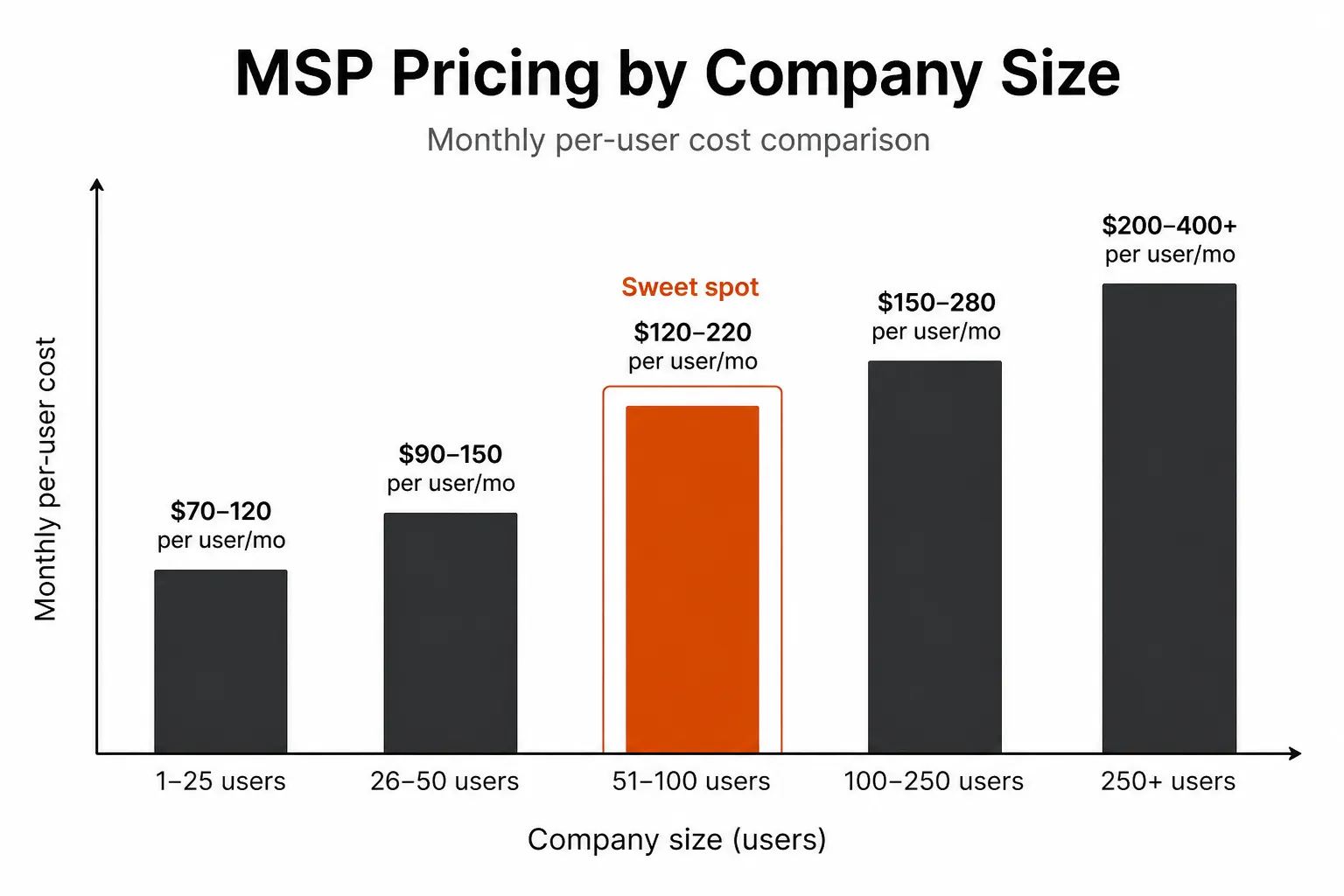
| Company size | Low end | Typical range | High end |
|---|---|---|---|
| 1–25 employees | $70/user | $70–$120/user | $150+/user |
| 26–50 employees | $90/user | $90–$150/user | $200+/user |
| 51–100 employees | $120/user | $120–$220/user | $280+/user |
| 100–250 employees | $150/user | $150–$280/user | $350+/user |
| 250+ employees | $200/user | $200–$400+/user | Custom |
A few things that drive variation within these ranges:
Security stack depth is the biggest one. A basic managed services contract (help desk + monitoring + patching) sits at the low end. Add EDR, email security, SOC monitoring, and vulnerability management, and you're 30–50% higher before you've changed anything else.
Support hours add up fast. Business-hours-only is the baseline. Extended hours (7am–7pm, M–F) adds roughly $20–$40/user. True 24/7 with guaranteed SLA response times can add $40–$100/user.
Compliance requirements are the largest single premium. Healthcare organizations on HIPAA-aligned support, financial firms with SOC2 or PCI requirements, defense contractors under CMMC - these clients routinely pay $40–$100 more per user than equivalently-sized non-regulated businesses, and that premium is real: it pays for compliance reporting, tighter incident response SLAs, and documentation overhead.
One thing worth noting from r/msp community threads: there's meaningful geographic variation that no benchmark fully captures. A standard managed services contract at $150/user in South Carolina might be $180/user in Chicago and $225/user in New York or San Francisco. Labor costs and competitive density both shift the ceiling on what the market will bear.
The tier structure most MSPs are moving toward
The market has largely converged on a three-tier structure. Individual MSPs name them differently (Bronze/Silver/Gold, Basic/Professional/Enterprise, Essentials/Standard/Premium) but the service logic is similar across almost everyone selling in 2026.
Here's the shape that emerges from current market research:
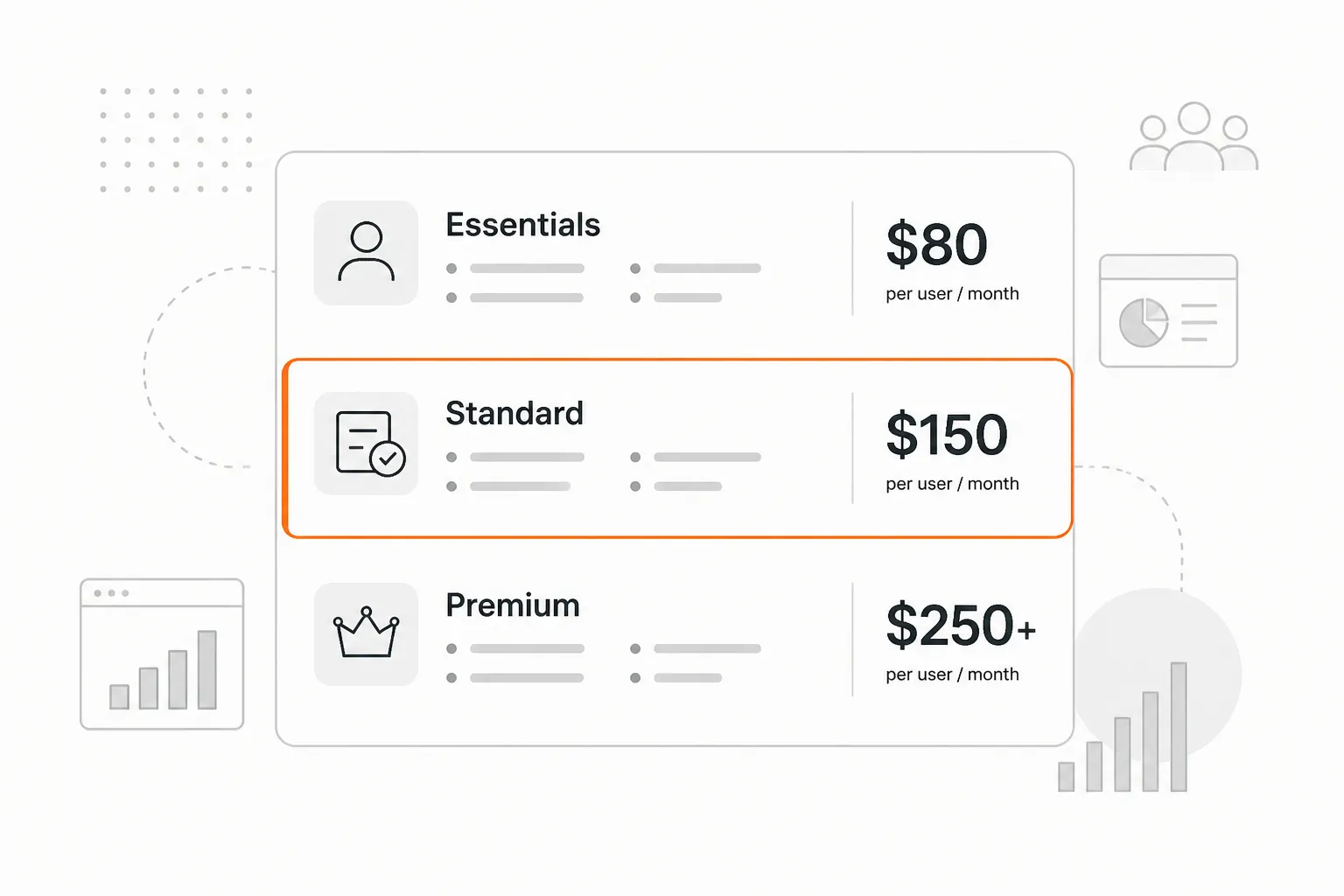
Tier 1 - Basic managed services: $80–$150/user/month
This is the floor of full-service MSP work. It includes:
- Help desk support (business hours)
- Remote monitoring and management (RMM)
- OS patching and updates
- Microsoft 365 or Google Workspace administration
- Basic security (antivirus, firewall monitoring)
- User onboarding and offboarding
- Monthly reporting
What it usually excludes: backup, EDR, email security, after-hours support, server management (billed separately), compliance reporting, and any project work.
Tier 2 - Standard security + support: $150–$200/user/month
This is where most mid-market deals land. Everything in Tier 1, plus:
- Endpoint detection and response (EDR)
- Managed backup and disaster recovery
- Email security (spam filtering, phishing protection)
- Extended support hours or escalation paths
- Monthly service reviews with a dedicated tech
Tier 3 - Premium / compliance-aligned: $200–$300+/user/month
For organizations that need depth:
- 24/7 proactive monitoring with guaranteed response times
- SOC monitoring or MDR
- Compliance reporting (SOC2, HIPAA, PCI)
- vCIO or strategic guidance
- Vulnerability scanning and threat hunting
- Advanced incident response
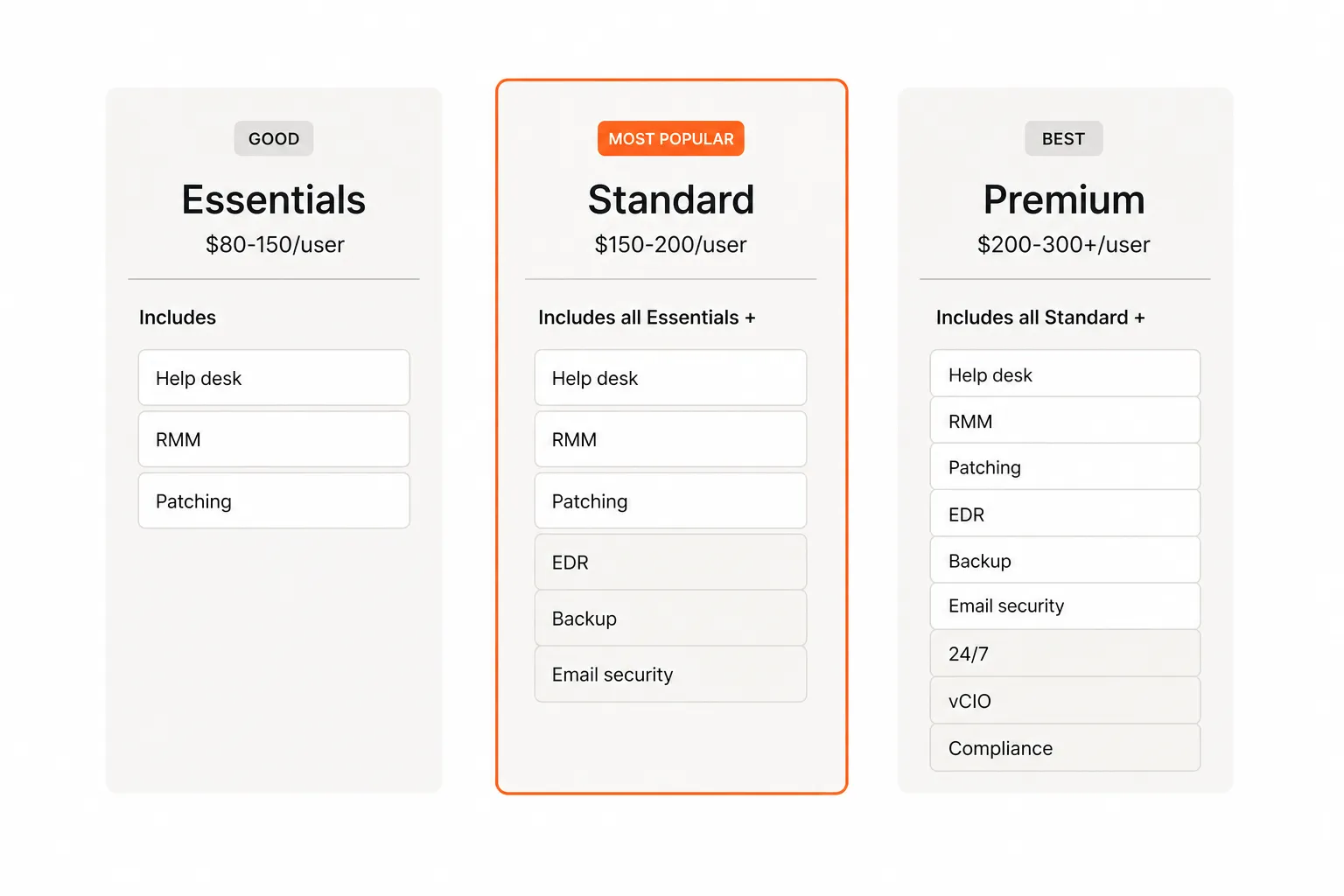
The reason MSPs have standardized on this structure is buyer psychology, not operational convenience. When a client gets three options, they stop shopping on price and start shopping on risk tolerance. The business owner who'd churn at $125/user stays at $140/user because they're choosing Tier 2 - they made the call, it wasn't done to them.
As one r/msp user put it in a thread on tiered pricing: "You need to really focus on what your 'stack' includes, what it's costing you per user, and then set prices accordingly. A 50–70% margin is where healthy MSPs land."
The hidden variable: scope exclusions
Two proposals at $150/user can be wildly different services. This is the part of MSP pricing that burns buyers who compare headlines.
MSP A at $150/user includes: Help desk, RMM, patching, M365 admin, EDR, managed backup, quarterly business reviews.
MSP B at $150/user excludes: Servers (billed at $250–$400/month each). After-hours work (billed at $175–$200/hour). Onboarding and offboarding beyond simple password resets. Any project work. Advanced incident response.
MSP B will almost always cost more, at any realistic scale.
The exclusions that catch people most often:
Servers. Per-device pricing for servers is standard even among per-user MSPs. Expect $150–$400/server/month as a separate line. A 100-person company with 5 servers adds $750–$2,000/month before any user-based fees.
Onboarding and stabilization. This one's underestimated badly. Getting a new environment up to managed standards - documenting assets, cleaning up security posture, deploying tools - takes 40–500 hours depending on what state the environment is in. According to industry guides, this can add $10,000–$50,000 in one-time costs. Some MSPs bake it in; most don't.
Project work. Migrations, major upgrades, new deployments - these are almost always excluded and billed at T&M rates ($150–$200/hour).
The right question to ask every MSP you evaluate: "What does a typical 100-person company with 5 servers actually pay you annually, fully loaded, including onboarding and all add-ons?" That number tells you more than the per-user rate.
How MSPs calculate their per-user price
Understanding the math here helps you evaluate whether a quote is reasonable or suspiciously low.
Healthy MSPs use a cost-build approach:
Tool cost per user: EDR, RMM, backup, M365 licensing pass-through, email security, documentation tools. For a Tier 2 stack, this is typically $25–$60/user/month.
Labor cost per user: How many hours per month does the average user generate in support time, and what does that labor cost? At 2–3 tickets/user/month at 15–20 minutes per ticket and $50–$80 loaded technician cost, you're looking at $25–$40/user/month for L1 support alone.
Overhead allocation: Office, tools, management, sales. Typically 20–30% of labor.
Target margin: According to Service Leadership benchmarks, healthy MSPs target 50–60% gross margin. The Kaseya 2024 survey shows realized gross margins of 30–40% for most.
The floor calculation: (tool cost + labor cost + overhead) ÷ (1 - target margin) = minimum viable per-user rate.
At $50 tools + $35 labor + $15 overhead = $100 cost base. At 50% target margin: $100 ÷ 0.5 = $200 minimum viable rate.
This is why quotes below $80–$100/user for any meaningful scope should raise questions - not as a red flag on the MSP's character, but as a signal that either the scope is thinner than it looks, or the MSP is underpricing and will eventually either cut corners or go out of business.
Why per-user pricing is under margin pressure right now
MSP tool costs have inflated substantially since 2022. EDR and ITDR solutions that were $3–$5/endpoint/month are now $6–$12. Backup and disaster recovery licensing has risen. Compliance tooling has become a real line item where it was once bundled. Email security is no longer a commodity.
According to industry analysis, MSP tool stacks have become 30–50% more expensive to operate over the past two years. MSPs that locked clients into multi-year contracts at 2023 rates are taking the hit on their margins.
The response from most well-run MSPs has been two-pronged:
Pass-through clauses: Contract language that allows tool cost increases to flow through to client billing with 30–60 days notice. This is now standard in most new agreements.
Automation and AI tooling: Reducing the labor cost per ticket is the only lever MSPs fully control. If a technician spends 15 minutes on a password reset that could be handled automatically, that's $18–$40 of margin gone per ticket, at scale, across hundreds of tickets per month.
This is where tools like Rallied become financially interesting in the context of per-user pricing. Rallied is an AI technician that autonomously handles L1 and L2 ticket work - password resets, account unlocks, MFA issues, user onboarding and offboarding - across your PSA, RMM, and identity stack. At 40–60% ticket automation rates, the labor cost component of a per-user contract compresses meaningfully without requiring headcount reduction.
What AI automation actually does to MSP per-user economics
The traditional labor math for L1 support: 2–4 tickets/user/month at 15–20 minutes each. At $75–$100/hour loaded technician cost, that's $37–$133 in labor cost per user per month before overhead.
Password resets, account unlocks, and MFA resets alone account for a substantial chunk of that - commonly cited at 20–30% of total L1 ticket volume for a typical MSP. Automated resolution of those tickets doesn't improve SLA metrics cosmetically; it removes real labor from the cost base.
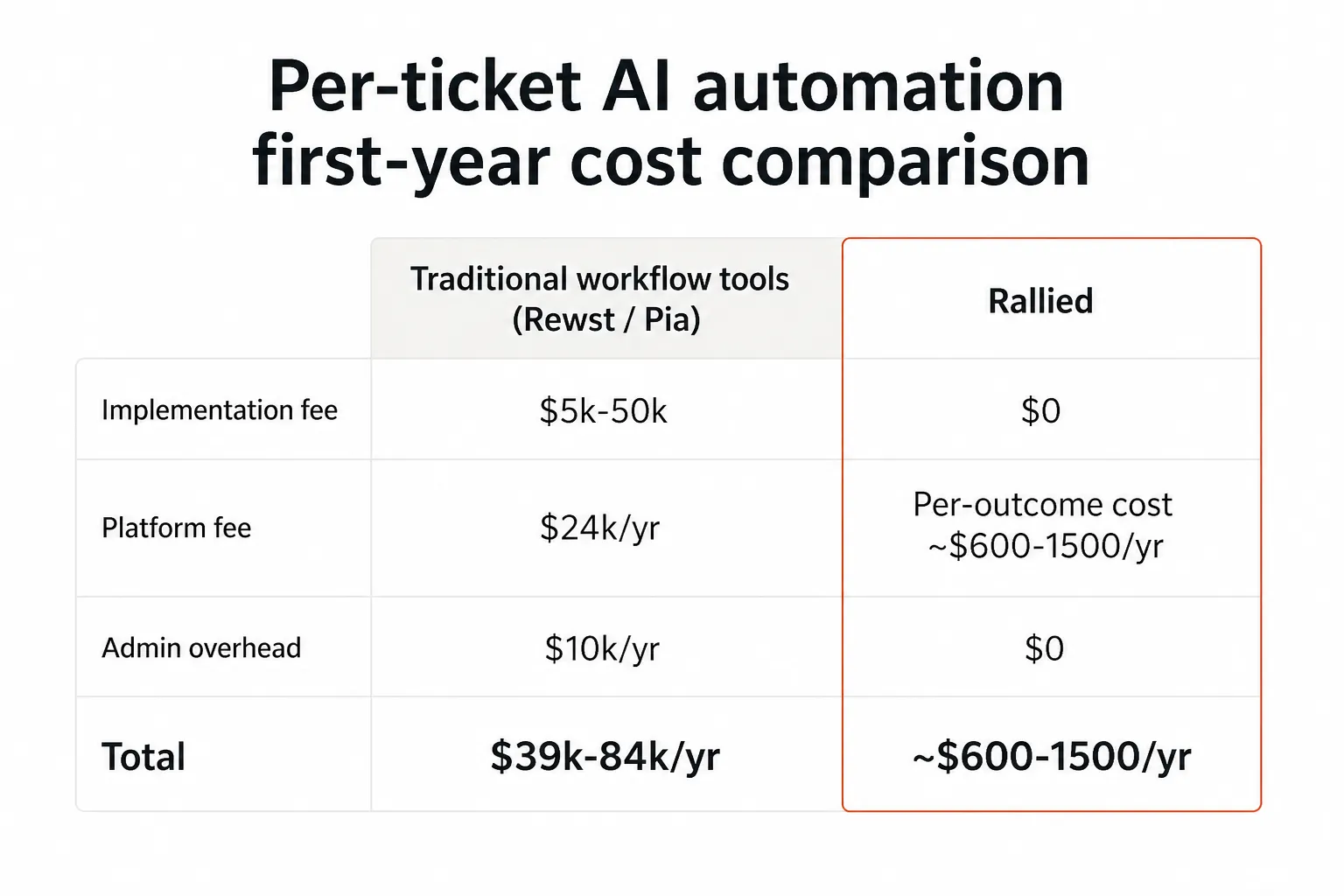
The cost comparison for automation tools matters here. Traditional workflow automation platforms like Rewst and Pia require substantial implementation investment - community reports put the forward-deployed engineer fee at $5,000–$50,000 upfront, with 6–12 month timelines to positive ROI and 20–40 hours/month of ongoing admin overhead. For a small or mid-market MSP without a dedicated automation engineer, this is a real barrier.
Rallied's pricing is fundamentally different: $3 per ticket outcome, $150/month minimum, zero implementation cost, and deployed in under a week. At 200–400 outcomes per month (a reasonable volume for an MSP managing 100+ users), that's $600–$1,200/month against $3,750–$15,000/month in recovered technician margin - strong economics before you account for client satisfaction improvements.
The real question isn't whether automation pays for itself in MSP unit economics. It does. The question is whether the automation platform you choose adds its own implementation tax that defeats the purpose.
What to watch for in 2026 and beyond
A few trends worth tracking if you're either buying managed services or selling them:
Outcome-based pricing is coming. Less than 15% of MSPs currently use it as their primary model, but it's growing. Instead of billing per user per month, outcome-based contracts tie billing to measurable results - uptime percentage, security score improvement, ticket resolution rate, compliance audit pass. The appeal for clients is obvious. The appeal for MSPs is that it rewards delivery excellence rather than just presence. The challenge is measurement and accountability.
Security costs are the forcing function for tier migration. As clients face insurance pressure, regulatory requirements, and genuine cyber risk, the business case for Tier 2 and Tier 3 is getting easier to make. MSPs that can clearly articulate the security delta between tiers will migrate clients up-tier without needing to have uncomfortable pricing conversations.
AI automation changes what's possible at Tier 1. If an MSP can automate 40–60% of routine L1 tickets, the economics of offering a strong Tier 1 product at a competitive price improve substantially. The old constraint was that $100/user couldn't sustain adequate staffing for real responsiveness. With automation covering the high-volume routine work, that math shifts.
Try Rallied
Rallied is an AI technician built for MSPs. It connects to your PSA (ConnectWise, Halo, Autotask), RMM, identity stack (Entra ID, Okta, JumpCloud, Google Workspace), and documentation, then autonomously handles L1 and L2 ticket work - password resets, account unlocks, MFA issues, user onboarding and offboarding, software installs, RMM script execution.
At $3 per ticket outcome with a $150/month minimum, zero implementation cost, and same-week deployment, it's designed for MSPs that need automation to actually be economical rather than a multi-month project. The 14-day free trial includes no credit card - real tickets can start closing in the first week.
For a 200-outcome month, that's $600 against typically $7,500–$15,000 in recovered technician margin. The math works whether you use the savings to improve margins, reduce per-user rates to win competitive bids, or reinvest in higher-tier services.
Frequently Asked Questions
How much does an MSP charge per user per month in 2026?
Most MSPs charge $70–$280 per user per month depending on company size, service tier, and whether compliance stacks are included. The majority cluster in the $100–$200 range for standard managed services. Regulated industries like healthcare and finance typically pay an additional $40–$100 per user for compliance-aligned support.
What's typically included in MSP per user pricing?
A standard per-user managed services contract typically includes help desk support, endpoint monitoring and patching, Microsoft 365 or Google Workspace administration, basic security (antivirus, firewall monitoring), user onboarding and offboarding, and recurring reporting. Backup, EDR, email security, and 24/7 coverage are usually reserved for higher tiers or sold separately.
Is per user or per device pricing better for MSPs?
Per user pricing dominates for knowledge work environments where employees have 2–4 devices each. It's simpler to forecast, easier for clients to understand, and aligns naturally with identity-based licensing like Microsoft 365 and EDR tools. Per device pricing makes more sense for environments with extreme device variance - manufacturing floors, clinics with shared workstations, or infrastructure-heavy operations with many servers and network appliances.
Can AI reduce what MSPs need to charge per user?
Yes - AI-powered automation tools that handle L1 ticket work (password resets, account unlocks, onboarding tasks) directly reduce the labor cost per ticket, which is the main driver of per-user pricing. Tools like Rallied that autonomously resolve 40–60% of ticket volume can let MSPs maintain margins at lower per-user rates, or improve margins at existing rates, without adding headcount.
What are the hidden costs in MSP per user pricing?
Two common ones: scope exclusions and onboarding. Many MSP quotes at $150/user exclude servers (billed separately at $150–$400/server/month), after-hours work (billed at $150–$200/hr), and project labor like migrations. Onboarding is another - expect 40–500 hours of stabilization work priced separately, which can add $10,000–$50,000 before your recurring fees even start. Always ask for a total-cost example including these variables before comparing proposals.