Atera vs N-able in 2026: which RMM is right for your MSP?

TL;DR
Atera and N-able are both capable RMMs, but they're aimed at different shops. Atera suits growing MSPs and IT departments that want an all-in-one platform at a predictable per-technician cost - it bundles RMM, PSA, and ticketing with an AI agent (Robin) that can autonomously fix device and cloud issues. N-able N-Central is for power users managing complex, multi-site environments at scale - 500+ endpoints, heavy scripting, deep automation - and it prices per device. If you're under 500 endpoints and want something running this week, Atera wins on speed and simplicity. If you're managing thousands of endpoints across many clients and need surgical control, N-able's depth is worth the learning curve. Neither one eliminates the L1 grunt work at the ticket level - for that, you'd want a purpose-built AI ticket resolution tool layered on top.
We spent time with both platforms: scraping their docs, pricing pages, and help centers, and digging through community discussions across Reddit and G2. The goal was simple - figure out when each one is actually the right call, not just repeat their marketing back at you.
Here's what we found.
What each platform actually is
The framing matters before you compare features. Atera and N-able come from different traditions, and that shapes everything about how they work.
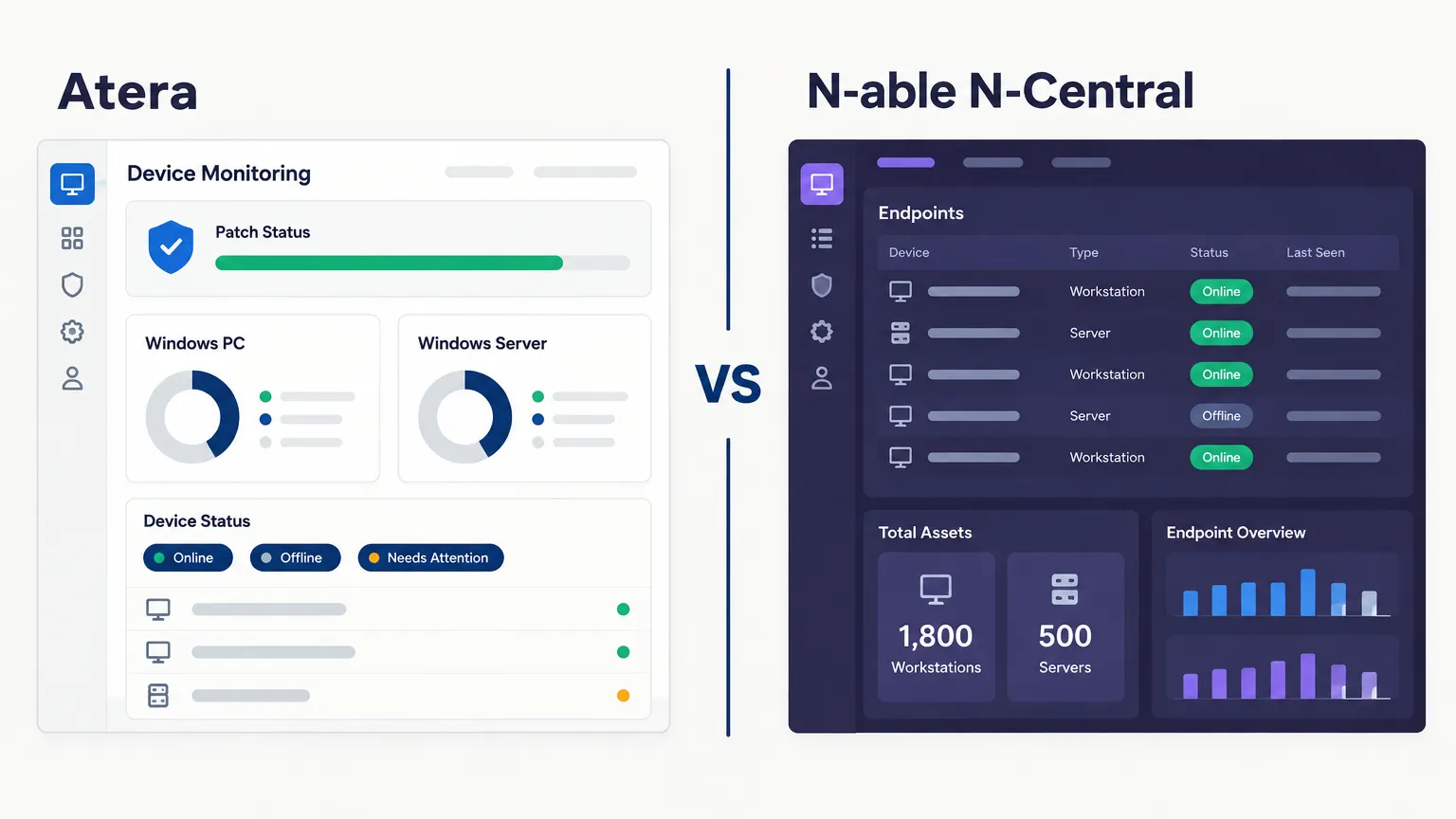
Atera is an all-in-one IT management platform: RMM, PSA, ticketing, and an AI agent (Robin) in a single product. It's built around the idea that most IT teams - MSPs or internal IT departments - don't need separate tools for monitoring, ticketing, and billing. You pay per technician, not per managed device, so your costs stay flat as your endpoint count grows. Atera reports 13,000+ organizations running on the platform, including names like Domino's and Boeing. Gartner placed Atera in the Visionaries quadrant for its 2025 Endpoint Management Tools report, recognizing the AI-first direction.

N-able has two separate RMM products - N-Sight (cloud-based, suited to smaller MSPs) and N-Central (the heavyweight, on-premise-capable platform for complex environments). N-Central is what most serious MSP shops mean when they say "N-able." It's a power-user tool: deep scripting, drag-and-drop automation, extensive integrations, and a track record of managing 1,800+ workstations and 500+ servers for a single customer. The trade-off is that it takes time to learn. Community consensus on r/msp is consistent: "N-Central has a bit of a learning curve but it's a superior platform," as one r/Nable discussion put it. N-able landed G2's Momentum Leader badge for Spring 2026.
Side-by-side comparison
Here's the practical summary before we go deeper:
| Atera | N-able N-Central | |
|---|---|---|
| Pricing model | Per technician, unlimited endpoints | Per device, scales with endpoint count |
| Public pricing | Gated behind signup | Quote only |
| Free trial | 30 days, no credit card | Contact sales |
| Deployment | Cloud-only | Cloud or on-premise |
| RMM | Full - Windows, Mac, Linux | Full - Windows, Linux, macOS |
| PSA / ticketing | Built-in | Built-in (integrated billing) |
| Patch management | Yes, all OS types | Yes, with vulnerability scanning |
| Remote access | Splashtop (included) + AnyDesk (Expert+) | Instant secure remote access |
| AI tier | Robin (autonomous resolution) | N-zo agents (AI-assisted) |
| Integrations | M365, Entra ID, Okta, major PSAs | 100+ integrations, Autotask, SentinelOne |
| Best for | Growing MSPs, SMB IT departments | Large MSPs, complex multi-site environments |
| G2 rating | 4.6/5 (1,221 reviews) | 4.3/5 (348 reviews) |
Atera: the all-in-one bet
The thing Atera got right is tool consolidation. Most MSPs running separate RMM, PSA, and ticketing tools are bleeding admin time on integrations, data mismatches, and context switching. Atera's approach - one bill, one login, one data model - removes all of that.
Robin: where Atera swings differently
Robin is Atera's patented AI agent and the most distinctive thing about the platform. It's not a chatbot, it's not a ticket summarizer, and it's not a workflow builder. Robin takes ownership of a ticket end-to-end: it reads the request, verifies the user, pulls technical context, runs the approved fix on the device or cloud system, verifies the resolution, and closes the loop.
The device skill set covers Windows, macOS, and Linux - diagnostics, registry changes (policy-driven), service management, software installation, file system operations. The cloud skill set covers Microsoft 365 and Entra ID: password resets, account unlocks, MFA configuration, Exchange operations, license management. Customer numbers reported by Atera include one CIO who said Robin "resolved 85% of help desk tickets" and another VP who cited "instant ticket responses" with technicians freed up by more than two hours per day.
A Forrester Total Economic Impact study commissioned by Atera reported 321% ROI with payback under six months - though as with all commissioned studies, take the specific number with the usual grain of salt while noting that the directional case is real.

What the community says
Atera sits at 4.6/5 across 1,221 G2 reviews - 80% of them five stars. The top praise tags are Ease of Use (386 mentions), Automation (273 mentions), and Efficiency (210 mentions). The criticism is consistent too: "Missing Features" and "Limited Features" show up as the top concern tags, suggesting the all-in-one approach sometimes trades depth for breadth.
The Reddit community leans positive for small-to-mid MSPs. The pattern that comes up repeatedly: Atera is more modern and easier to deploy than ConnectWise, the per-technician model is especially appealing to shops with growing endpoint counts, and Robin's direction is interesting even if some users are still in "wait and see" mode on full autonomous resolution.
"The platform is reliable, fast, and makes it easy to manage tickets, monitor devices, and support clients across different time zones." - G2 user review
Atera's helpdesk in practice
The ticketing interface is cleaner than most legacy PSAs. You get AI auto-tagging for ticket categorization (Expert plan and above), a service portal for end-user submissions, SLA enforcement, and live chat support. The Atera AI Copilot - separate from Robin - handles ticket summarization, suggested replies, and script generation for technicians who want AI assistance without full autonomous mode.

Our take: Atera is the right call for MSPs who want everything in one place, don't want to think about per-device pricing, and want AI moving in a direction that reduces ticket volume rather than just organizing it. The ceiling is around mid-market - if you're pushing 1,000+ endpoints per client with serious compliance and scripting requirements, you'll start to feel the edges.
N-able N-Central: the power-user bet
N-Central is the tool that serious MSP engineers mean when they say "I know my RMM." It's deep, flexible, and genuinely powerful - and it earns that reputation. The trade-off is that you have to invest in learning it, and the investment is non-trivial.
What N-Central does well
Endpoint visibility is the standout. N-Central's dashboard is consistently cited in community discussions as better than competitors for its "north and south pane" layout that gives instant visibility across sites, device states, and alerts. One r/msp user managing Ninja for years described N-able's dashboard as "more informative" after switching.
The automation capabilities are deep. Drag-and-drop policy automation, advanced scripting, and push-based task management let power users resolve issues proactively before tickets are ever opened.
"One of my favorite tools is the ability to push policies and tasks, which lets me reboot users' machines when needed. Honestly, this solves about 50% of issues most of the time, often before they even happen." - Helpdesk technician, G2
The platform handles scale that most tools struggle with. Users report managing 1,800+ workstations and 500+ servers from a single console, with 10+ years of continuous operation. That kind of long-term reliability is hard to fake in community reviews.
N-able's AI: N-zo
The N-zo platform is N-able's AI layer. It includes four agents:
- Product Expert - answers questions about N-Central itself using the console, claiming 80% efficiency gains on console navigation tasks
- Asset Expert - improves device classification and visibility, claiming 53% efficiency gains in asset management
- Security Expert - prioritizes CVEs across the environment to help techs focus on what matters
- MCP Server - enables agent-to-agent automation, connecting N-Central to other tools in the stack
These are meaningfully useful for visibility and workflow efficiency. But they're AI-assisted, not autonomous - a tech still makes the call and runs the fix.
Where N-Central struggles
The honest community feedback is consistent on two things: the learning curve is real and the documentation is thin.
"I wish there was more quality training/learning materials from N-able. Even the help menu in N-Central is bare bones and almost useless." - r/msp, Atera vs N-Central discussion
The UI also shows its age in places. G2 reviewers note that while monitoring and management capabilities are strong, "UI consistency, patching reliability, and more intuitive scripting support" could all use work.
Our take: N-Central is the right call for established MSPs running large, complex environments where depth and scripting flexibility outweigh setup cost. If you're onboarding a new tech every quarter and need them productive in two days, this isn't it. If you're a senior engineer managing thousands of endpoints with a highly scripted automation library, N-Central is a genuine competitive advantage.
Pricing: two different philosophies
The pricing structures here say a lot about who each tool is actually built for.
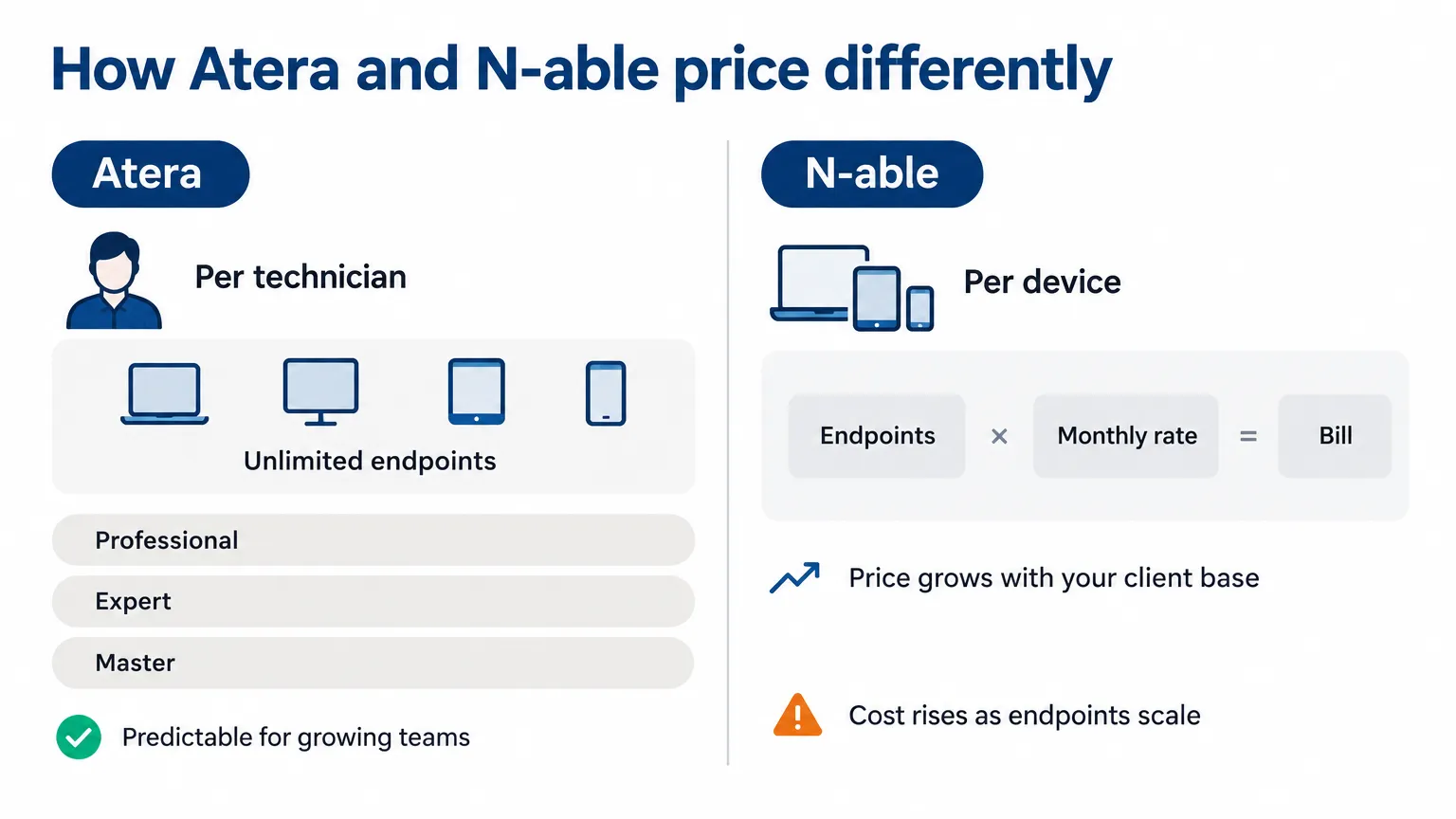
Atera's model is per-technician. You pick a plan - Professional, Expert, or Master - and pay per seat. Unlimited endpoints are included on every plan. The actual per-seat prices aren't published publicly; you get a quote after entering your headcount and company size at signup. There's a 30-day free trial with no credit card required. The practical implication: your Atera bill doesn't change when you sign a new client with 200 endpoints. That predictability is worth a lot for MSPs managing growth.
| Plan | Highlights |
|---|---|
| Professional | RMM, ticketing, AI copilot, Splashtop (2 concurrent sessions), 15GB file transfer/month |
| Expert | Everything in Pro + unlimited Splashtop, AnyDesk, AI auto-tagging, 11 preset reports, 50GB file transfer |
| Master | Everything in Expert + unlimited custom asset types, advanced reporting, 12-month audit log |
N-able's model is per device. N-Central pricing requires a sales conversation - there's no self-serve signup and no public per-device rate. The G2 data shows an average 10% discount is common, and the average time to ROI is 8 months per reported implementations. What N-able does offer is a long-term price lock option for multi-year contracts, which appeals to larger MSPs who value cost predictability over flexibility.
The bottom line: if your endpoint count is growing, Atera's per-tech model is cheaper at scale. If you're already managing a stable, large environment and want to lock in a rate, N-able's per-device model with multi-year pricing can work. Neither tool publishes enough public pricing to do a truly honest dollar-for-dollar comparison - you need to talk to both sales teams.
How AI actually works in each platform
This is where the real difference sits, and it's worth slowing down on.
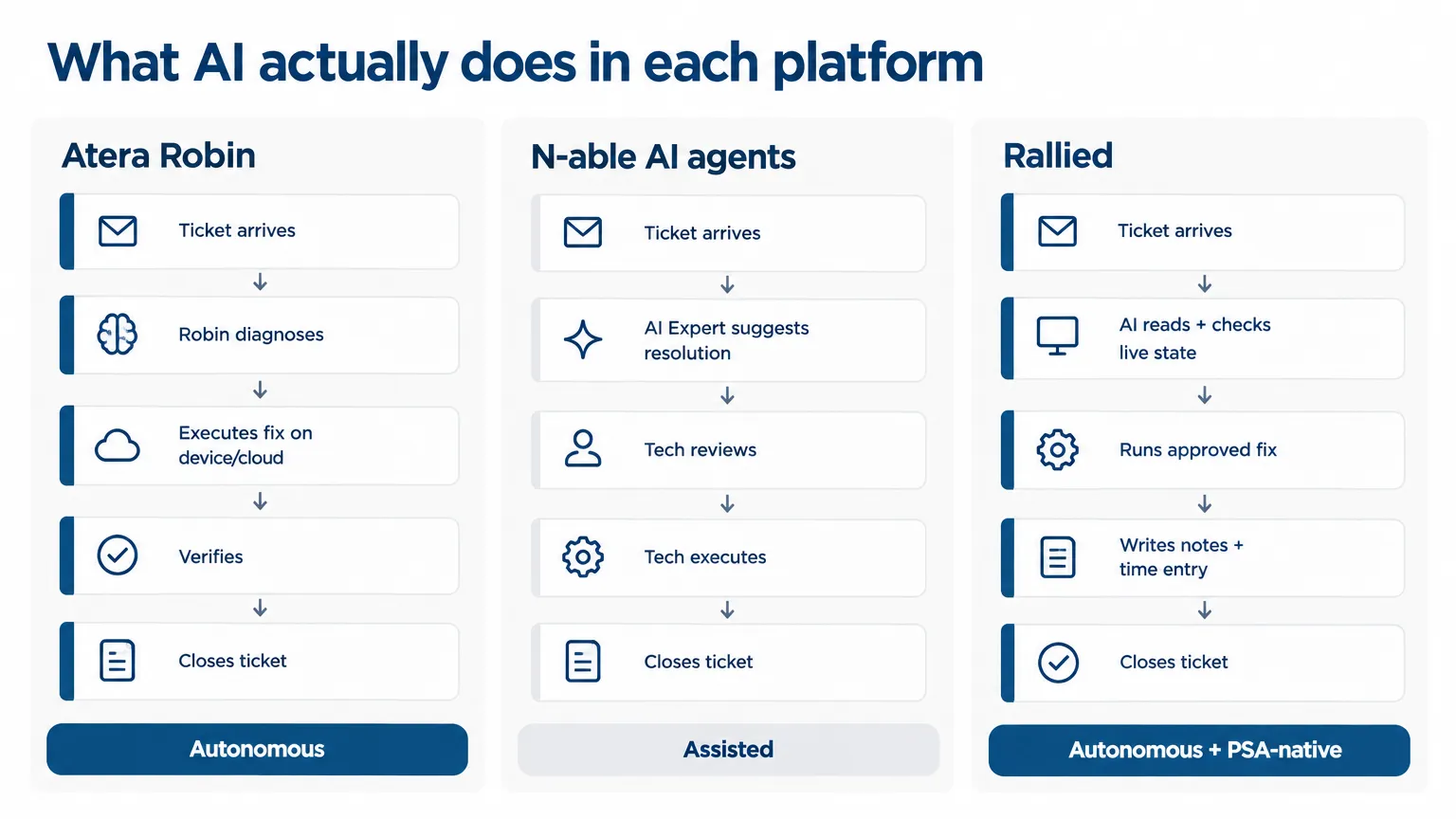
Atera's Robin and N-able's N-zo represent two genuinely different bets on what AI means in an MSP context.
Robin is autonomous. A ticket comes in, Robin reads it, gathers context, runs the approved fix (on the device or in M365/Entra ID), verifies the result, and closes the ticket. The tech's job is to configure the approval gates - which action classes run automatically, which require human sign-off - not to process the ticket itself. This is closer to how AI ticket resolution is supposed to work: fewer humans in the loop for routine work.
N-zo is AI-assisted. The Product Expert helps a tech navigate the console faster. The Asset Expert classifies devices more accurately. The Security Expert helps prioritize CVEs. These are genuinely useful capabilities that make a tech more efficient - but the tech is still executing. The platform doesn't autonomously connect to Entra ID and reset a password; a tech uses N-zo's insights to do that more quickly.
That's not a criticism of N-able, it's a product philosophy difference. N-able is betting that MSPs want deep control and will use AI as a co-pilot. Atera is betting that autonomous resolution is the future and is building toward a world where Robin handles most L1 and L2 tickets without human involvement.
Where each tool wins and where each falls short
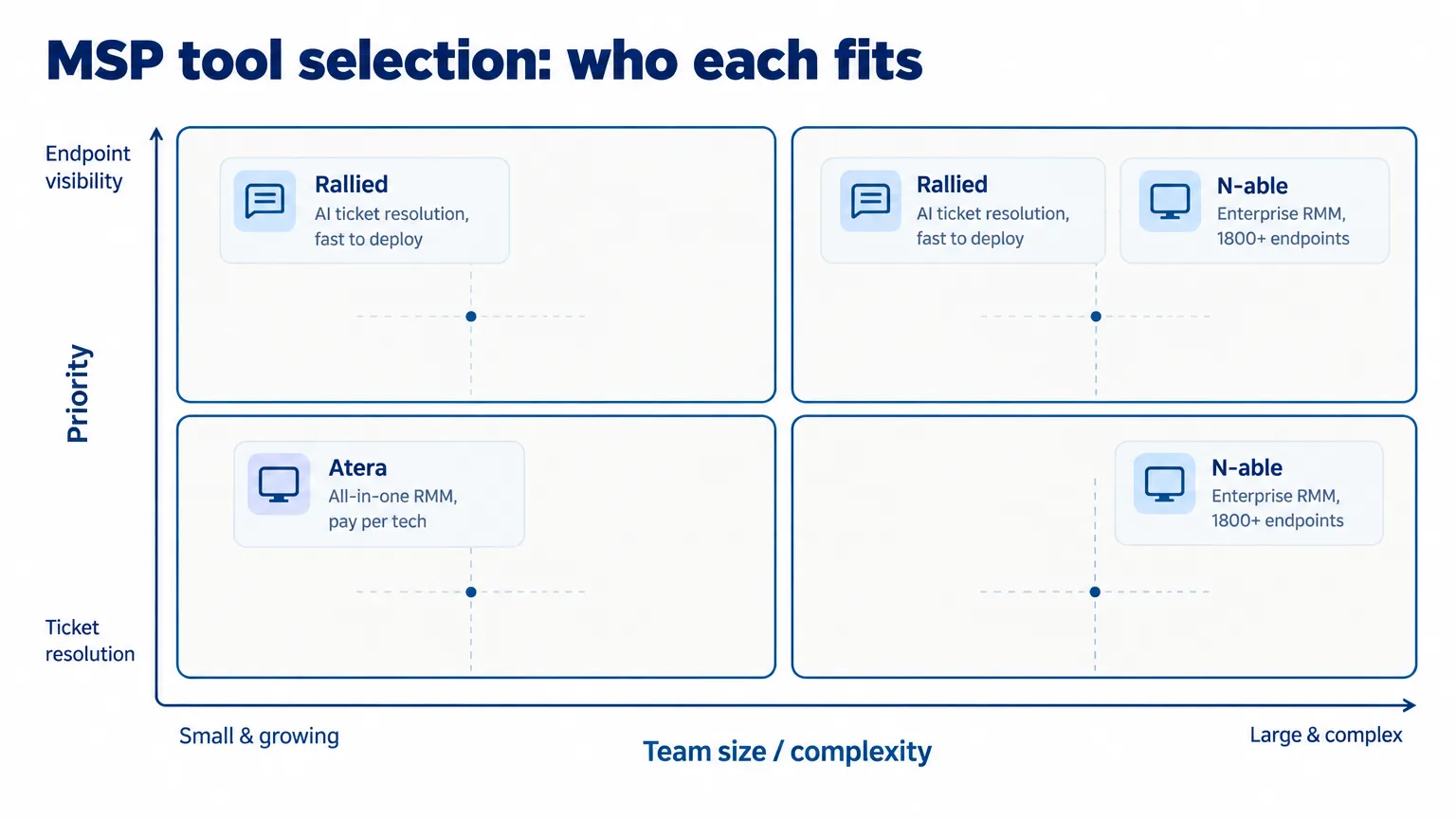
Choose Atera if:
- You're an MSP under ~500 endpoints per client, or an IT department wanting one consolidated tool
- Predictable per-tech pricing matters more than per-device flexibility
- You want AI moving toward autonomous resolution, not just assistance
- You need to be operational within days, not months
Choose N-able N-Central if:
- You're managing 500+ endpoints across complex, multi-site environments
- Your team has the expertise to configure and maintain a power-user platform
- You need deep scripting, automation policies, and long-term stability
- You're already invested in N-able's ecosystem and want the most powerful tier
Where both fall short:
Neither Atera nor N-able is designed to eliminate L1 ticket labor at the PSA level in a stack-agnostic way. Atera's Robin is impressive, but it's tightly coupled to the Atera ecosystem - if your shop runs a different PSA or ticketing system, Robin isn't available to you. N-able's AI agents improve efficiency without replacing the human execution step.
The MSP community has noticed this gap. The consistent feedback in threads across r/msp: teams want a tool that actually resolves the ticket, not one that routes it or suggests a resolution for a human to execute. The category that matters is password resets, account unlocks, MFA re-enrollment, onboarding steps, printer fixes, disk cleanup via RMM script. These are the tickets that chew through technician hours every day. An RMM with AI features isn't the same as an AI that closes those tickets in the PSA, writes the internal note, logs the time entry, and moves on.
The Gartner view
Worth noting for context: the Gartner Magic Quadrant for Endpoint Management Tools (December 2025) placed Atera in the Visionaries quadrant - strong on completeness of vision, working toward execution scale. N-able sits in the Niche Players quadrant. Neither is in Leaders (NinjaOne holds a spot there, alongside Microsoft and Tanium at the top).
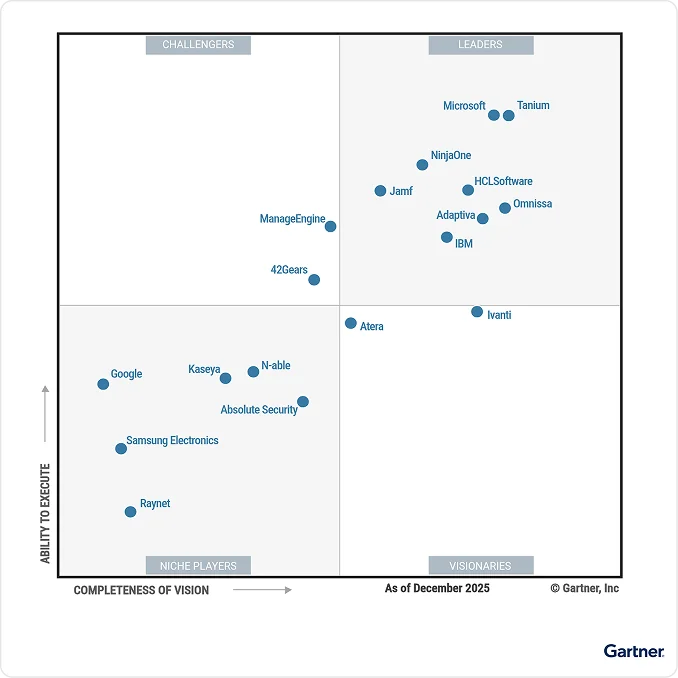
That positioning reflects the broader dynamic we've described: Atera is directionally interesting and getting more powerful; N-able is deep and proven in specific niches. The Leaders quadrant is dominated by enterprise-grade tools serving different buyers entirely.
Try Rallied
If you've landed on this comparison because you're trying to reduce the L1 ticket load on your team, it's worth separating two questions: what RMM you should run, and how you handle autonomous ticket resolution.
Rallied is an AI technician for MSPs that connects to whichever PSA and RMM you run - ConnectWise, Autotask, Halo PSA, Datto RMM, NinjaRMM - and autonomously resolves L1/L2 tickets. Password resets, account unlocks, onboarding, offboarding, mailbox permissions. It reads the ticket in your PSA, checks the live state in your identity provider and RMM, runs the approved fix, and closes the ticket with internal notes and a time entry. No workflow library to build before it starts working, no dedicated admin to maintain it.
The Rallied pricing model is $150/month with 2,000 credits included - 1 credit for simple operations, 3 for standard (password resets, account lookups), 8 for complex (multi-system tasks like offboarding). You only pay for the work it actually does. The math works out to about 700 tickets a month on the base plan. For a shop burning 50-100 hours a month on L1 grunt work, that's $7,000-$15,000 a month in technician time given back.
Atera and N-able handle endpoint management. Rallied handles the tickets those endpoints generate. They're not competitors - they're different layers of the same stack.
Request a demo at rallied.ai or read more about how AI ticket resolution works to see what it looks like in practice.
For the wider picture, read 7 Best MSP Automation Tools in 2026.
Frequently Asked Questions
Is Atera better than N-able for small MSPs?
For most small MSPs, Atera is the easier entry point. Its per-technician pricing means costs don't rise as you add endpoints, and the all-in-one RMM + PSA + ticketing package avoids tool sprawl early on. N-able N-Central is better suited to shops already managing 500+ endpoints that need deep automation and complex scripting capability.
How does Atera pricing work compared to N-able?
Atera charges per technician - not per device - so you can manage an unlimited number of endpoints without your bill growing. Exact pricing is gated behind signup. N-able N-Central uses per-device pricing that scales with your managed endpoint count, and pricing requires a sales quote rather than self-serve signup.
Does N-able have AI features in 2026?
Yes. N-able's N-zo platform includes a Product Expert agent (console Q&A claiming 80% efficiency gains), an Asset Expert (device visibility, 53% more efficient), a Security Expert (CVE prioritization), and an MCP Server for agent-to-agent automation. These are AI-assisted features that surface insights and suggestions - human techs still execute most actions.
What does Atera's Robin AI agent actually do?
Robin is Atera's autonomous AI agent. It handles the full resolution cycle: capturing and verifying the request, running approved fixes on devices and cloud systems like M365 and Entra ID, verifying the fix worked, and closing the ticket. It's designed to resolve tickets end-to-end without a human in the loop for any approved action class.
What if I want AI to actually resolve tickets, not just suggest things?
That's a separate category from traditional RMM. Tools like Rallied are built specifically to autonomously resolve L1/L2 tickets - password resets, account unlocks, onboarding, offboarding - by connecting to your PSA, RMM, identity providers, and documentation tools. They work alongside whichever RMM you already run.