Atera vs SuperOps: which PSA-RMM platform is right for your MSP?

TL;DR
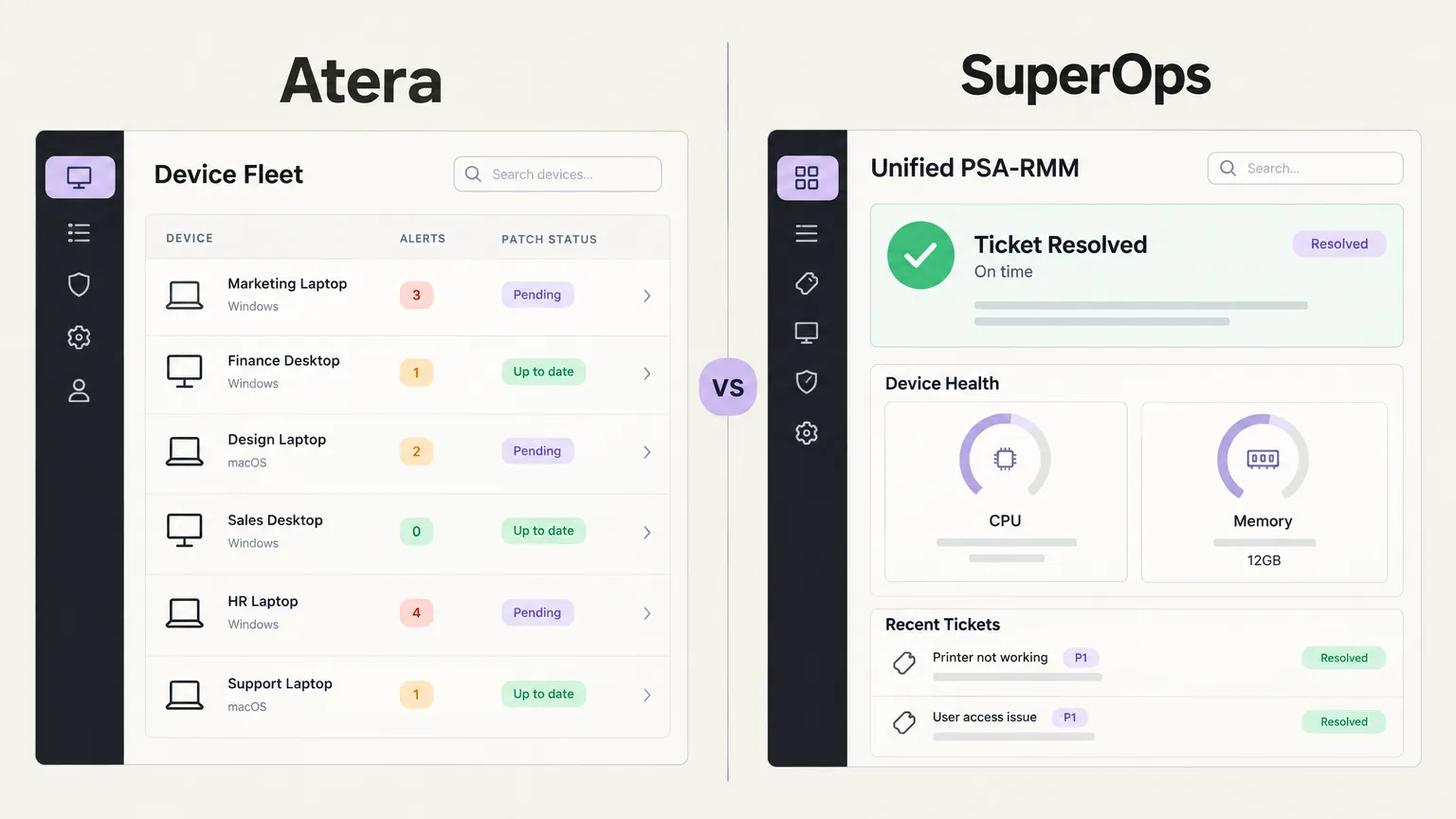
Atera and SuperOps are both solid, modern platforms - the real decision is about pricing model and AI philosophy. Atera charges per technician (which rewards high endpoint-to-tech ratios) and gives you Robin, an AI agent that takes full ownership of tickets end-to-end. SuperOps charges per endpoint (which rewards growing your headcount without blowing up your SaaS bill) and ships Monica, an AI that accelerates your techs rather than replacing them. Neither platform resolves L1/L2 tickets the way a purpose-built AI technician like Rallied does - but both are worth the comparison before you commit to either.
We spend a lot of time with MSP platforms, and "Atera vs SuperOps" comes up constantly. Both platforms pitch themselves as the one platform to consolidate your RMM, PSA, helpdesk, and AI. Both have real traction. And both feel genuinely modern compared to the ConnectWise-era stack that still runs most MSPs.
But they're optimized for different things, and the choice between them is less obvious than either vendor makes it sound. Here's the honest breakdown.
How they actually differ
The instinct is to compare feature lists - Robin vs Monica, patch management depth, ticketing workflows. That's useful eventually. But the more important question upfront is the pricing model, because it fundamentally changes the economics of your business as you grow.
Atera is per-technician. You pay a fixed rate for each tech seat, and the platform manages an unlimited number of endpoints. This is great if you're a lean MSP managing a large device fleet - every additional endpoint you bring on costs you nothing.
SuperOps is per-endpoint. You pay by the number of devices you manage, starting at $1.20-$1.50/endpoint/month on the Prime plan (depending on volume tier). As you manage more devices, your bill scales up directly. As you hire more techs, your bill stays the same.
Those two models produce very different answers depending on where your business sits:
- A 3-tech MSP managing 600 endpoints probably gets a better deal from Atera - the per-tech rate covers a large fleet.
- A 10-tech MSP managing 800 endpoints probably gets a better deal from SuperOps - adding techs doesn't compound costs.
- The crossover point depends on Atera's actual per-tech pricing, which is not public.
That last point is worth naming directly: Atera gates its pricing behind a signup form. SuperOps publishes a full tiered table. We'll get to the numbers in the pricing section, but know going in that one of these comparisons requires a demo call and the other doesn't.
Atera at a glance
Atera is an all-in-one IT management platform combining RMM, helpdesk, PSA, patch management, and network discovery. It's trusted by 13,000+ organizations, including enterprise names like Boeing, Domino's, and Marriott - a signal that it's built for more than just SMB MSPs.
The platform's defining feature is Robin, Atera's autonomous AI agent. Robin takes end-to-end ownership of support requests: it captures the request, verifies the user, diagnoses the issue, executes an approved fix on the device or cloud system, verifies the resolution, and closes the ticket with a full audit log. It's not a copilot - it's the tech.
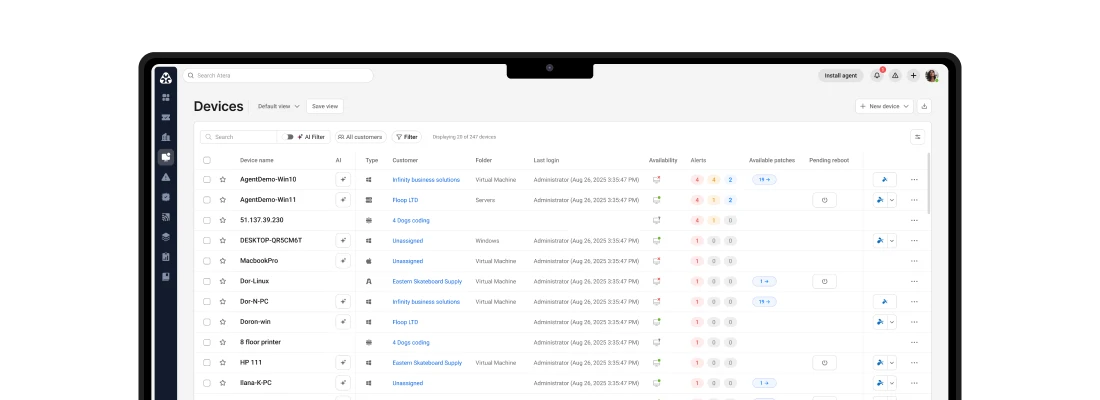
On the RMM side, Atera covers the full stack: real-time monitoring with threshold-based alerting, remote access via Splashtop (unlimited concurrent sessions on Expert+, plus AnyDesk as an alternative), automated patch management across Windows/Mac/Linux, software deployment via Chocolatey, Homebrew, and WinGet, and SNMP monitoring for network devices. The helpdesk includes AI auto-tagging, SLA enforcement, a customer portal, and a knowledge base.
Gartner recognized Atera as a Visionary in the 2024 Endpoint Management Tools Magic Quadrant. A Forrester TEI study found 321% ROI with payback in under six months.
On G2, Atera holds a 4.6/5 rating from 1,221 reviews, with 80% five-star. "Ease of Use" is the top tagged pro with 386 mentions; "Missing Features" is the top con with 161 mentions. That ratio - strong usability praise, feature-gap frustration - is a pretty accurate characterization of where the platform sits.
SuperOps at a glance
SuperOps is an AI-native PSA/RMM platform built specifically for MSPs and lean IT teams. Where Atera targets both MSPs and enterprise in-house IT departments, SuperOps is sharper in its focus: it's for managed service providers who want to escape the ConnectWise + separate RMM dual-tool tax.
The unified platform combines endpoint management, ticketing, asset management, patch management, MDM, and Monica - its embedded AI - into one product. The PSA side (contracts, billing, dispatch, SLAs) integrates natively with the RMM layer, so alerts can become tickets automatically and ticket resolution can trigger device actions without manual context-switching.
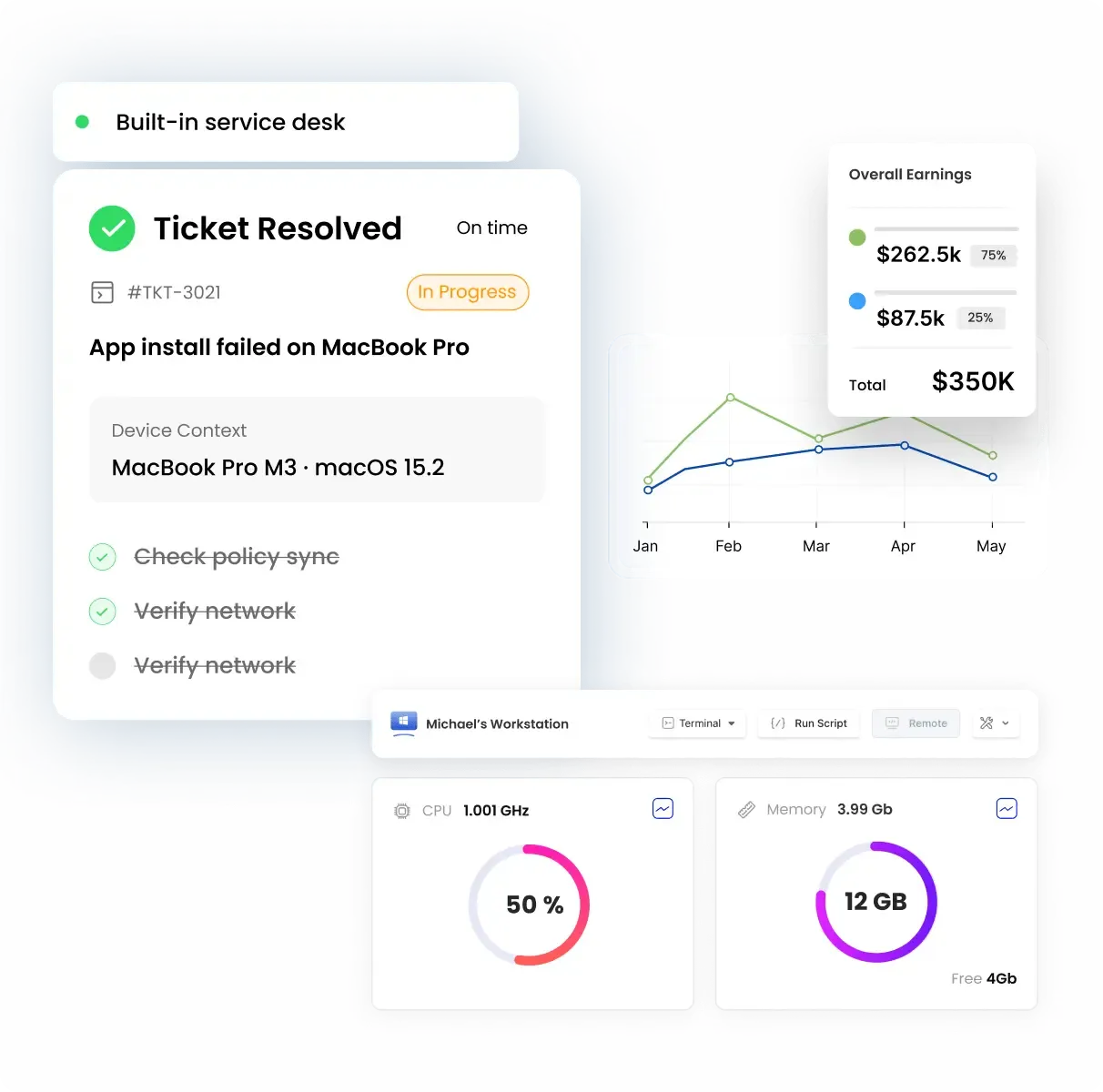
SuperOps holds a 4.4/5 on G2 from 197 reviews. Users consistently call out the unified experience, transparent per-device pricing, fast onboarding, and the native ticketing. One G2 reviewer from a managed IT firm put it well:
"Coming from ConnectWise + a separate RMM tool, the per-device pricing model is refreshing. We're not paying per technician seat, so adding staff doesn't increase costs. At 250 endpoints, we're paying less than we were with the old stack, and we have more features." - Service Manager, MSP, G2
The main friction points users flag: third-party integrations (IT Glue and Hudu are API-first, not native), some advanced feature complexity, and an interface that some reviewers describe as busy compared to alternatives.
How the AI works
Both platforms have named AI agents. They're doing different things.
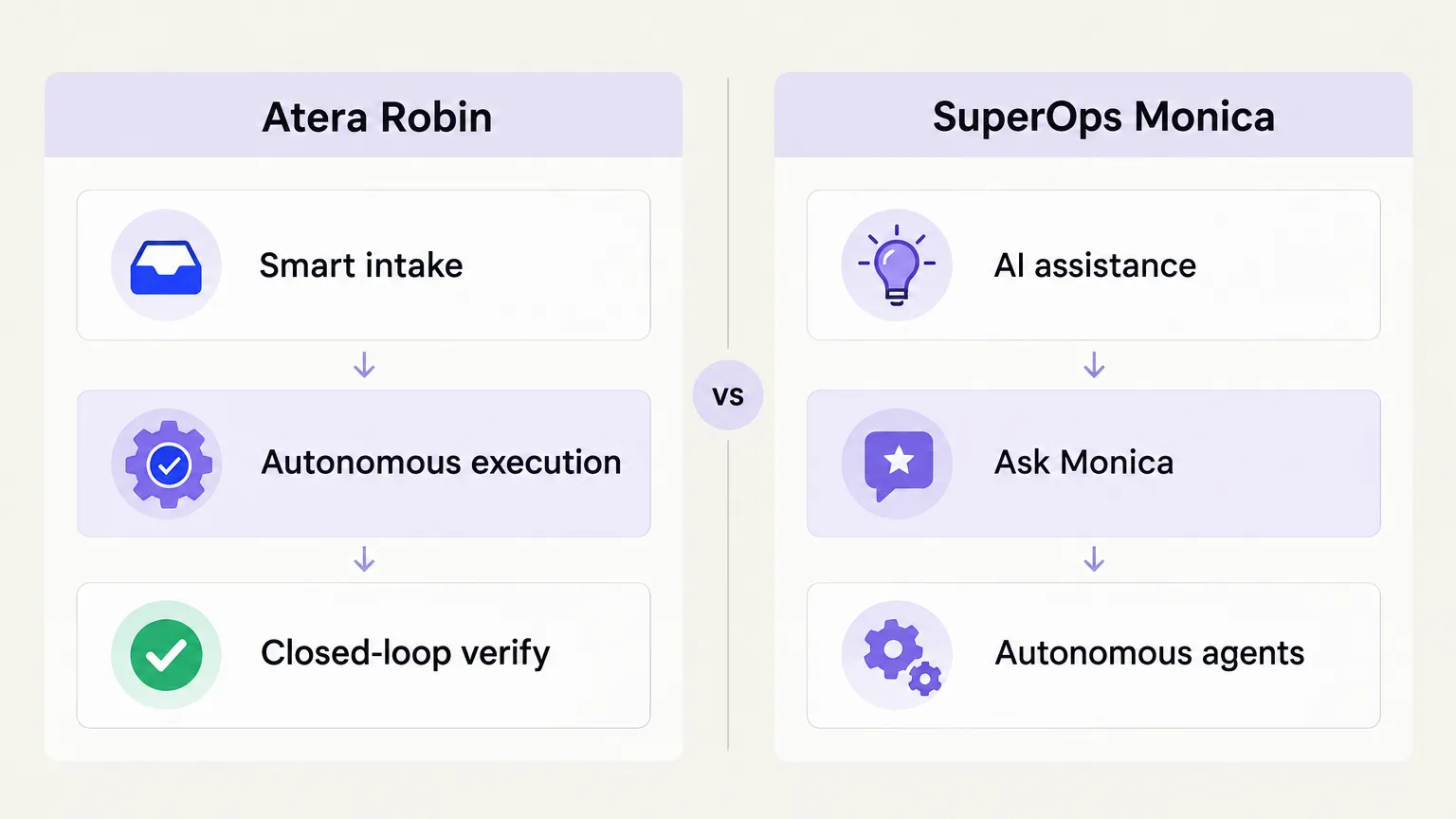
Robin (Atera) is built around end-to-end ticket resolution. The workflow has three phases: smart intake (capturing the request, verifying the user, gathering technical context), autonomous resolution (executing approved actions on devices, networks, and cloud systems), and closed-loop optimization (verifying the fix, logging all actions, keeping stakeholders updated). Admins configure approval gates for sensitive actions; within those guardrails, Robin acts without a tech in the loop.
Device skills cover Windows, Mac, and Linux - diagnostics, file operations, service management, user account management. Cloud skills cover Microsoft 365 and Entra ID - password resets, account unlocks, MFA configuration, license management. One CIO customer cited Robin resolving 85% of help desk tickets autonomously.

Monica (SuperOps) operates in three escalating levels of autonomy. Level 1 is AI assistance: ticket summarization, worklog generation, AI script generation from plain-English prompts. Level 2 is supervised execution: ticket deflection (Monica surfaces relevant KB articles before a ticket is even filed), recommended solutions, similar ticket surfacing, AI-informed patch decisions with community sentiment data. Level 3 is autonomous agents: AI Patch Manager, AI Dispatcher, and Pathfinder AI (autonomous incident resolution - listed as coming soon).
The honest difference: Robin is closer to an autonomous replacement for the tier-1 tech. Monica is closer to a smart co-pilot that makes your existing techs faster. Both approaches are defensible - the right one depends on whether you'd rather automate ticket handling entirely or accelerate your team's throughput.
Pricing
Here's where things get concrete - and where the comparison becomes asymmetric.
SuperOps publishes full pricing. No demo required.
| Plan | 100 endpoints | 500 endpoints | 1,000 endpoints |
|---|---|---|---|
| Prime (basic) | $150/month ($1.50/device) | $700/month ($1.40/device) | $1,200/month ($1.20/device) |
| Prime Plus (adds MDM) | $375/month ($2.50/device, early bird) | $1,150/month ($2.30/device) | $2,000/month ($2.00/device) |
Minimum commitment: 100 endpoints for Prime, 150 for Prime Plus. Both plans offer a free trial.
Atera does not publish per-technician pricing. Pricing is revealed during a free 30-day trial signup or demo. What's public: the three plans (Professional, Expert, Master), each billed per technician, with unlimited endpoints included on all plans. Expert is the most popular and adds AnyDesk remote access, unlimited Splashtop sessions, 11 preset reports, and AI auto-tagging.
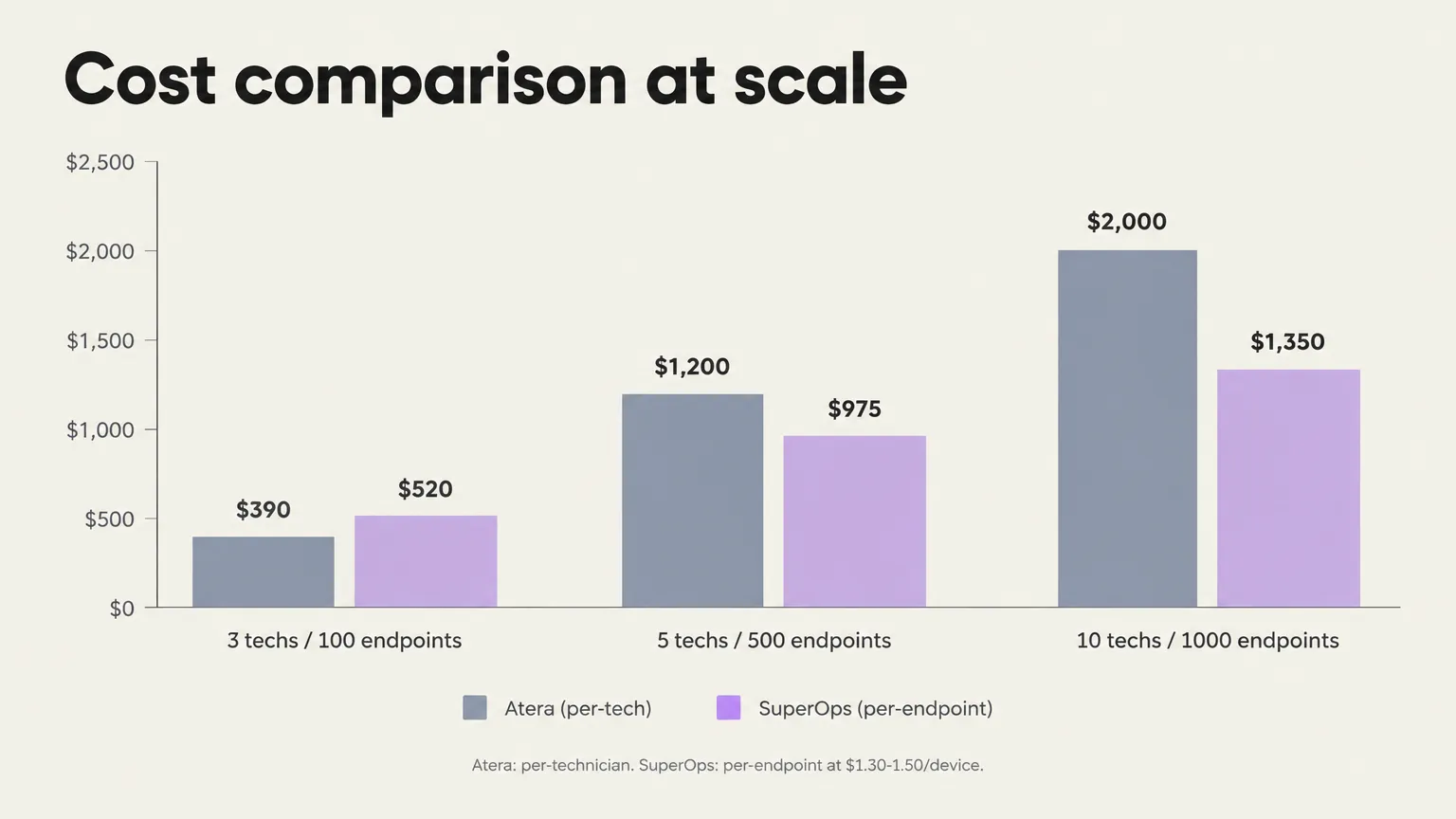
The practical implication: If you're evaluating on cost, you'll need to go through Atera's trial flow to get an actual quote. The per-tech model means that Atera gets more expensive as you hire and stays flat as you grow endpoints, while SuperOps does the reverse. MSPs with high device-to-tech ratios (think: 150+ endpoints per tech) often find Atera's unlimited-endpoint model wins on paper once they see the actual rate. MSPs scaling headcount faster than endpoints tend to find SuperOps more predictable.
Feature comparison
| Feature | Atera | SuperOps |
|---|---|---|
| RMM (Windows/Mac/Linux) | Yes | Yes |
| PSA / ticketing | Yes (built-in) | Yes (built-in) |
| Patch management | Yes (automated, all OS) | Yes (AI-informed, all OS) |
| Network discovery | Yes | Yes (network monitoring) |
| MDM (mobile devices) | No | Yes (Prime Plus) |
| Remote access | Splashtop included; AnyDesk on Expert+ | Splashtop integration |
| AI autonomous resolution | Robin (end-to-end) | Pathfinder (coming soon) |
| AI assistance / co-pilot | AI Copilot (all plans) | Monica Levels 1-2 (all plans) |
| Script library | Yes (CVE remediation included) | Yes (AI script generation) |
| Knowledge base | Yes | Yes (ticket deflection) |
| Customer portal | Yes | Not documented |
| G2 rating | 4.6/5 (1,221 reviews) | 4.4/5 (197 reviews) |
| Pricing model | Per technician | Per endpoint |
| Pricing transparency | Requires trial/demo | Fully public |
| Free trial | 30 days, no credit card | Yes |
| Audit log retention | 1-12 months (plan-dependent) | Not publicly documented |
| Gartner recognition | Visionary (2024) | Not found in research |
One area where SuperOps wins cleanly: MDM. The Prime Plus tier includes mobile device management for Apple, Android, Windows, macOS, and Linux devices - Atera doesn't offer a comparable built-in MDM solution.
One area where Atera wins cleanly: established enterprise credibility. 13,000+ organizations, Gartner recognition, a Forrester TEI study, and customer names like Boeing give Atera a credibility signal that SuperOps, at a fraction of the review count, doesn't yet match.
What MSPs say
SuperOps' community presence on r/msp is instructive. Threads show a consistent pattern: people switching from Atera or SyncroRMM tend to praise the modern UI and the per-endpoint pricing clarity, but the product's relative newness (and occasional instability) comes up. One thread from r/msp said:
"Super Ops is modern and seems to be developing quickly but with hiccups and constant bugs. Syncro is a great value but missing modern features." - r/msp, 5 months ago
The PSA-only use case gets questioned in multiple threads - SuperOps' real strength is the unified PSA-RMM combo, not either piece standalone.
Atera's G2 data tells a cleaner story at scale: 4.6/5 with 1,221 reviews is harder to fake, and "ease of use" leading the praise tags across 386 mentions is consistent with what you'd expect from a platform that's had years to smooth its onboarding. The main gripe - "missing features" and "limited features" tagged 296 times across two variations - suggests that as customers grow, they hit ceilings Atera hasn't yet filled.
The actual decision
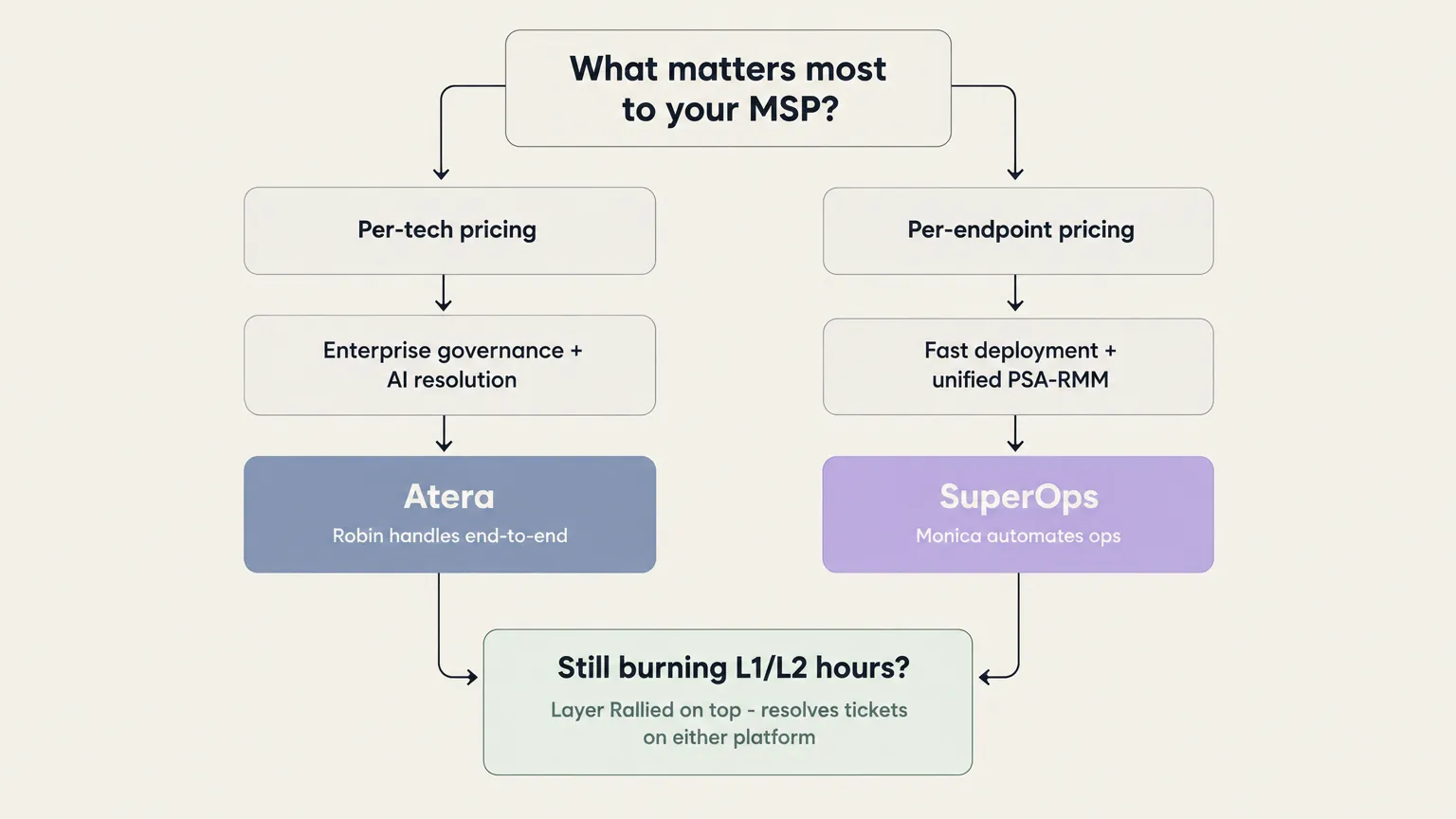
Pick Atera if:
- You have a high endpoint-to-tech ratio (150+ devices per tech) and want the economics of unlimited endpoints in a single seat cost
- You need enterprise-grade credibility - SOC 2, Gartner recognition, a 13,000-org customer base - for procurement conversations
- You want AI that takes full ownership of ticket resolution (Robin), not just assists
- You're managing diverse OS environments and need battle-tested Windows/Mac/Linux parity
- A 30-day free trial to evaluate the actual pricing makes sense for your buying process
Pick SuperOps if:
- You're scaling headcount and want predictable per-endpoint costs that don't compound as you hire
- You want published, transparent pricing without a demo call
- MDM is a requirement - SuperOps Prime Plus covers mobile device management; Atera doesn't
- You're replacing a fragmented ConnectWise + RMM stack and want the unified PSA-RMM integration to feel native from day one
- You value a fast implementation - G2 reviewers consistently report going live in 3-7 days
Our take: If we had to pick for a mid-market MSP managing 5+ techs and 500+ endpoints, we'd lean SuperOps for the per-endpoint economics and PSA-RMM unity, but we'd evaluate Atera's actual per-tech quote first. The right answer genuinely depends on a number that Atera hasn't made public. For an enterprise-adjacent MSP managing large clients who'll ask about Gartner positioning and SOC 2, Atera's credibility markers are worth the pricing opacity.
Try Rallied
Once you've picked your PSA-RMM, you still have the same L1/L2 flood hitting your queue every day: password resets, account lockouts, onboarding requests, access changes. The average MSP runs 50-100 hours of that work per month, and neither Atera nor SuperOps eliminates it entirely - Robin gets close on autonomous resolution, but requires setup and governance configuration; Monica speeds techs up but doesn't fully remove them from the loop.
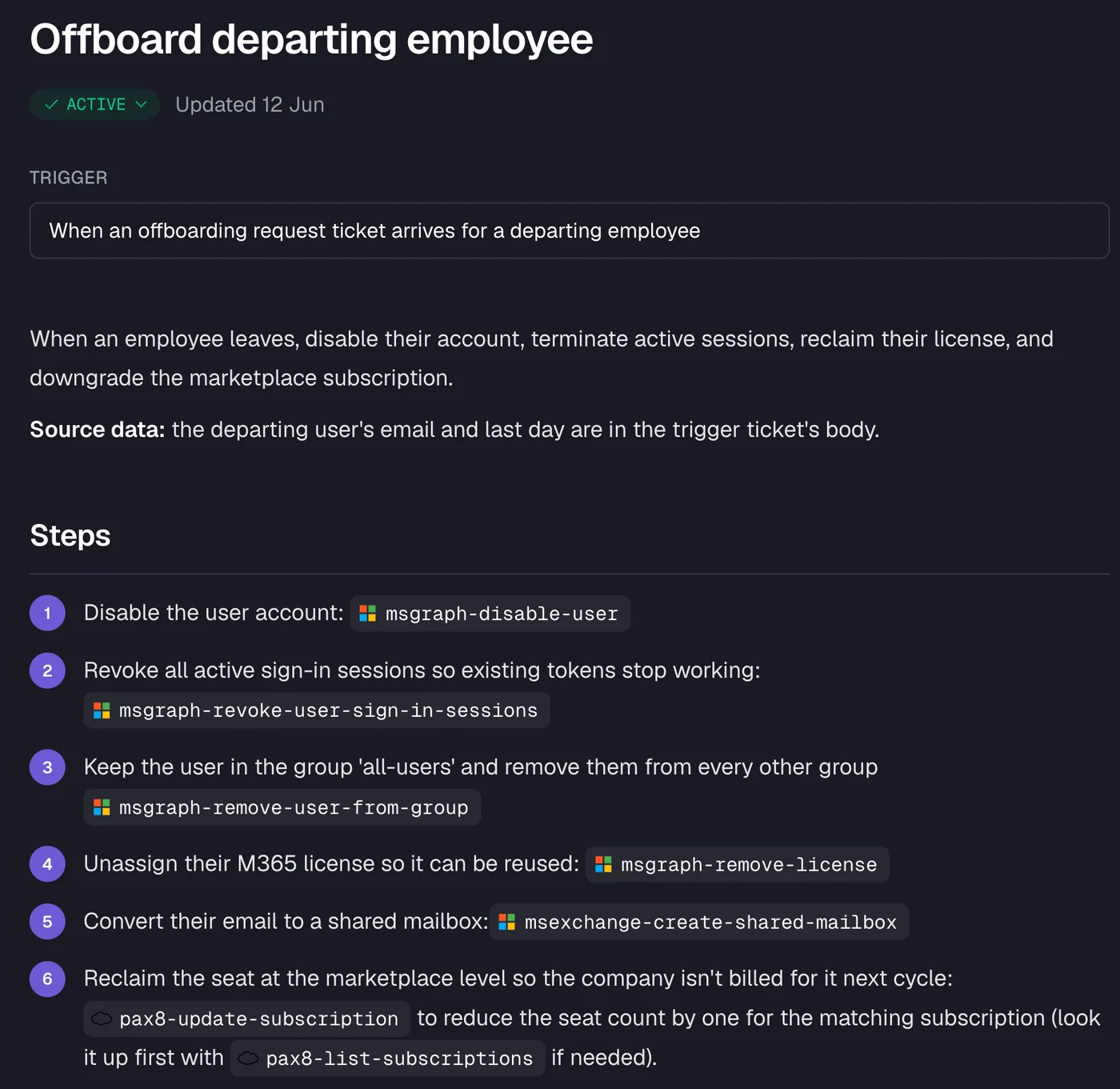
Rallied is an AI technician that sits on top of your PSA - including SuperOps - and handles that work at the ticket level. It connects to your PSA, reads the ticket, checks the client's live state in your RMM and identity provider, runs the approved fix (password reset, account unlock, license assignment, offboarding runbook), and closes the ticket with notes and a time entry. No workflow builder to configure, no 6-month implementation. Most teams are live in a week.
At $300/month with 2,000 credits included, it's the layer between "we have a modern platform" and "our techs aren't doing grunt work anymore."
For the wider picture, read 7 Best MSP Automation Tools in 2026.
Frequently Asked Questions
Is Atera or SuperOps better for a small MSP with 2-3 technicians?
It depends on your endpoint count. Atera's per-technician billing means a 2-3 tech shop pays the same regardless of how many endpoints they manage - a clear win if you're managing 200+ devices per tech. SuperOps' per-endpoint model (starting at $1.50/endpoint/month) only becomes cost-competitive when your ratio of endpoints-to-techs is lower. For very small shops just starting out, Atera's 30-day free trial with no credit card is also a lower-commitment entry point. See Atera's pricing page and SuperOps' pricing page to run the numbers for your specific situation.
Does Atera's Robin AI work without human approval?
Robin can operate autonomously on actions you explicitly approve in advance, but the system includes configurable approval gates so you decide which actions it takes on its own and which ones require a tech's sign-off. Sensitive actions - like account deletions or major configuration changes - are approval-gated by default. You can think of it as 'autonomous within your defined guardrails.' Learn more at Atera's Robin page.
What is SuperOps Monica AI, and how is it different from Atera Robin?
Monica is SuperOps' embedded AI operating in three levels: AI assistance (summaries, script generation), supervised execution (ticket deflection, recommended solutions), and autonomous agents (AI Patch Manager, AI Dispatcher). Robin is Atera's equivalent but takes a more end-to-end ownership approach - diagnosing, executing, verifying, and closing tickets autonomously. Monica leans toward workflow acceleration and assistance; Robin leans toward full ticket resolution without human touch. Both are genuinely useful; the difference is emphasis. Compare them at SuperOps Monica AI and Atera Robin.
How much does SuperOps cost for 500 endpoints?
On SuperOps' Prime plan (the standard tier), 500 endpoints falls into the $1.40/endpoint/month tier, putting you at $700/month or $8,400/year. Adding MDM via Prime Plus bumps that to $2.30/endpoint/month at the 151-500 tier, for $1,150/month. These figures reflect SuperOps' current published pricing, including the early-bird rate for Prime Plus. Atera's pricing for the same headcount is not publicly published and requires requesting a quote.
Can Rallied work with both Atera and SuperOps?
Yes. Rallied is an AI technician layer that sits on top of your PSA/RMM stack - it reads incoming tickets from your PSA, executes the fix (password resets, account unlocks, onboarding/offboarding, access management), and writes notes back to the ticket. It connects to ConnectWise, Autotask, Halo PSA, SuperOps, and other PSAs, meaning you can use it alongside either platform in this comparison. Rallied handles the L1/L2 grunt work that floods in regardless of which PSA-RMM you've chosen.