Synthreo review: AI workforce platform for MSPs in 2026

Synthreo is a Phoenix-based AI platform built for MSPs. It gives each of your clients a branded AI workspace and no-code agents, running in isolated tenants under your name, so you can sell AI as a managed service. The stack is four products: Threo, Wingtip, Pylon and Canopy. MSP veteran Vince Kent founded it in 2025.
The pitch lands on a real problem. Your clients' staff already use consumer AI tools outside your management and outside your invoices, and building your own AI practice means engineers you probably don't have. Synthreo says you can skip the build, put AI into your service plans and keep the client relationship.
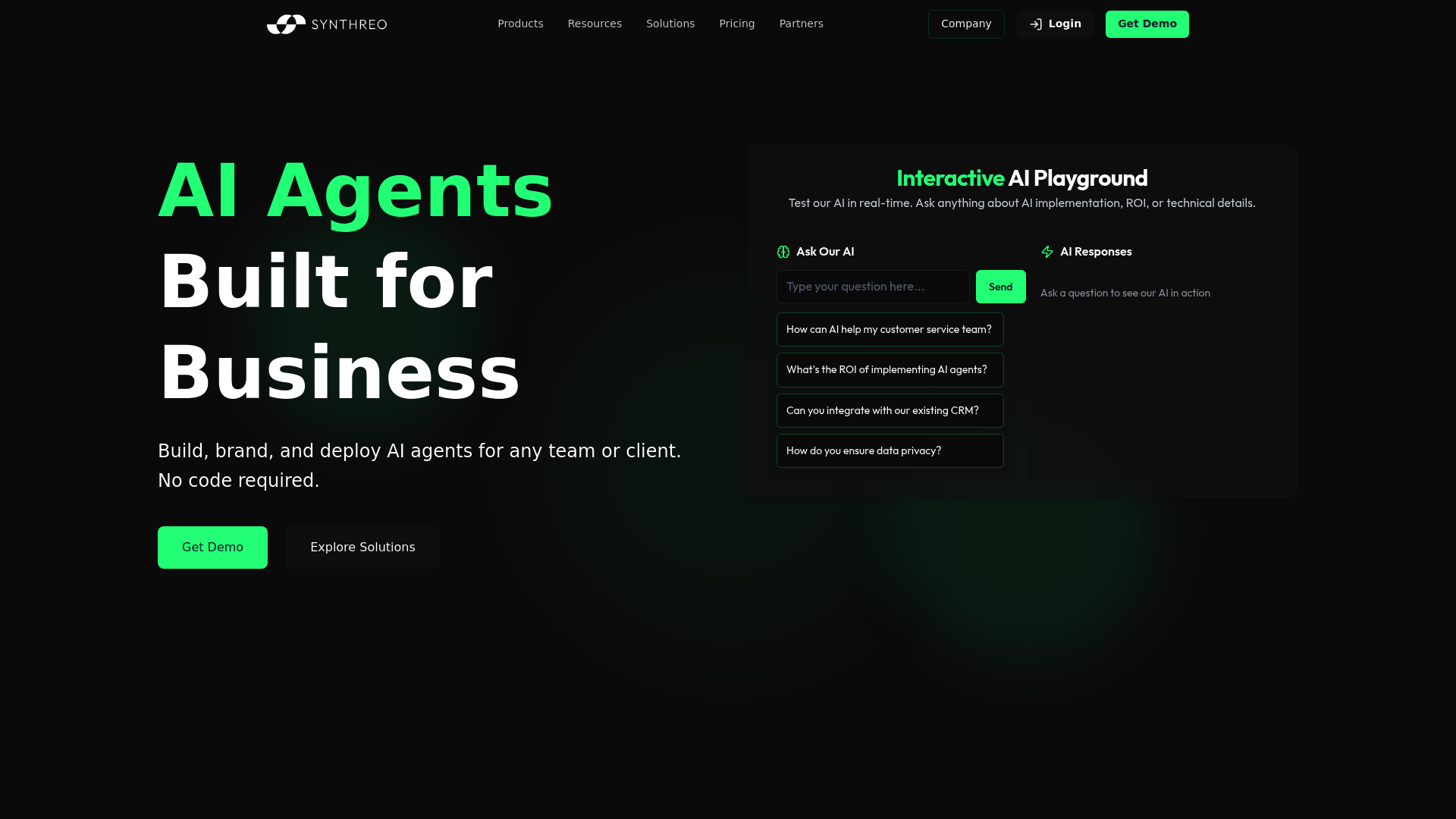
The company has changed a lot since we first reviewed it. The products have new names, the methodology page has been rewritten, and the per-agent price list we covered is no longer what the site leads with. This review covers what Synthreo looks like now, what still needs checking on a demo, and where it sits next to tools that work your ticket queue.
What is Synthreo?
Synthreo is AI infrastructure for MSPs and enterprises: multi-tenant, white-label, and deployable across dozens of client environments from one dashboard. The founding story explains the focus. An AI engineering team had built a multi-tenant platform for enterprise LLM workflows, and Vince Kent, who sold his MSP cloudIT and then became CTO at Lyra Technology Group, went looking for exactly that technology. Kent is now founder and board chair, Callen Sapien, a ConnectWise and Liongard veteran, is co-founder and CEO, and 40-year MSP veteran Arlin Sorensen is an advisor, according to Synthreo's leadership page. Gregg Lalle, who led IT Nation at ConnectWise for 15 years, was president when we first reviewed Synthreo but is not listed there now.
The core idea is the "Managed Intelligence Provider." Instead of only managing endpoints and infrastructure, you become the place your clients get AI from. We cover that model in more depth in what a Managed Intelligence Provider is and how MSPs get there.
Synthreo's current Start Here page frames the case with what it calls the Six Walls Framework. Anyone turning a cheap AI tool into something a business runs on hits subscription tiers, usage caps, sharing, hosting, security and finally certification, and Synthreo positions its platform as the thing on the other side of all six.
Synthreo and Rallied sit in different layers. Synthreo is the AI workspace and agent platform your clients log into. Rallied is an AI agent that works tickets inside your PSA, running fixes like password resets and account unlocks and writing the notes back. If your goal is to sell branded AI to clients, Synthreo is worth a look. If your goal is to close L1 tickets without a tech touching them, that is a different tool.
How the Synthreo platform works: Threo, Wingtip, Pylon and Canopy
The product names in our first review (Builder, ThreoAI, Tenant Management) have been replaced by four products.
| Product | Role | What it does |
|---|---|---|
| Threo | Run | The secure workspace clients log into: chat, agents, file work and connectors under your brand, on desktop and mobile |
| Wingtip | Execute | Takes a plain English request and produces reports, documents, dashboards and repeatable automations |
| Pylon | Build | Where agents are created and run in production, on a canvas or programmatically |
| Canopy | Manage | The control plane: configure each client environment, gate features per tenant, watch usage across your book |
Synthreo's own platform overview video shows what Threo looks like in practice. Users pick from the frontier models, upload documents, and can send one question to two models at once to compare answers. Chats save to a history that can be moved into projects, and the workspace keeps memory about the user between conversations.
Pylon is the piece your technical team will spend time in. It has a canvas with breakpoint debugging and full payload visibility at each node, named versions with one-click rollback, and per-agent run counts and success rates you can show a client. Pylon also exposes itself as an MCP server, so Wingtip and outside tools can build and deploy agents without opening the interface, and individual agents can be published as MCP endpoints other platforms call. Synthreo says existing MSP automations move over as a migration project rather than a rebuild.
Wingtip is the agentic piece. In the June 2026 overview video, Synthreo describes it as an autonomous agent that completes tasks by taking control of the browser or local computer, and says it is available only to a few customers for now with a wider rollout planned. Ask where availability stands before you plan a client offer around it.
Earlier Synthreo material organized projects as a 4D process: Discover, Distill, Design, Deploy. The current site has moved to the Six Walls framing, but the 4D steps are still a sensible way to scope a first deployment, starting with high-frequency tasks that are painful enough to be worth fixing.
Synthreo pricing: what to confirm on the demo
When we first reviewed Synthreo, it listed pre-built agents at a flat $995 per month each, including Rex (HR), Scopey (SOW design), CRM Insights and IT Triage, with custom pricing for the white-label partner model. None of the current Synthreo pages we checked show that price list or those agent names, so treat the $995 figure as historical until Synthreo confirms it.
The current site describes the commercial model differently. You package a branded AI workspace into your service plans so each client seat becomes recurring AI revenue, and you set usage budgets per client and per job so the margin holds as you add clients. Partners join one of three MSP Partner tracks: Start for MSPs with no AI offering yet, Monetize for those running AI for a client but not billing for it, and Scale for those with their own agents that aren't client-ready.
Synthreo's FAQ says pricing is not published because partners set their own retail prices on top of wholesale rates. Partners can bill workspace seats inside managed service plans, deployed agents as line items and automation projects on outcomes, and configurable usage budgets cap platform cost per client.
If per-agent pricing near the old level still applies, the math is the main filter. Five agents at $995 a month is close to $60K a year, which works for high-volume processes at larger clients and is harder to justify for small clients or niche use cases. Get the per-seat or per-tenant price, the usage budget mechanics and any minimums in writing before you quote a client.
Synthreo security and compliance
Security is where Synthreo spends most of its words, which makes sense because compliance teams block more AI projects than model quality does. The platform is multi-tenant from day one, with platform-level isolation between clients, Zero Data Retention on model calls, no training on your data, and hosting on Azure.
One detail matters for client conversations. In Synthreo's overview video, the presenter says Synthreo keeps a copy of conversation history, while content uploaded into a model is deleted when that conversation ends and is not retained on the LLM side. So "zero retention" applies to the model providers, and the workspace itself stores chat history. Make sure your clients' data policies allow for that.
At the time of our first review, Synthreo listed SOC 2 Type II (In Process), HIPAA compliance, GDPR alignment and ISO 42001:2023 AI governance practices. The current pages we checked talk about certification and attestation as a wall partners no longer have to climb, but they don't state the SOC 2 status. If a client needs a completed SOC 2 Type II report, ask for it directly.
Synthreo integrations with your RMM, PSA and Microsoft 365
Our earlier review noted Microsoft 365, CRM systems, ticketing platforms and document repositories as supported connections. Pylon now adds webhooks in both directions: inbound triggers with filtering and signing, and outbound events your RMM and monitoring stack can consume, so nobody has to log in to check on an agent.
What we could not confirm from Synthreo's pages is a named, native connector for ConnectWise, Autotask or HaloPSA. Webhooks and MCP endpoints make a PSA connection possible, but someone on your team will build and maintain it. Ask for a live example running against your PSA on the demo.
Synthreo use cases and results
Synthreo says it is deployed across construction, legal, recruiting and healthcare through its MSP partner network. The current site lists the work partners deploy agents for as ticket triage, email inquiries, document generation and reporting.
Synthreo has also published case studies with specific numbers:
- A medical device manufacturer cut clinical document review time by 68% by having AI extract and summarize clinical data for clinician review.
- A manufacturer took email inquiry processing from 20 minutes to 16 seconds, with AI reading orders from attachments, checking them against the catalog and pushing confirmed records into the ERP.
- A legal team freed 12 hours per week per attorney on trademark monitoring by having a vision system flag only likely conflicts.
- A capital markets team expanded ESG signal coverage from a small manual sample to millions of documents a day.
These are vendor-selected results. High-volume, rules-based processes like order intake tend to work well, while judgment-heavy work is harder. Synthreo's own blog makes a related point, citing a July 2025 MIT NANDA report that 95% of generative AI initiatives showed no measurable return, and arguing that the cause is messy data, missing documentation and weak guardrails rather than the models.
Synthreo reviews: what MSPs and customers say
Synthreo lists customers including cloudIT, Summit Digital Networks, Nucleus, Clare Computing, F1 Information Technology, xpollens, Navlacil, Dutch Bros West Valley, GB Tech and Framework IT. Testimonials on its site include:
"The solution is fast, super efficient, available 24/7, and never calls in sick. Even the 90% we've covered so far is incredibly valuable." Marek Navlacil, Navlacil
"Synthreo has saved us time and resources, providing the AI capabilities we need to grow. The team has been incredibly supportive, always going the extra mile." Kevin Resio, Resio
Arlin Sorensen, quoted on Synthreo's site, says: "Of all the transformations the industry's gone through... this one has the greatest potential to drive the most impact for MSPs and their customers."
Independent feedback is thinner. In an r/msp thread on AI tooling, one MSP wrote that they "tried Synthreo but it was way too immature at the time," while the same thread said Hatz AI was getting good buzz for agents. That comment predates some of the product changes above, so treat it as a reason to test with your own workflow rather than a verdict.
For background on the company's thinking, Gregg Lalle walked through the move from MSP to Managed Intelligence Provider on the IT Business Podcast, recorded in July 2025 when Synthreo was competing in IT Nation's Pitch It program.
Synthreo alternatives to consider
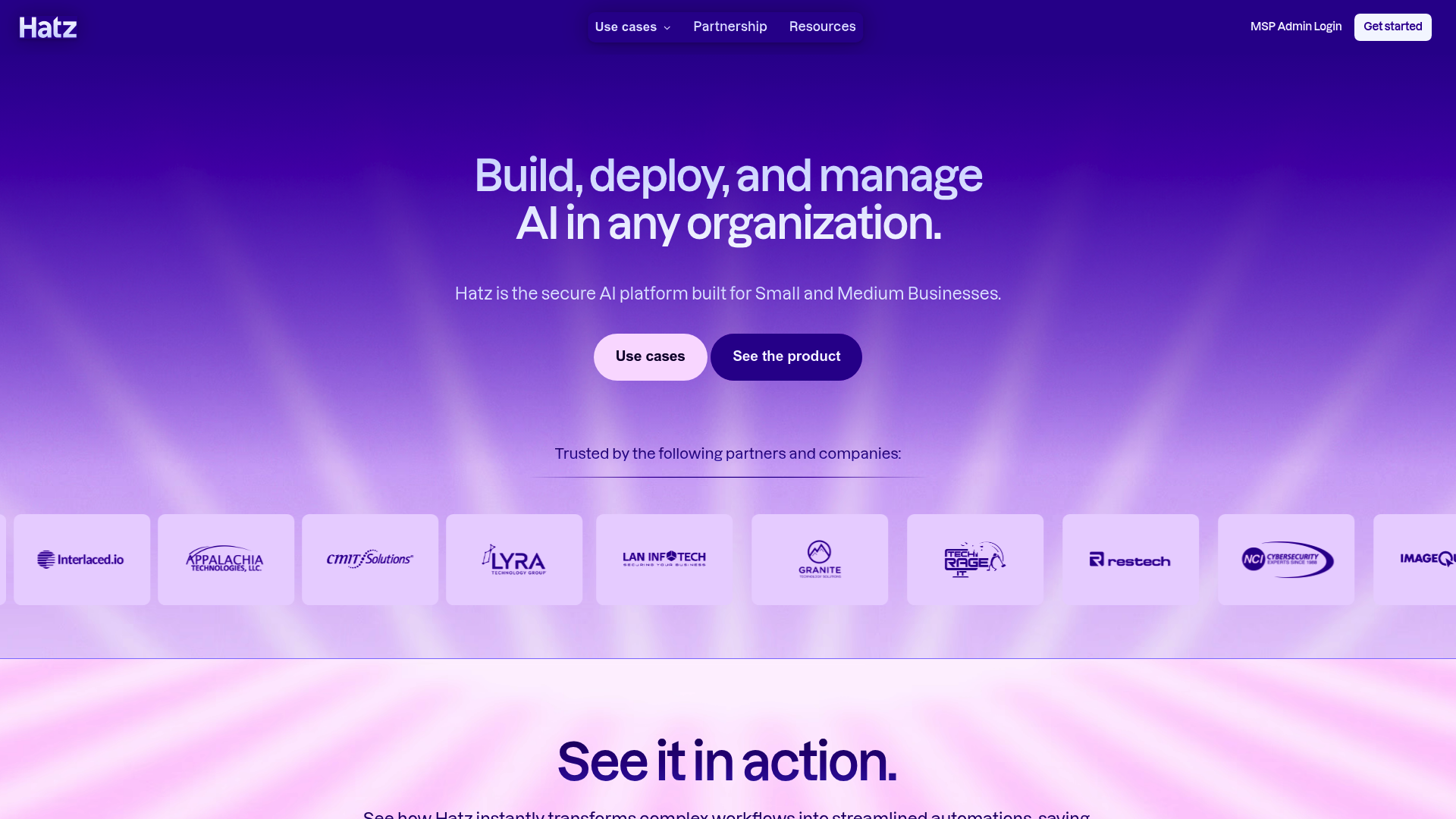
Hatz AI is the closest MSP-focused alternative. When we reviewed it, Hatz had completed SOC 2 Type 2, offered natural language workflow creation and a partner admin dashboard, and Appalachia Technologies reported a 20% efficiency gain. If a finished SOC 2 report is a hard requirement, Hatz may have the edge. Our Hatz AI review covering features, pricing and MSP fit goes deeper.
General-purpose agent tools such as Zapier Agents and Lindy show up as Synthreo alternatives on directories like WebCatalog. They can automate client workflows, but they were not built for multi-tenant MSP delivery, so you would assemble the isolation and white-labeling yourself.
Rallied works on a different layer. It is an AI agent that works tickets in ConnectWise, HaloPSA or Autotask, runs the fix in Microsoft 365 and your RMM (including NinjaOne), pulls client docs from IT Glue or Hudu during triage, and writes the notes and time entry back to the ticket. Pricing is one plan at $300 a month with 2,000 credits, which in Rallied's production data covers roughly 700 tickets in a typical month, and a ticket the agent couldn't finish isn't charged. If you are weighing ticket automation, compare deflecting tickets versus resolving them before you pick a tool.
The two can run side by side: Synthreo for the AI your clients' staff use, Rallied for the tickets your techs would otherwise work. Be clear about which layer you are buying for, and see how MSPs are building an AI agent stack for how the pieces fit.
Is Synthreo right for your MSP?
Synthreo makes sense if:
- You want to sell AI to clients under your brand without building the platform yourself
- Your clients already use consumer AI and you want that usage inside your security policies and your invoices
- You have someone technical who can build and maintain agents in Pylon
- You can live with SOC 2 status being confirmed on the demo rather than on the website
Look elsewhere if:
- You need L1 tickets closed inside your PSA rather than a client-facing AI workspace (consider Rallied)
- You need a native ConnectWise, Autotask or HaloPSA connector out of the box
- A completed SOC 2 Type II report is a hard requirement today
Getting started with Synthreo
Synthreo's demo starts with a short discovery call about your business and AI priorities, and the product demo is tailored from there. You can book through the Synthreo demo page. Every partner works with the Synthreo team on practice design and first deployments, and larger projects can be delivered co-managed and handed back to your team.
Questions worth asking on the call:
- What does it cost per client seat or tenant, and how do usage budgets bill when a client goes over?
- Are the Rex, Scopey, CRM Insights and IT Triage agents still offered, and at what price?
- Can you show a working connection to my PSA, and who maintains it?
- What is the current SOC 2 Type II status, and can I see the report?
- When will Wingtip be generally available?
- What happens to client conversation history if I leave the platform?
If your bigger problem is the L1 queue rather than client AI, read about autonomous L1 ticket resolution for MSPs, or check out Rallied. To see how Rallied handles this inside your PSA, read about AI Ticket Triage and Routing for MSPs.
For the wider picture, read Best MSP AI Tools for Ticket Automation in 2026.
Frequently Asked Questions
What is Synthreo?
Synthreo is a Phoenix-based AI platform built for MSPs that lets you deploy branded, multi-tenant AI workspaces and no-code agents to your clients. It was founded in 2025 by MSP veteran Vince Kent. The platform has four products: Threo for the client workspace, Wingtip for agentic execution, Pylon for building agents and Canopy for managing client environments.
How much does Synthreo cost?
Synthreo previously listed pre-built agents such as Rex and Scopey at $995 per month each, with custom pricing for white-label partners. Its current FAQ says pricing is not published because partners set their own retail prices on wholesale terms, with per-client usage budgets capping platform cost. Confirm wholesale per-seat or per-tenant pricing and overage terms on a demo.
What security certifications does Synthreo have?
Synthreo states platform-level tenant isolation, Zero Data Retention on model calls, no training on your data, and hosting on Azure. At the time of our first review it listed SOC 2 Type II as in process, plus HIPAA compliance, GDPR alignment and ISO 42001:2023 practices. Current pages don't state SOC 2 status, so ask for the report directly.
Does Synthreo store client conversations?
According to Synthreo's platform overview video, Synthreo keeps a copy of conversation history in the workspace. Content uploaded into a model is deleted when the conversation ends and is not retained on the LLM side. Check that this fits your clients' data policies.
Can I white-label Synthreo under my own MSP brand?
Yes. Synthreo's white-labeling runs two layers deep: your instance carries your brand, and each client workspace carries that client's own logo and name. The packaging, invoice and client relationship stay with you.
Does Synthreo integrate with ConnectWise, Autotask or HaloPSA?
We could not confirm a named native PSA connector from Synthreo's pages. Pylon supports inbound and outbound webhooks that RMM and monitoring tools can consume, and agents can be exposed as MCP endpoints, so a PSA connection is possible but will need building. Ask for a live example on the demo.
What's the difference between Synthreo and Rallied?
Synthreo is a white-label AI workspace and agent platform your clients use directly. Rallied is an AI agent that works tickets in ConnectWise, HaloPSA or Autotask, runs the fix in Microsoft 365 and your RMM, and writes notes and time entries back to the ticket. Rallied costs $300 a month with 2,000 credits, and the two can run side by side.