Best Data Backup and Disaster Recovery Services for MSPs in 2026

TL;DR
The backup and disaster recovery market for MSPs hit $25.43B in projected value through 2029, growing at 32% CAGR. Datto SIRIS is the safest pick for most mid-market MSPs - flat-fee, free hardware, 99%+ AI screenshot verification. Axcient is the best value play if you're done getting surprised by per-GB overages. Veeam is the right call for enterprise clients who care about Gartner credentials. Acronis makes sense if you want backup and security under one vendor. MSP360 wins on storage flexibility and white-labeling for cost-conscious shops. Rubrik is the premium choice for clients in regulated industries who need cyber resilience as a first-class feature. And if your techs are drowning in backup alert tickets, Rallied handles the L1/L2 operational noise automatically - so your team focuses on actual problems, not false alarms.
Running a backup and disaster recovery practice is one of the steadiest MRR lines in the MSP business - and one of the most operationally messy. Clients expect 100% reliability. Ransomware hits and recovery tests eat technician hours. Alert noise from failed backup jobs fills the queue. And the vendor landscape has gotten genuinely confusing: consolidations (Kaseya swallowed Datto for $6.2B in 2022), pricing model changes, and a new wave of cloud-native alternatives have made "which BCDR tool should we standardize on?" a harder question than it was five years ago.
We tested and evaluated six platforms that MSPs are actively using in 2026. Here's what we found.
Why BCDR is a must-have MSP service line
The case doesn't need much making, but the numbers are worth having handy for client conversations. The global backup-as-a-service market is forecast to reach $25.43B by 2029, compounding at 32% annually. Ransomware hit a record in 2025, with the average MSP client experiencing at least one attempted attack. And recovery time expectations have compressed - clients who used to accept "we'll have you back up in 24 hours" now expect sub-hour RTOs.
For MSPs, this means two things. First, the service line is growing and clients will pay for it. Second, the operational overhead of running it - monitoring, verification, alert triage, and actual recovery work - can eat margin if you're not running an efficient stack.
How we evaluated these tools
We looked at six platforms across six dimensions:
- Recovery speed - RTO and RPO commitments, and whether real-world performance matches the spec sheet
- Pricing model - flat-fee vs. per-GB vs. per-workload, and where surprise overages lurk
- MSP-specific features - multi-tenant management, PSA/RMM integrations, white-labeling
- Deployment speed - how long from signed agreement to protected workloads
- Community sentiment - what MSPs actually say on r/msp, G2, and Capterra
- Security and ransomware resilience - immutable backups, air-gapping, detection capabilities
Comparison at a glance
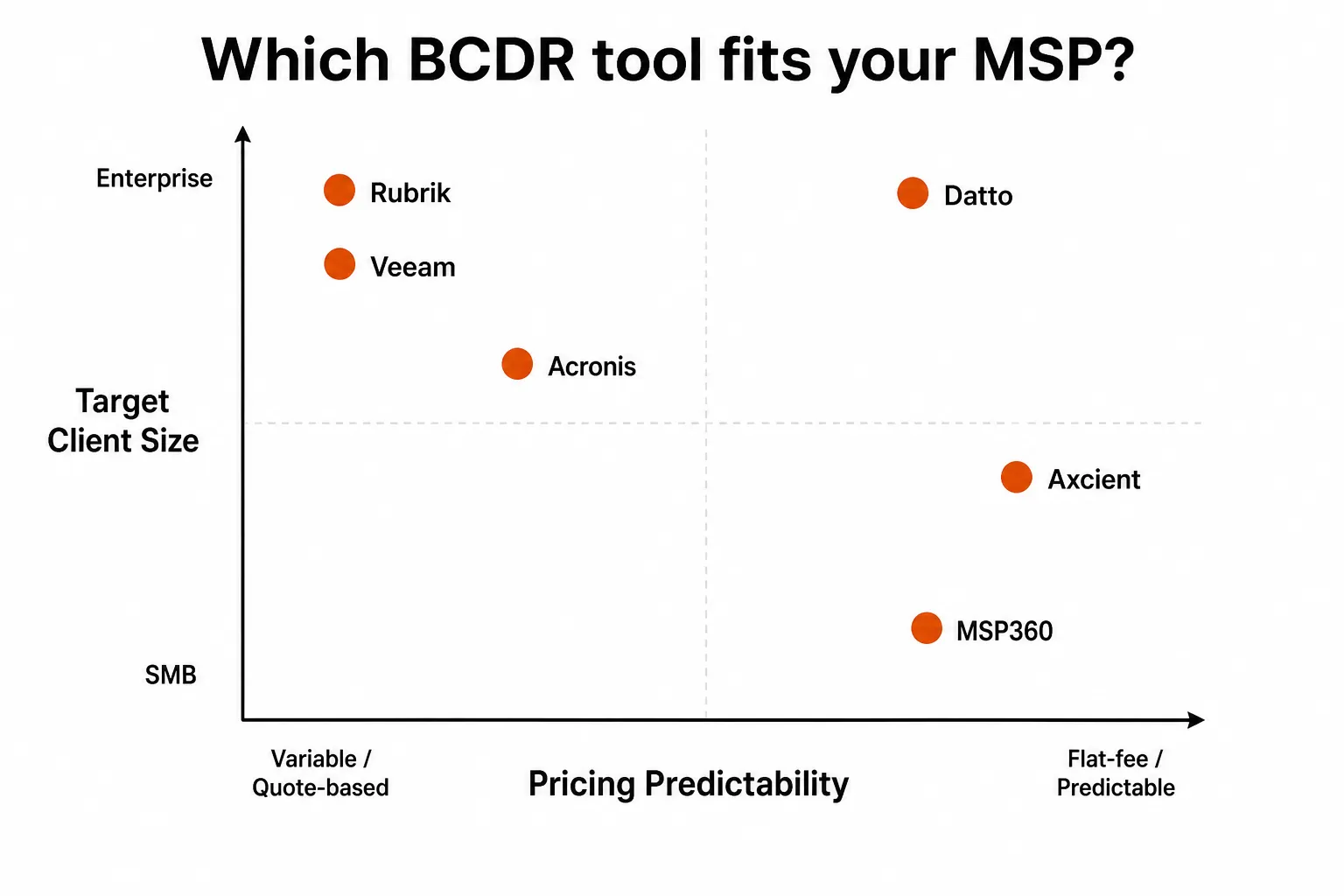
| Tool | Best for | Pricing model | RTO | G2 rating |
|---|---|---|---|---|
| Datto SIRIS/ALTO | Mid-market MSPs | Flat-fee (SIRIS from ~$995/mo) | <1 hour | 4.6/5 (G2) |
| Veeam Data Platform | Enterprise clients | Quote-based (VCSP program) | Minutes | 4.6/5 (1,739+ reviews) |
| Acronis Cyber Protect Cloud | Unified backup + security | Per-workload, per-GB, or bundled | Varies | ~4.2-4.4/5 (G2) |
| Axcient x360 | MSP margin, no surprises | Flat-fee pooled storage | <1 hour | 4.6/5 (132 reviews) |
| MSP360 Managed Backup | Storage flexibility, white-label | Per-endpoint + storage | Varies | 4.5/5 (IT Pro Today) |
| Rubrik | Enterprise cyber resilience | Quote-based | Minutes | 4.5/5 (277 reviews) |
1. Datto Backup (SIRIS + ALTO) - best for mid-market MSPs
Datto is the market-leader in MSP BCDR by most measures - G2's Fastest Implementation award, 4.6/5 from hundreds of verified reviews, and a community that regularly describes it as the closest thing to a "set and forget" backup platform. The Kaseya acquisition in 2022 caused real anxiety in the MSP community - forced bundling, price hikes, the usual post-acquisition fears. Three years in, most of that skepticism has been replaced by grudging acknowledgment: DattoCon 2025 announcements made a credible case that Kaseya's investment is going into the product, not into extracting margin.
SIRIS is the flagship - a physical appliance for mid-market clients with image-based backups, local virtualization for instant failover, and cloud replication to the Datto Cloud. ALTO is the same concept in a desktop-form-factor appliance aimed at smaller SMB clients, supporting up to 4 concurrent backup agents.
The headline feature in 2026 is AI-powered screenshot verification: every backup gets automatically booted and visually checked with 99%+ accuracy on detecting valid boot states - included at no extra cost. If you've ever had a client discover their "healthy" backup wouldn't actually boot during a real recovery, you understand why this matters. The automated verification eliminates a whole category of overnight surprises.
Pricing is flat-fee and all-inclusive. SIRIS 5 starts at approximately $995/month, covering hardware (free to partners), unlimited cloud egress, DR testing, and 24/7/365 support with no tier system. There are no per-GB egress fees and no DR testing charges - a meaningful differentiator when you're running monthly recovery tests for compliance clients.
On the downside: managing Datto at scale can be time-intensive. As one MSP noted on r/msp, "We have found that managing Datto backups is pretty time-intensive on the MSP side" - even when backups are healthy, staying on top of verification status, storage allocation, and alert noise requires active technician attention. For MSPs standardizing on Datto, pairing it with automated ticket triage helps here (more on that at the end).
Pricing: SIRIS from ~$995/month flat-fee; ALTO pricing is gated behind partner portal. All-inclusive: hardware, unlimited egress, DR testing, 24/7 support.
Pros:
- Flat-fee model makes client billing predictable
- Free hardware to MSP partners
- AI screenshot verification included (99%+ accuracy)
- 24/7/365 support with no tier system
- Best-in-class G2 recognition for ease of implementation
- PSA/RMM integrations with ConnectWise, Autotask, Datto RMM
Cons:
- Management overhead can be significant at scale
- SIRIS pricing starts higher than some alternatives
- Full pricing requires partner portal login - no public transparency
- Some MSPs have migrated away to cloud-native alternatives (Cove) for simpler environments
Our take: Datto is the safe, proven choice for MSPs serving mid-market clients with on-premises infrastructure. If your clients have physical servers, compliance requirements, and need sub-hour RTO without a complex project, SIRIS is the benchmark. The flat-fee model alone eliminates the "surprise invoice" conversations that plague per-GB alternatives.
2. Veeam Data Platform - best for enterprise client environments
Veeam occupies a different market position than the other tools on this list. It's not primarily built for MSPs managing SMB clients - it's the enterprise data protection standard, trusted by 82% of Fortune 500 companies and a Gartner Magic Quadrant Leader for 10 consecutive years with the highest execution rating for 7 of those years. 4.6/5 on G2 from 1,739+ verified reviews across enterprise, TrustRadius, and Gartner Peer Insights.
For MSPs with enterprise clients - financial services, healthcare, large manufacturing - Veeam is often the only acceptable answer. The client's internal IT team or auditor may explicitly require it.
The MSP offering works through the VCSP (Veeam Cloud & Service Provider) program, which provides rental licensing (pay as you consume, no upfront commitment) and access to multi-tenant management via the Veeam Service Provider Console. MSPs can build BaaS (Backup as a Service) and DRaaS (Disaster Recovery as a Service) offerings on top of Veeam software or deliver them through Veeam Data Cloud, the SaaS version that handles the infrastructure.
The platform covers the full workload spectrum: VMware vSphere, Microsoft Hyper-V, Nutanix AHV, physical servers, Microsoft 365, Entra ID, AWS, Azure, Google Cloud, and Kubernetes. The RESTful API library is extensive, which makes automation straightforward for MSPs who want to build custom billing or alerting workflows.
The honest limitation: Veeam requires investment. Configuration is not simple for smaller MSPs, licensing complexity is a consistent complaint in community reviews, and support costs at enterprise scale add up. If your clients are mostly sub-50-employee SMBs, Veeam is overkill - the management overhead won't be justified by the fees you can charge.
Pricing: Quote-based through VCSP program. No public pricing. Contact Veeam or a VAR for rental licensing terms.
Pros:
- Enterprise gold standard - 82% Fortune 500 adoption
- Gartner Leader for 10 consecutive years (highest execution rating)
- VCSP rental licensing: pay as you consume, no upfront
- Full workload coverage: VMs, physical, M365, cloud, Kubernetes
- Extensive API for automation and custom integrations
- Multi-tenant Service Provider Console for MSP management
Cons:
- No public pricing - enterprise/quote-based model
- Higher learning curve for smaller MSP teams
- Licensing complexity is a consistent G2 complaint
- Best suited for enterprise clients; overkill for most SMBs
- Support costs can be substantial at scale
Our take: Veeam is non-negotiable if you have enterprise clients. The Gartner recognition isn't just a badge - it's often a procurement requirement. If your book is mid-market and below, you're likely overpaying for capability you won't use. But if you're managing enterprise infrastructure and want a platform that gives you credibility and depth, nothing else on this list competes.
3. Acronis Cyber Protect Cloud - best for unified backup + security
Acronis Cyber Protect Cloud plays a different game than the others: instead of being the best backup tool or the best security tool, it's the platform that combines both in a single agent, single console, single vendor. Backup, disaster recovery, EDR, MDR, RMM, and security operations - all licensed together or in whatever combination you need.
The value proposition is consolidation. As one G2 reviewer put it: "We moved from Veeam + separate EDR and haven't looked back. One vendor, one console, one support number. Sure, it costs more than just backup, but the integration saves us hours a month." For MSPs managing 50-200 clients who want to simplify their stack and reduce vendor relationships, Acronis is the strongest case.
The backup itself is solid - multiple independent G2 reviewers describe it as reliable and the console as intuitive for multi-tenant management. The BaaS market that Acronis operates in is forecast to hit $25.43B by 2029 at 32% CAGR, and Acronis has been a consistent beneficiary of MSPs looking to consolidate security and backup.
Three licensing models give MSPs flexibility: solution-based (bundled per workload), per-workload (fixed cost per device regardless of data), and per-GB (scales with usage). The Acronis price calculator is genuinely useful for modeling costs before committing.
The honest critique is that Acronis doesn't dominate on any single dimension. Backup restore speeds are slower than Veeam (reviewers cite ~30% difference in test environments). The EDR has a false-positive problem that requires active tuning. And the console lags noticeably with 100+ customers. Community sentiment on G2 and Reddit tends to converge on: "Good at everything, great at nothing." If you need best-in-class backup specifically, Datto or Axcient outperforms. If you need best-in-class EDR, a dedicated endpoint security platform is sharper. Acronis wins when the whole-is-greater-than-the-sum case applies - i.e., when your team is stretched across too many vendor portals.
Pricing: Three models - solution-based (bundled), per-workload, or per-GB. Volume-tiered discounts. No fixed public pricing; use the calculator or contact Acronis.
Pros:
- Genuinely unified platform: backup + DR + EDR + MDR + RMM in one agent
- Three licensing models give billing flexibility
- Multi-tenant console built for MSP workflows
- Compliance reporting built in (healthcare, finance)
- Single support number - no finger-pointing between vendors
Cons:
- Restore speeds ~30% slower than Veeam in head-to-head tests
- EDR false positives require active tuning
- Console performance degrades with 100+ customers
- Per-GB overages can be shocking if storage isn't scoped correctly
- Not best-in-class on any single feature
Our take: Acronis is the right call if stack consolidation is your goal and you're managing a mid-market client base. The trade-off is accepted: you get "very good" at everything instead of "excellent" at one thing. For MSPs with tight ops teams who can't maintain expertise across six separate vendor portals, that trade is worth it. Just scope storage carefully before committing to a per-GB model.
4. Axcient x360 Platform - best for MSP margin and no-surprise pricing
Axcient built its whole product philosophy around a single MSP frustration: backup vendor pricing that looks reasonable until the invoice arrives. The flagship technology is Chain-Free backup - where traditional backup tools create dependent backup chains (each incremental backup linked to the previous), Axcient creates fully independent recovery points.
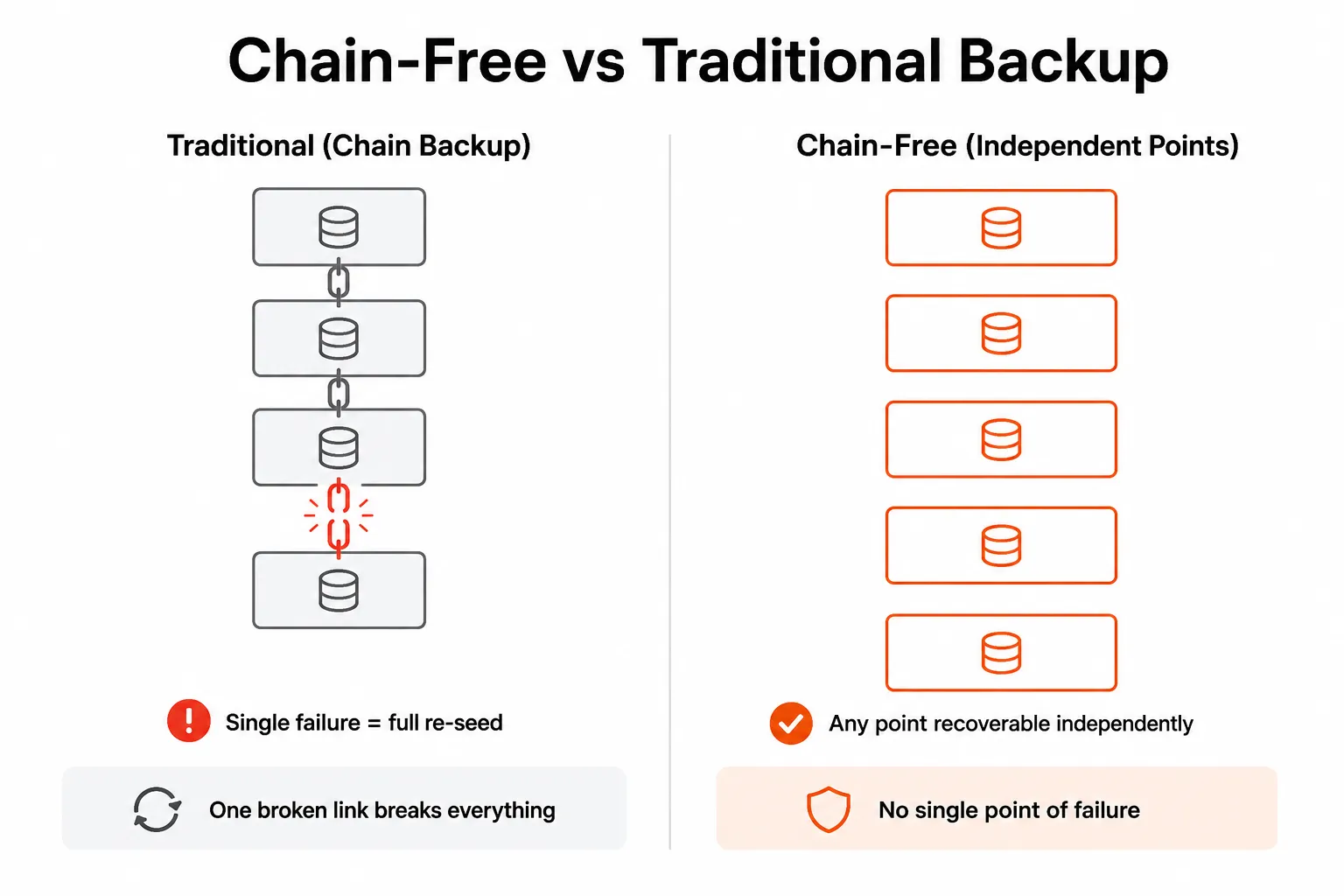
The practical consequence: a chain failure in a traditional tool means re-seeding from the last full backup, which can mean hours of work and data exposure. With Axcient, any recovery point is independently recoverable without touching any other point. Less chain management overhead, no re-basing complexity, and no single-point failures that wipe out a month of incrementals.
The pricing model follows the same philosophy. Flat-fee pooled storage means you pay a predictable monthly amount regardless of how much data your clients throw at it (subject to a Fair Use Policy, but no per-GB overage invoices). Cygnus Systems saved $12,000/month switching to Axcient. Lair Services grew backup margins by 200% through vendor consolidation onto the x360 platform. Osprey I.T. moved from N-able to Axcient for "better BDR at the same price."
The G2 profile backs this up: 4.6/5 from 132 reviews, 75% five-star, with average implementation at 1 month. The reviewers break mostly into MSP admins (73%) and consultants (14%) - this isn't an enterprise tool dressed up for service providers, it's purpose-built for the MSP model.
The x360 platform has three components: x360Recover for BCDR (appliance, direct-to-cloud, or hybrid), x360Cloud for Microsoft 365 and Google Workspace backup, and x360Sync for secure file sync. The AutoVerify feature tests every backup automatically with screenshot verification, and Virtual Office lets you restore entire client environments to cloud in minutes with pre-configured DR runbooks.
The legitimate weakness: the UI can be confusing when navigating between features, and some reviewers report restore issues in specific configurations. Onboarding support is good (one MSP described getting fully integrated in under 8 minutes after missing their initial onboarding call), but the platform's depth means there's a learning curve for advanced features.
Pricing: Quote-based. Flat-fee pooled storage model - no per-GB overage charges. Contact Axcient for a custom quote.
Pros:
- Chain-Free backup: independent recovery points eliminate chain failure risk
- Flat-fee pooled storage - no surprise overage invoices
- AutoVerify: automated screenshot-based backup verification
- Virtual Office: instant cloud environment restore with DR runbooks
- Deployment-flexible: appliance, direct-to-cloud, or hybrid
- Strong case studies on MSP margin improvement
- 75% five-star on G2 from MSP-heavy reviewer base
Cons:
- Pricing not publicly available - requires sales contact
- UI navigation can be confusing between feature areas
- Some restore configuration issues reported in G2 reviews
- Smaller review count (132) than Veeam or Rubrik
- Fair Use Policy limits the "unlimited" pooled storage claim
Our take: Axcient is the best value play for MSPs who are tired of unexpected per-GB bills and chain-failure headaches. The flat-fee model and Chain-Free technology remove two of the biggest sources of BCDR operational stress. If you're evaluating alternatives to Datto and want something built specifically for MSP economics - not enterprise tools adapted for service providers - Axcient deserves a serious look.
5. MSP360 Managed Backup - best for storage flexibility and white-labeling
MSP360 (formerly CloudBerry Backup) takes a fundamentally different approach: instead of bundling its own storage, it gives you a centralized backup management platform that connects to whatever cloud storage your clients already use or you prefer to source. Amazon S3, Wasabi, Backblaze B2, Microsoft Azure, Google Cloud, IDrive e2 - you choose, you price, you margin.
The result is a G2 Leader (Summer 2026) with Happiest Users, Quality Choice, and Trusted Vendor badges, a 4.5/5 from IT Pro Today, and 4/5 from PCMag and PCWorld. For cost-conscious MSPs who want to build higher margins by sourcing cheap storage (Wasabi at ~$7/TB/month is a popular pairing), MSP360 is the enabler.
White-labeling is comprehensive - your clients see your brand, not MSP360's. The platform supports Windows, macOS, Linux, VMware, Hyper-V, and Proxmox across physical and virtual machines, plus SQL Server backup. A 15-day free trial with no credit card required is a genuine commitment-free entry point, which is rare in enterprise backup software.
Storage costs are separate from licensing. MSP360's own S3 integration runs at $23 flat per TB, with free API calls and no data egress fees - better than standard S3, though Wasabi's standalone rate of ~$7/TB goes lower. The platform's pricing calculator lets you model cost per endpoint before committing.
The meaningful limitation: MSP360 does not do disaster recovery the way Datto or Axcient does. There's no cloud virtualization, no "spin up the client's environment in 15 minutes" story. It's backup and restore, not business continuity. For clients who need sub-hour RTO with full environment failover, this is the wrong tool. For clients who mainly need reliable, cost-efficient data protection with granular restore options across many platforms, it's a strong fit.
Linux support is file-level only - no image-based backups for Linux servers. If your client base includes Linux-heavy environments, factor that in.
Pricing: Per-endpoint licensing + separate storage costs. Example: ~$23/TB with S3 Standard through MSP360. Use the calculator or contact sales for volume pricing.
Pros:
- Bring-your-own-storage: source from Wasabi, Backblaze B2, Azure, etc.
- White-label ready: complete rebranding for MSP resellers
- Multi-platform: Windows, macOS, Linux, VMware, Hyper-V, Proxmox, SQL Server
- G2 Leader Summer 2026 with Happiest Users recognition
- 15-day free trial, no credit card required
- Lowest per-TB costs when paired with low-cost storage like Wasabi
Cons:
- No cloud virtualization or DR failover - backup and restore only
- Linux: file-level only, no image-based backup
- Pricing requires calculator or sales contact - not transparent upfront
- Lighter PSA/RMM integration depth vs. Datto or Axcient
- Not suitable for clients with sub-hour RTO requirements
Our take: MSP360 is the specialist tool for MSPs who want to build a high-margin, white-labeled backup service using cheap commodity storage. It's not a full BCDR platform - don't sell it to clients who need real DR. But for the right client segment (Office 365-heavy SMBs, endpoints-focused environments, clients who want cheap and reliable) it's one of the most profitable backup services you can run.
6. Rubrik - best for enterprise cyber resilience
Rubrik is the premium tier. Public company (NYSE: RBRK) since 2023. Gartner Magic Quadrant Leader for 7 consecutive years, and positioned furthest in Completeness of Vision in 2026 - meaning analysts think Rubrik is seeing the market most clearly among its peers. 4.5/5 on G2 from 277 verified reviews, with 71% five-star.
The positioning is different from other tools on this list. Rubrik doesn't just protect data - it treats backup as a cyber resilience layer. Immutable snapshots are the baseline. The platform adds continuous data protection for VMware (recover to any point in time, not just scheduled backup points), identity security integration, and ransomware recovery workflows that let clients revert to a last-known-clean state without paying a ransom. The company claims 30-50% TCO reduction vs. traditional backup architectures, backed by consolidating backup hardware and software into one plane.
G2 reviewers are remarkably consistent: 71% five-star, with praise clustering around ease of use ("very user friendly, simple to use and also looks great"), reliability, and support quality. The consistent criticism is cost - "Licensing costs are a barrier" and "expensive relative to competitors" appear in 17+ reviews. Implementation takes an average of 2 months, which is meaningful for MSPs used to same-week deployment with Datto or Axcient.
For MSPs who manage enterprise clients in regulated industries - healthcare, finance, legal, government - Rubrik's 6,000+ customer reference base and analyst recognition often make it the procurement-safe answer. The client's auditor or CISO may specifically require a Gartner Leader or a publicly-traded backup vendor.
The MSP story is real but less developed than Veeam's VCSP program. Rubrik is actively building out partner capabilities, but the primary motion is enterprise-direct with MSP/partner channel as a secondary path. If you're building a pure managed service offering at volume, Veeam's multi-tenancy tooling is more mature.
Pricing: No public pricing. Enterprise/quote-based. Contact Rubrik sales. Expect enterprise-tier investment - reported ranges in the $7K-$15K+ annual range for typical enterprise deployments.
Pros:
- Gartner Leader 7 consecutive years, furthest in Vision in 2026
- G2 4.5/5 from 277 reviews, 71% five-star
- Immutable backups + cyber resilience as first-class features
- Continuous data protection for VMware (any-point-in-time recovery)
- 30-50% TCO reduction vs. legacy backup infrastructure
- Ransomware recovery workflows built in
- Trusted by 6,000+ organizations across all industries
Cons:
- Premium pricing - cost is the #1 G2 complaint
- No public pricing, enterprise/custom model
- 2-month average implementation time
- MSP multi-tenancy tooling less mature than Veeam
- Overkill for SMB-focused MSPs
Our take: Rubrik is the right answer when the client's risk profile demands it - regulated industries, large enterprises, organizations that have been through a ransomware incident and know exactly what "real cyber resilience" means now. The cost is real and the implementation timeline is real. If you're managing SMBs or want something deployable in a week, look elsewhere. If you're managing clients for whom backup failure is a regulatory or reputational existential event, Rubrik is the platform that makes that conversation easy.
How to choose the right BCDR tool for your MSP
The honest answer is that most MSPs don't need a single platform for everything. The market has segmented, and the right answer usually depends on client mix.
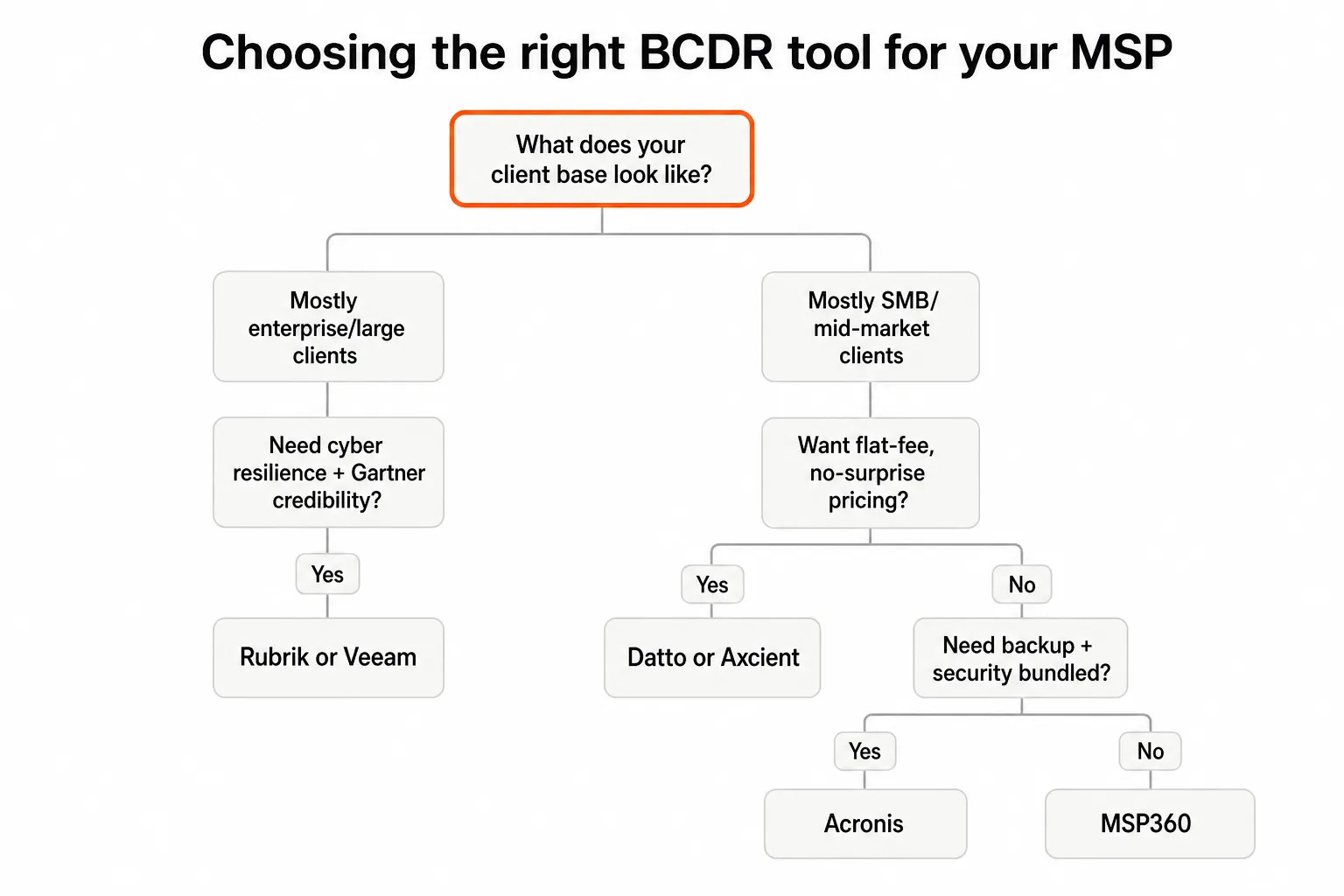
Here's how we'd think through the decision:
Start with client size and risk tolerance. Enterprise clients with compliance requirements or cyber insurance mandates point toward Veeam or Rubrik - the Gartner credentials matter in procurement decisions. Mid-market clients with on-premises infrastructure point toward Datto. SMB-heavy books with cost pressure point toward Axcient or MSP360.
Then look at your pricing model tolerance. If you hate explaining variable invoices to clients, flat-fee wins - Datto and Axcient both offer this. If you're comfortable modeling costs and want the flexibility to source cheap storage, MSP360's per-endpoint + bring-your-own-storage approach can generate the highest margins on the list.
Ask whether backup alone is enough. If clients are demanding a one-stop security + backup story, Acronis is the consolidation play. If you're already running a security stack and just need the best backup, keep those concerns separate and pick the best backup tool independently.
Factor in your team's capacity. Veeam and Rubrik are deep platforms with learning curves. Datto and Axcient are designed for same-week deployment with minimal ongoing configuration overhead. If your team is lean, simpler wins.
And practically: most well-run MSPs end up with two platforms - one for enterprise clients (Veeam or Rubrik) and one for the SMB majority (Datto, Axcient, or MSP360). The economics support this; the complexity of running two backup stacks is manageable when the alternative is fitting a $995/month enterprise appliance at a 10-person accounting firm.
Try Rallied
Whichever BCDR platform you run, the backup practice generates a predictable category of technician tickets: failed backup alerts, verification warnings, restore requests, access issues post-recovery, and "why did my backup not run last night?" queries. These tickets follow patterns. They have known resolution paths. And they're eating 15-20 minutes of a skilled technician's time per ticket.
Rallied is an AI technician purpose-built for MSPs that resolves L1 and L2 tickets - including backup-related operational noise - without human involvement. It connects to your PSA (ConnectWise, Autotask, Halo PSA, SuperOps), pulls context from your documentation (IT Glue, Hudu), and closes tickets the same way a tech would: diagnosing, resolving, notifying the user, and escalating when the situation genuinely needs a human. Deployment takes the same week, there's no implementation fee, and pricing is $300 a month for 2,000 credits, about 700 tickets in a typical month - a typical MSP recaptures $7,500-$15,000/month in tech time.
The BCDR practice isn't going to run itself. But the operational overhead of running it doesn't have to run your team into the ground either.
For the wider picture, read Best MSP Software in 2026.
Frequently Asked Questions
What is the difference between backup and disaster recovery for MSPs?
Backup is the process of copying data to a secondary location so it can be restored if lost. Disaster recovery (DR) goes further - it includes the processes, tools, and infrastructure needed to resume operations after a major outage, ransomware attack, or hardware failure. Most modern BCDR platforms (Business Continuity and Disaster Recovery) handle both: they back up data and provide cloud virtualization so clients can failover to a working environment within minutes. MSPs benefit most from tools like Datto SIRIS or Axcient x360Recover that combine both into one managed platform.
How much does data backup and disaster recovery cost for an MSP?
Pricing varies significantly by platform and model. Datto SIRIS starts at roughly $995/month on a flat-fee model. Axcient uses flat-fee pooled storage (quote-based). MSP360 charges per endpoint plus separate storage (around $23/TB with S3 Standard). Veeam and Rubrik are enterprise/quote-based with no public pricing. Acronis offers three licensing models - per-solution, per-workload, or per-GB. Most MSPs mark up BCDR services to clients at 2-3x, making it a strong MRR line item. Use the vendors' pricing calculators or request a quote to build your model.
Which backup and disaster recovery service is best for small MSPs?
For smaller MSPs (under 50 clients), Axcient x360Recover and MSP360 Managed Backup are the strongest fits. Axcient's flat-fee pooled storage eliminates surprise overages and the platform is built exclusively for MSPs. MSP360's bring-your-own-storage model lets you use Wasabi or Backblaze B2 to keep storage costs low while white-labeling the product under your brand. Both offer same-day onboarding without a dedicated implementation project. Datto ALTO is also worth considering for clients with simpler on-premises needs.
Is Veeam or Datto better for MSPs?
It depends on your client mix. Veeam is the stronger choice for enterprise clients - 82% of Fortune 500 companies use it, and its multi-tenant Service Provider Console scales well for complex environments. Datto wins on simplicity, flat-fee pricing, and speed of deployment - it's the market-leader for mid-market MSPs. If your clients are mainly SMBs and mid-market, Datto's all-inclusive model and free hardware are hard to beat. If you manage enterprise infrastructure or large VM environments, Veeam's depth and flexibility are worth the complexity.
How can MSPs reduce the ticket volume from backup monitoring?
Backup platforms generate a steady stream of alerts and tickets - failed jobs, verification warnings, storage overages, and recovery requests. Most MSPs handle these manually, burning technician time on tickets that follow predictable patterns. Rallied is an AI technician built for MSPs that can triage and resolve backup-related L1/L2 tickets automatically - categorizing the alert, pulling context from your documentation (IT Glue, Hudu), and either resolving or escalating with full context. It deploys in the same week and handles 50-100 hours of monthly tech work, including backup ticket noise, on a $300 a month plan that includes 2,000 credits (about 700 tickets in a typical month).