ITIL vs ITSM: What's the Difference and Why MSPs Should Care in 2026
TL;DR
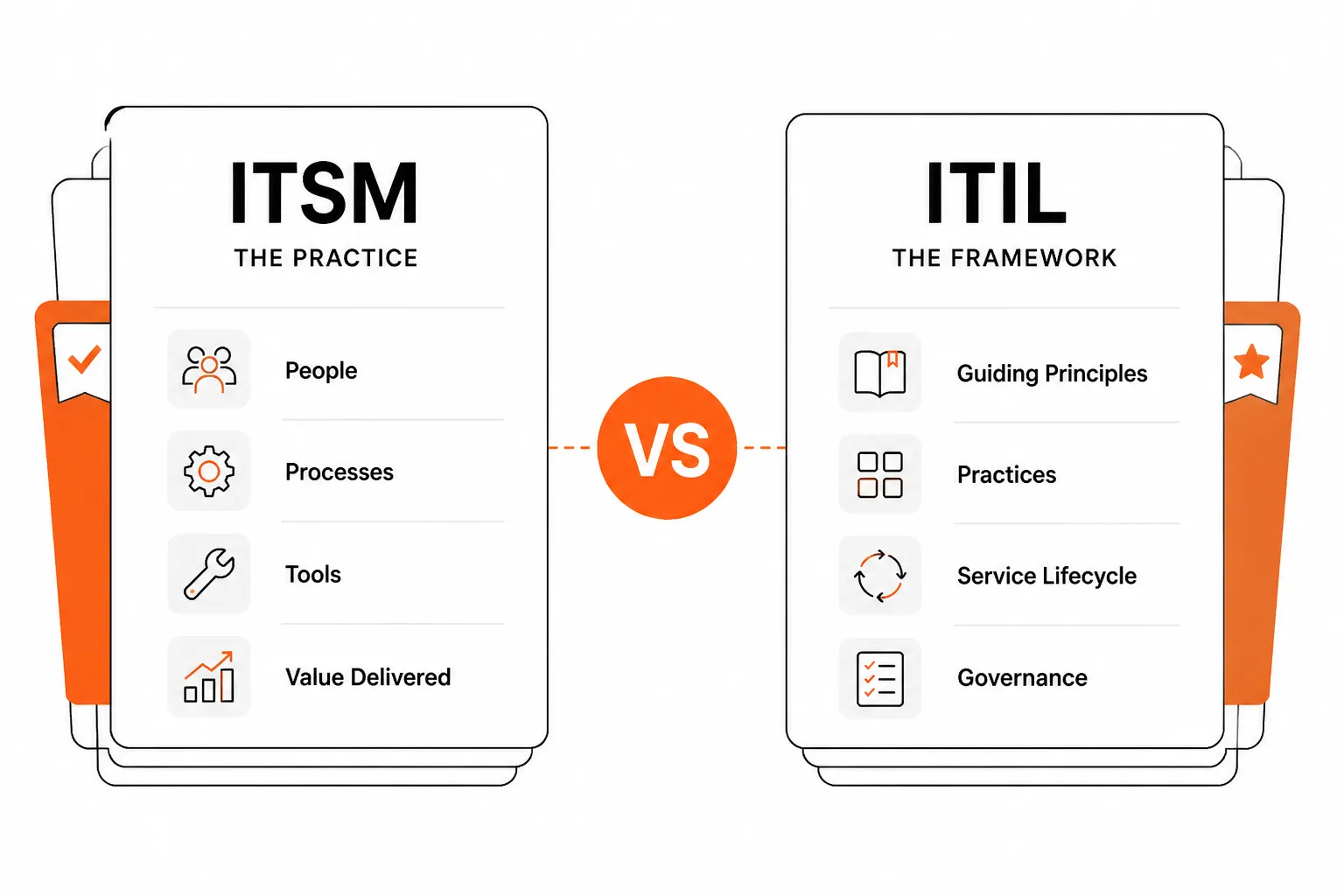
ITSM is what you do - the full practice of managing IT services for your clients. ITIL is how one framework says you should do it. Every MSP does ITSM. Not every MSP follows ITIL - and that's fine, as long as you're clear on the difference. For 2026, the practical takeaway: understand ITIL concepts because your PSA tools are built on them, but don't mistake the framework for the goal. The goal is reliable, efficient service delivery. ITIL is one route there. Rallied is another layer that handles the actual execution - resolving tickets autonomously so your technicians aren't manually doing what a well-run ITSM process says should happen automatically anyway.
We hear "ITIL" and "ITSM" used interchangeably all the time - in job postings, vendor marketing, MSP forums, and the mouth of every freshly-credentialed service delivery manager. They're not the same thing, and the confusion causes real problems: MSPs that think they need to "implement ITIL" before they can have good service delivery, or teams that treat ITSM as a certification track rather than an operational discipline.
So let's just clear it up.
What ITSM actually is
ITSM stands for IT Service Management. It's the broad practice of designing, delivering, managing, and improving IT services for your users or clients. If your MSP has a ticketing system, a service desk, SLAs, and some kind of process for handling incidents - congratulations, you're doing ITSM. You've been doing ITSM without necessarily calling it that.
ITSM covers the people, processes, and tools that make up your service operation. It's organization-neutral, meaning every MSP's ITSM looks different depending on their clients, team size, and toolset. What counts as "good ITSM" at a 3-person shop serving SMBs is different from what it looks like at a 150-person firm with enterprise healthcare clients.
The five stages of ITSM, as laid out in traditional frameworks, are:
- Service strategy - what services you offer and why
- Service design - how you build and configure those services
- Service transition - how you roll out changes safely
- Service operation - day-to-day delivery, incident management, service desk
- Continual service improvement - measuring and getting better over time
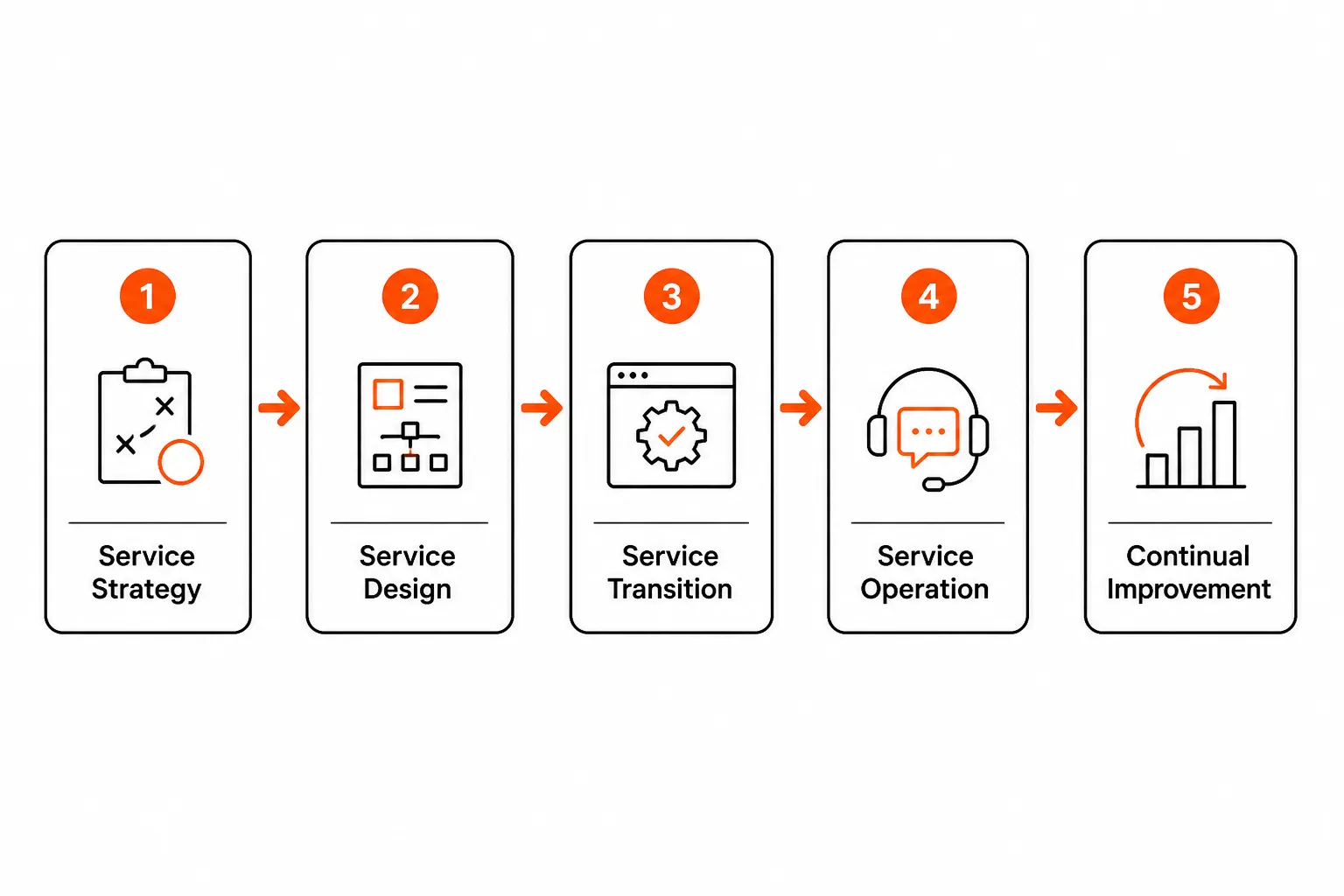
Most MSPs live in stages 4 and 5 - operational delivery and continuous improvement. The earlier stages (strategy, design, transition) tend to matter more as you scale or as client complexity increases.
What ITIL actually is
ITIL stands for Information Technology Infrastructure Library. It's a specific framework for implementing ITSM - a set of best practices, common terminology, and process guidance developed by the UK government's Central Computer and Telecommunications Agency (CCTA) in the 1980s, and now maintained by AXELOS.
ITIL gives you shared vocabulary: Incidents, Problems, Changes, Releases, Service Requests, CIs (Configuration Items), CMDBs. Without that vocabulary, two MSPs talking about "how they handle tickets" might actually be describing completely different workflows while using the same words. ITIL standardizes the language, which matters a lot when you're hiring, training, or buying tooling.
The latest version, ITIL 4, was designed for the modern cloud-and-DevOps world. It emphasizes integration of IT into business operations, cross-department collaboration, and customer feedback loops - less of the rigid process bureaucracy that gave earlier ITIL versions a reputation for overhead. ITIL 5 launched in 2026, adding AI and digital transformation concepts, though ITIL 4 remains the operational standard for most MSP contexts.
The relationship: ITSM is the goal, ITIL is one route
Here's the key diagram. ITSM is the larger category. ITIL is one framework that fits inside it, alongside others like COBIT, ISO/IEC 20000, and lighter-weight approaches like Kanban-based service management.
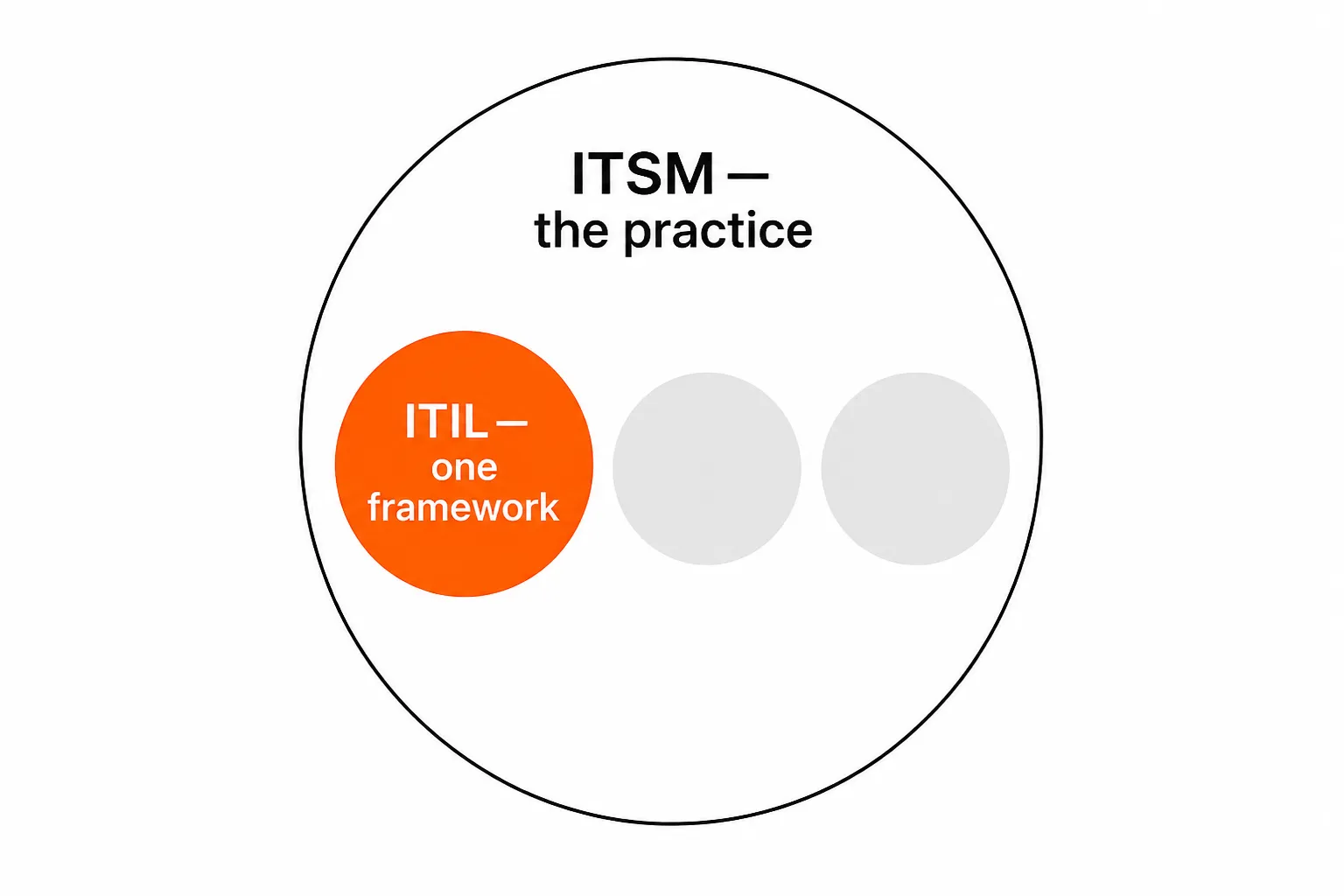
As Ivanti puts it: "ITSM is the actual practice, or professional discipline, of managing IT operations as a service, while ITIL is a set of best practices that provide guidance for ITSM."
You can practice excellent ITSM without ever formally adopting ITIL. You can also follow ITIL to the letter and still deliver mediocre service. The framework isn't the discipline - it's scaffolding for building the discipline.
Why the confusion persists
A few reasons the ITIL/ITSM distinction gets muddied:
PSA tools blur the line. ConnectWise, Autotask, and Halo PSA are architected around ITIL concepts - their ticket types, workflow states, and SLA engines map directly to ITIL's incident, problem, and change management definitions. If you've configured one of these tools, you've implemented ITIL patterns without necessarily calling them that.
Certifications conflate the two. The ITIL 4 Foundation exam teaches ITSM concepts through the ITIL lens, so people who've studied for it often think "ITIL" and "ITSM" are synonymous. They're not - they just share a curriculum.
Vendors use them interchangeably in marketing. "ITIL-aligned" and "ITSM platform" appear on the same product pages constantly, reinforcing the idea that they're the same category.
What this means for MSPs specifically
Let's get practical. NinjaOne frames it well: ITIL "acts as a framework for ITSM with more focus on organization efficiency and service delivery." For MSPs, the question isn't really "ITIL or ITSM" - it's "how much ITIL structure does my service delivery actually need?"
The honest answer depends on your client base.
| MSP context | ITIL value | What to focus on instead |
|---|---|---|
| SMB clients, informal SLAs | Low | PSA workflow discipline, response time metrics |
| Enterprise clients, formal SLAs | Medium-High | Change management, incident classification, CMDB |
| Healthcare/finance clients | High | Compliance-grade change advisory, audit trails |
| MSP under 10 techs | Low-Medium | Core incident management, basic escalation paths |
| MSP scaling to 50+ | Medium-High | Standardizing process across teams |
For most MSPs serving small and mid-size businesses, the highest-value ITIL concepts to internalize are:
- Incident vs. Problem - An incident is a one-off service disruption (Sarah's VPN is down). A problem is the root cause (VPN auth failures after expired certificates). Tracking them separately stops your team from closing tickets without fixing the underlying issue.
- Change management - A structured process for approving and logging changes that could affect client environments. Even a lightweight version prevents the "who changed what?" post-mortem scramble.
- Service Request vs. Incident - Not everything is broken. Onboarding a new user is a service request. Knowing the difference helps you route and prioritize properly.
You don't need a full ITIL implementation to use these concepts. But using them consistently - even informally - makes your service delivery noticeably more organized.
Is ITIL certification worth it?
The community has opinions here. From the r/ITIL_Certification discussion on 2026 market value, the consensus is nuanced: ITIL Foundation ($150-$200 to sit) remains a legitimate resume line item, but the salary premium ($1-5K/year depending on role and employer) is incremental at best.
The certification most useful when: current employer mandates it (they pay for it), already working in enterprise IT operations, moving into management or service design roles, combined with platform-specific certs like ServiceNow. - r/ITIL_Certification - "2026 market value of ITIL 4 Foundation"
The r/ITCareerQuestions thread surfaces a consistent theme: hands-on experience with actual ticketing platforms (ServiceNow, ConnectWise, Zendesk) tends to move the needle more in hiring than ITIL credentials alone. Job postings explicitly requiring ITIL have dropped from 15-20% in 2018 to roughly 8-12% today, per aggregated job posting analysis - though "preferred" mentions remain higher.
Our read: if your employer will fund it, take it. If you're at a small MSP and paying out of pocket, the ROI is unclear. The concepts are valuable regardless; the certification is mainly a signal.
When ITIL structure actually helps vs. when to skip it
Where ITIL structure earns its keep:
- Enterprise clients who reference ITIL in RFPs or contracts - your processes need to map to their expectations
- Healthcare and finance clients where audit trails and change approval processes are compliance requirements
- Scaling MSPs standardizing workflow across multiple technicians and service managers
- QBR (Quarterly Business Review) preparation, where ITIL metrics give you clean data to present
Where ITIL becomes process overhead:
- Small MSPs (under 5 techs) with informal client relationships - the overhead of formal change advisory boards and problem records outweighs the benefit
- Fast-moving startup-phase clients who need you to move quickly, not submit change requests
- Environments where all "ITSM" is handled by a single technician who informally knows the full picture
The honest thing about ITIL is that it was designed for enterprise environments with large, specialized IT teams. The core concepts translate to MSP operations, but the full framework applied rigidly to a 4-person shop is a lot of process for not much return.
How ITIL 4 connects to your PSA today
This is the part that often surprises MSPs: you're probably already running ITIL-aligned processes without knowing it.
ConnectWise Manage, Autotask, and Halo PSA are all architected around ITIL 4's service value system. When you configure ticket types as "Incident" vs. "Service Request," set SLA response time targets, or use a change board before pushing a major update to a client's environment - that's ITIL. When you pull a report on recurring issues to identify a root cause, that's Problem Management. The framework is baked into the tools.
Understanding ITIL terminology helps you configure those tools more intentionally. It also helps when onboarding new techs, because the PSA's built-in categories and workflows make more sense when you know what they're modeled after.
The automation layer: where ITSM is heading in 2026
ITIL describes what should happen in a well-run service operation. What's changed in the last two years is that a lot of what ITIL describes can now be automated end-to-end.
Password resets, account unlocks, MFA issues, onboarding and offboarding - these are the incident types that ITSM frameworks spend a lot of space defining process for. In 2026, those processes don't need to be human-executed anymore. An AI technician can receive the ticket, authenticate with your identity provider, execute the fix, confirm resolution with the user, and close the ticket - all within the workflow your ITSM process describes, just without a human in the loop.
That's not a replacement for ITSM discipline. It's what ITSM discipline was pointing toward all along: reliable, consistent service delivery without unnecessary manual steps.
Try Rallied
Rallied is an AI technician built for MSPs. It connects to your full stack - PSA, RMM, M365, Entra ID, Okta, JumpCloud, IT Glue - and handles the L1 and L2 work that clogs your team's queue: password resets, account unlocks, MFA issues, onboarding, offboarding, software installs.
Most MSP AI tools require months of setup and a near-full-time admin to manage. Rallied connects to your stack the same week, no implementation fee. At $0.50 per ticket - and handling 40–60% of ticket volume autonomously - the math tends to work out to $7K–$15K/month in recovered tech time.
The ITSM framework describes the process. Rallied runs it.
Frequently Asked Questions
What is the main difference between ITIL and ITSM?
ITSM (IT Service Management) is the broader practice of managing IT services to meet business needs. ITIL is one specific framework of best practices for implementing ITSM. Think of ITSM as the goal and ITIL as one structured path to get there. TeamDynamix puts it well: 'ITSM describes how a given organization manages its IT services, whereas ITIL is a framework for ITSM that is made up of specific processes and guidelines.'
Is ITIL still relevant for MSPs in 2026?
Yes, but with nuance. ITIL 4 remains the architecture behind most major PSA tools (ConnectWise, Autotask, Halo PSA), so MSPs benefit from understanding it even if they never pursue formal certification. For MSPs serving enterprise clients or those with formal SLA contracts, ITIL literacy is genuinely useful. For smaller MSPs handling informal SMB support, the framework may be more process overhead than it's worth. Rallied automates much of the L1 execution that ITIL describes, so your team spends time on relationship and escalation work, not routine ticket-closing.
What are the 5 stages of ITSM?
The five stages of ITSM are: (1) Service Strategy - defining what services to offer and to whom; (2) Service Design - designing services, processes, and tools; (3) Service Transition - managing the rollout of new or changed services; (4) Service Operation - day-to-day delivery, incident management, and service desk; and (5) Continual Service Improvement - measuring and improving performance over time. These stages come from the ITIL v3 lifecycle; ITIL 4 reorganizes these into a Service Value System.
Is ITIL certification worth it for IT professionals in 2026?
The ROI depends heavily on your context. ITIL 4 Foundation costs $150–$200 to sit, with potential salary premiums of $1–5K/year depending on role and employer. The cert matters most in enterprise IT operations and consulting contexts where employers have formal ITSM governance. For MSP roles, hands-on PSA platform experience (ConnectWise, ServiceNow) is typically valued more than ITIL credentials. If your employer offers to fund it, take it - that signals they value it. If you're paying out of pocket for a small-MSP role, the ROI is less clear.
What's the difference between ITSM and ITOM?
ITSM (IT Service Management) focuses on delivering IT services to users - helpdesk, incident management, change management, and SLAs. ITOM (IT Operations Management) focuses on the internal infrastructure side - monitoring networks, managing servers, and keeping the underlying environment healthy. Both are influenced by ITIL guidelines, but ITSM is outward-facing (toward clients and users) while ITOM is inward-facing (toward your own infrastructure). MSPs typically care about both: ITSM for service delivery and ITOM for RMM and monitoring.