NinjaOne pricing explained: what MSPs actually pay in 2026

If you've ever tried to find NinjaOne's pricing page, you've felt the frustration firsthand. There isn't one -- not really. You get a range, a prompt to request a demo, and a ROI calculator that shows you how many FTEs you'd save. Which, honestly, isn't wrong. But it doesn't answer the question MSPs actually need answered: what is this going to cost us per month, and is it worth it?
We've dug into what NinjaOne actually charges, how the per-device model works at different scales, what's included versus what costs extra, and how it stacks up against the alternatives. If you're evaluating NinjaOne for your stack, this is the breakdown we wish existed when we were doing the same research.
TL;DR
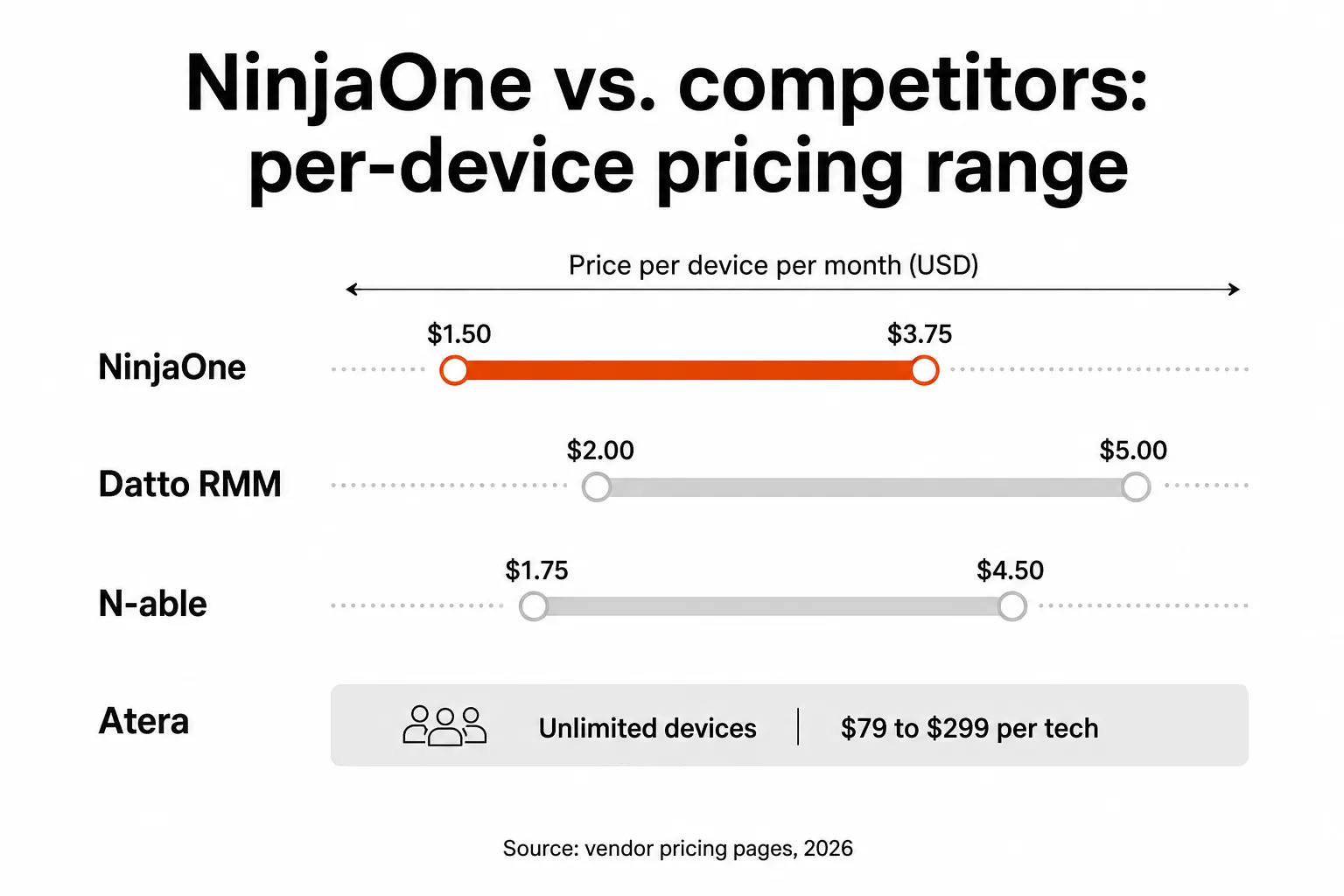
NinjaOne charges $1.50 to $3.75 per device per month on their commercial instance, with volume discounts kicking in as endpoint counts climb. Implementation is free, support is unlimited and free, and there's a 14-day free trial. The pricing is quote-based -- you won't find a public rate card -- but the range is well-documented. For MSPs managing 500+ endpoints, the per-device cost is competitive. Where it gets genuinely interesting is the ROI math: NinjaOne's own calculator puts average time savings at 605 hours per month across automation tasks, which works out to 3.6 FTEs. Whether that math holds for your shop depends heavily on how much of the automation you actually use.
How NinjaOne pricing works
NinjaOne uses a per-device pricing model with volume discounts. The more endpoints you manage, the lower your unit cost. Pricing isn't published in full on their website -- they note this is to avoid disrupting partner margins -- but the ranges are publicly available.
Here's what we know from NinjaOne's pricing page:
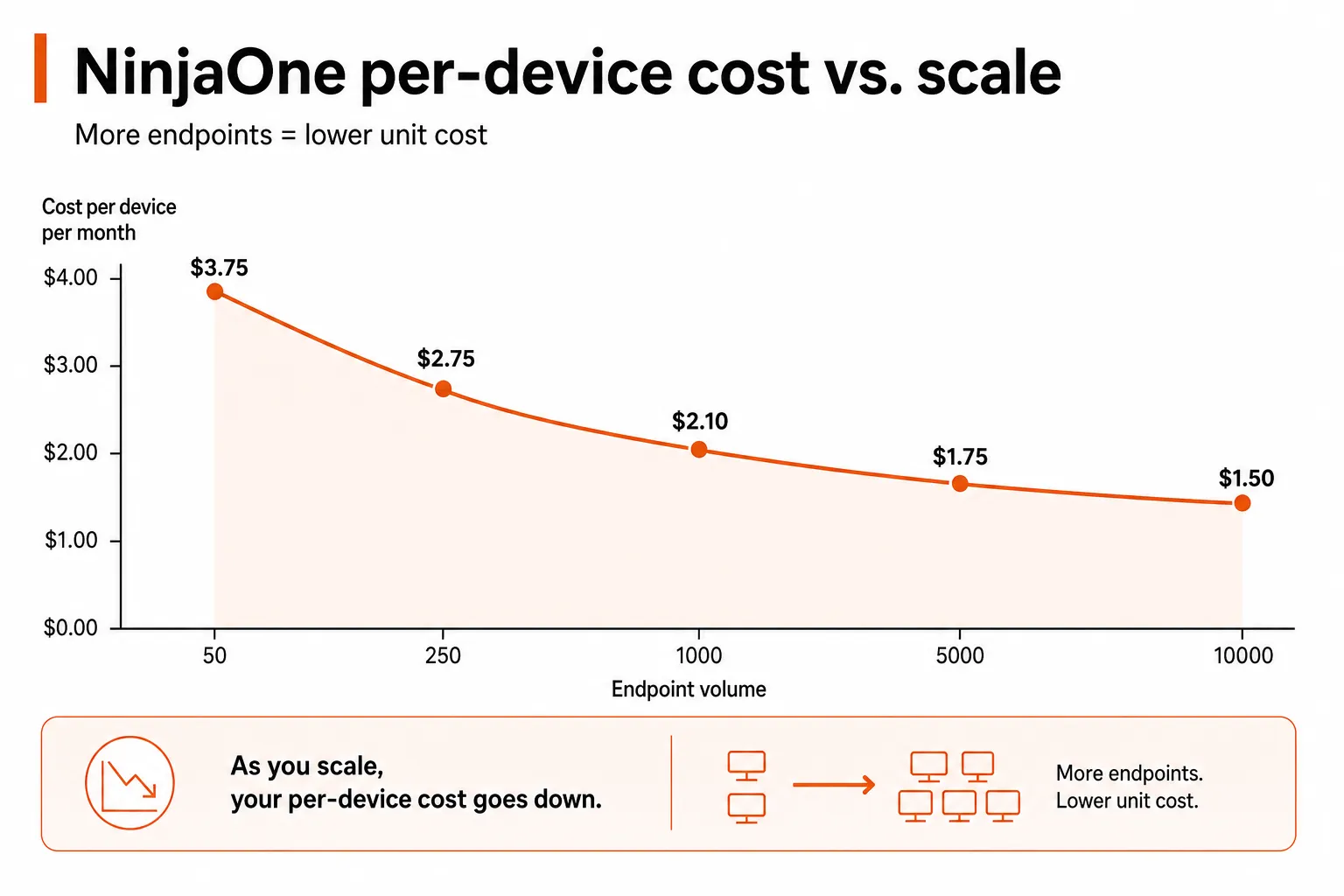
| Endpoint volume | Approx. cost per device/month | Approx. monthly total |
|---|---|---|
| 50 endpoints | ~$3.75 | ~$188 |
| 250 endpoints | ~$2.75 (est.) | ~$688 |
| 1,000 endpoints | ~$2.00 (est.) | ~$2,000 |
| 5,000 endpoints | ~$1.75 (est.) | ~$8,750 |
| 10,000 endpoints | ~$1.50 | ~$15,000 |
Exact mid-tier estimates based on the published range. Actual pricing depends on region, product bundle, and negotiated terms.
The pricing only applies to the commercial, non-FedRAMP instance. If you're in a government or compliance-heavy environment, expect a separate conversation.
Four factors drive your actual price: endpoint count, product bundle (RMM only vs. adding Backup, MDM, or Remote Access), promotional timing, and contract length. Annual commitments unlock better rates; month-to-month is available but typically priced at a premium and only approved case-by-case.
What's included in the base price
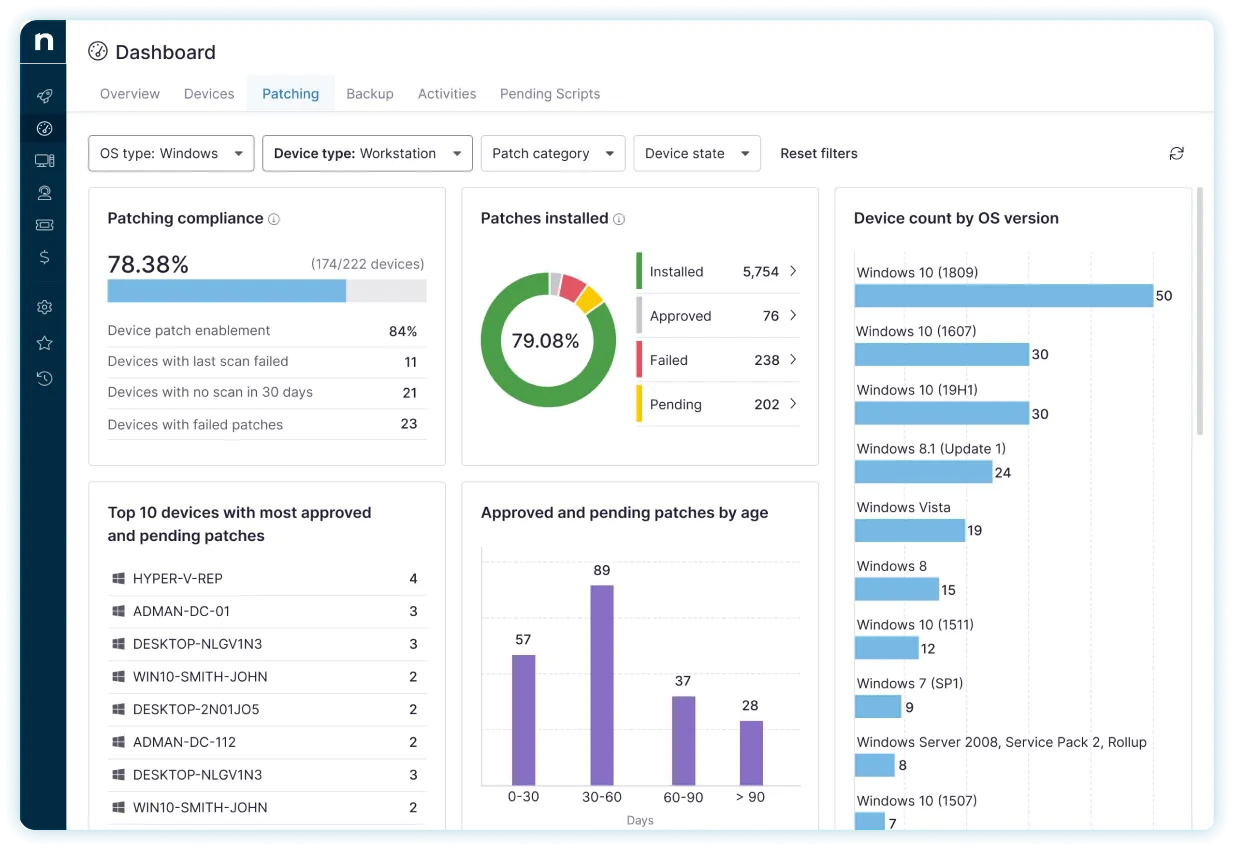
The core NinjaOne RMM covers a lot of ground. Remote monitoring and alerting, patch management across Windows, macOS, and Linux, one-click device actions, endpoint task automation, self-service portal for end users, native IT documentation, and warranty tracking are all included.
What costs extra: Backup (device, server, and SaaS backup with M365 and Google Workspace compliance), MDM (Android and Apple device management), and additional Remote Access solutions beyond the included option. These are sold as add-ons and bundled at discounted rates when combined.
Two things that are notably free regardless of tier: implementation and unlimited support. No onboarding fee, no premium support tier, no support ticket limits. For MSPs who've been burned by hidden services costs on other platforms, that's actually meaningful. Most NinjaOne users report being fully operational in under a week, with core task learning taking under 3 hours on average.
How the ROI math plays out
NinjaOne's internal ROI calculator uses a sample environment to show where automation time savings show up. These are their numbers, based on a typical deployment:
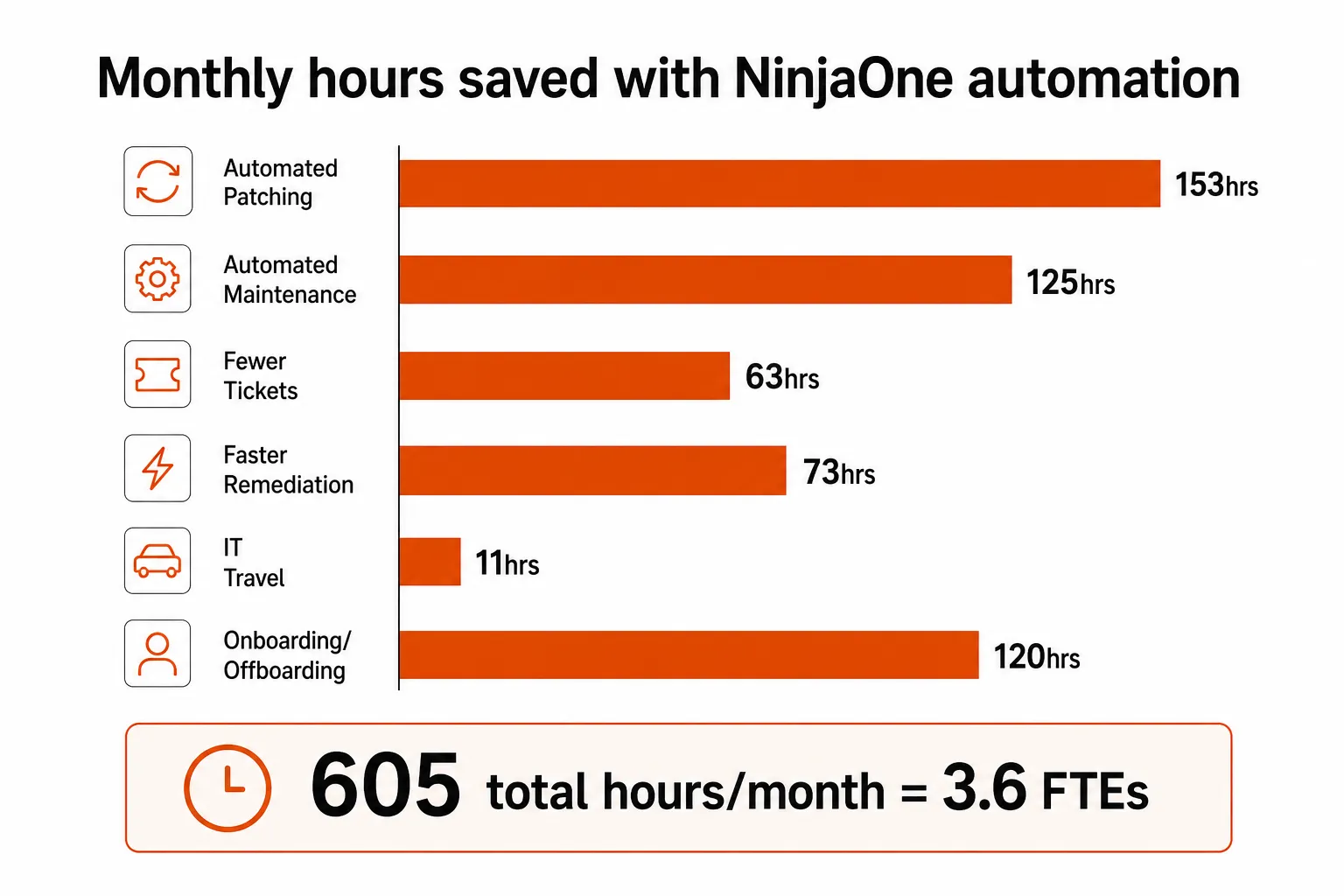
| Automation category | Before (hrs/mo) | After (hrs/mo) | Hours saved |
|---|---|---|---|
| Automated patching | 175 | 21.9 | 153 |
| Automated maintenance | 175 | 50 | 125 |
| Fewer tickets | 208 | 146 | 63 |
| Faster remediation | 146 | 73 | 73 |
| IT travel reduction | 21 | 11 | 11 |
| Onboarding/offboarding | 180 | 60 | 120 |
| Total | ~605 hrs/mo |
Source: NinjaOne ROI Calculator
605 hours per month is the equivalent of 3.6 full-time employees. NinjaOne cites this directly as their average outcome across customers.
The honest caveat: these are averages across a wide range of deployments. Smaller shops with simpler environments won't see 600 hours saved. The automation value compounds with endpoint count and team size -- it's not linear. If you're managing 50 devices for 5 clients, the ROI story looks different than if you're managing 2,000 devices for 80 clients.
That said, the 6-month positive ROI timeline NinjaOne claims is consistent with what we hear from MSPs in the field. The caveat is always the same: automation only saves time if the automation is actually configured and running.
The fine print worth knowing
Before you sign anything, a few contract terms that matter:
- 60-day cancellation notice is required for non-promotional customers. That's longer than many vendors require and worth building into your planning if you're not sure about a multi-year commitment.
- Month-to-month billing is available but only on a case-by-case basis -- don't assume you can roll in without a term commitment.
- Payment methods include ACH, credit cards, wire transfer, and check. No surprises there.
- Bundling discounts are available for multiple products. If you're considering adding Backup or MDM, get the bundle quote at the same time as your RMM quote -- the math often changes meaningfully.
- 14-day free trial with full feature access. No credit card required to start.
"I've been using it for a couple years now and love it. The support is legitimately best in class."
-- r/msp user, r/msp: switching to NinjaOne after 5 years (80+ comments)
The pricing model being quote-based is worth engaging with directly. MSPs who report the best outcomes typically go in with a clear endpoint count, a shortlist of products they want bundled, and a defined contract length. Showing up without those details means you're negotiating without information, which rarely goes in your favor.
What MSPs say about NinjaOne pricing
The most consistent complaint about NinjaOne pricing isn't the price -- it's the process. Having to contact sales just to understand whether a budget is in the right ballpark creates unnecessary friction early in the evaluation.
"Pricing for NinjaOne... I keep seeing they don't list pricing but have a fair price. Anyone willing to help me understand what fair price means?"
-- r/msp user, r/msp: Pricing for NinjaOne (60+ comments)
That frustration is real and understandable. But once MSPs get to the actual quote stage, sentiment tends to flip. The per-device model makes cost predictable and scales reasonably well. The complaint isn't usually that NinjaOne is expensive -- it's that the discovery process takes longer than it should.
On the other side: when users compare NinjaOne's total cost (tool + support + implementation) against legacy RMM tools with opaque add-on fees and paid support tiers, NinjaOne regularly comes out ahead in value perception. The included support is a genuine differentiator -- most competitors charge for premium tiers.
How NinjaOne stacks up against competitors
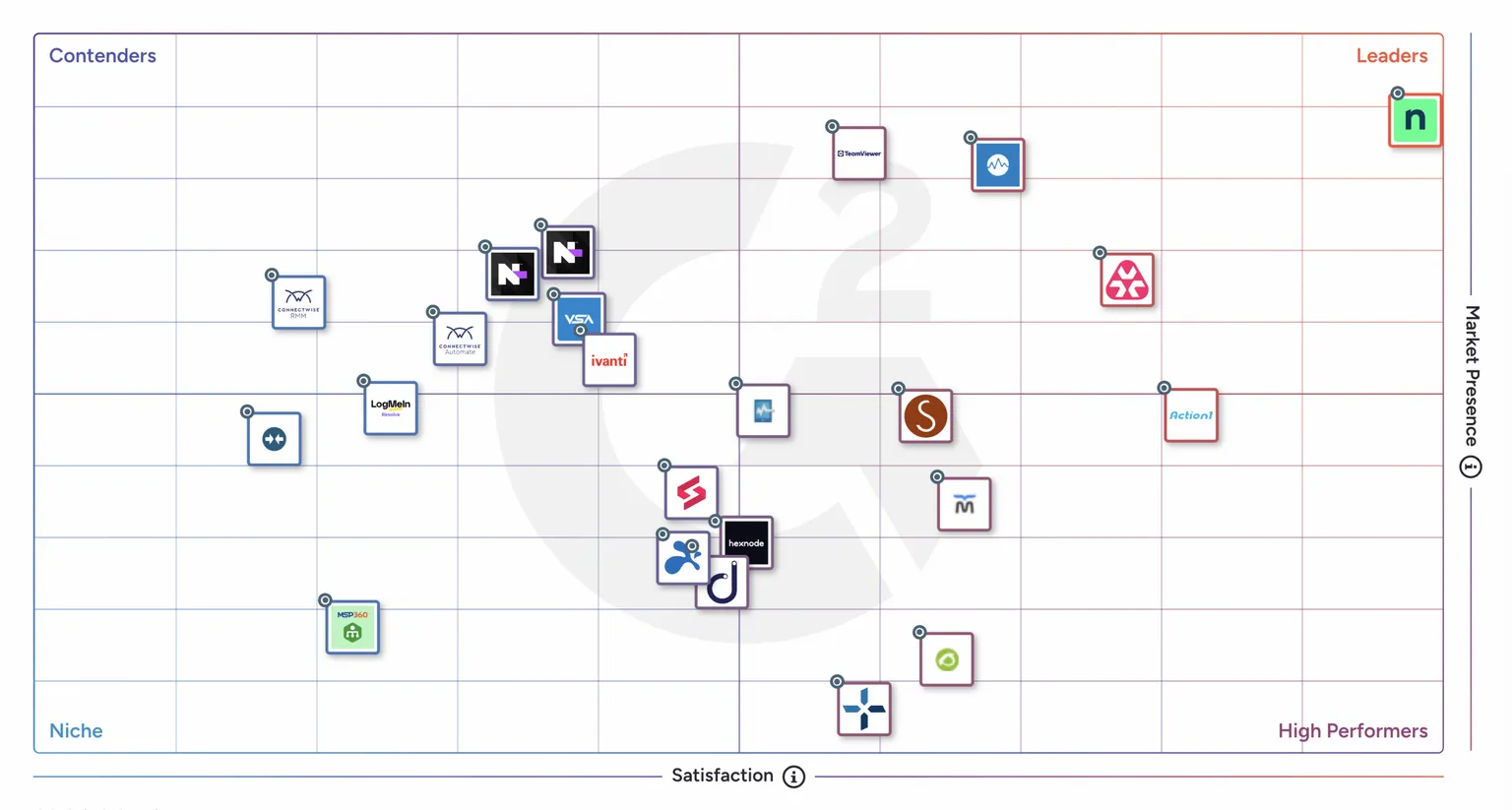
G2's Spring 2026 RMM report gives us the cleanest apples-to-apples comparison across the major RMM platforms:
| Platform | G2 Overall Score | Ease of Admin | Support Quality | Patch Management |
|---|---|---|---|---|
| NinjaOne | 9.3 | 9.3 | 9.3 | 9.1 |
| Datto RMM | 9.0 | 9.0 | 8.7 | 8.8 |
| N-able N-central | 8.6 | 8.2 | 8.3 | 8.4 |
| Atera | 9.1 | 9.2 | 9.2 | 8.8 |
| Kaseya VSA | 8.4 | 8.2 | 7.7 | 8.4 |
| ConnectWise RMM | 8.4 | 8.1 | 7.7 | 8.3 |
Source: G2 Spring 2026 RMM Comparison Report
NinjaOne leads on support quality by a meaningful margin -- nearly 0.6 points above Kaseya and ConnectWise. That gap is consistent across years of G2 data and is one of the main reasons MSPs cite for switching.
On pricing model differences: Atera's per-technician model (unlimited devices) can be attractive for smaller shops where device count is low and technician count is even lower. But as your device-to-tech ratio climbs -- which it should, if you're scaling an MSP efficiently -- the per-device model typically wins. At 200 devices per tech, Atera's per-tech fee starts to look less appealing against NinjaOne's volume-discounted per-device rate.
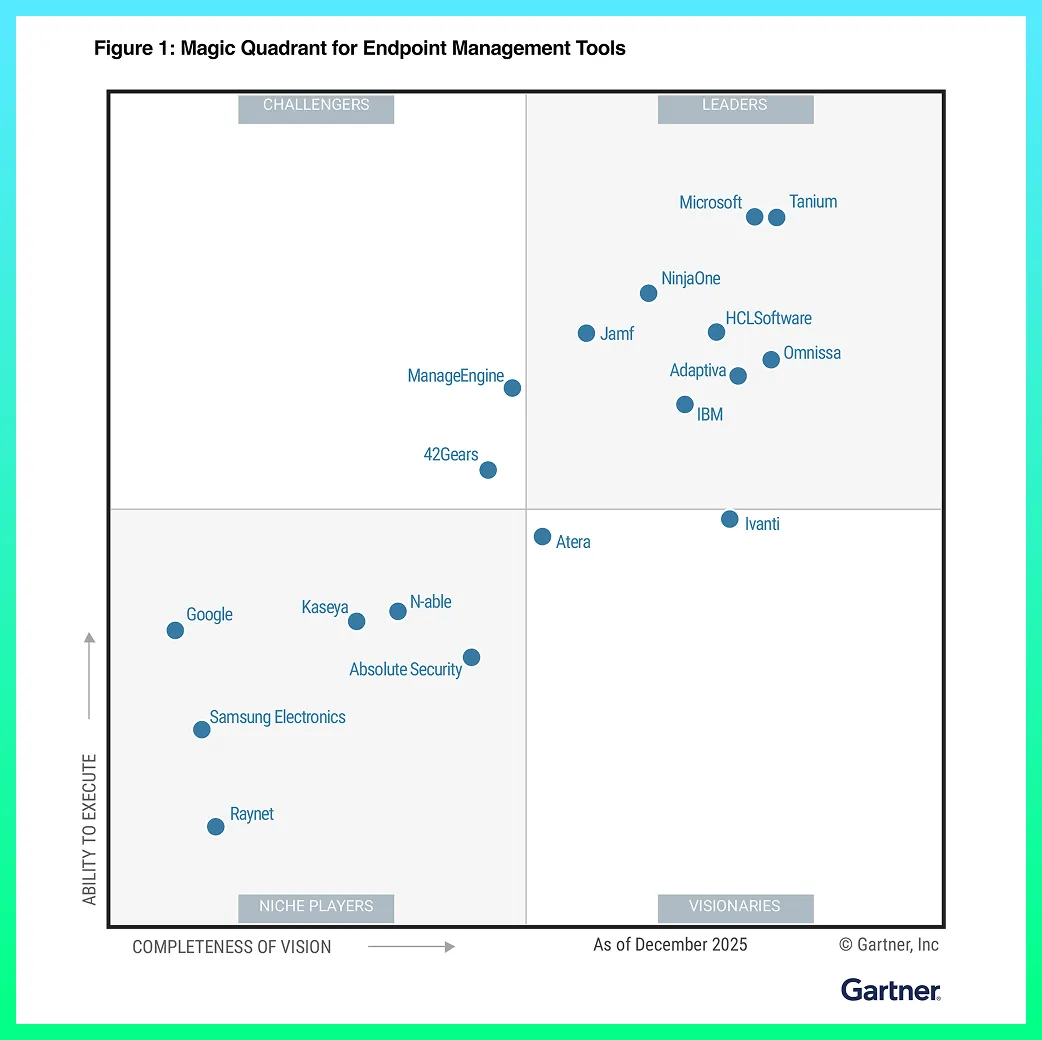
NinjaOne also holds the Gartner Leader position in the 2026 Magic Quadrant for Endpoint Management Tools, placing it alongside Microsoft and Tanium in the Leaders quadrant. For MSPs who need to justify tool selection to enterprise clients, that credential carries weight.
Our take: is NinjaOne worth it?
For most MSPs managing 200+ endpoints across multiple clients, yes -- NinjaOne's per-device pricing and included support make it one of the more cost-effective choices in the RMM market. The 4.7/5 score across 4,302 G2 reviews isn't a fluke; it reflects a product that's genuinely usable out of the box and backed by support that actually responds.
The places where it's less clear-cut:
Small shops under 100 devices. At $3.75/device/month for 50 endpoints, you're paying $187/month for RMM. That's not expensive in absolute terms, but the ROI story relies on automation that becomes more valuable at higher device counts. If you're running a tight shop with a handful of clients, evaluate whether you'll actually configure and use the automation.
Teams burned by patch inconsistencies. Reddit has a vocal minority of NinjaOne users who've hit patch deployment issues -- patches failing to apply, remote tools being unreliable. It's not universal, but it's consistent enough to be worth a focused trial evaluation on your specific environment before committing.
Shops already deep in a competing stack. If you're on Datto with Autotask and Datto Backup, NinjaOne's RMM is excellent, but pulling everything out and switching costs real time. The 60-day cancellation notice on your existing contracts adds up. Model the full switching cost before assuming NinjaOne's pricing makes the migration worthwhile.
For everyone else -- growing MSPs who want a clean UI, reliable automation, and support that doesn't feel like a hostage negotiation -- NinjaOne is the right call.
Try Rallied
If you're running NinjaOne for endpoint management and still have techs manually handling password resets, account unlocks, and onboarding requests, you're leaving automation on the table. Rallied is an AI technician that connects directly to NinjaOne and your PSA to handle L1 and L2 tickets end-to-end -- executing fixes, closing tickets, notifying users -- without a tech ever opening the queue.
The average MSP handles 200 to 400 tickets per month that don't actually need a human. Rallied handles that automatable work for $300 a month, which covers about 700 tickets in a typical month, and deploys in the same week, with no implementation fee and no months of configuration.
If NinjaOne is your RMM layer and you want AI handling the ticket layer on top of it, Rallied is worth a look.
For the wider picture, read Best MSP Software in 2026.
Frequently Asked Questions
How much does NinjaOne cost per device?
NinjaOne charges between $1.50 and $3.75 per device per month, depending on volume. Smaller deployments (around 50 endpoints) land near the $3.75 mark; large deployments at 10,000+ endpoints can get down to $1.50. Exact pricing requires a quote. Start a trial or request pricing on their site.
Does NinjaOne offer a free trial?
Yes. NinjaOne offers a 14-day free trial with full access to all features. No credit card is required to start, and the trial includes the full RMM, patch management, and remote access toolset.
Is NinjaOne pricing negotiable?
Yes, to a meaningful degree. NinjaOne's pricing is quote-based, which means volume, contract length, and bundle mix all affect the final number. Annual commitments typically unlock better rates than month-to-month. Referral bonuses and promotional incentives are also common. Going in with a clear endpoint count and a willingness to commit to an annual contract gives you the most leverage.
What's included in NinjaOne's base price?
The base per-device price covers core RMM features: remote monitoring, alerting, patch management, endpoint task automation, and the service desk. Backup, MDM, and Remote Access are available as add-ons and affect the bundle price. Implementation and support are free with all plans. See the NinjaOne pricing page for current bundle options.
How does NinjaOne pricing compare to other RMM tools?
NinjaOne's per-device model is competitive at scale. Atera uses an unlimited-device per-technician model (starting around $79/tech/month), which favors smaller teams. Datto RMM and N-able N-central are also per-device but tend to run higher on contract minimums. For MSPs with 500+ endpoints, NinjaOne's volume discounts generally make it one of the more cost-effective choices in the market. Rallied integrates with NinjaRMM to further reduce your cost-per-ticket by handling L1 and L2 work autonomously.