How to reduce ticket volume as an MSP using AI (2026 guide)

TL;DR
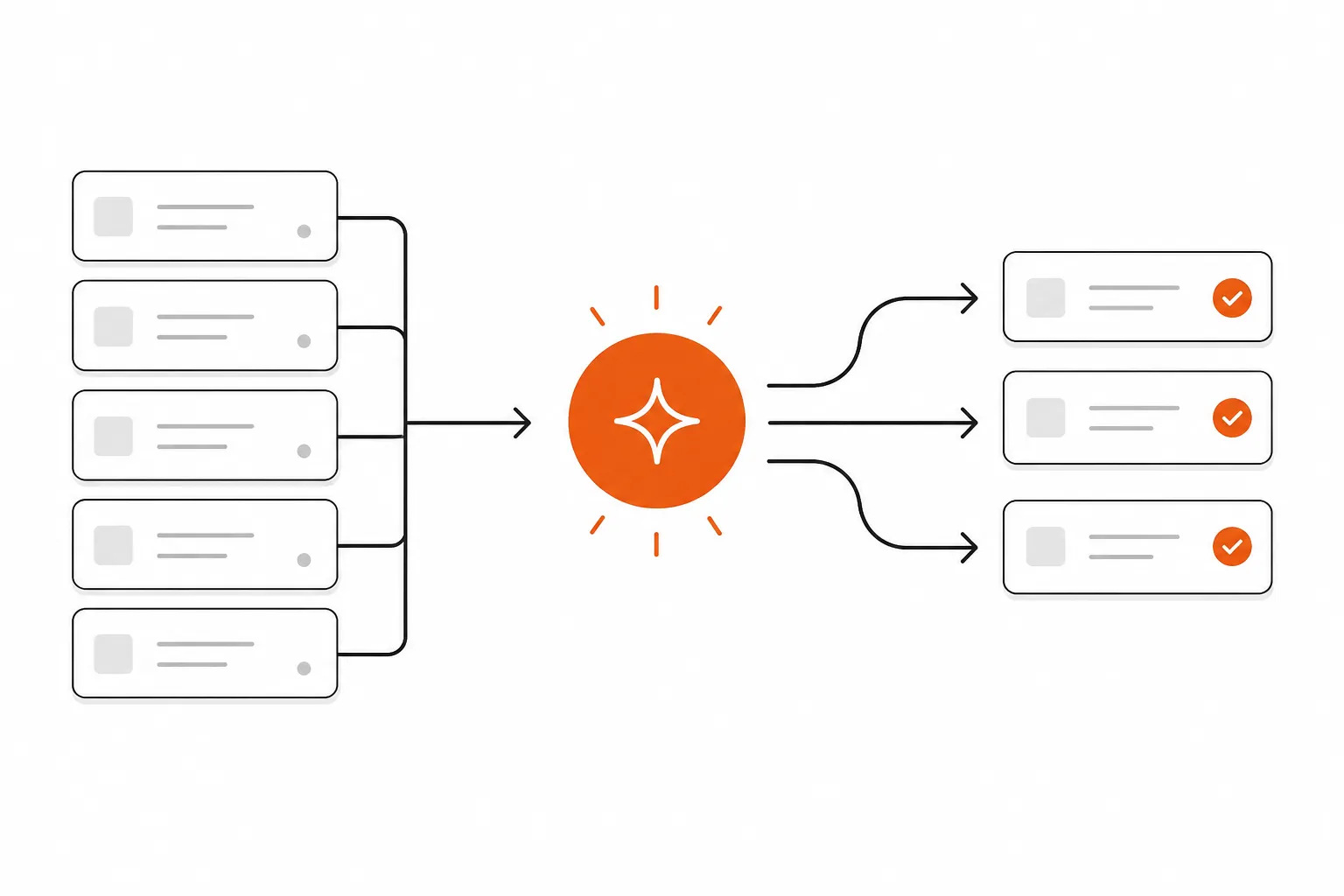
Password and credential tickets alone are 20-50% of help desk volume - and you can't hire your way out of them. AI that connects to your PSA, RMM, and identity stack can handle 40-60% of total ticket volume autonomously: password resets, account unlocks, onboarding, offboarding, and RMM-triggered remediation. The tools that actually deliver don't need a 6-month workflow-building project; they deploy in a week and start working. Rallied is built specifically for MSPs on this model - $300 a month for 2,000 credits, about 700 tickets in a typical month, live by Friday.
The ticket volume trap MSPs can't escape
Here's the math that's making MSP owners miserable in 2026: client count keeps climbing, and every new client brings tickets faster than you can hire for them. You add a client, you add tickets. You add tickets, you need a tech. You hire a tech, they take three to six months to train. Meanwhile the next client signed last Tuesday.
The traditional answer - hire more L1 staff - has three problems. It's slow. It's expensive. And according to the Salesforce State of Service report, 41% of service agent time goes to work that doesn't directly resolve the customer's issue - searching for information, reworking cases, administrative overhead. You're not getting 100% of a new hire toward resolution. You're getting 59%.
The underlying issue is that ticket volume doesn't scale linearly. ITBD's analysis found that as client count grows, complexity grows faster than volume - misrouted tickets, unnecessary escalations, and inconsistent prioritization become the norm. Your dispatcher isn't struggling with too many tickets. They're struggling with tickets that shouldn't require a human at all.
48% of MSPs rank AI and automation as the number-one thing their clients want in 2026, per Kaseya's State of the MSP report. Only 13% see it as a meaningful revenue stream yet. That gap is the entire plot of this piece.
The three ways AI actually cuts ticket volume
Not all "AI ticket automation" is the same thing. There are three distinct moves, and they do different work.
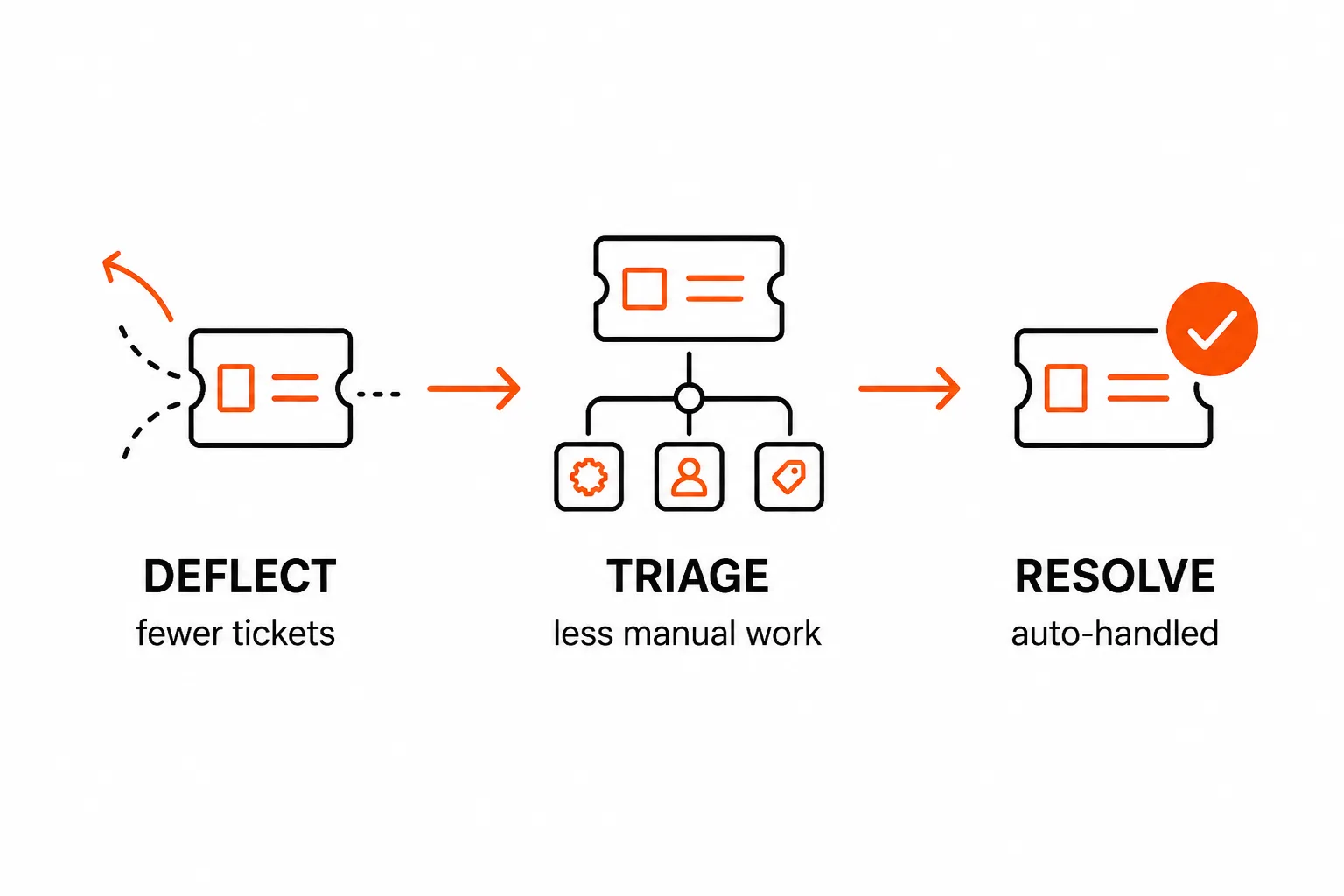
Deflection keeps tickets from arriving in the first place. Client-facing self-service portals, AI-powered chatbots, and automated status updates let end users resolve common issues without ever submitting a ticket. TeamDynamix reports 30-60% deflection rates with virtual service agents; Usepylon puts the range at 20-60%. Deflection is powerful but requires client-facing infrastructure most MSPs haven't built yet.
Triage automation doesn't reduce ticket count but cuts the time each ticket costs. Intelligent routing, automated categorization, and priority scoring mean the right ticket goes to the right tech without a dispatcher touching it. Autotask's AI already does basic categorization from ticket title and description; tools like Thread go further with AI-assisted inbox management across Slack, Teams, and email.
Autonomous resolution is the category that actually changes the economics. The AI connects to your systems, takes action, resolves the ticket end-to-end, and closes it - without a technician. ITBD estimates 70-80% of L1 issues are theoretically automatable. In practice, Rev.io puts 40-60% of total ticket volume in scope for autonomous resolution with current tooling.
Most MSPs can realistically expect 30-40% total volume reduction from a combination of all three, rising to 40-60% as more integrations are connected and the AI's context deepens.
The category that matters most: password resets
Before we get into which tools do this well, let's be specific about where the volume actually lives.
Gartner research estimates that 30-50% of all service desk calls are password resets alone. Not "access issues broadly." Password resets specifically. Add account unlocks and MFA resets and you're looking at a category that could represent half your L1 volume, handled entirely by one technician following the same four-step process every time.
This is what makes autonomous resolution so compelling for MSPs: the highest-volume tickets are also the most predictable. A password reset in Entra ID follows the same workflow every time. An account unlock in Okta follows the same workflow every time. Rev.io found that the top 10 recurring issues, automated with self-healing scripts, generate a 10-20% volume reduction on their own.
Beyond resets, the other high-frequency automatable categories:
- New user onboarding -- creating accounts, assigning licenses, provisioning access across M365, identity providers, and line-of-business apps
- Employee offboarding -- revoking access, reclaiming licenses, disabling accounts before the last day
- RMM-triggered remediation -- disk space cleanup, antivirus update pushes, VPN reconnect scripts running automatically when an alert fires
Rev.io also found that RMM alert copy-paste alone -- moving alert data from the RMM into the PSA manually -- consumes about 100 minutes per technician per day across a typical team. That's 8.3 hours a week, per tech, doing data entry. Not IT work. Data entry.
Why workflow builders have a deployment problem
At this point in the conversation, someone usually mentions Rewst or Pia. Both are real tools with real users. Both have a fundamental constraint worth naming.
Rewst is a low-code automation platform that lets you build workflows across your entire stack -- PSA, RMM, M365, billing, documentation. Real users report saving 75-80 hours per week once it's running well. The catch: it requires at least one dedicated person to build and maintain the automations. That's not a knock on the product -- it's honest about what it is. A platform-agnostic workflow engine requires someone to build the workflows. For a 5-tech MSP without a dedicated automation engineer, that's 6 months of setup before you see meaningful results. Pricing starts around $175 per technician per month, with no free trial.
Pia is PSA-native and AI-first with 100+ prebuilt automations out of the box. Community feedback notes it "doesn't have much depth yet" and requires careful workflow tuning to avoid issues like ticket loops. Pricing starts at $850/month, with custom quotes reaching significantly higher for larger shops.
The pattern both share: they're automation platforms. You bring the automation logic. The AI assists, but the scaffolding is yours to build.
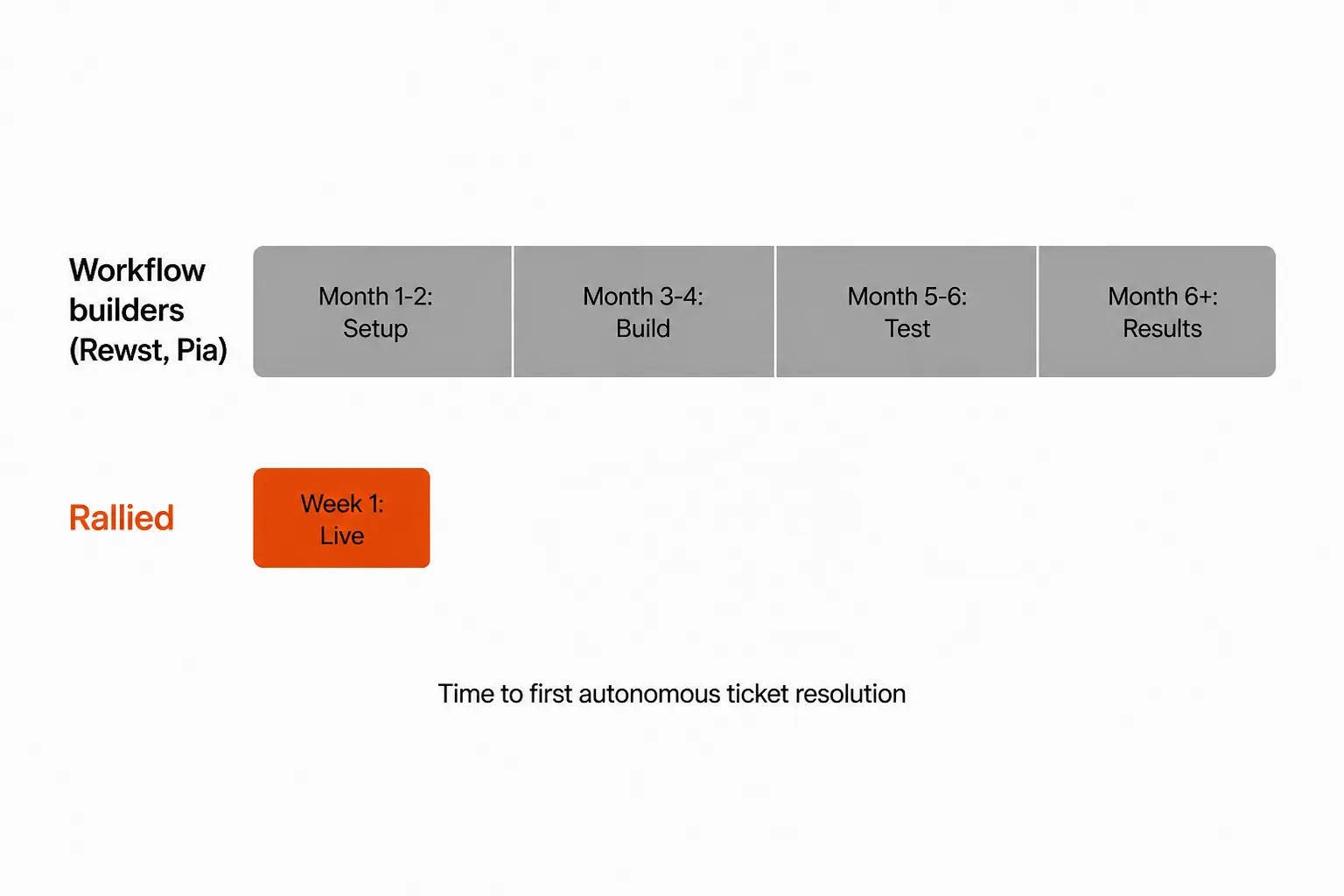
The alternative model is a purpose-built AI technician: something that arrives pre-trained on L1 resolution patterns, connects to your stack, and starts handling tickets autonomously without a workflow-building phase. The tradeoff is scope -- a purpose-built tool is narrower than a flexible platform, but it's running in week one instead of month six.
The ROI math for autonomous resolution
Start with the ticket category where the numbers are cleanest. A password reset costs about $70 fully loaded once you count the end user's lost time, not the $15 most teams assume, and a single 300-seat client generates $7,000-$10,000 of them a year. Automate that one category and the cost drops under $500. That's one ticket type, at one client.
Now widen it to a whole queue -- 800 tickets per month, $140 average handling cost including loaded labor:
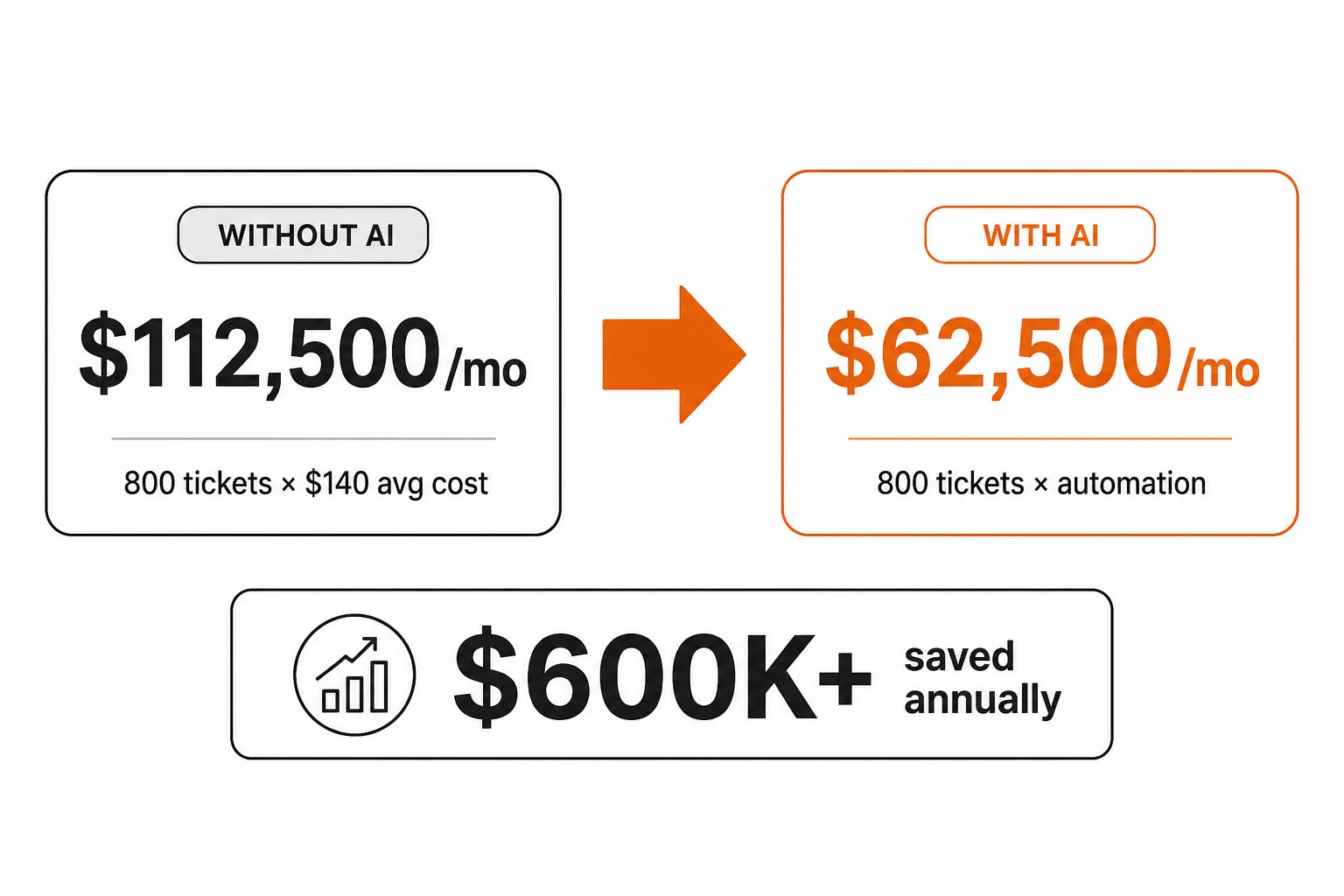
Rev.io's analysis of a similar 800-ticket/month baseline found 235-370 tickets per month eliminated through a combination of self-healing scripts (120-160 tickets), prevented escalations (40-80 tickets), and reduced repeat tickets from root cause fixes (60-100 tickets). That's a 30-46% reduction without touching the autonomous resolution layer at all.
Add agentic resolution on top -- the AI actually fixing tickets rather than just routing them -- and you're in the 40-60% range Rallied reports for connected MSPs.
What to actually look for in an MSP AI tool
Most vendors claim "autonomous resolution." Here's how to separate the ones that mean it from the ones that mean "we summarize the ticket for you":
Real system access, not suggestions. The AI needs to actually connect to Entra ID, Okta, JumpCloud, Google Workspace, your RMM, and your PSA. Not read from them -- write to them. A password reset requires changing a value in your identity provider. If the tool can't do that, it's a suggestion engine, not an AI technician.
PSA-native ticket handling. The resolution should close the ticket in your PSA, add time entries, and leave a note -- not require a tech to copy output somewhere. If a tech has to do anything after the AI "resolves" it, it's not resolved.
Identity verification. Any tool doing password resets and account unlocks needs to verify the requester before acting. This isn't optional -- it's how you avoid resetting the CEO's password for someone who sent an email that looked legit.
Predictable pricing. Per-tech pricing penalizes growth in a way that doesn't align incentives. If you add techs because the AI freed them up for higher-value work, you shouldn't pay more for the automation.
Same-week deployment. If the vendor needs a forward-deployed engineer for implementation, or if they're quoting a 60-90 day onboarding timeline, price that labor into your evaluation. It's a real cost.
Try Rallied
Rallied is an AI technician built specifically for MSPs. It connects to your PSA (ConnectWise, Autotask, Halo), RMM (Datto, NinjaRMM), and identity stack (Entra ID, Okta, JumpCloud, Google Workspace) and resolves L1 tickets autonomously -- password resets, account unlocks, MFA resets, onboarding, offboarding, RMM script execution. No workflow builder. No forward-deployed engineer. Deploy on Friday, it starts working.
Rallied is $300 a month, billed monthly, with 2,000 credits included. Each ticket costs 1, 3 or 8 credits depending on how much work the agent did on it, so a typical month covers about 700 tickets, and tickets it couldn't finish are never charged.
The recovery Rallied targets is $7K-$15K/month in tech time: 50-100 hours per month of L1 grunt work redirected toward the client relationships and complex projects that actually grow the business.
To see how Rallied handles this inside your PSA, read about AI Ticket Triage and Routing for MSPs.
For the wider picture, read Best MSP AI Tools for Ticket Automation in 2026.
Frequently Asked Questions
What percentage of MSP tickets can AI automate?
ITBD estimates 70-80% of L1 issues are theoretically automatable, while Rev.io puts 40-60% of total ticket volume in scope for autonomous resolution today. In practice, most MSPs see 30-40% reduction from a combination of deflection, triage automation, and agentic resolution - with higher rates as more integrations are connected. Rallied reports 40-60% autonomous handling for connected MSPs.
Does AI ticket automation replace technicians?
No - and the tools that pitch it that way tend to disappoint. The honest framing is that AI handles the repetitive L1 layer (password resets, account unlocks, onboarding steps) so your technicians can focus on the complex work that actually needs them. 73% of MSPs report difficulty hiring skilled technicians - automation doesn't replace people, it lets the team you have punch above its weight.
How long does it take to deploy MSP AI ticket automation?
It depends heavily on the tool. Workflow builders like Rewst typically take 3-6 months to build out meaningful automation, since each workflow has to be constructed manually. Purpose-built AI technicians like Rallied are designed for same-week deployment - connect your PSA and RMM on Monday, have autonomous ticket handling running by Friday, without a forward-deployed engineer or a dedicated internal admin.
What does MSP AI ticket automation cost?
Pricing varies widely. Rewst starts around $175 per technician per month. Pia starts at $850/month with custom quotes reaching significantly higher. Rallied costs $300 a month for 2,000 credits, about 700 tickets in a typical month, and tickets it couldn't finish or wasn't allowed to act on are never charged. At 200 tickets per month, that volume fits inside the plan in a typical month.
What types of tickets can AI resolve autonomously?
The highest-volume automatable categories are password resets and account unlocks, which Gartner research estimates at 30-50% of all service desk calls. Beyond that: new user onboarding, employee offboarding, MFA resets, software installs, VPN troubleshooting, disk space cleanup, and RMM-triggered remediation scripts. Rallied handles all of these autonomously across Entra ID, Okta, JumpCloud, Google Workspace, M365, Datto RMM, and NinjaRMM.