Password reset ticket volume statistics: what the numbers actually say (2026)

TL;DR
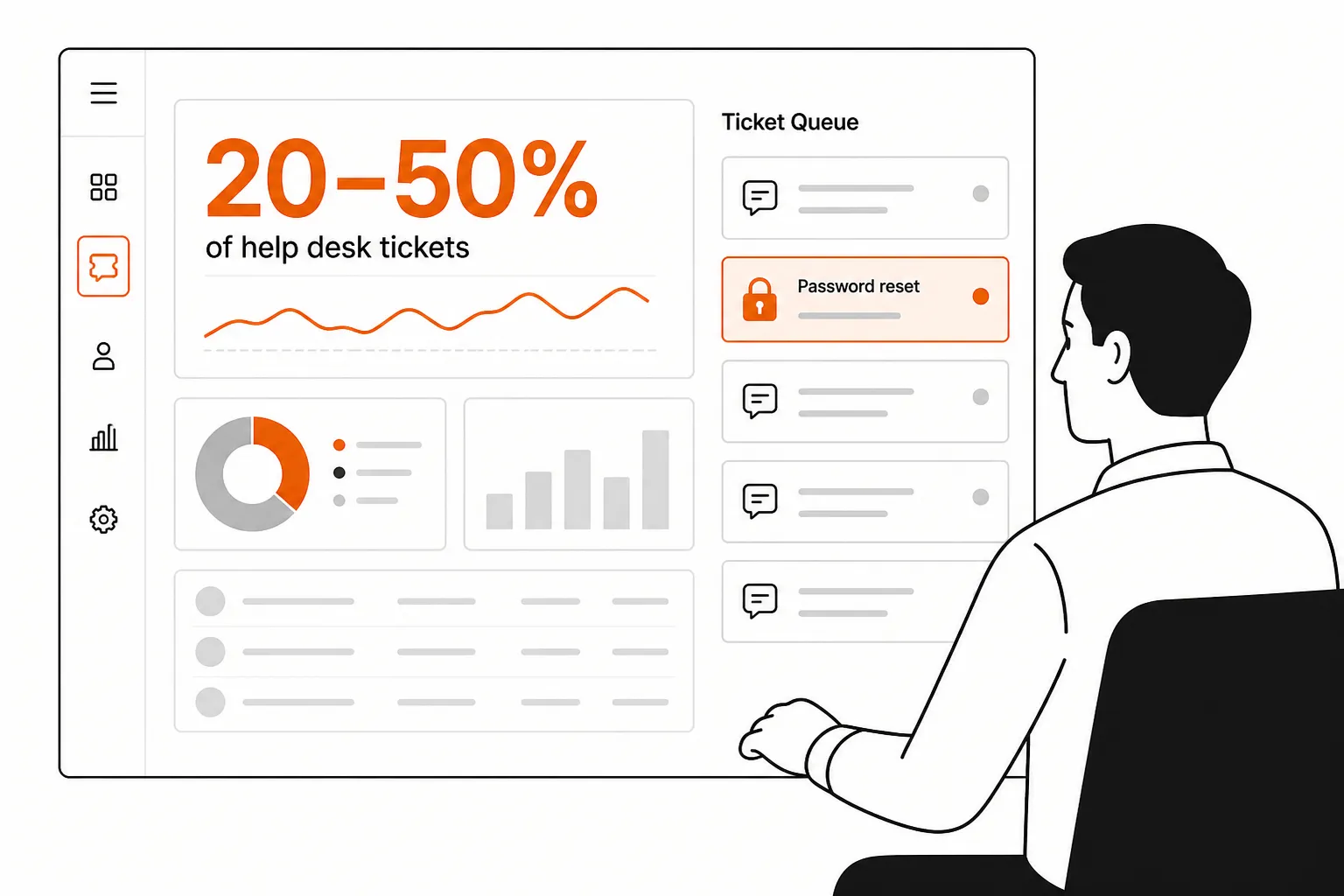
Password resets consume 20-50% of all IT help desk volume (Gartner). Each one costs $70 fully loaded (Forrester), not the $15 most teams assume. A typical 300-person MSP client generates $7,000-$10,000 in password reset costs annually. Automating them cuts that to under $500 - and frees your techs for work that actually requires a human.
The "simple ticket" that isn't simple
Every MSP has felt it. The Monday morning surge, the Friday afternoon lockout before a holiday weekend, the end-user who calls three times in a week because they keep getting locked out of the VPN. Password resets feel routine. They're not.
The IT industry has spent years treating password resets as the canonical "low-value ticket" - quick to handle, easy to deflect. And technically that's true: a reset takes 6-8 minutes of technician time. But that framing misses how much of it happens, how often, and what it costs when you stack 923 of them across a year.
Here's what the data actually shows.
How many tickets are password resets?
Gartner's long-running estimate puts 20-50% of all IT help desk calls in the password-and-credentials category. The range is wide because it includes MFA resets, account unlocks, and access-related issues alongside pure password resets - and because organizations vary enormously based on how mature their identity stack is.
The Gartner Peer Community poll offers more granularity: across 21,251 respondents, 38% report that 10-20% of their help desk volume is password/MFA-related, while 17% report 21-30%. A notable 22% say it's under 10%, typically organizations with mature SSPR deployments.
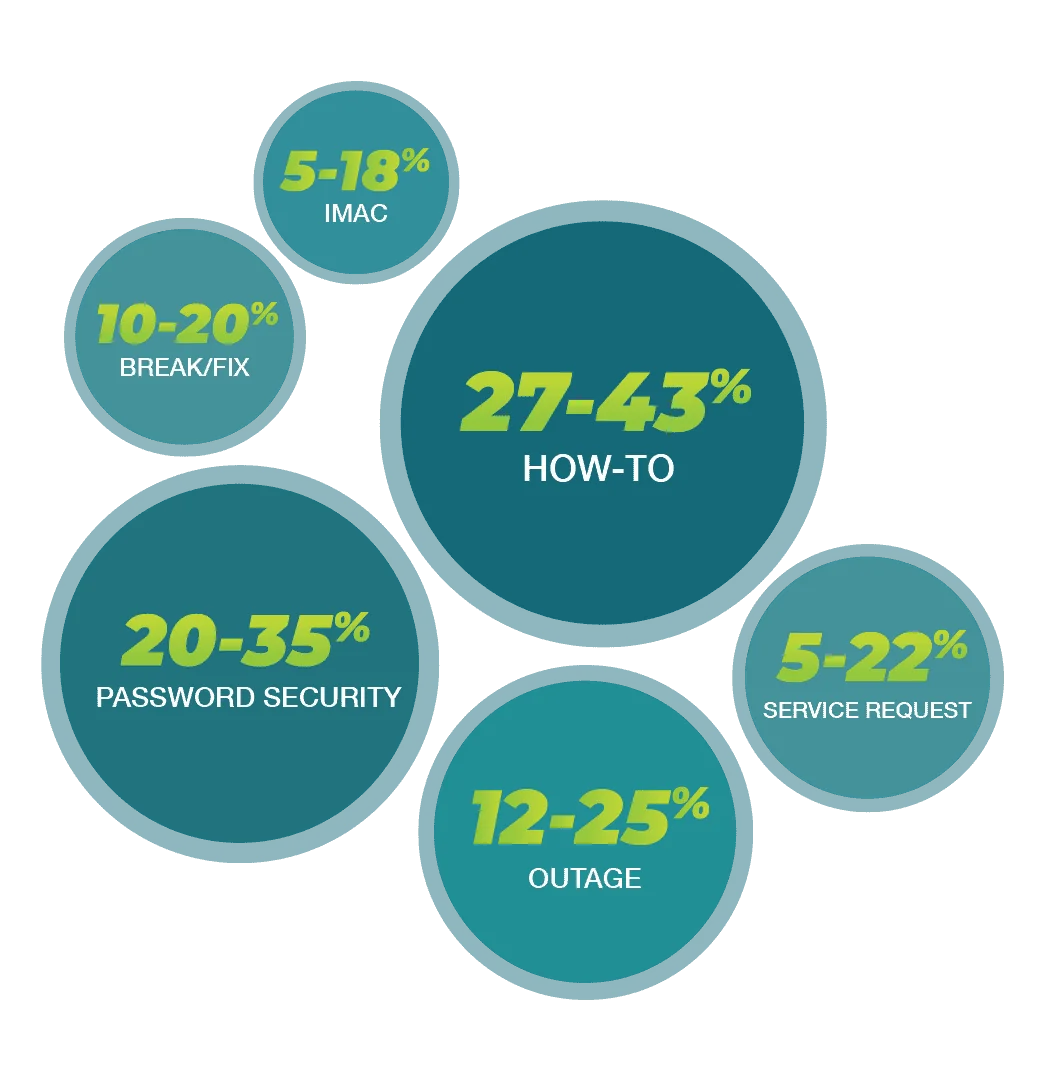
What's surprising is how sticky that percentage is even in organizations that have invested in modern identity tools. Helpt's analysis finds that password resets still drive 15-20% of helpdesk volume in environments with both MFA and SSO deployed. The reasoning: application proliferation. The average employee now interacts with 50+ applications. Each one is a separate credential lifecycle. MFA adds a layer of security; it doesn't shrink the unlock volume.
For MSPs serving SMBs in particular, MSP Process benchmarks from their AI automation dataset show that roughly 12% of inbound voice tickets are password-reset, MFA-reset, or credential-status calls specifically - a narrower definition, but still a meaningful chunk of inbound volume.
What Fixify's 2026 benchmark shows
The most detailed public dataset on this comes from Fixify's 2026 IT Help Desk Benchmark Report, which analyzed 50,000+ tickets from January 2025 through February 2026 across 30+ organizations. Their taxonomy is more granular than most - and the results are worth understanding.
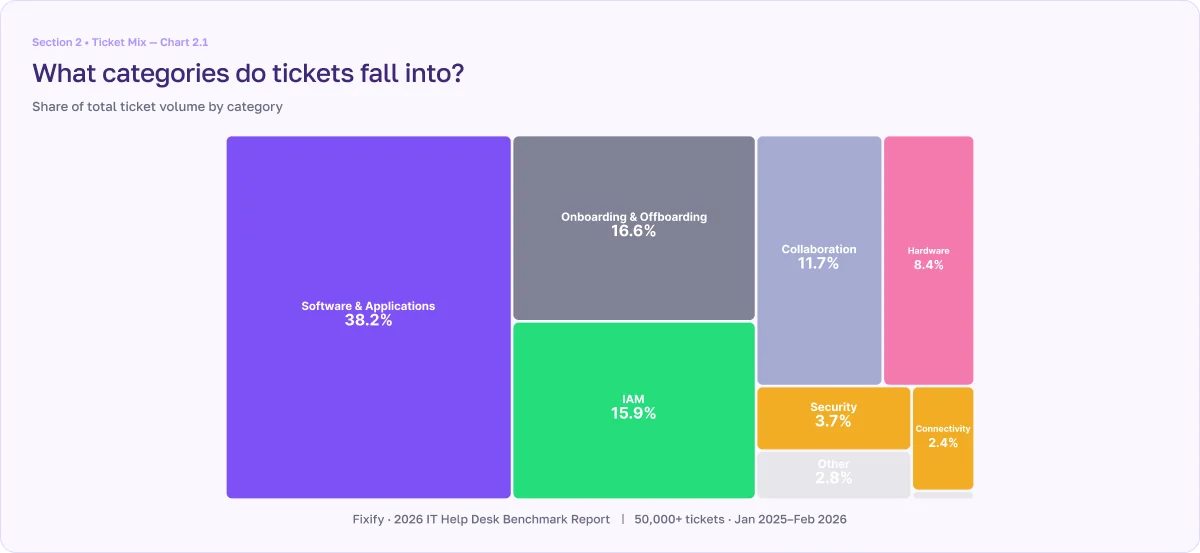
Identity and Access Management (IAM) - the category that includes password resets, permissions management, account unlocks, and login troubleshooting - accounts for 15.9% of all tickets. When you look at specific use cases, the breakdown is:
- App assignment: 28.1% (the single largest driver)
- Permissions management: 6.2%
- Login troubleshooting: 4.9%
Passwords don't show up as a single row in this dataset - they're spread across IAM subcategories - but the 15.9% IAM figure is consistent with what Gartner reports when you account for the fact that not every IAM ticket is a password reset.
The more interesting finding from Fixify: the ticket mix shifts meaningfully with company size.
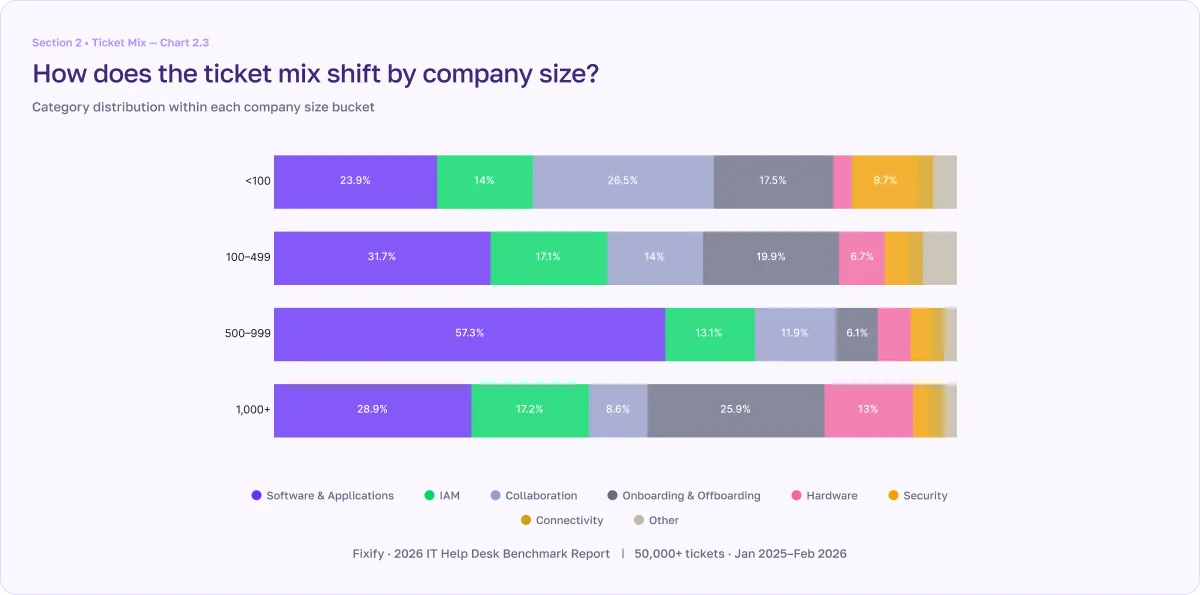
IAM stays relatively consistent across company sizes - it doesn't disappear at scale the way some IT problems do. That matters for MSPs: whether you're managing a 50-seat client or a 500-seat one, credential issues are a dependable chunk of the queue.
What a password reset actually costs
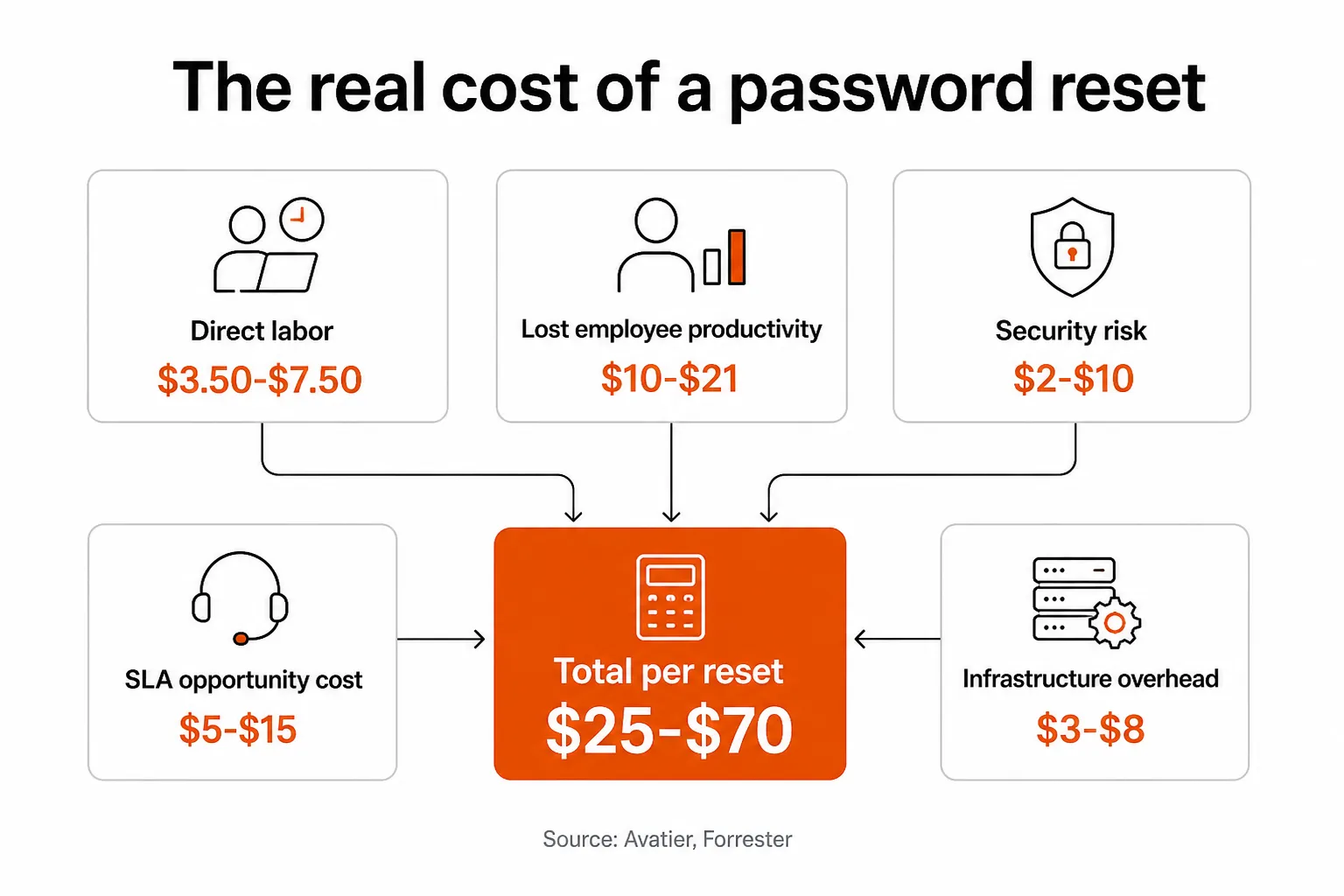
This is where most teams get it wrong. The conventional wisdom puts a password reset at $15-20 - a few minutes of L1 technician time at loaded rates. Forrester Research's estimate is $70. That's a 4x gap, and the difference is what you're not counting.
Avatier's 2026 analysis breaks the real cost into five components:
The comic-book version of this from Avatier is worth a look if you want to show it to a skeptical client:
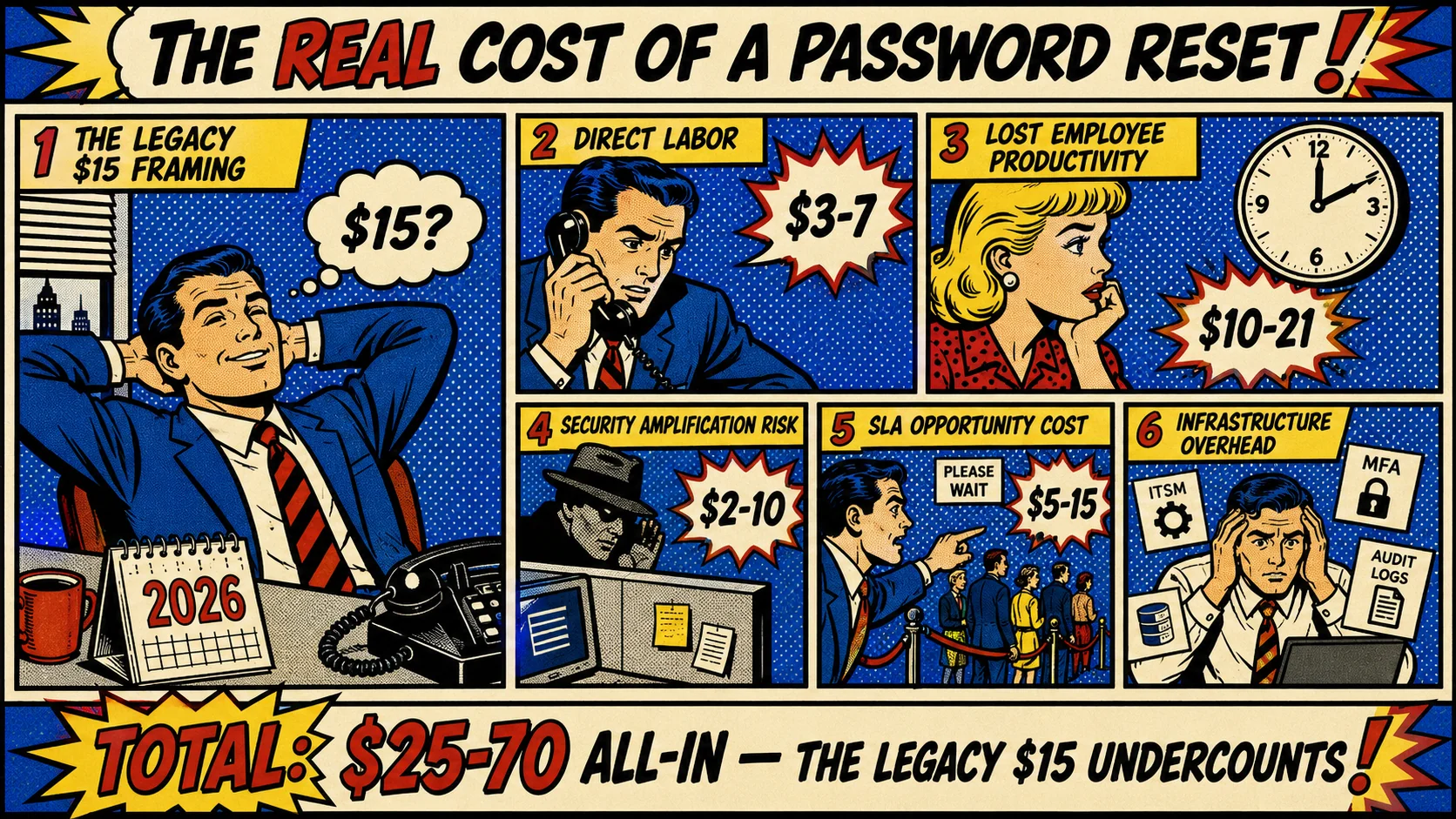
The two biggest cost buckets are almost never tracked:
Lost employee productivity during the wait. The end-user isn't just inconvenienced; they're idle for 15-30 minutes while the ticket gets routed, verified, and processed. At typical loaded labor rates, that wait period costs $10-21 per incident - more than the technician's handling time.
SLA opportunity cost. The technician handling a password reset cannot simultaneously be triaging a network outage, closing a security incident, or doing anything that requires actual judgment. A technician spending 20 minutes on a credential reset is a technician not spending 20 minutes on the work that grows accounts or reduces churn.
Helpt puts the true cost at 3-4x the visible handling time when you factor in: follow-up tickets when the reset didn't land right, context-switching overhead for the technician, after-hours calls (which carry shift-differential premiums), security verification failures that require escalation, and rework when temporary passwords expire before the user logs in.
"Password resets are a gateway to understanding your environment's identity health. Spikes in reset volume are almost always signaling something - a new SaaS tool without SSO, a vendor portal bypassing identity governance, a legacy integration that fell off the policy radar."
That reframe - password resets as telemetry, not just annoyances - is one of the most useful mental shifts for an MSP. Volume spikes tell you something about the environment.
How volume adds up at scale
SpecOps Software's analysis of 700+ organizations running their uReset product gives the clearest public picture of actual reset volume:
- 923 password resets per organization per year on average
- Roughly two resets per end user per year
- 4 account unlocks per end user per year on average (often bundled with password resets in managed environments)
- 10 individuals were responsible for 5,703 resets in a single year - the extreme end of the distribution
Volume is seasonal. January sees 8.6% of annual resets - the holiday-forgetting bump - while August is the peak month at 10.5%, presumably driven by summer vacation returns and laptop handoffs. The single busiest day in their 2023 dataset: August 14, 3,546 resets.
For teams managing scheduled maintenance windows or planning technician coverage, that seasonality is actionable data. Monday mornings are reliably worse than Friday afternoons; post-holiday returns spike consistently.
At the per-org averages, here's what annual password reset costs look like by client size:
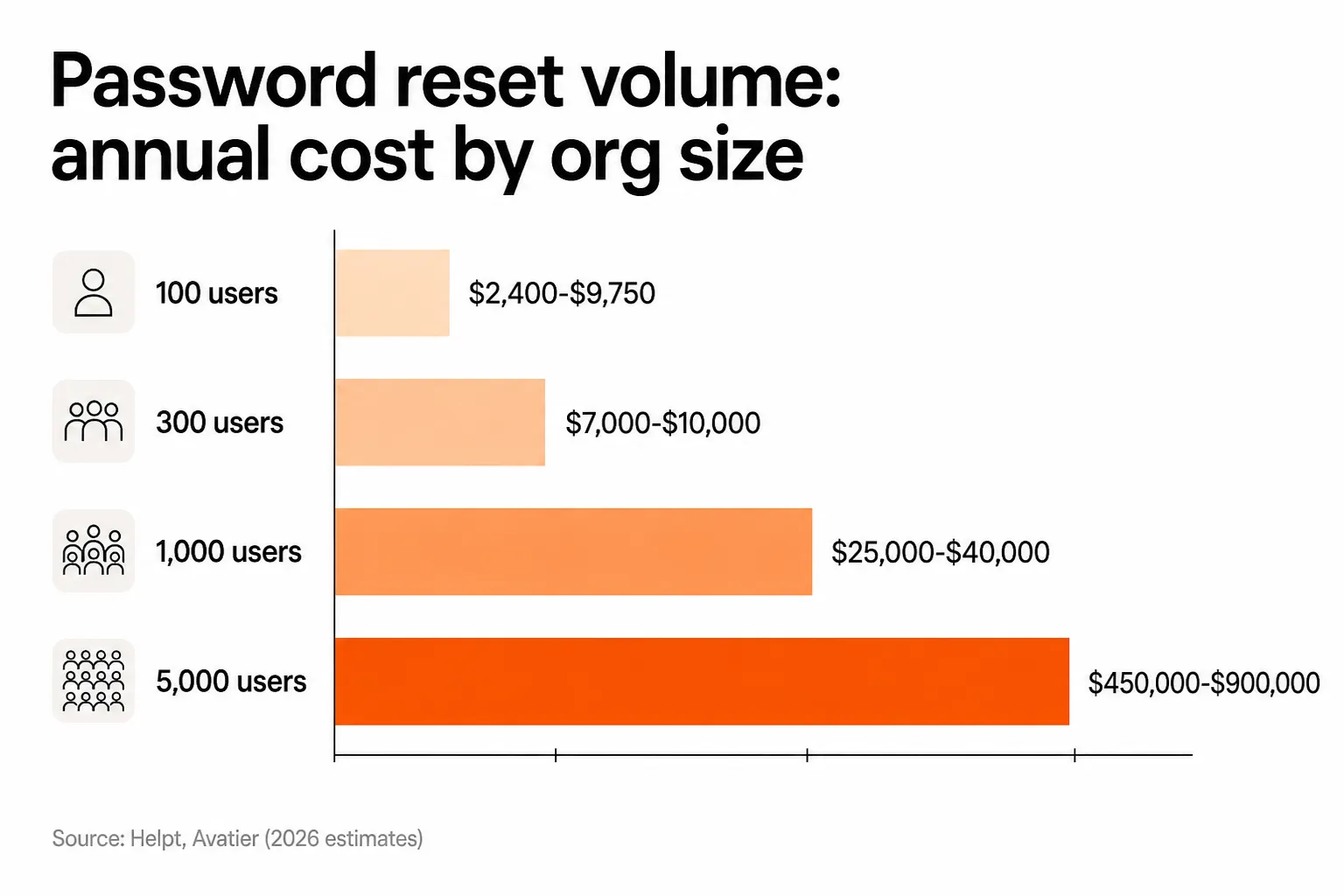
The 5,000-employee enterprise figure - $450,000-$900,000 per year - is where the conversation with a mid-market client starts getting their attention. For most MSPs, the per-client numbers are smaller, but the aggregate across a 30-client book of business adds up fast.
The MSP-specific numbers
Most of the public statistics on password reset volume come from enterprise IT surveys. The MSP picture is slightly different, because MSPs often handle multiple client environments, deal with more heterogeneous stacks, and absorb a disproportionate share of credential support because clients don't have internal IT.
MSP Process's AI Assist ROI calculator, built from real MSP automation deployments, surfaces a few useful benchmarks:
- ~12% of inbound voice tickets are password-reset, MFA-reset, or credential-status calls
- 4.5 hours per week per technician recovered through password reset automation
- $265,358 per year in deflection value from password reset automation alone
- 36% of total automation ROI in Year 1 comes from password reset deflection
That last figure is striking. For most MSPs exploring automation, password resets aren't the flashiest use case - they're not the complex multi-step onboarding flows or the RMM-triggered remediations. But they generate more than a third of the measurable ROI from automation investment, because they're so dense in the queue.
What automation does to the numbers
The comparison between manual and automated password reset handling isn't subtle:
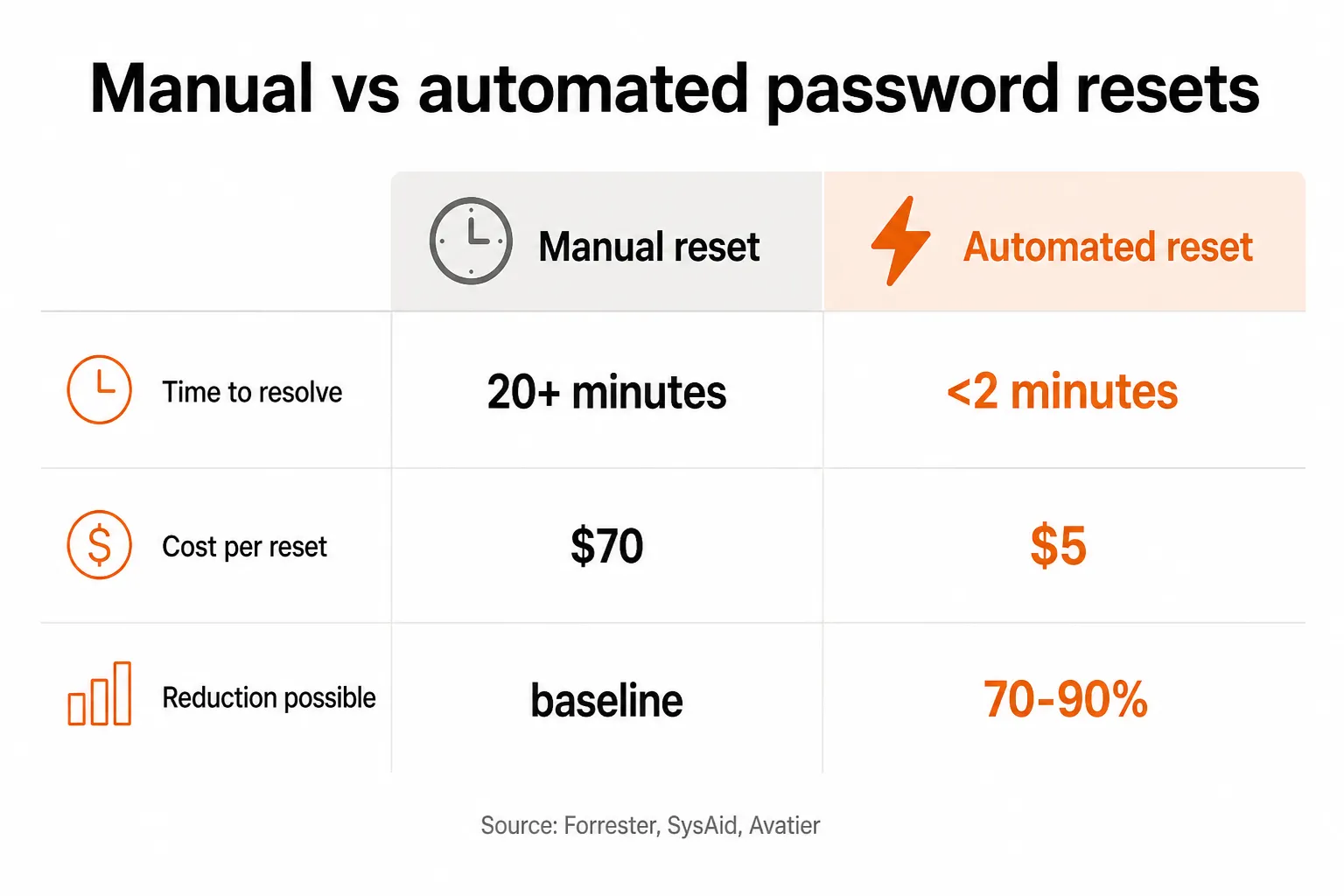
SysAid puts the resolution time contrast at 20+ minutes manually versus under 2 minutes automated. FastPass cites a 90% reduction in password-handling costs, bringing the per-reset cost from ~$70 down to approximately $5. Avatier's first-quarter deployment baseline is a 70% reduction, with clients reporting 80-90% at steady state.
These aren't vendor claims in isolation - they track with what case study data shows:
| Organization | Outcome | Source |
|---|---|---|
| Fortune 500 financial services | $1.4M saved over 3 years, 80% MTTR reduction | Resolve.io |
| South African telco | 100,000 staff hours saved in under 1 year | Resolve.io |
| Top-10 global bank | $1M saved annually, 60% ticket volume reduction | Resolve.io |
| Average SSPR customer | $65,610 saved in 2023 ($136 per user annually) | SpecOps Software |
| Financial services firm (15K employees) | 92% reduction in password-related tickets | Avatier |
The SSPR savings data from SpecOps deserves attention because it's based on actual customer behavior across 700+ organizations - not a case study or a lab scenario. 75% self-service adoption drives a 40% reduction in related help desk costs (Forrester). Most organizations don't get to 75% adoption with basic SSPR; they get somewhere in the 40-60% range, which still produces material savings.
For MSPs, the question isn't really whether to automate password resets. The data on that is settled. The question is what kind of automation to reach for: self-service portals (users reset their own passwords), workflow automation (tickets get auto-routed and processed), or AI execution (an agent receives the ticket and performs the reset end-to-end in the connected identity system).
The difference matters because SSPR requires user adoption - and getting SMB end-users to change behavior is its own project. Workflow automation requires the ticket to arrive in a predictable format and the resolution path to be scripted in advance. AI execution, done right, handles the messy middle: a ticket that says "can't log in to my account" and requires looking up which account, which identity provider, and whether the policy allows a reset without an in-person verification step.
Try Rallied
Rallied is built specifically for MSPs who want AI execution - not another workflow builder. It connects to your PSA, your RMM, and your identity stack (Entra ID, Okta, JumpCloud, Google Workspace) and handles password resets autonomously when a ticket comes in.
The economics are straightforward: $300 a month for 2,000 credits, about 700 tickets in a typical month, and tickets it couldn't finish are never charged. At the 923-resets-per-year average, one client's resets cost $64,610 a year at the Forrester $70 baseline, and that volume fits inside the plan's typical month. The same-week deployment means MSPs can test it against a real client's queue without a consulting engagement or a months-long implementation project.
Password resets won't disappear. But they don't need to be the thing your best technicians are doing at 7 AM on Mondays.
To see how Rallied handles this inside your PSA, read about Microsoft 365 Management for MSPs.
For the wider picture, read How MSPs automate user onboarding in 2026.
Frequently Asked Questions
What percentage of help desk tickets are password resets?
Gartner consistently cites 20-50% of IT help desk calls as password-related. A Gartner Peer Community poll of 21,251 respondents found that 38% of organizations report 10-20% of calls are password/MFA-related, while 17% report 21-30%. Even in environments with MFA and SSO, Helpt's analysis puts password issues at 15-20% of total volume. For MSPs, MSP Process benchmarks show ~12% of inbound voice tickets are password-reset or MFA-reset calls specifically.
How much does a password reset cost in IT support?
The most widely cited figure is $70 per reset (Forrester Research), which includes direct labor, lost employee productivity, security risk, SLA opportunity cost, and infrastructure overhead. Gartner's own benchmark is lower at $22 per reset, while Forrester's labor-only estimate comes in at $40-50. The true all-in cost - including indirect costs like context-switching, after-hours interruptions, and rework - is likely in the $25-70 range. Helpt estimates the actual cost is 3-4x higher than the direct handling time alone.
How many password resets does a typical organization handle per year?
SpecOps Software's analysis of 700+ organizations found an average of 923 password resets per organization per year - roughly two resets per end user annually. Volume is heavily concentrated: 10 individuals in their dataset were responsible for 5,703 resets in a single year. Volume also spikes seasonally: January accounts for 8.6% of annual resets (holiday forgetting), while August is the highest month at 10.5%. Their dataset recorded 3,546 resets on the single busiest day (August 14, 2023).
What is the ROI of automating password resets?
The numbers are significant. Avatier reports a 70% cost reduction baseline in the first quarter after deployment, with some organizations achieving 80-90%. FastPass cites 90% reduction in password-handling costs, dropping cost-per-reset from ~$70 to ~$5. For MSPs specifically, MSP Process benchmarks show password reset deflection generates $265,358 per year in recovered value - 36% of total automation ROI. SpecOps data shows average organizations saved $65,610 in 2023 alone through self-service password reset adoption.
Can an AI agent automatically handle password resets for MSPs?
Yes. Tools like Rallied connect directly to identity providers - Entra ID, Okta, JumpCloud, and Google Workspace - and execute password resets autonomously when a ticket comes in. Rather than routing the ticket to a technician, the AI verifies identity and performs the reset end-to-end, typically in under 2 minutes vs. 20+ for a manual process. Rallied costs $300 a month for 2,000 credits, about 700 tickets in a typical month, and MSPs can deploy it same-week and start recovering technician hours from password resets almost immediately.