Sherweb vs Ingram Micro: which cloud distributor actually works for MSPs in 2026?
TL;DR
Sherweb is the better pick for SMB-focused MSPs who want curated Microsoft licensing, hands-on expert support, and free partner programs with no sales quotas. Ingram Micro has a legitimate use case - its 1,500+ vendor catalog and hardware reach are hard to match - but its cloud marketplace has a decade-long reputation for being exactly as bad as r/msp says it is, a 2025 ransomware attack didn't help, and most MSPs who use it are doing so for hardware margins, not because they love the experience.
For most cloud-first MSPs managing SMB clients, Sherweb wins this comparison on nearly every dimension that actually matters day-to-day. Where Ingram wins, it wins on scale and breadth - not on experience.
Why MSPs keep asking this question
The cloud distribution market for MSPs has consolidated around a handful of players: Pax8, Sherweb, Ingram Micro, and a handful of smaller regional players. The question of which to use - or which to add - keeps coming up because the platforms are genuinely different in ways that aren't obvious from the marketing pages.
Pax8 tends to dominate the conversation for good reason: the interface is clean, the marketplace is fast-growing, and the brand spends heavily on community visibility. But MSPs who have billing issues with Pax8 (and there are enough of them to fill dozens of r/msp threads) often end up looking at Sherweb and Ingram Micro as alternatives.
This comparison lives in that specific context. The reader showing up here has probably already used one, is frustrated with something, or is building out their distribution stack for the first time and trying to figure out which horse to back.
Let's be direct about what each one is.
What Sherweb is
Sherweb is a Canadian cloud marketplace and MSP partner platform that has been operating since 1998. That longevity matters - they've been doing Microsoft licensing and CSP programs for over two decades, and their 198 internal Microsoft certifications and Microsoft Solutions Partner designation are genuinely earned, not a marketing claim.
The platform has three core pillars: a marketplace of curated cloud and security solutions, a partner platform for billing and provisioning, and a layer of expert services - account managers, presales engineers, technical specialists - that Sherweb positions as the thing that separates them from a pure catalog play.
The partner programs are free - no sales quotas, no minimum commitments. MSPs can join the White-label, Co-branded, or Advisor programs without betting anything on it, which lowers the on-ramp considerably.
Sherweb's Microsoft depth
Microsoft is where Sherweb earns its reputation. The 20+ years of CSP experience shows in how they think about SMB licensing: they've deliberately avoided the approach of taking enterprise products and cramming them into the SMB space. As Michael Slater, Sherweb's head of sales, put it in 2024: "Rather than taking enterprise-level solutions and trying to force them into the SMB space, something many vendors do, we handpicked solutions that fit the budget and operational needs of SMBs."
That philosophy carries through to the actual support structure: they have specialists dedicated to Microsoft licensing optimization, presales engineers who can help size deals, and a migration support team that handles the messy parts.

Sherweb's support model
This is where the real differentiation lives. Sherweb's 2026 Annual Partner Survey shows 85% of partners say the company is "easy to work with" and 85% would recommend them to peers. Their CSAT score with technical, sales, and billing support hit 4.7/5 in July 2026.
The support structure includes 24/7 technical support with L1/L2 escalation, dedicated account managers, and presales engineers. There's also a suite of white-label professional services - outsourced helpdesk, MDR for Microsoft 365, NOC monitoring - that let MSPs offer services they don't have the headcount to staff.

The honest caveat: some MSPs in the community have noted that dedicated named account reps have been pulled back more recently. A recent r/msp thread from August 2026 included this observation from an MSP that switched from Pax8: "We switched to Sherweb from Pax8 because of their billing issues. We had a named account rep with Sherweb to start also. That ended recently."
It's a real data point. Sherweb is still better than most alternatives on support, but watch this trend if you're evaluating.
Sherweb's security marketplace
In 2024, Sherweb added 7 cybersecurity vendors to its marketplace, expanding its curated security offering significantly. The current security lineup includes Huntress, SentinelOne, Bitdefender, Proofpoint, and Office Protect - a solid stack for SMB-focused MSPs that want to run a coherent security practice without stitching together vendor relationships individually.
The CyberMSP Community sits alongside the marketplace: webinars, knowledge sharing, and access to security specialists. It's not just a vendor catalog - it's an attempt to help MSPs actually understand and sell security, which for SMB-focused practices is a meaningful difference.

Sherweb's partner platform
The partner portal handles billing, provisioning, custom catalogs, and PSA integrations - ConnectWise, Autotask, Halo, and SuperOps are all in the mix. MSPs can quote, provision, and invoice from a single command center, build custom SKUs and bundles, and give clients a self-service portal for license and subscription management.
What Ingram Micro is
Ingram Micro is a global technology distributor operating at a completely different scale: 165,000+ customers, 1,500+ vendors, and a footprint that spans dozens of countries. It's one of the world's largest IT distributors by revenue, and for good reason - if you need a vendor that Sherweb or Pax8 doesn't carry, the odds are high that Ingram Micro has them.
The company's current platform play is Xvantage, an AI/ML-powered digital commerce platform designed to automate B2B workflows, provide business intelligence, and speed up quoting and provisioning. The marketing is compelling: documented customer cases where workflows that took 3 days now take 3 minutes.
The Xvantage platform
Xvantage is Ingram's biggest recent investment and genuinely interesting in concept: a unified platform that promises business insights (AI-driven recommendations), process automation (CPE lifecycle management, rapid multi-vendor quoting), and a single interface across all of Ingram's technology, cloud, solutions, and services.
The SHI testimonial and MRE Consulting case studies on the Ingram homepage show real workflow improvements. For enterprise-level resellers doing high-volume, multi-vendor deals, a platform that collapses quote time from hours to minutes is a meaningful advantage.
The catch: Xvantage is Ingram's answer to the complaint that their marketplace has been "utter trash" (direct quote from r/msp). Whether it solves that problem or just reframes it with better branding is something the community hasn't fully validated yet.
The support problem Ingram can't shake
Here's the part that's hard to ignore: Ingram Micro's cloud support has been a recurring complaint in the MSP community for at least a decade. This isn't ancient history that doesn't apply today - recent threads still reference these experiences as ongoing.
"Their support is awful, their customer service is non existent, their sales reps don't exist."
That's from r/msp's most-commented thread about Ingram Micro Cloud, which itself was titled "The Ingram Micro cloud site is utter trash." A separate thread from six years ago - Ingram Micro Cloud support is sooooo bad - has over 70 comments and remains relevant because MSPs in newer discussions cite it as still accurate.
The platform issues compound the support problems. The cloud marketplace's navigation has been called out as unusable: "you can't really browse at all." When you're trying to find a product for a client at 4pm on a Tuesday and the interface fights you, that's not a minor UX complaint - it's a real cost in hours.
The ransomware incident
In 2025, Ingram Micro confirmed a ransomware attack by the SafePay group that impacted internal systems and some customer-facing services. For an MSP that had been tolerating a rough platform because of the catalog breadth, this was the kind of incident that accelerates the "let's evaluate alternatives" conversation.
Ingram recovered and operations resumed, but the optics of a major distributor being hit by ransomware while already fielding complaints about support quality wasn't great. The community noticed.
Head-to-head: the dimensions that matter
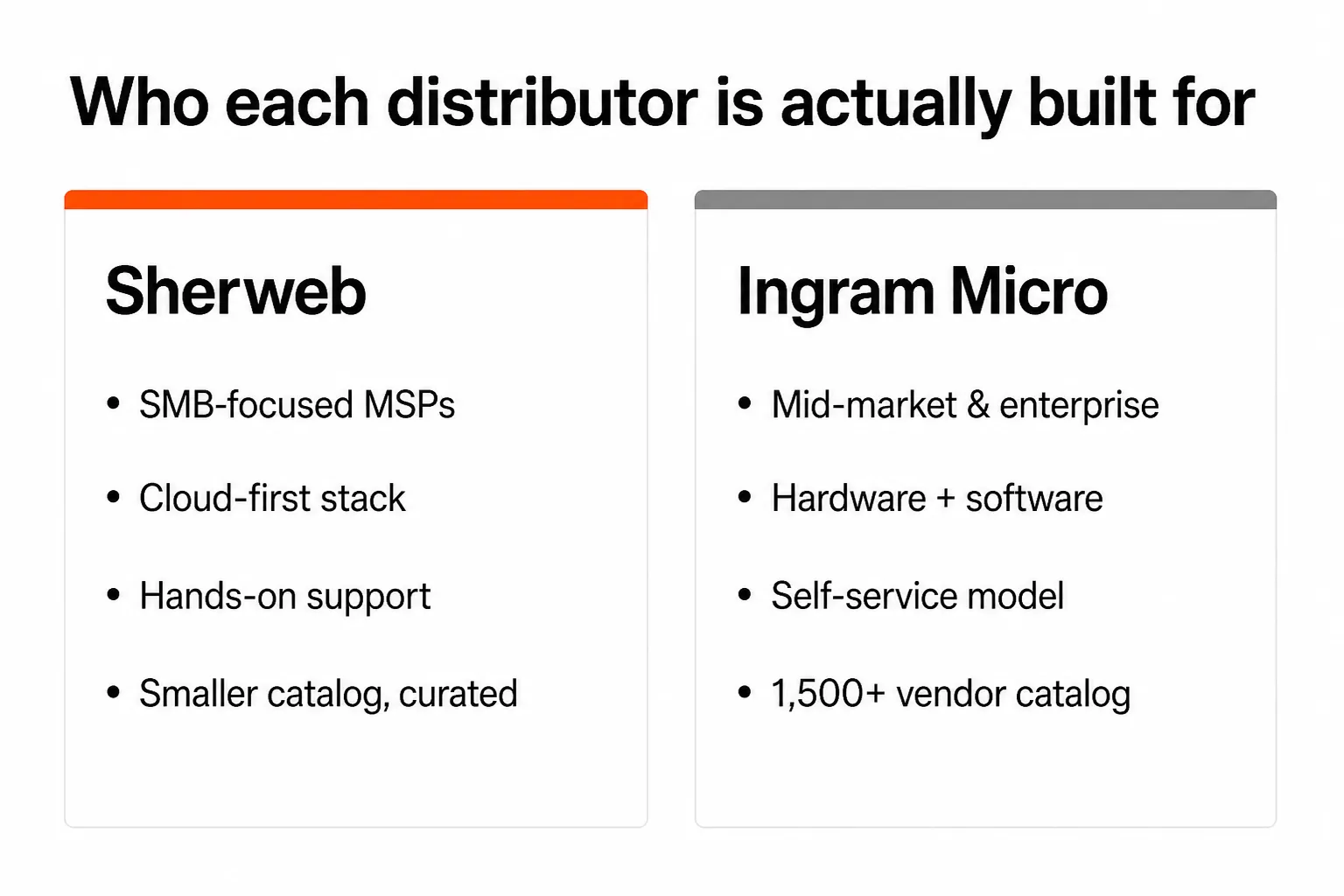
| Dimension | Sherweb | Ingram Micro |
|---|---|---|
| Target MSP size | SMB-focused | Mid-market to enterprise |
| Vendor catalog depth | Curated (focused) | 1,500+ vendors (broad) |
| Microsoft expertise | Deep (198 certs, 20+ years) | Broad (largest Microsoft CSP globally) |
| Support quality | 4.7/5 CSAT, 85% "easy to work with" | Persistent community complaints, decade-long |
| Partner programs | 3 free tiers, no quotas | Volume-tier / relationship-based |
| Marketplace interface | Functional, improving | Historically poor, Xvantage relaunch in progress |
| Hardware distribution | Limited | Major strength |
| Security marketplace | Curated (Huntress, SentinelOne, etc.) | Broad, includes Palo Alto, Fortinet, etc. |
| Ransomware history | None | 2025 SafePay incident |
| Community sentiment | Mostly positive, some recent support dip | Overwhelmingly negative for cloud |
How the partner programs actually work
One of the more confusing parts of cloud distribution is understanding how money flows. The diagram below breaks down the three common models:
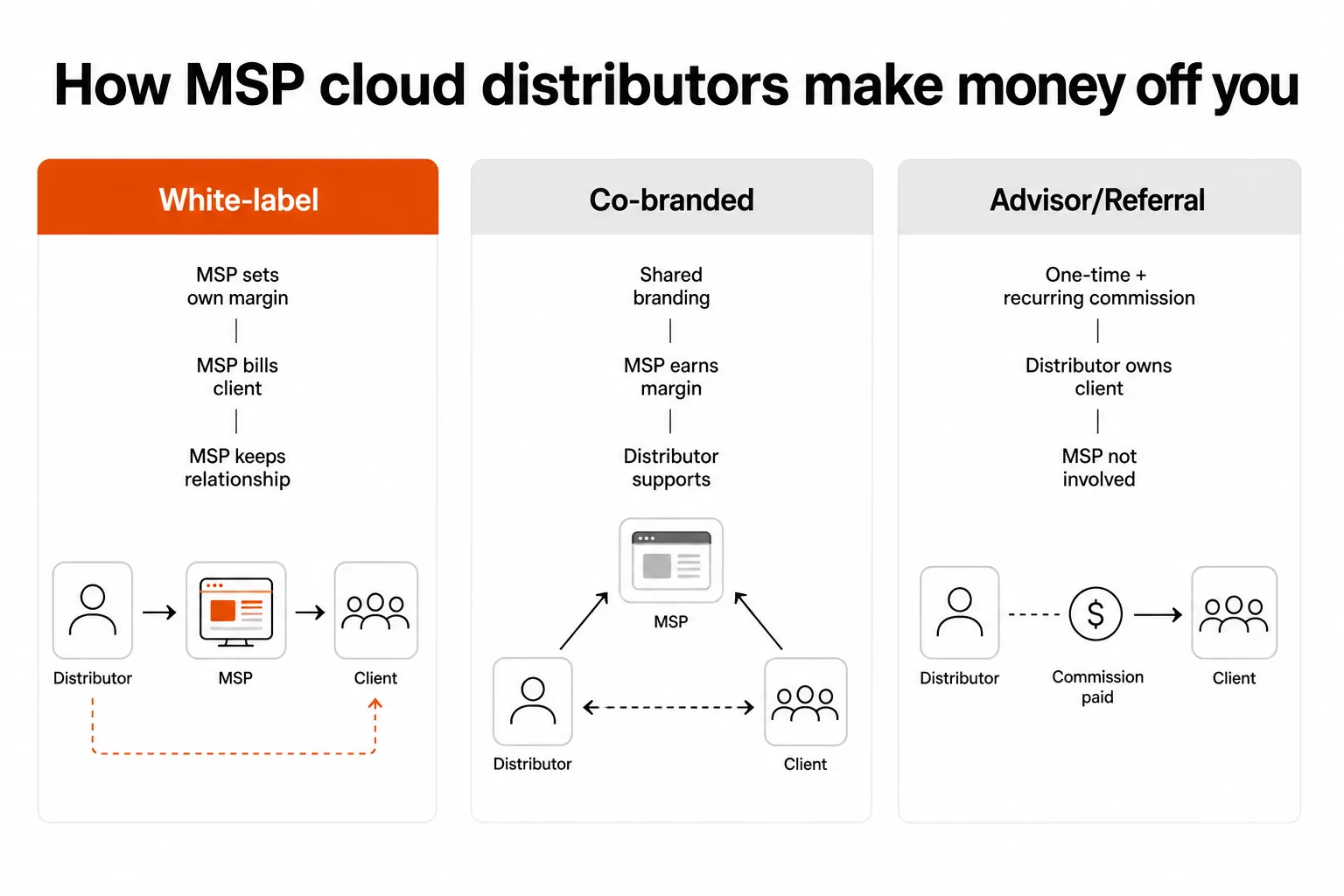
Sherweb's three programs - White-label, Co-branded, and Advisor - are all free to join. In the White-label model, the MSP owns the client relationship entirely, bills them directly, and sets their own margin. Sherweb provides 24/7 L2/L3 escalation support behind the scenes. In the Co-branded model, the MSP still owns the relationship but the branding is shared with Sherweb. In the Advisor model, Sherweb owns the client relationship and pays the MSP a one-time plus recurring commission.
Ingram Micro's partner economics are different and less transparent - pricing and margin structures are negotiated based on volume tiers and relationships rather than published as clear program options. For an MSP just starting out with Ingram, this creates friction that Sherweb's open programs avoid.
What the MSP community actually says
The community verdict is not ambiguous, and it's worth quoting directly rather than softening it.
On Sherweb:
"I'm only a month into Sherweb and it's great. I had an issue with a vendor setup and their phone support was excellent."
From r/msp's Pax8 vs Sherweb thread, which has 50+ comments and represents the most current community comparison available. The theme across the thread: Sherweb's support is meaningfully better than Pax8, the interface is less polished, and the pricing is slightly higher. MSPs who prioritize support quality over cost choose Sherweb. Those who are comfortable with self-service often stay with Pax8.
On Ingram Micro:
The switching pattern is telling. MSPs describe moving from Pax8 to Sherweb when billing breaks down. No one in these threads describes moving to Ingram Micro Cloud as a first choice for anything cloud-related. The use case that keeps Ingram in the conversation is hardware margins and specific vendor relationships - not the cloud or SaaS experience.
"Ingram Micro Cloud vs Pax8: Their support is god awful, below 0 knowledge."
r/msp, 2022 thread that continues to be referenced in newer discussions as still accurate.
Which one should you pick?
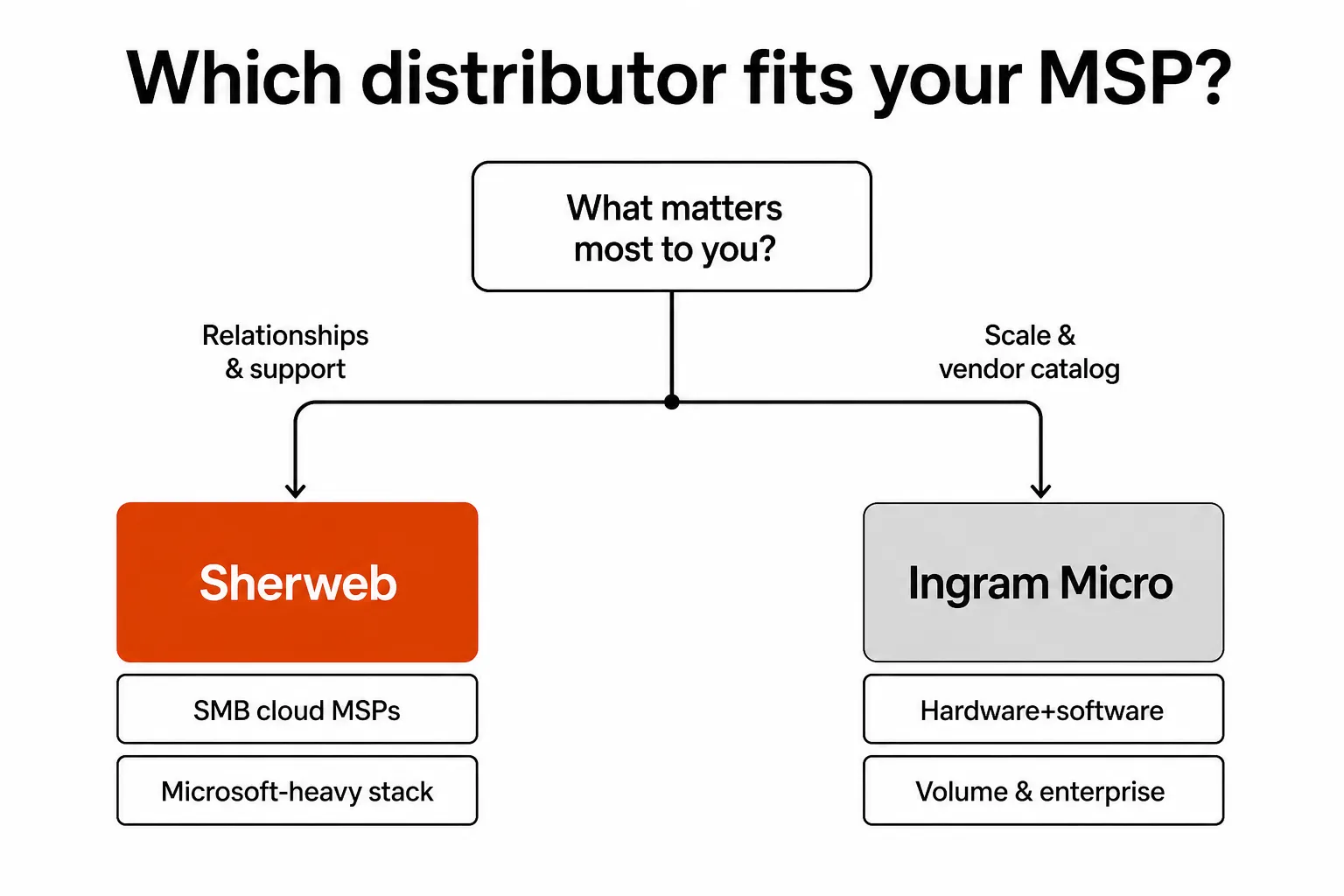
The honest answer is that these two don't serve exactly the same MSP, which makes the head-to-head a bit artificial. But since you're reading this comparison, here's the decision framework:
Pick Sherweb if:
- Your client base is primarily SMBs (under 250 seats per account)
- Microsoft 365 licensing is the core of what you sell
- You want curated security solutions without having to manage 40 vendor relationships
- Support quality matters more to you than raw catalog breadth
- You want transparent, no-commitment partner programs
- You're coming from Pax8 with billing frustrations
Pick Ingram Micro if:
- You're procuring hardware at volume and want distributor-level pricing
- You have specific enterprise vendors in your stack that Sherweb doesn't carry
- You're large enough that the Xvantage platform's automation ROI justifies the support overhead
- You already have an established relationship and account team at Ingram
Use both if:
- You need Ingram's hardware catalog and vendor breadth but want Sherweb for the cloud and Microsoft 365 experience
- Many MSPs run this split successfully
Try Rallied
Once you've got your distribution stack sorted - Microsoft 365 through Sherweb, hardware through Ingram, whatever the mix is - the next problem is usually the tickets that come in because of those services. Password resets, account lockouts, onboarding requests, offboarding workflows. They're all downstream of the services your distributor provisions.
Rallied is an AI technician built specifically for MSPs that connects to your PSA, RMM, and identity stack and handles those L1 and L2 tickets autonomously. No workflow builder to configure for months - it's deployed in the same week and starts resolving tickets: Entra ID, Okta, JumpCloud, Google Workspace, M365. At $3 per resolved ticket with a $150/month minimum, most MSPs see it handle 40–60% of ticket volume without adding headcount.
The distributor question and the service delivery question are separate - but they're related. Better distribution means more services provisioned, which means more tickets. Rallied is built for that second problem.
Frequently Asked Questions
Is Sherweb or Ingram Micro better for a small MSP?
Sherweb is generally the better fit for smaller MSPs. The partner programs are free with no sales quotas, the support is hands-on and responsive, and the marketplace is curated specifically for SMB-focused stacks. Ingram Micro's scale and complexity tends to suit mid-market and enterprise-level resellers who need massive vendor breadth or hardware volume.
Does Ingram Micro still have cloud support problems?
Unfortunately, yes - the complaints about Ingram Micro's cloud support are persistent and span a decade of r/msp threads. A 2025 ransomware attack by the SafePay group added operational disruption on top of an already struggling platform. MSPs consistently report using Ingram Micro for hardware and Microsoft CSP depth while routing cloud SaaS through Sherweb or Pax8.
What are Sherweb's partner programs and what do they cost?
Sherweb offers three partner programs - White-label, Co-branded, and Advisor - and all three are free to join with no sales quotas and no obligations. White-label and Co-branded let MSPs set their own margins and bill clients directly. The Advisor model pays one-time plus recurring commissions for referrals where Sherweb owns the client relationship.
Can I use both Sherweb and Ingram Micro at the same time?
Yes, and many MSPs do exactly that. A common pattern in the community is using Sherweb for Microsoft 365, security bundles, and cloud SaaS - where Sherweb's support and pricing expertise shine - while using Ingram Micro for hardware procurement and any vendor catalog items that Sherweb doesn't carry.
How does Rallied fit into an MSP's distribution stack?
Rallied works alongside your distributor, not instead of it. Once your Microsoft 365, security, or other cloud services are provisioned through Sherweb or Ingram Micro, Rallied's AI technician handles the L1 and L2 tickets that flow from those services - password resets, account unlocks, onboarding, offboarding. It connects to your PSA and identity stack and starts resolving tickets autonomously, typically handling 40–60% of volume with no extra headcount.