HaloPSA vs Freshservice: which one is actually right for your team in 2026?

TL;DR
HaloPSA and Freshservice aren't really competing. HaloPSA is a PSA built for managed service providers - multi-client billing, contracts, the whole stack. Freshservice is an enterprise ITSM platform for internal IT teams at a single organization. If you're an MSP, HaloPSA wins on the features that matter. If you're an internal IT team that doesn't do managed services, Freshservice deploys faster and fits your workflow better. The teams who genuinely need to compare them are the edge cases: growing MSPs wondering if enterprise ITSM tools could simplify their stack, or internal IT shops that do some managed services on the side. For everyone else, the choice is usually clearer than the vendor marketing makes it seem.
Where Rallied fits: if you land on HaloPSA (or any MSP PSA), Rallied slots in above it as the autonomous resolution layer - handling the L1/L2 tickets so your techs don't have to. Same-week deployment, $300 a month for about 700 tickets in a typical month. Worth knowing before you finalize the PSA decision.
Why you're probably asking the wrong question
Search "HaloPSA vs Freshservice" and you'll get a dozen comparison posts that treat these as direct competitors. They're not. One is a fish, one is a bicycle. What they have in common: both involve tickets, both have a monthly per-user price, and both will show up in the same Google searches if you type "IT helpdesk software."
That's where the overlap ends.
HaloPSA is Professional Services Automation for managed service providers. The core job it does: manage multiple client organizations from one platform - their tickets, their contracts, their billing, their SLAs - while giving your techs a single place to work across all of them. MSPs have been the target market since the product launched. Everything from the billing model (per-client contracts, Microsoft CSP integration, time-and-materials invoicing) to the automation engine (Actions, which can do things like "if ticket is from Client A and tagged 'network outage', escalate to the Tier 2 team and auto-charge 2 hours to their retainer") is designed around how MSP operations actually work.
Freshservice is IT Service Management for a single organization's IT team. The core job it does: give an internal IT department structured ticket workflows - incident management, change management, problem management, asset tracking, self-service portal - built on ITIL best practices. Freshworks built it for IT managers at 100-5,000 person companies who are tired of managing support through email chains and spreadsheets. 20,000+ enterprises including RingCentral, McLaren, Databricks, and New Balance use it.
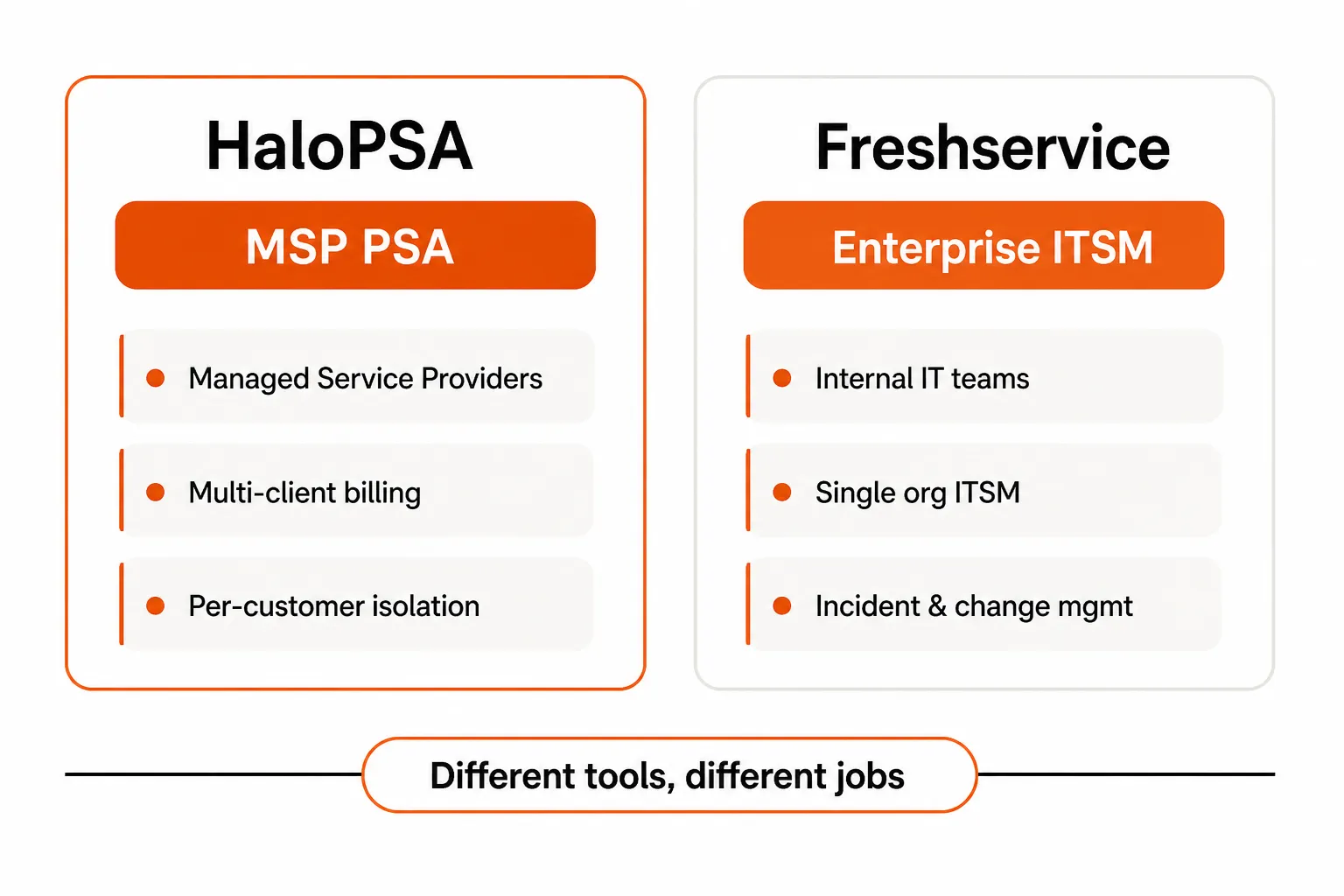
The reason this comparison keeps coming up: both tools can technically handle the basic "someone emails in a problem, a tech resolves it, ticket closes" workflow. If you only look at surface-level features, they're confusingly similar. If you look at what they're actually engineered for, they diverge immediately.
So who actually needs to read this comparison? A few real situations:
- A small MSP that's also doing some internal IT work for one or two larger clients, wondering if an enterprise ITSM tool might simplify things
- An internal IT team that's started offering managed services to a sister company or subsidiary and suddenly needs multi-client billing
- A tech evaluator who got both tools on a shortlist by accident and needs to cut through the noise before a stakeholder meeting
For everyone else: if you're an MSP, you want HaloPSA (or ConnectWise or Autotask). If you're an internal IT team at a company, you want Freshservice (or ServiceNow if you're enterprise, or Jira Service Management if your team already lives in Atlassian). Decision made.
For the edge cases, let's go deep.
HaloPSA
HaloPSA is made by Halo Service Solutions, a UK company founded in 1994 as NetHelpDesk. It has 5,000+ customers across 75+ countries, rates 4.8-4.9/5 on G2, Capterra, and Software Advice, and in 2022 took a majority investment from Hg Capital - one of the more credible software PE firms - while committing to a 10+ year independence pledge. That last part matters for MSPs doing a PSA migration: you want to know the platform will exist in five years without being absorbed into a larger software bundle.
The platform has four integrated modules:
- Service Desk - ticketing, SLA management, time tracking, customer portal
- Sales & CRM - opportunity pipeline, quote generation, proposal automation
- Time Tracking & Billing - billable time, invoice automation, Microsoft CSP billing
- Projects & Operations - project management, contract lifecycle, inventory, reporting
All four come for a single per-agent monthly fee, no add-ons. That pricing transparency - rates are published on their website, no sales call required - is unusual in the PSA category where ConnectWise and Autotask both require a quote.
The Actions engine
The thing that separates HaloPSA from lighter tools is the Actions engine. Actions are event-driven workflows that chain together with conditional logic - not just "if ticket created, assign to Team A" but genuinely multi-step business logic:
Trigger: Ticket created with "Network Outage" tag
→ Assign to Network Team
→ Set priority to Urgent
→ Post alert to Slack #network
→ If SLA < 1 hour, escalate to manager
→ Auto-log 15 minutes to "Response" billing code
You can nest conditions up to three levels before it gets unmaintainable. For most MSP automation - SLA escalation, auto-assignment, billing triggers, approval workflows - three levels is plenty. Users on Reddit and G2 consistently call it the highest automation ceiling in the PSA category.
Pricing
| Agent tier | Monthly per agent | Example: 20-tech team |
|---|---|---|
| 5-9 agents | ~$109 | $545/month |
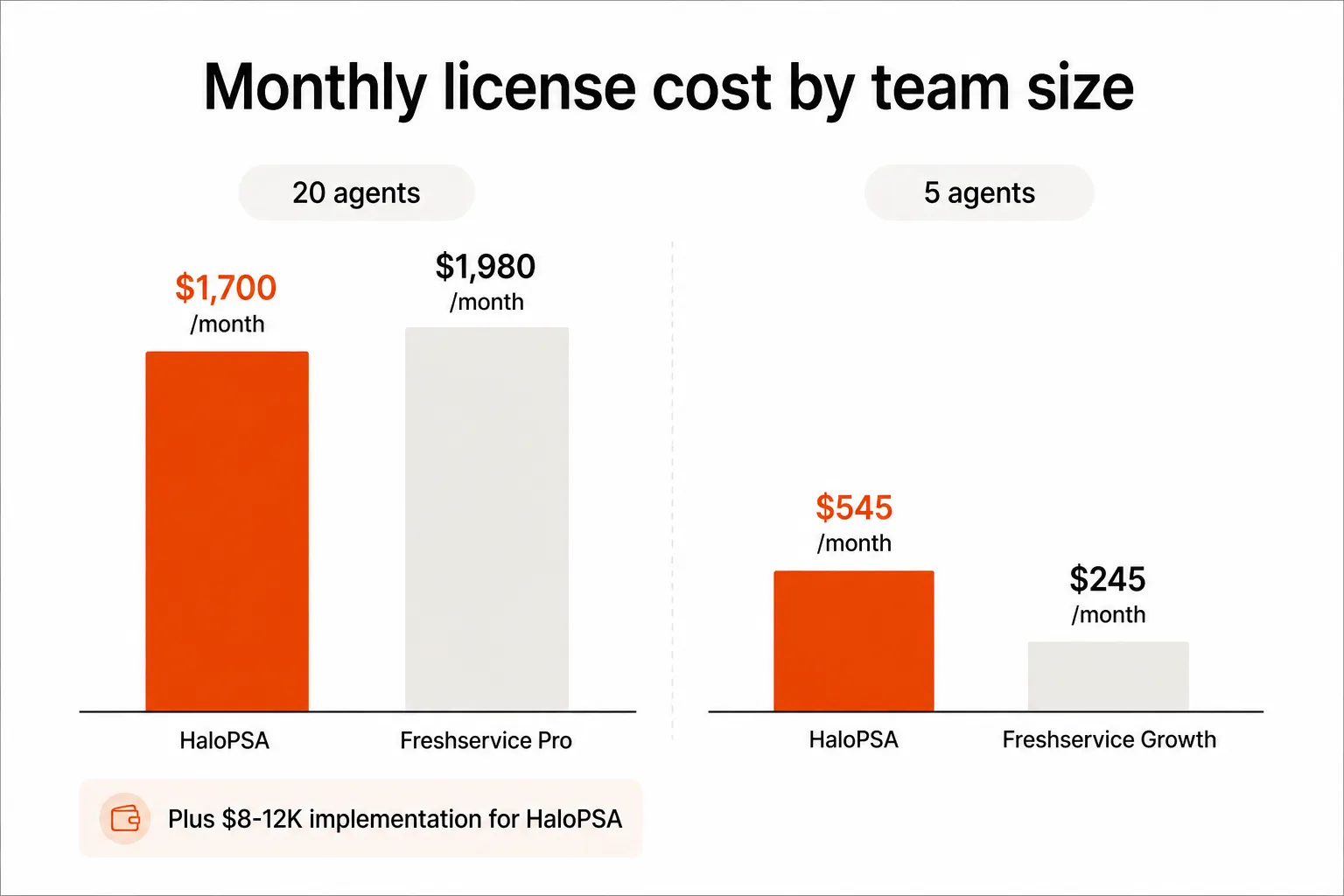
| 10-24 agents | ~$85 | $1,700/month |
| 25-49 agents | ~$69 | $2,070/month |
| 50-99 agents | ~$55 | $3,300/month |
| 150+ agents | ~$35 | – |
Hard floor: 5 agents minimum. Solo techs and 2-4 person shops either overpay or look elsewhere.
The number not on the pricing page: the "Halo admin" labor cost. A real HaloPSA rollout for a 20-tech MSP needs one tech dedicated to configuration - 20+ hours/week for the first three months, then 5-10 ongoing. At $35/hr, that's roughly $25,000-$50,000/year in labor. HaloPSA is cheaper on software than Autotask or ConnectWise; it's more expensive on the hidden labor side. A real 20-tech Year 1 cost lands around $28,400-$32,400 including licenses and implementation partners. Year 2+ drops to ~$18,000/year.
What real users say
The G2 sentiment is split by tenure. Long-term users (2+ years) give it five stars and rave about the customization depth. New users under six months often give four stars and note the learning curve. One candid CTO on G2 put it cleanly: "Halo's greatest strength, its customizability, also plays into its greatest weakness. It's incredibly complex."
On Reddit, the most-cited complaints are the mobile app ("the mobile app honestly may as well not exist"), billing sync reliability with QuickBooks, and documentation gaps - official guides that cover the what but not the why. The community fills in with MSPGeek Slack (#halopsa) and r/halopsa.
"We switched from [ConnectWise] and never looked back. But if you don't have someone who loves configuration, don't buy Halo." - r/msp community consensus, synthesized from multiple threads
HaloPSA is right for you if: You're a 10-50 tech MSP, you can staff a Halo admin, you sell Microsoft 365 (native CSP billing is worth it alone), and you want automation depth that scales with your operations.
Skip it if: You're under 5 techs, you want plug-and-play, or you need strong mobile for field ops.
Freshservice
Freshservice is the ITSM product in the Freshworks suite (alongside Freshdesk for customer support, Freshsales for CRM). It's been around since 2014 and sits firmly in the enterprise IT quadrant - a 2026 Gartner Magic Quadrant Leader for ITSM platforms, PinkVERIFY ITIL Gold certified, trusted by 20,000+ enterprises.
The product's pitch is straightforward: modern ITSM that deploys in weeks, not months. Against ServiceNow (which can take 6-12 months to implement), Freshservice's claim that 80% of customers go live in under 90 days is both true and the single most compelling thing about it. For IT managers who've watched a ServiceNow implementation eat an entire year and two FTEs, that number lands hard.
Core capabilities
- Incident Management - auto-routing, AI-assisted resolution, SLA tracking
- Change Management - risk assessment, dependency mapping, rollout orchestration
- Problem Management - root cause analysis, linked incident investigation
- Asset Lifecycle Management - hardware, software, contracts, SAM
- CMDB - asset relationships, continuous discovery
- Service Catalog - self-service portal, approval workflows
- Freddy AI - AI copilot for drafting responses, ticket routing, trend analysis
Freddy AI is worth a closer look because it's genuinely useful rather than feature-marketing. G2 reviewers note that Freddy Copilot saves "2-3 hours per agent per week on response drafting" and that "ticket routing now happens automatically; manual assignment load dropped 80%." The AI Insights tier (Enterprise plan) surfaces trends you'd otherwise miss - which categories are recurring, where resolution times are longest, what knowledge gaps are costing time. Freddy AI Copilot is a $29/agent/month add-on on Pro; it's included on Enterprise.
Pricing
| Plan | Annual billing | Monthly billing | Key additions |
|---|---|---|---|
| Starter | $19/agent/month | $23/agent/month | Incident management, knowledge base |
| Growth | $49/agent/month | $59/agent/month | Service catalog, SLAs, on-call |
| Pro | $99/agent/month | $119/agent/month | Change, problem, major incident mgmt |
| Enterprise | Custom | – | Freddy AI Insights, Agent Studio, sandbox |
For a 20-agent team: Growth at $980/month, Pro at $1,980/month. No 5-agent minimum. No implementation partner requirement. Self-service deployment with a 14-day free trial, no card required.
The total-cost-of-ownership picture is simpler than HaloPSA's - no "Freshservice admin" labor cost baked in, no implementation partner fees. Most mid-market IT teams deploy with one internal IT manager part-time over 8-12 weeks.
What real users say
G2 gives Freshservice 4.5/5 with 1,000+ verified reviews. Capterra puts it at 4.6-4.7. The praise is consistent: fast to deploy, modern UI, practical AI, transparent pricing. One typical review: "Deployed to 150 agents in 8 weeks with one internal admin, no consulting."
The criticisms are equally consistent: CMDB autodiscovery isn't as comprehensive as legacy tools like Cherwell or LANdesk, the workflow builder hits a ceiling for complex approval chains, and advanced analytics require custom development. And crucially - a common finding in G2 reviews: "We realized Freshservice isn't built for MSPs; no per-customer billing." At least one reviewer explicitly notes they switched to HaloPSA because of this.
The MSP absence in Freshservice reviews is telling. Search r/msp for Freshservice and you'll find almost nothing. The tool doesn't show up in MSP community conversations because it doesn't serve MSP workflows. That's not a criticism - it's clarity.
Freshservice is right for you if: You're an internal IT team at a 100-5,000 person company, you need structured ITSM without a year-long implementation, and you want modern AI tooling baked in.
Skip it if: You're an MSP or managed services operation, you need per-customer billing, or you have complex infrastructure that requires deep CMDB discovery.
Head-to-head comparison
| HaloPSA | Freshservice | |
|---|---|---|
| Primary market | Managed service providers | Enterprise/mid-market internal IT |
| Multi-client management | Yes (core feature) | No |
| Per-customer billing | Yes (T&M, retainer, CSP) | No |
| ITIL framework | Partial | Full (PinkVERIFY certified) |
| Change management | Basic | Full (Pro tier) |
| Asset management | Basic (inventory/stock) | Full (CMDB, SAM, lifecycle) |
| Automation depth | Very high (Actions engine) | Medium (no-code + low-code) |
| AI features | Via Actions + add-ons | Freddy AI built-in |
| RMM integration | 250+ integrations (native) | Via marketplace apps |
| Microsoft CSP billing | Native | Not available |
| Mobile app | Weak | Decent |
| Deployment time | 4-12 weeks (with Halo admin) | 2-12 weeks (self-service) |
| 5-agent minimum | Yes | No |
| Pricing (20 agents) | ~$1,700/month + implementation | $980-$1,980/month |
| G2 rating | 4.8/5 | 4.5/5 |
| Best for | 10-50 tech MSPs | 100-5,000 person IT teams |
The automation gap
This is the most interesting head-to-head dimension. HaloPSA's Actions engine is deeper - it was built for MSPs who need to model complex multi-client business logic: conditional billing, SLA escalation per client, multi-step approval chains, API calls to RMM tools. Freshservice's no-code workflow builder handles 80% of enterprise IT use cases well. Beyond that, you need custom development.
For an internal IT team, Freshservice's automation ceiling is usually enough. You're automating incident routing, change approval workflows, SLA triggers - not per-customer billing rules. For an MSP, HaloPSA's depth is the reason to pick it. No-code workflow builders can't replace the Actions engine when you need to model different automation behavior per client.
When to Pick HaloPSA
Pick HaloPSA when:
- You're running a managed service business. Multi-client billing, contract management, per-customer SLA isolation - these are table-stakes for MSPs and HaloPSA has them built in.
- You sell Microsoft 365 as a CSP reseller. The native CSP/Pax8 billing integration alone is worth the switch from Autotask for Microsoft-heavy shops.
- You need automation that scales. If you're building complex workflows - conditional billing, multi-tier escalation, API integrations with RMM tools - the Actions engine is the highest ceiling in the PSA category.
- You have 10+ techs and can staff a Halo admin. The 5-agent floor and the admin overhead make less sense for smaller shops, but from ~10 techs upward the platform starts paying back.
- You want published pricing and a transparent roadmap. Community-voted feature requests, public roadmap at halo.com/community, weekly release cadence. That's unusual for PSA vendors.
When to Pick Freshservice
Pick Freshservice when:
- You're an internal IT team, not a managed services operation. If you're managing one organization's IT, not multiple clients, you don't need PSA multi-tenancy. You need ITSM.
- Speed to value matters more than customization depth. A 20-tech internal IT team can be live in 6-8 weeks without a dedicated implementation partner. That's genuinely faster than most alternatives.
- You're replacing email/spreadsheet support or a legacy ITSM like Cherwell or LANdesk. Freshservice's migration path from legacy tools is well-documented and the UI is modern enough that adoption usually isn't the struggle.
- You want AI built in, not bolted on. Freddy AI Copilot and Insights are practical tools that save measurable time, not marketing theater. If this matters to you, the Enterprise tier is worth evaluating.
- You're on a tight budget for sub-10 agents. No minimum seat requirement, Starter at $19/agent/month - if you have a small IT team and just need structured ticketing, Freshservice is cheaper to start.
The missing piece: autonomous ticket resolution
Here's the thing neither HaloPSA nor Freshservice was built to do: actually resolve tickets autonomously. Both are platforms for managing tickets - routing, tracking, billing, reporting. The work of resolving them still lands on your techs.
For MSPs, this matters because 40-60% of inbound ticket volume is L1 grunt work - password resets, account unlocks, MFA issues, software installs. These tickets are fully automatable. They just need a layer that connects to your identity stack (Entra ID, Okta, JumpCloud), your RMM, and your PSA - and executes the fix, not just flags it.
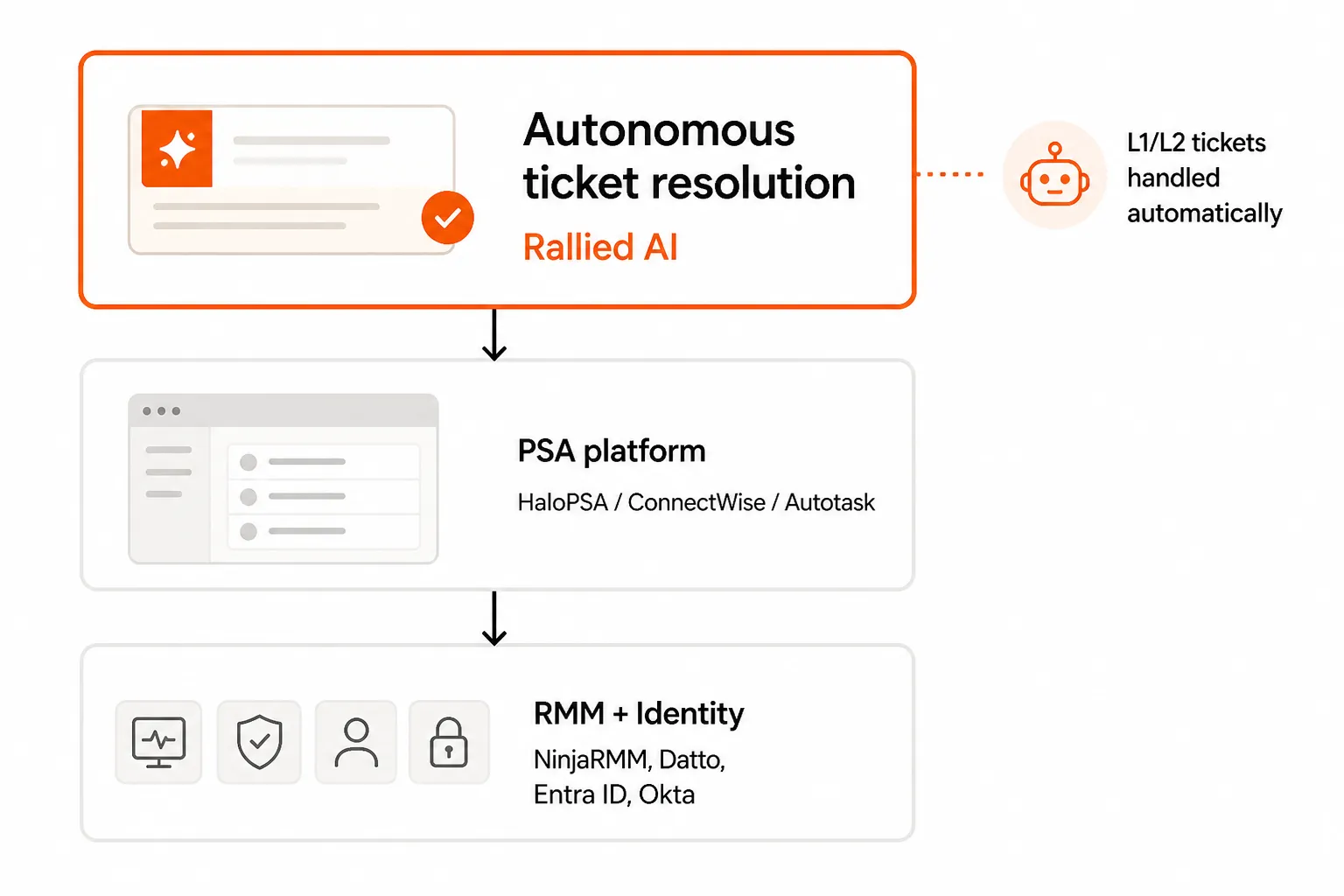
That's the problem Rallied is built to solve. It connects to your PSA (HaloPSA, ConnectWise, Autotask), your RMM (Datto, NinjaOne), and your identity tools (Entra ID, Okta, JumpCloud, Google Workspace), and handles L1/L2 tickets end-to-end. Not "here's a suggested reply" - actual execution. The PSA still owns the ticket; Rallied just closes it without a tech having to touch it.
The economics: at 200-400 automatable tickets per month at 15 minutes each, that's 50-100 hours of tech time recovered. Most MSPs put that at $7,000-$15,000/month in labor value. Rallied is $300 a month for 2,000 credits, about 700 tickets in a typical month, and deploys in the same week - not the 6-month Rewst implementation.
If you're evaluating HaloPSA and doing this math, it's worth sizing what the autonomous resolution layer would save before locking in the PSA contract. They stack: PSA owns workflow management, Rallied owns resolution execution.
Try Rallied
Rallied is an AI technician built for MSPs - it plugs into your PSA and handles L1/L2 tickets autonomously. Password resets, account unlocks, onboarding, offboarding, access management - done without a tech in the loop. Connects natively to HaloPSA, ConnectWise, and Autotask, plus the full identity and RMM stack.
Deploy it on a Friday. It starts working.
For the wider picture, read Best MSP Software in 2026.
Frequently Asked Questions
Is HaloPSA better than Freshservice for MSPs?
Yes - HaloPSA wins for managed service providers. It has per-customer billing, multi-client ticket isolation, native Microsoft CSP billing, and an automation engine (Actions) built around MSP workflows. Freshservice is designed for single-organization IT teams and has no multi-tenant support, which makes it a poor fit for MSPs who need to manage multiple client environments.
What is the difference between HaloPSA and Freshservice?
HaloPSA is a Professional Services Automation (PSA) platform for managed service providers - it handles ticketing, billing, contracts, CRM, and time tracking across multiple client organizations. Freshservice is an IT Service Management (ITSM) platform for enterprise IT teams within a single organization, focused on incident management, change management, asset management, and ITIL workflows. They serve different buyers and use cases.
How much does HaloPSA cost compared to Freshservice?
HaloPSA runs $109/agent/month for 5-9 agents, dropping to $85/agent/month for 10-24 agents and $69/agent/month for 25-49 agents. Freshservice costs $49/agent/month (Growth) or $99/agent/month (Pro) on annual billing. For a 20-agent team, HaloPSA comes to roughly $1,700/month vs. Freshservice Pro at $1,980/month - similar license costs, but HaloPSA typically adds $8,000-$12,000 in one-time implementation fees.
Can I use Freshservice as an MSP?
Technically yes, but it's a poor fit. Freshservice has no native multi-tenant architecture, per-customer billing, or reseller model. Managing multiple client environments would require workarounds - separate workspaces, manual billing processes, and custom integrations for RMM tools. MSPs are better served by purpose-built PSA platforms like HaloPSA, ConnectWise, or Autotask.
Does HaloPSA have AI features?
HaloPSA's AI capabilities center on its Actions engine - a powerful automation framework that can chain workflows, trigger on events, call APIs, and execute multi-step business logic. For autonomous ticket resolution (password resets, account unlocks, onboarding), MSPs typically pair HaloPSA with a dedicated AI layer like Rallied, which handles L1/L2 execution directly in the PSA.