MSP AI adoption statistics: what the data actually shows in 2026


TL;DR
90% of MSPs say AI is critical to their future. Only 41.5% have deployed it at any meaningful scale. The gap isn't skepticism - it's the brutal mismatch between what AI vendors promise and what MSPs actually experience in production. The data shows three clear patterns: IT monitoring and Copilot have solid adoption, autonomous ticket agents are overhyped, and the MSPs actually capturing ROI are the ones deploying narrow, deeply-integrated AI that does one thing well on day one. If you're evaluating AI tools for your shop, Rallied is worth a look - it connects to your PSA and identity stack and handles L1 tickets autonomously, no 6-month tuning project required.
The managed services industry is in a strange place with AI right now. Talk to any MSP owner at a conference and you'll hear two things in the same breath: "AI is going to transform everything" and "we tried three tools and none of them actually worked."
Both are true. That tension is what the data actually shows when you read past the vendor press releases.
Kaseya's 2026 State of the MSP Report, compiled from more than 1,000 MSPs worldwide, found that 48% of MSPs rank AI and automation as their clients' #1 need. The Lansweeper MSP AI adoption report found that 90% recognize AI as vital to growth, with 63.6% calling it "very important."
And yet: only 41.5% of MSPs have achieved AI integration above 25%.
That's the story. Broad recognition, thin deployment. Here's what the numbers actually show about why - and where the real wins are hiding.
Where MSPs actually stand on AI right now
The headline stat is striking but also misleading if you don't read the fine print. 90% awareness doesn't mean 90% deployment. Lansweeper's data is clear: most MSPs are early. Below 25% integration is a polite way of saying "we have Copilot for a few technicians and maybe some automated alerts."
The broader market gives you context for why adoption is accelerating anyway. Enterprise AI investment hit $37 billion in 2025, more than triple the $11.5 billion of 2024, according to Menlo Ventures. AI applications now represent 6% of the entire software market - the fastest-growing software category in history, reaching that share in just three years since ChatGPT's launch.
76% of AI solutions are now purchased rather than built internally, flipping from near-parity just 18 months ago. MSPs are buying, not building. The question is what they're buying and whether it's actually working.
Among the MSP 501 - Channel Futures' ranking of the industry's top performers - 72% report using Microsoft Copilot. That's the dominant AI tool in managed services right now. It's a research and scripting aid, not an autonomous agent. Technicians use it; it doesn't replace them. That distinction matters for understanding where AI ROI is real versus theoretical.
What MSPs are actually using AI for
The use case breakdown tells a cleaner story than the adoption-rate numbers do.
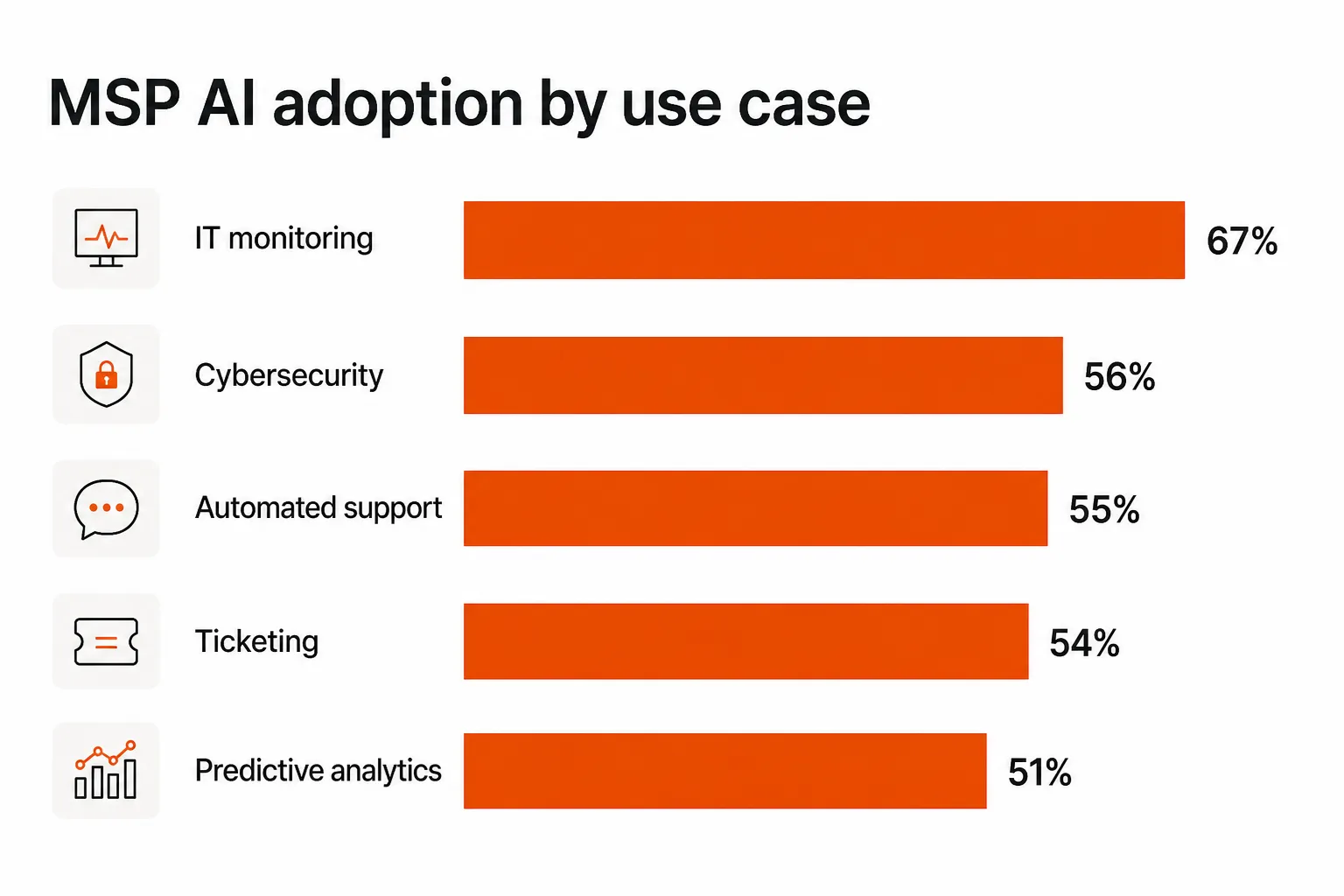
According to Lansweeper and Pax8 surveys, 66.7% of MSPs use AI for IT monitoring, making it the most widely deployed use case. That makes sense - alert triage and anomaly detection are exactly the kind of pattern-matching work where AI delivers reliable value without requiring deep integration into client workflows.
From there: 56.4% use AI-powered cybersecurity (increasingly a revenue-generating service offering, not just an internal tool), 55.4% deploy chatbots or virtual assistants for automated client support, 54.4% have automated some portion of ticketing and incident management, and 51.3% use predictive analytics to anticipate issues and cut downtime.
The pattern: AI is winning where it integrates into existing workflows without requiring MSPs to build new ones. Monitoring AI sits inside the RMM the team already uses. Native PSA AI - ConnectWise's built-in features, Autotask's AI - gets adopted because there's no additional vendor, no separate credential, no integration project.
Standalone autonomous agents are a different story.
The barriers that are actually slowing adoption
The data on what's blocking adoption is where things get interesting, because the top barrier isn't what most AI vendors focus on in their sales pitch.
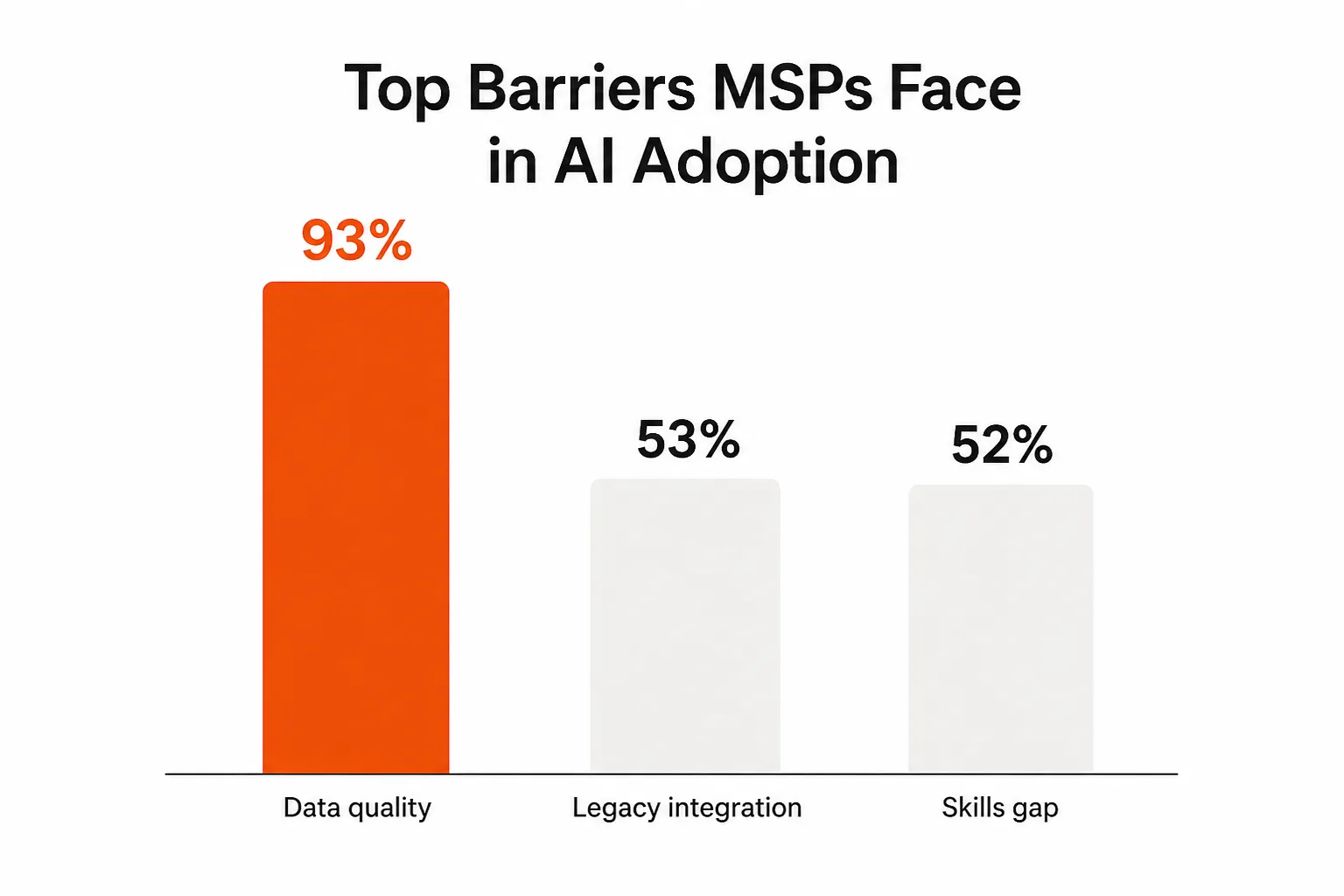
93.3% of MSPs cite data quality as a major barrier to AI adoption. That number is striking. It's not cost, not vendor trust, not executive buy-in - it's data quality. MSPs are sitting on years of inconsistently formatted ticket data, half-populated client records, and documentation that lives partly in IT Glue and partly in a tech's head. AI tools that depend on that data to work reliably... often don't.
52.8% struggle with legacy system integration. The PSA that's been running the business for eight years wasn't built with API-first AI integration in mind. Neither was the identity platform from 2017. Making a modern AI tool talk to all of that is a project, not a configuration.
51.8% face a shortage of skilled AI professionals. This one is particularly painful for smaller shops where "the team" is six people who are already stretched. There's nobody to own an AI implementation project.
Regional differences show up in the data too. EMEA MSPs rate AI as more critical to business growth than their North American counterparts, while North American MSPs face greater challenges sourcing skilled AI talent.
What the surveys undercount: the implementation-promise gap. Vendors say "30-minute setup." MSPs consistently report 3-6 months of integration work before seeing reliable results. That gap doesn't show up as a named barrier category in a survey, but it's the underlying driver behind every one of those three numbers above.
The ROI math: what actually pencils out
For MSPs who have gotten AI working, the numbers are real.
MSPs using AI report 50% faster ticket resolution times, per Kaseya. Those offering AI services have seen 20-30% year-over-year revenue growth, according to Pax8. Ticket deflection rates - the percentage of tickets handled without human intervention - average 23% without AI, but MSPs deploying AI effectively report rates of 40-60%.
The cost-per-ticket comparison is where the math becomes compelling:
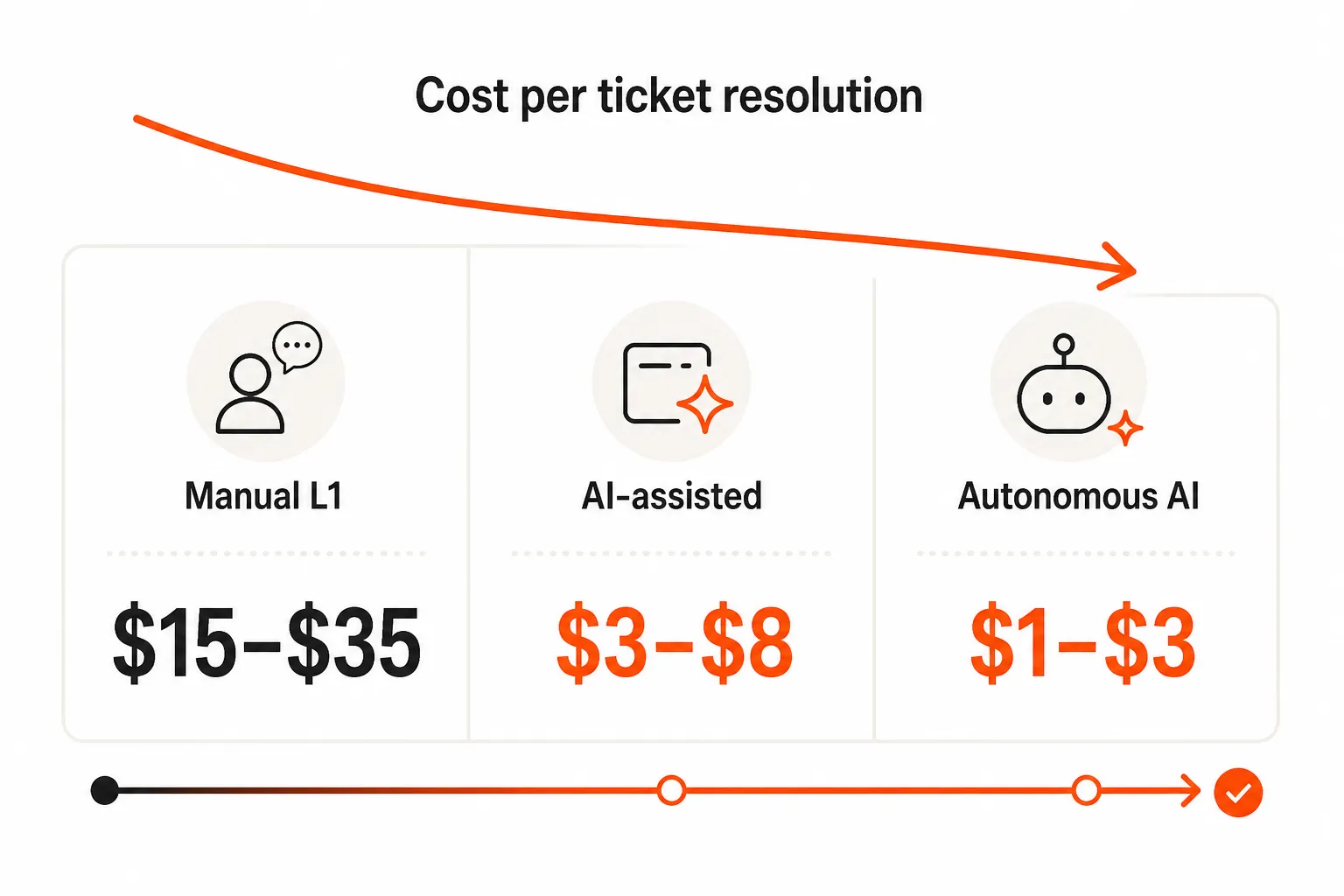
The 2026 AI Automation ROI Benchmark from Alice Labs puts manual L1 resolution at $15-35 per ticket. AI-assisted (human review, AI drafts) lands at $3-8. Fully autonomous L1 handling: $1-3. For an MSP handling 400 L1 tickets a month, that math gets attention fast.
But that's gross savings. The community is right to push back on the net calculation. Integration costs - typically $3-10K upfront plus $2-5K annually for maintenance - eat into the first year. Tuning time, when it exists, extends payback from "quarter one" to "sometime in year two." For many MSPs, the standard payback period lands at 6-12 months.
Where the ROI genuinely holds on a short timeline: narrow, task-specific automation that's already integrated with the systems it needs. Password resets via Entra ID. Account unlocks via Okta. MFA distribution through Google Workspace. These work on day one because they're talking to one API for one task. No tuning, no data quality dependency, no 6-month runway.
What the MSP community actually says
The surveys give you percentages. The forums give you the texture.
The most common complaint in MSP communities isn't that AI doesn't work - it's that vendors oversell what AI can handle in production environments:
"The vendor demos work on their lab setup with perfect data. Reality is your clients' environments are chaos - legacy systems, weird customizations, zero documentation. The AI is lost."
"We did a 90-day trial of an AI ticket tool. Cost: $3K tool fee plus 80 hours of our time integrating and configuring. Result: handled 35% of tickets without human review. Accuracy: 62%. We paid $4.5K to automate $1.2K of labor. Did not renew."
The ROI check is brutal because MSPs are running on thin margins. Unlike an enterprise IT department that can absorb a failed AI experiment as a learning budget line, MSPs have to justify every tool dollar against direct labor cost.
There's also a trust dimension that doesn't show up cleanly in surveys:
"Our clients pay us because we know their environment. An AI doesn't. I can't hand them an AI response on something critical. The risk isn't worth the tiny time savings."
This explains why Copilot adoption is so high. It's AI as a second opinion, not AI as the primary responder. The tech reviews it, decides, then acts. That's a fundamentally different risk profile than autonomous ticket resolution.
What actually gets adopted without friction - from every consistent thread in the MSP community - follows the same pattern: zero additional integration, narrow scope, immediate measurable ROI, human in the loop, and transparent decision logic. The AI tools that check all five boxes see adoption. The ones that check two or three face 6-month evaluations that often end in "did not renew."
Where MSP AI adoption is heading
The trajectory is clear, even if the timeline isn't. The ScalePad 2026 MSP Trends Report, which surveyed 1,100+ MSPs across North America in late 2025, found MSPs entering 2026 with plans to increase headcount, introduce new services, and pursue revenue growth - with AI as a key lever in all three.
The divide that's emerging is sharper than the overall adoption numbers suggest. Native AI in existing platforms - ConnectWise, Autotask, RMM tools - is seeing genuine traction because it requires no additional integration work. Standalone autonomous agents are facing sustained skepticism from the community, particularly from owners who've already been through a failed implementation.
From the MSP 501 perspective, the most candid assessment came from Sourcepass CEO Craig Fulton: "2025 marked a major shift toward automated, measurable outcomes, with AI-driven ticket resolution, workflow orchestration, and proactive issue prevention replacing traditional reactive support models." The operative word there is "measurable." The MSPs extracting real value are the ones holding AI to concrete metrics - ticket deflection rate, cost per outcome, resolution time - not feature lists.
The global MSP market is heading toward $511 billion by 2029, and AI is increasingly the differentiator in who captures margin and who competes on price. MSPs who deploy AI that integrates seamlessly and solves narrow problems with day-one ROI will scale. Those waiting for perfect conditions to adopt, or who've been burned once and written off the whole category, risk falling behind shops half their size that got the implementation right.
The window where "evaluating AI" is a competitive position is closing. The question is no longer whether to deploy it - it's which deployment actually works.
Try Rallied
Rallied is an AI technician purpose-built for MSPs - the kind of narrow, integrated, day-one deployment that the data shows actually delivers ROI. It connects to your PSA (ConnectWise, Halo, Autotask), RMM (Datto, NinjaRMM), and identity stack (Entra ID, Okta, JumpCloud, Google Workspace) to handle L1 tickets autonomously: password resets, account unlocks, MFA issues, onboarding, offboarding.
The differentiator that matters most given the data above: Rallied deploys in the same week, with no forward-deployed engineer and no 6-month tuning project. Rallied is $300 a month for 2,000 credits, about 700 tickets in a typical month, and tickets it can't finish are never charged. For an MSP handling 200 routine L1 tickets a month, $300 covers that volume in a typical month, against a $15-35 per-ticket manual baseline, and the difference shows by the end of the first billing cycle.
If the gap between "90% think AI is vital" and "41% have deployed it" has anything to do with your shop, that's where Rallied is designed to fit.
For the wider picture, read MSP Benchmarks 2026.
Frequently Asked Questions
What percentage of MSPs are using AI?
According to Lansweeper's MSP AI adoption report, 90% of MSPs recognize AI as vital to their growth strategy. However, only 41.5% have achieved AI integration above 25%, meaning the vast majority are still in early adoption stages. Kaseya's 2026 State of the MSP Report found that 48% of MSPs rank AI as their clients' top need - but awareness and deployment are two very different things.
What are the most common AI use cases for MSPs?
The top AI use cases among MSPs are IT monitoring (66.7%), AI-powered cybersecurity (56.4%), automated client support/chatbots (55.4%), ticketing and incident management (54.4%), and predictive analytics (51.3%), according to surveys by Lansweeper and Pax8. The highest-adoption use case is also the most practical: 72% of MSPs on the MSP 501 report using Microsoft Copilot as a daily research and scripting tool for their technicians.
What is the ROI of AI for MSPs?
MSPs deploying AI report concrete returns: 50% faster ticket resolution times, 20-30% year-over-year revenue growth for MSPs offering AI services, and 50-100 freed technician hours per month for shops automating L1/L2 work. Cost per ticket drops dramatically - from $15-35 for manual resolution to $1-3 for fully autonomous L1 handling, per the 2026 AI Automation ROI Benchmark. The catch: integration costs and tuning time often extend payback periods to 6-12 months.
What stops MSPs from adopting AI?
The three biggest barriers, according to Lansweeper's research: data quality issues (cited by 93.3% of MSPs), legacy system integration complexity (52.8%), and a shortage of skilled AI professionals (51.8%). Beyond those numbers, MSP communities consistently report a fourth barrier the surveys undercount: implementation promises that don't match reality. Vendors say '30-minute setup.' MSPs report 3-6 months of integration work before seeing reliable results.
Is AI actually worth it for smaller MSPs?
For smaller MSPs, the ROI math depends heavily on the use case. General-purpose autonomous ticketing agents rarely pencil out at smaller scale - the integration cost and tuning time often exceeds the labor saved. Narrow, task-specific automation (password resets, account unlocks via identity platforms like Entra ID or Okta) delivers faster payback with lower risk. Native AI in platforms MSPs already use - like ConnectWise AI or Autotask AI - is the highest-ROI entry point because it requires no additional integration spend. Rallied is purpose-built for exactly this use case, connecting to your existing PSA and identity stack to handle L1 tickets autonomously from day one.