vCIO services: the MSP's highest-margin offering


TL;DR
vCIO is the highest-margin service line most MSPs will ever sell - 60%+ gross margin on paper, with no product cost and a recurring retainer. The catch: about half of MSP vCIO programs collapse within two years, almost always for the same reason. The vCIO starts getting pulled into L1/L2 work. Scope creeps. What looked like a 60% margin engagement quietly becomes 25%. The fix isn't a better contract template - it's solving what's happening below the vCIO layer. When your technicians aren't spending 50–100 hours a month on password resets and account unlocks, the math for vCIO actually holds. Rallied handles that layer autonomously, so your senior people can stay in the advisory seat where the margin lives.
What vCIO actually means (and what it doesn't)
The term gets stretched. We've seen MSPs call it "we do QBRs" and we've seen it mean genuine C-suite advisory work that shapes a company's three-year infrastructure strategy. Those are not the same thing, and the margin difference between them is real.
At its core, a vCIO is a virtual Chief Information Officer - a senior advisor who takes responsibility for a client's technology strategy on a contractual basis. They're not managing the help desk. They're not patching servers. They're sitting across the table from the CFO explaining why the company's current vendor stack is going to cost $200k more than necessary over the next three years and what to do about it.
The deliverables that make vCIO distinct from managed services:
- Technology roadmap - a 12–36 month plan with milestones, cost projections, and risk assessment
- Quarterly business reviews (QBRs) - structured 2–4 hour sessions covering roadmap progress, budget vs. actual, and upcoming decisions
- IT budget forecasting - year-over-year spend projections, vendor consolidation opportunities
- Vendor management - contract reviews, renewal negotiations, replacement evaluations
- Strategic planning - aligning IT investment with business objectives
- Ad hoc advisory - available for technology decisions, hiring advice, RFP guidance
What's not included: day-to-day break-fix, implementation work, hardware procurement, or staff training delivery. The vCIO plans. Someone else executes.
That boundary is the whole business model. The moment it breaks down, so does your margin.
The margin math - and why it usually doesn't hold
The numbers look compelling. A $3,000/month vCIO retainer on a 50-person client costs roughly $1,200 in labor (15–20 hours/month at a blended senior rate). That's 60% gross margin. Add it to an existing $5,000/month managed services contract and you've taken the account from $5,000/month at 30% margin to $8,000/month at 41% margin - a 60% revenue increase with most of it dropping to the bottom line.
At scale, an MSP with 10 vCIO clients at $3,000/month is generating $360,000/year in vCIO revenue. With a fully-loaded senior resource at $150,000/year, that's $210,000 in gross profit from one service line. That's why every MSP conference has a vCIO session.
Here's what actually happens:
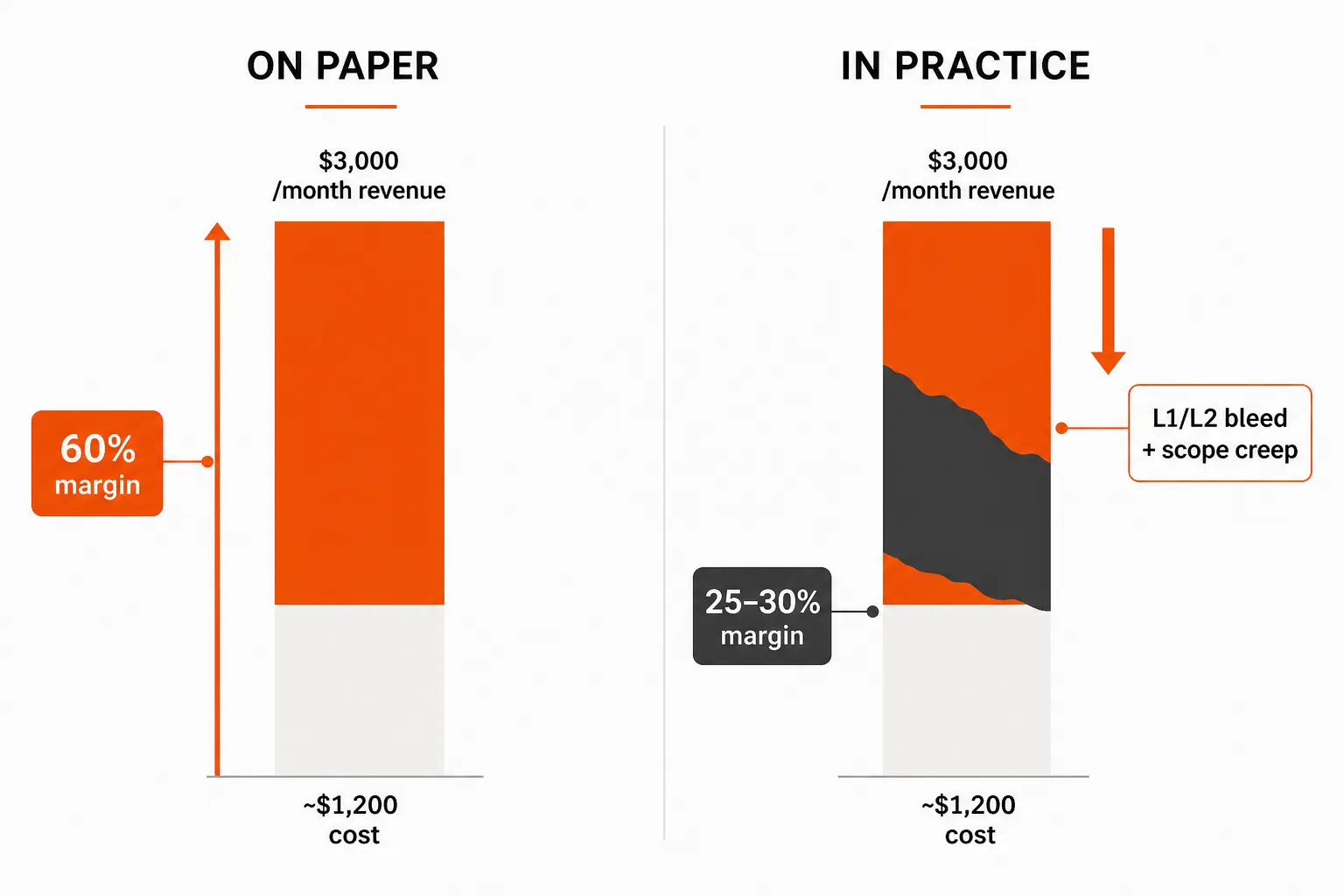
The vCIO is typically your most trusted, most knowledgeable person on the account. So when the email server has a problem, they get called. When the CFO's laptop won't connect to a vendor portal the day of a board meeting, they get called. When there's a project that only one person understands, that person is the vCIO.
On r/msp, the post-mortem reads the same way every time:
"We launched a vCIO service with our principal tech. First 6 months looked great - $2,500/month, margin looked solid. By month 8, he's basically on-call for every client emergency. Now he's doing 30 hours of break-fix work and 20 hours of strategy. The margin math broke."
That 50/50 split is the norm, not the exception. The fix isn't better intentions - it's operational structure. The vCIO must not own L1/L2 resolution. Which means someone (or something) else has to.
How to structure vCIO delivery that actually holds margin
Three things separate the MSPs that make vCIO work from the ones who exit the program after 18 months.
1. Separate the stack
The vCIO never handles tickets. Full stop. This isn't a philosophy - it's a staffing and workflow decision. If your vCIO is also your escalation path for L1/L2 work, you've made them too expensive and too distracted for the advisory role. This means you need a clear, trusted L1/L2 resolution layer that doesn't depend on the vCIO.
For most MSPs, this is where the operational math gets hard. Hiring a second senior tech costs $80–100k/year. Outsourcing to a NOC adds latency and inconsistency. The option that's actually changed the calculus in the last two years: AI technicians like Rallied that close L1 tickets end-to-end - password resets, account unlocks, onboarding, offboarding - without a human touching them. At $300 a month, which covers about 700 tickets in a typical month, a 300-ticket/month MSP gets back what used to eat 75 hours of tech time. That $300 buys back the capacity that makes vCIO delivery sustainable.
2. Written scope with hour caps
"Strategic advisor" is not scope. Neither is "quarterly business reviews." Every vCIO engagement needs a written engagement letter that specifies:
- Exact deliverables (number of QBRs per year, frequency of roadmap updates, vendor review cadence)
- Monthly hour cap ("up to 20 advisory hours/month; additional hours billed at $[rate]/hour")
- What's out of scope (project management, staff training delivery, implementation work)
- What escalation looks like when scope expands
Without this, "advisory" becomes everything. You'll be writing RFPs, attending board meetings, and project-managing vendor migrations before you realize you've turned a $3,000/month retainer into a full-time job.
Time tracking matters here too. Every hour a vCIO spends should be logged to the engagement. If strategic work drops below 70% of logged hours, that's a flag - not for the client, but for your own operation.
3. Right-sized client load
A vCIO carrying 8–10 clients will burn out. The economics look great on the spreadsheet - $3,000/month × 10 clients = $360,000/year from one person - but the reality is that deep advisory work can't scale that way. You need relationship continuity, deep account context, and protected planning time. That's hard when you're rotating across 10 accounts.
The r/msp consensus puts the sustainable load at 4–6 clients per dedicated vCIO. Beyond that, engagement quality degrades and clients feel it. They're paying for a senior advisor who knows their business - if they're getting a rotating cast of people who can't remember last quarter's decisions, the engagement won't renew.
The implication: scaling vCIO means hiring, not overloading. Plan for a new vCIO hire when you have 4–5 clients lined up for them - not after you've already burned the first one.
Pricing models that work (and the mistake most MSPs make)
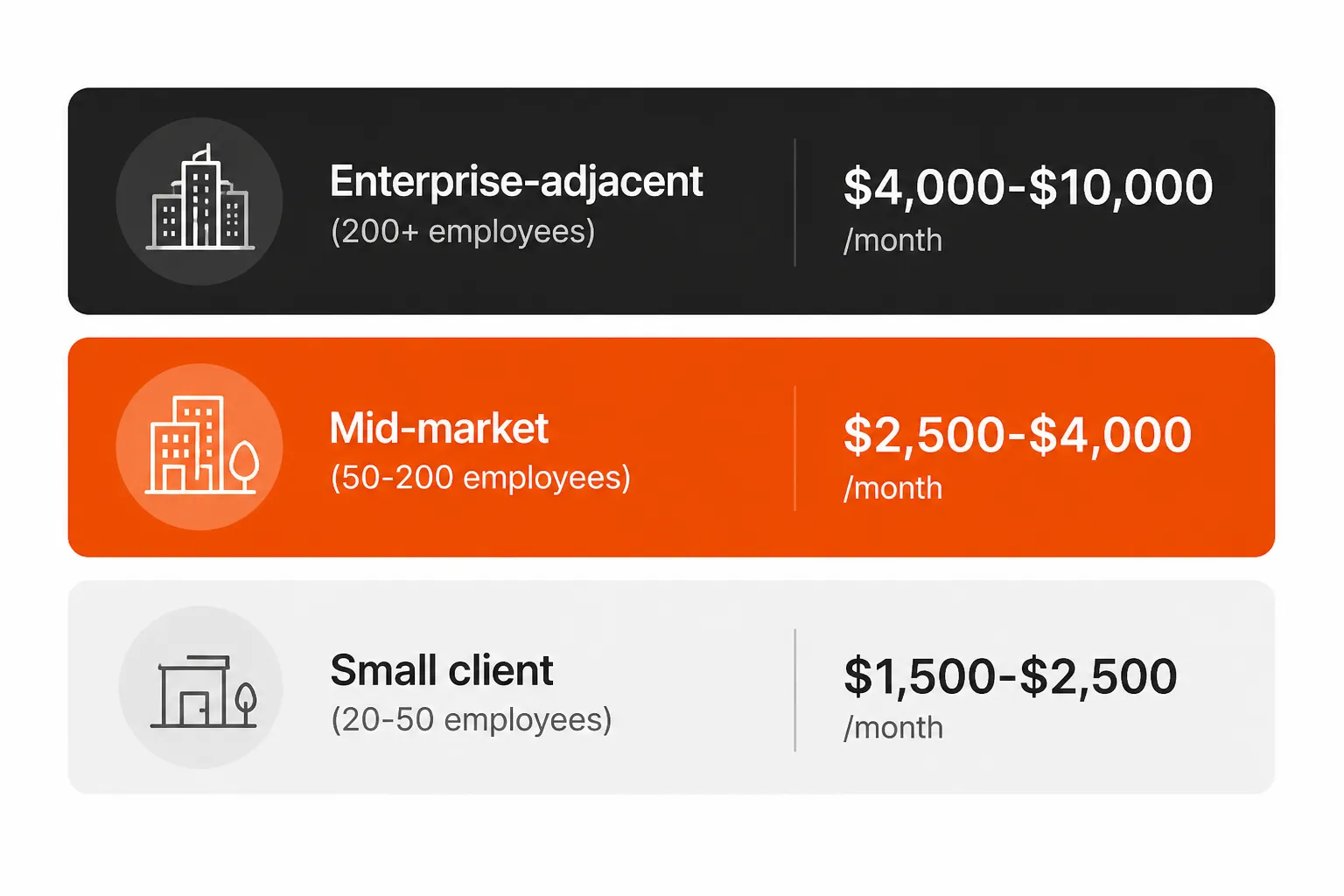
Four models are in active use across the MSP market:
Monthly retainer (most common)
Fixed fee for a defined package of deliverables. The benchmarks from r/msp and industry surveys cluster around:
| Client size | Typical monthly retainer |
|---|---|
| Small (20–50 employees) | $1,500–$2,500/month |
| Mid-market (50–200 employees) | $2,500–$4,000/month |
| Enterprise-adjacent (200+ employees) | $4,000–$10,000+/month |
Healthcare and finance clients typically carry a 20–40% premium on these ranges. A 100-person healthcare clinic is a $3,500–$5,000/month vCIO engagement, not a $2,500 one. The regulatory complexity and audit requirements are real, and clients in those verticals understand the premium.
Per-user, blended with managed services
$50–$200 per user per month, rolled into the overall managed services rate. This works for smaller MSPs who want to avoid a separate pricing conversation, but the downside is discipline: if vCIO is just "part of the service," it's easy to accidentally give it away without capturing the value.
Quarterly flat rate
$3,000–$10,000 per quarter for a defined package (2–4 QBRs, one strategic planning session, vendor reviews). Simple to quote and sell. Works best for clients with predictable, seasonal needs.
Project-based entry
For MSPs new to vCIO, a one-off project (technology roadmap: $5,000–$20,000; vendor evaluation: $2,000–$10,000; compliance assessment: $10,000–$50,000+) is a natural first engagement. About 30–50% of project clients convert to ongoing retainers within 6–12 months once they see the value.
The pricing mistake that's hardest to recover from
Underpricing the first engagement. It's tempting to offer $1,500/month to "get started," but that anchors the relationship. Twelve months of deep engagement later, when you try to raise it to $3,500, the client compares it to what they've been paying and balks. The first engagement sets the price expectation for the entire relationship.
Price for your actual cost from day one. A vCIO resource costs $104,000–$169,000/year fully loaded. At 5 clients, they need to average $1,733–$2,817/month just to break even. At $2,500+ each, you're building real margin. At $1,500, you're not.
The vCIO staffing problem (and why it kills programs)
This is the one most MSP owners underestimate. vCIO is not a technical role - it's a business advisory role with an IT overlay. The person in that seat needs to:
- Talk to the CFO in language the CFO cares about (ROI, risk, budget, competitive positioning)
- Negotiate vendor contracts with leverage
- Translate technical trade-offs into business consequences
- Hold a room of executives' attention for two hours without sounding like the help desk
Most MSPs have one or two people who can genuinely do this. Promoting the senior architect usually doesn't work - they know the stack but default to technical depth in client conversations. The client feels like they're talking to a very smart technician, not a strategic advisor.
On LinkedIn, the MSP operators who've scaled vCIO successfully are consistent: they hired for business acumen and trained for technology, not the other way around. People with consulting backgrounds, finance experience, or operations management who happen to understand IT often outperform pure technologists in the vCIO seat.
That's a different hiring profile, which means a different salary band. A credible vCIO earns $100,000–$150,000+. Budget accordingly.
Vertical focus beats generalism every time
Generic vCIO programs struggle. Healthcare-specialist vCIO programs succeed. The difference is defensibility.
A generic vCIO competes on "we do strategic IT advisory." Any MSP can say that. A healthcare-focused vCIO competes on "we know HIPAA, we've guided 12 medical practices through BAA negotiations, we understand how audit requirements translate into infrastructure decisions, and we benchmark you against your peers." That's a very different conversation - and it commands a 20–40% pricing premium.
The same dynamic applies to finance, manufacturing, and legal. Regulatory complexity is the vCIO's best friend: it creates genuine, high-stakes advisory need that clients can't satisfy with a Google search.
Pick one or two verticals. Build real depth. The margin follows.
The layer below vCIO: why it matters more than MSPs expect
The vCIO margin story only holds when the operational layer beneath it is clean. That's the part most conversations skip.
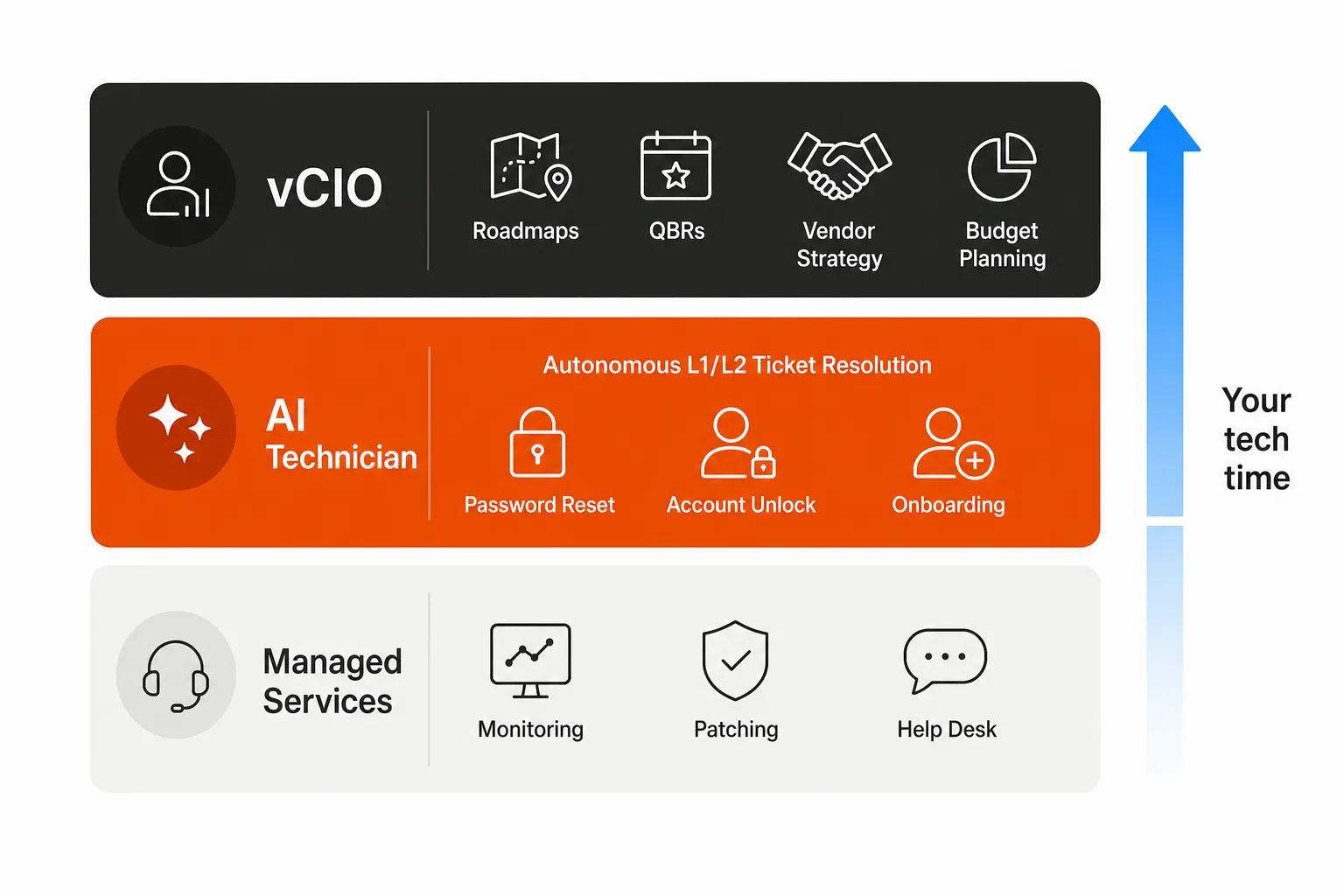
The math: a typical MSP handles 200–400 L1/L2 tickets per month. At 15 minutes per ticket, that's 50–100 hours/month of tech time. At $75/hour blended rate, that's $3,750–$7,500/month in labor on work that doesn't require a human - password resets, account unlocks, onboarding, offboarding, license assignments.
That's the same pool of senior tech time you need for vCIO delivery. If it's being consumed by L1/L2, your vCIO program is competing with the help desk for the same scarce hours.
The cleanest fix is removing the L1/L2 dependency altogether. That's what Rallied does - an AI technician that connects to your PSA (ConnectWise, Autotask, Halo PSA, SuperOps), your RMM (Datto, NinjaRMM), identity systems (Entra ID, Okta, JumpCloud, Google Workspace), and documentation (IT Glue, Hudu), and closes L1 tickets end-to-end without a technician involved. Password reset: resolved and closed. Account unlock: done. New hire onboarding across M365, AD, security groups, and RMM: handled.
At $300 a month, a 300-ticket/month MSP frees 75 hours of tech capacity, and that volume fits inside the plan in a typical month. That's 75 hours that can go into vCIO work - client roadmaps, QBR preparation, vendor analysis - rather than password resets.
Rallied deploys the same week. There's no six-month implementation or dedicated admin overhead. Which means the ROI math on freeing up vCIO capacity is immediate, not theoretical.
The five failure modes worth obsessing over
We covered the margin math above. These are the specific operational failures that kill vCIO programs - worth naming explicitly so you can check your own setup against them.
1. L1/L2 bleed - The vCIO handles tickets because they're the most trusted person on the account. Margin collapses. Fix: hard operational boundary, dedicated L1/L2 resolution layer.
2. Vague scope - "Strategic advisor" means everything. By month four, the vCIO is writing RFPs, attending board meetings, and managing vendor relationships that weren't in the original scope. Fix: written engagement letter with specific deliverables and monthly hour cap.
3. Underpricing the first deal - Price anchors. If you open at $1,500/month, $3,500/month feels like extortion twelve months later. Fix: price from cost, not from the urge to win.
4. Wrong person in the role - The senior architect knows the stack but can't hold a CFO's attention. The engagement loses credibility and doesn't renew. Fix: hire for business acumen, train for technology.
5. Overloading the vCIO - Eight clients instead of five. The calendar has no protected planning time. Quality degrades, the vCIO burns out, clients churn. Fix: conservative load (4–6 clients max), hire ahead of demand.
What a working vCIO engagement looks like quarter by quarter
Quarter 1 (assessment): Deep current-state audit - infrastructure, vendors, spend, security posture. Interviews with C-suite and key staff. Output: baseline report and initial recommendations. High touch, high cost in hours, but sets up everything downstream.
Quarters 2–3 (planning and roadmap): Build the technology roadmap, draft the IT budget, identify quick wins and major initiatives. First QBRs. Scope discipline is most critical here - projects and priorities will multiply if you don't enforce boundaries.
Year 2+ (steady state): Monthly or quarterly touchpoints. Steering project work. Vendor reviews. Roadmap updates at each QBR. The vCIO should have enough account depth that they're adding value in every conversation, not catching up.
One rule worth internalizing: the roadmap never ends. Clients who finish a major initiative sometimes think the engagement is over - "we did the cloud migration, thanks." The retention play is always having the next initiative scoped, budgeted, and on the roadmap before the current one closes.
Try Rallied
If vCIO delivery is on your roadmap - or if you're already running a vCIO program and watching the margin erode - the place to start is the L1/L2 layer.
Rallied is an AI technician built specifically for MSPs. It connects to your PSA, RMM, identity systems, and documentation, and autonomously resolves L1/L2 tickets - password resets, account unlocks, onboarding, offboarding - without a human involved. Same-week deployment, no implementation fee, $300 a month for 2,000 credits, about 700 tickets in a typical month.
Frequently Asked Questions
What does a vCIO actually do for an MSP client?
A vCIO provides strategic IT oversight: building technology roadmaps, running quarterly business reviews, managing vendor contracts, and aligning IT spend with business goals. Unlike managed services - which handle day-to-day operations - vCIO is a boardroom-level advisory role. The client brings the business objectives; the vCIO builds the IT strategy to support them.
How much should an MSP charge for vCIO services?
The typical range is $1,500–$5,000/month depending on company size, vertical, and engagement depth. Small clients (20–50 employees) usually land at $1,500–$2,500/month; mid-market clients (50–200 employees) at $2,500–$4,000/month. Healthcare and finance clients typically carry a 20–40% premium due to regulatory complexity. Most MSPs that price below $2,000/month to 'win' the deal struggle to raise it later - price for your actual cost from the start.
Why do vCIO programs fail?
The most common cause is L1/L2 work bleeding into strategic time. When the vCIO is also the most trusted technical person on the account, they get pulled into fires that eat 40–50% of their capacity. The margin math collapses. Other common causes: vague scope (no written hour caps), underpricing the first engagement, and staffing the role with junior technicians who don't have C-suite credibility.
How many vCIO clients can one person handle?
A sustainable load is 4–6 clients per vCIO. Beyond that, engagement quality degrades: the vCIO can't maintain deep relationship context across too many accounts, and scope creep starts eating hours faster than they can track it. MSPs that push a single vCIO to 8–10 clients usually see burnout within 18 months and client churn shortly after.
How does automating L1/L2 tickets help MSPs deliver better vCIO services?
The math is direct: a typical MSP handles 200–400 L1/L2 tickets/month at 15 minutes each - that's 50–100 hours of tech time that could be redirected to strategic work. Tools like Rallied autonomously resolve these tickets (password resets, account unlocks, onboarding/offboarding) without a technician touching them. That reclaimed time is what makes vCIO delivery feasible at scale - you can staff the advisory role without burning your best people on grunt work.