Auvik vs PRTG: Which network monitoring tool is right for your MSP in 2026?
TL;DR
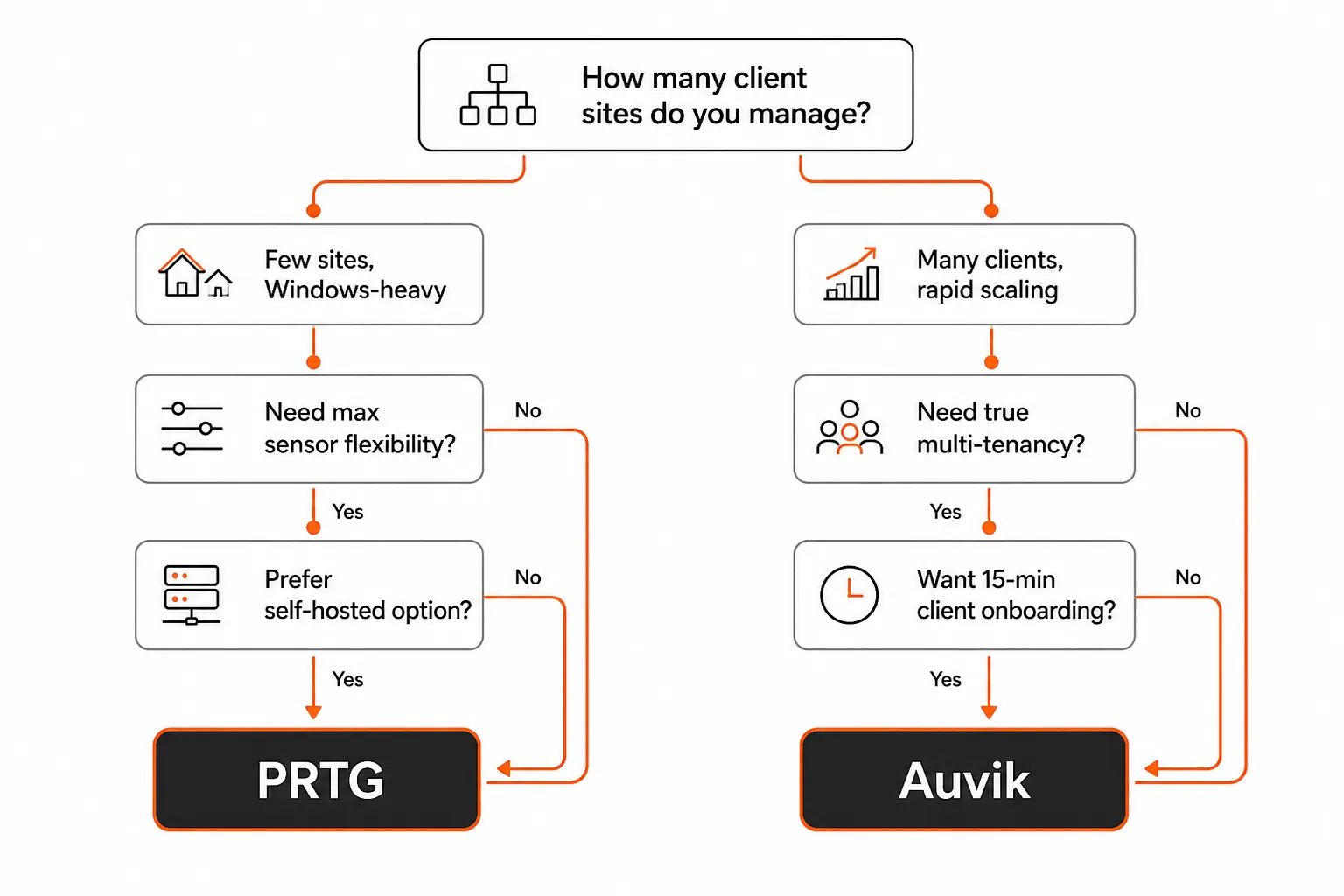
Auvik is built for MSPs. PRTG is built for IT departments that happen to have MSP ambitions. If you're managing a handful of Windows-leaning SMB clients and want maximum sensor depth, PRTG earns its reputation - its free 100-sensor tier is genuinely useful and the sensor library is unmatched. If you're scaling a multi-client portfolio and need clean tenant isolation without babysitting a sensor budget, Auvik's architecture was designed for exactly that shape. The pricing twist: neither publishes a clean number you can plan against, and PRTG's 2024 subscription shift made its cost structure considerably less predictable than it was three years ago. Pick based on your client volume, not the feature sheet.
Both tools will monitor your clients' networks. The question is which one keeps working as your MSP grows - and which one turns into a billing surprise you have to explain at renewal. We've run through both in detail: the docs, the pricing pages, the G2 reviews, the Flamingo MSP teardown of PRTG, the Reddit threads. Here's what we found.
Why this comparison matters more in 2026
When MSPs compare network monitoring tools, they're usually in one of two situations: they're just getting started and want something they can actually deploy without a two-week project, or they're mid-scale and realizing their current tool doesn't fit how their business has grown.
PRTG's July 2024 subscription change pushed a lot of MSPs into that second camp. Paessler ended perpetual licenses and converted maintenance renewals to full subscriptions - the XL1 (Unlimited) license went from around €3,900/year in annual maintenance to €8,800/year as a full subscription. The Register documented the shift; community threads on r/msp called it everything from "expected" to "a gut punch." MSPs who'd been paying small legacy renewals suddenly faced bills that were 200-300% higher.
That made the Auvik comparison suddenly very relevant. So let's run it properly.
Auvik at a glance
Auvik is a cloud-native network monitoring and management platform built specifically for MSPs. The core loop is simple: install a lightweight collector on a client network, and within 30 minutes you have automated device discovery, a live topology map, and 64+ preconfigured alerts running. Auvik's marketing claims 15-minute client onboarding - and based on the community feedback we read, that's not hyperbole. Multiple MSPs on Reddit and G2 confirm the setup time is genuinely fast.
The platform is cloud-only. There's no self-hosted option, which is worth knowing if your clients have compliance requirements that touch where monitoring data lives. The architecture is natively multi-tenant - every client is a first-class tenant with hard data isolation, not a role-filtered view into a shared database.
Auvik integrates with ConnectWise, Autotask, Halo PSA, IT Glue, PagerDuty, and 20+ other MSP stack tools. It won 2025 MSP Today Product of the Year and counts 80,000+ IT professionals in its user base.
Where Auvik is strong:
- MSPs managing many clients simultaneously
- Fast onboarding of new client sites
- True multi-tenancy without per-client server overhead
- PSA/RMM integration for auto-ticketing on alerts
Where it's weaker:
- No published pricing - requires a sales call
- No self-hosted option
- Less sensor flexibility than PRTG for non-standard or industrial monitoring
- No AI-driven anomaly detection (vs PRTG 25.4's baseline AI features)
PRTG at a glance
PRTG (Paessler Real-time Graphing) is one of the most established network monitoring platforms in the market. 500,000+ active users. 4.7/5 on G2 with 209 reviews. 4.6 on Capterra (240+ reviews). PC Magazine gives it an Editor's Choice. There's a reason it's been in the stack of so many IT teams for over a decade.
The core unit is the sensor - one metric from one device. PRTG ships with 320+ sensor types out of the box, covering SNMP, WMI, SSH, REST APIs, packet sniffing, NetFlow, Modbus, MQTT, custom PowerShell/Python scripts, and more. Auto-discovery finds ~90% of what you need without manual config, per user reviews.
PRTG runs self-hosted (on your server), as a Paessler-managed hosted monitor (cloud SaaS), or as an enterprise multi-database deployment. The free tier - 100 sensors, unlimited time - is a genuinely useful evaluation environment.
Where PRTG is strong:
- Maximum sensor depth and protocol breadth
- Self-hosted option for compliance-sensitive clients
- Free 100-sensor tier for evaluation
- AI anomaly detection in v25.4+
- Broad third-party integrations via HTTP API
Where it's weaker:
- Sensor-based pricing creates unpredictable cost as portfolio grows
- Subscription-only since July 2024 (no perpetual escape hatch)
- Multi-tenancy requires separate instances for real client isolation
- Setup complexity increases significantly past auto-discovery
Deployment and setup speed
This is one place where the two tools genuinely diverge.
Auvik's 15-minute client onboarding claim is real. Install the collector, wait 30 minutes for full topology. The Darren Schmidt quote from Executech on Auvik's site - "It's so flexible, but so powerful. It's something in my tool belt that I don't ever wanna lose" - is representative of what the community says. Junior techs can navigate and troubleshoot without needing senior oversight.
PRTG's auto-discovery is also fast for the first client. As Peeyusha D. put it in a G2 review from February 2026:
"When I drop a new core switch or a hypervisor onto the network, PRTG's Auto-discovery finds about 90% of what I need (CPU, traffic, disk) without me having to manually look up OIDs or hunt for templates. It's the 'lazy man's' dream that makes me look like I'm working much harder than I am."
The friction with PRTG comes when you're deploying it across a multi-client MSP environment. Remote probes are free (Paessler's MSP program includes them), but you're still setting up a central server, managing probe connectivity, and - if you want real client isolation - provisioning separate instances per client. That's infrastructure overhead that compounds as your portfolio grows.
For a new client onboard in an MSP context, Auvik is faster. For adding a new monitoring dimension on an existing PRTG setup, PRTG often wins because the sensor is already built.
Monitoring depth: where PRTG pulls ahead
This is PRTG's strongest argument.
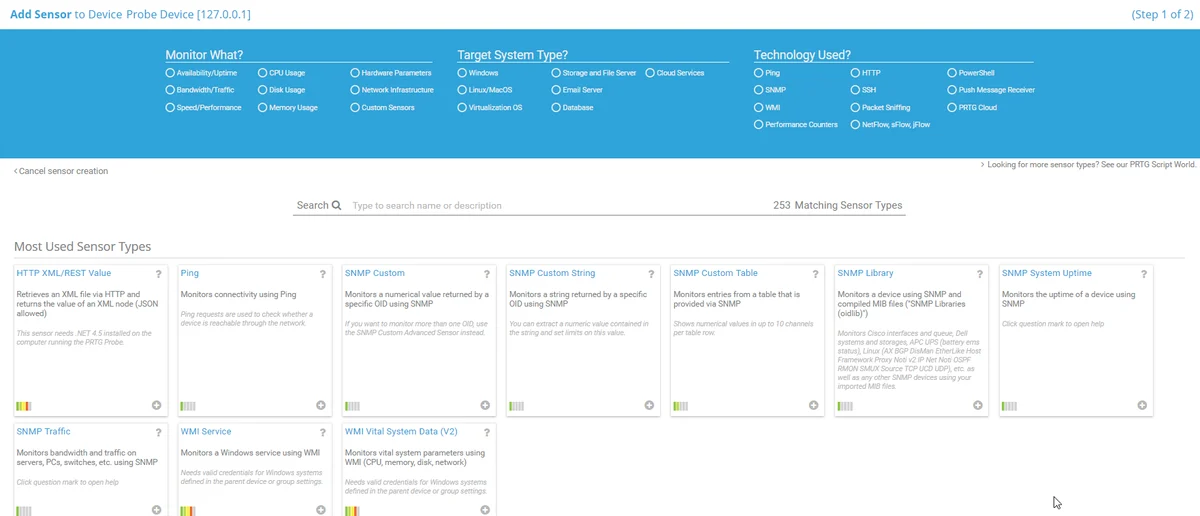
The sensor picker above shows what we mean. 320+ sensor types. Filter by what you want to monitor, the target system type, the technology. Industrial PLCs via Modbus. Custom EXE scripts for proprietary APIs. WMI on every Windows box, SNMP on every network device, SSH on every Linux server. You can monitor legacy SCADA systems running on hardware from 2004 if you need to.
From Sainath H., Associate Software Engineer at G2 in March 2026:
"The absolute standout for me is how effortlessly I can spin up custom EXE sensors that pull live Modbus data straight from our legacy PLCs on the factory floor and correlate it with power draw on individual CNC machines. No other tool I've tried lets me do that without fighting through three layers of middleware or writing a full-blown agent."
Auvik doesn't have an equivalent. Its monitoring is excellent for standard network infrastructure - switches, routers, firewalls, servers - but if your clients have industrial equipment, custom applications, or non-standard protocols, you'll hit a wall.
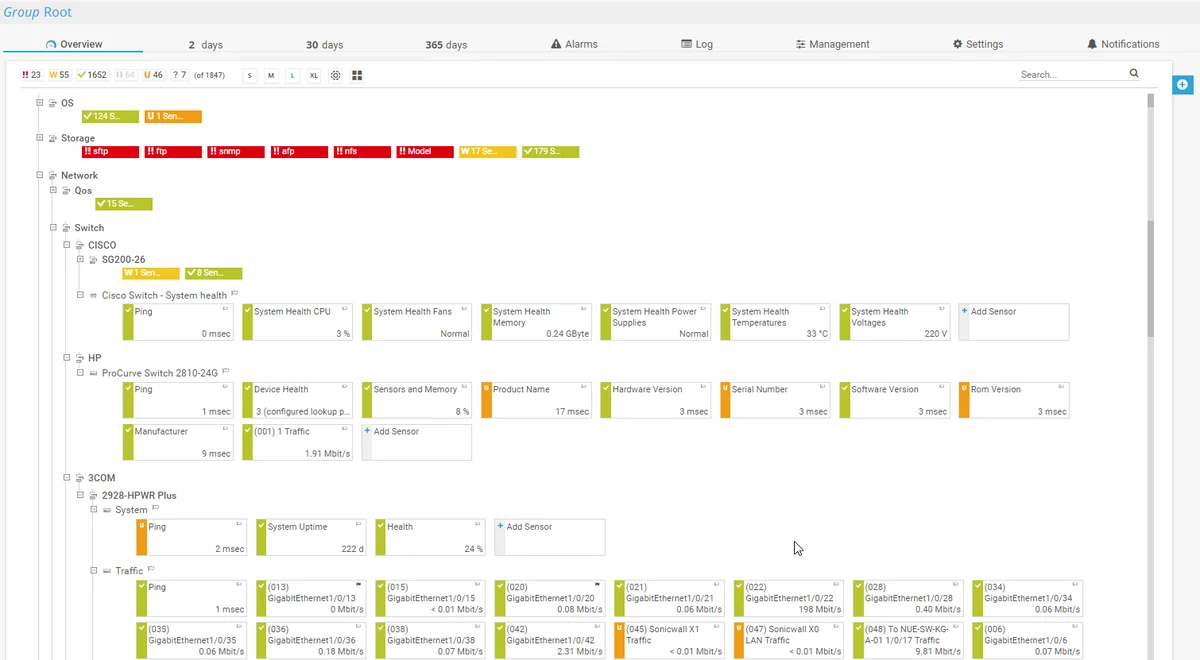
The device tree above shows PRTG's depth in practice - each device broken out by vendor, each sensor showing its live metric. Every row is a sensor that could push you over a tier boundary.
PRTG v25.4 also added AI-driven anomaly detection - learned baselines that flag gradual drift without fixed thresholds, smart sensor recommendations, and similarity detection to reduce noise. Auvik has no equivalent on the AI side. For MSPs who've had alert fatigue from static thresholds, that's a real differentiator.
Multi-tenancy and MSP architecture
This is where Auvik wins decisively for scaling MSPs.
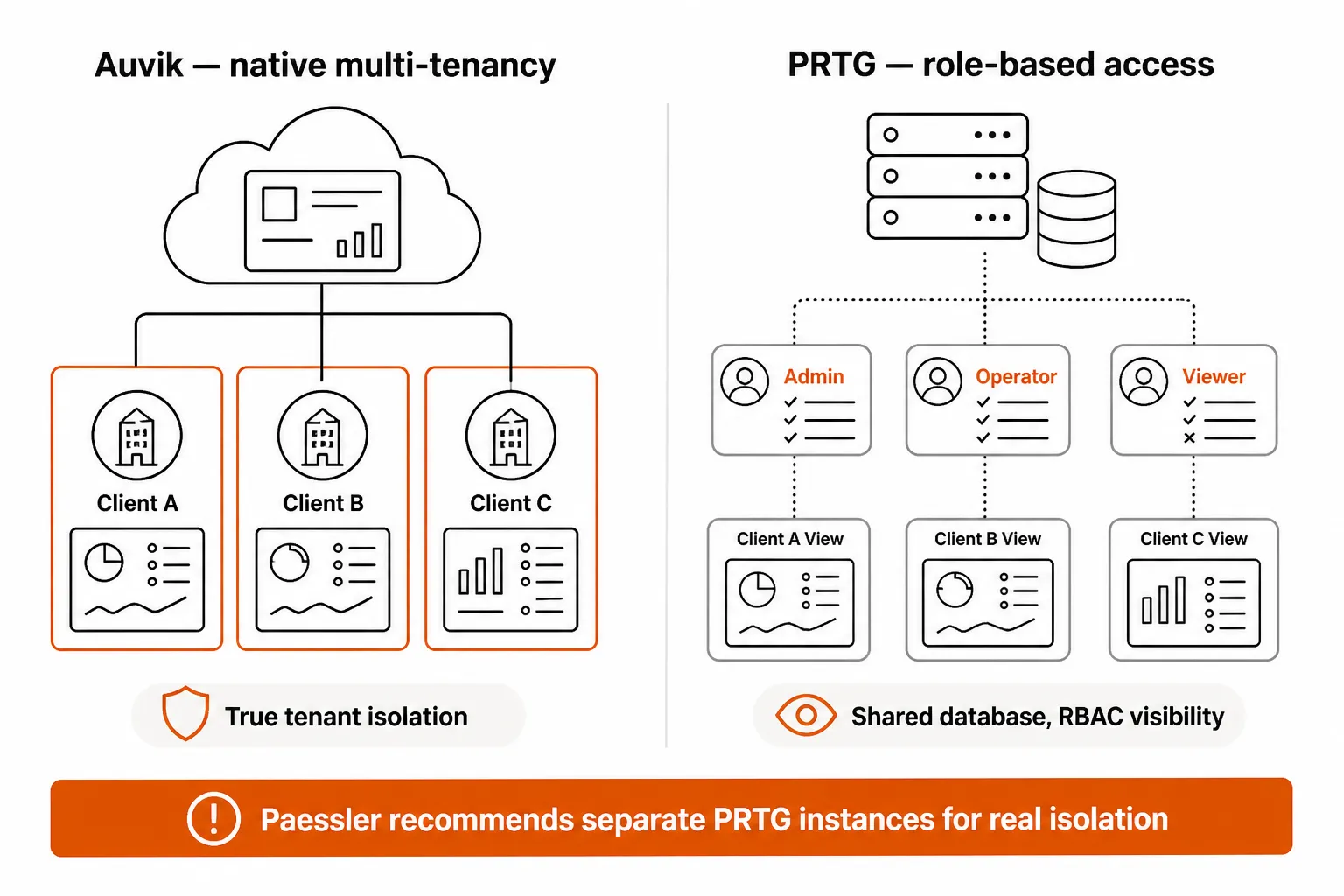
Auvik's architecture is natively multi-tenant. Each client is an isolated tenant - separate data, separate views, no risk of one client's data bleeding into another's visibility. Managing 50 clients is the same architecture as managing 5. The MSP adds a new client, deploys a collector, and that client is a first-class tenant from day one.
PRTG's multi-tenancy is role-based access control over a single database. You create user groups per client, scope each group to their devices. It works - but as Flamingo's MSP review puts it plainly:
"PRTG is single-application, single-database with role-based visibility. Paessler recommends separate instances per customer for real isolation, unlike natively multi-tenant MSP tools (Auvik, Domotz, NinjaOne) where every client is a first-class tenant."
Paessler's own MSP program includes free remote probes, which helps. But "free remote probes" doesn't solve the fundamental architecture question: for genuine per-client isolation, you're looking at separate instances, which means more servers, more maintenance, more cost.
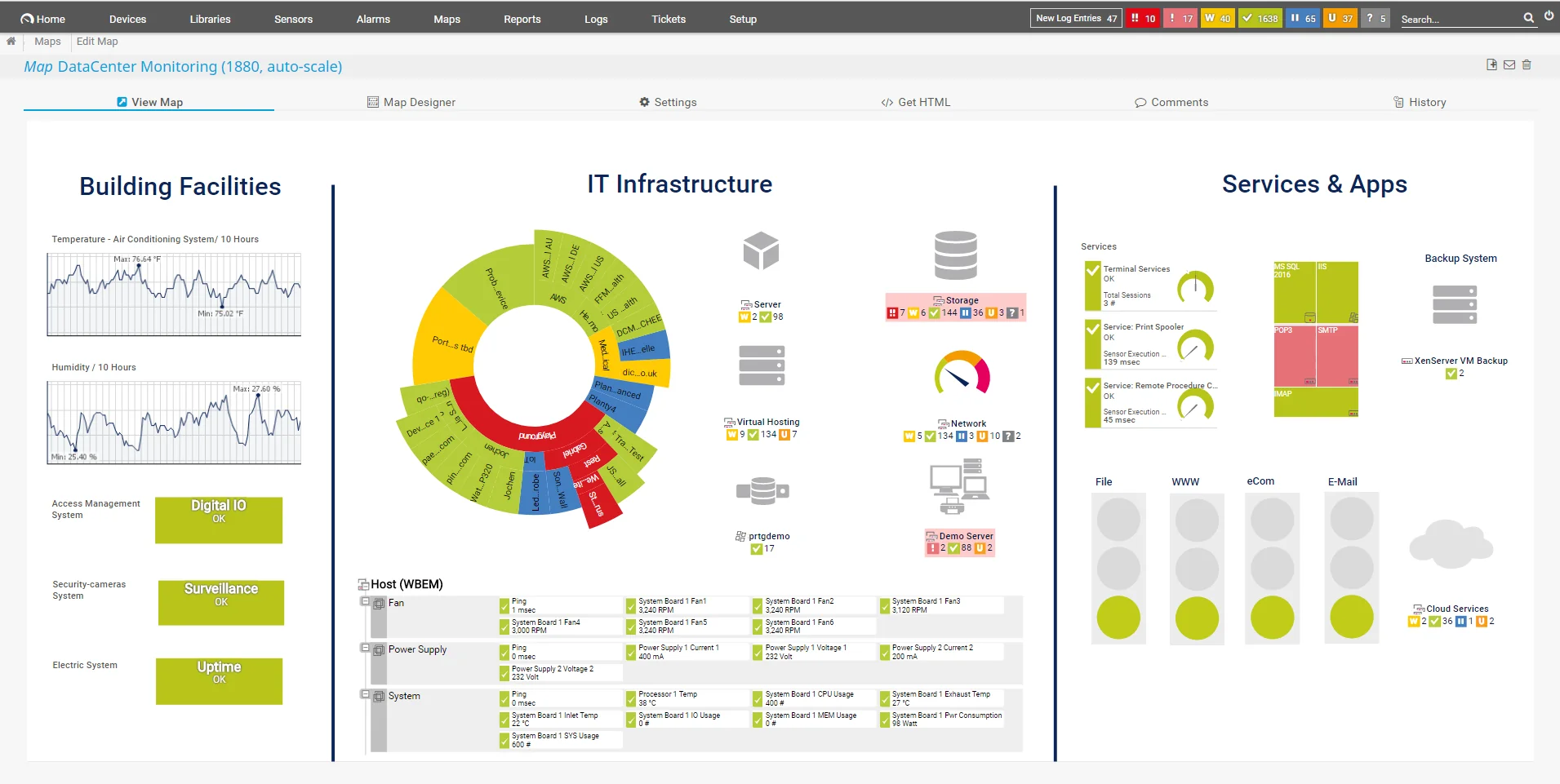
The map view above - PRTG's strongest visual feature - is genuinely impressive. Custom floor plans overlaid with live device status, building facilities alongside IT infrastructure, the whole environment in one visual. For a single organization's IT team, it's powerful. For an MSP managing 20 different clients, each with their own network diagram, the overhead of maintaining 20 custom maps starts adding up.
Flamingo's verdict is the most useful summary we've seen for MSPs:
"PRTG fits the MSP whose clients are mostly single-site, Windows-leaning SMBs, where fast deployment and broad coverage beat deep customization, and where the client count is small enough that managing a core or two stays sane. It fits less well when you are scaling a portfolio that needs per-tenant isolation, per-client billing, and a single pane across many clients without manual reconciliation."
That's the honest version of the comparison. Not "PRTG is bad for MSPs" - it's "PRTG's architecture starts showing cracks above a certain scale."
Pricing: the honest version
Neither tool makes this easy. Here's what we know.
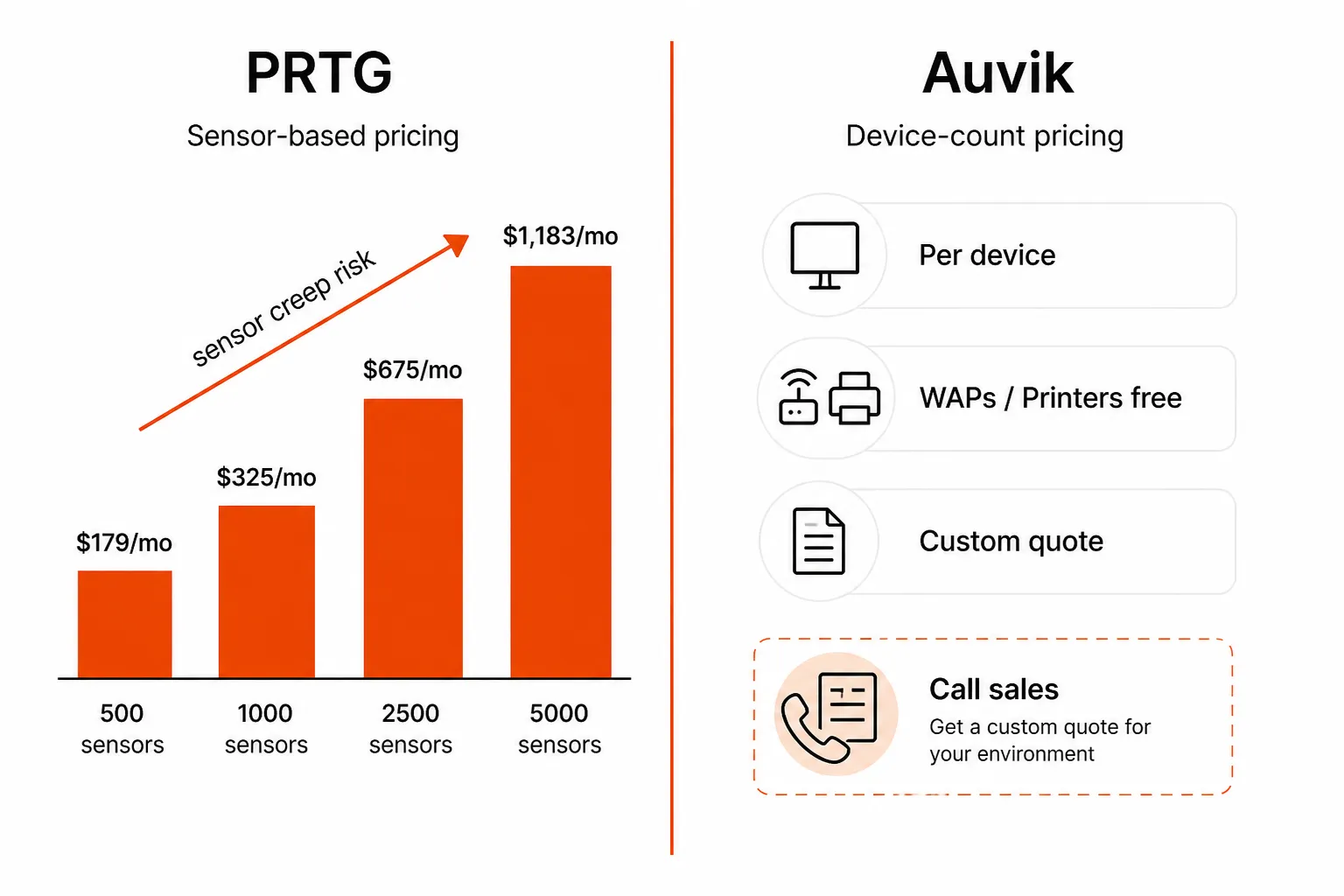
PRTG pricing
Paessler publishes pricing tiers:
| Tier | Sensor limit | Approx. monthly cost |
|---|---|---|
| Freeware | 100 | $0 |
| PRTG 500 | 500 | $179 |
| PRTG 1000 | 1,000 | $325 |
| PRTG 2500 | 2,500 | $675 |
| PRTG 5000 | 5,000 | $1,183 |
| XL1 (Unlimited) | 10,000+ | $1,492 |
| Enterprise Monitor | 10,000+ | from $1,671 |
The transparency is welcome. The catch is sensor creep. IT Pro's hands-on review ran PRTG against a modest test rig: one firewall, one 52-port switch, one VMware host, three Hyper-V hosts, six Windows servers, two NAS units, and a printer. Total sensors consumed: 700+. That's one small client site nearly filling a PRTG 1000 license.
Now picture your MSP with 20 clients. Each adds a new switch or VM every quarter. Sensor count climbs silently until one renewal day you've crossed from PRTG 2500 to PRTG 5000 and owe an extra $6,000/year. That's not a hypothetical - it's the scenario community threads on r/msp consistently flag.
And since July 2024, there's no escape hatch. Perpetual licenses ended. Maintenance renewals became full subscriptions. The XL1 went from ~€3,900/year in maintenance to ~€8,800/year as a full subscription - a 126% increase, before accounting for any sensor growth.
Auvik pricing
Auvik prices by device, not sensor. The exact per-device rate isn't published - you fill out a form and get a custom quote. WAPs, printers, UPS units, and NAS devices are monitored free; you only pay for network infrastructure, servers, and edge devices.
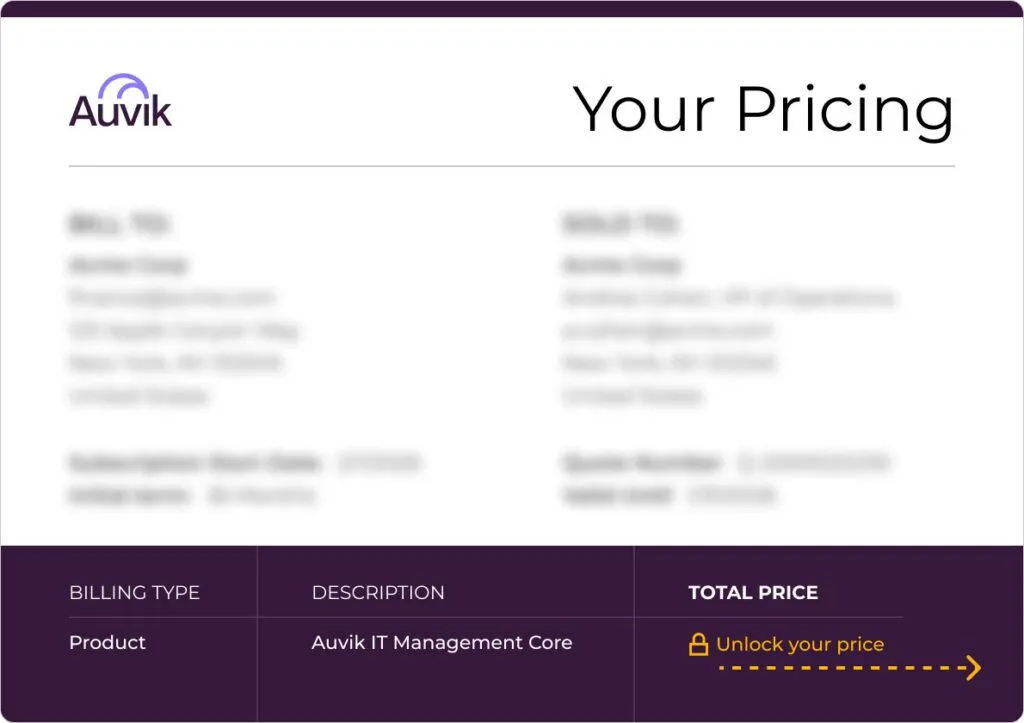
Auvik explicitly says on its pricing page: "Competitors and AI tools show the wrong prices. Get accurate pricing directly from Auvik." Third-party comparisons peg Auvik's range at roughly $12-30/device/month, though your actual quote will depend on volume and configuration.
This opacity is a real friction point. MSPs trying to build a clean per-client P&L need to know their monitoring cost before they sign the contract, not after a sales call. Auvik has MSP-specific pricing packages and volume discounts, so it's not one-size-fits-all - but the lack of a published rate card is a legitimate complaint.
The bottom line: PRTG's pricing is visible but has a hidden scaling risk (sensor creep). Auvik's pricing model scales more cleanly with client count but isn't published. Neither is ideal for budget planning, which is honestly part of why MSPs keep switching between them.
PRTG alerts and notifications
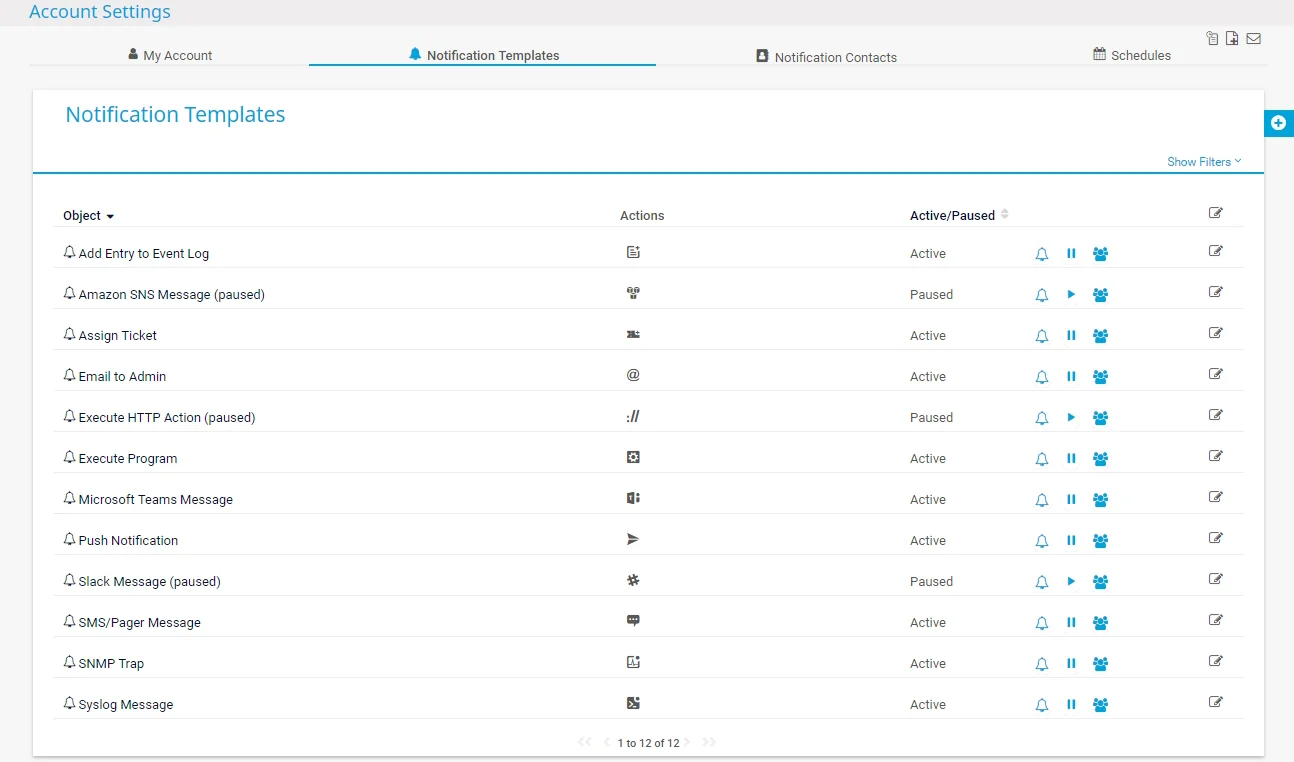
One area where PRTG genuinely shines is alert configurability. The notification templates above - Amazon SNS, Microsoft Teams, Slack, SMS/Pager, SNMP Trap, Syslog, email, and custom HTTP - represent a built-in notification library that covers almost every escalation path an MSP uses. Quiet hours, escalation chains, parent-child alert dependencies (don't page "disk full" when the whole device is down) - all built in.
Auvik ships 64+ preconfigured alerts out of the box with less customization overhead. For most MSPs, that's enough - hardware failures, latency spikes, config changes. PRTG wins on depth; Auvik wins on speed-to-production.
Who picks Auvik
- MSPs managing 10+ clients - the multi-tenant architecture pays dividends above this threshold
- Fast-growing MSPs - adding a new client in 15 minutes is a real operational advantage
- Shops with lean teams - junior techs can operate Auvik without extensive training
- PSA/RMM-heavy stacks - ConnectWise, Autotask, Halo, IT Glue integrations are tight
- Teams who want cloud-native with zero infrastructure - no server to manage, updates automatic
Who picks PRTG
- MSPs with Windows-heavy, SMB clients - WMI is PRTG's home turf
- Teams monitoring non-standard environments - industrial, OT, or legacy systems where custom sensors matter
- IT departments managing one organization - PRTG's single-org architecture is perfectly suited here
- Shops comfortable managing infrastructure - self-hosted option works well if you have the ops capacity
- Teams using the 100-sensor free tier - PRTG's freeware tier is a genuine starting point with no time limit
Try Rallied
Whichever monitoring tool you land on, the tickets it generates still need to be handled. When Auvik fires an alert and creates a ConnectWise ticket, or when PRTG's threshold breach triggers a ServiceNow item, someone has to work it - usually a tech who'd rather be doing something higher-value than resetting a password or unlocking an account.
Rallied is an AI technician built for exactly that layer. It connects to your PSA (ConnectWise, Autotask, Halo), your RMM (Datto, NinjaRMM), and your identity platforms (Entra ID, Okta, JumpCloud, Google Workspace), then handles L1 and some L2 tickets autonomously. Password resets, account unlocks, MFA issues, onboarding, offboarding - resolved, not just triaged.
MSPs using Rallied recover 50-100 hours of tech time per month ($7,000-$15,000 in monthly capacity). Deployment is same-week. No 6-month implementation, no dedicated admin overhead. You pick your monitoring layer; Rallied handles what it generates.
Frequently Asked Questions
Is Auvik or PRTG better for MSPs managing many clients?
Auvik is generally the better fit for MSPs managing a large, growing portfolio. Its native multi-tenant architecture gives each client genuine data isolation without requiring separate server instances. PRTG's role-based access control works, but Paessler itself recommends separate PRTG instances for real client isolation - which adds infrastructure overhead as your client count climbs.
How does PRTG's sensor-based pricing actually work?
PRTG licenses by the number of sensors, not devices. One sensor monitors one metric - so a single server might use 5-10 sensors for CPU, memory, disk, network interfaces, and services. Plans run from $179/month for 500 sensors up to $1,671+/month for Enterprise Monitor. The catch: sensor counts grow faster than expected as you add clients, devices, and monitoring depth - a small test rig of one switch, a VMware host, and six servers already consumed 700+ sensors in IT Pro's hands-on review.
Does Auvik publish its pricing?
No. Auvik's pricing page requires a form submission to get a quote. Pricing is device-based, but the per-device cost varies by client count and configuration. Auvik explicitly states on their site: 'Competitors and AI tools show the wrong prices. Get accurate pricing directly from Auvik.' WAPs, printers, UPS units, and NAS devices are monitored free.
Can PRTG monitor cloud services and Linux servers?
Yes - PRTG's 320+ sensor types cover Windows (WMI), Linux/Unix (SSH), network devices (SNMP, NetFlow, packet sniffing), cloud platforms (AWS, Azure, Google Cloud via REST APIs), databases, and even industrial protocols like Modbus. It's one of the broadest monitoring platforms available. The trade-off is that more monitoring depth means more sensors, which means higher costs.
What happened to PRTG's pricing in 2024?
On July 1, 2024, Paessler ended perpetual licenses entirely and moved PRTG to subscription-only billing. Like-for-like maintenance costs rose roughly 124-126% - the XL1 (Unlimited) license went from around €3,900/year in annual maintenance to €8,800/year as a full subscription. Customers who previously paid small annual renewals saw much larger jumps, which is where the often-cited '300% increase' figure in community threads comes from.