Auvik pricing in 2026: what you actually pay (with real numbers)

TL;DR
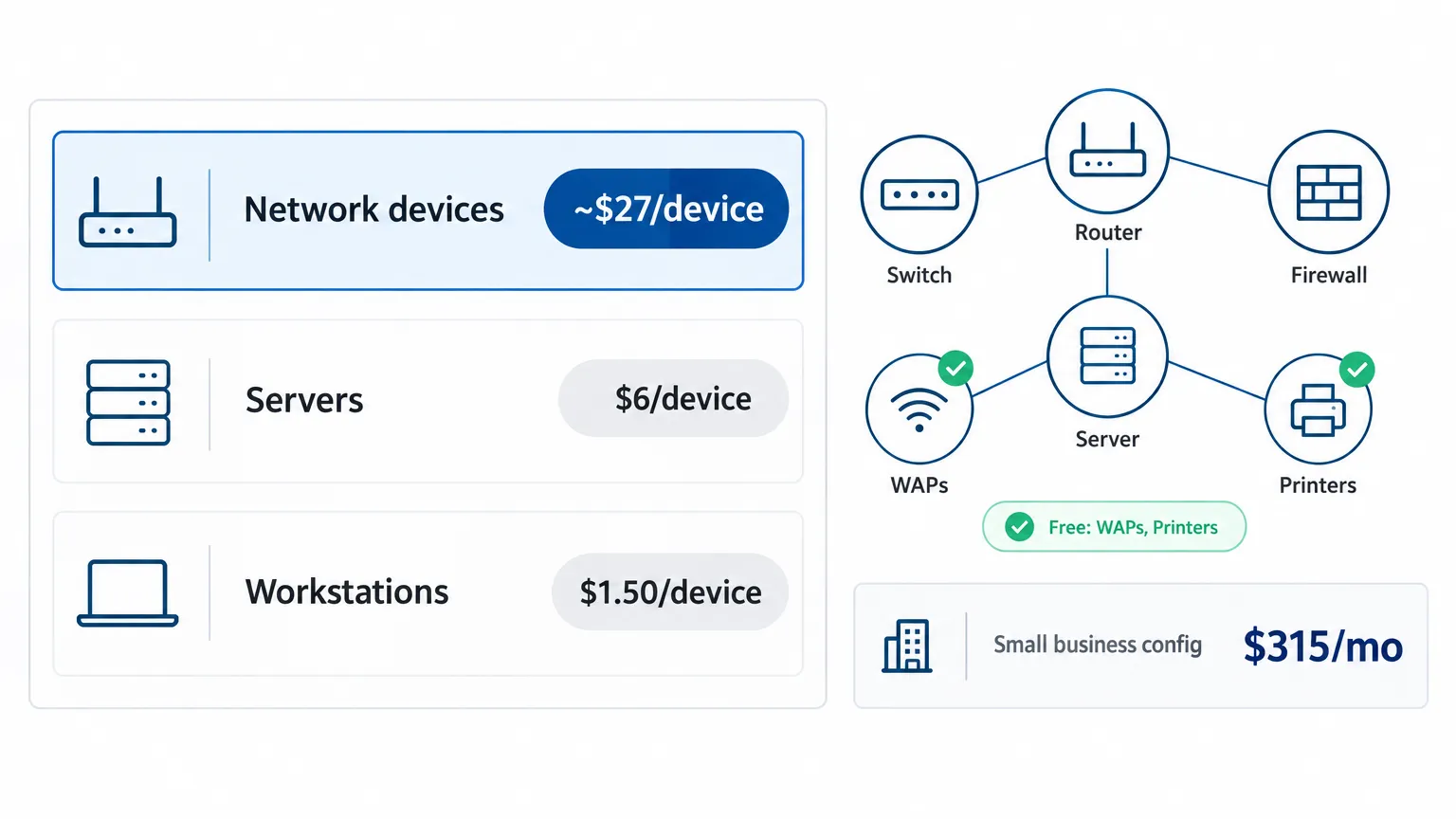
Auvik hides its pricing behind a sales form, but their own blog publishes real worked examples. Network devices run around $27/device/month, servers about $6/device/month, workstations around $1.50/device/month on the Core tier. WAPs, printers, UPS, and NAS are monitored free. A typical small MSP client costs about $315/month; a mid-size client runs ~$1,250/month. Volume discounts exist but aren't disclosed publicly. The 14-day free trial requires no credit card. If you're evaluating Auvik, the pricing is defensible for network monitoring - but watch the renewal trajectory and budget separately for SaaS Management, which is billed per user on top.
Why Auvik doesn't publish its pricing
Auvik's pricing page greets you with a form and a pointed note: "Competitors and AI tools show the wrong prices. Get accurate pricing directly from Auvik."
That's a deliberate choice, not an oversight. Per-device pricing at the MSP scale gets complicated fast - different device categories, different tiers, volume discounts, multi-tenant licensing, add-on modules. A simple price list would either mislead or require so many asterisks it would be useless. We've seen this pattern across the MSP tooling space, and Auvik's logic is sound enough.
The frustrating part: you still have to call sales to get a number.
The good news is that Auvik publishes a detailed pricing explainer on their own blog with real worked examples. That's the most reliable source for what you'll actually pay - and it's where the numbers in this post come from.
How Auvik's billing actually works
The core mechanic is per-device billing, but "device" covers three distinct categories that are priced very differently.
Network devices are the most expensive - routers, switches, firewalls, and anything that makes routing or switching decisions. These are the devices Auvik is most valuable for monitoring, so they carry the highest per-device rate.
Infrastructure devices - servers and hypervisors - sit in the middle tier. They're billable but cheaper per unit than network gear.
Edge devices - workstations and laptops - are the cheapest per unit. Auvik is mainly watching these for connectivity and software, not deep network behavior.
Then there's a fourth group that Auvik monitors for free entirely: wireless access points, printers, UPS units, NAS devices, IoT, and other peripherals. These show up on your network map and fire alerts like any other device, but they don't add to your bill.
This structure matters because it changes how you count. An MSP client with 200 devices on paper might only have 20 billable network devices and 50 billable servers - the rest are WAPs and printers that cost nothing. Understanding the split before you request a quote gives you a much clearer sense of what you'll pay.
Real cost examples
These figures come directly from Auvik's pricing blog post, updated September 2025. They reflect the Core tier.
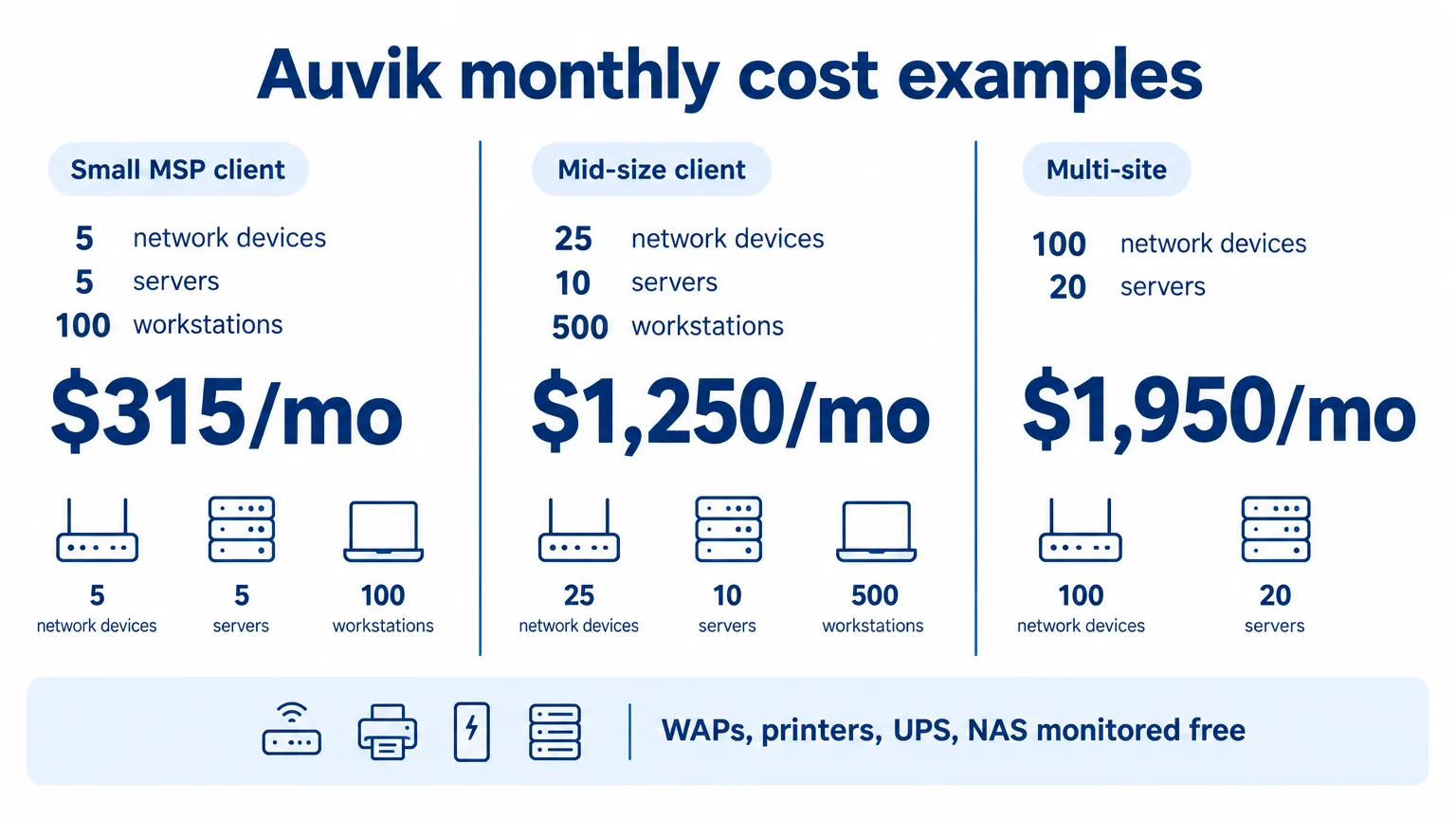
| Config | Network devices | Servers | Workstations | Est. monthly cost |
|---|---|---|---|---|
| Small client | 5 | 5 | 100 | ~$315/month |
| Mid-size client | 25 | 10 | 500 | ~$1,250/month |
| Multi-site | 100 | 20 | - | ~$1,950/month |
Back-of-the-envelope math on the small client: at ~$27 per network device, ~$6 per server, ~$1.50 per workstation:
- 5 × $27 = $135
- 5 × $6 = $30
- 100 × $1.50 = $150
- Total: $315/month
That math tracks for the Core tier. Volume discounts kick in at higher device counts and pull the per-device rate down, though Auvik doesn't publish the thresholds publicly.
For an MSP managing 20 clients at the small-client profile, you're looking at roughly $6,300/month across the book of business. That's before any SaaS Management add-ons.
Basic vs Core: what's actually different
Auvik offers two tiers, and the difference matters more than the names suggest.
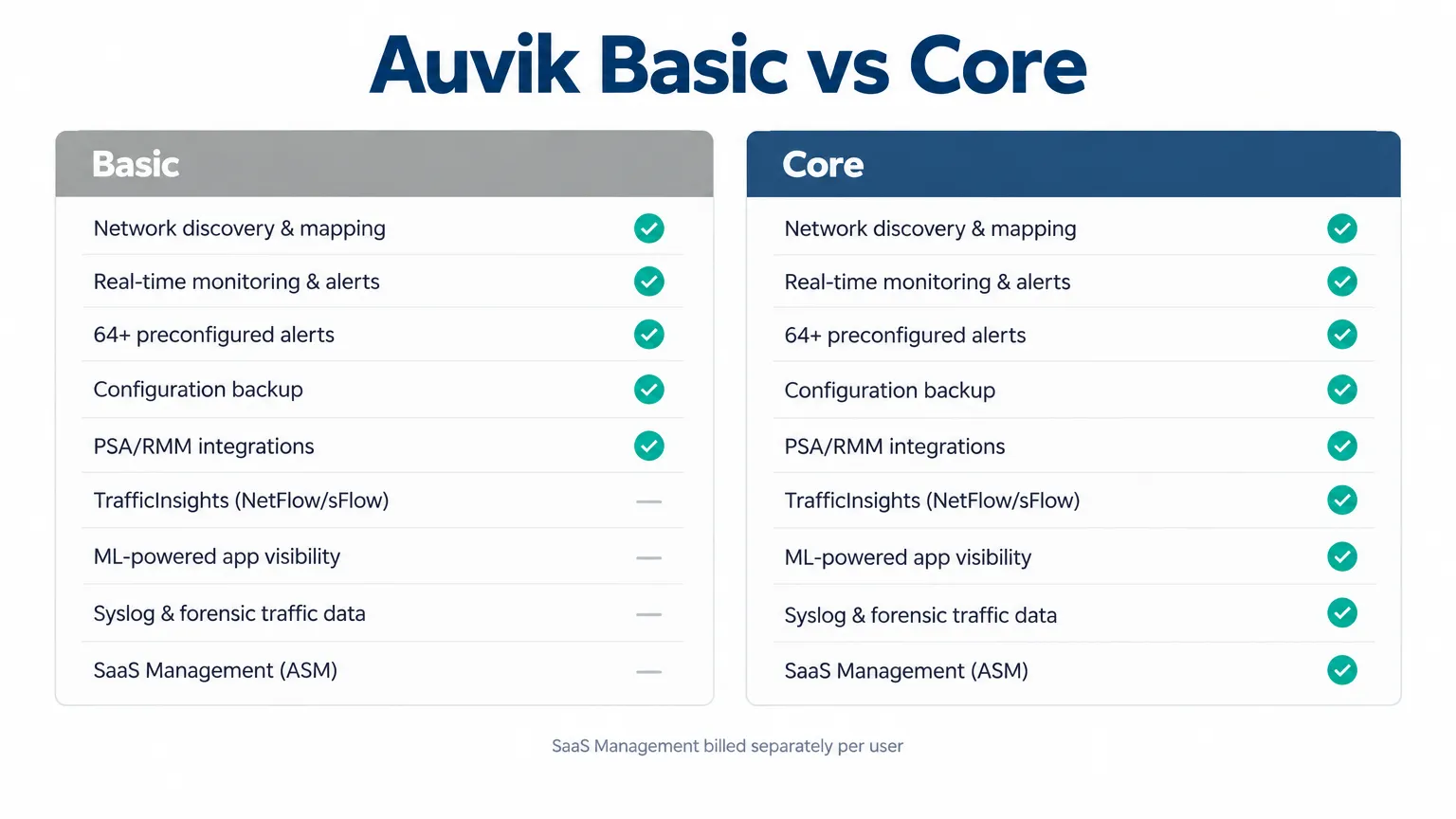
Both tiers include:
- Automated device discovery and real-time network mapping
- Continuous monitoring with bandwidth and performance metrics
- 64+ preconfigured alerts covering hardware failures, latency spikes, and config changes
- Configuration backup and rollback
- Multi-tenant support for MSP environments
- PSA and RMM integrations - ConnectWise, Autotask, Halo PSA, ServiceNow, and 20+ others
Core adds:
- TrafficInsights - NetFlow, sFlow, and IPFIX-based traffic analysis that identifies bandwidth hogs down to user, application, and protocol level. This requires hardware that supports those protocols, which excludes many SMB-grade routers and managed switches.
- ML-powered application visibility - identifies which applications are consuming bandwidth without relying on port-based classification
- Syslog collection and forensic traffic data - useful for incident investigation and security-adjacent monitoring
"I can't stress this enough: most network management platforms (SolarWinds NMS, PRTG) take days to weeks to configure properly. Auvik deploys in under 30 minutes and you're getting real alerts the same day. For MSPs that need to get a new client operational quickly, this time-to-value difference is enormous."
If your clients are running commodity networking gear that doesn't support NetFlow, the Core-exclusive features won't be accessible anyway. That's worth knowing before you pay for the higher tier.
MSP-specific pricing
Auvik's MSP program includes dedicated licensing designed for service providers managing multiple client networks. A few things that matter operationally:
Multi-tenant architecture is built in. You manage all client networks from one dashboard, with client isolation - each client sees only their own data. There's no per-seat charge for adding technicians to the MSP account.
Volume discounts apply across your book of business. The more total devices you manage across all clients, the lower your per-device rate. The specific thresholds require a conversation with sales.
SaaS Management is billed separately. Auvik's application discovery module (ASM) - which identifies what cloud apps are running across client environments - is charged per user, not per device. This is easy to miss when quoting a client. A 200-user environment adds a separate line to the bill.
Annual contracts are standard. Auvik operates on SaaS-only, annual licensing billed monthly or annually. Mid-term upgrades are prorated, but downgrades mid-term are typically not. Some MSPs on Reddit have noted that renewals can come in higher than expected - "2 to 3x higher than last year's" was mentioned in one community thread - so read the renewal terms before you commit.
The hidden costs MSPs miss
The per-device billing is the headline, but a few other costs tend to catch MSPs off guard.
SaaS Management (ASM). If you're quoting clients based only on device counts, ASM adds a user-based layer on top. Budget for it separately from the network monitoring quote.
TrafficInsights hardware requirements. Core's traffic analysis features require NetFlow, sFlow, or IPFIX support from the underlying hardware. If a client is running budget networking gear, you're paying for Core but can't use its most differentiated features. This isn't a reason to avoid Auvik, but it affects which tier makes sense.
Per-device cost at scale. Linear scaling is fine for small and mid-size client networks. For enterprise-size environments with thousands of devices, the math changes. A third-party reviewer noted that "for very large enterprise environments with thousands of devices, costs scale linearly and can become significant." Volume discounts help, but the threshold isn't published.
The "Sales Trap" perception. A notable Reddit thread in r/msp titled "Auvik Sales Trap" generated 50+ comments from MSPs surprised by their per-device billing as networks grew. The billing model itself isn't misleading - it's clearly device-based - but MSPs who didn't track device counts closely found their bills higher than expected at renewal. Auditing billable device counts before contract renewal is worth building into your process.
Is Auvik worth it? Our take
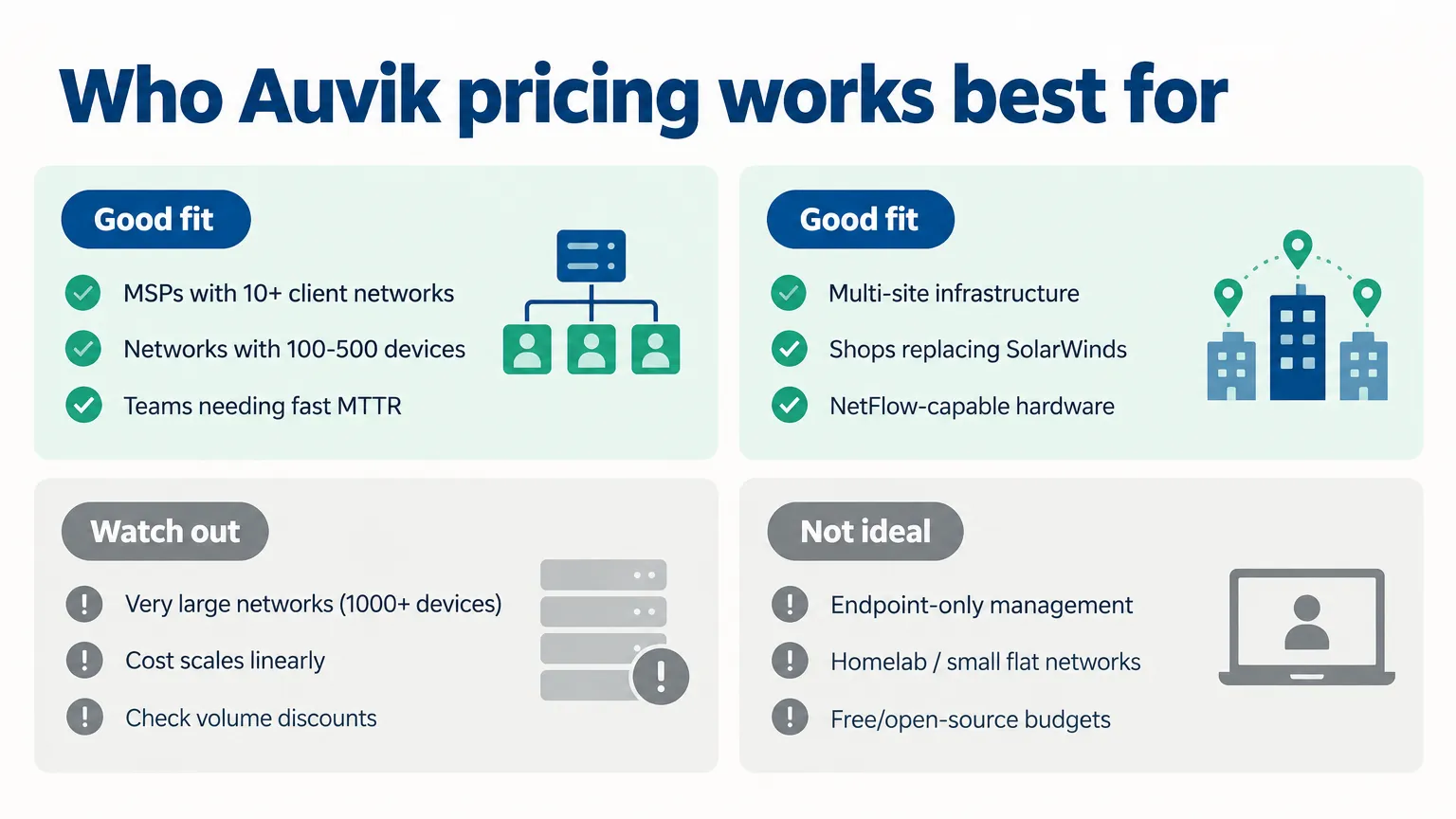
For MSPs managing 10+ client networks with real infrastructure - switches, firewalls, servers - Auvik is hard to beat on time-to-value. The 15-minute deployment claim isn't marketing hyperbole; community reviews consistently confirm it. Automated discovery, real-time topology, 64+ preconfigured alerts, and solid PSA integrations mean you're getting value on day one without a week of configuration work.
The per-device pricing is reasonable at the small and mid-market client scale Auvik was built for. Where it gets expensive is at the high end - clients with large device counts will feel the linear cost scaling more than smaller ones.
The honest limit: Auvik monitors network infrastructure. It is not, as one community reviewer put it, a provisioning or ticket-resolution tool - "Auvik is for monitoring not provisioning". Auvik surfaces the issue and fires the alert. What you do with that alert - the ticket it creates, the tech time spent resolving it - is out of scope for the tool.
That's where the Auvik story intersects with the broader MSP automation stack. Network monitoring and ticket resolution are complementary, not competing, layers of the stack.
Auvik pricing summary table
| Factor | Detail |
|---|---|
| Pricing model | Per billable device, custom quote |
| Published pricing | None - form-based request required |
| Network device cost | ~$27/device/month (Core, est.) |
| Server cost | ~$6/device/month (Core, est.) |
| Workstation cost | ~$1.50/device/month (Core, est.) |
| Free device types | WAPs, printers, UPS, NAS, IoT |
| Tiers | Basic, Core |
| SaaS Management | Billed separately per user |
| Volume discounts | Yes - thresholds not published |
| Free trial | 14 days, no credit card required |
| Contract | SaaS only, annual standard |
| MSP pricing | Dedicated packages available |
Try Rallied
Rallied is an AI technician for MSPs that closes the loop Auvik opens. When Auvik fires an alert or a ticket lands in your PSA, Rallied reads it, connects to your PSA, RMM, and identity stack, and resolves it end-to-end - password resets, account unlocks, onboarding, offboarding - without a tech ever opening the ticket.
The economics: $300/month includes 2,000 credits, which covers roughly 700 resolved tickets at a 2.7-credit average. That's 50-100 hours of L1 grunt work per month off your techs' plates - the same hours the Rallied ROI calculator pegs at $3,750–$15,000/month in recoverable labor at typical MSP loaded costs.
Auvik tells you what's broken. Rallied fixes it.
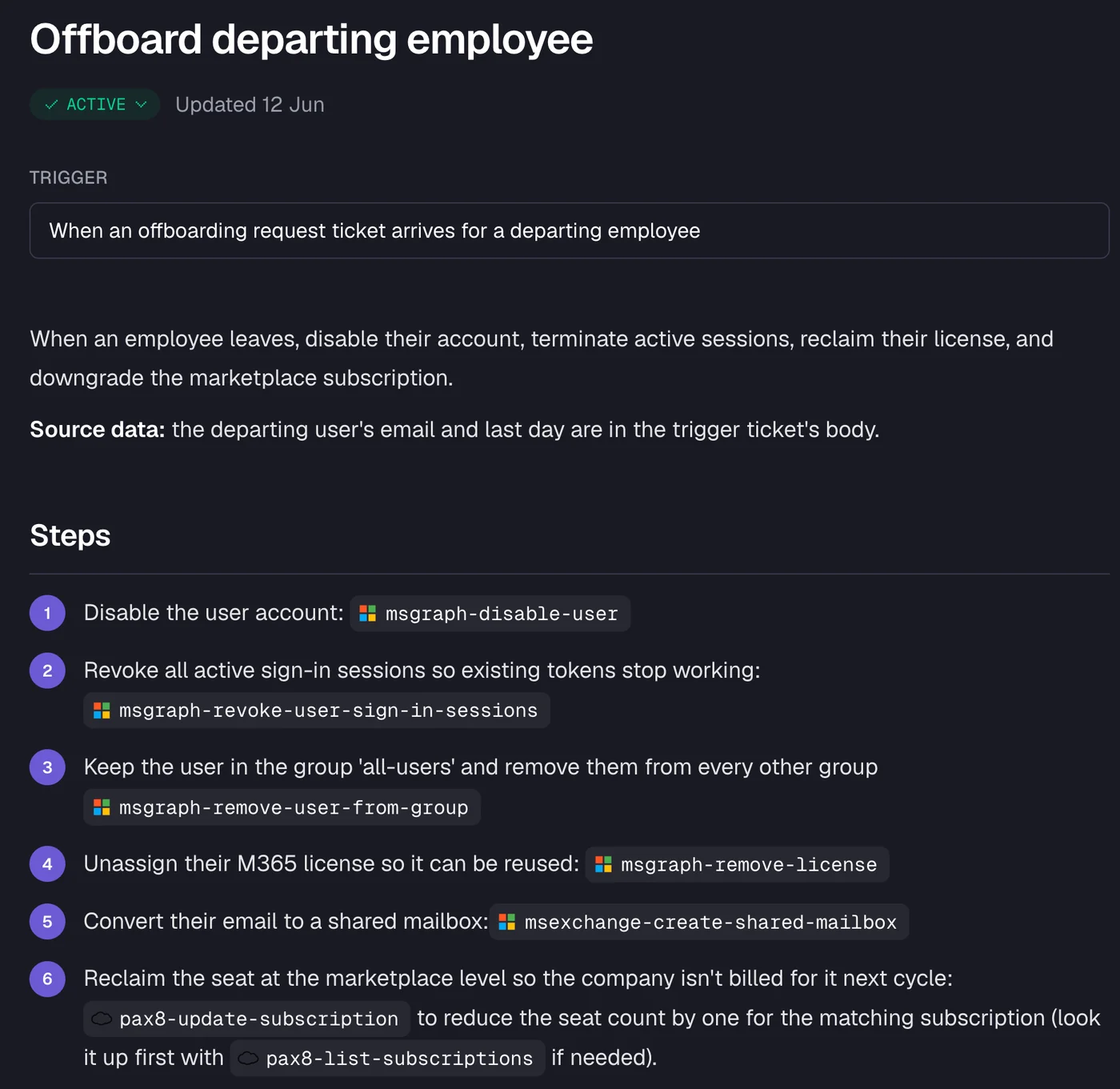
Connects to ConnectWise, Autotask, Halo PSA, and the rest of the stack you're already running. Deploys the same week, no implementation fee. Book a 30-minute demo to see what it would handle from your last 30 days of tickets.
For the wider picture, read Best MSP Software in 2026.
Frequently Asked Questions
How much does Auvik cost per month?
Auvik doesn't publish a fixed price list, but their own blog provides example figures: a small client with 5 network devices, 5 servers, and 100 workstations runs about $315/month. A mid-size client (25 network devices, 10 servers, 500 workstations) runs about $1,250/month. A multi-site setup with 100 network devices and 20 servers costs around $1,950/month. Volume discounts apply at higher device counts. For an exact quote, request pricing from Auvik directly.
What devices are free in Auvik's pricing?
Auvik monitors several device categories at no charge: wireless access points (WAPs), printers, uninterruptible power supplies (UPS), and network-accessible storage (NAS). IoT and other peripheral devices are also typically free. You only pay for network infrastructure devices (routers, switches, firewalls), servers and hypervisors, and edge devices like workstations and laptops.
What's the difference between Auvik Basic and Core?
Both tiers include automated device discovery, real-time network mapping, monitoring, 64+ preconfigured alerts, configuration backup, and PSA/RMM integrations. Auvik Core adds TrafficInsights (NetFlow/sFlow/IPFIX traffic analysis), ML-powered application visibility, syslog collection, and forensic traffic data - capabilities that matter if you need deep bandwidth analytics or application-level troubleshooting. Core costs more per device. For most MSPs managing standard client networks, Basic covers the fundamentals.
Does Auvik offer MSP-specific pricing?
Yes. Auvik has dedicated pricing packages for MSPs, including multi-tenant licensing that lets you manage unlimited client networks from one dashboard. MSP pricing is still quote-based rather than published, but volume discounts apply across the client base. SaaS Management (Auvik's application discovery module) is billed separately per user.
How does Auvik pricing compare to alternatives like Domotz?
Domotz typically charges per site rather than per device, which can be cheaper for large, device-dense networks. Auvik's per-device model scales linearly - cost-effective for moderate-size client networks, but it can become significant at 1,000+ devices. Auvik beats Domotz on TrafficInsights depth and PSA integration breadth for most MSPs. For very large networks, it's worth getting quotes from both. MSPs also often pair Auvik's network monitoring with an AI technician like Rallied for ticket resolution - Auvik surfaces the issue, Rallied closes the ticket.