7 best endpoint management tools for MSPs in 2026
TL;DR
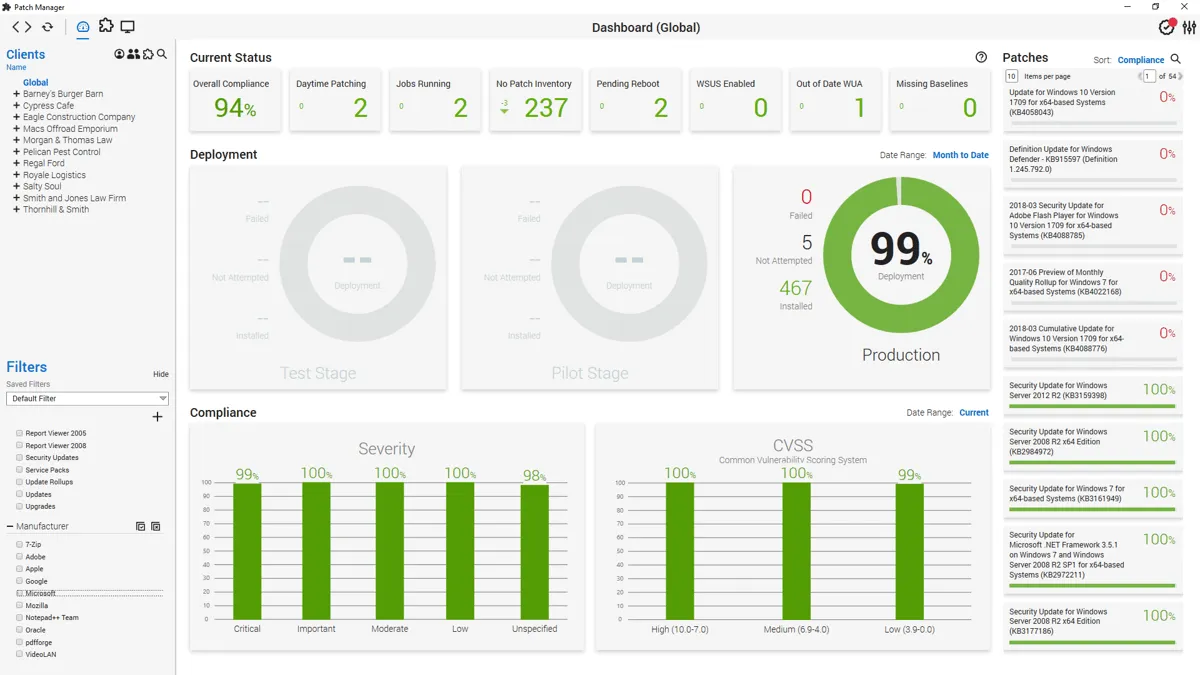
The endpoint management tool market for MSPs has consolidated around a clear top tier. NinjaOne leads on ease, support, and G2 ratings (4.7/5 across 4,591 reviews). Atera wins on pricing transparency for smaller shops. N-able and ConnectWise Automate suit power users who need deep customization. Microsoft Intune is the right answer if your clients are Microsoft-heavy. Automox is the most focused cross-platform patching specialist. Datto RMM is solid but comes with Kaseya ownership baggage.
The thing most listicles miss: every endpoint management tool is an alert factory. Choosing the right one gets you visibility. What happens next - the tickets those alerts generate - is a separate problem worth solving. Rallied connects to your RMM and PSA and handles those tickets autonomously, closing the loop from alert to resolution without a technician touching it.
What endpoint management actually means in 2026
A few years ago, "endpoint management" meant running a script across Windows desktops. That definition aged poorly fast.
Today's MSP client has a MacBook fleet, a bunch of iPhones, some Android tablets, a handful of Linux servers, and half a dozen employees who insist on using their personal devices. Managing all of that from five separate tools - one for Windows, one for MDM, one for patching, one for remote access - is how you end up with three techs spending their Tuesdays on manual patch confirmations instead of anything strategic.
Modern endpoint management tools solve this by consolidating discovery, monitoring, patching, configuration, and remote access into one dashboard. The right tool dramatically reduces the number of tickets your team needs to touch manually. The wrong tool creates more overhead than it saves.
Here's what we looked at across seven platforms:
- Pricing model - per device vs per technician, and what you actually pay at real-world scale
- Deployment speed - time from purchase to managing your first client
- Multi-OS support - Windows, macOS, Linux, iOS, Android
- Patch management depth - first-party and third-party application coverage
- Integration ecosystem - PSA and RMM integrations that matter to MSPs
- G2 and community sentiment - what real practitioners say after living with it
Quick comparison
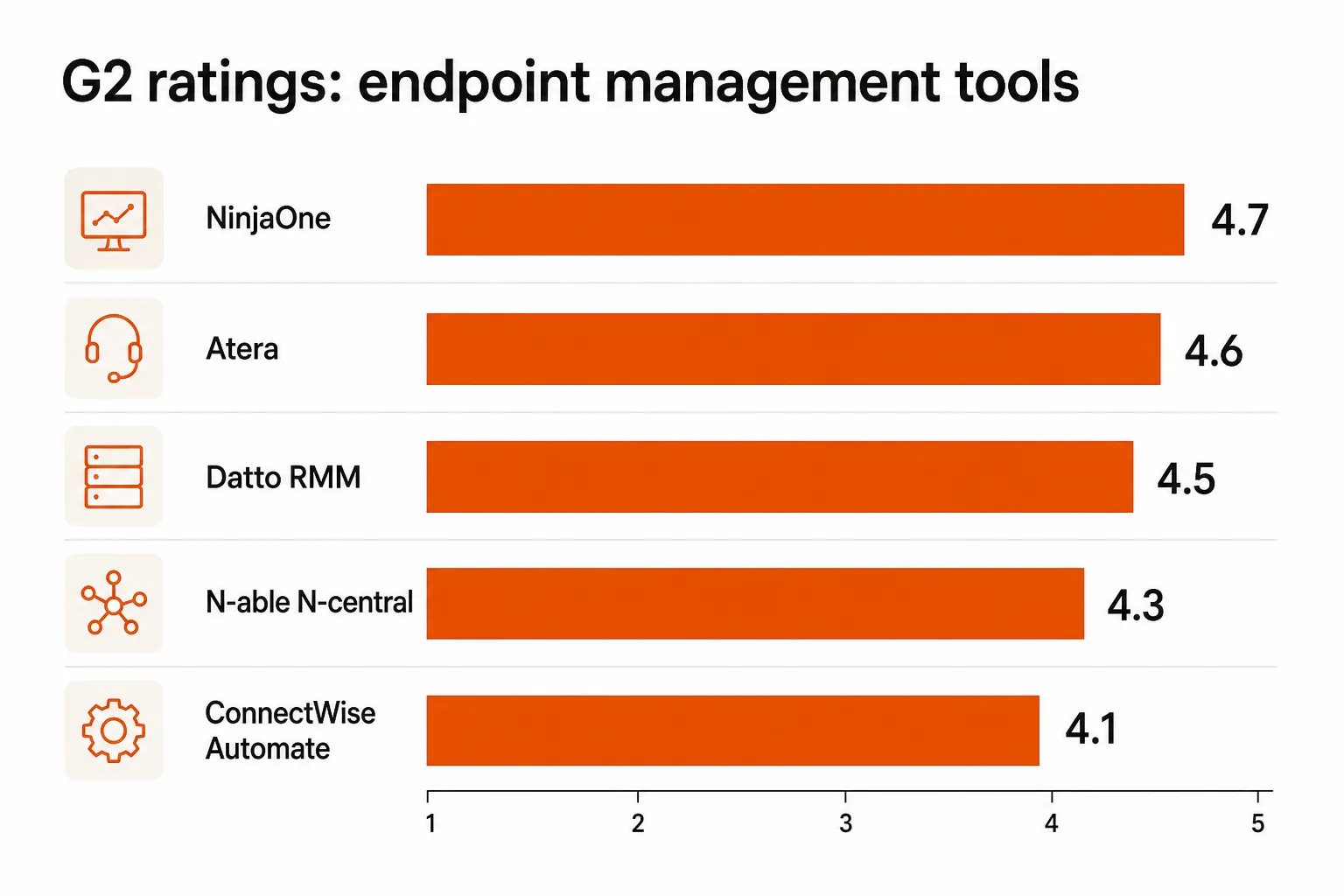
| Platform | G2 Rating | Pricing model | Best for |
|---|---|---|---|
| NinjaOne | 4.7/5 (4,591 reviews) | Per device | Most MSPs |
| Atera | 4.6/5 (1,221 reviews) | Per technician | Small-to-mid MSPs |
| Datto RMM | 4.5/5 (700+ reviews) | Per device | Autotask/Kaseya shops |
| N-able N-central | 4.3/5 (348 reviews) | Per device | Complex environments |
| ConnectWise Automate | 4.1/5 (139 reviews) | Quote-based | Power users |
| Microsoft Intune | N/A | Bundled with M365 | Microsoft-heavy clients |
| Automox | N/A | Per device | Multi-OS patching |
1. NinjaOne - best overall for MSPs
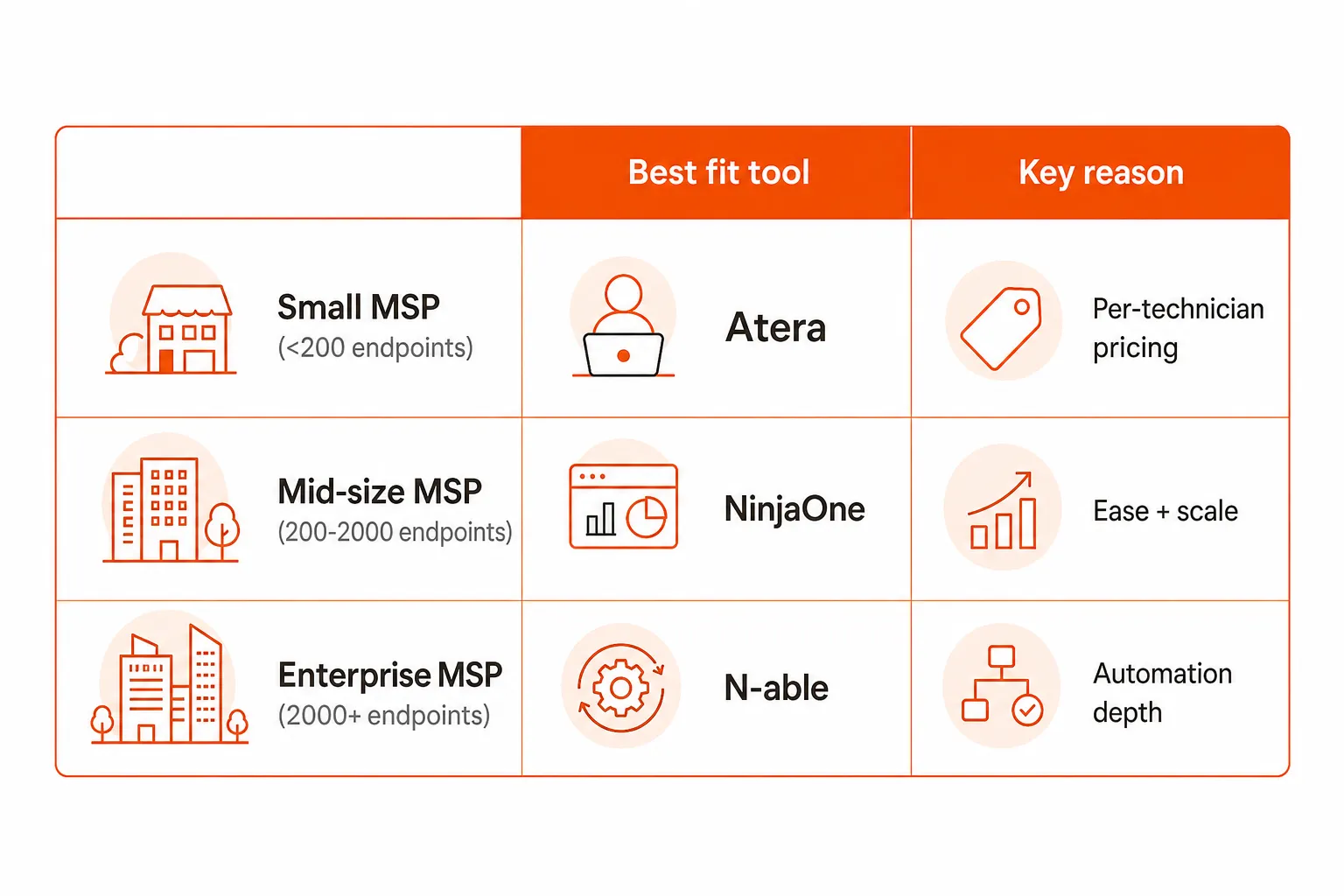
NinjaOne has been the #1-rated RMM on G2 for 23 consecutive quarters as of Summer 2026. That's not an accident, and it's not just marketing - 4.7/5 stars across 4,591 verified reviews with 84% five-star ratings is the kind of consistency that's hard to fake.
What actually sets NinjaOne apart is the combination of deployment speed and feature depth. Most users are fully operational within one week, with an average learning curve under 3 hours. That's unheard of in a category where ConnectWise Automate takes two months to implement. You get:
- Unified management of Windows, macOS, Linux, iOS, and Android from one console
- Autonomous patching - cuts patch deployment time by 30% versus prior solutions, per customer reports
- Backup, remote access, and endpoint management bundled, so you're not bolting five products together
- Free, unlimited support - the only RMM in the category that offers this
- NinjaOne's ROI calculator shows 605 monthly hours saved and 3.6 FTE equivalents recovered for a typical deployment
The G2 community consistently calls out patch management as the standout. One reviewer: "Patch management is without question the best we've used - reputation-based patch holds saved us from a bad KB that would've bricked machines." Another noted that the platform freed them from "10-15 different tools" into a single dashboard.
Pricing: Per-device, ranging from $3.75/device/month at 50 or fewer endpoints down to $1.50/device/month at 10,000+. 14-day free trial, no credit card required. No implementation fees.
Worth knowing: NinjaOne now positions itself as a full UEM platform, not just RMM - MDM for iOS and Android launched in 2024. If you're managing mobile devices for clients, this matters.
Verdict: This is the default recommendation for most MSPs. It's not the cheapest per device at small scale, but the time saved on implementation, training, and support more than covers the delta. If you're evaluating RMMs and not seriously looking at NinjaOne, you're leaving something on the table.
2. Datto RMM - best for Autotask and Kaseya stack users
Datto RMM is a solid, cloud-native platform that positions itself as the enterprise-grade option with 99.99% uptime SLA and regional data residency in the US, Ireland, and Sydney. 4.5/5 on G2 across 700+ reviews - genuinely good, not just good-for-the-category.
The native Autotask PSA integration is its real differentiator. If your shop runs Autotask for ticketing and billing, Datto RMM creates a tight loop: endpoint alerts flow directly into Autotask as tickets with all the device context already populated. No copy-pasting, no manual correlation. For MSPs already invested in the Autotask/Datto/Kaseya ecosystem, this integration alone justifies the evaluation.
The patching engine is consistently praised on G2 - thorough, reliable, good compliance reporting. Native Microsoft 365 management is a genuine feature, not just a checkbox.
The Kaseya elephant in the room: Datto is owned by Kaseya, and that ownership matters operationally. Reddit threads are consistent: the RMM product itself is good, but Kaseya's acquisition brought three-year contract lock-ins, overlapping toolsets, and support friction that wasn't there before. One r/msp commenter put it plainly: "Datto RMM is solid. Kaseya support is not." Factor this in if contract flexibility matters to your business.
Pricing: Quote-based, per device. Not publicly available - contact sales.
Verdict: A strong second choice for MSPs already in the Kaseya/Autotask ecosystem. If you're not - and you're weighing Datto RMM against NinjaOne on features alone - NinjaOne is the easier, lower-friction choice. The Kaseya ownership adds a risk premium you'll want to price in.
3. N-able N-central - best for complex, large-scale environments
N-able N-central is the platform that MSP veterans reach for when environments get genuinely complicated. Managing 1,800+ workstations across multiple sites? N-central handles it. Have a team of power users who want to build sophisticated automation policies from scratch? N-central's drag-and-drop automation engine was built for that.
The platform sits in Gartner's 2025 Magic Quadrant for Endpoint Management Tools and earns a 4.3/5 on G2 across 348 reviews - not as flashy as NinjaOne, but the power users are fiercely loyal.
The AI agent integration (N-zo) is worth noting: a console Product Expert that answers questions and guides configuration, an Asset Expert for device visibility reporting, and a Security Expert for CVE prioritization. N-able claims 80% efficiency gains on console tasks and 53% improvement in asset visibility from these agents.
Community feedback from r/msp and r/Nable is consistent: N-central "excels in complex environments; requires expertise to configure but pays off with strong automation and scriptability." The flip side is a steep learning curve - users also call out the documentation gap and steeper onboarding compared to NinjaOne.
Pricing: Per-device, quote-based. Long-term price lock available on multi-year contracts.
Worth knowing: N-able offers two products - N-central (full-power, on-premise option available) and N-sight (lighter, cloud-only). If you're evaluating, confirm which you're looking at. The community tends to mean N-central when they mean the serious version.
Verdict: N-able is NinjaOne for shops that need more control and are willing to invest in the learning curve. For an MSP under 500 endpoints or one that values deployment speed, NinjaOne wins. For complex multi-site environments with a technical team that wants to build sophisticated automation, N-central earns its place.
4. Atera - best for small and growing MSPs
Atera wins on pricing model, full stop. Every other major RMM charges per device - as your client base grows, so does your monthly bill, sometimes uncomfortably fast. Atera charges per technician: $129/month per tech on the MSP Pro plan billed annually, or $149/month per tech for IT departments. You can manage 500 endpoints or 5,000 endpoints - the tech count is the same, the bill doesn't change.
That model is a genuine competitive advantage for MSPs with large device-to-technician ratios. If you have three techs managing 2,000 devices, Atera at $387/month competes very favorably with per-device alternatives.
The platform bundles RMM, helpdesk, ticketing, patch management, and automation in one dashboard with 60+ integrations including ConnectWise PSA, Autotask, IT Glue, Hudu, Microsoft 365, Entra ID, and Okta. 4.6/5 on G2 from 1,221 reviews, trusted by 13,000+ organizations in 120 countries.
Atera's headline 2026 differentiator is Robin - a patented AI agent that handles smart ticket intake, autonomous resolution, and closed-loop optimization. Early adopters report Robin resolves 85% of help desk tickets and saves 2+ days per technician per week. Those numbers are bold, and early-adopter data is always worth scrutinizing - but the direction is right.
The trade-offs: Reporting is less customizable than enterprise-grade RMMs. Power users building complex automation scripts may hit limits at lower tiers. And recent price increases in 2025 generated friction in the r/msp community - worth factoring into multi-year planning.
Verdict: If you're a small or growing MSP and per-device pricing feels like a ceiling on your margins, Atera is the right conversation. The per-tech model removes a growth penalty most MSPs quietly absorb on their current RMM.
5. ConnectWise Automate - best for deep customization
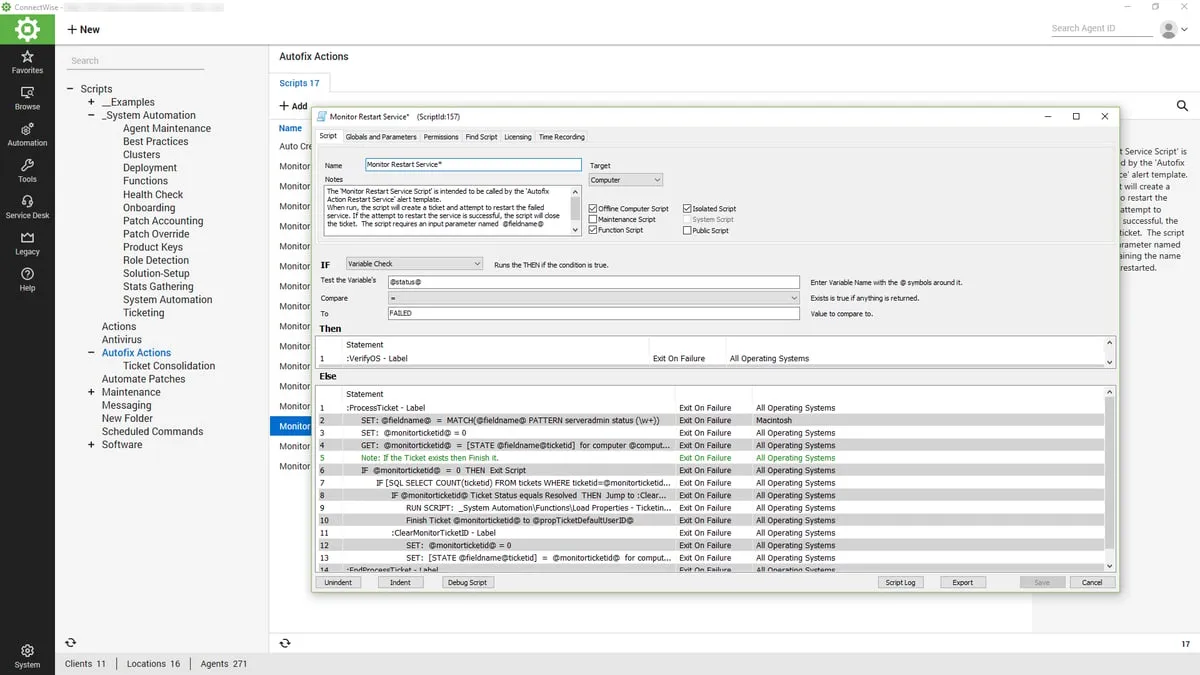
ConnectWise Automate is where the power users live. If you've been in the MSP world for a decade and you've built out a library of custom monitors, scripts, and automation rules, Automate gives you the granular control to run complex environments exactly the way you want. Trusted by 5,500+ MSP partners worldwide, 4.1/5 on G2 from 139 reviews.
The customization depth is real: build custom monitors and alerts tailored to individual client environments, write AI-assisted PowerShell scripts, create role-based policies with granular audit trails. For MSPs managing 2,500+ endpoints with established standards and policies, it's a trusted workhorse.
The honest picture in 2026: G2 reviews consistently flag a steep learning curve - initial setup "takes ages" and complex scripting requires "time-consuming research and experimentation." The web interface lacks features available in the older desktop app, and ConnectWise has deprioritized Automate development in favor of their newer RMM product, creating legitimate questions about the platform's long-term direction.
The "is Automate approaching end-of-life?" thread in r/msp is worth reading before you commit. ConnectWise hasn't confirmed EOL, but the community skepticism is grounded in reduced feature velocity.
Pricing: Quote-based. G2 reports an average 10% discount on annual contracts. Typical ROI timeline is 18 months post a 2-month implementation.
Verdict: ConnectWise Automate earns its seat if you have a technical team that will genuinely use its depth and an existing investment in ConnectWise PSA. If you're starting fresh or your team is smaller, NinjaOne's lower implementation friction and stronger support win out. Anyone already on Automate should watch the product roadmap signals carefully before renewing multi-year contracts.
6. Microsoft Intune - best for Microsoft-heavy environments
Microsoft Intune occupies a unique position: for clients already running Microsoft 365, Intune is either already bundled or very close to it. It's the only endpoint management platform on this list where the total-cost-of-ownership calculus changes dramatically based on what the client is already paying for.
Intune covers Windows, Android, macOS, iOS, and Linux endpoints from a single console, with deep Zero Trust security integration through Entra ID and Microsoft's Security Copilot AI. Named a Leader in the IDC MarketScape for Worldwide Unified Endpoint Management Software 2024 and has Forrester's Total Economic Impact report showing cost savings, productivity gains, and lower security risk.
HPE's End User Compute Manager put it directly: "Cloud-native endpoint management with Intune was definitely the right choice for us. All the savings we see from comprehensively securing and patching our endpoints, along with all the options and agility we get - it all more than pays for itself."
The limitations: Intune is a Microsoft product with Microsoft's priorities. The admin experience is designed for enterprise IT teams, not MSP techs managing 50 client tenants simultaneously. Multi-tenancy for MSPs is workable via Microsoft's Lighthouse tool, but it's not as streamlined as a purpose-built MSP platform. For clients without an existing Microsoft 365 relationship, there's no pricing advantage.
Pricing: Bundled with Microsoft 365 Business Premium and E3/E5 plans. Also sold standalone - check Microsoft's current licensing page for details.
Verdict: The right answer for MSPs serving clients who are already deep in the Microsoft ecosystem. Not a universal replacement for an MSP-native RMM - but as a complementary tool for managing corporate device compliance in M365-heavy environments, it's hard to beat the integration depth.
7. Automox - best for cloud-native cross-platform patching
Automox is the most focused tool on this list. It doesn't try to be a full RMM - it's built specifically to solve the patching problem across Windows, macOS, and Linux, and it does that job exceptionally well.
The headline number: 630+ third-party applications supported for automated patching, including Chrome, Zoom, Slack, Adobe, and most of the applications your clients are actually running. WSUS handles Microsoft software only. Automox patches everything else automatically, including devices that aren't on the corporate network - no VPN required.
The Worklets automation library lets teams automate configuration, compliance, and remediation scripts across all OS types without complex scripting expertise. Otto AI (Automox's generative AI feature) accelerates script creation and automation building.
Architecture-wise: fully cloud-native, no on-premises infrastructure, agents deploy in seconds. The University of Colorado Law School used it for exactly this reason: "We needed a solution that was cloud-based, served our multi-OS environment, and gave us the right mix of automation and control needed to configure/customize a variety of end users. Automox just worked."
Worth noting: Automox is a patching-first tool. It doesn't replace a full RMM for remote access, ticketing, or comprehensive device monitoring. MSPs using Automox typically pair it with another platform for the broader endpoint management surface.
Pricing: Per-endpoint with a 15-day free trial. Public pricing available on their site.
Verdict: Automox earns a serious look for any MSP with multi-OS client environments and a patching problem they can't solve with their current RMM's native capabilities. As a standalone tool, it's the best cross-platform patcher on the market. If you need full RMM functionality, you'll still want something else alongside it.
The problem these tools don't solve
Every one of these platforms does something important: it surfaces what's broken. An endpoint goes offline, a patch fails, a drive fills up - the tool catches it and creates visibility.
What happens next is a different story.
Every alert is either ignored (bad) or becomes a ticket. That ticket sits in a queue. A technician opens it, resets a password or unlocks an account or installs a software package, closes it, moves to the next one. For a mid-size MSP managing a few thousand endpoints, the math here is brutal: 200-400 L1 tickets a month, 10-15 minutes each, 50-100 hours of tech time on work that follows the same procedure every time.
"The real problem isn't which tool is best - it's that we have to know five tools to manage one client's infrastructure."
- r/msp community thread on endpoint management consolidation
The good news is that the tickets endpoint management tools generate are among the most automatable in IT. Password resets, account unlocks, permission changes, MFA re-enrollments, software installs - these follow known workflows, connect to systems with APIs, and have clear success conditions. They don't need a human; they need a fast, reliable execution layer.
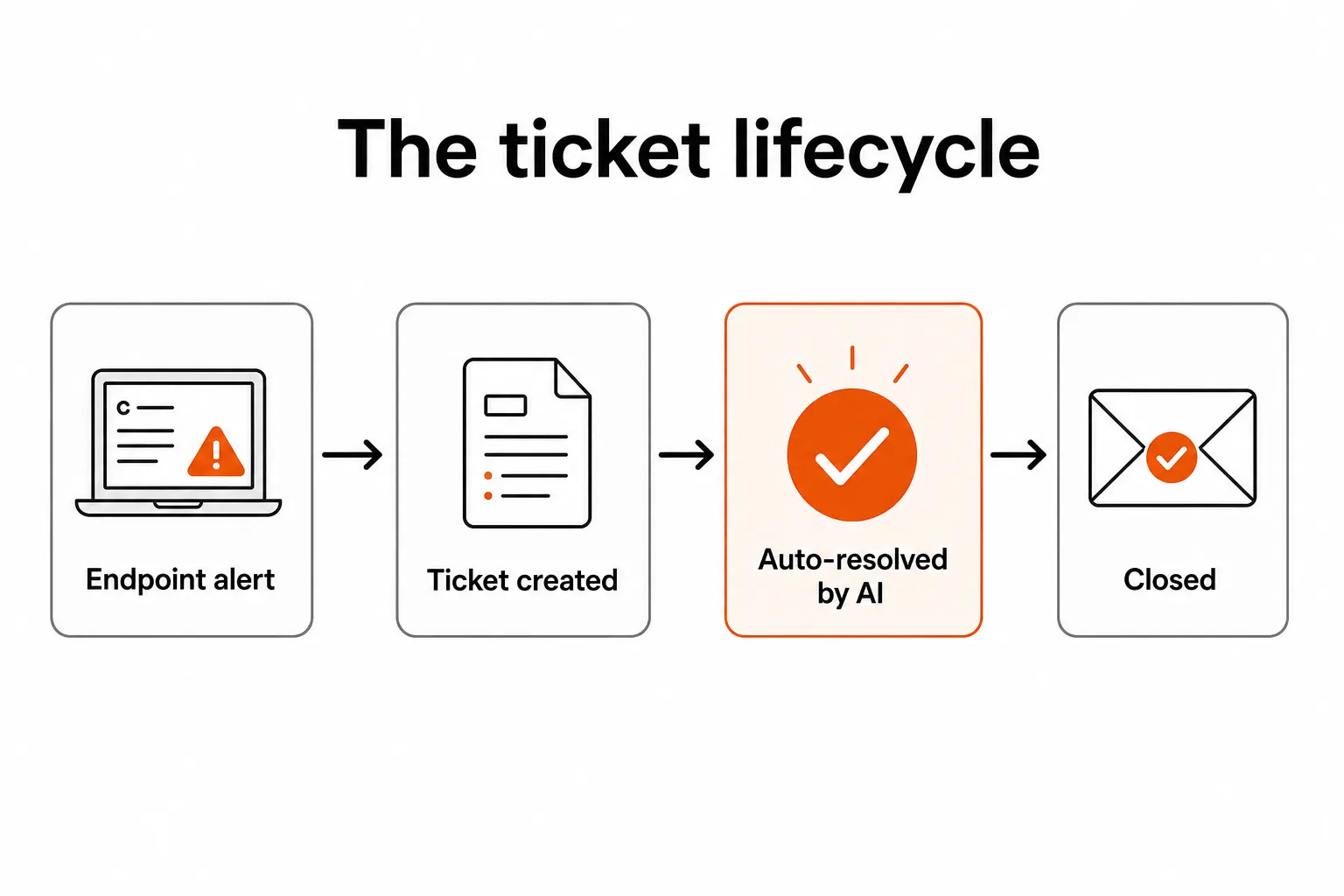
This is the gap in the current endpoint management conversation. The tools are good at finding problems. Most MSPs are still manually solving them.
Which tool fits your MSP?
Picking the right endpoint management platform comes down to four real factors:
Scale: If you're under 500 endpoints, Atera's per-tech pricing typically wins on cost. NinjaOne's ease of use wins on time-to-value. Above 2,000 endpoints with a technical team, N-able and ConnectWise Automate offer depth that pays off.
Stack integration: Running Autotask? Datto RMM's native integration matters. Microsoft-heavy clients? Intune makes the compliance work much easier. ConnectWise PSA users have natural paths to ConnectWise Automate, though that's worth evaluating carefully given the roadmap questions.
Multi-OS requirements: If your clients have mixed device environments - Windows, Mac, mobile - you need explicit MDM capabilities. NinjaOne launched MDM in 2024. Atera supports it. N-able covers it. Not all RMMs handle mobile with the same depth.
Automation philosophy: Some teams want to buy a platform and have it work out of the box (NinjaOne, Atera). Others want to build everything exactly to their standards (N-able, ConnectWise Automate). Neither philosophy is wrong, but be honest about which one your team will actually execute on.
"BYOD is real now. We used to say 'we only support Windows' - clients won't accept that anymore. UEM is becoming table stakes, not a nice-to-have."
- r/msp practitioner thread on endpoint management platform selection
Try Rallied
Rallied is an AI technician built specifically for MSPs. It connects to your PSA (ConnectWise, Autotask, Halo, SuperOps), your RMM (Datto, NinjaOne), and your identity stack (Entra ID, Okta, JumpCloud, Google Workspace) - and autonomously handles the L1 and L2 tickets that your endpoint management tools generate.
Password resets, account unlocks, MFA re-enrollments, permission changes, onboarding and offboarding - Rallied executes the full workflow: reads the ticket, takes the action, verifies the fix, notifies the user, closes the ticket. No human opens it.
MSPs using Rallied alongside their RMM recover 40-60% of L1 ticket volume autonomously, translating to $7K-$15K/month in tech time recovered. Same-week deployment, $0.50/ticket, 14-day free trial.
Your endpoint management tool finds the problems. Rallied fixes them.
Frequently Asked Questions
What is endpoint management in an MSP context?
Endpoint management for MSPs is the practice of remotely monitoring, patching, configuring, and securing all client devices - Windows PCs, Macs, servers, mobile phones, and more - from a single platform. Tools like NinjaOne and Atera let MSPs manage thousands of endpoints across dozens of clients without being on-site. The goal is proactive management: catching issues before users notice and automating fixes so techs spend time on work that actually needs them.
How much does endpoint management software cost for MSPs?
Most MSP endpoint management tools use per-device pricing, typically ranging from $1.50 to $4/device/month depending on the platform and volume. NinjaOne starts at $3.75/device/month for fewer than 50 endpoints, dropping to $1.50/device at 10,000+. Atera is the exception - it charges per technician ($129/month/tech on the Pro plan), not per device, which makes it very attractive for MSPs with large device counts. ConnectWise Automate and N-able are quote-based.
What's the difference between RMM and UEM?
RMM (Remote Monitoring and Management) was the original category - tools designed to monitor Windows servers and PCs and run scripts remotely. UEM (Unified Endpoint Management) evolved to cover all device types: Windows, macOS, Linux, iOS, and Android from one console. In practice, most modern MSP RMM tools have absorbed UEM capabilities, so the distinction is blurring. NinjaOne, for instance, is now marketed as a UEM platform while having deep RMM roots. If you're managing a multi-OS client base, look for explicit MDM (mobile device management) support in addition to traditional RMM features.
How long does it take to deploy an endpoint management tool?
Deployment timelines vary significantly. NinjaOne reports most users are fully operational within one week, with an average learning curve of under 3 hours. Atera users consistently report fast onboarding. ConnectWise Automate is more complex - G2 data shows a typical 2-month implementation with an 18-month ROI timeline. If deployment speed is a priority, prioritize tools with cloud-native architectures and free implementation support.
Can AI automatically handle tickets that endpoint management tools generate?
Yes - and this is where the biggest efficiency gains live for MSPs in 2026. Endpoint management tools surface alerts; those alerts become tickets. AI technician platforms like Rallied connect to your RMM and PSA and autonomously resolve L1 and some L2 tickets: password resets, account unlocks, permission changes, software installs. MSPs using this combination report handling 40-60% of ticket volume without human intervention, recovering $7K-$15K/month in tech time.