Domotz pricing explained: what MSPs actually pay in 2026

TL;DR
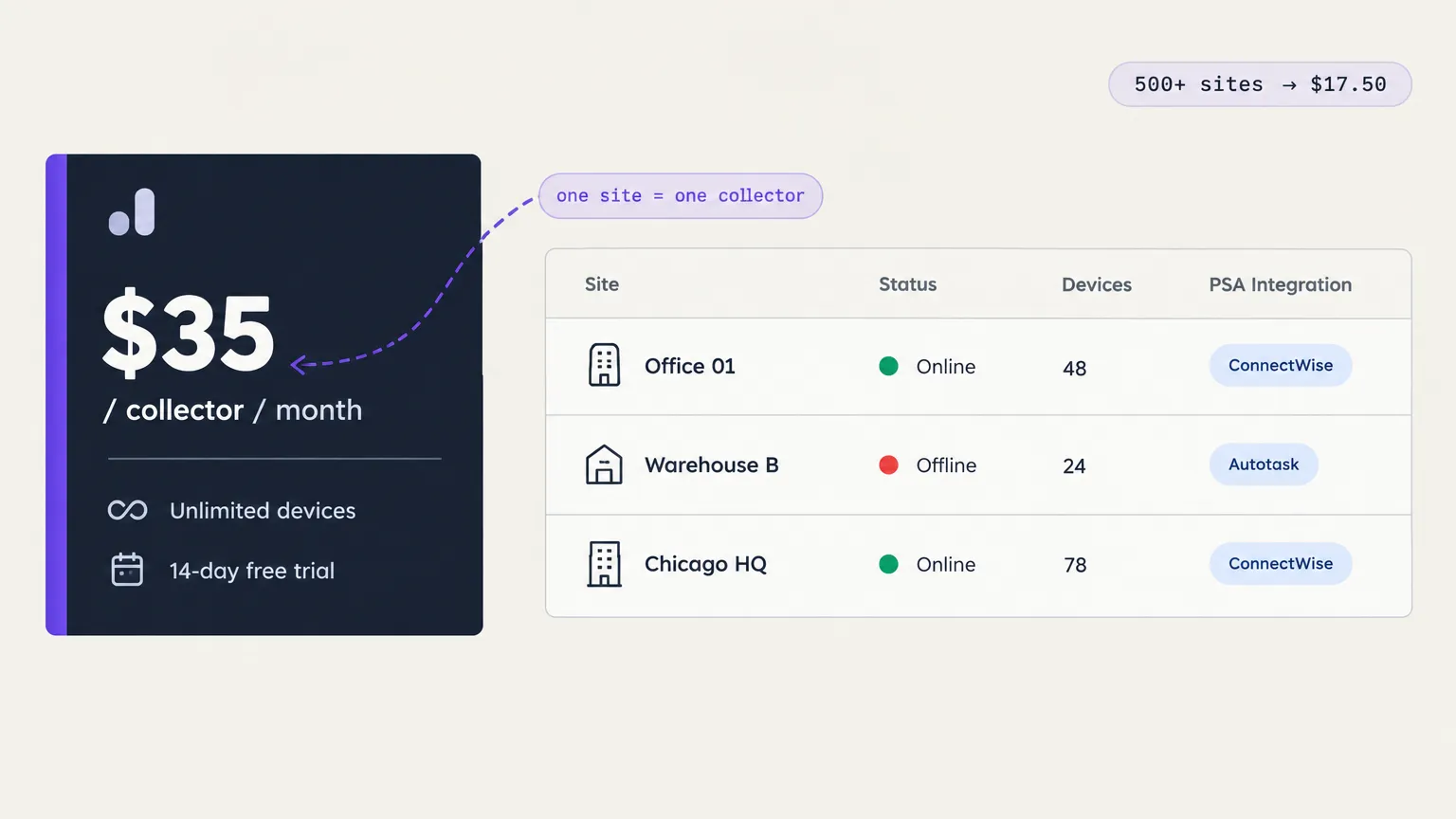
Domotz costs $35 per collector per month - one flat price per site, unlimited devices, every feature included. MSPs managing 100+ sites can get it down to $22.50 with a 12-month commitment; at 500+ sites, it's $17.50. There's a 14-day free trial with no card required.
The pricing model matters as much as the number: you pay per collector (one per client site), not per device. Adding devices to a site costs you nothing. If your client sites average more than 23 devices each, you'll almost certainly pay less with Domotz than with any per-device tool on the market. If your sites are tiny, that calculus might flip.
For MSPs already using an AI ticket resolution platform to handle L1 tickets, Domotz fills a complementary gap: it's the network visibility layer your RMM doesn't give you, and its PSA integrations mean network alerts can flow into the same ticket queue your AI technician is already resolving.
What you're actually paying for
The central concept in Domotz pricing is the collector - a lightweight agent that runs at a client site, discovers every device on the network, and monitors them continuously. You pay per collector, not per device. One collector covers one site, including multiple VLANs and up to 8 routed Layer-3 subnets.
That's the key difference from most network monitoring tools. Auvik, PRTG, and SolarWinds all charge based on how many devices or sensors you're monitoring. Add a dozen switches to a client's network and your bill goes up. With Domotz, it doesn't.
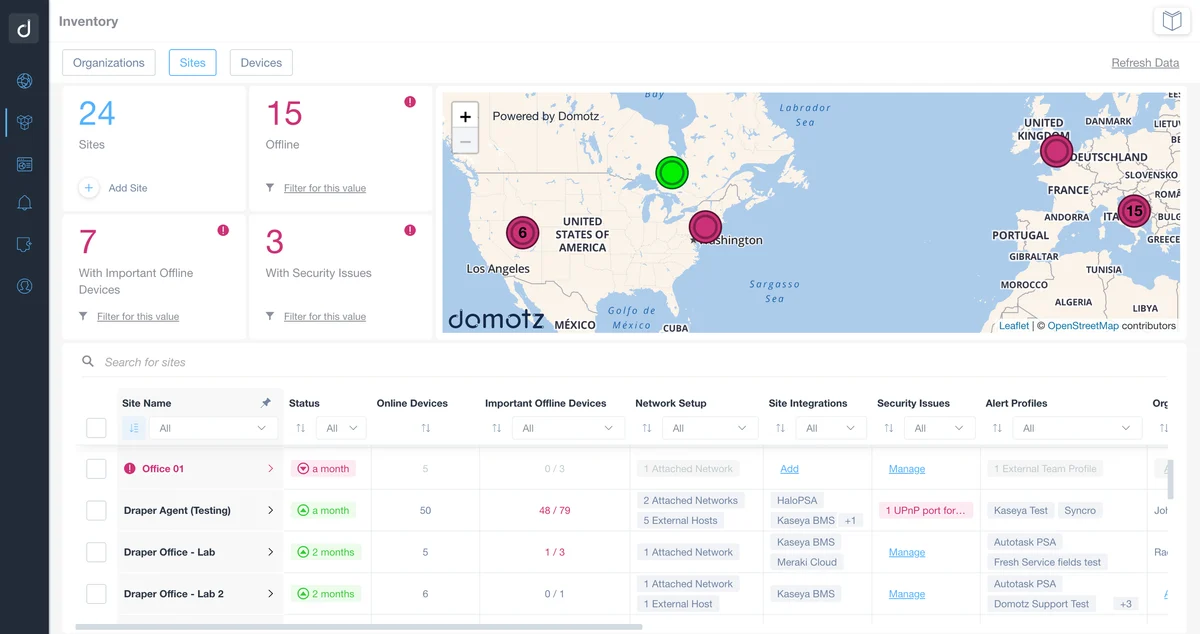
The collector runs on hardware you already own - a server, a NUC, a Raspberry Pi - or on a Domotz appliance. Setup takes about 15 minutes, and the multi-tenant dashboard shows every client site in one view. 4.8/5 on G2 from 105 reviews, and 4.9/5 on Capterra from 126 reviews. One long-time Capterra reviewer described it as "an indispensable tool in my toolbox, like a compass guiding a ship in deep water" - and that same reviewer has been using it for over five years.
Full pricing breakdown
There's one product, four market segments, and a single per-unit rate that varies by segment and volume.
| Segment | List price | Unit | Lowest rate | Term for discount |
|---|---|---|---|---|
| General / IT teams | $35.00 | per collector/month | $35.00 (no volume table) | No commitment |
| MSPs | $35.00 | per site/month | $17.50 (500+ sites) | 12-month, billed monthly |
| Commercial integrators | $35.00 | per site/month | $17.50 (500+ sites) | 12-month, billed monthly |
| Residential integrators | $20.00 | per home/month | $8.00 (500+ homes) | 12-month, billed monthly |
Sources: Domotz pricing page, MSP pricing, commercial integrator pricing, residential integrator pricing
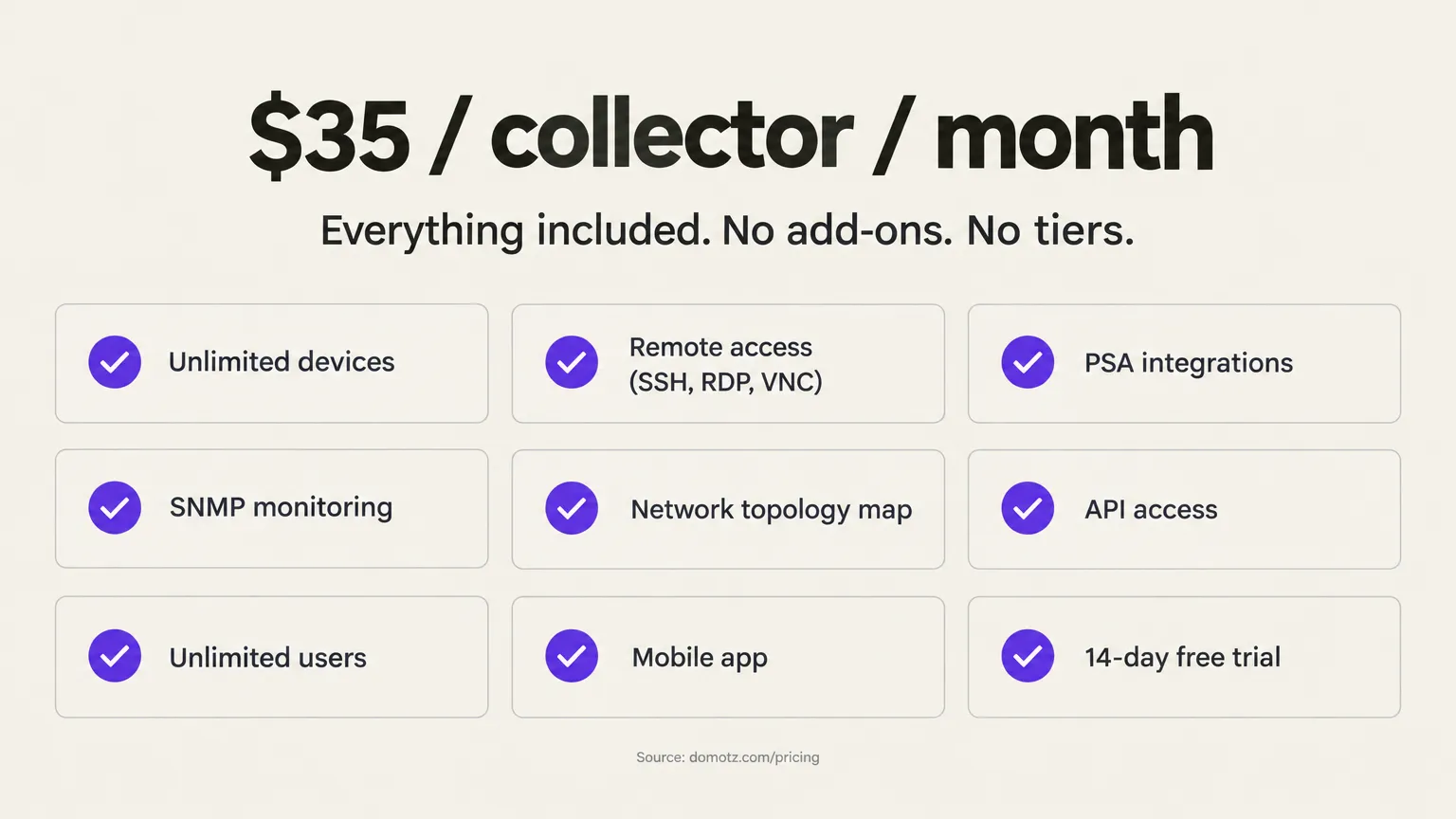
Every tier includes: unlimited devices, unlimited users and read-only viewers, every feature on the platform (no premium tier required), API access, PSA integrations, and mobile app access. No add-ons, no feature gating.
MSP volume pricing
This is where it gets interesting for larger MSPs. Volume discounts kick in at just 5 sites, require a 12-month term, and are billed monthly - so you don't have to pay a year upfront.
| Sites | Per site/month | Discount vs list |
|---|---|---|
| Under 5 | $35.00 | - |
| 5 to 9 | $31.50 | 10% |
| 10 to 49 | $28.00 | 20% |
| 50 to 99 | $25.00 | 29% |
| 100 to 249 | $22.50 | 36% |
| 250 to 499 | $20.00 | 43% |
| 500+ | $17.50 | 50% |
Source: Domotz MSP pricing
A few worked cost examples directly from Domotz's MSP pricing page:
- 10 sites (no commitment): $350/month at $35 per site
- 10 sites (12-month term): $280/month at $28 per site - saving $70/month vs month-to-month
- 70 sites (12-month term, 50-99 band): $1,750/month at $25 per site
- 100 sites (12-month term): $2,250/month at $22.50 per site
- 500+ sites: $17.50/site - you're paying exactly half of list
Adding sites mid-term keeps your current rate rather than automatically bumping you to a new band. You'd need to commit to a new 12-month term at the next tier to get the lower rate.
What $35 actually includes
The "no feature gating" part is worth dwelling on, because it's not how most SaaS tools work. Every feature is available on every plan from the first collector. That means:
- Network discovery - automatic device detection by MAC address, with new-device alerts
- Remote access - SSH, RDP, VNC, and Telnet to any device, plus VPN on demand
- SNMP monitoring - polling for device metrics, with custom alert thresholds
- PSA and ticketing integrations - ConnectWise Manage, Autotask PSA, HaloPSA, Syncro, Kaseya BMS
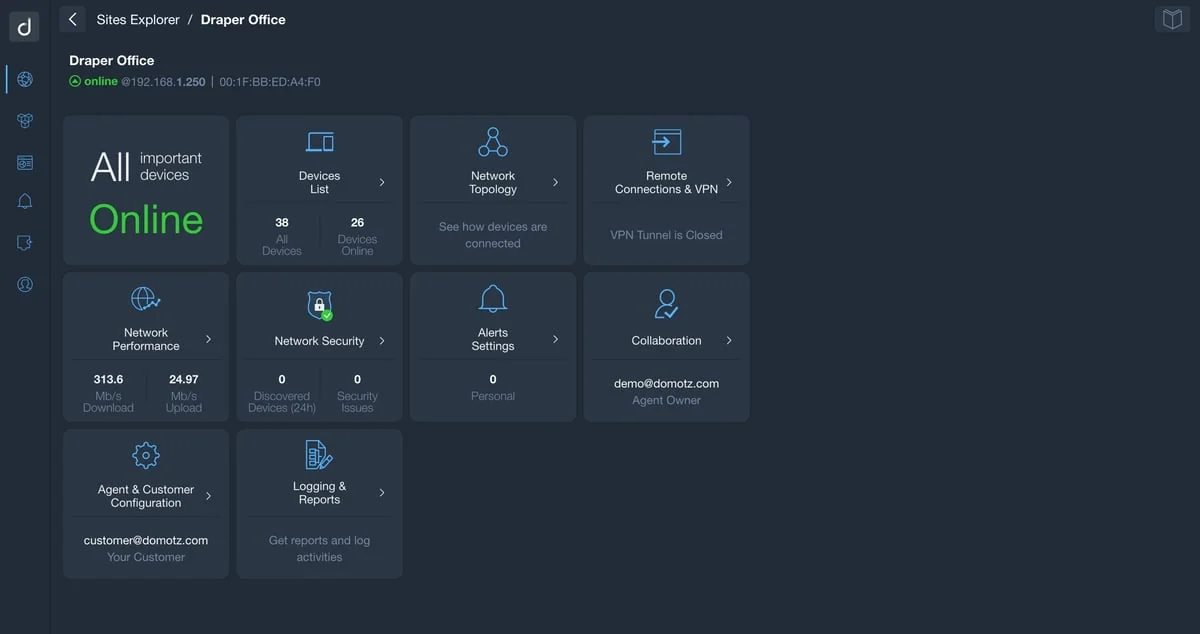
- Network topology mapping - automated maps of how devices connect at each site
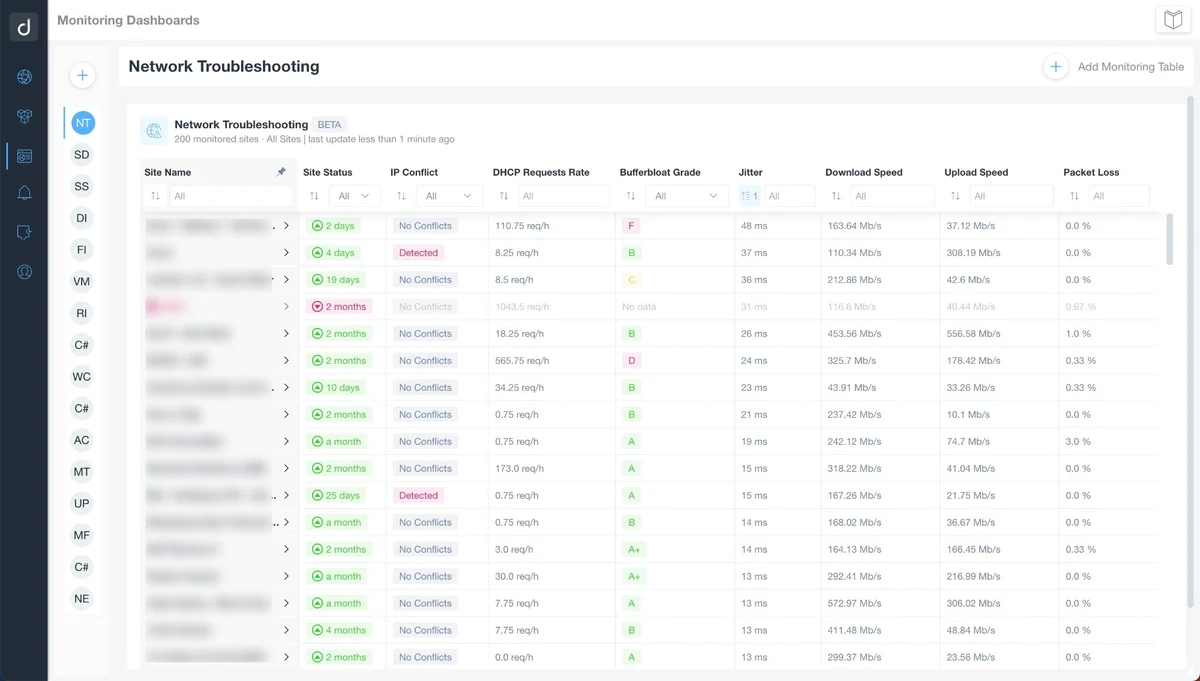
- Speed testing and diagnostics - traceroutes, bufferbloat grading, jitter measurements
- Custom scripting and API access - a public REST API and custom scripting framework
- Multi-tenant view - one pane across all client sites, with per-site branding for client reports
- MCP server - 40+ tools exposed for AI agent access, so AI technicians can work the same network as your human techs (Domotz MCP server)
Source: Domotz features
The per-collector vs per-device math
This is the real question every MSP should answer before committing.
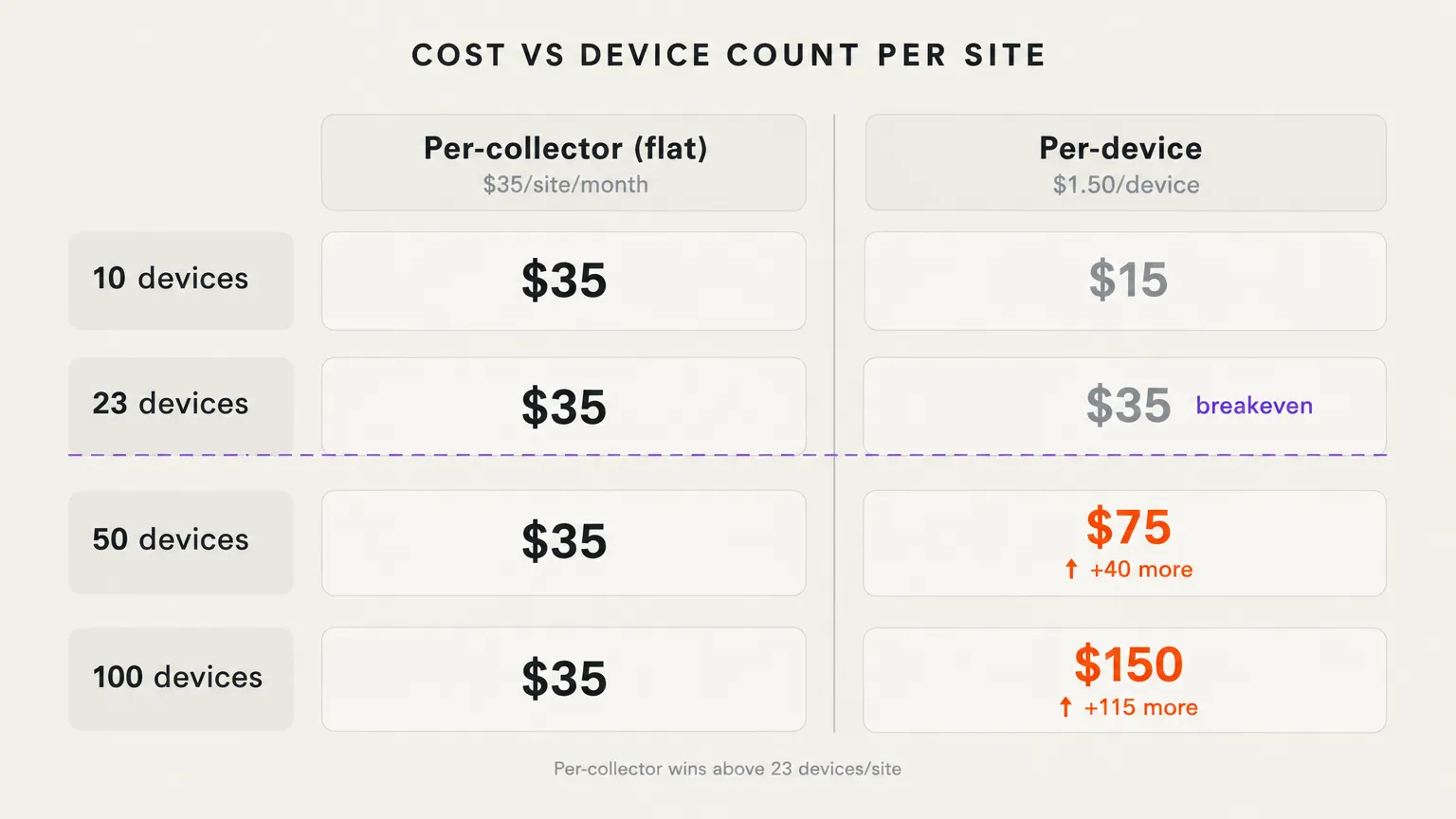
At $1.50/device/month (a common per-device rate that has appeared in Domotz's own pricing history and competitors like some Auvik configurations), the crossover point is 23 devices per site:
- 22 devices × $1.50 = $33 - per-device is cheaper
- 23 devices × $1.50 = $34.50 - roughly equal
- 24 devices × $1.50 = $36 - per-collector wins, and the gap widens from here
For a typical MSP client site - office infrastructure, managed switches, firewalls, wireless APs, workstations - 30 to 100 devices is normal. The per-collector model is almost always cheaper at real site densities. The main exception: very small offices or single-tenant environments where you're genuinely watching 10 to 15 devices.
This is also why Domotz's positioning against Auvik is interesting. Auvik is quote-based and per-device, which means Domotz wins on transparency and on cost for any reasonably populated site. One r/msp commenter framed it directly: "From the website Domotz is $35 per site. Auvik is about $10 per device…" - which means a 10-device site costs about the same, but a 50-device site with Auvik could run $500/month vs Domotz's $35 (or $28 with a commitment).
How Domotz compares to the alternatives
This comparison comes from Domotz's own pricing page - so treat the framing as theirs, but the pricing structure is accurate:
| Tool | Pricing model | Rough entry price | Feature gating |
|---|---|---|---|
| Domotz | Flat per collector | $35/collector/month | None |
| Auvik | Per device, quote-based | Quote required | Yes (tiered plans) |
| PRTG | Per sensor | ~$2,149/year (500 sensors) | Sensor cap |
| SolarWinds | Per node | From ~$7/node/month | Module-based |
For MSPs, the PRTG and SolarWinds comparisons are mostly irrelevant - those are enterprise-oriented tools with complexity to match. Auvik is the real comparison point, and the answer is: Domotz is cheaper and simpler to budget for, Auvik has stronger enterprise reporting and some tighter RMM integrations on specific platforms. One G2 reviewer put it plainly: "dashboard is less user-friendly than Auvik."
Known rough edges
No tool is perfect, and the community has been pretty clear about where Domotz falls short.
The biggest operational frustration: when a collector goes offline, historical uptime data for all devices at that site becomes unreliable. Tina W. on Capterra: "When the Domotz collector device goes offline, the historical data (all other device uptimes) are inaccurate." That's a meaningful limitation if you're reporting uptime SLAs to clients.
The topology mapper also has known accuracy issues. The GUI has a learning curve - particularly around where to find alert settings and PSA notification configuration. And there's no API for configuration items, which limits some automation use cases.
The price increase history is also worth knowing. An r/msp thread from roughly two years ago documented a jump from $23 to $35 per site - a roughly 50% increase that generated over 110 comments. The thread isn't ancient, and Domotz's pricing has been in multiple different models over the years (per-device, per-site at different rates). If you're signing a 12-month commitment, price stability is a real thing to ask about.
That said: the 5-year retention from reviewers like Andrew Y. on Capterra ("Domotz continues to work well for me 5+ years later") suggests that for the right use case, people stay.
Who Domotz makes financial sense for
Strong fit:
- MSPs with client sites averaging 25+ managed devices - per-collector pricing pays off fast
- Commercial AV and residential integrators - there's a segment-specific pricing tier and integrations tuned for this work
- Teams that want network visibility alongside (not instead of) their RMM - Domotz is explicitly positioned as a complement, and the MSP community backs that framing
- Anyone who wants an AI-accessible network - the MCP server is a genuine differentiator for teams building agentic workflows
Weaker fit:
- Very small client sites (under 20 devices each) where per-device tools are actually cheaper
- MSPs who need enterprise-grade reporting out of the box - Auvik has an edge there
- Teams who want a true single-vendor RMM/NMS stack - Domotz is a specialist tool, not a platform play
Try Rallied
If you're an MSP evaluating Domotz, you're probably already thinking about where network monitoring tickets end up - in your PSA queue, getting triaged by a tech who could be doing more complex work.
Rallied is an AI technician that resolves those L1 tickets end-to-end. Password resets, account lockouts, mailbox access, onboarding and offboarding - Rallied reads the ticket in your PSA, checks the client's live systems, runs the approved fix, and closes the ticket with notes and a time entry already written. About 700 tickets a month on a typical plan, at $300/month for 2,000 credits.
Domotz handles the network visibility; Rallied handles the ticket queue that network visibility generates. They're complementary tools for the same problem: getting more done with the team you have.
For the wider picture, read Best MSP Software in 2026.
Frequently Asked Questions
How much does Domotz cost per month?
Domotz costs $35 per collector per month at list price. MSPs and commercial integrators can get it down to $17.50 per site with a 12-month commitment at 500+ sites. Residential integrators pay $20 per home, or as low as $8 at volume. All plans include every feature and unlimited devices.
Does Domotz charge per device?
No. Domotz's current pricing model charges per collector (one per site), not per device. You pay the same $35 whether a site has 10 devices or 500. There have been per-device pricing models in Domotz's history, which is why you'll find conflicting figures in older community threads - the per-collector model with unlimited devices is what the official pricing pages show as of September 2026.
Can I get a volume discount on Domotz?
Yes. MSP volume pricing starts at 5 sites and goes down to $17.50 per site at 500+. Discounts require a 12-month commitment billed monthly. Under 5 sites pays list price with no commitment. The residential integrator program starts at $20 per home and drops to $8 at 500+ homes.
Is there a free trial for Domotz?
Yes. Domotz offers a 14-day free trial with full access to all features, including multi-tenant view and PSA integrations. No credit card is required. If you buy after the trial, you keep everything you set up during it.
How does Domotz pricing compare to Auvik?
Domotz charges flat per-site while Auvik charges per managed device on a quote-based model. Domotz's per-collector model wins financially once a site has more than roughly 23 devices - below that, per-device tools may be cheaper. Auvik offers more polished reporting and stronger RMM integrations on some platforms; Domotz counters with a simpler pricing model, better residential and AV integrator fit, and an MCP server for AI agent access.