MSP cost per ticket benchmarks: what you should be paying in 2026

TL;DR
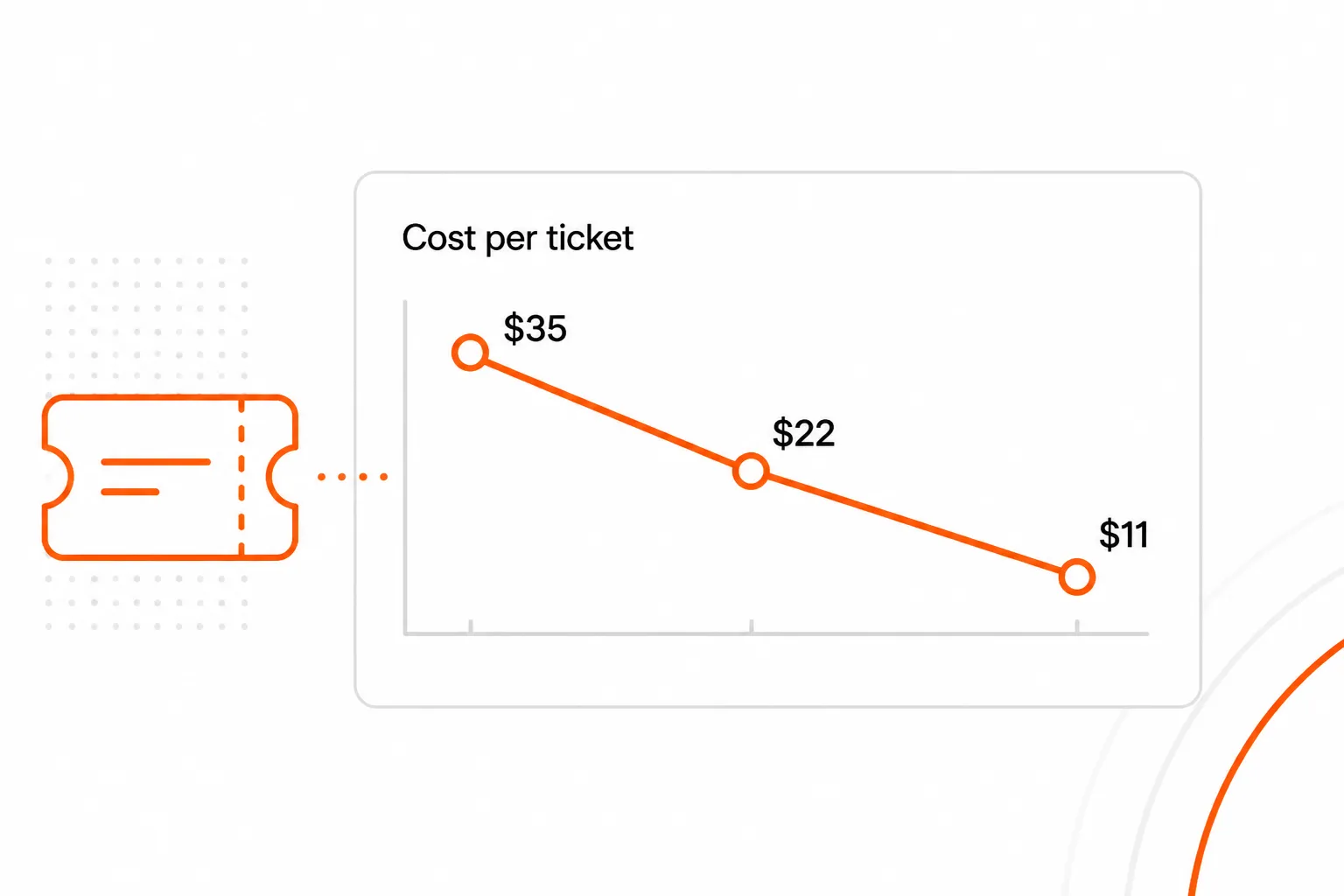
The published IT service desk benchmark is $15.56 per ticket (MetricNet). Most MSPs pay $30-50. The gap isn't because MSPs are inefficient - it's because MSPs handle multi-client environments, more variable ticket complexity, and often less ticket volume per tech than a large enterprise help desk. But roughly half of that gap is closeable. Password resets, account unlocks, and software provisioning - the tickets eating your L1 hours - are automatable. MSPs that tackle just that slice consistently get their blended cost per ticket into the $15-22 range. The ones using an AI technician for autonomous resolution are hitting $10-15.
What "cost per ticket" actually means
Cost per ticket is the total spend - labor, overhead, tools - divided by the number of tickets you close in a month. It's the single clearest indicator of your service desk's operational efficiency.
The formula:
Cost per ticket = (Total monthly labor + overhead) / Monthly tickets resolved
Where:
- Total monthly labor = tech salaries plus burden (payroll taxes, benefits, typically 25-35% of salary)
- Overhead = tools, facilities, management - generally 30-50% of direct labor
- Monthly tickets resolved = your PSA's closed ticket count for the month
For a 10-person MSP with $500,000 in annual tech labor, a 40% overhead load, and 2,500 monthly tickets, that math works out to roughly $28 per ticket. That's before factoring in escalations, after-hours calls, or tickets that require multiple touches.
The industry benchmarks
MetricNet, which benchmarks hundreds of IT service desks, puts the industry average at $15.56, with a full range of $2.93 to $49.69. A separate 2026 service desk benchmark from Maven AGI pegs the average at $22.50 per resolved incident.
HDI's North America research puts the broad range at $6 to $40+ across all IT help desk types.
The catch: those are enterprise IT help desk averages. They reflect large organizations with standardized environments, high ticket volume per tech, and years of accumulated automation. MSPs aren't running that kind of operation.
Evolved Management's MSP-specific benchmarking puts the typical MSP range at $30-50 per ticket - nearly double the published average. The reasons make sense: you're managing dozens of different client environments, dealing with tickets that don't follow a predictable pattern, and often carrying a lower ticket-per-tech ratio than a large enterprise help desk can sustain.
| Segment | Typical cost per ticket |
|---|---|
| Large enterprise IT help desk | $10-22 |
| Mid-market IT support | $20-35 |
| MSP (typical) | $30-50 |
| MSP with scripted automation | $18-28 |
| MSP with AI technician | $10-15 |
The benchmark isn't meant to make you feel bad about your number. It's meant to show you where the floor is - and roughly what it takes to get there.
How to calculate yours
Don't estimate. Pull the actual numbers.
- Get your last month's closed ticket count from your PSA (ConnectWise, Autotask, Halo, SuperOps - all have this report).
- Add up total tech labor for the month: salaries divided by 12, plus burden.
- Add overhead: if you don't have it modeled, use 40% of labor as a working figure.
- Divide.
If your number is between $30-50, you're normal for an MSP. If it's above $50, your overhead is high relative to ticket volume, your ticket mix skews complex, or both. If it's under $25 without heavy automation, you're either very high-volume or you have offshore labor in the mix.
What drives your cost above the benchmarks
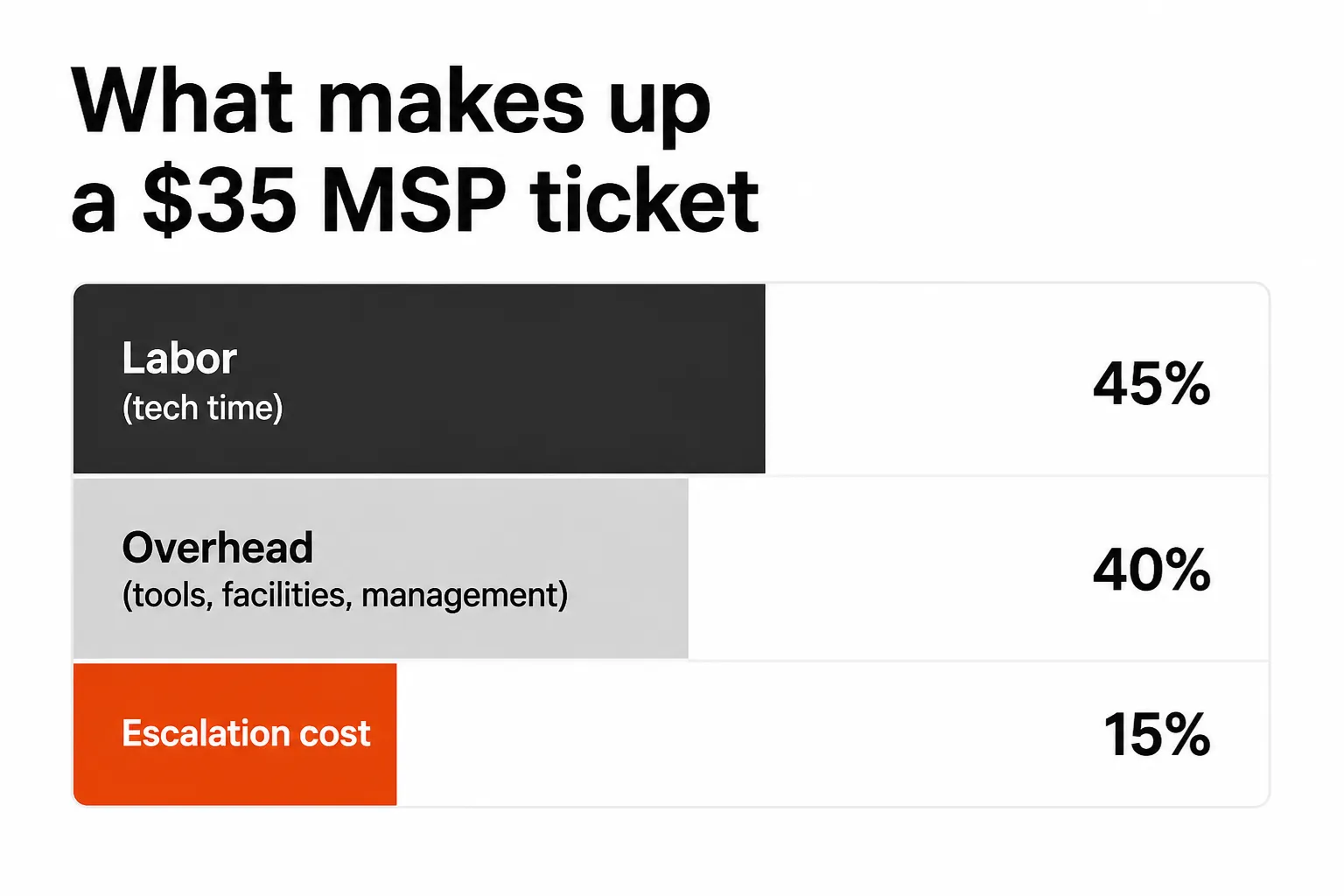
Three levers dominate:
Labor rate and resolution time. These are the core of the formula. An L1 technician at $50/hour spending 20 minutes on a ticket costs $16.67 in pure labor. Add overhead and you're at $23. Stretch that to 30 minutes and you're at $33. Resolution time is where most MSPs have the biggest opportunity - not because techs are slow, but because they're context-switching between clients and environments constantly.
Escalation rate. Every ticket that escalates to L2 costs 2-4x more. A 20% escalation rate on your L1 tickets can add $5-8 to your blended average across all tickets. According to MetricNet, the ratio of indirect staff (supervisors, QA, trainers) also adds meaningful overhead - replacement cost per technician in North America runs around $12,000, and that gets distributed across every ticket.
Ticket mix. An MSP whose L1 queue is 40% password resets and account unlocks has a very different cost structure than one whose L1 queue is 40% network troubleshooting. The former can automate aggressively; the latter is harder to touch.
Password and credential tickets alone run 20-50% of help desk volume, and 41% of service agent time goes to work that doesn't directly resolve the issue, per Salesforce's State of Service data. That's where the money goes. Not on the hard tickets. On the friction around every ticket.
The automation opportunity
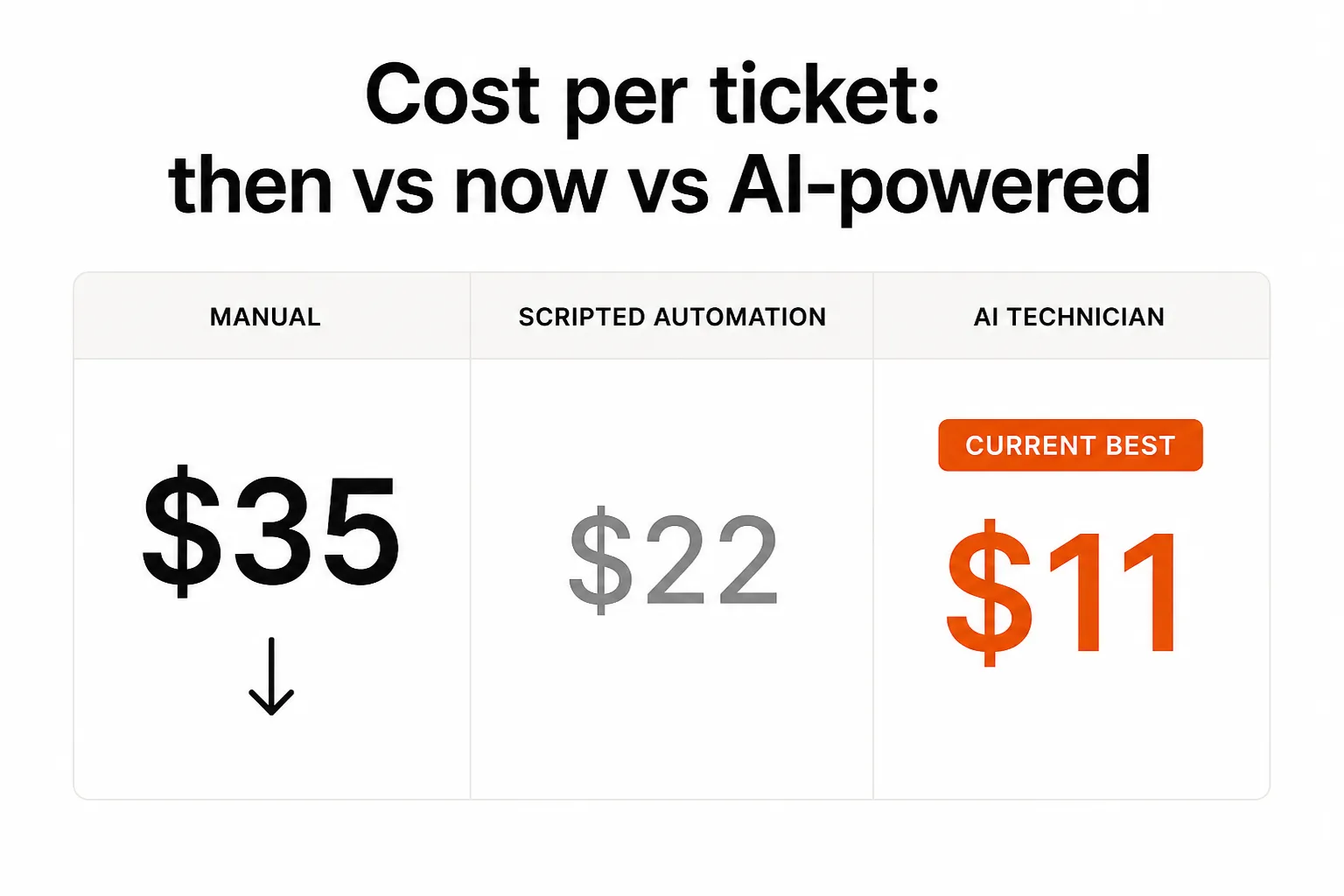
The math here is straightforward. If a password reset costs $12 with a human and $0.75 with automation, and you have 400 of them a month, that's $4,500/month in direct savings. Annual: $54,000. That's real money, and it's just one ticket type.
Maven AGI's 2026 benchmark puts service desk automation ROI at 320% within 18 months, with an average AI implementation payback of 9 months. Those are aggressive numbers - but they reflect what happens when you actually automate the high-volume repetitive slice of your queue rather than just getting better at routing it to the right person.
Traditional script-based automation (RMM-triggered workflows, self-service portals) typically covers 20-30% of ticket volume and reduces cost per ticket by 30-40% on that slice. For a $35/ticket MSP with 2,000 monthly tickets, that's roughly a $6-8 reduction in blended average - getting you to $27-29.
That's meaningful. But it's not a step-change.
Ticket type breakdown
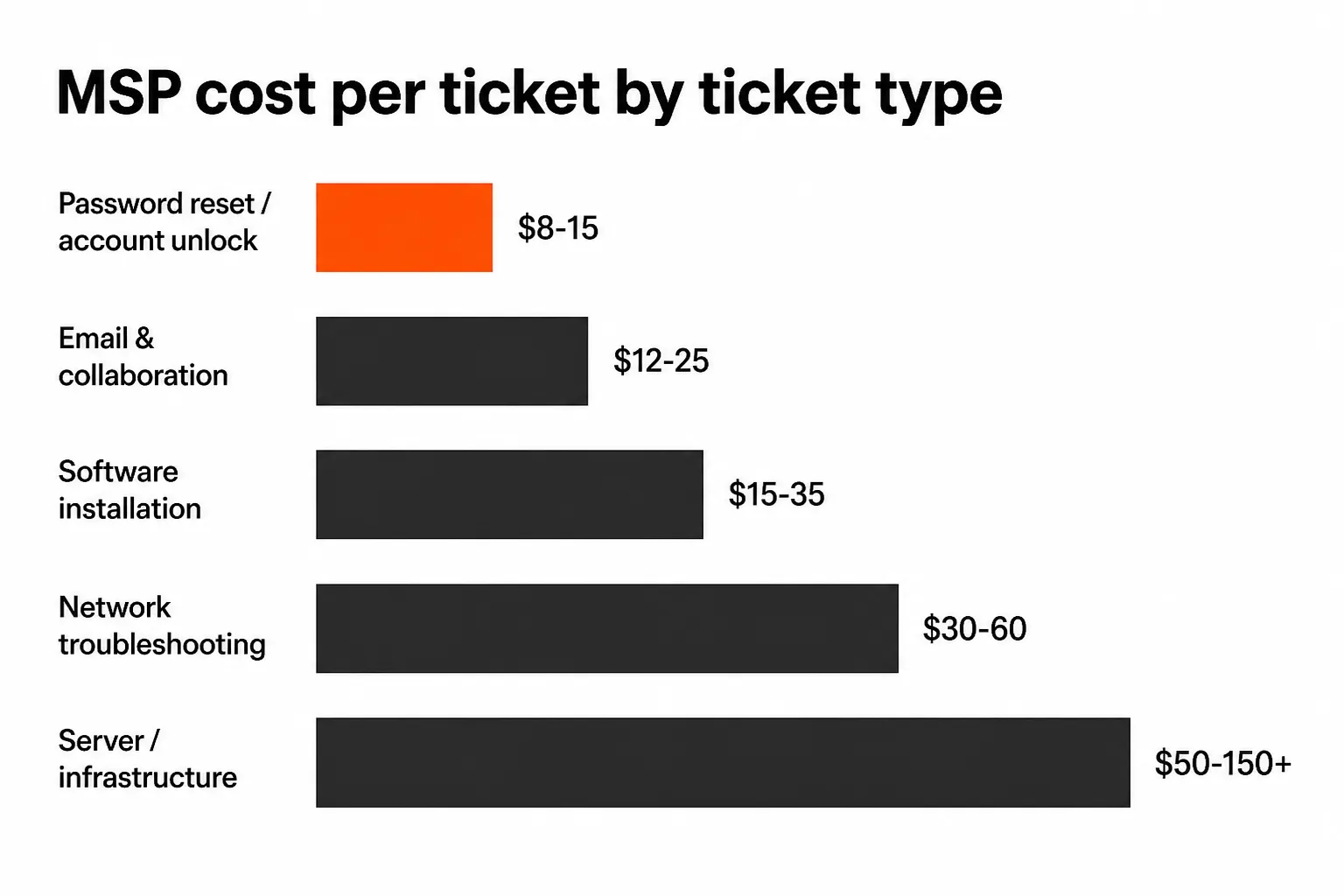
Not all tickets are created equal. Here's what different ticket types actually cost, and which ones move the needle:
| Ticket type | Typical cost | Volume (% of queue) | Automation potential |
|---|---|---|---|
| Password reset / account unlock | $8-15 | 20-30% | Very high (95%+ auto-resolvable) |
| Email & collaboration issues | $12-25 | 15-20% | Medium (60-70% with diagnostics) |
| Software installation | $15-35 | 10-15% | High (70-80% via RMM/MDM) |
| Network troubleshooting | $30-60 | 10-12% | Medium (60-70% for diagnostics) |
| User onboarding / offboarding | $40-80 | 5-10% | High (with identity integration) |
| Server / infrastructure | $50-150+ | 5-10% | Low - stays human |
The top of that table - password resets, account unlocks, MFA resets - is where most MSPs should start. It's high volume, low complexity, and the resolution path is deterministic. You either have permissions to reset a password or you don't. There's no judgment call involved.
That hiring gap is the real reason automation ROI looks so good right now. A skilled L1 tech takes months to hire and months more to train, and the queue doesn't wait. At $40-70/hour for an experienced L1 tech (before burden), every ticket that doesn't need a human is $8-20 back in your pocket.
The AI technician model: a different kind of math
Where traditional automation handles the 20-30% of tickets that follow a clean workflow, an AI technician changes the scope of what's automatable.
The difference is integration depth. A scripted workflow can reset a password if your RMM exposes a script for it. An AI technician that's connected to Entra ID, Okta, or JumpCloud can handle the full resolution: verify identity, check account status, reset the password, update the ticket, and close it - without a script for every scenario, and without a human in the loop.
That's the difference between 25% automation coverage and 50-60%.
For a 2,000-ticket/month MSP at $35/ticket:
- AI technician handles 1,200 tickets autonomously at $3/ticket = $3,600
- Human techs handle 800 (complex, escalated) at $55/ticket = $44,000
- Blended cost: $23,800/month = $11.90 per ticket
- vs. $70,000/month at baseline
That's a 66% reduction in total spend on those 2,000 tickets. The economics shift even more as you scale volume up - the AI technician's cost doesn't grow linearly with ticket count the way headcount does.
One important caveat: this math assumes the AI technician has the integrations to actually resolve tickets, not just classify and route them. Triage-only AI cuts cost by 5-15% on handling time. Autonomous resolution on 50-60% of volume is what gets you from $35 to $12.
Try Rallied
Rallied is an AI technician built for MSPs that connects directly to your PSA (ConnectWise, Autotask, Halo, SuperOps), RMM (Datto, NinjaRMM), and identity stack (Entra ID, Okta, JumpCloud, Google Workspace) to handle L1 and L2 tickets autonomously. Password resets, account unlocks, MFA issues, onboarding, offboarding, software provisioning - it does the actual work, not just the triage.
Rallied is $300 a month, billed monthly, with 2,000 credits included. Each ticket costs 1, 3 or 8 credits depending on how much work the agent did on it, so a typical month covers about 700 tickets. Tickets Rallied couldn't finish are never charged. If you're currently spending $15 per L1 ticket with a human tech, 400 of those tickets a month fit inside the $300 plan in a typical month, and that's before counting the senior tech capacity you've freed up.
Setup takes under a week. No workflow builder, no forward-deployed engineer, no 6-month implementation. That's a deliberate design choice: MSPs don't have a dedicated automation admin, so the product has to work without one.
For the wider picture, read MSP Benchmarks 2026.
Frequently Asked Questions
What is the average cost per ticket for an MSP in 2026?
MSPs typically run $30-50 per ticket, according to Evolved Management's MSP benchmarking. That's well above the general IT service desk average of $15.56 cited by MetricNet, because MSPs handle multi-client environments with more variable complexity. Your blended average depends on ticket mix, team size, and how much you've automated.
How do I calculate my MSP's cost per ticket?
The formula is: (Total monthly labor cost + overhead) / monthly tickets resolved. Add up tech salaries plus burden, estimate overhead at 30-50% of labor (tools, facilities, management), sum those two, then divide by how many tickets you closed. If you resolved 2,500 tickets on $70,000 of total monthly cost, your cost per ticket is $28. Most PSA systems can pull the ticket count; the labor math just takes a spreadsheet.
What is a good cost per ticket target for an MSP?
For a well-run MSP handling mostly L1 and L2 work, $20-28 per ticket is a realistic target without major automation. With scripted automation covering routine tickets, $15-20 is achievable. MSPs using an AI technician for L1 work report blended costs of $10-15 per ticket across their full ticket volume, since autonomous resolution eliminates labor cost on 40-60% of tickets entirely.
How much can automation reduce MSP cost per ticket?
Scripted automation (RMM workflows, self-service portals) typically cuts cost per ticket by 30-40%. AI-powered autonomous resolution goes further - targeting 50-65% reduction on tickets it handles. The catch is coverage: most automation tools handle 20-30% of ticket volume; an AI technician like Rallied that connects to your identity stack and PSA can handle 40-60%. The savings on unhandled tickets are zero, so coverage matters as much as the per-ticket cost.
Which ticket types have the most automation potential?
Password resets, account unlocks, and MFA resets are the highest-volume and easiest to automate - they account for 20-30% of typical MSP ticket volume and cost $8-15 each with a human, but under $1 with automation. Software installs, account provisioning, and onboarding tasks are next. Network diagnostics are partially automatable (run the diagnostic, fix the simple ones, escalate the rest). Complex hardware and infrastructure work stays human.