MSP ticket resolution time benchmarks: what good actually looks like in 2026

TL;DR
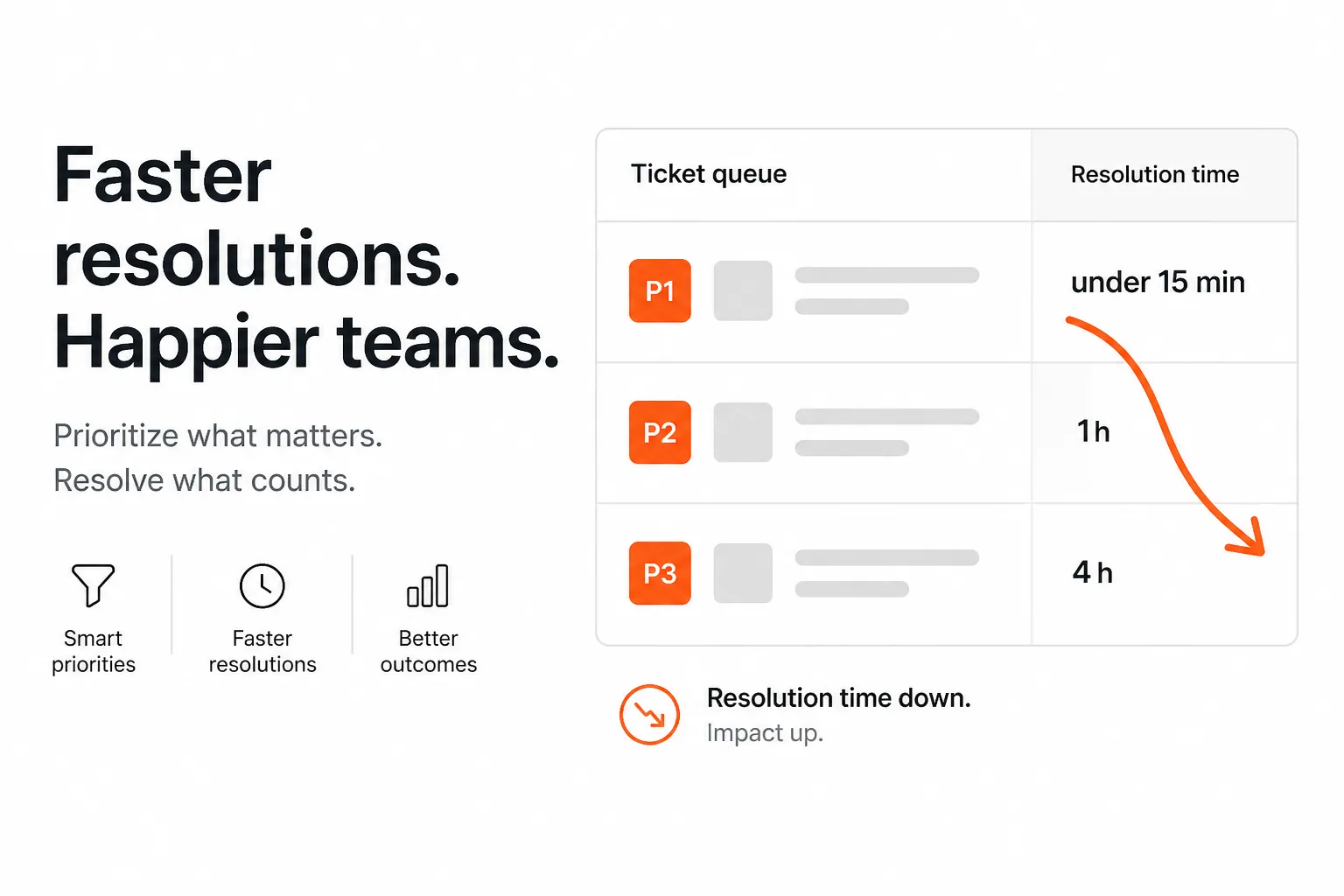
The industry average MSP ticket resolution time is 3 days and 10 hours. Best-in-class MSPs resolve tickets in under 30 minutes. That's not a small gap - it's the difference between a client who renews and one who starts shopping. Most of the gap isn't about headcount. It's about routing delays, repetitive L1 work, and after-hours coverage holes. AI automation is the lever that moves all three at once. If you're hitting P1 tickets in under 2 hours and normal tickets in under 4 hours, you're in the top tier. If not, the benchmarks below will show you where you're bleeding time.
Why resolution time is harder to measure than you think
Before benchmarks, a quick honest admission: "ticket resolution time" is slippery.
Your PSA might measure it one way. Your SLA contract defines it another. And your clients experience something else entirely. Specifically, most PSA clocks start when the ticket is created - but the client's frustration clock started when they first noticed the problem, which could be 20 minutes earlier.
There's also the first response vs. resolution confusion. A tech who sends a "we got your ticket" message in 2 minutes has hit the first-response SLA. But if the ticket isn't actually resolved for 2 days, the client doesn't care about that 2-minute mark.
"Generally in our contracts we have two SLAs - one is to acknowledge we received the ticket, that's 2 hours for emergencies."
The benchmarks below cover full resolution time - from ticket creation to close. That's the number that actually correlates with client satisfaction and renewal rates.
MSP ticket resolution time benchmarks by priority tier
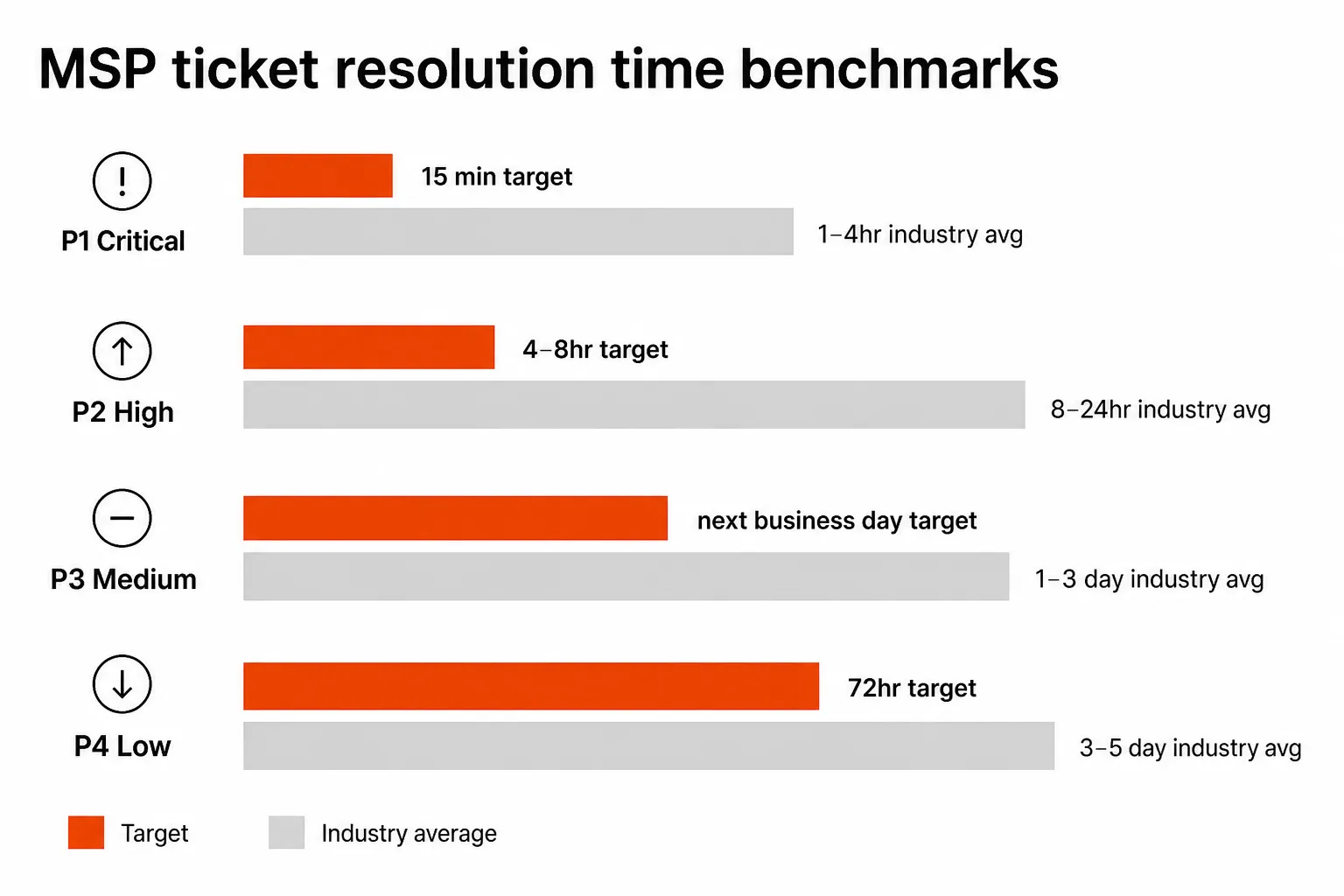
These are the targets that separate top-performing MSPs from average ones. Industry data comes from the Fixify 2026 IT Help Desk Benchmark Report, ECS Rocks SLA statistics, and Josys MSP efficiency research.
| Priority | Type | Response target | Resolution target | Industry average |
|---|---|---|---|---|
| P1 Critical | System down, security breach | 15 minutes | 1–4 hours | 2–8 hours |
| P2 High | Significant degradation | 30–60 minutes | 4–8 hours | 4–24 hours |
| P3 Medium | Moderate impact, workaround exists | 1–4 hours | Next business day | 1–3 days |
| P4 Low | Minor request, no urgency | 4–8 hours | 72 hours | 3–5 days |
| Overall average | - | - | 30 min (best-in-class) | 3 days, 10 hours |
The overall industry average of 3 days and 10 hours is dragged up by the long tail of stalled P3 and P4 tickets. Best-in-class MSPs get that number under 30 minutes by automating the routine work that inflates it.
One more data point worth anchoring on: 22% of all help desk tickets are work stoppages - the client literally cannot do their job until the ticket is closed. For organizations with over 1,000 employees, that climbs to nearly one-third. Which means slow resolution time has a direct cost on your clients' business productivity, not just their satisfaction score.
The SLA adherence target that matters
Resolution time benchmarks only matter if you're tracking compliance against them. Best-in-class MSPs consistently stay above 95% SLA adherence. Anything below 95% suggests process gaps, not just staffing gaps.
The CSAT correlation is sharp: sub-5-minute response time correlates with 92% CSAT. Wait 48 hours, and it drops to 23%. Your SLA adherence rate is essentially your client renewal probability in a single number.
Where most MSPs actually land - and why
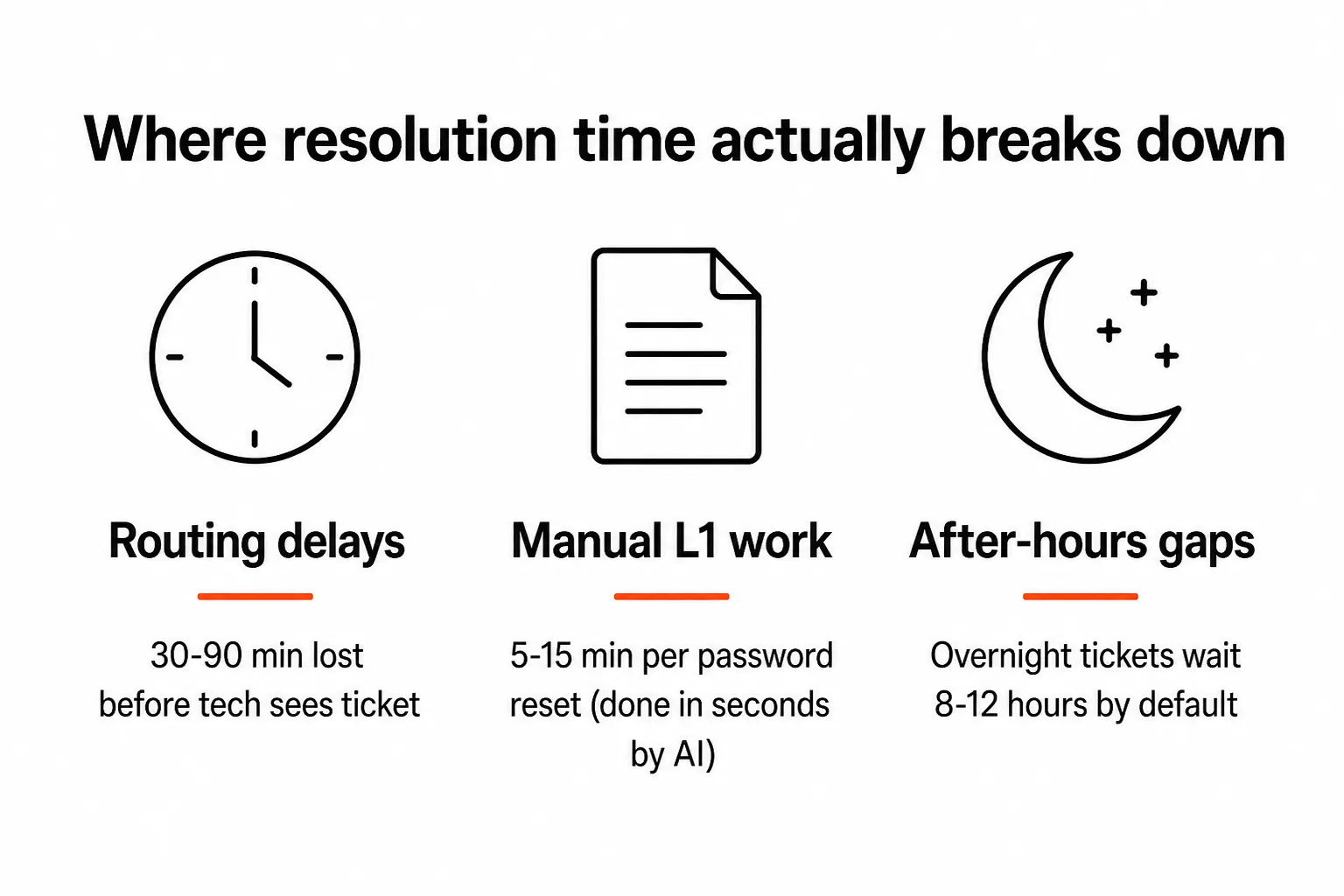
The gap between the 3-day-10-hour average and best-in-class comes from three compounding problems. They're solvable, but most MSPs are solving the wrong one.
Routing delays eat 30–90 minutes before a tech even touches the ticket
Most MSPs route tickets manually or rely on shared mailboxes and dispatcher judgment. When a ticket arrives, it might sit unassigned for 30 minutes to over an hour before a tech even opens it. That's dead time - the clock is running, no work is happening.
This is the bottleneck that MSPs most consistently underestimate. The instinct is to hire more technicians. The actual fix is fixing routing so existing technicians get to tickets faster.
Manual L1 work consumes time it shouldn't
Password resets alone account for roughly 18% of L1 ticket volume at most MSPs. A human technician takes 5–15 minutes to process each one: navigate the identity provider, find the user, reset, verify, email, close the ticket. It's not hard work. It's just time.
The same is true for account unlocks, permission changes, shared mailbox access grants, and offboarding tasks. These are deterministic workflows - the same 8 steps every single time. But when a human handles 40 of them a week, that's 3–10 hours of resolution time being burned on work that shouldn't need a human.
After-hours coverage gaps inflate the average
Most MSPs operate business hours. A ticket submitted at 5:01 PM on Tuesday sits untouched until 8:00 AM Wednesday - a 15-hour delay built into the system before anyone even looks at it. Multiply this across your P3 and P4 queue, and you understand most of where that 3-day-10-hour average comes from.
True 24/7 human coverage is expensive. On-call rotations burn out staff. Most MSPs don't have a good answer here - until automation enters the picture.
The burnout math underneath the benchmarks
There's a reason resolution time benchmarks are hard to hit consistently: the people responsible for hitting them are often running close to their limit.
60% of MSPs experience moderate to severe burnout. 150–190 tickets per week per technician is the point where burnout "hits hard" - and 40–60 tickets per week is the sustainable range for mixed-type ticket loads.
"I have some of my guys saying they're frustrated and overloaded. Despite me constantly tracking ticket load, their experience exceeds what the data shows."
The gap between what the metrics show and what technicians experience is real. Queue anxiety, context-switching overhead, and the psychological weight of a 200-ticket backlog don't show up in average resolution time - but they show up in CSAT scores, turnover, and SLA breach patterns.
Reducing L1 volume through automation doesn't just improve resolution time. It directly reduces the load that pushes technicians toward burnout.
How AI changes the resolution time equation
AI automation delivers a 16x resolution time advantage for automated ticket categories, according to Fixify's 2026 benchmark report. Leading MSPs using automation tools report 40–70% reductions in overall resolution time.
For the specific ticket types that inflate averages most - password resets, account unlocks, permission changes - AI agents complete in seconds what takes humans 5–15 minutes. That's not an incremental improvement. It's a category change.
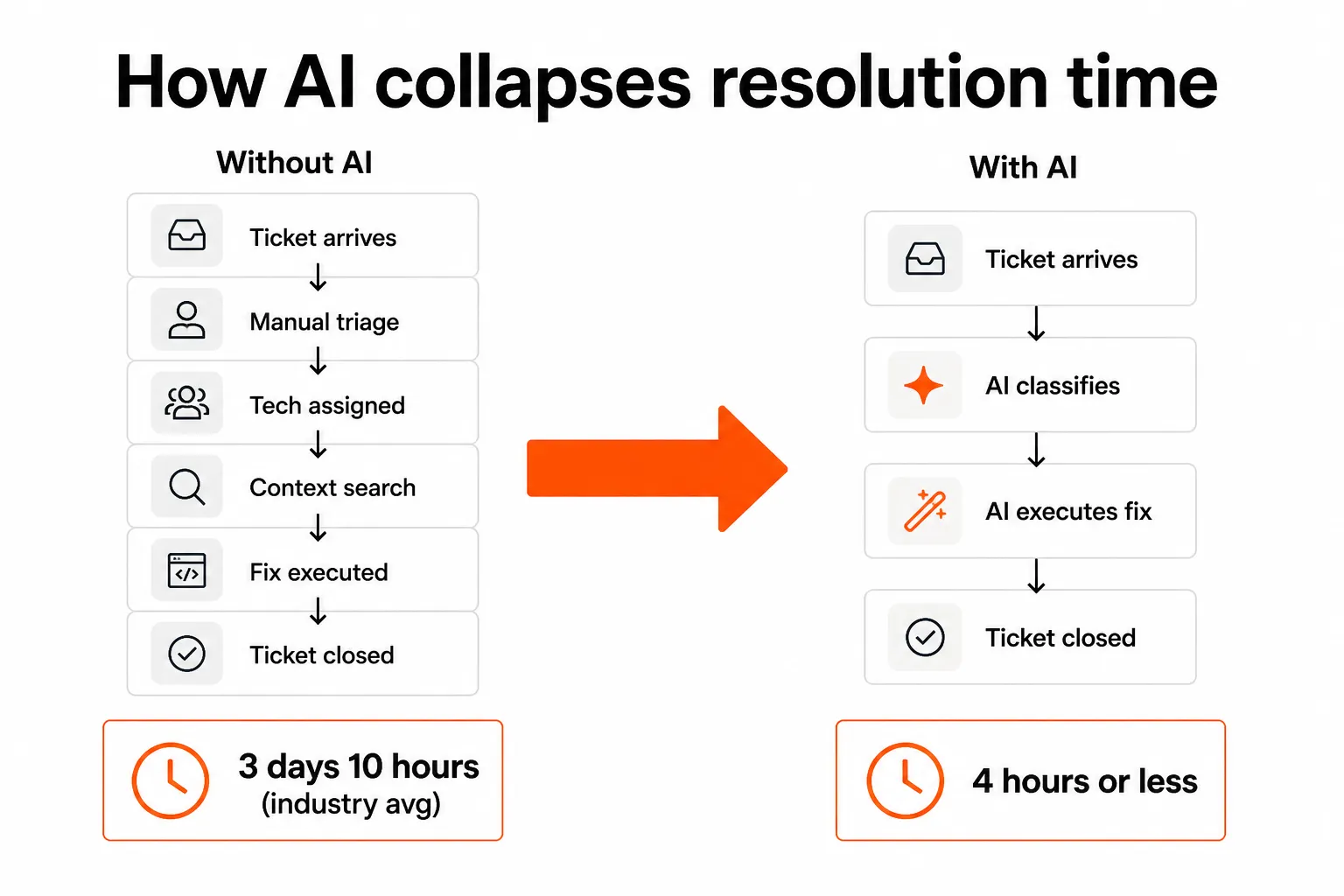
The mechanism is straightforward. A ticket arrives. The AI agent reads it, classifies it, pulls relevant documentation, executes the fix in the connected identity or RMM system, verifies the action succeeded, notifies the user, and closes the ticket. No queue wait. No tech assignment delay. No after-hours gap. The ticket is resolved before a human dispatcher would have even seen it.
The before-and-after numbers tell the story. Without AI: ticket arrives, waits for manual triage, gets assigned, tech searches for context, fix is executed. Average: 3 days, 10 hours. With AI on L1 tickets: ticket arrives, AI classifies and executes, ticket closes. Average: 4 hours or less.
84% of MSP clients now expect AI-driven support or accept it. That expectation is already priced in. The MSPs not closing the resolution time gap with AI aren't just slower - they're becoming the option clients leave.
What top-performing MSPs do differently
The MSPs hitting best-in-class benchmarks share a few habits that don't require huge teams.
They fix routing before they hire. Direct email-to-PSA routing, automatic assignment rules by ticket type, and escalation triggers for stalled tickets. Most resolution time improvement is upstream of technician speed - it's about getting tickets to the right person faster.
They track by priority tier, not overall average. An aggregate "2.4 hour average" is almost meaningless if it hides 8-hour P1 outliers. Tier-specific tracking surfaces where the actual SLA risk is.
They automate the predictable categories first. Password resets, account unlocks, simple permission changes - these are high-frequency, low-variance, fully deterministic. They're the easiest to automate and produce the biggest resolution time impact because they're so common.
They have an answer for after-hours. Not necessarily a full human shift - but something. AI agents that can handle common L1 tickets 24/7 are cheaper than an overnight team and don't burn out.
High-performing MSPs show 20%+ margins, 76% client retention, and 51% recurring revenue. The link between those numbers and resolution time benchmarks is direct: faster resolution improves CSAT, CSAT drives retention, retention drives margin.
Try Rallied
Rallied is an AI technician built for MSPs. It connects to your PSA, RMM, and identity providers - Entra ID, Okta, JumpCloud, Google Workspace - and resolves L1 and L2 tickets autonomously. Password resets, account unlocks, user onboarding and offboarding, mailbox configuration, permission changes, RMM script execution. Done in seconds, not minutes.
Rallied handles 40–60% of ticket volume without a human in the loop. For MSPs running 200–500 tickets per month, that's $7,000–$15,000 in monthly tech time recovered. Pricing is $300 a month for 2,000 credits, about 700 tickets in a typical month, and tickets it can't finish are never charged. Setup takes a week, not six months.
See how it works at rallied.ai.
For the wider picture, read MSP Benchmarks 2026.
Frequently Asked Questions
What is a good ticket resolution time for an MSP?
Best-in-class MSPs resolve tickets in 30 minutes or less on average. Industry leaders average around 4 hours for normal-priority tickets and under 15 minutes for critical ones. The overall industry average is 3 days and 10 hours - which means there's a wide gap between average and excellent. A reasonable target is resolving P3 tickets within 8–24 hours and P1 tickets within 1–4 hours.
What are typical MSP SLA response and resolution time targets by priority?
Standard MSP priority tiers look like this: P1 Critical - 15-minute response, 1–4 hour resolution; P2 High - 30–60 minute response, 4–8 hour resolution; P3 Medium - 1–4 hour response, next-business-day resolution; P4 Low - 4–8 hour response, 72-hour resolution. These are targets - whether your team consistently hits them depends on automation, staffing, and routing efficiency.
How does AI automation improve MSP ticket resolution times?
AI-driven automation compresses resolution times by eliminating the manual steps that slow tickets down most: triage, routing, context lookup, and executing repetitive fixes. The Fixify 2026 IT Help Desk Benchmark Report found a 16x resolution time advantage for AI-automated tickets. Leading MSPs using automation tools report 40–70% reductions in resolution time. For common L1 issues like password resets, AI agents like Rallied complete in seconds what takes humans 5–15 minutes.
Why do so many MSPs miss their resolution time SLAs?
Three root causes explain most SLA misses: manual triage and routing delays (tickets sit unassigned for 30–90 minutes before a tech even sees them), repetitive L1 work consuming technician time (password resets alone account for roughly 18% of ticket volume), and after-hours coverage gaps (tickets submitted after 5 PM wait until the next morning by default). Most MSPs try to solve these problems by hiring more staff, which is the slowest and most expensive fix.
What is first contact resolution (FCR) and what's a good benchmark for MSPs?
First contact resolution is the percentage of tickets resolved on the first interaction - no callbacks, no follow-ups. Desktop support organizations average 84% FCR worldwide, higher than general call centers (70–71%). Top performers aim above 85%. AI-driven technicians can raise FCR significantly for L1 tickets, since they have instant access to documentation and identity systems without needing to look anything up.