The 7 best ConnectWise RMM alternatives in 2026

TL;DR
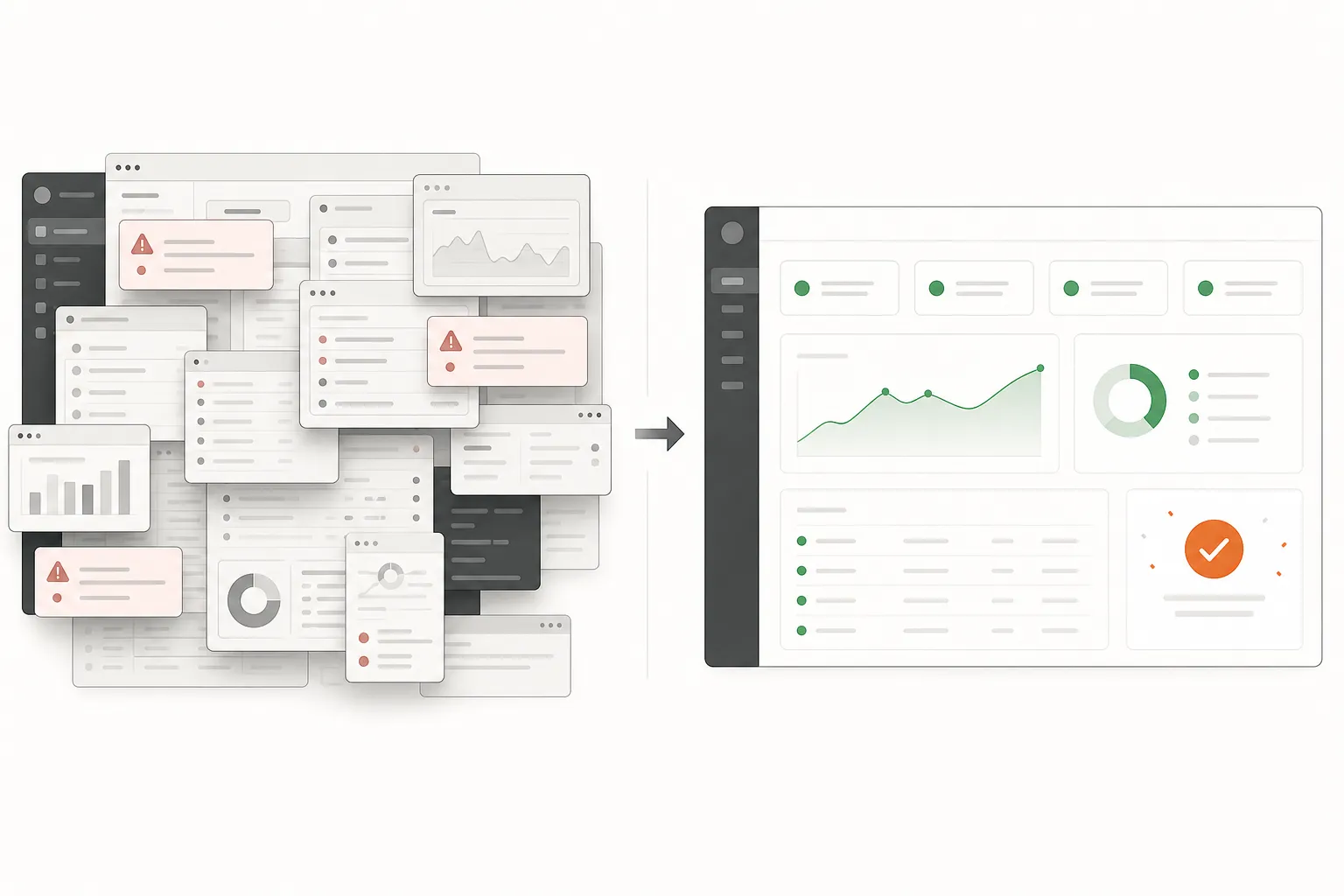
ConnectWise RMM is enterprise-grade infrastructure - but it comes with enterprise-grade friction: 3-month average implementation, custom pricing that requires a sales call, and a feature set calibrated for very large MSPs. Most of the shops looking to leave aren't replacing it because it's bad, they're replacing it because the implementation overhead doesn't match what a 5- or 10-person MSP actually needs.
The strongest alternatives in 2026 are NinjaOne (best overall - 4.7/5 on G2, live in a week, $1.50–$3.75/device), Atera (per-tech pricing, strong AI automation, best for small teams), and Syncro (bundled PSA+RMM that's often cheaper than running separate tools). The non-obvious option: if your real problem is L1 ticket volume eating senior tech time, layering an AI technician like Rallied on top of whatever RMM you have often delivers more ROI than switching platforms.
If you're in a hurry: pick NinjaOne if you want the safest, most-proven swap. Pick Atera if you're a small team and want fixed monthly costs. Read the full post if you want to understand why the AI automation angle might be the move you haven't considered.
ConnectWise RMM is a genuinely capable platform, and if you're getting real value from it, there's no reason to leave. But if the implementation overhead, pricing opacity, or feature complexity is grinding you down, there are faster, cheaper, and simpler options that didn't exist five years ago.
Why MSPs are looking for ConnectWise RMM alternatives
Before we get into the list, it's worth naming what's actually driving the switch - because the reasons vary, and they change which alternative makes sense.
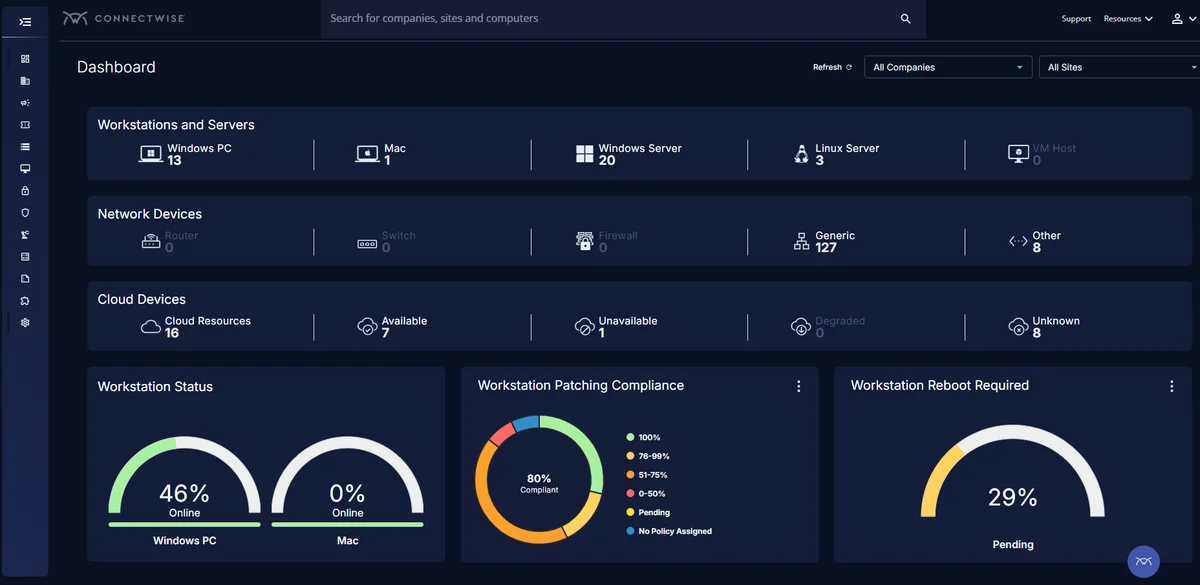
ConnectWise RMM earns a 4.2/5 on G2 from 66 verified reviews - respectable, and users genuinely praise its monitoring depth (1,200+ expert-maintained alerts, up to 90% alert noise reduction) and automation capabilities (75% faster task completion on routine work). The platform handles 100,000+ devices in a single tenant, and ConnectWise's NOC team vets every patch before release. For large MSPs, that's meaningful.
The problems are structural:
Implementation takes about 3 months. Not because ConnectWise is doing anything wrong - that's the documented average, and it reflects the platform's genuine complexity. For a 50-person shop supporting enterprise clients, 3 months of setup is a reasonable investment. For a 5-person MSP that needs wins by Friday, it's brutal.
Pricing requires a sales call. There's no published per-device pricing for ConnectWise RMM - it's custom and quote-based. The opacity itself frustrates buyers, and the final number often lands higher than alternatives that publish their rates.
Complexity calibrated for scale. The same depth of feature set that makes ConnectWise RMM excellent for complex multi-site environments also adds friction for smaller shops. When you only manage 500 endpoints and two technicians, you don't need 1,200 alert templates. You need something that works on day one.
Ecosystem lock. ConnectWise sells a full stack - Manage (PSA), Automate (legacy RMM), and the newer cloud RMM - and the products work best together. If you're not committed to the full suite, you're paying for integration overhead that alternatives include by default.
None of this makes ConnectWise RMM bad. It makes it the right tool for a specific profile - large, complex, scale-focused MSPs with dedicated ops capacity. If that's you, stay. If it's not, the alternatives have caught up in ways that matter.
What to look for in an alternative
A few things worth deciding before you pick a replacement:
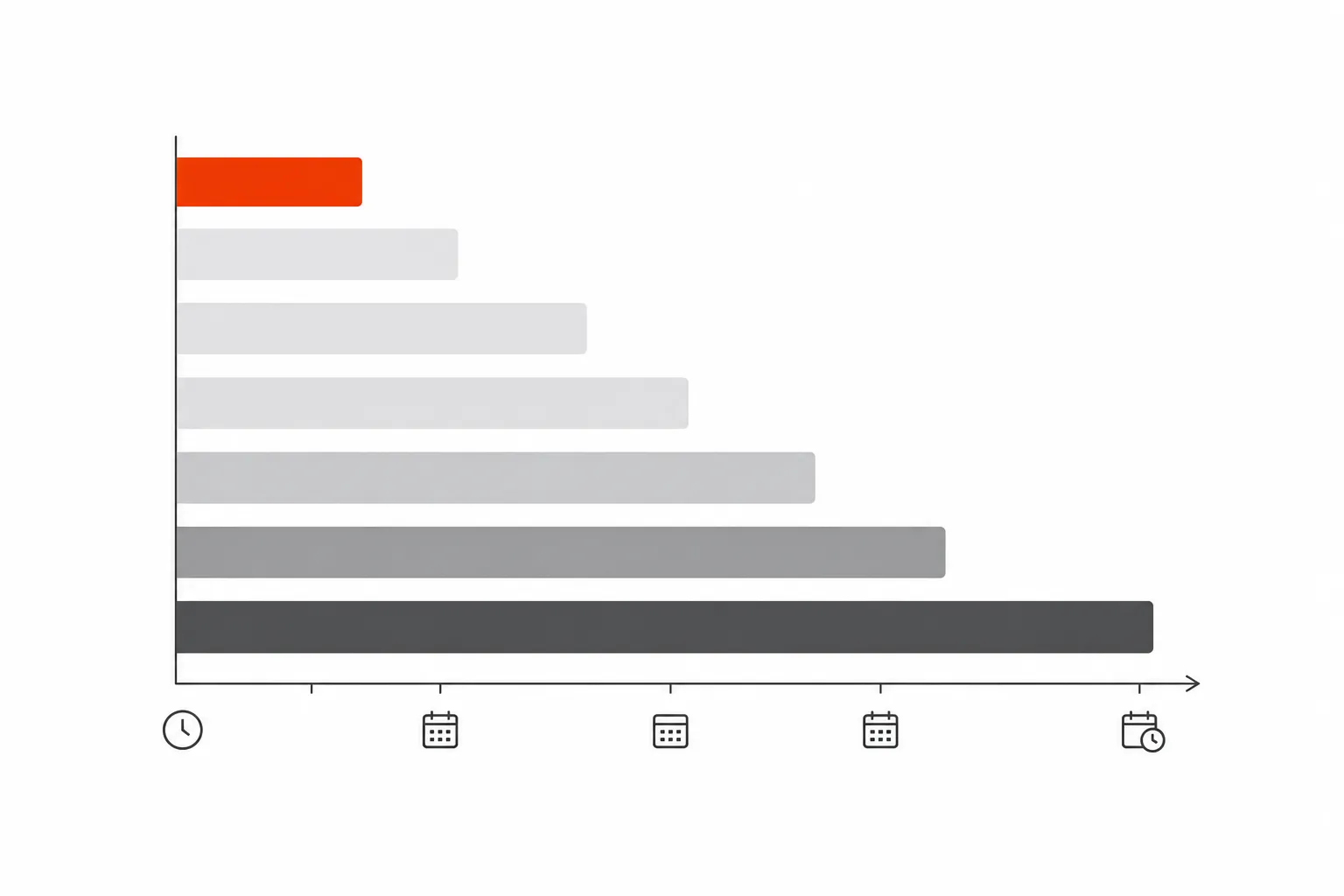
How fast do you need to be live? NinjaOne and Syncro both get most shops operational in under a week. Datto RMM and Kaseya average closer to 2 months. If you're mid-migration and need coverage fast, the difference matters more than almost any feature comparison.
Per-device or per-technician pricing? This is the single biggest pricing model split in the RMM market right now. Per-device (NinjaOne, SuperOps, Datto) scales with endpoints; per-technician (Atera, Syncro) scales with headcount. For a 3-tech shop managing 600 endpoints, per-tech pricing is almost always cheaper. For a 10-tech shop managing 300 endpoints, per-device often wins. Run the math for your ratio before you commit.
Do you actually need a PSA? ConnectWise RMM pairs with ConnectWise Manage as your PSA. Syncro and Atera both bundle their own PSA/ticketing - for shops that want to consolidate tools, that's a meaningful simplification. NinjaOne, Datto, and N-able assume you already have a PSA (Autotask, ConnectWise Manage, HaloPSA) and integrate rather than replace.
Is the real problem L1 ticket volume? This one gets missed. If what you're actually grinding on isn't the RMM itself but the flood of password resets, account unlocks, and MFA issues that eat 60% of your techs' day - a new RMM doesn't fix that. We'll cover the AI automation angle separately at the end.
Comparison at a glance
| Tool | Pricing model | Starting cost | Deployment | G2 rating | Best for |
|---|---|---|---|---|---|
| NinjaOne | Per device | $1.50–$3.75/device/mo | ~1 week | 4.7/5 (4,591) | Best overall |
| Atera | Per technician | $129–$149/tech/mo | 3–5 days | 4.6/5 (1,221) | Small teams |
| Syncro | Per technician | $129–$179/tech/mo | 48–72 hrs | 4.5/5 (514) | PSA+RMM bundle |
| N-able N-sight | Per device | ~$99/mo entry | ~1 week | 4.3/5 (201) | Feature depth |
| SuperOps | Per device | $1.50/device/mo | 48–72 hrs | 4.4/5 (197) | Modern UX |
| Datto RMM | Per device (partner) | Custom | ~2 months | 4.5/5 (782) | M365 integration |
| Kaseya VSA | Per device | ~$3–6/device/mo | ~2 months | 4.0/5 (326) | Legacy power users |
| Rallied | Monthly plan with credits | $300/mo for 2,000 credits | Days | - | AI automation layer |
1. NinjaOne - best overall
Best for: MSPs wanting the fastest, most proven swap from ConnectWise RMM without compromising on feature depth.
NinjaOne is the closest thing the RMM market has to a consensus pick right now. 4.7/5 across 4,591 G2 reviews - 84% of which are 5-star - puts it in a category of its own for the segment. The platform covers endpoint management, autonomous patching, backup, and remote access in a single console with free unlimited support included.
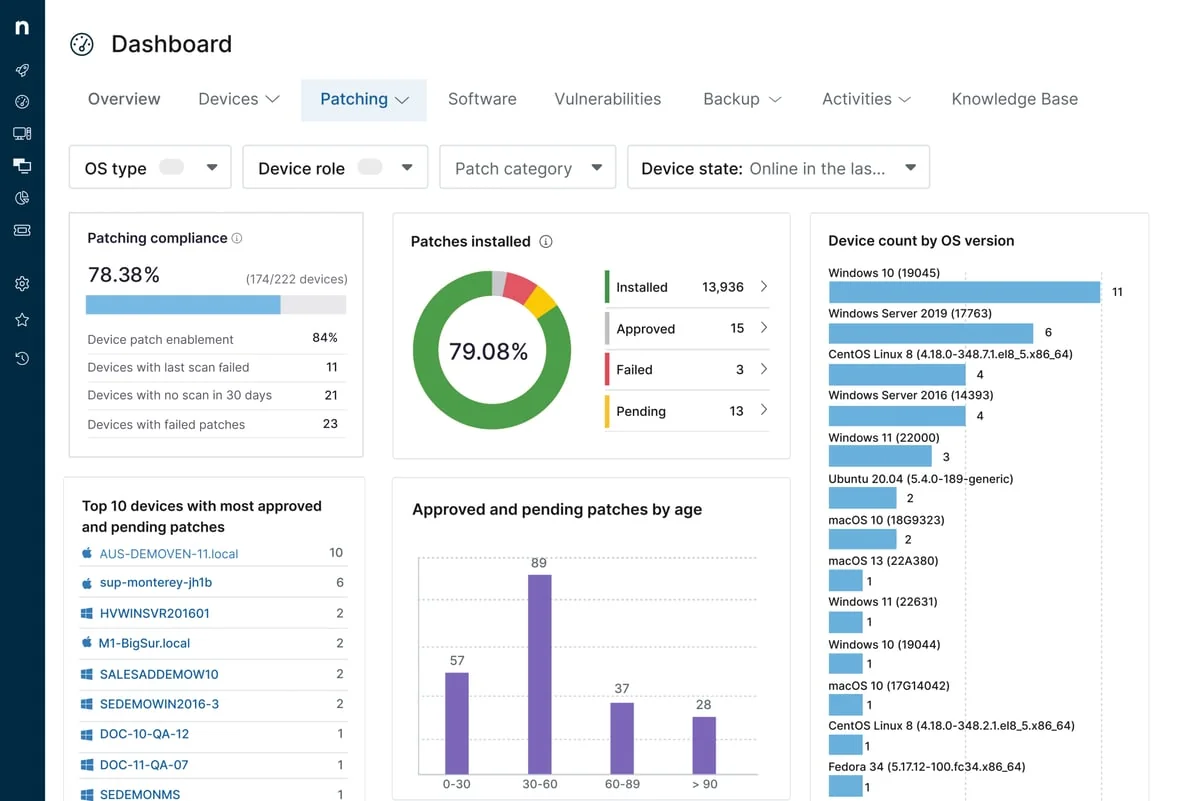
The deployment story is genuinely different from ConnectWise. Most users are fully operational in under a week, with an average learning curve of about 3 hours. NinjaOne's ROI calculator estimates 605 hours/month of time saved across a typical environment - 153 hours from automated patching alone.
On pricing: NinjaOne ranges from $1.50/device/month at 10,000+ endpoints to $3.75/device/month at 50 or fewer. Volume discounts are built in, there's no hidden fee for support or training, and the 14-day free trial requires no card. The one catch: 60-day cancellation notice is required, which is unusual.
"As a solo MSP, I like having RMM, PSA, patch management, and backup all in one platform instead of juggling separate tools. The interface is clean and easy to navigate, which matters when I'm jumping between clients all day... For a one person shop supporting healthcare and legal clients with compliance needs, all of that adds up to a lot less friction." - Chris O., Owner, Small Business, G2, July 2026
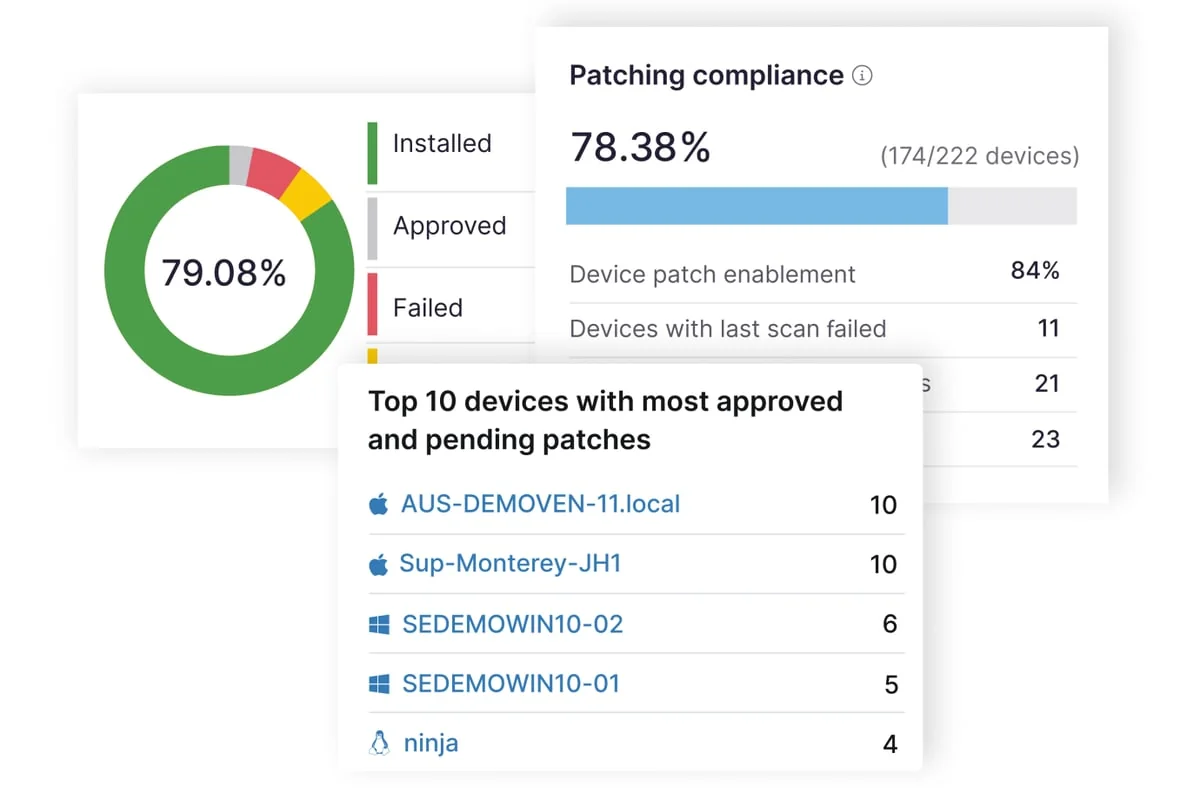
The main drawback: per-device pricing means your bill grows as your client base does, and the minimum monthly spend can be a pinch for very small MSPs still building their book. NinjaOne also doesn't have a native PSA - if you need ticketing and billing alongside RMM, you'll want to pair it with something like HaloPSA or Autotask.
Our take: If you're leaving ConnectWise RMM and want the lowest-risk replacement, NinjaOne is the move. The G2 scores, the community signal, the deployment speed, and the feature depth all point the same direction. The per-device cost is competitive if your endpoints-per-tech ratio is healthy.
2. Atera - best for small IT teams and MSPs
Best for: Small IT departments and MSPs under 50 technicians who want fixed predictable pricing and an AI automation layer built in.
Atera takes a different pricing stance than the rest of the market: fixed per-technician cost with unlimited endpoints. No per-device overages. MSP Pro plan starts at $129/tech/month billed annually, or $139 month-to-month. For a 3-tech shop managing 500 endpoints, that's $387/month regardless of how many devices you add.
The platform's current differentiator is Robin - a patented AI agent that handles smart intake, autonomous resolution, and closed-loop optimization. Early adopters report Robin resolves 85% of help desk tickets and saves 2+ days per week per technician. Those are impressive numbers for a feature that's included in the standard plan.
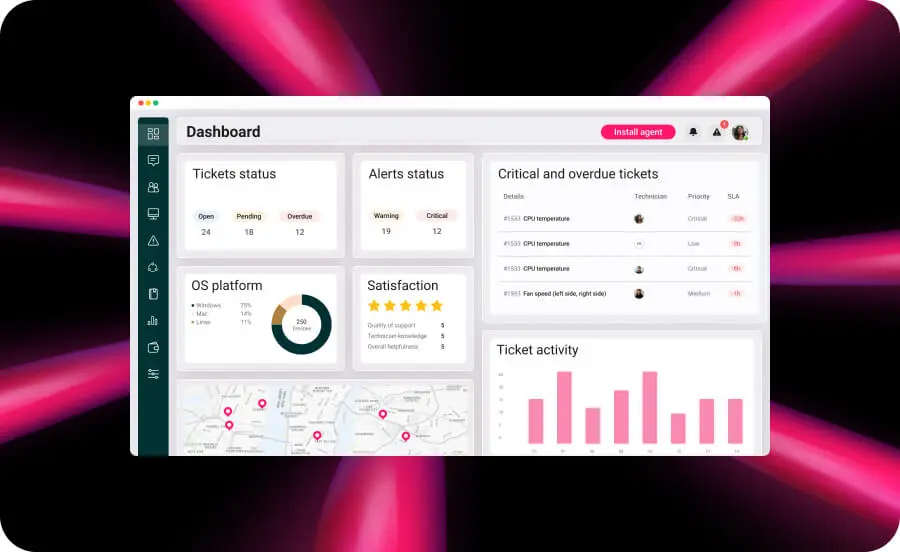
Atera's 13,000+ customers across 120 countries and 4.6/5 on G2 with 1,221 reviews reflect a mature, well-supported product. Users consistently praise the intuitive interface and the all-in-one consolidation - monitoring, ticketing, remote access, and patch management in one dashboard.
The friction points worth knowing about: reporting customization is limited at lower tiers, and there have been community-reported price increases in mid-2026 that some users found disruptive. If your workflow depends on deeply custom analytics, you'll feel the ceiling on the Professional and Growth plans before long.
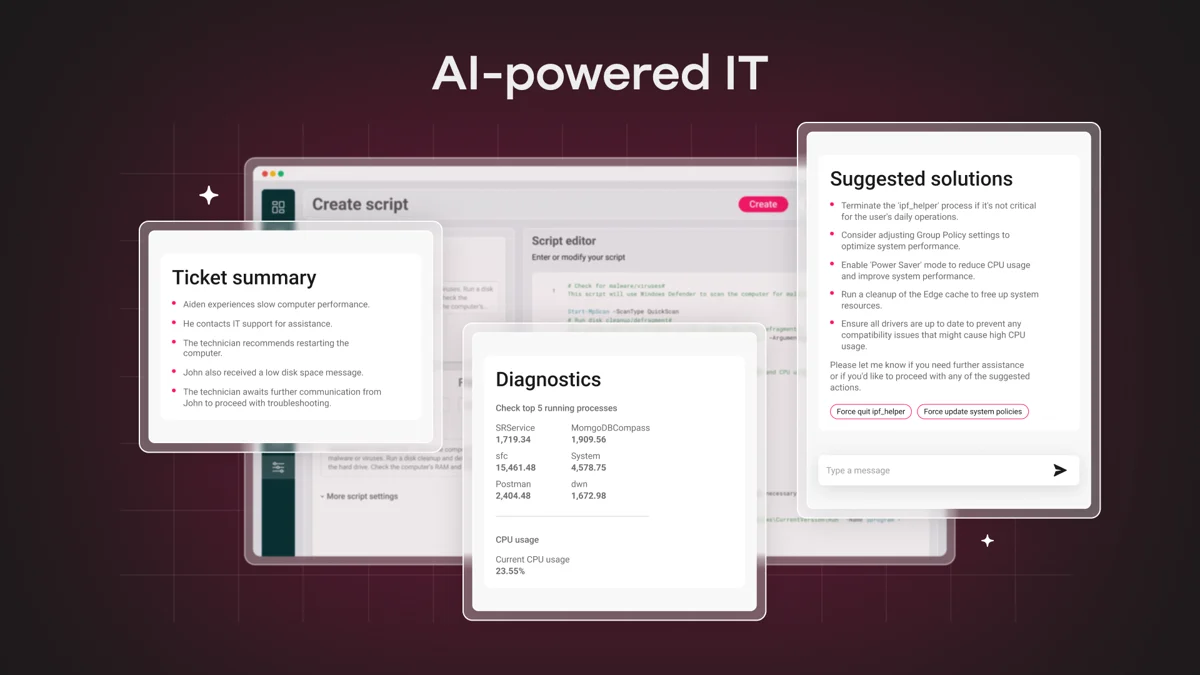
Our take: Atera is the strongest pick for small IT departments and MSPs who want a single bill that doesn't scale with endpoint count. Robin's ticket auto-resolution numbers are compelling enough to take seriously. Just check the current pricing before you commit - the per-tech model is the best in the market for its intended audience, but the specific tier prices have moved.
3. Syncro - best for PSA+RMM value in one bill
Best for: Small to mid-market MSPs that want RMM and PSA bundled, transparent pricing, and don't want to manage vendor sprawl.
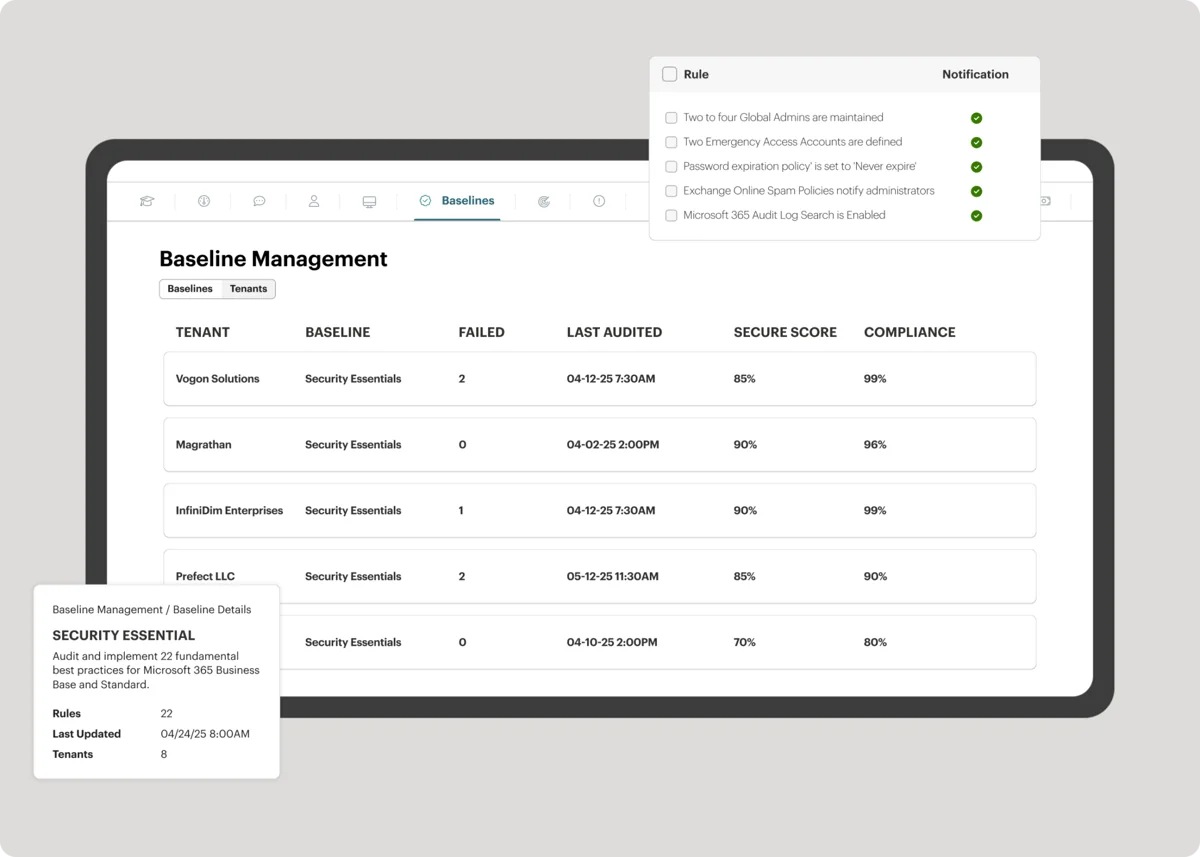
Syncro earns its slot on this list primarily through bundling. The Core Plan at $129/tech/month (annual) includes both RMM and PSA - monitoring, patching, ticketing, billing, invoicing, and remote access - in one price, with unlimited endpoints. The Team Plan at $179/tech/month adds full Microsoft 365 security management: Entra ID sync, CIS-aligned baselines, security posture scoring, and drift detection.
For a 3-tech shop on Team Plan annually, that's $6,444/year total. Running ConnectWise RMM separately with ConnectWise Manage for PSA typically runs several times that.
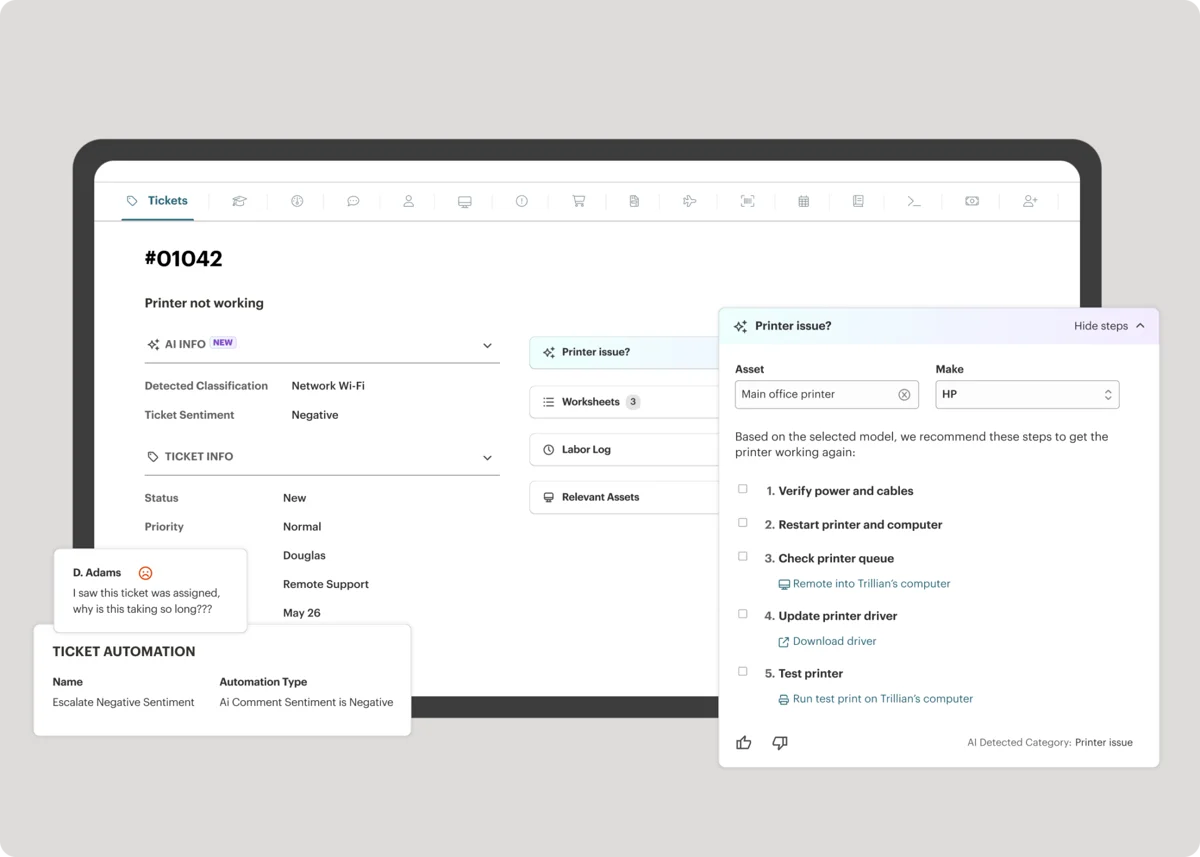
514 G2 reviews at 4.5/5, 71% of which are 5-star, back up the user sentiment. Reviewers hit on the same themes: the all-in-one consolidation reduces context-switching, the PowerShell scripting is genuinely powerful, and the setup gets shops live faster than almost any competitor.
"I really appreciate the ability to run PowerShell scripts on the assets with Syncro. This feature allows us to install our software and manage it effectively, keeping everything up to date... Syncro's PowerShell capability has opened up a lot of management automation avenues for us. Additionally, we chose Syncro over other products because of its simplicity, features, and cost." - Chris K., G2
Syncro's weaknesses are mostly in the depth of individual features. If you need enterprise-grade reporting, complex automation rule sets, or deep third-party integrations beyond the basics, you may find it thinner than NinjaOne or N-able. It also lacks the feature depth that Datto or Kaseya offer at scale. But for the target audience - MSPs under 20 technicians who want to get off a sprawling multi-tool stack - Syncro is a compelling, well-priced answer.
Our take: The best per-tech value in the market if you need PSA and RMM together. The M365 security module in the Team Plan is a real differentiator - few RMMs include CIS baseline management, Entra ID sync, and drift detection in the base price. If you're currently paying for ConnectWise Manage and a separate RMM, the math of consolidating to Syncro Team Plan almost always wins.
4. N-able N-sight - best for feature depth
Best for: MSPs who want ConnectWise RMM's feature breadth but with a more intuitive interface, better patching, and faster deployment.
N-able N-sight is the most direct functional equivalent to ConnectWise RMM on this list. Both are full-featured monitoring platforms with comprehensive patching, security, automation, and billing built in. What N-sight trades in is a significantly more intuitive interface and faster deployment - something the community notices.
Capterra lists a starting price of $99/month for the Basic entry point with per-device scaling. Unlike ConnectWise, the pricing model is published, and multi-year contracts offer price locks to protect against the per-endpoint increases noted in r/msp discussions.
The platform stands out on a few specific dimensions. Patch management is genuinely better than ConnectWise's - CVSS scoring, granular reboot control, OOB updates, and reliable reporting where ConnectWise reviewers have called the reporting inconsistent. Built-in vulnerability management includes SentinelOne EDR integration and Apple MDM with zero-touch enrollment - something ConnectWise RMM doesn't offer natively. The 650+ pre-configured scripts and drag-and-drop Automation Manager mean serious automation without writing everything from scratch.
N-sight also added an AI assistant (N-zo) and an MCP Server for custom AI integrations, which puts it slightly ahead of some competitors on the AI tooling side.
The downside is job execution speed. One Reddit comparison with NinjaOne calls N-able "usually a joke" on agent execution times versus NinjaOne's near-instant response. If your SLAs depend on fast remediation at volume, that's a real consideration. The community also notes price increases in recent cycles.
Our take: Pick N-able N-sight if you want something close to ConnectWise RMM's feature depth but with better patching, built-in security tooling, and an interface your team won't resent learning. The tradeoff is execution speed - NinjaOne is faster, but N-sight is broader.
5. SuperOps - best modern UI
Best for: MSPs and IT teams who want per-device pricing, a genuinely modern interface, and an AI-native platform that doesn't require them to build their own automation.
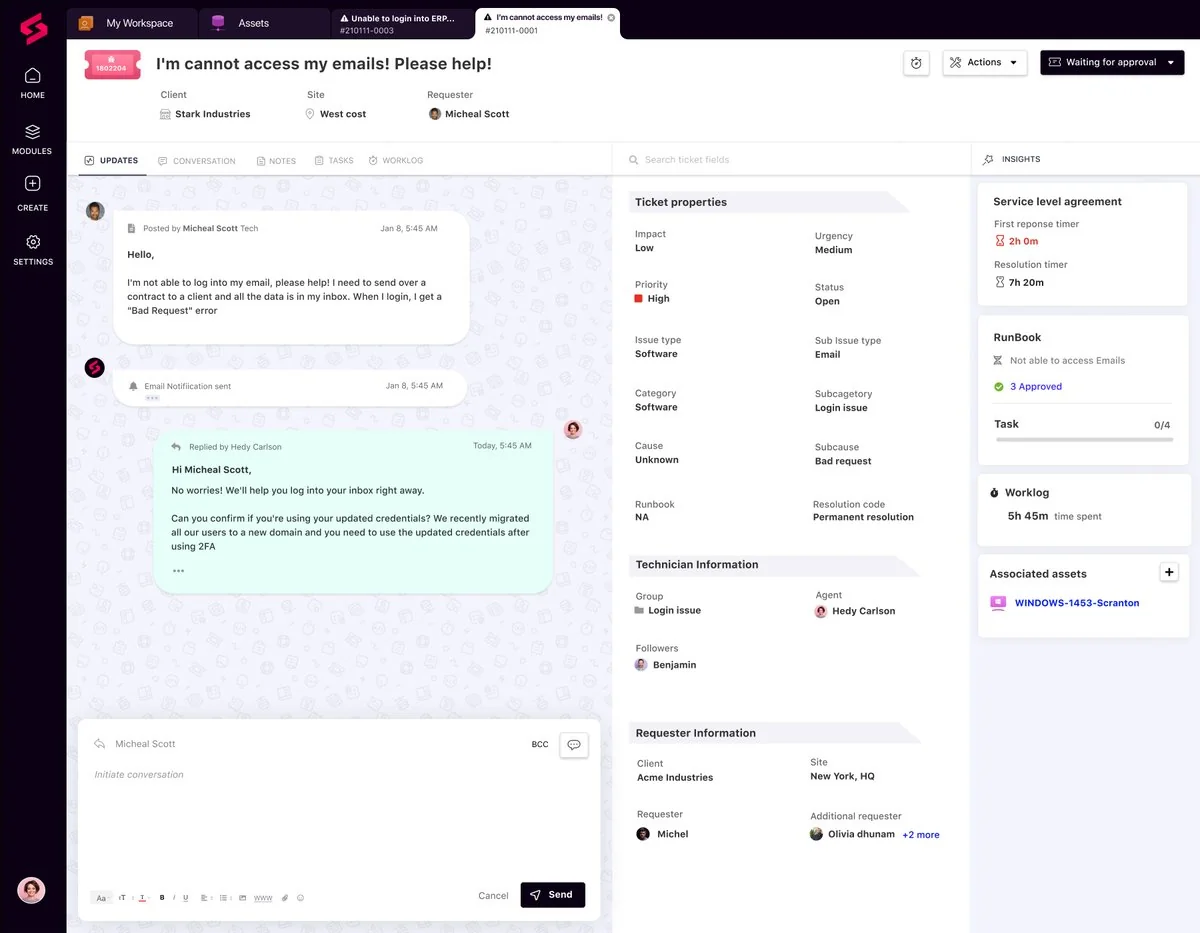
SuperOps positions itself as the sprawl-free alternative to the RMM+PSA+ticketing stack. Two product lines - ITSuite for internal IT and MSPSuite for managed service providers - share the same engine: unified endpoint management, native ticketing, patch automation, and network monitoring in one console.
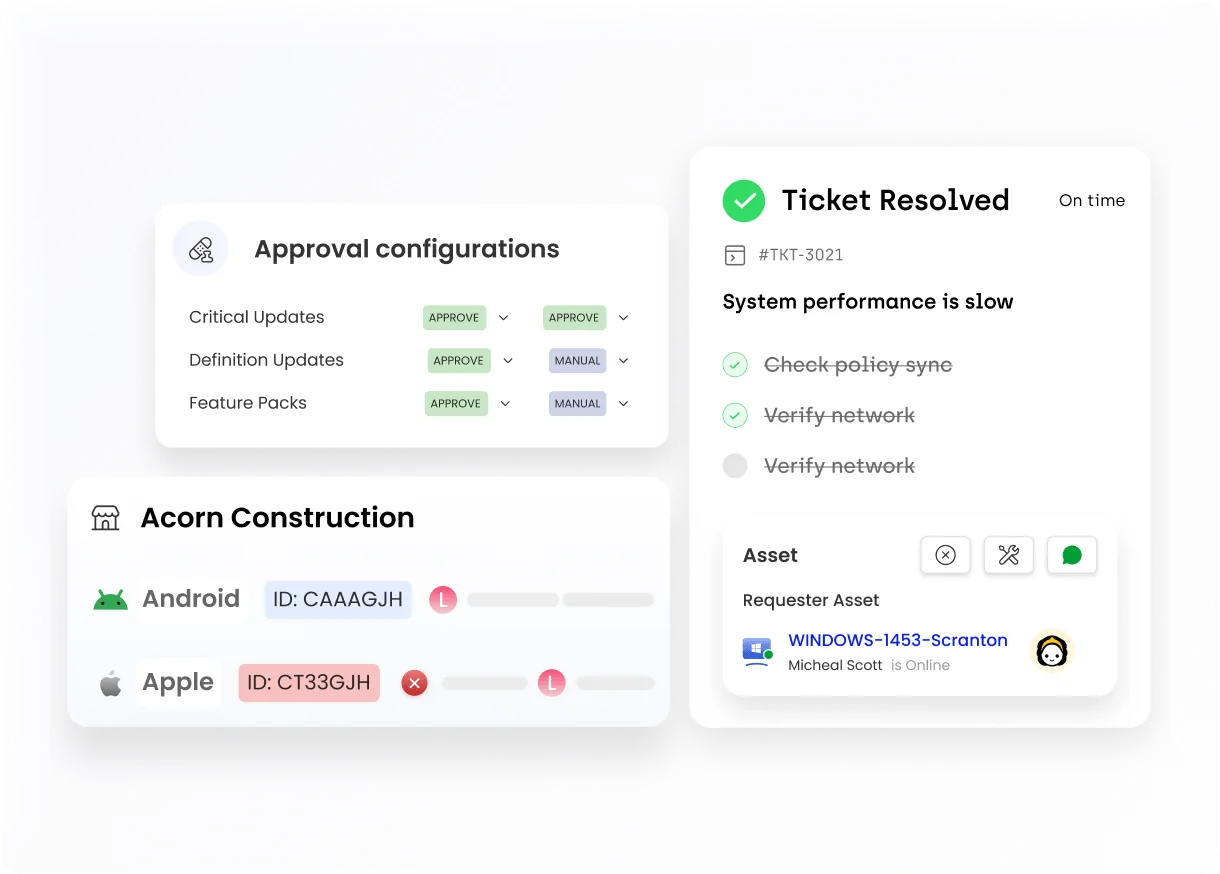
Pricing is per-device with published tiers: Prime starts at $1.50/device/month (100-device minimum), dropping to $1.20/device at 1,000+ endpoints. Prime Plus adds MDM at $3.00/device/month ($2.50 early-bird through 2026), with a 15% annual discount across both plans. Unlimited technicians are included - no per-seat charge on top.
The community reaction on G2 is positive: 4.4/5 from 197 reviews, with 92% of reviewers rating 4 or 5 stars. The consistent theme is the unified experience - reviewers specifically name relief at not having to context-switch between disconnected tools.
Where SuperOps falls short is integration depth. The platform's native features are well-built, but third-party integration coverage is thinner than NinjaOne or N-able - particularly for IT Glue, Hudu, and some security tools where the path is API-only rather than native. If your stack is heavily integrated, test those specific connectors before you commit.
Our take: The cleanest modern alternative for MSPs and IT teams who are starting fresh or consolidating from a messy multi-tool stack. The per-device model is straightforward, the UX is noticeably better than legacy RMMs, and the native ticketing genuinely replaces the "separate PSA" question for most shops. Just audit your specific integration needs first.
6. Datto RMM - best M365 integration
Best for: MSPs deeply embedded in the Microsoft 365 ecosystem who want a security-focused platform with native M365 user management.
Datto RMM holds 4.5/5 from 782 G2 reviews - 74% of which are 5-star - and carries the distinction of being the only RMM with a native Microsoft 365 management module. Reset passwords, offboard users, and quarantine accounts from the same pane you use to monitor endpoints. For MSPs managing heavy Microsoft tenant volume, that consolidation is genuinely useful.
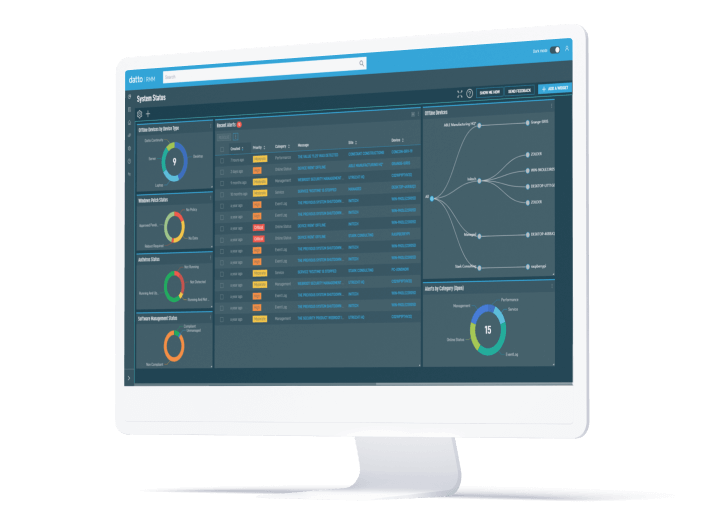
The platform is owned by Kaseya and positioned as part of the Kaseya ecosystem alongside Autotask PSA and IT Glue. The PSA integration with Autotask runs deep - real-time data flow between RMM and ticketing system - and the platform has been building monthly release cadence that reviewers specifically call out as a sign of active development.
The catch: Datto pricing is partner-exclusive and not publicly listed. You need to talk to sales to get a number, and implementation averages about 2 months. That's meaningfully longer than NinjaOne or Syncro, and the pricing opacity means you can't easily run a comparison without a sales process.
Our take: If you're Microsoft-first and want the tightest M365 integration on the market, Datto is the strongest pick. If you're not already in the Autotask/Kaseya ecosystem, the sales-only pricing and 2-month deployment start to look a lot like what you're leaving behind at ConnectWise.
7. Kaseya VSA - for teams already in the Kaseya ecosystem
Best for: Shops already running Kaseya IT Glue, BMS, or Autotask who want tight native integration without switching ecosystems.
We'll be honest: Kaseya VSA in 2026 is a complicated recommendation. The 4.0/5 on G2 from 326 reviews is the lowest on this list, and the community context matters.
The 9.5 version - still widely deployed - is in maintenance mode. One G2 reviewer put it plainly: "Kaseya VSA is a dying platform. We are still on 9.5 and they are only making security releases at this point. The software is no longer having developed features." The VSA X migration has been in progress for several years. Reddit sentiment is consistently critical of the UI and support quality - particularly first-line support, which reviews describe as outsourced and thin.
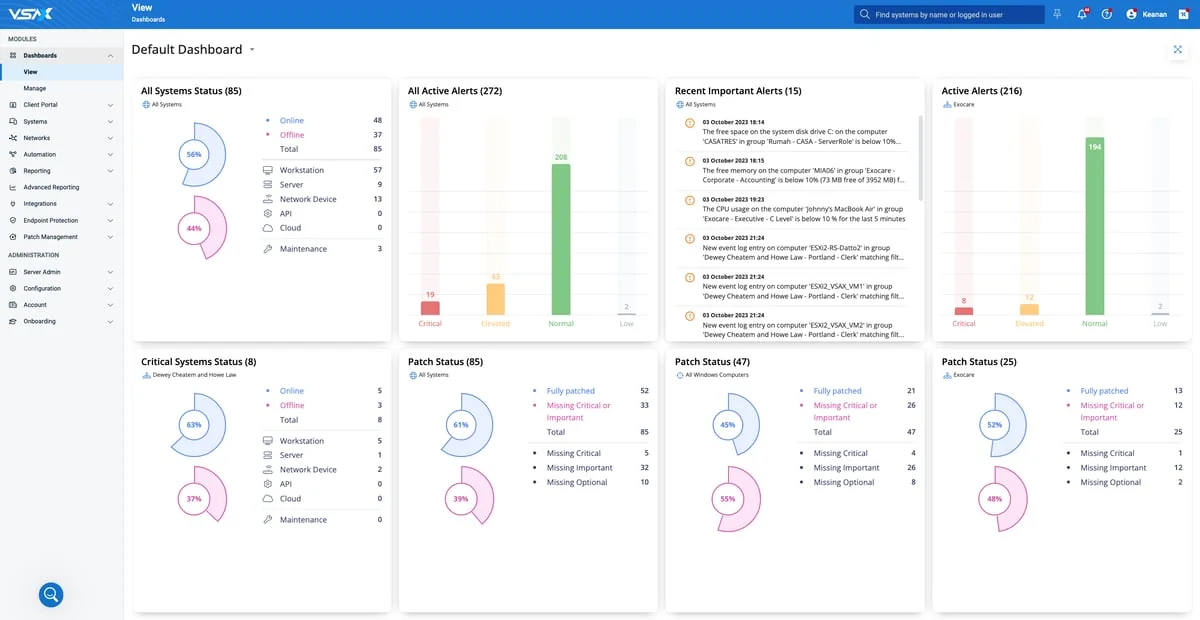
Where Kaseya makes the math work is in the bundle. The Kaseya 365 Endpoint offering at roughly $299–$399/tech/month packages VSA, BMS (PSA), IT Glue, security, and backup together. If you're already in all those products and the integration overhead of switching five tools simultaneously is prohibitive, staying in the Kaseya stack can make economic sense.
"The way the three tools - VSA, BMS and IT Glue are integrated and work with one another gives our team a great toolset to boost efficiency and save time." - Larry Robertson, Partner at MERIT Solutions, Kaseya
Our take: If you're already running IT Glue, Autotask, and Datto inside the Kaseya ecosystem, VSA is a manageable choice - the bundle economics and tight integrations have real value. As a fresh pick over NinjaOne or Syncro for someone starting clean? The case isn't there in 2026.
The pricing model that changes everything
Before you pick an alternative, the single most important decision is understanding how pricing scales with your specific business.
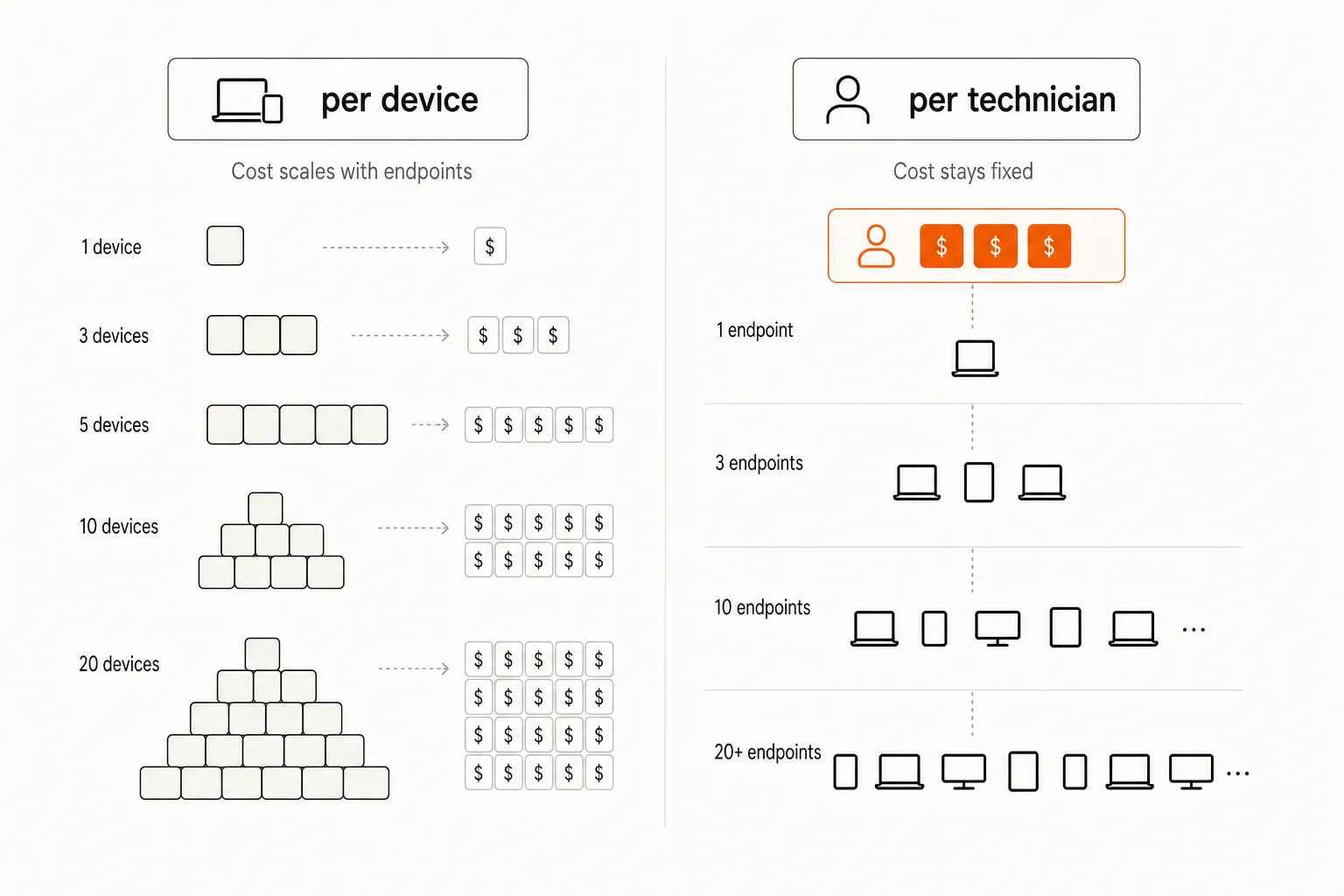
Run this calculation for your shop:
- Your tech count x $129–$179 = your Syncro or Atera monthly cost (fixed, regardless of endpoints)
- Your endpoint count x $1.50–$3.75 = your NinjaOne monthly cost (scales with endpoints)
For a 3-tech shop managing 600 endpoints: Syncro Team Plan = $537/month. NinjaOne at $2/device = $1,200/month. For a 10-tech shop managing 300 endpoints: Syncro = $1,790/month. NinjaOne = $600/month. The breakeven point matters, and most shops underestimate how quickly endpoint count grows when sales picks up.
The option most MSPs aren't considering: layering AI automation instead
Here's the angle that changes the calculus for a specific subset of MSPs: what if you don't need a better RMM? What if you need to stop paying senior techs to reset passwords?
For many shops, the real productivity problem isn't the monitoring platform - it's the L1 ticket queue. Password resets, account unlocks, MFA issues, software installs, onboarding and offboarding. These tickets typically account for 40-60% of total ticket volume, and they're uniformly the work that burns senior tech time without creating any lasting value.
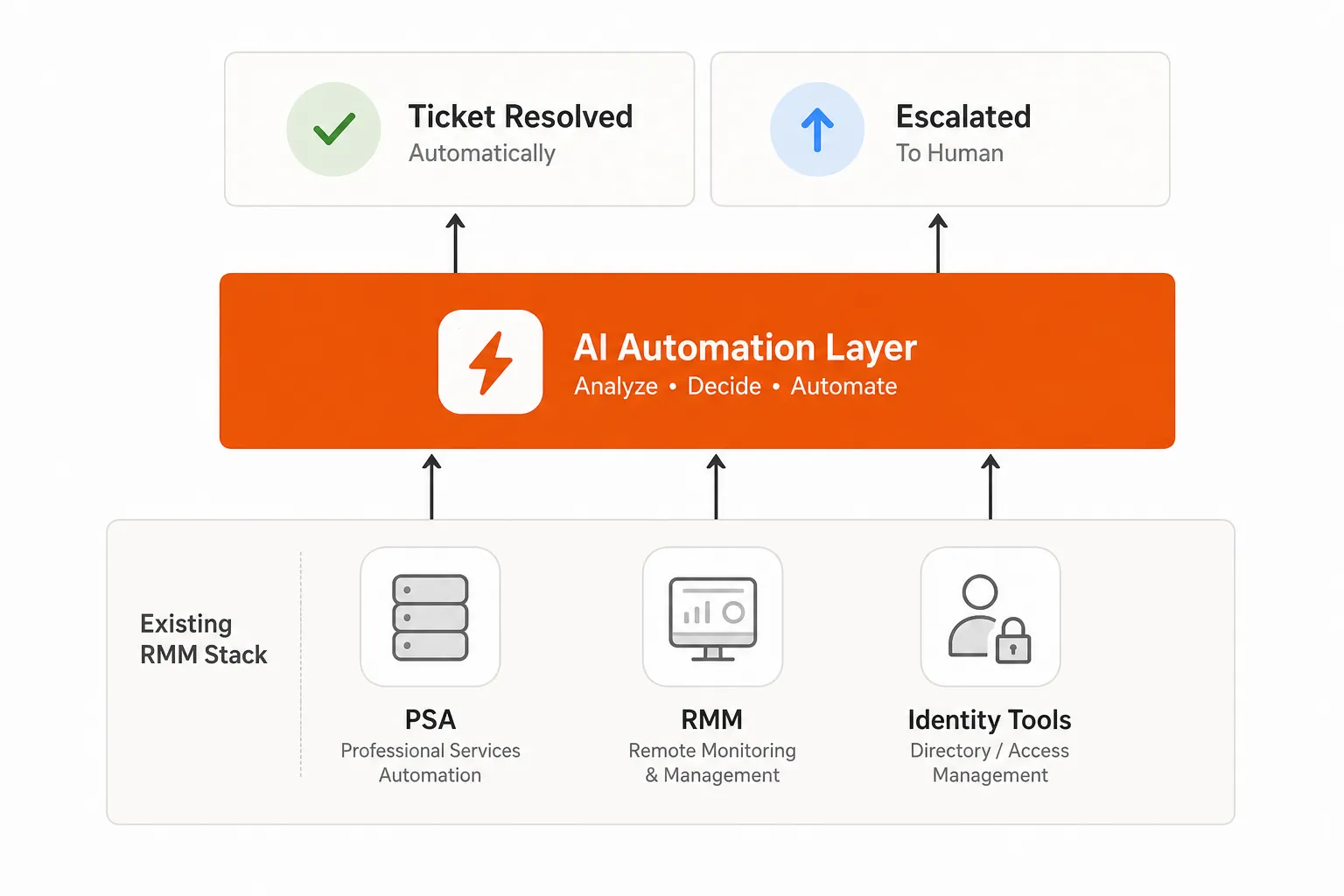
Rallied is an AI technician that handles this work autonomously - connecting to your existing PSA (ConnectWise, Autotask, Halo PSA, SuperOps) and RMM (Datto, NinjaOne) without requiring you to rip and replace either. Rallied's ConnectWise RMM integration covers the platform you are already on, so layering automation doesn't mean migrating first. It executes password resets, account unlocks, MFA resets, user onboarding and offboarding, and software installs. The tech never opens the ticket.
The math is worth doing: at 200–400 automatable tickets per month, each taking 15 minutes of tech time, that's 50–100 hours of L1 work. At a loaded cost of $75–$150/hour per tech, you're looking at $3,750–$15,000 in recovered margin monthly. Rallied is $300 a month for 2,000 credits, which covers about 700 tickets in a typical month, so 200 or 500 tickets usually fit inside the plan. No seat licenses, and tickets it can't finish are free.
Deployment is same-week. No implementation consulting, no forward-deployed engineer, no 6-month onboarding. Founder Amaresh Ray's background in infrastructure automation at Indeed, Webflow, and OpenGov shaped the product around one constraint: if it doesn't work by Friday, it's not shipped.
The honest scope: Rallied handles L1 and some L2. It's not a silver bullet for complex incidents that require judgment or context. It handles roughly 40-60% of ticket volume autonomously - the routine, high-volume work where automation has the biggest bang. The rest still needs human triage.
But for MSPs evaluating a ConnectWise RMM replacement primarily because they're drowning in tickets, there's a real question worth asking: is the problem your RMM, or is it the queue your techs are pulling from?
Try Rallied
If you're running an MSP and spending tech time on password resets, Rallied is worth a look before you commit to a platform migration. Connect your PSA and RMM, and it starts working. You'll know by Friday whether the ROI math lands for your shop.
The ROI calculator on rallied.ai/pricing is honest about what to expect - no invented case studies, just the arithmetic of your ticket volume and tech cost.
For the wider picture, read Best MSP Software in 2026.
Frequently Asked Questions
What is the fastest ConnectWise RMM alternative to deploy?
NinjaOne is consistently the fastest to deploy - most MSPs are fully operational in under a week, with a learning curve G2 reviewers put at about 3 hours. Syncro and SuperOps are close behind, both citing 48-72 hour typical go-live times. ConnectWise RMM's average is around 3 months. If deployment speed is your top priority, NinjaOne is the clear pick.
How much does ConnectWise RMM cost per device?
ConnectWise RMM does not publish pricing publicly - it's custom/quote-based. Based on community reports and G2, it typically lands in the $8–15/device/month range depending on scale, though exact numbers require a sales call. Alternatives like NinjaOne ($1.50–$3.75/device/month) and SuperOps ($1.20–$1.50/device/month at volume) publish their ranges directly.
Can I keep my existing RMM and still cut L1 ticket volume?
Yes - and for many MSPs this is the better play. Rallied is an AI technician that layers on top of your existing PSA and RMM (ConnectWise, Autotask, Datto, NinjaOne, and others). It autonomously handles password resets, account unlocks, MFA resets, and onboarding/offboarding - which typically account for 40-60% of L1 ticket volume - without you needing to touch your RMM at all.
What's the difference between per-device and per-technician RMM pricing?
Per-device pricing (NinjaOne, SuperOps, Datto) scales with how many endpoints you manage - cost goes up as your client base grows. Per-technician pricing (Atera, Syncro) stays fixed regardless of endpoint count, which is often cheaper for shops with many endpoints per technician. At 5 technicians managing 500 endpoints: Syncro Team Plan costs ~$895/month; NinjaOne at $2/device costs $1,000/month. At 2 technicians managing 500 endpoints: Syncro is $358/month vs. NinjaOne's same $1,000. The math flips depending on your ratio.
Is Kaseya VSA worth considering in 2026?
For most MSPs evaluating options today, no. G2 reviewers flag that VSA 9.5 (still widely deployed) is in maintenance mode with no new features, and the VSA X migration is still in progress. The interface is widely described as outdated, and support quality complaints are consistent across reviews. Kaseya's bundled Kaseya 365 Endpoint offering may make sense if you're already deep in the Kaseya ecosystem (BMS, IT Glue), but as a standalone choice against modern alternatives, the case is weak.