Cynomi pricing: what MSPs actually pay in 2026

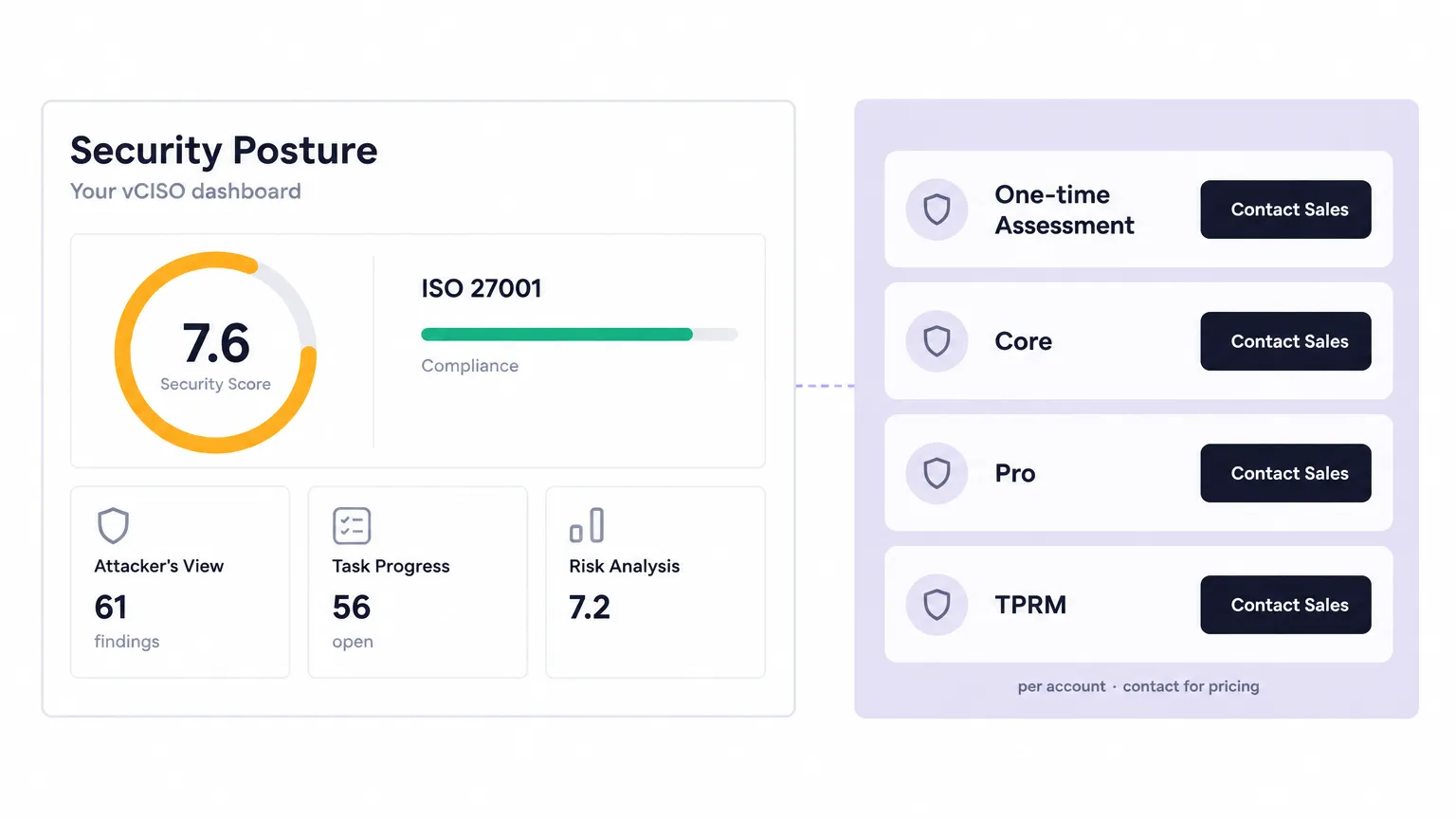
If you landed here hoping to find a number, we'll save you the scroll: Cynomi doesn't publish its prices. Every tier ends in "Contact Sales," and no amount of digging in their public docs will change that. What you can find out - and what this post lays out - is how the pricing is structured, what factors drive your quote, how it compares to vCISO platforms that do show their hand, and whether booking that demo is worth your time.
TL;DR
- Cynomi offers four license types: One-time Assessments, Core, Pro, and TPRM - all priced per client account, all quote-only.
- No dollar figures are published anywhere on their site. G2's perceived cost gauge pegs it at $$$ (maximum).
- One Reddit thread puts annual cost at "$18,000/year at $3,000/seat" - unconfirmed, treat accordingly.
- Comparable vCISO platforms with public pricing: GetCybr ($49–$199/client/month), RealCISO (~$42/client/month reported).
- Cynomi's internal ROI case rests on time savings: security reports that took 14 hours manually now take 20 minutes on the platform.
What is Cynomi?
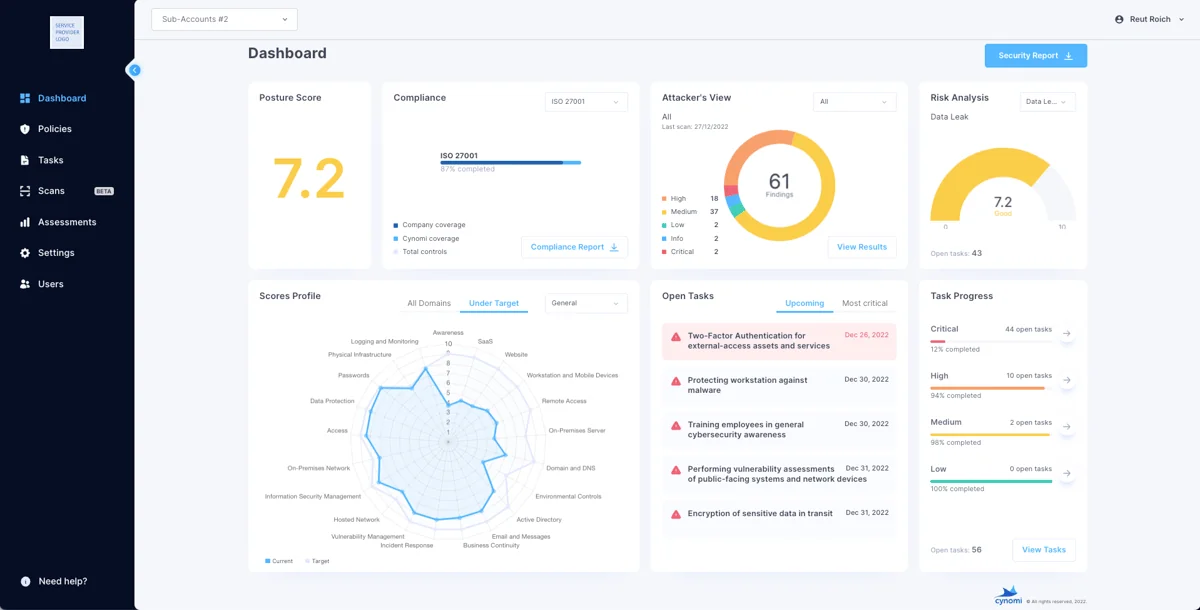
Cynomi is a vCISO platform built for MSPs, MSSPs, and security consultancies that deliver security advisory services to SMB clients. The pitch is a software-driven alternative to the spreadsheet-and-consultant model: instead of your team manually mapping controls, generating risk reports, and tracking remediation across clients, the platform handles the structured work so your people can focus on advisory.
Founded in 2021 with offices in Israel and London, Cynomi has raised $37M in total - a $3.5M seed in 2021, $20M Series A in 2024, and a $37M Series B in 2025. That funding trajectory is relevant context for pricing: a Series B-stage company targeting a space where the status quo involves hiring a part-time CISO at $150K+ isn't positioning itself as the budget option.
Their partner list includes 100+ MSPs and consultancies. Named logos include Grant Thornton, Ntiva, ECI, and TeamLogic IT - the kind of firms doing formal security advisory practices, not break-fix shops adding a compliance upsell.
Cynomi's four license types
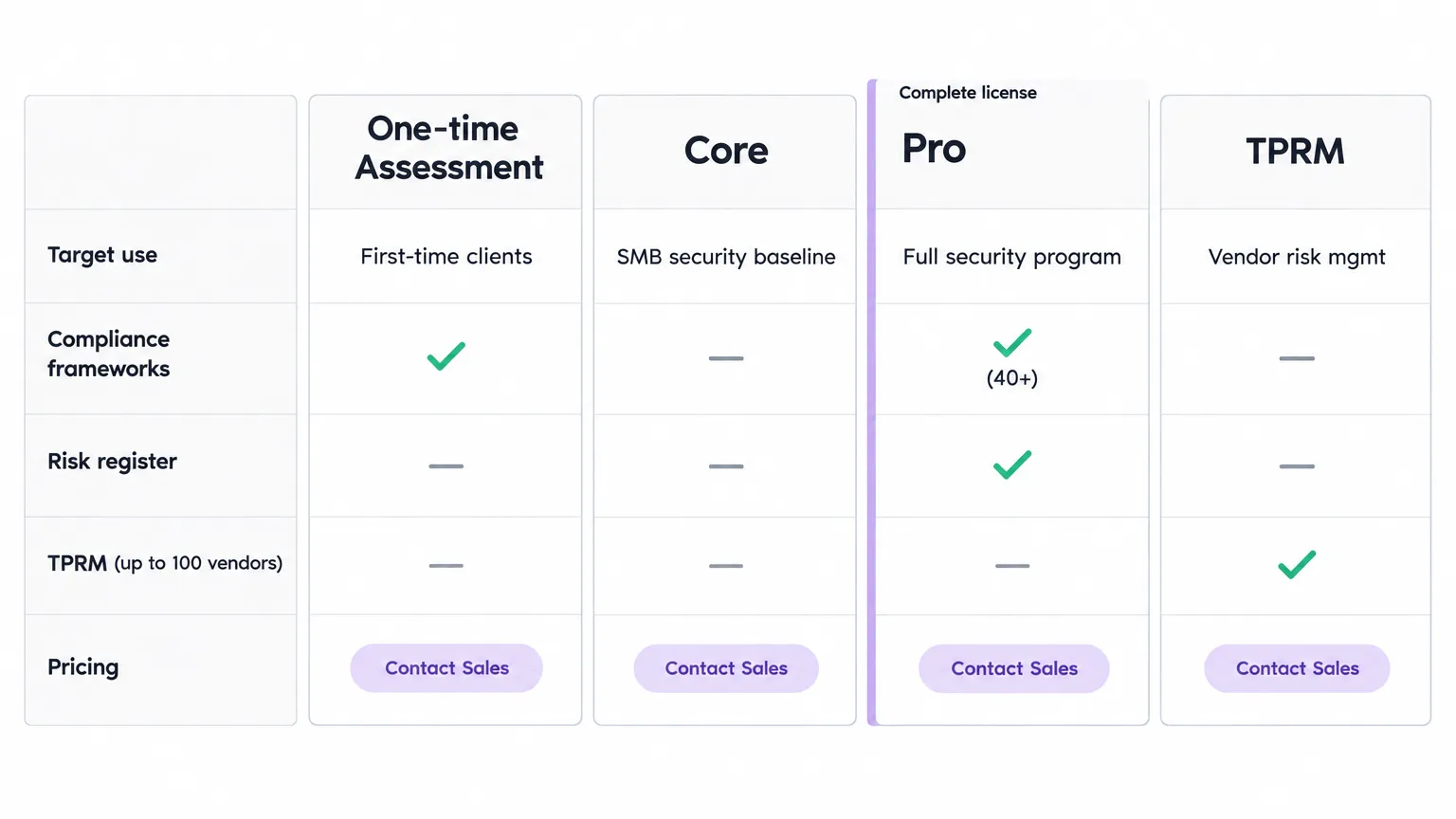
Cynomi structures its pricing around four distinct license types, with each designed for a different stage of the vCISO engagement.
One-time Assessments
Sold in packs (1, 5, 10, or 20 assessments), these are designed as a prospect hook - run a security assessment for a client who isn't yet on a retainer, deliver a report with findings and recommendations, and use the result to close an ongoing engagement. Cynomi sweetens the deal with a conversion incentive: if an assessed client converts to a paid license within 90 days, you get a free replacement assessment slot.
This tier is a sales tool as much as it is a product. If you're running a vCISO practice that starts with assessments, it's how you sample the platform without committing to a per-account recurring fee across your whole book.
Cynomi Core
Core is the entry-level recurring license - task-driven security management aimed at smaller clients who need a security baseline but don't require the full compliance and risk program depth. Think of it as the right tool for SMBs where the security ask is "are we basically secure and can we show it" rather than "we need ISO 27001 and 40 frameworks mapped."
Cynomi Pro
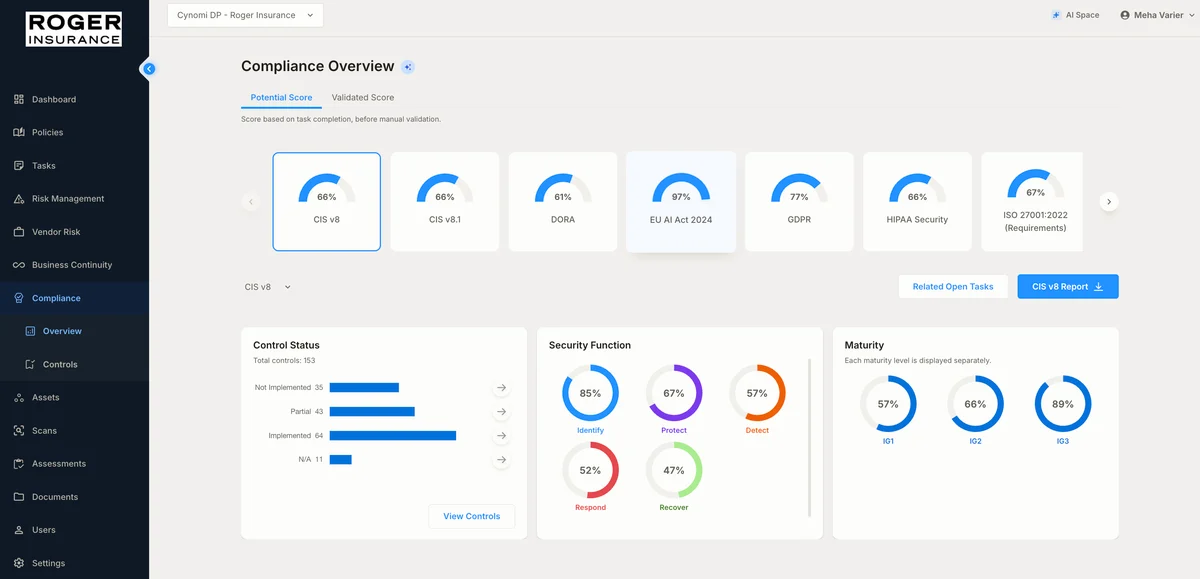
Pro is described as the complete license. It includes everything in Core plus the full compliance framework library (40+ frameworks including ISO 27001, DORA, GDPR, HIPAA, NIST CSF), a full risk register, and business continuity planning. This is what most established vCISO practices will land on for their core client base.
Third-Party Risk Management (TPRM)
TPRM is a standalone add-on for vendor risk management - up to 100 vendors per client account. This is Cynomi's answer to the growing requirement (from enterprise clients, compliance frameworks, and cyber insurers alike) to actively manage third-party risk, not just document it. If your clients have vendor risk as a line item in their security program, this is the module that covers it.
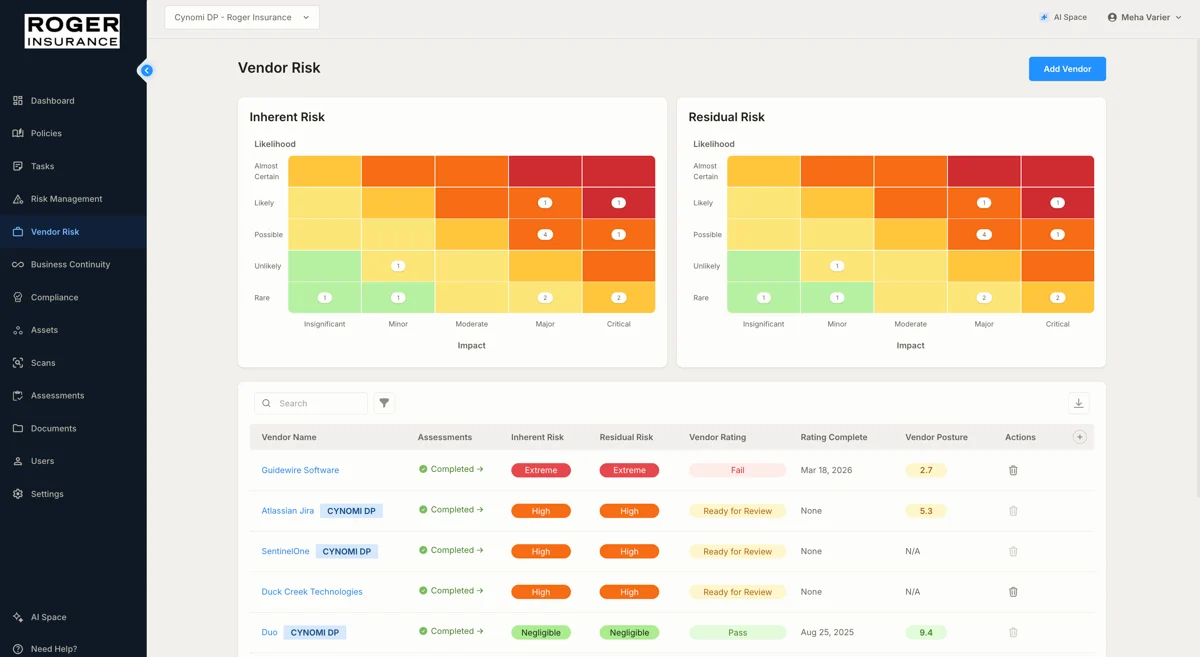
What's included with every license: Cynomi includes a demo environment, access to their GTM Academy, partner program benefits (including MDF), training and certifications, weekly community calls, and revenue insights dashboards. The partner program wrapper is real infrastructure - not just a landing page.
What actually drives your Cynomi quote
Cynomi charges per account - meaning per client organization you manage on the platform. That's the central pricing mechanic. Here's what determines where on the range you land:
Number of active client accounts. More clients means more licenses, though volume discounts almost certainly apply at scale. If you're managing 20 clients vs. 200, the conversation with their sales team will look different.
License tier mix. A book of Core clients costs less than the same size book on Pro. Most practices end up with a mix - smaller SMBs on Core, compliance-heavy clients on Pro, a handful on TPRM.
Geographic market. Cynomi operates globally. Pricing conversations in the UK, EU, and US may reflect different market dynamics.
Contract length. Annual contracts almost always come at better rates than month-to-month. Cynomi hasn't published terms, but this is standard for the category.
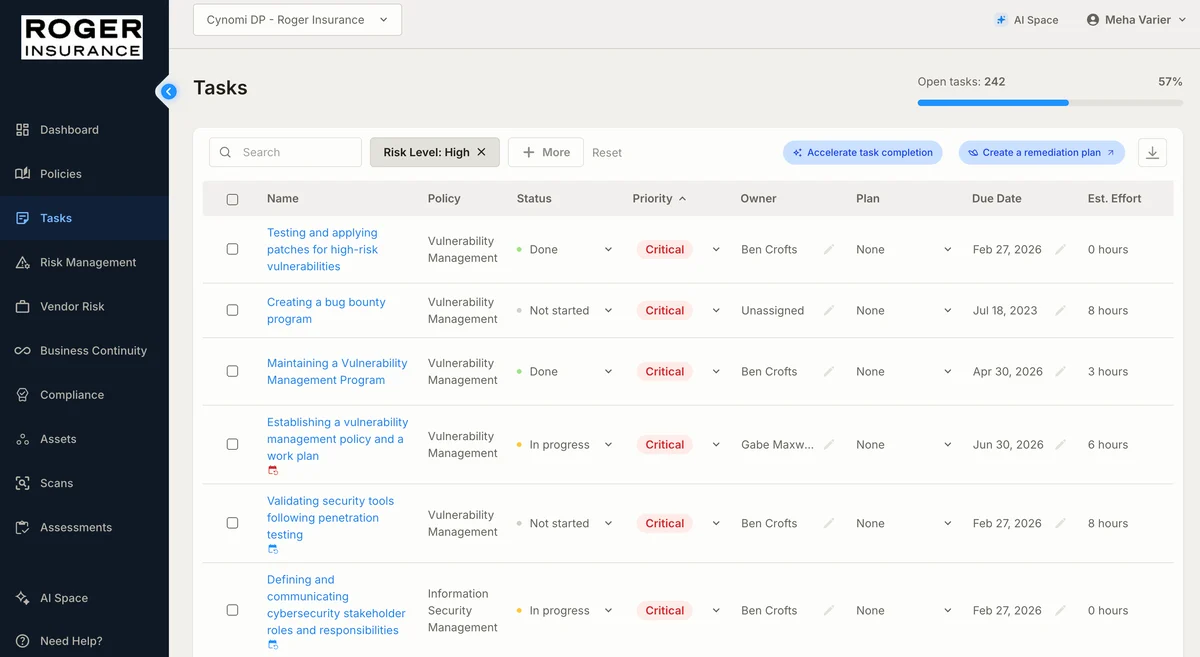
What the market is saying on cost: G2's perceived pricing indicator rates Cynomi at $$$ - the maximum on their scale. That's a composite signal from reviewers, not a published figure, so treat it as a qualitative read rather than a dollar range. One thread on r/msp cites "$18,000/year at $3,000/seat" but this is unverified and second-hand - mention it to their sales team and see what they say, don't build a budget case around it.
The time savings argument: Cynomi's internal ROI case
The honest version of the Cynomi pricing conversation is this: they're not competing with other software licenses - they're competing with your team's time. The economic case they make rests on hours saved across the vCISO workflow:
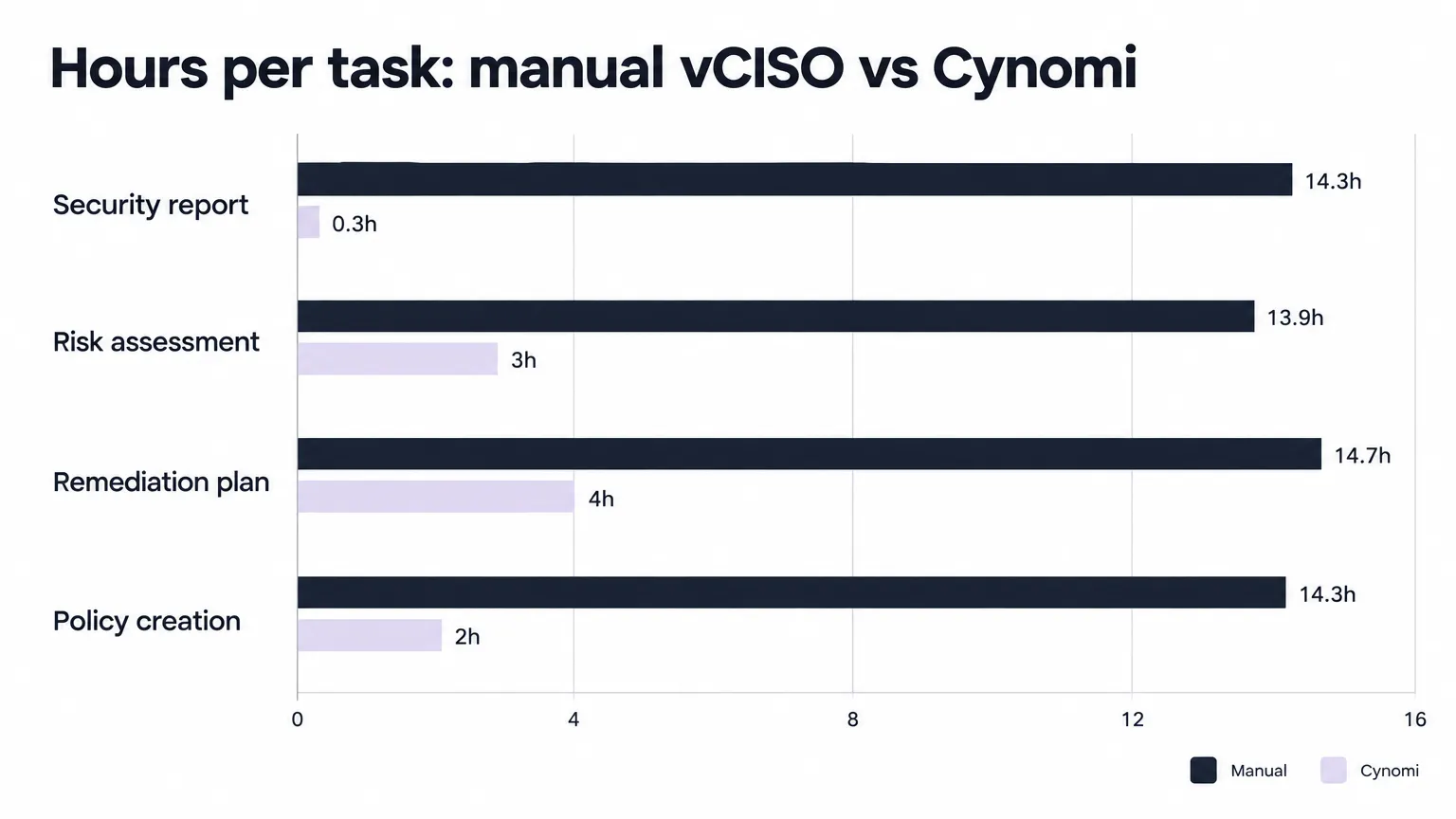
Cynomi's own data on manual vs. platform-assisted time:
| Task | Manual | With Cynomi |
|---|---|---|
| Security report | 14.3 hours | 20 minutes |
| Risk assessment | 13.9 hours | 2–4 hours |
| Remediation plan | 14.7 hours | 4 hours |
| Policy creation | 14.3 hours | 2 hours |
If those numbers hold for your practice at all, the math closes quickly. A security analyst billing $75/hour against 14-hour reports is a different cost conversation than the same analyst running 20-minute reports on a vCISO platform. The Gartner figure Cynomi references puts a full-time CISO at $208K–$337K/year - the pitch being that you can deliver similar outputs at a fraction of that cost.
Whether the time savings numbers hold in practice depends on your existing workflow. Teams running mature processes with solid templates will see smaller gains than teams where the analyst is rebuilding from scratch each engagement.
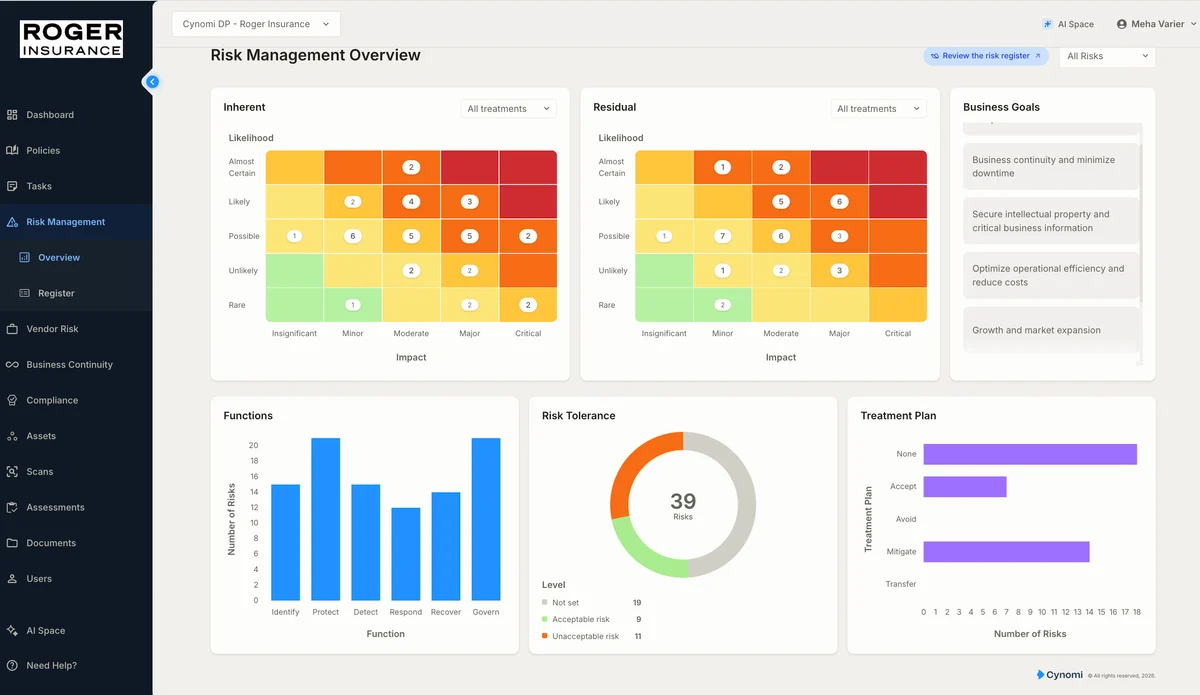
What G2 and Capterra reviewers say about value
Cynomi has 4.8/5 on G2 from 23 reviews (100% 5-star) and 4.8/5 on Capterra from 9 reviews. That's a small-but-uniform sample - the kind of ratings you see when a product is being actively promoted through its partner network rather than organically accumulating reviews.
What reviewers say about the cost and value question specifically:
"The automation in Cynomi is a game-changer. We no longer have to manually map controls, generate reports or create policies from scratch." - Abraham S., G2
One anonymous Capterra reviewer who listed cost and flexibility of pricing as the reason for choosing Cynomi wrote: "I really like the value it provides without breaking the bank for our smaller customers." That reviewer is operating in a market where the per-client economics actually work at the SMB level - not a given for a $$$ rated platform.
The consistent thread in positive reviews is time savings and automation of the structured work. The consistent gap is lack of specifics on what they're actually paying - which may be selection bias (happy customers at favorable rates are more likely to leave reviews), or just the natural reticence of partners who negotiated a good deal.
Cynomi vs vCISO platforms with public pricing
The obvious comparison question: what does it look like next to platforms that do show their hand?
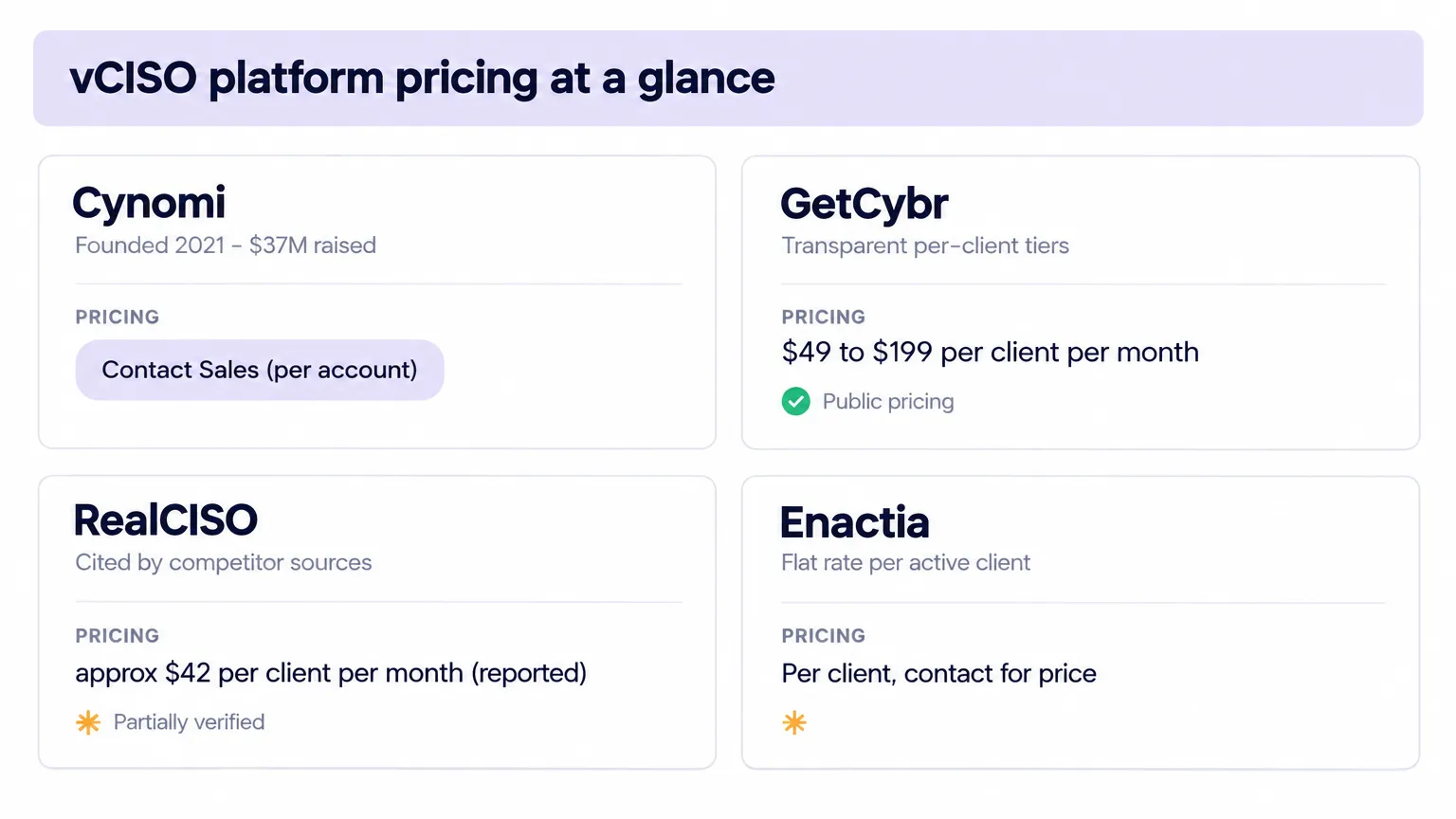
GetCybr publishes three tiers at $49, $99, and $199 per client per month. That's real transparency - you can run the math before anyone has to hop on a call. At the entry tier ($49/client/month, $588/year), you're getting a price point that works for smaller SMB clients. The top tier ($199/client/month, $2,388/year) is closer to where a Cynomi Pro license might land depending on your negotiated rate.
RealCISO doesn't publish pricing on their site, but competitor comparisons put them at approximately $42/client/month. That figure is search-derived and should be verified directly - but it establishes a rough market floor for the category.
Enactia operates on a flat rate per active client model but requires a quote. Similar approach to Cynomi - platform-centric pricing, contact sales.
The practical difference: if you're evaluating vCISO platforms for the first time and want to build a business case before sitting through demos, GetCybr gives you that. Cynomi requires the demo first. Whether that trade-off is worth it depends on how much time you have and how serious a Cynomi commitment would actually be for your practice.
Is the demo call worth it?
Short answer: yes, with realistic expectations.
Cynomi is a mature platform with 100+ deployed partners, a funded Series B roadmap, and a feature set that covers the full vCISO workflow - compliance, risk management, TPRM, policy creation, reporting. If you're running or building a vCISO practice, it's worth at least knowing your number.
The sales process for a platform at this price point is going to involve multiple conversations regardless - a discovery call, a demo with your specific use case, a pilot if they offer it, then commercial negotiation. That's true whether you book the first call now or after three more months of spreadsheet-based vCISO delivery.
What to do before you book the demo:
- Know how many client accounts you'd put on the platform, and at which tier mix.
- Have a rough hourly rate for your analysts, and an estimate of hours currently spent on report and assessment work.
- Ask specifically about One-time Assessment pricing if you want to trial it on one client before committing.
- Ask about the conversion incentive - the free replacement assessment slot on client conversion is worth understanding before you commit to assessment packs.
For the wider picture, read Best MSP Software in 2026.
Frequently asked questions
Does Cynomi publish its pricing?
No. All four license types - One-time Assessments, Core, Pro, and TPRM - require a sales conversation. Cynomi's pricing page lists the tiers and their feature differences but shows "Contact Sales" for all dollar amounts.
How much does Cynomi cost per client?
Cynomi doesn't publish per-client pricing. G2 reviewers rate the perceived cost at $$$ (maximum on their scale). One unverified Reddit reference puts annual cost at "$18,000/year at $3,000/seat" but this hasn't been confirmed through official sources. For an accurate number for your specific situation, you need to go through their demo and commercial process.
What's the difference between Cynomi Core and Cynomi Pro?
Core covers task-driven security management and a limited compliance framework set - suitable for SMBs that need a security baseline. Pro is the complete license: 40+ compliance frameworks (ISO 27001, DORA, GDPR, HIPAA, NIST CSF, and more), full risk register, and business continuity planning. Most practices delivering formal vCISO engagements will end up on Pro for their core clients.
Does Cynomi offer a free trial?
Cynomi offers a demo environment with every partner license, which lets you explore the platform before committing your client accounts. The One-time Assessment model also functions as a low-commitment entry point - assess a prospect client without taking on a full recurring license.
How does Cynomi pricing compare to hiring a full-time CISO?
Cynomi cites Gartner data putting a full-time CISO at $208K–$337K/year in total compensation. For MSPs delivering vCISO services to multiple SMB clients, the platform model allows one analyst or consultant to service many accounts at a fraction of the cost of a dedicated security hire per client. The ROI math depends on your analyst's hourly cost, how many client accounts you're managing, and how much of the report/assessment/policy work the platform actually handles in your practice.
Try Rallied
If you're running security advisory through Cynomi and still burning technician hours on routine ticket work - password resets, account unlocks, onboarding, offboarding, access management - that's the other side of the MSP margin equation.
Rallied is an AI technician that autonomously resolves L1/L2 tickets. It connects to your PSA (ConnectWise, Autotask, Halo), RMM (Datto, NinjaRMM), and identity stack (M365, Entra ID, Okta, JumpCloud, Google Workspace), and executes the actual work - not summaries, not suggestions. When a ticket comes in for a password reset, Rallied resets the password and closes the ticket.
The math: MSPs typically spend 50–100 hours per month on L1 grunt work. At $75–$150/hour, that's $3,750–$15,000/month in technician time you could redeploy toward security advisory and other higher-margin work.
Pricing is $300/month for 2,000 credits (roughly 700 resolved tickets). You only pay when Rallied actually changes something in your systems. 14-day free trial, no credit card required.